






Organizational Memory in 2026: Why Building Is Remembering
Organizational memory is the asset that outlives your apps. John Xie on what a project must keep, who owns it, and how AI agents turn memory into work.
On this page (23)
Organizational memory is what a team knows and keeps after its people and its tools change: its records, its decisions and the reasons behind them, what it tried, and what happened. I think it is the most valuable thing a company builds. AI is about to make that obvious, because AI makes the apps cheap and leaves the memory as the asset.
TL;DR: Organizational memory is the records, decisions and lessons a team keeps after people and tools change. When AI makes apps cheap, that memory is the asset: I call it memory capital. Keep six things per project, keep them where the work runs, and make sure you can take them with you. Build on memory with Taskade Genesis →
This is the second chapter of Build Without Permission. The first chapter, in 2025, was about permission: who gets to build software. This chapter is about what the permission builds. My answer is memory. The app is the part you can replace. The memory under the app is the part that lasts, and it is worth more than most of us account for.
The title comes from the last paragraph of a longer essay I finished in November 2026. Maybe building is just that, learning from the past to guide what comes next. I did not set out to write about memory. I set out to build a better outliner, and memory is what the outliner turned out to be.
📅 Building Is Remembering at a Glance
Building Is Remembering argues that the lasting value of software is the memory under the app. A tree that persists becomes memory. Memory that can be reconstructed and acted on becomes useful work. When the app belongs to the work, that memory becomes a form of capital, and the people who built it must be able to keep it.
| When | What happened | What it taught us |
|---|---|---|
| 2019 | We went through Y Combinator (S19) with a real-time workspace built on a tree | Thinking, organizing and working together are one activity |
| Late 2022 to 2023 | Taskade AI launches in beta in December 2022, and language models spread through the workspace in 2023 (the full history) | The workspace gave the model a lasting record of work |
| April 10, 2025 | Black Mirror airs "Eulogy" | Reconstruction of memory can arrive too late to act on |
| August 2025 | Build Without Permission, chapter one | The question was who gets to build |
| September 27, 2025 | The first big drafts of our memory work: tens of thousands of lines, not merged | Ideas that ship get smaller |
| October 7, 2025 | The build-order rule merges, ten days after the first draft | Memory before surface |
| February 2026 | Long-term memory goes live in the workspace | Memory belongs in projects that people can read |
| September 2026 | We publish four negative results from a year of memory experiments | Several memory designs did not earn their place |
🧠 What Is Organizational Memory?
Organizational memory is the knowledge an organization keeps from its past and brings to its present decisions: records, decisions with their reasons, procedures, what was tried and what happened. Management researchers have studied it since the early 1990s. Today it also means the context that AI agents read before they act, which is why the old term matters again.
The research is older than the web. In January 1991, Walsh and Ungson published "Organizational Memory" in the Academy of Management Review, and mapped six places where an organization keeps what it knows. Their point was that a company remembers in more places than its filing cabinet. A year earlier, Argote, Beckman and Epple had measured the other side in factories: "knowledge acquired through production depreciates rapidly."
My definition is shorter and more practical. Organizational memory is what is still there, and still usable, after the person who knew it has gone home, changed teams or left. That includes the reason a decision was made, which is the part most companies lose first.
People use five names for overlapping ideas. They are worth separating, because each one points at a different failure:
| Term | Plain meaning | Who uses it | What it warns about |
|---|---|---|---|
| Organizational memory | Everything an organization keeps from its past and uses now | Researchers, knowledge managers | Knowledge spread across people, tools and files |
| Institutional memory | The unwritten part held by long-serving people | Managers, HR | Knowledge loss when someone leaves |
| Corporate amnesia | What happens when memory is lost | Consultants, authors | Repeating old mistakes |
| Company brain | Organizational memory that AI can read and act on | Startups, founders | A search box over stale documents |
| Memory capital | Organizational memory treated as an asset | This essay, and a 2025 consulting study | Value that no balance sheet records |
In the threads I read for this post, people rarely say "memory". They say "context", "re-explaining the same thing to every tool", and "what happens when she leaves". Some call the unwritten part tribal knowledge. The philosopher Michael Polanyi named it better in 1966: "we can know more than we can tell." All of these describe the same gap: the knowledge exists, but not in a place where the next person or the next agent can use it.
📜 How Did People Keep Organizational Memory Before AI?
People kept memory first in their heads and on paper, then in linked notes, outlines, wikis, search engines and personal note systems, and now in workspaces that AI agents read and write. Each step made storage cheaper. Few made memory easier to act on.
The worry is ancient. In Plato's Phaedrus, an Egyptian king warns that writing "will produce forgetfulness in the minds of those who learn to use it", and calls it "an elixir not of memory, but of reminding". Later tools for memory met the same worry.
| When | How memory was kept | What it did well | What it lost |
|---|---|---|---|
| c. 370 BCE | Writing, as Plato's Phaedrus describes it | Records that outlive the speaker | Understanding, by the king's account |
| July 1945 | Vannevar Bush describes the memex, a desk that links records by "associative trails" | Links between records | Nobody to keep it up to date |
| 1951 to 1996 | Niklas Luhmann fills a slip box with about 90,000 linked notes | Memory that compounds for one person | It worked for one person |
| 1968 | Doug Engelbart's NLS keeps text as numbered statements, each with a level in an outline | Structure that people edit together | It reached few people |
| 1983 to 1986 | ThinkTank (planned for sale in 1983) and MORE (June 1986) bring the outliner to personal computers | Outlines on every desk | Personal, not shared |
| March 25, 1995 | Ward Cunningham's WikiWikiWeb begins | Anyone can edit the shared record | Pages go stale with no owner |
| May 22, 2020 | Retrieval-augmented generation pairs search with language models | Answers drawn from your documents | State, decisions and action |
| October 12, 2023 | MemGPT treats a language model's memory like an operating system's | Memory that an agent manages | One agent, not a team |
| February 13, 2024 | OpenAI starts to test memory in ChatGPT | Memory across chats for one person | Shared team memory |
| April 4, 2026 | Andrej Karpathy describes an LLM that "builds and maintains a persistent wiki" | Upkeep done by the model | Ownership, freshness and exit |
Karpathy's note names the problem that sits under the whole table. Writing about Bush's memex, he says: "The part he couldn't solve was who does the maintenance. The LLM handles that." I think that is half right. A model can do the upkeep. It cannot decide what the organization believes, who owns a decision, or whether the memory can leave with you. Those are design choices, and they are the subject of the rest of this essay.
Engelbart's 1968 work is why I think of the outline as a tool for a group (The Mother of All Demos). The histories of outlining software and Lotus Notes are the other threads that led to the workspace.
🌳 Where Does Organizational Memory Live? We Built an Outliner
Walsh and Ungson's 1991 map puts organizational memory in six places: individuals, culture, procedures, structures, the workplace, and archives outside the company. Only the written parts survive a departure on their own. Taskade began as an outliner, and a tree that persists is a written record that people edit and agents traverse.
| Walsh and Ungson's place | In plain words | Example | When someone leaves |
|---|---|---|---|
| Individuals | People | The account lead who knows why a client is unhappy | It leaves with them |
| Culture | Shared habits and stories | "We always call before we email a renewal" | It erodes slowly |
| Transformations | Procedures | The steps for onboarding a customer | It stays if it is written and current |
| Structures | Roles | Who approves a discount | It stays, but the reasons fade |
| Ecology | The workplace itself | Where the spare parts are kept | It stays until the office changes |
| External archives | Records kept outside | A former employee, an outside accountant | Hard to reach, easy to lose |
Their map was drawn before shared software was everywhere. Today most of the written part sits in a seventh place that every team now has: shared records of projects, decisions, files and run history, which the next person and the next agent can read.
Thoughts are rarely linear. You start with an idea. The idea branches into several smaller ideas. One becomes a task. Another becomes a question. The question leads to research. The research changes your original idea. Eventually, what began as a single sentence becomes an entire structure of knowledge, decisions and actions.
We wanted software that reflected this process, so the basic primitive behind Taskade was a tree.
    Idea
     |
     +-- Thought
     |    |
     |    +-- Question
     |    +-- Research
     |
     +-- Task
     |    |
     |    +-- Subtask
     |    +-- Decision
     |
     +-- Outcome
Task, cascade, subtask, branch. A relatively simple structure, but one capable of representing remarkably complicated things. The underlying structure remained the same. What changed was how you looked at it. A list, a board, a calendar, a mind map, a table, a Gantt chart: different representations of the same underlying information.
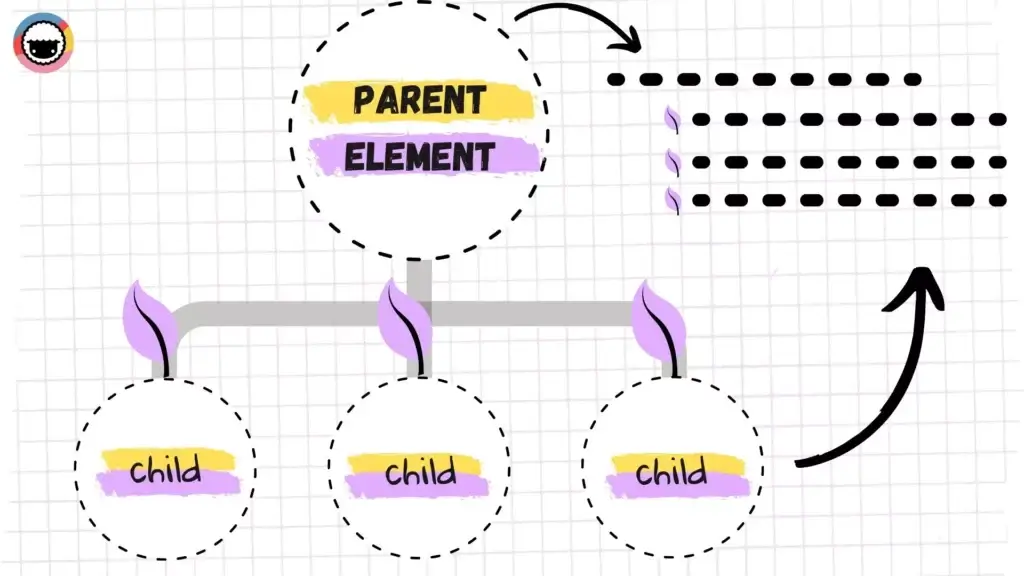
When we went through Y Combinator in 2019, we were building a real-time workspace for distributed teams. We were not thinking about AI agents at the time. But the structure had properties that would become useful for them. A tree can be traversed recursively, and it lets a large problem be split into smaller ones without losing sight of the original objective.
More importantly, it persists. Once the tree persists, it becomes memory. A completed task can preserve what was done. A failed task can preserve what was tried. A decision can preserve why one path was chosen over another.
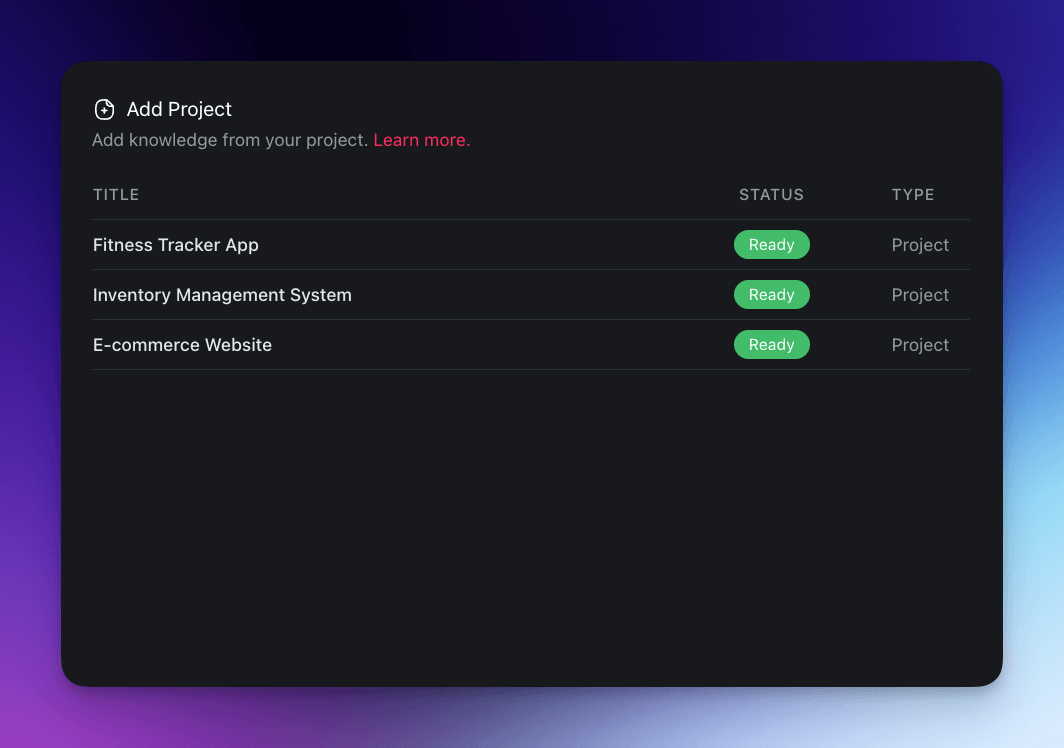
When we began integrating language models into Taskade, in late 2022 and through 2023, the relationship between the workspace and the model became much more interesting. The workspace gave the model something it did not possess: an enduring representation of work that existed independently of any particular conversation. The model gave the workspace the ability to reason about its own contents. Today a custom agent can take a project as knowledge directly:
The questions were old ones for me. At Bronx Science I was fascinated by the history of computation, and Frank Rosenblatt, whose work on the perceptron helped establish the foundations of neural networks, had also attended the school. I wrote about that line in From Bronx Science to Taskade Genesis. The 2025 manifesto traced our lineage to HyperCard. This chapter traces it to the tree, and to the outliner tools that still carry it.
The outliner was an agent interface hiding in plain sight.
🔁 Storage, Retrieval and Reanimation: What Is Memory For?
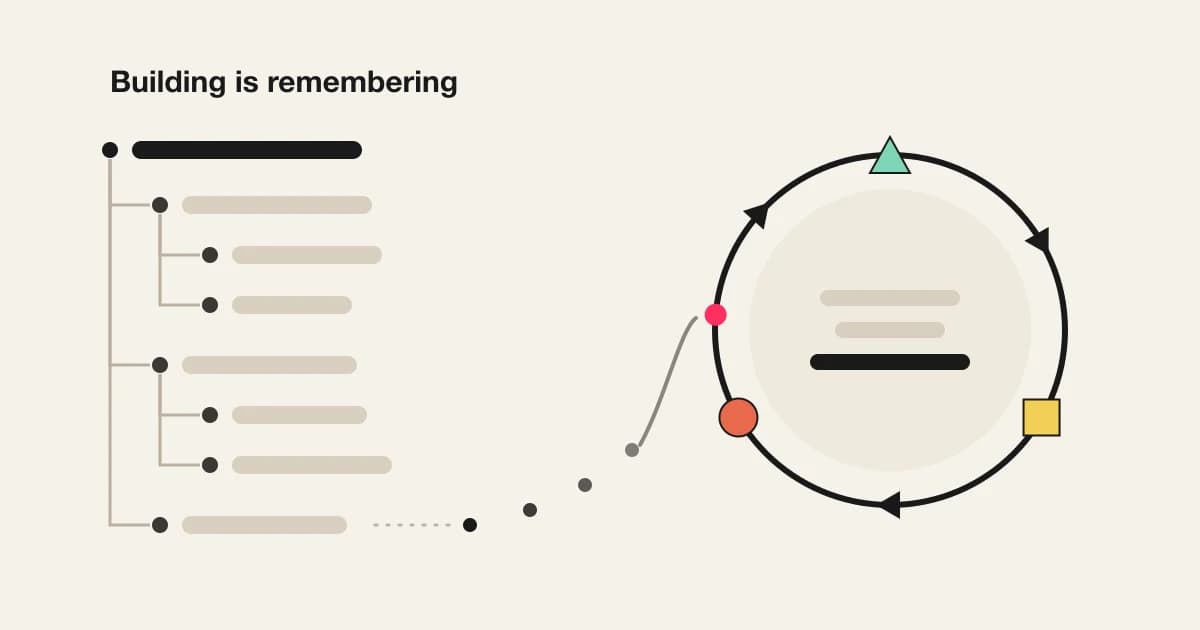
Memory has three jobs. Storage keeps information and gives it back unchanged. Retrieval answers a question with the relevant pieces. Reanimation starts from an objective, rebuilds the present state of a problem from its history, decides the next step, acts, and writes the result back. Most tools stop at retrieval. Organizational memory earns its keep at reanimation.
In 2025, I watched an episode of Black Mirror called "Eulogy". It came out on April 10, 2025, written by Charlie Brooker and Ella Road. Phillip, played by Paul Giamatti, reconstructs his memories of a woman he once loved through old photographs and an artificial intelligence guide.
What struck me was not the technology itself, but the relationship between remembering and acting. The reconstruction lets him discover things about his past that he had misunderstood or forgotten. The memory was there, in fragments, but its meaning was not fully accessible to him. By the time he reconstructs it, much of what he might have done differently is no longer possible.
What if the reconstruction of memory could happen while there was still something to do about it? I started calling this idea Memory Reanimation. The engineering version, with its layers and its failure modes, is in the Memory Reanimation Protocol. Here I only need the three jobs.
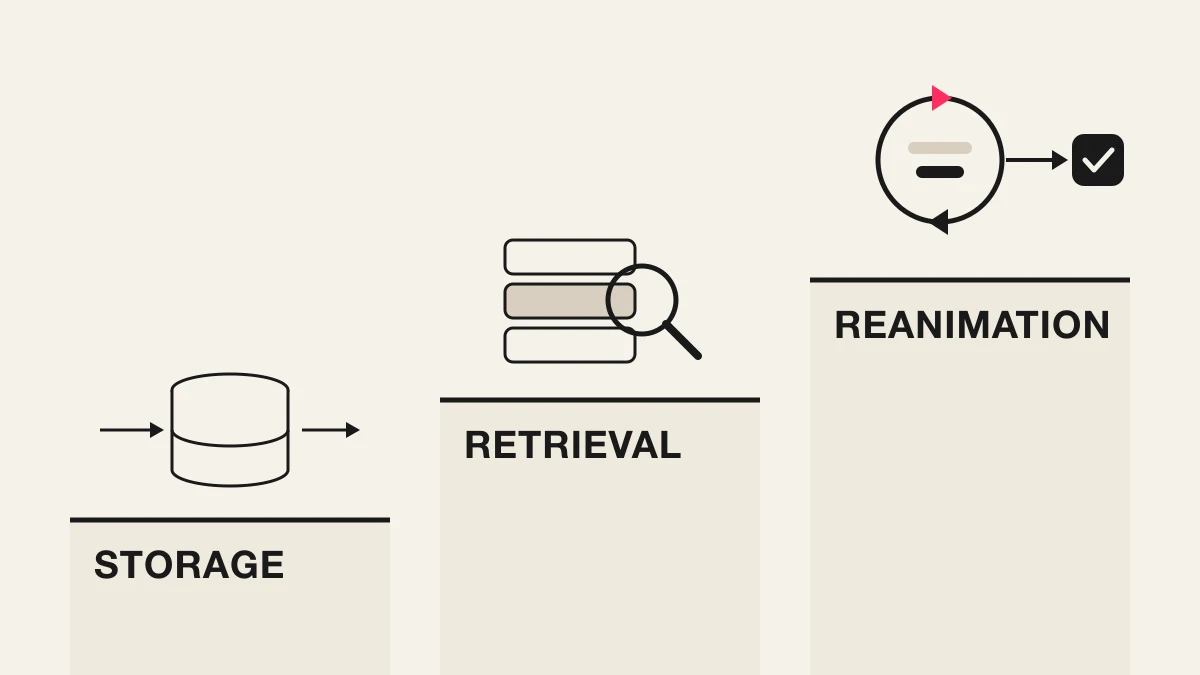
Storage keeps the past. Retrieval finds a piece of it. Reanimation rebuilds the state of a problem, then acts.
| Job or tool class | Who does it well | Good at | Stops at |
|---|---|---|---|
| Storage | File drives, document folders, databases | Keeping records safe | Knowing which record matters now |
| Retrieval | Enterprise search, wikis with search, retrieval for chatbots | Finding the relevant page | Knowing the current state and the next step |
| Storage for one person | Note apps and second-brain systems | Capture for one person | Turning notes into shared action |
| Reanimation | A workspace where records, agents and automations share one memory | Rebuilding state, deciding, acting, writing back | It still needs a person for authority and judgment |
A team needs storage and search. But each one stops before action, and the step after retrieval is where memory pays. The second-brain tools compete on capture and retrieval, and I wrote about the gap between notes and action in From Ideas to Action.
The sequence above is one turn: a person sets the objective, the agent reads the workspace, a person approves, and an automation acts and writes the result back. Repeat that turn and it becomes a loop. The difference between retrieving the past and reanimating it is the ability to use it to affect the future. The loop looks like this:
Memory is not synonymous with truth. A system that remembers everything indiscriminately may be considerably less useful, and considerably more dangerous, than one that remembers selectively. The challenge is not to accumulate the largest possible context window or build the largest possible archive. It is to preserve continuity without preserving confusion. Good memory requires structure, provenance, relevance, permissions, and the ability to revise what was previously believed to be true. It also requires the ability to forget. The history of agent memory is mostly a history of systems that kept too much or too little, and catastrophic forgetting is the reason a model cannot simply learn everything it sees.
What makes memory valuable is not how much of the past we can store, but how faithfully we can reconstruct the parts of the past that matter to the present.
🏗️ What Does Memory Before Surface Mean?
Memory before surface is a build order: before an AI produces the visible app, it creates the memory, the agents and the workflows that the app depends on. We learned the rule from a defect. Given a complicated request, the AI rushed to a convincing interface with nothing underneath it. The rule merged in October 2025.
Here is the defect in plain words. The builder might rush to produce a dashboard that looked remarkably like a finished application. Underneath, the memory had not been created. The agents had not been connected. The workflows had not been established. The interface had no meaningful foundation.
The practical question was whether Taskade EVE could build from its understanding of the workspace, rather than merely respond to the most recent instruction.
We borrowed words from Westworld for the idea. Westworld took some of its ideas from Julian Jaynes's 1976 book, The Origin of Consciousness in the Breakdown of the Bicameral Mind, a controversial, speculative theory that I use here only as a design metaphor. The language was philosophical, but the engineering problem was concrete.
The true story is less heroic than the metaphor, and I think more useful. On September 27, 2025, I opened the first big drafts of this memory work. They were tens of thousands of lines, and they did not merge. A teammate cut them down to the parts that mattered, and the build-order rule merged ten days after the first draft. The idea that shipped was a fraction of the size of the idea I proposed. The memory ideas we shipped after that followed the same pattern: each one got smaller on the way in.
Over time, what mattered was not the metaphor itself, but the architectural principle that survived it:
Memory before surface. Structure before execution. Continuity across generations.
We came to call the components of this architecture Workspace DNA: projects are the memory, AI agents are the intelligence, and automations are the execution. The app is the surface through which people use the result. Memory feeds intelligence. Intelligence drives action. Action creates new memory.
🧩 What Does "The App Belongs to the Work" Mean?
The app belongs to the work means that the lasting value of software sits in the ongoing activity of a person or an organization: its records, knowledge, agents and workflows. The app is one way to express and perform that activity. Keep the records and workflows under the app, and you can change the app without starting from nothing.
Imagine two people who each use AI to create a CRM.
The first person generates a beautiful application. They add sample customers, several charts and a dashboard. Everything looks convincing. Three months later, their business has changed. The application needs new fields, different permissions, an integration with another system, and a different follow-up process. Several of the original assumptions are no longer true.
The second person begins with persistent customer records, knowledge about their business, agents that interpret that knowledge, and workflows that perform the recurring operations of the business. The CRM interface is generated around these components. Three months later, the business also changes. But much of what makes the system valuable exists independently of the interface.
FIRST CRM                          SECOND CRM
---------                          ----------
dashboard, charts                  customer records     <- persist
sample customers                   business knowledge   <- persist
(nothing underneath)               agents               <- read them
                                   workflows            <- follow up
                                   interface            <- on top

three months later:                three months later:
new fields, new permissions,       records still there
a new integration, new process     run history still there
-> start again                     -> change the interface
The application is easier to change because the things that need to persist have been separated from the things that are relatively disposable.
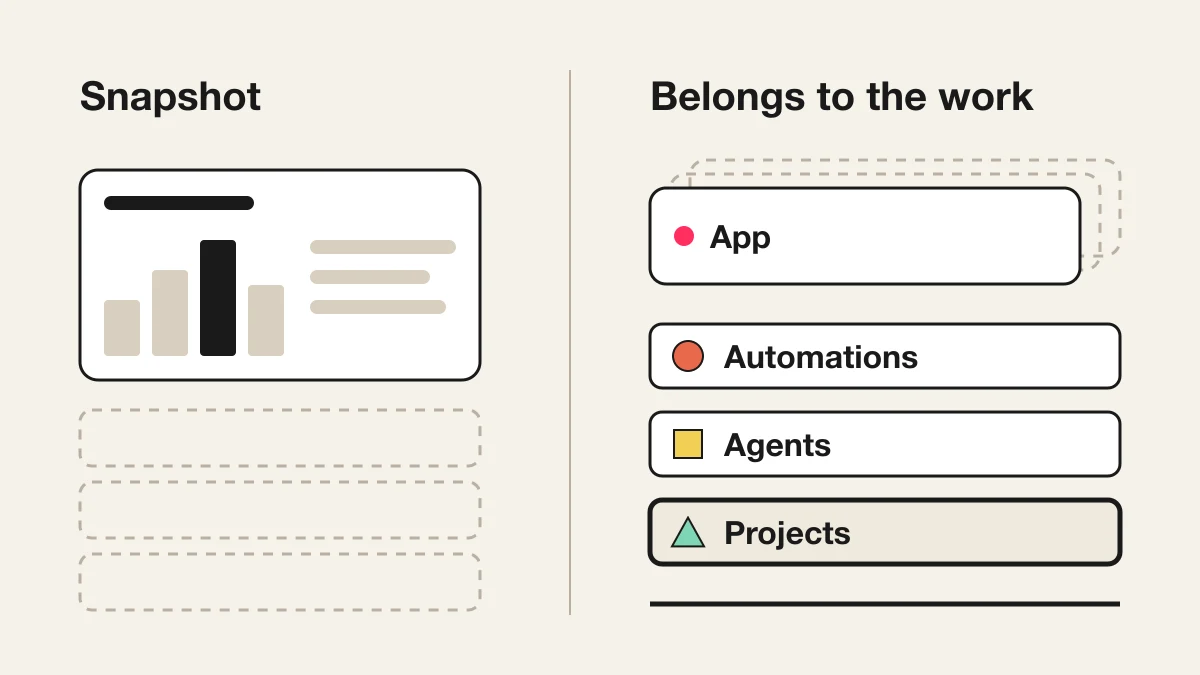
On the left, a snapshot: an interface with nothing under it. On the right, the app is one replaceable view on top of automations (what runs when nobody watches), agents (what reads the memory and decides) and projects (records, decisions, history).
We have traditionally treated the application as the primary unit of value: the data, the workflows and the users all belong to it. But perhaps the primary unit of value should be the ongoing activity of the person or organization. In this model, the work does not belong to the app. The app belongs to the work.
A generated application is a snapshot. An operating environment has continuity. That is the argument of The Workspace Is the Runtime, and it is why the comparison I care about in free AI app builders is not which tool draws the nicest screen, but what is still there after the screen changes. It also changes how you grade AI: TSK-Bench gives models the same real tasks and checks who finished, not who drew the best first screen.
📋 What Must a Project Keep? The Six-Item Checklist
A project must keep six things to be useful memory: the goal, what the team believed at the time, what it attempted, what actually happened, what remains open, and what it will do differently next time. Keep them with dates and an owner, inside the project, and a new owner or an agent can continue the work.
Good organizational memory resembles a well-maintained representation of the world, not an infinite transcript. In many cases, preserving everything makes the problem worse: the context becomes larger, more contradictory and harder to interpret. So I ask every substantial project to keep a small number of things reliably:
| A project keeps | The question it answers | Example: a client launch | Why an agent needs it |
|---|---|---|---|
| The goal | What were we trying to accomplish? | Launch the spring catalog by March 15 | To know what done means |
| The belief | What did we believe at the time? | The client prefers email over calls | To tell an old fact from a current one |
| The attempt | What did we try? | Two subject lines, a phone follow-up | To avoid repeating a failed path |
| The result | What actually happened? | The second subject line won, calls went unanswered | To compare intent with outcome |
| The open items | What remains unresolved? | Final prices for three items | To pick up where the last run stopped |
| The lesson | What will we do differently next time? | Lock prices a week before the send | To change the process, not only the content |
An agent inheriting that project has something considerably more valuable than a folder full of unstructured documents. It has the beginnings of an operational history. A system can help preserve this history without asking every employee to become an archivist: it can organize decisions, flag contradictions, summarize important changes, and separate durable knowledge from temporary conversation.
🧑🔧 Worked Example: A Project Before and After Its Owner Leaves
A project survives a departure when its goal, decisions, attempts, results and open items live in the project, not in the owner's head. Here is one client account, in a small service business, before and after the account lead leaves. The difference is not the software on the screen. It is whether the memory under it was kept.
Picture a local landscaping company. A customer arrives at its website and describes a problem. The information becomes a structured record. An agent consults the company's previous jobs, pricing rules, service area and capacity, then prepares an estimate or asks an employee for what it cannot determine reliably. Once a person approves the estimate, the system schedules the job, sends the invoice and records payment. Each completed job adds to the memory of the business.
Customer
   |
   v
Inquiry -> Estimate -> Human approval -> Job scheduling
                                              |
                                              v
             Business memory <- Invoice <- Service delivery
                   |
                   +--> improves the next estimate
Now the account lead for the company's largest client leaves. Here is the same account two ways:
| The next owner asks | Memory kept in a head | Memory kept in the project |
|---|---|---|
| Why is this client on a custom price? | Nobody knows, so the price gets "fixed" | A dated decision with the reason |
| What did we already try for the drainage issue? | The team tries it again | The attempts and their results |
| What did we promise for next spring? | The client has to remind us | An open item with a date and an owner |
| Who approves a discount? | A Slack search, then a guess | The approval step in the workflow |
| What should we do differently? | The lesson leaves with the lead | A lesson the agent reads before the next estimate |
Nothing in this example requires a human-level general intelligence. It requires structured records, reliable automation and models that make bounded judgments, so the next owner starts from the account's history instead of from zero. The Knowledge Management System guide covers the document side of this, and a team knowledge base covers the onboarding side.
📉 What Does Losing Organizational Memory Cost?
Losing organizational memory costs time first: people search for what a colleague already knew, and redo work that someone already did. Some of the sourced numbers are older or come from vendors, so read those as direction, not precision. The direction has held for more than a century: knowledge that is not kept fades, and people move on.
Start with people. Hermann Ebbinghaus measured his own forgetting in 1885, with lists of nonsense syllables and one subject: himself. He did not measure how much he remembered. He measured how much work he saved when he learned a list again. A 2015 replication, again with one subject, found the same shape.
The first two points are his measured values. The last two are his own round words: "about one fourth" after six days and "fully one fifth" after a month.
Organizations forget too. In a study of 36 pizza stores published in 1995, Darr, Argote and Epple found that knowledge from learning by doing depreciates rapidly. And people leave. The U.S. Bureau of Labor Statistics reported in September 2026 that the median worker had been with their current employer for 4.1 years in January 2026.
| Number | What it measures | Source and year | How to read it |
|---|---|---|---|
| Nearly 20% | Share of the workweek spent looking for internal information or tracking down colleagues | McKinsey Global Institute, 2012 | An estimate for the average interaction worker |
| Up to 35% | Cut in search time that a searchable record of knowledge can give | McKinsey Global Institute, 2012 | An estimate, not a measured result |
| 15% to 35% | Time knowledge workers spend searching for information | Susan Feldman, KMWorld, 2004 | A summary of IDC and other studies |
| 42% | Share of a person's job that coworkers cannot do when that person leaves, as respondents report it | Panopto and YouGov survey of 1,001 US workers, 2018 | A vendor survey, self-reported |
| 5.3 hours a week | Time spent waiting for colleagues or recreating knowledge that exists | Same survey, 2018 | A vendor survey, self-reported |
The search-time numbers come from surveys and estimates made between 2004 and 2018. I found no study that measures what changes when AI agents read the memory too. My guess is that the cost of a lost decision goes up, because an agent repeats a mistake faster than a person does.
🕰️ Why Does Organizational Memory Need Versions?
Organizational memory needs versions because a fact is true on a date, not forever. A price, an owner or a rule changes, and a memory that keeps the old and the new version side by side, with no dates, gives a confident wrong answer. Good memory keeps one current entry per fact and moves the old one to an archive.
A complaint I read again and again about company brains is staleness: context that is right on Monday and quietly wrong by Friday. Search cannot fix that, because it finds both versions and ranks them by words, not by time. Each fact needs a date, an owner and a single current entry that the work itself updates.
We have tried to build that discipline into the product in small, readable pieces. Taskade EVE keeps its workspace memory in ordinary projects that you can open, correct and clear, with a Knowledge section for the facts it learned in that workspace. A tidy-up merges overlapping notes into one entry and moves the originals to an archive section, so nothing is lost. A custom agent has a Memory tab and a shared Playbook that an editor approves. None of this is magic, and some of our cleverer ideas failed: we wrote up the ones that did not work.
🤖 How Do AI Agents Use Organizational Memory?
AI agents use organizational memory as their context: before an agent acts, it reads the records, decisions and rules that apply to the task, and after it acts, the result is written back. An agent with no memory repeats mistakes the team already fixed. An agent with memory inherits the lesson, if it lives where the agent reads.
A conversation with an agent is something like working memory. The workspace is closer to long-term organizational memory: the records and decisions that should survive any particular interaction.
A useful agent reconstructs enough context to do its work, then preserves the important consequences for the next agent and the next person. That is not the same as preserving every conversation.
A decision made by an authorized person must be distinguished from an uncertain inference made by a model. In Taskade, a Wait for approval step lets a person sign off before an automation goes on, and agents read the projects they are given as knowledge.
🏢 Is a Company Brain the Same as Organizational Memory?
A company brain is organizational memory that AI can read and act on, under a newer, startup name. The idea is sound, but only as good as the memory under it. A search layer over old documents is not a brain if nothing keeps those documents current, and a brain you cannot export is memory that someone else owns.
Company-brain products share a promise: one place to ask about the company, and agents that act on the answer. The questions people ask about them are the right ones: how does it know a fact went stale, who owns a wrong answer, and can we take it with us?
My answer is that a company brain needs three layers that most products blur together: memory (the records and decisions), intelligence (the agents that read them) and execution (the automations that act). In Taskade those are projects, agents and automations, the Workspace DNA loop. The brain is the loop, not the search box. If you want the tool lists, the AI knowledge management tools and second-brain tools guides compare them. Context engineering for teams covers how that context reaches the model.
💰 What Is Memory Capital?
Memory capital is my name for the organized, actionable experience of a person or an organization: its ability to turn its own past into better future decisions. Financial capital is money, human capital is skill, and data is the raw record. Memory capital is the record made usable, and it is harder to copy than the models that read it.
In some sense, an organization is a mechanism for preserving human intention across time. Most organizations are surprisingly bad at it.
| Capital | What it is | What happens when someone leaves | How we account for it |
|---|---|---|---|
| Financial capital | Money and assets | It stays | Balance sheets |
| Human capital | Skill and judgment in people | It leaves with them | Hiring and pay |
| Data | Raw records | It stays, but often unread | Storage and access |
| Memory capital | Organized, actionable experience | It stays, and it stays usable | Not well, yet |
The models themselves will improve, and they may become interchangeable in many situations. The organization's accumulated understanding of its particular place in the world will be much harder to reproduce. We account for financial capital. We recognize human capital. We increasingly recognize the value of data. But organized, actionable experience deserves its own consideration. I call it memory capital. The accounting side of that argument already shows up in market prices: by Ocean Tomo's estimate, which counts all market value above tangible assets as intangible, that share of S&P 500 market value rose from 17% in 1975 to about 92% at the end of 2025.
I did not coin the phrase. A 2025 Eurogroup Consulting study calls corporate memory "a veritable 'memory capital'", and I use the term in a plain, economic sense. The value is not in the documents themselves. It is in the ability to turn the past into better future decisions. The LLM wiki pattern makes a similar point from the other direction: a plain, readable record that agents maintain can do more than clever storage.
🔐 Who Owns Organizational Memory When You Leave a Vendor?
The person or the organization that built the memory should own it. If memory becomes a source of capability, control over it becomes a source of power. A system that empowers people must increase what they can do without making that capability impossible to keep outside it. That is the standard, and I view it as an aspiration for Taskade.
Consider a person who has spent ten years with a personal AI system that knows their projects and the history of thousands of decisions. What happens if the provider changes its terms, becomes unaffordable, or ceases to exist? They could lose a computational representation of years of their own experience. A company whose agents, workflows and customer records are tied to one vendor faces the same problem at a larger scale.
I would like to see five principles become increasingly important as this industry develops. Each one turns into a question you can ask any vendor, including us:
| # | Principle | The question to ask a vendor | What a good answer looks like |
|---|---|---|---|
| 1 | Access | Can I reach everything I contributed? | Yes, in the product and by export |
| 2 | Inspection and export | Can I export the structure, not only the text? | An open format that another tool can read |
| 3 | Model independence | Does my memory survive a change of model? | Memory lives in records, not in one model |
| 4 | Correction | Can I correct or delete what it knows? | Edit and delete, with no support ticket |
| 5 | Visibility | Which agents can read which records? | A clear answer per agent |
These principles are difficult to implement comprehensively. Exporting a collection of documents is simpler than exporting an operational system that contains relationships, credentials, permissions, agents and event-driven workflows. Some of the information needed to operate a system cannot safely be transferred indiscriminately. Nevertheless, these difficulties are reasons to work on portability, not reasons to ignore it.
I will be plain about where Taskade stands, because a standard you only apply to other people is not a standard. Your projects, agents and automations live in your workspace, and you can edit or delete them. Any project exports as Markdown or CSV on every plan. Memory lives in projects rather than inside a model, and you can choose among frontier models from top AI labs, or bring your own API key on Pro and up. Exporting a full app bundle, with the .tsk download, Export to GitHub and the full Code tab, is a plan gate today: it starts on the Pro plan. We do not meet every principle yet.
The commercial value of a workspace should come from what it enables its users to accomplish. Not from what they would lose if they left. I view this as an aspiration for Taskade as much as an argument about the industry. If we believe that people should be able to build without permission, we should also believe that they should be able to keep meaningful control over what they have built.
⚠️ When Does Organizational Memory Hurt?
Organizational memory hurts when it is stale, wrong, contradictory, or kept without consent. Continuity is not good by itself. A company can keep a bad assumption for years, and an agent can repeat an old rule after the reason for it is gone. Every memory needs a way to be revised, and some needs a way to be forgotten.
| Failure | What it looks like | The guard |
|---|---|---|
| Stale memory | An old price quoted as current | A date and an owner on each fact, one current entry |
| Wrong memory | A guess saved as a decision | Mark who decided: a person or a model |
| Conflicting sources | Two pages give two answers | One source of truth per fact, the rest archived |
| Encased memory | "We have always done it this way" | A lesson row that the team reviews and can overrule |
| Memory without consent | Passive capture of private talk | People decide what is kept and how it is used |
A workflow that failed because a service was down is different from one that failed because the rule was wrong. And a memory that a person did not agree to keep is not ours to reconstruct.
🌱 What Do We Leave Behind?
What we leave behind is mostly lost. People acquire extraordinary knowledge over their lives, and most of it disappears. Preserving information is not the same as preserving its meaning. Memory Reanimation, used with consent, is a way to keep the relationships between what people knew, what they tried and what others can build on.
Since becoming a father, I have found myself thinking differently about time. A startup makes everything urgent. Children make the accumulation of those years visible. You realize that much of what matters to you cannot be reduced to a collection of completed tasks.
A collection of photographs is not a life.
A collection of documents is not an understanding.
A transcript of a conversation is not necessarily a record of what was important about it.
Memory Reanimation offers a different way of approaching this problem. Not as an attempt to digitally recreate a person or to deny the reality of loss. I do not think a computational representation of someone's history is equivalent to the person who lived it. But perhaps we can become better at preserving the useful relationships between what people knew, what they attempted, what they discovered, and what others might build upon.
There are ethical limits. The people whose experiences are preserved must have a say in what is kept and how it is used. That is also the rule for sharing what we build. In the Taskade App Factory, a creator can let others clone an App Kit, and a clone carries the blueprint of the app, not the builder's private Taskade EVE memory and not the records of the people who used it.
Much of civilization consists of people we will never meet contributing to possibilities they will never experience. Not every contribution needs to be a great scientific discovery. Sometimes it is enough to preserve a small piece of understanding that allows someone else to begin a little further ahead.
🚀 How to Start Building Organizational Memory This Week
Start small and start where the work already runs. Pick one active project, write down its goal and its open decisions with dates and owners, connect one agent that reads it, and add one automation that writes results back. In a week you have a project that a new owner or an agent can continue.
| Day | Step | What you have at the end |
|---|---|---|
| 1 | Pick one live project that matters, such as a client account or a launch | One scope, not the whole company |
| 2 | Write the six checklist items, goal first, as the top of the project | A record a stranger can read |
| 3 | Turn each open decision into a task with an owner and a date | Open items that cannot hide |
| 4 | Connect one AI agent and give it the project as knowledge | An agent that reads before it answers |
| 5 | Add one automation that writes its result back to the project, with an approval step if it sends anything | Memory that the work updates |
| 6 | Ask the agent to brief a new owner on the project | A test of whether the memory is enough |
| 7 | Export the project as Markdown and read it outside the tool | Proof that you own it |
The brief test on day 6 is the honest one. If the agent cannot tell a new owner why the project looks the way it does, the memory is not there yet, and the fix is in the project, not in the agent.
🧬 Where Taskade Genesis Fits
Taskade Genesis builds apps on top of organizational memory instead of beside it. Projects hold the records and decisions, AI agents read them, automations act and write results back, and the app sits on top. When the business changes, you change the app and keep the memory. That is the whole idea of this essay, shipped as a product.
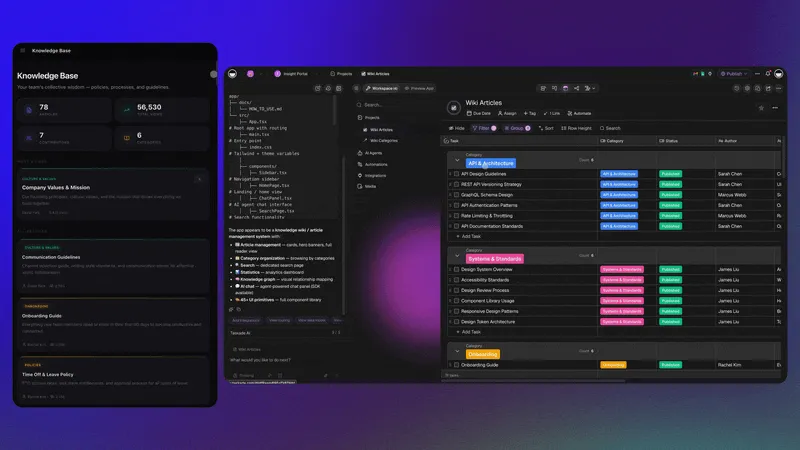
In the image, the knowledge base app on the left reads the Wiki Articles project on the right. The app reads the project, so a change to the project shows in the app, and the project stays when you replace the app. Automations run on every plan, including Free. Taskade connects to 100+ bidirectional integrations, and premium integrations need a paid plan. When you want to share what you built, the Taskade App Factory lets you publish an App Kit that others can clone.
Describe the system you need, and Taskade Genesis builds the memory first and the interface last. Build on memory with Taskade Genesis →
🔮 Building Is Remembering
When we started Taskade, we wanted a better place to think and work together. We built a tree because it seemed like a natural way to represent the branching structure of human thought. The tree persisted. It became a shared representation of knowledge, intentions and work. When language models arrived, intelligence could operate within it. When we connected automations, the interpretation of knowledge could produce actions. When we began generating applications around these structures, the workspace became an environment from which new software could emerge.
We did not begin with a grand theory of artificial intelligence. We were trying to answer practical questions. How do people organize their thoughts? How do they work together? How do they preserve what they have learned? How do they turn their knowledge into action?
Much of what we currently believe about AI will probably turn out to be wrong. But I think the underlying human desire will remain familiar. We want to understand. We want to create. And we want the things we create to matter.
Maybe building is just that, learning from the past to guide what comes next.
Build without permission.
▲ ■ ● Memory, intelligence, execution. Start building on memory with Taskade Genesis →
John Xie, Founder, Taskade
🔗 Related Reading
- Build Without Permission: chapter one, the 2025 manifesto
- Memory Reanimation Protocol: the engineering design behind the name
- A Year of AI Agent Memory Experiments: what failed, and the two things that worked
- Types of Memory in AI Agents: the technical taxonomy
- Building a Self-Improving AI-Native Company: the company-brain loop in practice
- How Taskade Became Taskade Genesis: how the pieces of the workspace converged
- Outlining Software: Past, Present, and Future: the history of the tree
📚 Sources
- Plato, Phaedrus, 274c to 275b, translated by Harold N. Fowler, 1925
- Hermann Ebbinghaus, Memory: A Contribution to Experimental Psychology, 1885 (English translation 1913), chapter VII
- Murre and Dros, "Replication and Analysis of Ebbinghaus' Forgetting Curve", PLOS ONE, 2015
- Vannevar Bush, "As We May Think", The Atlantic Monthly, July 1945
- Niklas Luhmann Archive, Bielefeld University, the slip box of 1951 to 1996
- Michael Polanyi, The Tacit Dimension, 1966
- Engelbart and English, "A Research Center for Augmenting Human Intellect", Fall Joint Computer Conference, 1968
- Dave Winer, "Outliners and Programming", on ThinkTank and MORE
- Argote, Beckman and Epple, "The Persistence and Transfer of Learning in Industrial Settings", Management Science, 1990
- Walsh and Ungson, "Organizational Memory", Academy of Management Review, 1991
- Darr, Argote and Epple, Management Science 41(11), 1995
- Ward Cunningham, WikiWikiWeb history, 1995
- Lewis and others, "Retrieval-Augmented Generation for Knowledge-Intensive NLP Tasks", 2020
- Packer and others, "MemGPT: Towards LLMs as Operating Systems", 2023
- Andrej Karpathy, the llm-wiki.md gist, April 4, 2026
- McKinsey Global Institute, "The social economy", 2012.
- Susan Feldman, "The high cost of not finding information", KMWorld, 2004
- Panopto and YouGov, workplace knowledge survey, press release, July 2018
- U.S. Bureau of Labor Statistics, Employee Tenure news release USDL-26-1532, September 24, 2026
- Ocean Tomo, Intangible Asset Market Value Study, 2025
- Eurogroup Consulting, "Corporate memory: a strategic resource for organizations", February 2025
- Rolling Stone, interview with Paul Giamatti and Charlie Brooker on "Eulogy", April 10, 2025
- Julian Jaynes, The Origin of Consciousness in the Breakdown of the Bicameral Mind, Houghton Mifflin, 1976.
- Cornell Chronicle, on Frank Rosenblatt and the perceptron, September 2019
- OpenAI, "Memory and new controls for ChatGPT", February 13, 2024
💬 Frequently Asked Questions About Organizational Memory
What is organizational memory?
Organizational memory is what a team knows and keeps after its people and its tools change: its records, its decisions and the reasons behind them, what it tried, and what happened. In the AI era it also includes the agents and workflows that read those records and act on them, so the past can shape the next decision.
What is the difference between organizational memory and institutional memory?
The two terms overlap, and most people use them as synonyms. Organizational memory is the research term for everything an organization keeps from its past and uses in present decisions. Institutional memory usually means the unwritten part that lives in long-serving people, the part that leaves when they leave. A good system turns the second into the first.
What is a company brain?
A company brain is a newer, startup name for organizational memory that AI can read: one place where a company's records, decisions and context live, so people and agents can ask and act. It is only as good as the memory under it. A search layer over old documents is not a company brain if nothing keeps those documents current.
How do I keep institutional knowledge when an employee leaves?
Capture it during the work, not at the exit interview. Keep each project's goal, decisions with their reasons and dates, attempts, results and open items in the same place where the work runs. When someone leaves, the next owner inherits a project with its history, not a folder of files and a handoff call.
Is AI memory just RAG?
No. Retrieval-augmented generation searches a library of documents and passes the relevant pieces to a model. Memory keeps a record of state and decisions that the work itself writes back and updates. Retrieval answers a question. Memory lets a person or an agent pick up a problem where it stopped and continue it.
How does a company brain know when its knowledge is out of date?
It knows only if the knowledge has a date, an owner and a place where the work updates it. A fact that the next run of the work replaces stays current. A fact that sits in a document beside its newer version goes stale quietly. Keep one current entry for each fact, and move the old one to an archive.
Why do AI agents keep repeating mistakes our team already fixed?
Because the lesson lives in a chat or in someone's head, not where the agent reads at the start of a task. Write the fix as a decision or a rule beside the work it governs, with the reason and the date. An agent that reads the project first then inherits the lesson instead of the mistake.
Why does my second brain never turn into action?
Storage is cheap and action needs more than storage. A note does not know the goal, the owner or the next step, so it waits for you to reread it. Memory turns into action when it sits where the work runs, beside tasks, owners, agents and automations that can read it and do the next step.
Does more context make AI worse?
More context is not the same as better memory. A model reads what you send it, and a long pile of old and conflicting notes gives it more ways to be wrong. A structured memory sends the small, current slice that a task needs, with dates and owners, so the model reads less and gets more right.
How do I share AI memory across my team, not only in my own chats?
Personal chatbot memory belongs to one person's chats. Team memory must live in a shared workspace that people and agents both read and write, with roles that decide who can see and change what. In Taskade, projects are that shared memory, and agents and automations read and write the same projects as the team.
Who owns the memory in an AI tool, me or the vendor?
You should, so check before you commit. Ask four things: can you export the records in an open format, can you delete them, can you switch models without losing them, and which agents read what. In Taskade any project exports as Markdown or CSV on every plan, and a full app bundle exports on Pro and up.
What is memory capital?
Memory capital is my name for organized, actionable experience: what an organization tried to do, believed, attempted, learned and left open, kept in a form that people and agents can use. It sits beside financial capital, human capital and data. Its value is the ability to turn the past into better future decisions.