

TL;DR: Taskade Genesis ships a deployed app with persistent agents, automations, and 100+ integrations that share one workspace memory. Manus AI is an autonomous agent in a browser VM that now also builds and hosts web apps, with paid tiers at about $20, $40, and $200 a month. Taskade Pro is $10/mo billed annually for 10 seats. Try Taskade Genesis free →
See the alternative working — clone in 60 seconds
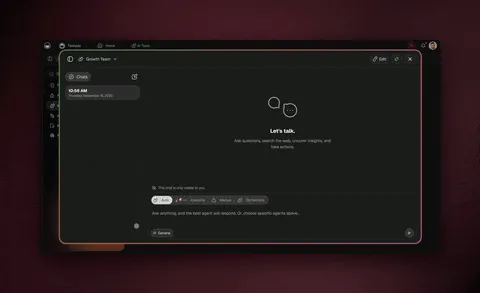
No signup, no credit card. Live multi-agent workspace
| Capability | Manus AI | Taskade Genesis |
|---|---|---|
| Pricing (starting) | Free tier; paid tiers at about $20, $40, and $200/mo | $0 Free · $10/mo Pro billed annually (10 seats) |
| Cloneable live app | ❌ | ✅ |
| Built-in AI agents | Yes, custom agents | ✅ built-in tools |
| Automation engine | Scheduled and event-triggered tasks (Manus 2.0) | ✅ Reliable runtime, 100+ integrations |
| Workspace DNA loop | ❌ | ✅ ▲ Memory · ■ Intelligence · ● Execution |
Overall winner: ✅ Taskade Genesis — for anyone whose goal is shipping a working product with persistent agents and team collaboration. Manus AI remains a strong pick for individuals who want to delegate a single autonomous task and pick up the deliverable.
Table of Contents
- Quick Comparison Table
- The fundamental difference
- What is Taskade Genesis?
- What is Manus AI?
- Feature-by-feature deep dive
- Web apps: Manus vs Taskade Genesis
- Wide Research, subagents, and agent teams
- What a Manus user can build with Taskade Genesis
- The Workspace DNA advantage
- Pricing and total cost of ownership
- Where Manus AI has the edge
- What users say
- Free and open-source Manus alternatives
- Which one should you choose?
- When to choose each
- Frequently asked questions
- Without permission
The fundamental difference
Manus AI is a sandboxed autonomous agent. You give it a task — research a market, scrape a dataset, write a report, prototype a script — and it spins up its own browser and virtual machine to complete the job, then hands you the artifact. The unit of value is a finished deliverable from a single session.
Since Manus 1.5 in October 2025, that session can also end in a hosted web app. Taskade Genesis starts further down the pipeline. You describe what you want and Taskade Genesis returns a deployed application with AI agents, real-time data, automation workflows, and team collaboration already wired in. Your workspace is the backend. Your projects are the database. Your agents are the runtime that keeps working long after the prompt.
Manus asks: "What task should I complete for you?" Taskade Genesis asks: "What app should exist?"
What is Taskade Genesis?
Taskade Genesis is the AI app builder inside the Taskade workspace. It is built on Workspace DNA — Memory (Projects), Intelligence (AI Agents), and Execution (Automations) — a self-reinforcing loop where what your team does becomes the substrate the agents reason over. Founded by John Xie, Dionis Loire, and Stan Chang in 2017, Taskade is a Y Combinator-backed platform with over a million users and a public Community Gallery of apps anyone can clone.
A single prompt to Taskade Genesis can produce a customer support portal, an ops dashboard, a CRM, a knowledge base, a form-driven intake system, or an internal tool - all with built-in AI agents, automations, custom domains, password protection, and the option to embed publicly with GenesisAuth. No DevOps. No CI/CD. No infrastructure to maintain.
Taskade Genesis is for everyone - founders, marketers, ops, product managers, customer success, and yes, engineers who want to skip plumbing and focus on the idea.
What is Manus AI?
Manus AI is a general-purpose autonomous agent that went viral on launch in early 2025 for completing complex multi-step tasks inside a sandboxed browser and VM. You describe a goal in plain language and Manus plans, browses, reads files, writes code, drafts documents, and returns a finished artifact — often without further intervention.
Manus at a glance (October 2026): Originated in China, launched invite-only in early 2025, and now publicly available with a free tier plus paid plans. Reached $100M ARR by December 2025. Meta announced an acquisition (reported ~$2B) on December 29, 2025. China's foreign-investment review ordered the deal unwound on April 27, 2026, Meta and Manus separated in June, and Manus announced on September 1, 2026 that it had formally resumed independent operations under its founding team. Sources: CNBC, Tech Startups. Strong autonomous browsing, file manipulation, and code execution inside a managed sandbox, plus a web app builder added in Manus 1.5. Manus 2.0 (September 28, 2026) added a new agent core called Cascade, a purchasable always-on Cloud Computer, event-triggered Automations, Manus Studio (the desktop app as a shared workspace for documents, slides, websites, code, games, and video), a timeline Video Editor, Remote Control and Computer Use, and Cue, a separate early-access app for agents with their own email and phone number. One of the first general-purpose autonomous agents to feel genuinely "agentic" out of the box.
Manus is a great fit for a researcher who wants a market scan completed end-to-end, an analyst who needs a one-off scrape and synthesis, or a founder who wants a script prototyped while they sleep. Each of those use cases is a session: prompt in, deliverable out.
Where Manus is less natural is the persistent surface. Its web app builder can host an app your customers open, and Manus Studio now gives people and AI a shared place for files and deliverables. The center of gravity is still the task an agent completes, not structured projects that agents and automations read and write as one memory. That is a different shape of product.
Feature-by-feature deep dive
App generation
- Taskade Genesis turns a single prompt into a deployed application with UI, data model, AI agents, and automations connected. You can iterate visually or in natural language. The output runs immediately at a shareable URL.
- Manus AI returns deliverables (research reports, spreadsheets, slides, scripts) and, since Manus 1.5, can build a full-stack web app with a backend, database, and user authentication that it hosts on a manus.space URL. Custom domains are supported.
AI agents that take action
- Taskade ships AI Agents v2 - first-class digital teammates with persistent memory, built-in tools (web search, file analysis, project management, image generation, code execution, and more), custom tools you define, and the ability to be embedded publicly inside Taskade Genesis apps.
- Manus centers on an autonomous agent that works one task at a time, with scheduled tasks, reusable skills, and event-triggered Automations since Manus 2.0. The agent is excellent at completing the task in front of it, but it is not a persistent teammate that lives across your team's projects.
Workflow automations and integrations
- Taskade includes reliable Automations with branching, looping, and filtering across 100+ bidirectional integrations. Triggers pull external events in (Slack messages, Gmail, Sheets rows, Calendly events, webhooks). Actions push data out (Stripe checkouts, Notion syncs, Salesforce updates, GitHub PRs).
- Manus can browse and act on the open web from inside its sandbox. That is powerful for one-shot tasks but is not the same shape as a persistent integration runtime your team triggers thousands of times a month.
Team collaboration
- Taskade is workspace-native: real-time multiplayer editing, comments, chat, video calls, and granular role-based access (Owner to Viewer).
- Manus is built around individual sessions. A Team plan exists, but the product's center of gravity is one person delegating one task at a time.
Project views and visual editing
- Taskade offers multiple project views — List, Board, Table, Mind Map, Docs (Beta), Gantt Chart, Calendar, Actionsheet, and Org Chart — plus visual app editing without writing code. The Timeline scrolling component lives inside the Gantt view.
- Manus is a conversation surface that produces files. Visual editing of those artifacts happens wherever you open them after the session.
Workspace memory and context
- Taskade's Workspace DNA gives every agent persistent context across projects, files, integrations, and the live state of your business.
- Manus's context is task-scoped by design, with projects and skills to reuse instructions. Each new task starts close to fresh, which is great for clean autonomous runs and less great for compounding institutional knowledge.
Autonomous browsing and VM tooling
- Manus wins outright here. The sandboxed browser plus VM is the headline feature, and it is genuinely strong for tasks that require navigating real websites, manipulating files, and running code end to end.
- Taskade has in-app web search and file tools for agents, but it is not trying to be a sandboxed VM provider.
Web apps: Manus vs Taskade Genesis, side by side
Manus and Taskade Genesis both turn a description into a hosted web app, and they differ in what surrounds the app. The table compares what each platform documents in September 2026.
| Capability | Manus web app builder | Taskade Genesis |
|---|---|---|
| Build path | Chat in the Manus workspace, live preview, publish | Prompt, then edit visually or in natural language |
| Hosting | Manus-managed, on a manus.space URL | Taskade-hosted, on a shareable URL |
| Database | Built-in multi-table database | Taskade Projects act as the database |
| User sign-in | Authentication with public, private, or role-based access | Sign-in on every plan, Free included |
| Custom domain | Supported | Business and above |
| AI agents inside the app | Embedded AI features | Persistent agents with memory, embedded for your users |
| Recurring work | Scheduled tasks, plus event-triggered Automations since Manus 2.0 | Automations across 100+ integrations, triggered by events or a schedule |
| Team workspace | Individual-first, with a Team plan | Real-time multiplayer with role-based access from Owner to Viewer |
Sign-in confirms who a visitor is. Matching records to that login is a separate step in both products, so test any portal with a second account before you invite real users.
Wide Research, subagents, and agent teams
Manus's pricing page highlights Wide Research, its feature for running large research requests as many parallel tasks. Taskade Genesis reaches a similar goal with a different structure: a team of specialist agents that share one workspace memory. On Pro and above, you describe the team in plain English, and Taskade EVE creates the specialists and wires the handoffs. Four modes decide who replies: Auto, Everyone, Manual, and Orchestrate.
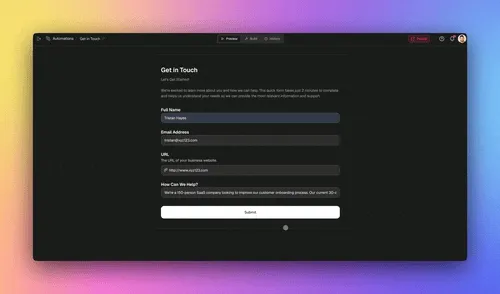
A team can also run inside an automation. In the clip below, a form response starts a flow, an "Ask Agent Team" step qualifies the lead, and the flow sends an email and adds a task while a lead table fills in.
  Manus session                          Taskade Genesis loop

  goal                                   trigger (schedule, email, form)
    |                                        |
    v                                        v
  plan, browse, code in a sandbox        agent or agent team + workspace memory
    |                                        |
    v                                        v
  deliverable or hosted web app          connected apps act, result written to projects
    |                                        |
    v                                        v
  session ends                           the next trigger starts from fresh data
Two guides go deeper. AI Subagents vs Agent Teams explains when a short-lived subagent is enough and when persistent peers pay off. Always-On AI Agents compares scheduled and event-driven agents, with a cost model. Taskade agents read the web through search and fetch tools and act through your connected apps. They do not drive a browser or a computer, so a job that needs a sandboxed browser stays a Manus job.
What a Manus user can build with Taskade Genesis
A Manus task returns one deliverable. In Taskade Genesis, the same job becomes a small system that repeats. The rows below turn common Manus tasks into apps. Each prompt is a starting point, and you can refine it by chat with Taskade EVE.
| Manus-style task | Starting prompt | Projects (Memory) | AI agent (Intelligence) | Automation (Execution) |
|---|---|---|---|---|
| Research a market | Build a research hub for my consulting team. A form takes a topic. A research agent searches the web and writes a cited summary into a project. |
Research briefs | Research agent with numbered source citations | A form submission starts the agent |
| Watch competitors | Build a competitor tracker. Every Monday, an agent reads each competitor's news page and writes a weekly summary. |
Competitors and weekly summaries | Summary writer | A weekly schedule trigger |
| Keep a knowledge base fresh | Build a knowledge hub that pulls new articles from an RSS feed and answers questions about them. |
Knowledge Hub | Research agent | An RSS automation adds new items |
| Qualify leads | Build a lead tracker for a wedding photographer. A public form collects name, date, venue and budget. Add an agent that scores each lead Hot, Warm or Cold. |
Leads | Lead scorer with a one-line reason | A form submission creates a lead record |
| Answer customers | Create a support agent trained on my help documents. Publish it as a website widget. |
Help documents | Public support agent | Chat threads route to Slack or email |
| Report weekly | Build a sales dashboard from my Deals project. Refresh it every morning and show a weekly summary. |
Deals | Weekly summary writer | A schedule trigger refreshes the data |
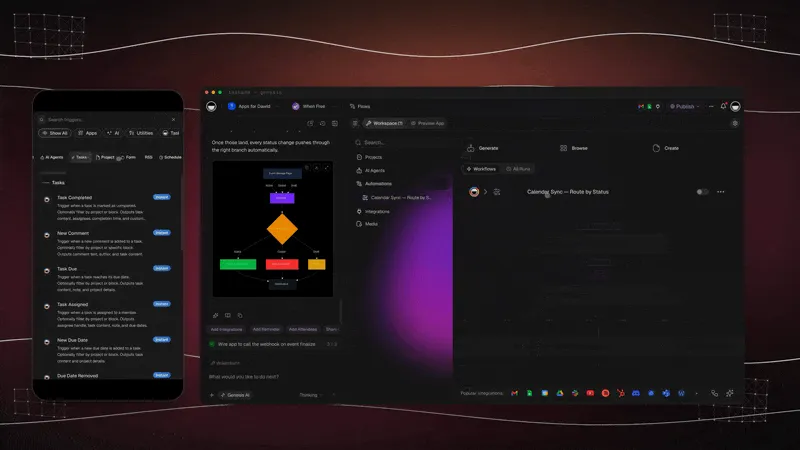
Each app keeps its own history, so the next run starts from what the last run learned. Taskade agents keep persistent memory, and they can wait for your approval before a sensitive step. Watch a flow come together in the builder:
Browse the Community Gallery for live apps you can clone, or read What Are AI Agents? for the concepts behind them.
The Workspace DNA advantage
Manus's mental model is "an autonomous agent completes one task." Taskade Genesis's mental model is Workspace DNA: a self-reinforcing loop between three pillars.
- Memory (Projects) — Your team's docs, tasks, files, and structured data become the substrate every agent reasons over. The longer you work, the smarter the workspace gets.
- Intelligence (Agents): Custom AI Agents with persistent memory, built-in tools, and your own custom tools, plus a hosted MCP server on paid plans that Claude Desktop, Cursor, and VS Code connect into, while automations carry the work into the 100+ apps you already use. Agents are first-class teammates that live in the workspace, not floating chat sessions.
- Execution (Automations): Reliable workflows triggered by external events (Slack, Gmail, Stripe, GitHub, Calendly, webhooks, schedules) that read from Memory and act through Intelligence, then write the results back into Memory. The loop closes.
Manus is brilliant at one slice of this loop - completing an autonomous task. Taskade Genesis runs the entire loop continuously, which is why the longer you use it, the more your workspace itself becomes the thing that builds the next app.
Pricing and total cost of ownership
| Plan | Taskade Genesis | Manus AI |
|---|---|---|
| Free | Free Forever - no AI credits at the start (earn or buy credits); full app builder access (3 Taskade Genesis apps) | Free - daily refresh credits |
| Entry paid | Pro $10 / month billed annually - unlimited apps, 10 seats | About $20 / month - credit pool (about 4,000 credits) |
| Mid | Business $25 / month billed annually - unlimited seats, higher AI capacity | About $40 / month - 8,000 credits a month |
| High capacity | Max $100 / month billed annually - maximum AI generation capacity | About $200 / month - 40,000 credits a month |
| Enterprise / Team | Enterprise $250 / month billed annually with custom SLA | Team plan with pooled credits |
Manus figures as of Sep 2026: the 8,000 and 40,000 credit tiers come from manus.im/pricing, and the entry price and credit count come from third-party trackers. Check manus.im/pricing for the current numbers.
Manus's pricing is credit-pool style: each session burns credits, and heavy autonomous tasks can drain a plan faster than expected. Taskade's pricing is workspace-style: a flat subscription includes AI credits, hosting, deployment, agents, integrations, and automations. For teams that want a predictable monthly number rather than a metered one, Taskade Genesis is the more comfortable shape.
Where Manus AI has the edge
Honest comparison matters. Manus genuinely wins on a few axes that a workspace-style product is not trying to compete on.
- Sandboxed browser plus VM. Manus's autonomous tooling is one of the strongest in the category for one-shot research and scripting tasks.
- Viral general-agent launch. Manus was the first product to make autonomous task execution feel mainstream, and that brand momentum is real.
- Pure delegation experience. If your job is "give the agent a task and walk away," Manus's UX is purpose-built for that loop.
- Strong code and file manipulation inside the sandbox. Useful for prototyping or scripting work that does not need to become a deployed product.
- Wide Research. Manus's pricing page highlights Wide Research, its feature for running large research requests as many parallel tasks.
Taskade Genesis chooses the opposite trade — persistent workspace, deployed apps, team collaboration, integration runtime — because most teams need a system, not a session. Both choices are legitimate.
What users say
Manus has built a vocal user base since launch. Recurring themes across product reviews and developer forums:
- "First agent that actually feels autonomous" — the browser plus VM combo gets specific praise.
- "Best for one-off heavy tasks" — research, scraping, prototyping.
- "Watch your credits" — heavy use can drain a paid plan faster than people expect.
The honest critique: Manus is not the product you log into to run your business. It is the product you call when you need a task completed. That is a feature for individual researchers and an awkward fit for teams that need a persistent surface.
Taskade Genesis users typically show up because they want to ship a portal, a dashboard, a CRM, an internal tool, or a customer-facing app, and they want it to keep running with agents and automations long after the original prompt. Browse the Community Gallery for examples.
Free and open-source Manus alternatives
Searches for a free Manus alternative return three groups of tools. The table shows what each group trades away, as of September 2026.
| Option | Type | Trade-off |
|---|---|---|
| Taskade Genesis | Hosted workspace with a Free plan | Builds apps, agents, and automations. It does not drive a browser or a computer |
| OpenManus | Open-source agent loop you self-host | You supply model keys, hosting, and upkeep |
| OpenClaw | Open-source personal agent you self-host | Updates, reliability, model keys, backups, and security are yours. See Best OpenClaw Alternatives |
| n8n | Open-source workflow automation with AI steps | Suits repeatable workflows better than one-off tasks, and self-hosting carries setup work |
| Simular | Agent that operates desktop software | See Taskade vs Simular |
Free and open-source routes move the cost from a subscription to setup time, hosting, and API keys. A hosted free tier is the shorter path when you want something that works today. Read our Manus AI review for a hands-on look at the product itself.
Which one should you choose?
| If you need... | Pick | Why |
|---|---|---|
| A market scan or dataset delivered while you do other work | Manus AI | Sandboxed browser and VM built for delegated research |
| A client portal or ops app your team runs every week | Taskade Genesis | Data, sign-in, agents, and automations live in one workspace |
| A quick landing site or small web app from a chat | Either | Both build and host web apps from a description |
| Several agents that share memory across projects | Taskade Genesis | Workspace DNA links Projects, agents, and automations |
| A predictable monthly bill for a team | Taskade Genesis | Flat plans; visitors to a published app do not draw on your credits |
| A one-off script or prototype in a sandbox | Manus AI | Code execution inside a managed VM |
When to choose each
Choose Manus AI if:
- You are an individual researcher, analyst, or founder delegating one complex task at a time.
- You need strong autonomous browsing and file manipulation inside a sandbox.
- The output you need is a finished deliverable, or a simple hosted web app, rather than a system with agents and automations behind it.
- Your workflow is "describe goal, walk away, pick up artifact."
- You are comfortable with a credit-pool pricing model.
Choose Taskade Genesis if:
- You want to ship a working app, not pick up a deliverable.
- Your team needs persistent AI agents that live in the workspace and remember context.
- You need workflow automations across Slack, Gmail, Stripe, Salesforce, Notion, and 100+ other integrations.
- You want a workspace your team and your customers can log into.
- You want one flat subscription that includes hosting, agents, automations, and team collaboration.
Use both if: Some teams use Manus for one-shot research or autonomous scraping work and use Taskade as the workspace where the resulting data, agents, dashboards, and automations actually live.
Frequently asked questions
Is Manus AI better than Taskade Genesis for AI work?
They are aimed at different jobs. Manus is built for one-shot autonomous task delegation. Taskade Genesis is built for shipping deployed apps with persistent agents. The "better" answer depends on whether you need a deliverable or a system.
How much does Manus AI cost in 2026?
Free tier with daily refresh credits, then paid tiers at roughly $20, $40, and $200 per month as of Sep 2026, plus a Team plan with pooled credits. Annual billing typically discounts about 17 percent.
Does Manus AI deploy applications?
Yes, since Manus 1.5 in October 2025: full-stack web apps with a database and authentication, hosted on a manus.space URL. Its main output is still the completed task. Taskade Genesis ships deployed apps at a shareable URL with agents and automations attached.
Does Taskade Genesis include workflow automations?
Yes - reliable automations with branching, looping, and filtering across 100+ bidirectional integrations. Manus's automation story is autonomous browsing inside a sandbox.
Which AI models does Taskade Genesis use?
Taskade routes work across frontier models from top AI labs. Auto is the default, so you never wire up API keys.
Can Manus AI build and host web apps in 2026?
Yes. Manus 1.5, released on 2025-10-16, added full-stack web app building with a backend, database, user authentication, analytics, and hosting on a manus.space URL, with custom domain support. Taskade Genesis focuses on the app plus the system around it: persistent agents, automations across 100+ integrations, and a team workspace where the data lives.
What happened to Manus and Meta?
Meta announced the acquisition on December 29, 2025 at a reported $2 billion. China's foreign-investment review ordered the deal unwound on April 27, 2026, Meta and Manus separated in June, and Manus announced on September 1, 2026 that it had formally resumed independent operations under its founding team.
Is Manus AI free to use?
Manus has offered a free tier with daily refresh credits, reported by third-party trackers at 300 a day. Paid tiers add larger monthly credit pools. Taskade Genesis Free includes up to three hosted apps, one agent, and two workspace members. Free starts with no AI credits: earn credits or buy a credit pack.
What is a free alternative to Manus AI?
Taskade Genesis Free keeps up to three hosted apps, one agent, and two workspace members. Free starts with no AI credits: earn credits or buy a credit pack. Open-source options such as OpenManus and OpenClaw cost no subscription, but you supply model keys, hosting, and upkeep. Manus itself has offered a free tier with daily refresh credits. A hosted free tier is the shortest path when you want an app, agents, and automations working today.
How do scheduled tasks in Manus compare with Taskade automations?
Manus lists scheduled tasks, so an agent can rerun a job on a timer. Taskade automations run on triggers from connected apps, such as a new email or a form response, and on schedules, and they can call agents that share the workspace memory. Manus scheduled tasks suit a recurring research job. Taskade automations suit a recurring business process that touches your data and your apps.
How does Manus Wide Research compare with Taskade agent teams?
Manus highlights Wide Research for running a large research request as many parallel tasks. Taskade AI Teams, on Pro and above, are specialist agents that share one workspace memory and hand work to each other in four modes: Auto, Everyone, Manual, and Orchestrate. A team can run inside an automation and write results into your projects. Wide Research suits one large research job. A Taskade team suits work that repeats and builds on its own history.
Can Manus AI run persistent agents for my team?
Manus centers on autonomous task execution with scheduled tasks and reusable skills, rather than teammates that live in a shared workspace. Taskade AI Agents v2 keep persistent memory, use built-in and custom tools, and can be embedded in a published Taskade Genesis app.
Can I use Manus AI and Taskade Genesis together?
Yes. Some teams use Manus for one-shot autonomous research or scraping and use Taskade Genesis as the workspace where the resulting data, agents, dashboards, and automations live.
Build without permission
Manus gives individuals a strong autonomous task agent. Taskade Genesis gives everyone, engineers and non-engineers alike, a workshop where the apps come out finished, hosted, and ready for users.
- Build with Taskade Genesis → - One prompt, one deployed app
- Browse the Community Gallery - Clone apps shipped by other Taskade Genesis builders
- Read the Workspace DNA explainer — How Memory, Intelligence, and Execution work together
Explore Taskade Genesis
- AI App Builder — Build complete apps from one prompt
- Vibe Coding — Natural-language app creation
- AI Agent Platform — Digital teammates that work 24/7
- AI Website Builder — Sites in seconds
- Workflow Automation — AI-powered business automation
- Automation workflow library — Ready-made workflows across 100+ integrations
- TSK-1 hub — The complete model benchmark dataset
Learn the Taskade Genesis architecture
Your living workspace includes:
- First-app guide — 5-minute tutorial
- Custom AI Agents — The Intelligence pillar
- Projects & Databases — The Memory pillar
- Automations & Workflows — The Execution pillar
Build without code
- AI App Generator — Full apps from prompts
- AI Dashboard Generator — Business dashboards
- AI Website Generator — Sites in seconds
- AI Form Generator — Smart intake forms
- Browse Community Apps — Clone and customize
Related reading
- The Build Without Permission article — Our manifesto
- How Workspace DNA Works — The architecture
- Origin of Living Software — The future of apps
- What Is an Agent Hosting Platform? — Hosted vs self-hosted agents
- Best Devin AI Alternatives in 2026 — Autonomous agents compared
- Manus AI Review - A hands-on look at the product
- Always-On AI Agents - Background agents compared, with a cost model
- AI Subagents vs Agent Teams - When a team of agents beats one agent
- What Are AI Agents? - Agents explained, with examples
- Multi-Agent Systems - Building a team of agents
- Autonomous Task Management - Agents that move work forward
- Best OpenClaw Alternatives - Personal agent assistants compared
- Free Emergent Alternative - A credit-based app builder versus deployed apps
- Free Base44 Alternative - Another prompt-to-app builder, compared
- Free Devin Alternative - An autonomous coding agent versus deployed apps
- Free OpenAI Codex Alternative - Pull requests versus a running app
- Agentic Workflows That Replace Your Startup's Busywork — Real automation patterns
- Stop Worshipping Prompts, Start Building Workflows — Prompts vs systems
- AI Tools Built With Taskade Genesis — What teams have shipped
- Taskade vs Simular — Sai operates desktop software, Taskade Genesis ships a cloud app