

See the alternative working — clone in 60 seconds
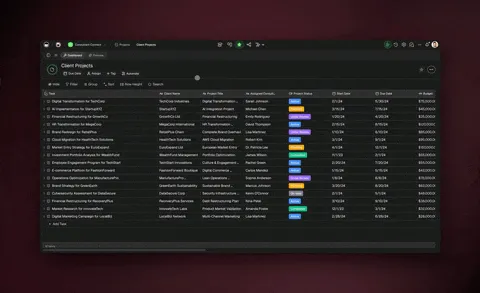
No signup, no credit card. Live sales pipeline
| Capability | Trello | Taskade Genesis |
|---|---|---|
| Pricing (starting) | Standard $6/user/mo month-to-month · $5/user/mo billed annually | $0 Free · $10/mo Pro billed annually (10 seats) |
| Cloneable live demo | ❌ | ✅ |
| Built-in AI agents | AI add-ons only | ✅ Built-in tools for web search, code, and file analysis |
| Automation engine | Limited workflow rules | ✅ Durable runtime, 100+ integrations |
| Workspace DNA loop | ❌ | ✅ ▲ Memory · ■ Intelligence · ● Execution |
Table of Contents
- Quick Comparison Table
- The fundamental difference
- What is Taskade?
- What is Trello?
- Feature-by-feature deep dive
- The Workspace DNA advantage
- Pricing and total cost of ownership
- When to choose each
- Frequently asked questions
TL;DR: Taskade Genesis pairs Kanban with AI agents, durable automations, and prompt-to-app building on a Free Forever plan. Pro is $10/mo billed annually for 10 seats. Trello Standard is $5 per user per month billed annually, or $6 month-to-month. Try Taskade Genesis free →
The fundamental difference
Trello pioneered the online Kanban board in 2011 and is still excellent at exactly that — drag-and-drop cards across columns, with labels, due dates, and assignees. If your only requirement is a single shared Kanban board, Trello does the job.
Taskade starts from a different premise. The Board view in Taskade gives you the same Kanban workflow Trello users love, but the same data also flows into List, Table, Mind Map, Docs (Beta), Gantt Chart, Calendar, Actionsheet, and Org Chart views. On top of that, AI Agents v2 can move cards, draft responses, and execute the underlying work, and Genesis can turn a prompt into a deployed app — a CRM, ops dashboard, support portal, or customer-facing tool — that uses your boards as live data.
Trello asks: "Where does this card belong?" Taskade asks: "What should this workflow actually do?"
What is Taskade?
Taskade is the AI-native workspace where teams plan, build, and ship together. Founded by John Xie, Dionis Loire, and Stan Chang in 2017 (Y Combinator-backed), Taskade combines multiple project views, AI Agents v2 with a large built-in toolkit, production-grade Automations across 100+ bidirectional integrations, and Genesis — the AI app builder that turns a prompt into a deployed application.
What is Taskade Genesis?
Genesis is Taskade's AI app builder. Describe what you want and Genesis returns a live, working application — UI, data, agents, and automations connected. Your workspace is the backend. Your projects are the database. Your agents are the runtime. No deployments, no DevOps, no per-seat math.
One prompt = one deployed app. Your Kanban board, plus everything around it.
How your first app comes together in 5 minutes →
What is Trello?
Trello is a visual Kanban tool created by Joel Spolsky and Michael Pryor at Fog Creek Software in 2011, acquired by Atlassian in 2017 for $425 million. It is one of the most popular productivity tools ever made, with hundreds of millions of registered users.
Trello at a Glance: Free tier (10 boards and 10 collaborators per Workspace, Board view only), Standard $6/user/month month-to-month or $5/user/month billed annually, with Premium and Enterprise tiers above it that unlock Calendar, Timeline, and Dashboard views. Butler automations are capped at 250 commands per month on free, 1,000 on Standard. Read our Trello history piece →
Trello excels at simple visual task organization. The honest critique surfaced in nearly every review thread: free workspaces cap at 10 collaborators after spring 2024, multiple views (Calendar, Timeline, Dashboard) require Premium, Butler is rule-based and capped, and there is no built-in chat or video. None of these are bugs — they are consequences of the audience Trello serves.
Feature-by-feature deep dive
Boards plus the rest of the project views
- Taskade ships multiple project views — List, Board, Table, Mind Map, Docs (Beta), Gantt Chart, Calendar, Actionsheet, and Org Chart — and the same data renders in all of them. The Timeline scrolling component lives inside the Gantt Chart view.
- Trello is Board-only on the free plan. Calendar, Timeline, and Dashboard views require the Premium tier, so switching perspectives is a paid upgrade rather than a setting.
AI agents that move cards and execute work
- Taskade ships AI Agents v2 — first-class digital teammates with persistent memory, built-in tools for web search, file analysis, image generation, code execution, and project management, custom tools you define, and the option to embed agents publicly inside Genesis Apps. Agents can triage incoming cards, draft replies, and execute the underlying work.
- Trello has no native AI agents. Atlassian Intelligence requires separate Atlassian product subscriptions and does not run autonomous agents on your boards.
Workflow automations and integrations
- Taskade includes production-grade durable Automations with branching, looping, and filtering across 100+ bidirectional integrations. Triggers pull external events in (Slack messages, Gmail, Sheets rows, Calendly events, webhooks). Actions push data out (Stripe checkouts, Shopify orders, Notion syncs, Salesforce updates, GitHub PRs).
- Trello Butler is rule-based and runs inside Trello only. Free workspaces are capped at 250 command runs per month; Standard at 1,000. Each automation is limited to 20 actions. Atlassian Marketplace Power-Ups add cost on top.
Genesis: full apps from a prompt
- Taskade Genesis turns one prompt into a deployed application — a CRM, support portal, ops dashboard, intake form, internal tool, or customer-facing app — with AI agents, automations, custom domains, password protection, and the option to embed publicly with GenesisAuth.
- Trello creates Kanban boards. There is no app generation, no deployed surface, no public embedding.
Team collaboration
- Taskade is workspace-native: real-time multiplayer editing, comments, chat, video calls, and granular role-based access (Owner to Viewer).
- Trello offers card-level comments. Real-time chat and video require external tools like Slack ($8.75/user/month) or Microsoft Teams.
Pricing model and seat math
- Taskade uses flat workspace pricing: Free Forever for up to 2 members with public link sharing, Pro $10/month annual (10 seats, unlimited Genesis apps), Business $25/month (unlimited seats), Max $100/month annual (max AI capacity), Enterprise $250/month (custom SLA).
- Trello is per-seat: Free (10 boards and 10 collaborators per Workspace), Standard $6/user/month month-to-month or $5/user/month billed annually, with Premium and Enterprise above it. Costs scale linearly with team size.
The Workspace DNA advantage
Trello's mental model is "boards organize cards." Taskade's mental model is Workspace DNA — a self-reinforcing loop between three pillars.
- Memory (Projects) — Your team's cards, docs, files, and structured data become the substrate every agent reasons over. The longer you work, the smarter the workspace gets.
- Intelligence (Agents) — AI Agents v2 with persistent memory, built-in tools for web search, code execution, and file analysis, and your own custom tools, plus a hosted MCP server that Claude Desktop, Cursor, and VS Code connect into. Agents can move cards, draft replies, and execute workflows alongside your team, while automations carry the work into the 100+ apps you already use.
- Execution (Automations) — Durable workflows triggered by external events (Slack, Gmail, Stripe, GitHub, Calendly, webhooks, schedules) that read from Memory and act through Intelligence — then write the results back into Memory. The loop closes.
Trello is brilliant at one slice of this — the visual board. Taskade runs the entire loop continuously, so the longer you use it, the more your workspace itself becomes the thing that builds the next app.
Pricing and total cost of ownership
| Plan | Taskade | Trello |
|---|---|---|
| Free | Free Forever — up to 2 members, public link sharing, basic views, 3 Genesis apps | 10 boards and 10 collaborators per Workspace, Board view only, 250 Butler commands/month |
| Entry paid | Pro $10/month billed annually (10 seats, unlimited apps) | Standard $6/user/month month-to-month, $5/user/month billed annually |
| Mid tier | Business $25/month (unlimited seats) | Premium (unlocks Calendar/Timeline/Dashboard) |
| Top tier | Max $100/month billed annually (max AI capacity), Enterprise $250/month | Enterprise — per-seat, quoted by head count |
| 15-person team, 6 months | $60 (Pro) or $150 (Business) | Standard billed annually: $5 × 15 × 6 = $450, before Power-Ups and external chat |
Trello's per-seat math compounds with head count, and the views most teams want sit above Standard. Taskade's flat workspace pricing keeps the same 15-person team at $60 on Pro or $150 on Business over six months, with every view included.
When to choose each
Choose Trello if:
- Your team is 10 people or fewer and only needs a shared Kanban board.
- You already live inside the Atlassian ecosystem (Jira, Confluence) and value tight Power-Up integration.
- Your workflows are simple enough that 250 Butler commands per month is plenty.
- You don't need built-in chat, video, AI agents, or app generation.
Choose Taskade if:
- You want a Board view plus the rest of the project views without paying per seat to unlock them.
- You want AI agents that can move cards, draft replies, and execute the underlying work.
- You want durable automations across 100+ bidirectional integrations.
- You want Genesis to build full deployed apps from a prompt — CRMs, dashboards, portals, intake forms.
- You want flat workspace pricing rather than per-seat math.
Use both if: Some teams keep Trello for a single shared board and use Taskade for everything else — agent-powered workflows, app generation, automations, and team collaboration.
Frequently asked questions
Is Taskade a good Trello alternative?
Yes. Taskade's Board view handles the same Kanban workflow Trello users love, and the same data flows into the other project views. Layer AI Agents v2 on top for autonomous execution, and use Genesis to build full deployed apps when you outgrow boards.
Does Taskade have a Kanban board view?
Yes. Board view supports drag-and-drop columns, labels, due dates, assignees, and attachments. The difference is the same data also renders as List, Table, Mind Map, Docs (Beta), Gantt Chart, Calendar, Actionsheet, or Org Chart, and AI agents can act on cards directly.
How does Trello pricing compare?
Trello is per-seat — Standard is $6/user/month month-to-month or $5/user/month billed annually — and locks Calendar, Timeline, and Dashboard behind Premium. Taskade is Free Forever for up to 2 members with public link sharing and basic views, Pro is $10/month billed annually, and Business is $25/month for unlimited seats.
Can Taskade automate workflows like Butler?
Yes — and more. Taskade automations are production-grade and durable, with 100+ bidirectional integrations and no monthly cap. Butler is rule-based, capped at 250 commands/month free, and runs inside Trello only.
What can Genesis do that Trello cannot?
Genesis turns a prompt into a deployed app — CRM, dashboard, support portal, intake form, customer-facing tool — with agents, automations, custom domains, and public embedding. Trello creates Kanban boards.
Can I migrate from Trello to Taskade?
Yes. Export Trello boards as JSON or CSV and import into Taskade. The same data then renders in any of the views, and you can layer agents and automations on top.
Build without permission
Trello gives you a board. Taskade gives you boards plus the workspace, the agents, the automations, and the option to ship the whole thing as a deployed app.
- Build with Genesis → — One prompt, one deployed app
- Browse the Community Gallery — Clone apps shipped by other Genesis builders
- Read the Workspace DNA explainer — How Memory, Intelligence, and Execution work together
Explore Taskade Genesis
- AI App Builder — Build complete apps from one prompt
- AI Agent Platform — Digital teammates that work 24/7
- Workflow Automation — AI-powered business automation
- AI Website Builder — Sites in seconds
- Vibe Coding — Natural-language app creation
Build without code
- AI App Generator — Full apps from prompts
- AI Dashboard Generator — Business dashboards
- AI Website Generator — Sites in seconds
- AI Form Generator — Smart intake forms
- Browse Community Apps — Clone and customize
Compare Taskade to other platforms
- Taskade vs Asana
- Taskade vs Monday
- Taskade vs ClickUp
- Taskade vs Jira
- Taskade vs Notion
- Taskade vs Airtable
Related reading
- The Build Without Permission article — Our manifesto
- How Workspace DNA Works — The architecture
- Origin of Living Software — The future of apps
- Agentic Workflows That Replace Your Startup's Busywork
- AI Tools Built With Taskade Genesis