




In 1985, Bill Atkinson dropped acid in a forest near Portola Valley, California. A few hours later he had the design for what would become HyperCard in his head: stacks of cards, each card holding fields and buttons, each button running a little script in English. He spent the next two years building it.
On August 11, 1987, at MacWorld Boston, Apple shipped HyperCard free with every Macintosh. By the end of the decade, hundreds of thousands of stacks were circulating on floppy disks, BBSes, and university networks. Wikipedia editors trace half a dozen foundational web ideas back to it. Brendan Eich said HyperTalk shaped JavaScript. Tim Berners-Lee's collaborators were studying it. Myst, the best-selling PC game of the 1990s, was a HyperCard stack.
Then Apple killed it.
Thirty-nine years later, Taskade Genesis is what HyperCard would be if Bill Atkinson had been able to add an AI co-pilot to every card. This is the story.
TL;DR: HyperCard (1987–2004) was the first no-code app builder. Bill Atkinson's bet: every Mac user can build software. The substrate was stacks of cards with fields, buttons, and English-like HyperTalk scripts. HyperCard inspired JavaScript, the Web, AppleScript, and 40 years of low-code/no-code. Taskade Genesis is its AI-native heir, describe an app in plain English, get a running app in seven minutes. 150,000+ apps built since launch. Bill Atkinson died June 5, 2025. The lineage continues. Try Genesis →
🗺️ HyperCard in One Diagram
Thirty-nine years, one substrate idea: let regular people build software.
👨💻 Bill Atkinson: The Engineer Who Made the Mac Drawable
Bill Atkinson was born on March 17, 1951 in Amityville, New York. He studied chemistry and neurobiology at UC San Diego, then started a PhD in computer science at the University of Washington, leaving when his advisor (Jef Raskin, later one of the original Macintosh team) recruited him to Apple in 1978.
He was Apple employee #51.
Atkinson's pre-HyperCard track record is one of the most consequential in computer-graphics history:
| Year | Atkinson contribution | Why it mattered |
|---|---|---|
| 1978-1983 | QuickDraw | The Macintosh graphics engine; defined how every Mac and Lisa drew to the screen for 25+ years |
| 1979 | LisaGraf (predecessor to QuickDraw) | The first attempt at the bitmap graphics paradigm |
| 1981 | Atkinson dithering algorithm | Error-diffusion dithering still used in retro / pixel-art rendering 45 years later |
| 1983 | Region-based graphics | The math that made arbitrary clipping regions efficient on 1MHz hardware |
| 1984 | MacPaint | The killer demo of the original Mac; the application that defined bitmap painting on personal computers |
| 1984 | Marching ants selection | The animated dashed border around copied regions — still used everywhere |
| 1984 | The menu bar | Atkinson designed how Mac apps got menus at the top of the screen |
| 1984 | The selection lasso | Freeform selection that became standard in every paint application thereafter |
| 1985-1987 | HyperCard | The first no-code application builder, ships 1987 |
The Fortune obituary recounts the story Steve Jobs told about how Atkinson won his respect: Jobs gave Atkinson six days to write a Pascal compiler for the Lisa. He had it working in five. The Lisa's entire toolkit was Atkinson's code.
After leaving Apple in 1990, Atkinson co-founded General Magic (one of the seminal post-Apple computing ventures — its alumni went on to build the iPod and iPhone, Android, and eBay), and later focused on nature photography, his PhotoCard app was a long-running personal project. He served on the board of Numenta with Jeff Hawkins, working on biologically-plausible AI.
Bill Atkinson died of pancreatic cancer in Portola Valley, California on June 5, 2025, at age 74. This post is in part a tribute.
🧠 The Origin Story: WildCard and the LSD Trip
Atkinson told this story in multiple interviews over the years. In 1985, frustrated with how hard it was for non-programmers to build software on the Mac, he took LSD on a hike near his Portola Valley home. During the trip, and over the following weeks, the core design of HyperCard crystallized:
- Stacks, a HyperCard document is a stack of cards (like a Rolodex)
- Cards, each card is a screen with its own background and contents
- Fields, text containers with rich formatting
- Buttons, clickable regions that run scripts
- Backgrounds, shared layout templates across cards in a stack
- Scripts: HyperTalk code attached to any object, triggered by events
Atkinson took the design to Apple management. He offered to give the company HyperCard for free, on one condition: it had to ship with every Macintosh, at no extra cost to users. Apple agreed. The project codename was originally WildCard; the rename to HyperCard came when trademark issues forced a change.
Dan Winkler joined Atkinson in 1986 to design HyperTalk, HyperCard's scripting language. Winkler's brief was specific: make it readable by non-programmers. The resulting language read like:
Hypertalk
on mouseUp
  put "Hello, " & the short name of me & "!" into card field "greeting"
  if the date is "Tue" then
    go to next card
  end if
end mouseUp
Compare that to the closest 1986 competitors, C, Pascal, BASIC, and you can see why HyperTalk landed. The script reads like a stage direction, not a programming language.
🚀 August 11, 1987: HyperCard Ships
HyperCard 1.0 was launched at MacWorld Boston on August 11, 1987. The launch was unusual: instead of a press conference, Apple put HyperCard 1.0 onto every new Macintosh sold thereafter and onto the upgrade discs of existing Macs. Within a quarter, every Mac user had it.
The canonical HyperCard "Home" stack — the screen 8 million people saw first  ┌─────────────────────────────────────────────────────────┐
│  ◀  Home                                            ◉   │
├─────────────────────────────────────────────────────────┤
│                                                         │
│   ┌──────┐  ┌──────┐  ┌──────┐  ┌──────┐               │
│   │  📇  │  │  📅  │  │  💾  │  │  ➕  │               │
│   │Address│  │Cal'r │  │Save  │  │ Add  │               │
│   │ Book │  │      │  │ As   │  │Stack │               │
│   └──────┘  └──────┘  └──────┘  └──────┘               │
│                                                         │
│   ┌──────┐  ┌──────┐  ┌──────┐  ┌──────┐               │
│   │  🎨  │  │  🧮  │  │  📊  │  │  📝  │               │
│   │ Art  │  │ Calc │  │Graph │  │ Note │               │
│   │Bits  │  │      │  │      │  │ Pad  │               │
│   └──────┘  └──────┘  └──────┘  └──────┘               │
│                                                         │
│   ┌──────┐  ┌──────┐  ┌──────┐  ┌──────┐               │
│   │  🎲  │  │  📚  │  │  ⚙️  │  │  ❓  │               │
│   │ Game │  │Stack │  │ Pref │  │ Help │               │
│   │      │  │ Help │  │      │  │      │               │
│   └──────┘  └──────┘  └──────┘  └──────┘               │
│                                                         │
│       ◀ Prev                          Next ▶            │
└─────────────────────────────────────────────────────────┘
12 buttons. Each one is a destination stack.
Click → cmd-Opt-Tab to edit script → write 3 lines of HyperTalk.
That's the whole programming model.
The initial response surprised even Atkinson. Within weeks, HyperCard stacks were circulating on floppy disks, BBSes, and university networks. By the end of 1988 there were stacks for:
- Personal information management, address books, calendars, journals
- Education, interactive textbooks, language drills, history simulations
- Games, adventures, puzzle games, trivia stacks, the precursor of Myst
- Reference databases, recipes, plant guides, baseball statistics, every imaginable hobby
- Music, interactive Beatles "A Hard Day's Night" CD-ROM, classical analysis tools
- Productivity, small accounting tools, time trackers, project organizers
- Research, academic data-collection tools, lab notebook prototypes, ethnographic studies
Hundreds of thousands of stacks, hundreds of thousands of builders, in a culture that had never built software before HyperCard.
🎮 Myst, "A Hard Day's Night," and the Cultural Footprint
The single most famous HyperCard stack is Myst, the surreal adventure game released by Cyan in 1993. Cyan brothers Rand and Robyn Miller had been making children's interactive fiction in HyperCard for years (The Manhole, 1988; Cosmic Osmo, 1989; Spelunx, 1991) before Myst. Myst was the best-selling PC game of the 1990s, with 6+ million copies sold across all platforms.
Myst's runtime, the rendering engine that made it work, was a HyperCard stack with custom externals (XCMDs) for QuickTime video, image scaling, and sound. The game's level structure mapped 1:1 to HyperCard cards. Every door click, every puzzle, every page-turn was a HyperTalk script.
Other notable cultural-impact stacks:
- "A Hard Day's Night" (1993), Beatles interactive CD-ROM with annotated lyrics, video, photos
- The Voyager Macbeth CD-ROM: Shakespeare annotated by Kenneth Branagh
- Beyond Cyberpunk! (1991), interactive guide to cyberpunk culture
- Many university Anthropology / Art History / Linguistics teaching tools
HyperCard taught a generation that software was something they could make, not just consume.
🌐 The Hidden Lineage: HyperCard → Web → JavaScript
The web that Tim Berners-Lee built at CERN starting in 1989 has a quiet HyperCard fingerprint. Berners-Lee's collaborator Robert Cailliau had been impressed by HyperCard's hypertext model and brought several of its ideas into the web design discussions. The web's clickable links, navigable pages, embedded media, and "back" navigation all have HyperCard precedents.
In 1995, Brendan Eich designed JavaScript at Netscape in ten days. In multiple later interviews, Eich cited HyperTalk's English-like design as one of his references for how a language could be approachable to non-programmers. JavaScript's syntax doesn't look like HyperTalk. But JavaScript's strategic ambition (a language that web designers, not programmers, would write) is HyperTalk's direct descendant.
In 1993, Apple shipped AppleScript, the system-wide scripting language for OS X (and earlier Mac OS). AppleScript is literally HyperTalk extended to control any application:
Applescript
tell application "Finder"
  set the name of folder "Old" to "Archive"
end tell
Same English-prose readability. Same event-driven model. AppleScript still ships in macOS in 2026.
⚰️ The Slow Death: 1998–2004
Apple stopped active HyperCard development in 1998, after Steve Jobs returned to the company and consolidated product lines. The last major release was HyperCard 2.4 in 1998. The product was formally discontinued in March 2004.
Three forces killed HyperCard:
1. The Web
By 1996, the Web was making HyperCard's hypertext-on-a-floppy paradigm look quaint. Networked information, accessible from any platform, by any user, eclipsed the local-stack model. Atkinson said publicly that his biggest professional regret was not making HyperCard network-first; he believed HyperCard could have been the first Web browser if he had focused on networking.
2. The Move to Paid Licensing
HyperCard 2.x moved from "free with every Mac" to a $49.95 standalone product. This fragmented the user base, older Macs had HyperCard 1.x; newer users had to choose to buy it. The free-distribution model that had made HyperCard ubiquitous in 1987-1990 was broken.
3. Steve Jobs's Strategic Narrowing
When Jobs returned to Apple in 1997, his explicit strategy was fewer, more focused products. The iMac, iPod, OS X, and iLife defined Apple's renaissance. HyperCard didn't fit the new portfolio. It was killed quietly.
🌱 The No-Code Movement: HyperCard's Children
HyperCard the product died. HyperCard the idea, regular people can build software, propagated through forty years of low-code / no-code tools:
| Year | Product | HyperCard inheritance |
|---|---|---|
| 1991 | Microsoft Visual Basic | Drag-and-drop form designer + BASIC scripting |
| 1993 | Lotus Approach | No-code relational database |
| 2003 | WordPress | Themes + plugins + drag-and-drop publishing |
| 2007 | iOS App Store | App-level distribution model HyperCard never had |
| 2012 | Bubble | Visual web app builder |
| 2014 | Airtable | Spreadsheet-as-database with a visual builder |
| 2014 | Webflow | Visual web design with code output |
| 2018 | Microsoft Power Apps | Enterprise no-code |
| 2019 | Glide | Apps from Google Sheets |
| 2020 | Notion | Block-based document + database hybrid |
| 2023 | v0 by Vercel | LLM-generated React components |
| 2023 | Lovable | LLM full-stack app builder |
| 2024 | Bolt.new | One-prompt deployable apps |
| 2024 | Replit Agent | Conversational app generation |
| 2025 | Taskade Genesis | AI-native workspace app builder; Workspace DNA loop |
Forty years, twenty products, one idea Bill Atkinson had on a hike in 1985.
HyperCard's children in 2026: what each inherited, what each added
| Tool | Year | What it inherited from HyperCard | What it dropped | What it added | Reach |
|---|---|---|---|---|---|
| LiveCode | 1997 | Stack/card/field/button + English-like script | Free distribution model | Cross-platform: macOS, Windows, Linux, iOS, Android, web | ~150K developers |
| Decker | 2021 | Black-and-white aesthetic + 1-bit dithered art + linear stack metaphor | Color (intentionally) | Modern Lua-style scripting; runs in browser | Open source, ~6K stars |
| ViperCard | 2018 | Visual scripting layer with HyperTalk syntax | macOS-specific OS hooks | TypeScript-based, runs in browser | Niche community |
| Bubble | 2012 | Drag-and-drop visual programming for non-coders | The stack metaphor | Modern web stack, plugin marketplace, paid hosting | 5M users |
| Glide | 2019 | "Apps from a spreadsheet" simplicity | A coding layer | Native mobile output, real-time sync from Sheets | 1M users |
| Softr | 2020 | "Anyone can build" pitch | Database step | Airtable-backed, member portals, billing | 500K users |
| v0 / Bolt.new | 2023 | "Tell the computer what you want" | The visual canvas | LLM code generation, deploy on click | $40M+ ARR (Bolt) |
| Taskade Genesis | 2025 | The complete model: card-as-state, button-as-action, script-as-script — but the script is a prompt | Manual scripting | AI agents inhabit the workspace, durable automations run the I/O, Workspace DNA closes the loop | 150K+ apps |
🧬 Why HyperCard Predicted Taskade Genesis
Taskade Genesis is the closest spiritual successor to HyperCard that exists in 2026, and the connection is not metaphorical. Five concrete parallels:
1. The Substrate Thesis
HyperCard's claim: the Mac is a substrate non-programmers can build on. Taskade's claim: the workspace is a substrate non-programmers can build on. Same architectural conviction, four decades apart, AI-native instead of bitmap-native.
The Taskade blog post Your Workspace Is a Computer makes this thesis explicit. HyperCard turned the Mac into a programmable canvas; Taskade turns the workspace (with its projects, agents, automations, and files) into a programmable canvas. The substrate just got smarter.
The difference between 1987 and 2026 is the infrastructure stack beneath the canvas. HyperCard ran on a single Mac. Taskade Genesis runs on top of sixty years of compute-as-utility, mainframe timesharing, virtualization, the public cloud, containers, serverless, and AI compute, all stacked. For that lineage end-to-end, see The History of Cloud Computing.
| Dimension | HyperCard (1987) | Taskade Genesis (2026) |
|---|---|---|
| Substrate | One Macintosh | Global hyperscaler cloud + AI compute |
| Authoring | HyperTalk script | Plain-English prompt |
| Sharing | Stack on a floppy | URL + custom domain, in 60 seconds |
| Intelligence | None | EVE + custom agents + built-in tools |
| Memory | Card stack on disk | Workspace projects + knowledge graph |
| Execution | Local mouseUp handlers | 100+ bidirectional integrations + automations |
| Reach | One Mac in one room | Any browser, anywhere, any device |
Same idea, democratize software creation, at two different cloud eras.
2. HyperTalk → Vibe Coding
HyperTalk in 1987:
Hypertalk
on mouseUp
  if card field "rating" is less than 3 then
    send "Customer satisfaction alert" to "manager@company.com"
  end if
end mouseUp
Genesis in 2026:
You: "Build a customer feedback app with sentiment analysis.
      When ratings drop below 3, alert the manager on Slack
      and create a follow-up task."Genesis: builds the app in 7 minutes with database,
sentiment AI agent, Slack integration, automation.
Same idea, code that reads like speech. HyperTalk got us 70% there; LLMs finished the job.
3. One Stack vs One App: Same Proliferation Curve
HyperCard stacks numbered in the hundreds of thousands within years of launch. Taskade Genesis crossed 150,000 apps in months. Same democratization pattern, AI-native cadence. Both substrates worked because they removed the bottleneck of "how do I start", HyperCard with templates and free distribution; Genesis with one-sentence prompts.
4. Community Sharing as Distribution
HyperCard's culture was stacks shared on floppies, BBSes, and AOL forums. Taskade's Community Gallery is the cloneable, embeddable, 2026 version, every /share/apps/* URL is a Genesis app you can fork and remix in 60 seconds.
The 150K+ apps in the gallery span Freelancer, E-commerce, Agency, SaaS Founder, Engineering, Marketing, Solopreneur, Consultancy, Events, Finance, exactly the categories HyperCard stacks covered in the 1980s, with Stripe checkout and AI agents wired in by default.
5. Workspace DNA Closes the Loop Atkinson Couldn't
HyperCard's biggest missing piece, in Atkinson's own framing, was the network. Stacks ran locally; cross-stack data sharing was awkward; the web ate the model.
Taskade's Workspace DNA closes the loop HyperCard couldn't:
- Memory (Projects), the database HyperCard cards were trying to be
- Intelligence (AI Agents v2 with built-in tools), the script that HyperTalk wanted to be, now LLM-powered with persistent memory
- Execution (Automations across 100+ bidirectional integrations), the cross-stack "network" HyperCard never reached
- Media (files, images, attachments), what HyperCard's external commands tried to do, now first-class
Memory feeds Intelligence triggers Execution writes back to Memory. The loop closes. The substrate is alive.
🌐 Taskade Genesis: The AI-Native HyperCard
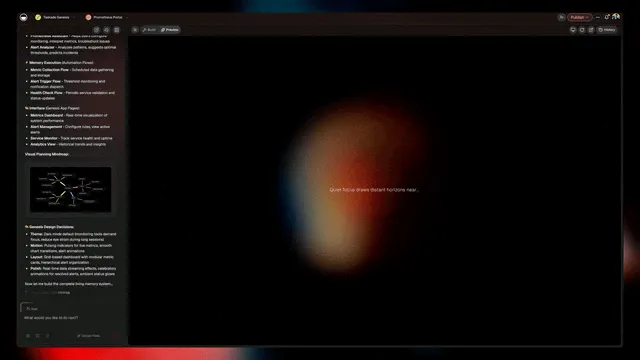
Genesis Capability Map: From the May 2026 Newsletters
The full surface of Taskade Genesis was rolled out chapter by chapter across the recent newsletters. Six newsletter chapters; each shipping a capability HyperCard wanted but couldn't reach:
| Newsletter chapter | What it ships | HyperCard 1987 analogue |
|---|---|---|
| Workspace Memory · Mind Graph | Workspace-scoped knowledge graph | HyperCard "find" + cross-stack links |
| Agent Workflows · Tools Wired | built-in tools + 100+ integrations | HyperTalk + XCMD externals |
| App Payments · Stripe Live | Native Stripe Checkout actions | HyperCard never reached commerce |
| Frontier Models · Auto-Routed | Frontier models from OpenAI, Anthropic, Google + open-weight | LLMs didn't exist |
| Embed Apps · Anywhere | Genesis Apps embed as responsive widgets | HyperCard stacks were local-only |
| Clone Apps · Instantly | 150,000+ apps in the Community Gallery; clone in 60 seconds | Floppy-disk stack-swap, faster |
Plus vibe coding · vibe payments · vibe workflows · vibe marketing · vibe tracking and a hosted MCP server on every paid plan. 198 platform releases in 2026.
What you can build with one prompt:
| You say... | Genesis builds (~7 minutes) | HyperCard 1987 equivalent |
|---|---|---|
| Customer feedback app with sentiment analysis | Ratings DB + photo uploads + AI sentiment + Slack alerts + follow-up workflows | A rating stack with manual review |
| Booking system with Stripe checkout | Scheduling + payments + confirmations + history | A calendar stack you'd write a check against |
| CRM for inbound leads with AI qualification | Multi-source capture + AI scoring + automated nurturing + pipeline | A Rolodex stack with mail merge |
| Onboarding portal for new hires | Forms + provisioning + checklists + document collection | A welcome packet stack |
| Help desk with AI routing | Ticket submission + AI categorization + KB + SLA timers | A help-desk stack with no routing |
| Team Knowledge Base with Mind Graph | Wiki database + ask-the-wiki agent + knowledge-graph visualization | A reference stack with table of contents |
| Sales pipeline with Shopify-style storefront | Pipeline DB + product catalog + checkout + automation triggers | A sales tracker stack |
Same democratization, four decades later, with AI inside.
Taskade Genesis vs Modern No-Code Builders
The 2026 no-code landscape has dozens of products, but only a few credibly fill HyperCard's "regular people build software" niche. Head-to-head against the top three:
| Capability | Taskade Genesis | Notion | Glide | Bubble |
|---|---|---|---|---|
| One-prompt app generation | Yes — ~7 minutes to running app | No (block-based, manual assembly) | Limited (AI add-on) | No (visual builder) |
| Built-in AI agents (built-in tools) | Yes — persistent memory, multi-agent | Notion AI (chat only) | No native agents | No native agents |
| Workflow automations | 100+ bidirectional integrations, durable execution | Limited (Notion Automations beta) | Glide Actions (one-way) | Workflows tab |
| Native Stripe checkout | Yes — first-class action | No (third-party) | Yes (Pro tier) | Yes (plugin) |
| Embed / clone live apps | Public embed + 1-click clone from gallery | Public pages only | Embed + clone | Embed only |
| Custom database + AI fill | Workspace DNA — Memory feeds Intelligence | Databases (no AI fill) | Sheets-backed | Built-in DB |
| Frontier model coverage | 15+ frontier models from OpenAI, Anthropic, Google + open-weight, auto-routed | Single model | Single model | None native |
| Hosted MCP server | Yes — Claude and Cursor connect in and drive your workspace, on every paid plan | No | No | No |
| Starter price | Free | $10/mo | $25/mo | $32/mo |
Notion is a great document-database; Glide is great for sheet-backed apps; Bubble is great for visual full-stack, none ship the AI-agent loop Atkinson's HyperCard descendant needed.
Vibe Coding, Vibe Payments, Vibe Workflows
Genesis ships the things HyperCard pointed toward but couldn't reach:
- Vibe Coding, describe apps in plain language → instant builds (HyperTalk's actual dream)
- Vibe Payments: Stripe-powered flows triggering automations (HyperCard never crossed into commerce)
- Vibe Workflows, forms and requests create automated processes (HyperCard's "external" commands wanted this)
- Vibe Marketing, content aggregation and cross-platform publishing
- Vibe Tracking, leads and data synced across tools via webhooks
- MCP in both directions — the federation HyperCard never shipped. The hosted MCP server, on every paid plan, lets Claude, Cursor, and VS Code connect in and drive your workspace. Pointed outward, the MCP Client step inside an automation calls a third-party MCP server on every plan including Free, and your agents also reach Notion, Linear, and Salesforce through 100+ integrations
MIT Technology Review named vibe coding a "breakthrough technology of 2026." Bill Atkinson would have recognized it instantly.
💭 A Tribute: Bill Atkinson, 1951–2025
When Bill Atkinson died in June 2025, the obituary genre struggled. Wired called him "Macintosh pioneer." TidBITS called him "Mac legend." Fortune retold the 6-day-Pascal-compiler story. None of them quite captured the strangeness of what he had built. That one engineer with a chord keyboard could reach down through forty years of personal computing and put a tool in the hands of someone today, on a workspace platform with AI agents and Stripe checkout, and have that tool still feel like his idea.
The substrate Atkinson built, let regular people build software, is the substrate Taskade Genesis ships in 2026. The loop closes.
I'd rather give people tools to make things than make things for them.
— Bill Atkinson, in multiple late-career interviews
We agree.
🔗 Further Reading
- The HyperCard Moment: From Bill Atkinson to AI Micro-Apps, the companion deep-dive on Atkinson's lineage
- The Micro-App Economy (2026), HyperCard's stack explosion reborn at AI cadence
- History of Real-Time Collaboration: From Engelbart to AI Agents, the lineage HyperCard sits inside
- History of Spreadsheets: From VisiCalc to Genesis, the parallel programmable-document lineage
- Your Workspace Is a Computer, the Taskade thesis HyperCard pointed at
- What Is Taskade Genesis? Complete History, the AI-native heir to HyperCard
- History of Lotus Notes, the workspace-software sibling lineage
- History of Workflow Automation, how HyperCard's externals matured into bidirectional automations
- Bill Atkinson, Wikipedia
- HyperCard, Wikipedia
- Wired, Bill Atkinson Obituary (June 2025)
- Fortune, Atkinson won Jobs's respect in 6 days
- Internet Archive, 30 Years of HyperCard
- Quantum Supremacy for App Builders: Why Taskade Genesis Builds in Parallel Branches (2026)
- How to Build Micro Apps with AI: 10 Team Examples and Templates (2026)
- Best Calculator Builders 2026: 10 No-Code Tools Compared (We Tested Them All)
❓ Frequently Asked Questions
Can I still run HyperCard in 2026?
Yes, via emulation. The Internet Archive hosts dozens of historical HyperCard stacks in an in-browser Mini vMac emulator. You can play original HyperCard 2.x stacks (including educational classics, the Cyan adventure series, and Myst's original card layouts) at archive.org. For native HyperCard development on modern hardware, HyperNext and LiveCode are spiritual successors that compile to modern platforms.
Was HyperCard really free?
For HyperCard 1.x (1987-1992), yes. It shipped with every Mac at no extra cost. HyperCard 2.x (1992 onward) moved to a $49.95 standalone product, which Atkinson and Apple's HyperCard team publicly regretted as the wrong direction. The free-distribution model is what made HyperCard ubiquitous in its first five years.
Who actually built HyperCard?
Primary credit goes to Bill Atkinson (architecture, graphics, overall design) and Dan Winkler (HyperTalk language). The HyperCard team also included Robin Goldberg, John Cherry, and several others at Apple. The project was small relative to its impact, typical of Apple in that era.
What was the relationship between HyperCard and Atkinson dithering?
Atkinson dithering is a separate Bill Atkinson invention from 1981, an error-diffusion algorithm for converting grayscale images to 1-bit black-and-white for the original Mac's monochrome display. Atkinson dithering is still widely used in retro / pixel-art rendering (search for "Atkinson dither" in any image-processing toolkit). HyperCard supported Atkinson dithering for its 1-bit graphics by default.
Did Steve Jobs kill HyperCard?
Indirectly. Jobs returned to Apple in 1997 and consolidated product lines. HyperCard didn't fit the new iMac / iPod / OS X focus. Active development stopped in 1998; formal discontinuation came in March 2004. Atkinson never publicly blamed Jobs but did say in interviews that the strategic-narrowing decisions of the late 90s and early 2000s killed HyperCard.
Is Taskade Genesis "HyperCard for AI"?
Yes. That's the cleanest one-sentence framing. Taskade Genesis is the AI-native workspace where you describe what you want in plain English and a meta-agent (EVE) generates a working app with custom databases, AI agents, automations, and integrations in about seven minutes. The substrate thesis is identical to HyperCard's: regular people can build software. The substrate is now a workspace with AI inside instead of a Mac with HyperTalk inside.
What is Workspace DNA?
Taskade's framing of how Genesis works: Memory (Projects + databases) feeds Intelligence (AI Agents v2 with built-in tools and persistent memory), Intelligence triggers Execution (Automations across 100+ bidirectional integrations), Execution writes back to Memory. A self-reinforcing loop. Media (files, images, documents) is the fourth strand, providing knowledge to all three.
How many apps have been built in Taskade Genesis?
150,000+ as of mid-2026. The Community Gallery at taskade.com/apps shows the public ones. App Kits across Freelancer, E-commerce, Agency, SaaS Founder, Engineering, Marketing, Solopreneur, Consultancy, Events, and Finance categories.
What does "vibe coding" mean?
Coined by Andrej Karpathy in February 2025, "vibe coding" is the practice of building software through natural-language conversation with an AI assistant rather than by writing code directly. Genesis took the concept further by extending it to entire workspaces, Vibe Coding (apps), Vibe Payments (Stripe flows), Vibe Workflows (forms + automations), Vibe Marketing (content engines), Vibe Tracking (lead sync). MIT Technology Review named vibe coding a breakthrough technology of 2026.
Where can I try Taskade Genesis?
Taskade Genesis is free to start at /create. Free tier includes Genesis apps and live agents. Paid plans (Pro $10/mo, Business $25/mo, billed annually) unlock more credits, agents, MCP support, and integrations. 150,000+ apps built since launch. Bill Atkinson would have been one of the first users.