

TL;DR: Taskade Genesis is a Free Forever workspace with AI agents, automations, and deployed apps from one prompt. MeisterTask is Kanban with a 3-project Basic plan and Pro at €13.50/user/mo billed annually. Taskade Pro is $10/mo billed annually for 10 seats. Try Taskade Genesis free →
See the alternative working — clone in 60 seconds
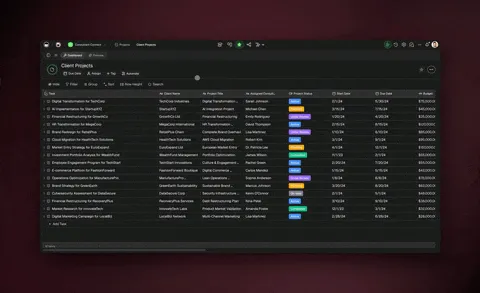
These are live Taskade apps, not screenshots. No signup, no credit card — open one, switch it between Board and Gantt, and clone it if you like it.
- Operations command board — the multi-project overview MeisterTask reserves for its Business Timeline.
- Client portal app — a customer-facing deployed app, the surface a Kanban tool has no answer for.
More live builds sit in the Community Gallery. ▲ Memory · ■ Intelligence · ● Execution
The fundamental difference
MeisterTask is a Kanban tool with a genuinely lovely interface, built by a Vienna-based company and hosted in Frankfurt. If your work fits on a board and your team is comfortable inside the Meister ecosystem, it does that job cleanly and it does it with a GDPR posture most competitors cannot match.
Taskade starts from a different premise. Board view gives you the same Kanban workflow, but the same data also renders as List, Table, Mind Map, Docs (Beta), Gantt Chart, Calendar, Actionsheet, and Org Chart — on every paid plan. On top of that, AI Agents v2 execute the underlying work rather than just labelling it, and Taskade Genesis turns a prompt into a deployed application that uses your boards as live data.
MeisterTask asks: "Which column is this task in?" Taskade asks: "What should this workflow actually do?"
What is Taskade?
Taskade is the AI-native workspace where teams plan, build, and ship together. Founded by John Xie, Dionis Loire, and Stan Chang in 2017 and backed by Y Combinator, it combines multiple project views, AI Agents v2 with a large built-in toolkit, durable Automations across 100+ bidirectional integrations, real-time chat and video, and Taskade Genesis — the AI app builder that turns a prompt into a deployed application with its interface, data, agents, and automations already connected.
One prompt = one deployed app. Your workspace is the backend, your projects are the database, and custom domains, password protection, and app sign-in are included. No deployment step and no per-seat math.
What Is MeisterTask?
MeisterTask is a project management tool from Meister, the company founded in 2006 by Till Vollmer and Michael Hollauf, headquartered in Vienna and hosting its data in Germany. Meister's other product is MindMeister, the mind mapping tool; notes and documentation now live inside MeisterTask itself. MeisterTask launched in 2015 to give MindMeister users a clean Kanban tool for their to-dos, and it follows the Kanban methodology closely.
MeisterTask at a Glance: Basic is free for up to 3 projects. Pro is €13.50/user/month billed annually (€17.50 monthly). Business is €24/user/month billed annually (€31 monthly). Enterprise is quoted by sales. Servers sit in an ISO 27001-certified data center in Frankfurt, Germany, and Meister offers a 30% discount when MeisterTask and MindMeister are bought together.
MeisterTask does several things genuinely well. The interface is uncluttered and pleasant to use — ease of use is consistently its highest-rated attribute in public review directories. Time tracking is built into each task rather than bolted on. Viewer seats are unlimited and free on every plan, which is unusually generous. New accounts get a 14-day Business-tier trial before dropping to Basic.
Why teams look for a MeisterTask alternative
MeisterTask is not a disliked product — it rates around 4.7 out of 5 across the major review directories, and ease of use is its strongest score. Teams rarely rage-quit it. They outgrow it. Three structural constraints drive most of the searching.
The 3-project cap on Basic. MeisterTask Basic allows up to 3 projects per team, plus up to 5 notes and 5 Content Manager seats. That is enough to evaluate the tool and not much more. A team running marketing, sales, and product has used its allowance before onboarding anyone, and the only way forward is Pro at €13.50 per person per month billed annually. Note the cap counts projects, not people — a solo user with four workflows hits it as fast as a team of ten.
The tier where the useful features live. Timeline — MeisterTask's Gantt-style view — is a Business feature. So are subtasks, custom fields, roles and permissions, and group sharing. A team that wants task hierarchy and a date-based plan is not choosing between free and €13.50; it is choosing between free and €24 per person per month billed annually. For 15 people that is €4,320 a year.
Board-first by design. MeisterTask's product tour names four perspectives: the Kanban project board, a Home screen, a cross-project overview, and Timeline. There is no spreadsheet-style table view and no mind mapping — mind maps live in MindMeister, a separate product with a separate subscription. Teams whose work does not decompose neatly into columns end up bending the work to the tool or paying for two products.
Kanban-first vs multiple views
This is the core of the comparison. MeisterTask's view model is a board; Taskade's is one dataset rendered nine ways.
In Taskade, all project views — List, Board, Table, and Mind Map as inline tabs, plus Docs (Beta), Gantt Chart, Calendar, Actionsheet, and Org Chart under More Views — are available on every paid plan. The Timeline scrolling component lives inside the Gantt Chart view rather than being a separate view. Switching is one click and changes nothing about the underlying data.
The Mind Map view matters more than it first appears. The MeisterTask proposition has always been a pairing: brainstorm in MindMeister, execute in MeisterTask, sync between them. That is two subscriptions, two interfaces, and a sync boundary. In Taskade the mind map and the board are the same project seen two ways — nodes are tasks, branches are subtasks, and a structure you brainstormed in Mind Map is already assignable and schedulable when you flip to Board or Gantt. One product replaces the pairing.
Feature-by-feature deep dive
AI that executes, not just assists
- Taskade ships AI Agents v2 — digital teammates with persistent memory, built-in tools (web search, file analysis, image generation, code execution, project management), custom tools you define, and public embedding inside Taskade Genesis apps. Taskade EVE sits in every project. Work routes across 15+ frontier models from OpenAI, Anthropic, and open-weight providers. Auto is the default, so you never wire an API key.
- MeisterTask includes Meister AI on every plan, metered at 20 credits per month on Basic, 75 on Pro, and 350 on Business, one credit per request. These are assistive features on a task manager — they summarize and draft rather than run autonomous multi-step work.
Automations and integrations
- Taskade includes durable Automations with branching, looping, and filtering across 100+ bidirectional integrations. Triggers pull external events in — Slack, Gmail, Google Sheets, Calendly, webhooks. Actions push data out — Stripe, Shopify, Notion, Salesforce, GitHub.
- MeisterTask offers recurring tasks, rule-based automations, third-party integrations, and API access from the Pro tier up. Basic gets none of them, and the rules run inside MeisterTask rather than across your stack.
Collaboration and building real apps
- Taskade is workspace-native: real-time multiplayer editing, built-in chat, video, and screen share on every project, with role-based access on every plan. Taskade Genesis then turns one prompt into a deployed application — CRM, support portal, ops dashboard, intake form — with agents, automations, custom domains, and public embedding via GenesisAuth.
- MeisterTask has comments, mentions, and Watchers but no built-in chat or video, so teams add Slack or Microsoft Teams at a per-seat cost on top. Roles and permissions require Business, and there is no app generation or deployed surface to hand a customer.
The Workspace DNA advantage
MeisterTask is a polished single-purpose tool. Taskade runs on Workspace DNA, a self-reinforcing loop: Memory (your projects become the substrate every agent reasons over), Intelligence (agents with persistent memory and a large built-in toolkit work inside that substrate), and Execution (durable automations act on external events and write results back into Memory). The longer you use it, the more the workspace itself becomes the thing that builds the next app.
MeisterTask pricing vs Taskade pricing
MeisterTask prices per user per month. Taskade prices the workspace. The gap widens with every person you add.
| Plan | Taskade | MeisterTask |
|---|---|---|
| Free | Free Forever — no project cap, basic views, Taskade Genesis access (3 apps) | Basic — 3 projects, 5 notes, 5 Content Manager seats, 20 AI credits/mo |
| Entry paid | Pro $10/month billed annually — 10 seats, unlimited apps | Pro €13.50/user/month billed annually (€17.50 monthly) — unlimited projects, automations, API |
| Mid tier | Business $25/month billed annually — unlimited seats | Business €24/user/month billed annually (€31 monthly) — Timeline, subtasks, custom fields, roles |
| Top tier | Max $100/month billed annually; Enterprise $250/month billed annually | Enterprise — quoted by sales; adds SAML SSO, portfolios, workload planner |
| 15-person team, 1 year | $300 flat on Business | €4,320 on Business (€24 × 15 × 12) |
The detail most teams miss: the features they eventually need — Timeline, subtasks, custom fields, permissions — sit on Business rather than Pro. So the realistic upgrade path is €24 per person per month billed annually, not €13.50.
Credit where it is due: unlimited free Viewer seats genuinely reduce the bill for organizations with many read-only stakeholders, the 30% Meister Bundle discount is real if you need MindMeister too, and students, educators, and non-profits get 50% off. MeisterTask also uses geo-based pricing, so figures outside the eurozone differ — check meistertask.com/pricing in your own region before budgeting.
Taskade's pricing does not move with head count. Free Forever has no project cap. Pro is $10/month billed annually ($20 monthly) for 10 seats. Business is $25/month billed annually ($50 monthly) for unlimited seats. Max is $100/month and Enterprise $250/month, both billed annually.
When to choose each
Choose MeisterTask if:
- EU data residency is a hard requirement. Meister hosts in an ISO 27001-certified data center in Frankfurt with a clear GDPR posture. For European buyers with procurement rules about where data physically sits, this is the strongest reason on this list — and one most US-based competitors cannot match.
- You want simple, beautiful Kanban and nothing more. The interface is one of the nicest in the category — uncluttered, fast to learn, with per-task time tracking built in. If your work fits on a board, extra views are complexity you did not ask for.
- You already use MindMeister. If mind mapping there is core to how your team thinks, the 30% bundle discount and the native link between the two products is a coherent setup.
Choose Taskade if: you need more than 3 projects without paying per seat; you want Gantt, Calendar, Table, and Mind Map included rather than gated behind Business or a second subscription; you want AI agents that execute multi-step work instead of a monthly credit allowance for summaries; you want durable automations across 100+ integrations; or you want flat workspace pricing instead of per-seat math.
Use both if: some teams keep MeisterTask for an EU-hosted board that satisfies a compliance requirement, and run everything else in Taskade.
Migrating from MeisterTask
MeisterTask exports projects to CSV on every plan, including Basic. Import that into Taskade, open it in Board view to match the layout your team already knows, then flip to Calendar, Table, Gantt, or Mind Map as the work demands. Because all views read the same data, migration is a one-time import rather than a rebuild — and only the paid-plan views (Gantt Chart, Actionsheet, Org Chart) ask for an upgrade.
Frequently asked questions
Is Taskade a good MeisterTask alternative?
Yes. Taskade's Board view handles the same Kanban workflow MeisterTask users already know, and the same data flows into List, Table, Mind Map, Docs (Beta), Gantt Chart, Calendar, Actionsheet, and Org Chart. Gantt Chart, Actionsheet, and Org Chart need a paid plan. Add AI Agents v2 with a large built-in toolkit for autonomous execution, and Taskade Genesis when a workflow needs to become a deployed app.
How many projects does the free MeisterTask plan allow?
Three. MeisterTask Basic allows up to 3 projects per team, up to 5 notes, and up to 5 Content Manager seats, with unlimited free Viewer seats. Passing 3 projects means upgrading to Pro at €13.50 per user per month billed annually. Taskade's Free Forever plan has no project cap.
How much does MeisterTask cost in 2026?
Basic is free. Pro is €13.50 per user per month billed annually, or €17.50 billed monthly. Business is €24 per user per month billed annually, or €31 billed monthly. Enterprise is quoted by sales. MeisterTask uses geo-based pricing, so prices outside the eurozone vary by region.
Does MeisterTask have a Gantt chart?
Yes, called Timeline, but it is a Business-tier feature at €24 per user per month billed annually. Subtasks, custom fields, and roles and permissions sit on the same tier. In Taskade, Gantt is one of the project views, included on every paid plan.
Do I need MindMeister to get mind maps?
With MeisterTask, yes — mind mapping lives in MindMeister, a separate Meister product with its own subscription, discounted 30% when bundled. Taskade includes Mind Map as one of its built-in views, so the mind map and the Kanban board are the same project rendered two ways.
Is MeisterTask hosted in Europe?
Yes. Meister hosts MeisterTask in an ISO 27001-certified data center in Frankfurt, Germany, with stated GDPR compliance and EU data residency. If that is a procurement requirement, it is a real and fair reason to stay.
How do I move my MeisterTask data to Taskade?
Export to CSV from MeisterTask, then import into Taskade and open the result in Board view so the layout matches what your team already knows. From there any of the views is one click away.