

TL;DR: Emergent generates full-stack code plus the cloud infrastructure each app runs on, from around $20 a month for the entry plan. Taskade Genesis is workspace-native: one prompt returns a deployed app with AI agents, automations, and 100+ integrations, and no infrastructure to manage. Free Forever to start, Pro $10/mo billed annually. Try Taskade Genesis free →
See the alternative working — clone in 60 seconds
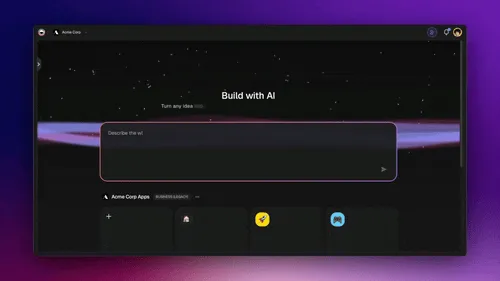
No signup, no credit card. Live Shopify-style storefront
| Capability | Emergent | Taskade Genesis |
|---|---|---|
| Pricing (starting) | ~$20/mo entry plan + cloud infrastructure | $0 Free · $10/mo Pro billed annually (10 seats) |
| Cloneable live demo | ❌ | ✅ |
| Built-in AI agents | Code generation, no live agents | ✅ Large built-in toolkit |
| Automation engine | No automation engine | ✅ Durable runtime, 100+ integrations |
| Workspace DNA loop | ❌ | ✅ ▲ Memory · ■ Intelligence · ● Execution |
What is Taskade Genesis?
Taskade Genesis is the AI app builder that lives inside a Taskade workspace, from the Y Combinator-backed team that has been building collaborative software since 2017. Where a code generator hands you a repository, Taskade Genesis hands you the running thing: interface, data layer, AI agents, and automations, already deployed and already talking to each other.
Ask it for an internal ops console, a customer portal, a CRM, or a form-driven intake tool and it returns a live application — no repo to clone, no container to build, no pipeline to babysit. Client sign-in arrives with it through GenesisAuth, and one click publishes the finished app to the Community Gallery. Publishing shows the app; letting other people clone it is a separate, deliberate choice — the "Share as Template" toggle in the publish menu, which stays off unless you turn it on.
What Taskade Genesis actually builds
Taskade Genesis builds deployed, data-backed applications: the interface, the tables behind it, the AI agents, and the automations all come out of one prompt and run on Taskade's infrastructure. Before committing to any prompt-to-app tool it is worth checking whether the AI behind it produces apps that actually open and hold on to your data — the TSK-1 Benchmark grades nine frontier models on exactly that.
What is Emergent?
Emergent is an AI full-stack app generator that turns natural language prompts into frontend, backend, and database code, plus the cloud infrastructure to run them. It targets developers who want AI-accelerated coding and full ownership of the resulting stack.
Emergent at a glance: Generates a complete codebase from a prompt, provisions cloud infrastructure, gives developers ownership of the source. Best fit for engineering teams who want to ship faster while keeping the code they can deploy anywhere.
Where each tool wins
Generated full-stack code you own — Emergent
If the goal is owned source code that the team can host, modify, and deploy on its own infrastructure, Emergent is purpose-built for that workflow.
Working app right now — Taskade Genesis
If what you need is the application running — not the source that produces it — Taskade Genesis hands that over on the first prompt, with its data layer, agents, and integrations already connected. Nothing to provision, nothing to deploy, no cloud bill arriving separately.
The Workspace DNA advantage
Emergent's mental model is "AI generates a codebase, the team deploys it." Taskade Genesis's mental model is Workspace DNA: a self-reinforcing loop between three pillars.
- Memory (Projects) — Specs, tickets, docs, and structured tables sit in the same workspace the agents read from, so context is not something you paste into a prompt window. Read How Workspace DNA Works.
- Intelligence (Agents) — AI Agents v2 keep memory between sessions, carry tools you define, and can be embedded inside a shipped app for the people using it.
- Execution (Automations) — Durable workflows fire on Slack messages, GitHub events, Stripe charges, webhooks, or a schedule, act through the agents, and write what happened back into the workspace.
Emergent is excellent at one slice of that: generating the codebase. Taskade Genesis keeps all three pillars running together, so the work your team does inside the workspace is the same work that makes the next app faster to build.
Pricing comparison
| Plan | Taskade Genesis | Emergent |
|---|---|---|
| Free | Free Forever — full app builder access | Limited trial credits |
| Entry | Free Forever, upgrade to Pro when ready | ~$20/mo + cloud infrastructure |
| Most popular | Pro $10/mo billed annually (10 seats, unlimited apps) | Pro tier + cloud infrastructure |
| Team | Business $25/mo billed annually (unlimited seats) | Team tier + cloud infrastructure |
| High capacity | Max $100/mo billed annually | Custom |
Choose Taskade Genesis if
- You want the running application, not a repository to build and deploy
- You need agents with memory and tools that can be embedded for the people using the app
- You want automations across GitHub, Slack, Stripe, Gmail, and 100+ other tools on a managed runtime
- You would rather pay one flat subscription than a subscription plus cloud bills
- Product, ops, and engineering all need to build in the same place
Choose Emergent if
- You want owned source code and full deployment control
- Your team has the DevOps capacity to manage cloud infrastructure
- You prefer a code-first editing model
- You are building applications that will live outside any single platform
Frequently asked questions
Is Taskade Genesis a good Emergent alternative?
When the job is a deployed app you can ship today — yes. When the job is owned source code with full deployment control, Emergent remains the better fit.
How does Taskade Genesis pricing compare to Emergent?
Taskade Genesis is Free Forever, with Pro at $10 per month billed annually for unlimited apps and 10 seats, and Business at $25 per month billed annually for unlimited seats. Emergent's entry plan runs around $20 per month as of Aug 2026, and the cloud infrastructure behind each generated app is billed separately.
Does Taskade Genesis include AI agents?
Yes — AI Agents v2 with persistent memory, built-in tools for web search, code execution, and file analysis, custom tools, and public embedding. A hosted MCP server connects Claude Desktop, Cursor, and VS Code to the same workspace.
Does Taskade Genesis include workflow automations?
Yes — durable workflows across 100+ bidirectional integrations, on a managed runtime with no worker process to operate.
Do I own the code that powers a Taskade Genesis app?
Taskade Genesis is a managed platform: hosting, deployment, and agent infrastructure are included, and your Taskade Projects export to Markdown or text at any time. If owning the source is the requirement, Emergent is the fit.
Which AI models power Taskade Genesis?
Taskade includes access to 15+ frontier models from OpenAI, Anthropic, and open-weight providers. No API keys to wire up, no providers to manage, and one AI allowance included in your plan instead of a bill per provider.
Can a non-technical user build with Taskade Genesis?
Yes. A plain-English description is the whole interface — no terminal, no deploy step, no waiting on engineering capacity.
Who founded Taskade?
John Xie, Dionis Loire, and Stan Chang started Taskade in 2017. It went through Y Combinator and now serves more than a million users worldwide.
Can I publish a Taskade Genesis app to a custom domain?
Custom domains are available on Business ($25/mo billed annually) and above. Email-and-password sign-in through GenesisAuth works on every plan including Free, and password protection starts at Pro.
Build without permission
Emergent gives engineering teams a sharper code generator. Taskade Genesis gives every team — engineers and non-engineers alike — a workshop where apps come out finished, hosted, and ready for users, and where the Workspace DNA loop makes each build faster than the last.
- Start with Taskade Genesis — Describe the app, get the deployed one
- Browse the Community Gallery — Open and clone what other builders shipped
Explore Taskade Genesis
- AI App Builder — Describe the app, get a deployed one
- AI Agent Platform — Agents with memory, tools, and public embedding
- Workflow Automation — Event-driven workflows across 100+ tools
- Vibe Coding — Where natural-language building meets shipped software
- AI Website Builder — Marketing sites without a build step
Build without code
- AI App Generator — Full applications from a prompt
- AI Dashboard Generator — Internal dashboards and ops consoles
- AI Internal Tools Generator — The tools your team keeps asking for
- AI Form Generator — Intake forms that write to real tables
- Browse Community Apps — Clone something that already works
Related reading
- How Workspace DNA Works — Why Memory, Intelligence, and Execution compound
- Origin of Living Software — Apps that keep changing after launch
- Best Vibe Coding Tools in 2026 — The category, compared
- Best Claude Code Alternatives in 2026 — AI coding agents compared
- Best Cursor Alternatives in 2026 — AI code editors compared
- Vibe Coding for Teams — Building without a handoff
- AI Tools Built With Taskade Genesis — Apps you can open and clone