







What if your workspace could actually remember?
Not remember like a chat log you scroll through. Remember like a colleague who was in every meeting, read every document, and can recall exactly what was decided three weeks ago.
Long-Term Memory (LTM) is now live in Taskade Genesis.
Every conversation with your AI agents, every brainstorm, every project decision - automatically captured as structured, living memory that your workspace learns from.
This is not incremental. This changes what a workspace is.
TL;DR: Long-Term Memory is live in Taskade Genesis. Every conversation with your AI agents is automatically saved as a structured Memory Project that your whole workspace can recall, edit, and build on. Memory is shared across agents, works with all models, and compounds over time. Try Taskade free →
Why Memory Matters More Than Intelligence
The AI industry has been obsessed with intelligence - better models, faster responses, more capable reasoning. But intelligence without memory is performance without continuity.
Think about how you work today:
- You have a detailed conversation with an AI about a project strategy
- You close the tab
- Next week, you start over from scratch
The AI was brilliant for 20 minutes. Then it forgot everything.
This is the pattern that Long-Term Memory breaks.
┌──────────────────────────────────────────────────────┐
│           BEFORE LTM              AFTER LTM          │
├──────────────────────────────────────────────────────┤
│                                                      │
│  Chat → Response → Gone     Chat → Memory → Growth   │
│                                                      │
│  Every session starts       Every session builds      │
│  from zero                  on everything before it   │
│                                                      │
│  AI forgets your            AI knows your context,    │
│  context instantly          decisions, and history    │
│                                                      │
│  You repeat yourself        You continue where        │
│  constantly                 you left off              │
│                                                      │
└──────────────────────────────────────────────────────┘
With LTM, your workspace accumulates knowledge. Every interaction makes the next one better. Your AI agents do not just respond - they remember, learn, and evolve.
How Long-Term Memory Works
The mechanism is simple. The implications are not.
When you chat with a Taskade AI Agent, every conversation is automatically saved as a Memory Project - a structured, editable record that lives in your workspace.
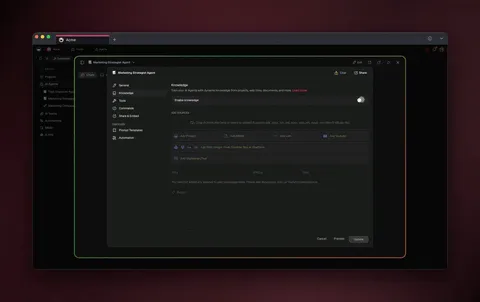
This is not a flat transcript. Memory Projects are structured documents with hierarchy, context, and connections to your other projects. They are first-class workspace objects - searchable, editable, and accessible to every agent in your workspace.
Here is what happens in practice:
Step 1: Start with a conversation.
You chat with your AI agent about a product launch - goals, timeline, messaging, risks.
Step 2: The conversation becomes memory.
Taskade automatically creates a Memory Project capturing the full conversation - structured with headings, decisions, action items, and references.
Step 3: Your agent learns.
The next time you interact with the same workspace, your agent can recall what was discussed. "Last week we decided to launch on March 15. Do you want me to draft the launch checklist?"
Step 4: Memory compounds.
Over weeks and months, your workspace accumulates a growing knowledge base of decisions, strategies, and context - all automatically. No manual organization required.
┌──────────────────────────────────────────────────────┐
│                 THE MEMORY LOOP                      │
├──────────────────────────────────────────────────────┤
│                                                      │
│     You chat ──────▶ Memory Project created          │
│        ▲                       │                     │
│        │                       ▼                     │
│     Agent recalls ◀──── Agent learns from memory     │
│        │                       │                     │
│        ▼                       ▼                     │
│     Better responses      Smarter over time          │
│                                                      │
└──────────────────────────────────────────────────────┘
The same loop, as a flow — context read in, reasoning applied, action taken, and the result written back to memory so the next pass starts smarter:
Where LTM Fits in Workspace DNA
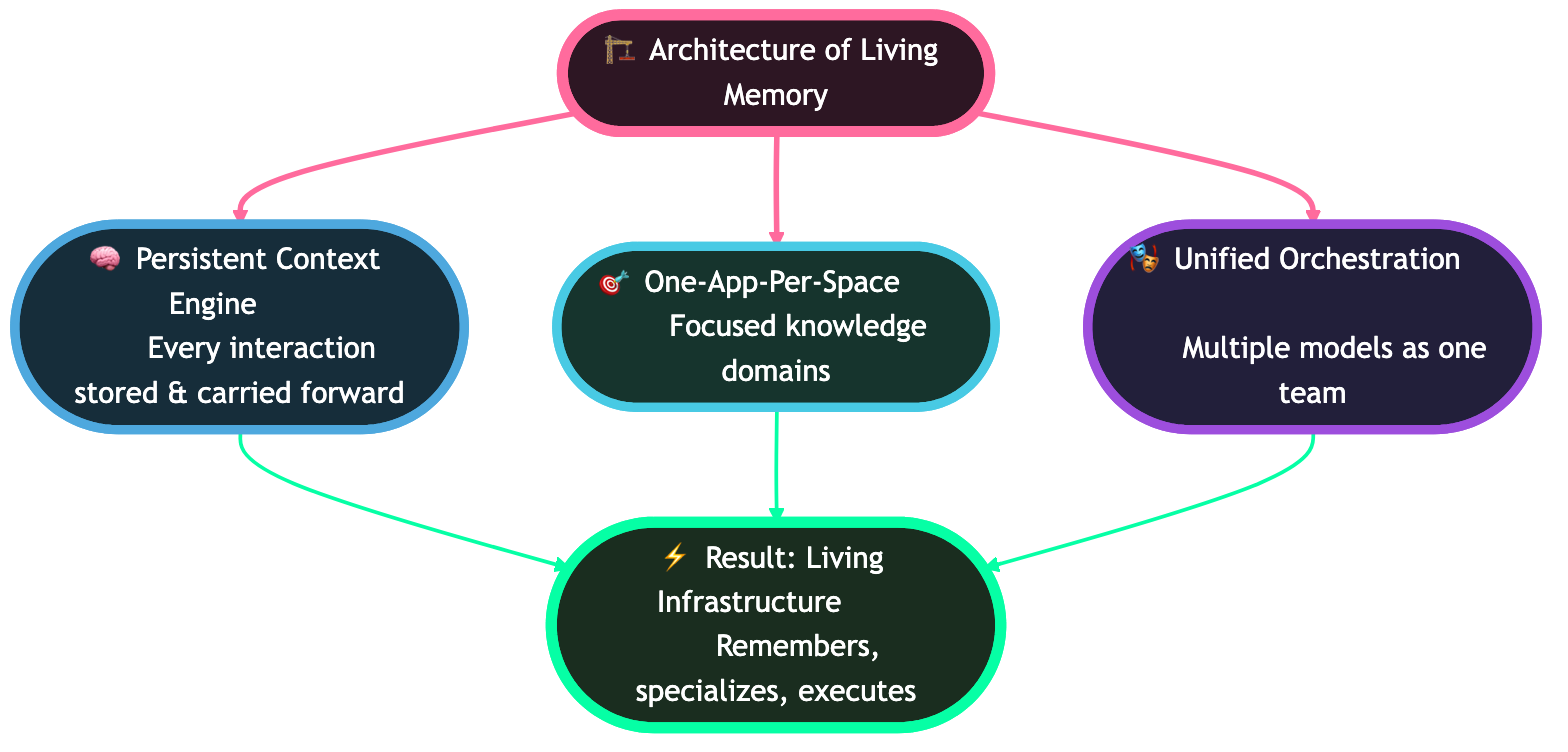
Long-Term Memory is not a standalone feature. It is the completion of Workspace DNA - the three-pillar architecture that powers Taskade Genesis.
Projects are memory.
Your structured data - tasks, notes, databases, and now conversation history. The persistent knowledge layer that grows over time.
Agents are intelligence.
AI systems that reason over your workspace data. With LTM, agents can now reason over your entire history of interactions - not just the current session.
Automations are execution.
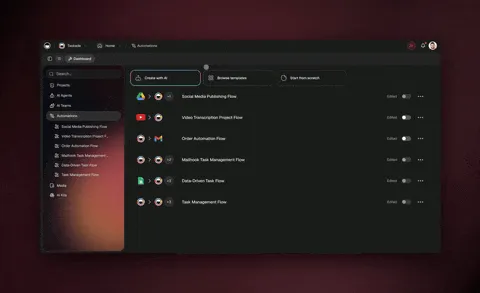
Workflows that act on triggers, conditions, and state changes - driven by memory, informed by intelligence.
The three pillars form a self-reinforcing loop - memory feeds intelligence, intelligence triggers execution, and execution creates new memory:
For a broader map of how these pieces fit together, see our guide to the AI agent stack.
🧠 Workspace
├── 🌱 Genesis App - "Product Launch Manager"
│   ├── 🗄️ Projects (Databases + Memory)
│   ├── 🤖 Agents (Intelligence, now with full recall)
│   ├── ⚙️ Automations (Execution layer)
│   └── 💬 Conversations → Stored as Memory Projects
│
│   Chat feeds Projects.
│   Projects inform Agents.
│   Agents power Genesis Apps.
│   This is Memory Reanimation.
Before LTM, the memory pillar was manual - you structured projects by hand. Now, your conversations automatically feed into the memory layer, creating a self-building knowledge base.
What You Can Do Right Now
LTM is live. Here are the fastest ways to experience it:
Talk to Your Agent About an Ongoing Project
Open any workspace and chat with your AI agent about a real project. Ask it to help you plan, brainstorm, or troubleshoot. Close the chat. Come back tomorrow. Ask: "What did we discuss yesterday about the project timeline?" Your agent remembers.
Open Your Memory Projects
Navigate to your Memory Projects to see your conversations transformed into structured, editable documents. You can read them like meeting notes, reorganize them, and share them with your team.
Build a Genesis App with Memory Built In
Start with a prompt like:
Build a weekly team standup tracker with an AI agent that
remembers each team member's blockers and follows up
on unresolved items from previous weeks.
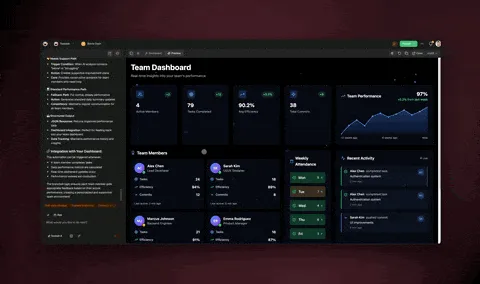
Your Genesis app now has memory baked in. The AI agent tracks blockers across weeks, not just within a single session.
Train Your Agents Naturally
You do not need to upload training files or write system prompts. Just work. Every conversation becomes training data. Every project becomes context. The more you use Taskade, the more your agents understand your work, your preferences, and your goals.
Why This Is Not Just Another AI Feature
Every AI workspace claims some form of "memory." Here is how Taskade LTM is different:
| Feature | ChatGPT Memory | Competitor "Memory" | Taskade LTM |
|---|---|---|---|
| What it stores | Simple facts | Chat logs | Structured Memory Projects |
| Organization | Flat list | Chronological | Hierarchical, searchable |
| Shared across agents | No (single thread) | No | Yes (workspace-wide) |
| Editable | No | Limited | Fully editable documents |
| Connected to projects | No | No | Yes (Workspace DNA) |
| Drives automations | No | No | Yes (event-driven) |
| Grows with usage | Minimal | Linear | Compounds over time |
The key difference: Taskade LTM does not just remember facts. It creates structured knowledge that your entire workspace - agents, automations, and apps - can reason over.
How Your Brain Actually Stores Memory
Taskade LTM mirrors principles that neuroscience has spent decades uncovering.
In the biological brain, memories are not stored in single neurons. They are encoded as engrams - sparse ensembles of neurons scattered across brain regions. When you experience something, a small subset of neurons (as few as 2-6% in the hippocampus) undergoes lasting changes that physically encode that memory.
| Brain Mechanism | How It Works | Taskade LTM Equivalent |
|---|---|---|
| Engrams | Sparse neuron ensembles (2-6% of hippocampal neurons) physically encode each memory as a unique activation pattern | Each conversation becomes a structured Memory Project - a distinct, addressable knowledge trace in your workspace |
| Pattern Completion | A partial cue reactivates the full engram - hear a song snippet, recall the entire concert | Agents reconstruct full context from fragments - ask a partial question and LTM surfaces the relevant decisions, history, and next steps |
| Memory Linking | Overlapping neuron ensembles bind related experiences - recalling one memory triggers associated ones | Related Memory Projects share workspace context - decisions in one project automatically inform agents working on another |
| Reconsolidation | Every act of recall makes the memory malleable, allowing it to be updated before re-storage | Memory Projects are fully editable - revisit, restructure, and refine past conversations, and your agents incorporate the updates |
Retrieval works through reactivation. When you encounter a cue related to a past experience - a familiar smell, a snippet of a song - the same ensemble of engram neurons fires again, reconstructing the full memory from a fragment. Research has shown that activating these specific neurons is both necessary and sufficient for recall: silence them, and the memory disappears; stimulate them artificially, and the memory replays even without an external cue.
How the brain stores and recalls — and how LTM mirrors it: an experience encodes as a sparse engram (a Memory Project), a partial cue reactivates the full trace, and overlapping ensembles link related memories.
What makes this powerful is memory linking. When two experiences happen close together in time, some of the same neurons get recruited into both engrams. This shared overlap creates an automatic association: recalling one memory triggers the other. The degree of overlap determines the strength of the link.
Taskade LTM works on the same architecture:
- Sparse, structured traces - each conversation becomes a Memory Project, not a raw log. Like engrams, these are structured representations, not bulk storage.
- Associative retrieval - agents reconstruct context from fragments. Ask a partial question and the system settles into the relevant memory, just as your brain completes a pattern from a cue.
- Memory linking through overlap - related conversations share workspace context. Decisions made in one project inform agents working on another, because the underlying knowledge overlaps.
- Compounding over time - biological engrams strengthen with repeated reactivation. Taskade memory compounds the same way: the more you use it, the richer the associations become.
The result is not a search engine for your chat history. It is an associative memory system that mirrors how the brain actually works. If you want the technical foundations behind associative retrieval, see our guides on vector databases and retrieval-augmented generation.
The Second Brain, Realized
The "second brain" concept has been around for years. Tools like Evernote, Notion, and Obsidian pioneered the idea of an external knowledge system. But they all required one thing: you.
You had to capture. You had to organize. You had to link. You had to maintain.
The second brain was a filing cabinet that you had to fill by hand.
Taskade LTM is a second brain that fills itself.
Your conversations become structured notes automatically. Your agents connect the dots between projects. Your workspace grows smarter without you spending time on organization.
This is what we mean by Memory Reanimation - your thoughts transforming into structured knowledge that keeps growing.
For a deeper look at how AI agent memory systems work, see our guide on types of memory in AI agents.
From Conversations to Compounding Intelligence
Here is how LTM changes different workflows:
For founders and executives:
Every strategic conversation with your AI is preserved. Product decisions, market analysis, investor prep - all searchable, all building on each other. Your workspace becomes institutional memory that never leaves when someone does.
For product teams:
Feature discussions, user research summaries, sprint retrospectives - all automatically captured and connected. Your agents understand the full product context, not just the current ticket.
For customer success:
Every client interaction generates memory. Your agents can recall what was discussed with a specific client weeks ago, suggest follow-ups, and identify patterns across accounts.
For marketing teams:
Campaign brainstorms, content calendars, performance analysis - all feeding into a growing knowledge base. Your agents draft content that is consistent with previous messaging because they remember it.
What's Already Shipped Since Launch
Since LTM launched, we've continued expanding the memory layer:
- Memory works across all AI models. Whether you use models from top AI labs, your agents remember. No model-specific limitations. Persistent memory is now universal.
- Taskade EVE remembers important information. The workspace AI companion now retains key details from your conversations and applies them automatically in future interactions. You don't need to repeat context.
- Knowledge sync frequency by plan. How often your agent's knowledge refreshes depends on your plan: manual on Free, daily on Starter/Pro, hourly on Business, and real-time on Enterprise. This means Business and Enterprise workspaces have near-live awareness of everything happening across projects.
- Background agents with memory. On Pro plans and above, agents run autonomously, and they carry their full memory context while doing it. A background agent processing overnight form submissions remembers the decisions you made last week about how to handle each type.
The Open Frontier: Cross-Session, Cross-Agent Memory
Anyone running a serious coding-agent workflow in 2026 has felt this problem. You start a Claude Code session on Monday and explain the architecture, the constraints, the gotchas. Tuesday morning you start a new session — and everything is gone. You re-explain. You paste the same files. You watch the agent re-discover the same dead ends it explored yesterday.
Claude Code's CLAUDE.md file is a partial answer: a per-project memory file the agent reads on startup. But it has two structural limits. First, it lives inside one repository — open another project and your knowledge does not come with you. Second, on a complex codebase that file blows up fast, and once it does the agent's effective context window starts working against you. The marketed 1M-token context window is only ~120K-200K of effective context before quality degrades; a bloated CLAUDE.md consumes that budget before the agent has read a single source file.
The open-source community is now attacking this from below. Projects like the Git Context Controller and One Context (March 2026) treat agent memory the way Git treats source code: a structured filesystem of main.md, branch/, commit.md, log.md, and metadata.md files that any agent — Claude Code, Codex, OpenClaw — can read progressively. Branch when exploring an alternative approach, commit at milestones, merge when the path concludes. Independent benchmarks show this lifts Claude Code performance on SWE-bench by ~13% and lets cheaper models like GLM-4.5 Air punch at frontier-model levels. The pattern works because the model is not limited by raw context length — it is limited by which tokens reach the attention window at the right time.
Long-Term Memory in Taskade is the workspace-native expression of the same idea, with one important difference: there is no main.md for you to maintain. The Memory Project is the structured store. Every conversation writes to it, every agent session reads from it, every team member shares it in real time, and the routing happens automatically because the workspace knows what each agent is working on. The compounding intelligence that the Git Context Controller produces per repository, Long-Term Memory produces per workspace — across every agent, every project, and every team member, with no manual file management.
This is the missing piece for cross-session, cross-agent memory: a substrate that any agent can read and write into, that survives the death of any individual session, and that gets richer the more your team uses it. The frontier work in the open-source coding-agent community is converging on the same architectural conclusion Taskade reached two years ago — memory has to be a first-class workspace primitive, not a per-session afterthought.
What Comes Next
LTM is the foundation. Here is what we are building on top of it:
- Connected memory across workspaces - shared intelligence between separate environments, so your agents understand your entire organization
- Smart Recall - instant rediscovery of any idea, conversation, or decision across your entire memory
- Visual memory maps - see how your projects, conversations, and decisions connect in a visual graph
- Adaptive AI personalities - agents that evolve to match your communication style, priorities, and goals over time
- Memory-driven automations - workflows that trigger based on accumulated knowledge, not just single events
The foundation is set. Your workspace DNA - memory, intelligence, execution - is complete. LTM is the piece that makes memory alive.
Get Started
Long-Term Memory is available now on all Taskade plans, including free.
- Open your workspace and chat with any AI agent
- Watch your conversations become Memory Projects automatically
- Come back tomorrow and see how much your workspace remembers
The more you use it, the smarter it gets. No configuration. No setup. Just work.
Try Taskade Genesis with Long-Term Memory →
Further Reading
- Types of Memory in AI Agents - how AI memory systems work under the hood
- A Rebuild. And an Unbuild. - why we rebuilt Taskade as infrastructure for autonomous work
- Your Second Brain on Autopilot - the vision for self-organizing workspaces
- Best Second Brain Apps - how Taskade compares to other knowledge management tools
- Anatomy of a Genesis App - how Workspace DNA powers living software
- Building a Second Brain for Your Team - collaborative knowledge management
- Founder Memory & Databases - how LTM connects to workspace memory
- Best Practices for Multi-Agent AI Teams - building agent teams with shared memory
Frequently Asked Questions
What is Long-Term Memory in Taskade?
Long-Term Memory (LTM) is a feature in Taskade Genesis that automatically preserves every conversation with your AI agents as structured Memory Projects. Instead of context disappearing when you close a chat, your workspace remembers everything - what you discussed, what you decided, and what you planned. Agents can recall past interactions and build upon them.
How does Long-Term Memory work?
When you chat with a Taskade AI Agent, the conversation is automatically saved as a living Memory Project - a structured, editable record connected to your workspace. The next time you interact with the same agent, it can recall past conversations, reference previous decisions, and continue where you left off. The more you use it, the smarter your workspace becomes.
Is Long-Term Memory the same as a second brain?
Long-Term Memory builds on the second brain concept but goes further. Traditional second brain apps store notes that you organize manually. Taskade LTM automatically captures, structures, and connects your conversations and work - and AI agents can actively reason over this memory to help you make decisions, recall context, and take action.
Do I need to set up Long-Term Memory manually?
No. Long-Term Memory works automatically. When you chat with your AI agent inside Taskade, conversations are saved as Memory Projects without any configuration. You do not need to upload files, write prompts, or organize anything manually. Just work, and your workspace remembers.
How does neuroscience explain memory storage and retrieval?
Neuroscience shows that memories are stored as engrams - sparse ensembles of neurons (2-6% in the hippocampus) that undergo lasting physical changes during learning. Retrieval happens through reactivation: when you encounter a related cue, the same neurons fire again, reconstructing the full memory from a fragment. Memories become linked when two experiences recruit overlapping sets of neurons. Taskade Long-Term Memory mirrors this architecture: conversations become structured Memory Projects (like engrams), agents retrieve context associatively (like engram reactivation), and related projects share workspace context (like overlapping neural ensembles).
How is this different from ChatGPT memory?
ChatGPT memory stores simple facts from conversations. Taskade Long-Term Memory creates structured Memory Projects - full records with hierarchy, context, and connections to your workspace data. Your agents do not just remember facts; they understand the structure of your work, your projects, and your decisions. And the memory is shared across your workspace, not locked to a single chat thread.
Can multiple agents share the same memory?
Yes. Long-Term Memory is part of your workspace, not individual agents. All agents in your workspace can access the same Memory Projects, enabling connected intelligence across your entire operation. One agent can reference decisions made in a conversation with another agent.