

TL;DR: Taskade Genesis is a collaborative workspace with AI agents, automations, and 100+ integrations, including two-way Google Calendar and Gmail. Google Tasks is a free solo list bundled with a Google account. Taskade is Free Forever. Pro is $10/mo billed annually for 10 seats. Try Taskade Genesis free →
See the alternative working — clone in 60 seconds
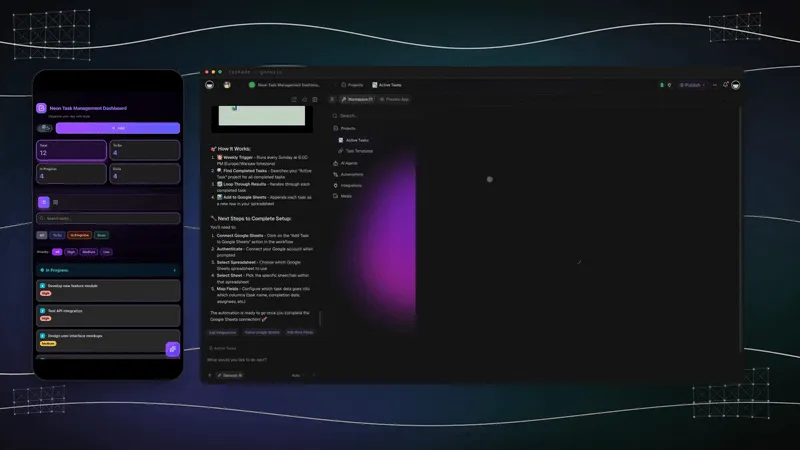
No signup, no credit card. Live neon task manager
| Capability | Google Tasks | Taskade Genesis |
|---|---|---|
| Pricing (starting) | Free (bundled with Google account) | $0 Free · $10/mo Pro billed annually (10 seats) |
| Cloneable live demo | ❌ | ✅ |
| Built-in AI agents | None | ✅ built-in tools |
| Automation engine | Reminder rules only | ✅ Durable runtime, 100+ integrations |
| Workspace DNA loop | ❌ | ✅ ▲ Memory · ■ Intelligence · ● Execution |
What Is Google Tasks?
Google Tasks is Google's minimalist task manager. Originally launched as a feature of Gmail in 2008, it became a standalone iOS and Android app in 2018. It is integrated with Gmail and Google Calendar and is free with any Google account.
Google Tasks at a glance: Bare-bones to-do list. Title, due date, subtasks, and that's it. No views, no collaboration, no AI, no integrations beyond Google.
What Is Taskade?
Taskade is an AI-native workspace founded by John Xie, Dionis Loire, and Stan Chang in 2017 (Y Combinator-backed). It combines documents, projects, custom AI Agents, Automations, and the Genesis app builder in one platform — with native two-way Google Calendar, Sheets, Drive, and Gmail sync built in.
Taskade routes across 15+ frontier models from OpenAI, Anthropic, and open-weight providers. The free plan includes unlimited projects, real-time collaboration, the Genesis app builder (3 apps), custom AI Agents, basic project views (Gantt Chart, Actionsheet, and Org Chart need a paid plan), and workflow templates.
Google Tasks vs Taskade
Google Tasks does one thing well: a flat list of to-dos that lives next to your inbox. For one person managing the day's quick wins, that's enough.
Taskade is what you graduate to when a flat list stops scaling. Multiple project views, real-time team collaboration, custom AI Agents that act on your work, durable automations across 100+ integrations, and the Genesis app builder for full deployed apps. Native Google Workspace sync means you keep the Google ecosystem you already use.
The Workspace DNA advantage
Google Tasks is a list. Taskade is a workspace built on Workspace DNA: a self-reinforcing loop between three pillars.
- Memory (Projects) — Your team's tasks, docs, files, and structured data become the substrate every agent reasons over. The longer you work, the smarter the workspace gets.
- Intelligence (AI Agents) — Custom AI Agents with persistent memory, built-in tools, and the ability to call out to external services. Agents are first-class teammates that live in the workspace.
- Execution (Automations) — Durable workflows triggered by external events (a Google Calendar event, a Gmail thread, a new Sheets row, a Slack message) that read from Memory, act through Intelligence, and write the results back into Memory. The loop closes.
Read the full architecture in How Workspace DNA Works.
Taskade Pricing
| Plan | Price | Best For |
|---|---|---|
| Free Forever | $0 | Solo users and small teams |
| Pro | $10/mo annual (10 seats) | Growing teams |
| Business | $25/mo (unlimited seats) | Larger teams |
| Enterprise | $250/mo with custom SLA | Organizations with security/compliance needs |
When to choose each
Choose Google Tasks if:
- You manage a single flat to-do list and never collaborate.
- You live in Gmail and need nothing more than a sidebar checklist.
Choose Taskade if:
- You collaborate with anyone — even one teammate.
- You want native two-way Google Calendar sync plus 99 other integrations.
- You want custom AI Agents that act on your work, not just remind you about it.
- You want to ship apps, dashboards, and internal tools from prompts via Genesis.
Build without permission
- Build with Genesis — One prompt, one deployed app
- Browse the Community Gallery — Clone apps from other teams
- How Workspace DNA Works — The architecture