

TL;DR: Claude Code is Anthropic's terminal-based coding agent for engineers, reached through Claude Pro at $20 a month or Max from $100. Taskade Genesis is the workspace where anyone ships a deployed app from one prompt, with AI agents, automations, and 100+ integrations included. Free Forever to start, Pro $10/mo billed annually. Try Taskade Genesis free →
See the alternative working, clone in 60 seconds
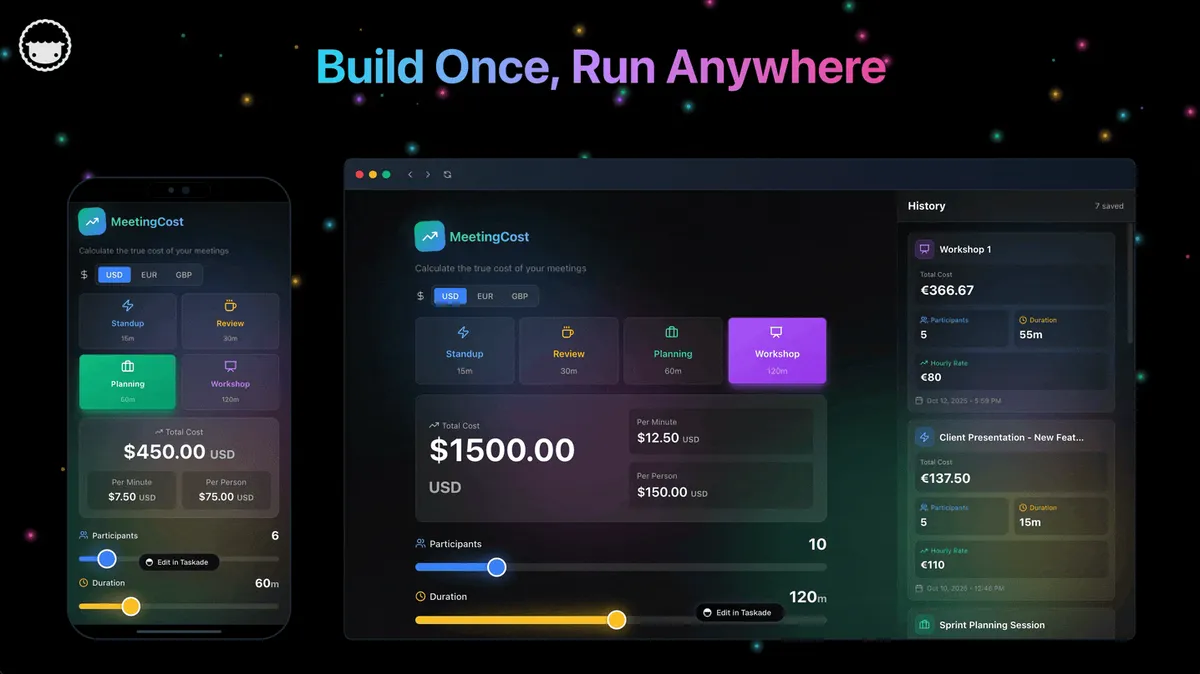
No signup, no credit card. Live AI dev workspace
| Capability | Claude Code | Taskade Genesis |
|---|---|---|
| Pricing (starting) | Claude Pro $20/mo or Max $100/$200/mo (no free tier) | $0 Free · $10/mo Pro billed annually (10 seats) |
| Cloneable live demo | ❌ | ✅ |
| Built-in AI agents | Code agent only | ✅ built-in tools |
| Automation engine | No workspace automation | ✅ Durable runtime, 100+ integrations |
| Workspace DNA loop | ❌ | ✅ ▲ Memory · ■ Intelligence · ● Execution |
Overall winner: ✅ Taskade Genesis: for anyone whose goal is shipping a working app, not editing code in a repo. Claude Code remains a strong pick for engineers doing deep work in an existing codebase.
Table of Contents
- Quick Comparison Table
- The fundamental difference
- What is Taskade Genesis?
- What is Claude Code?
- Feature-by-feature deep dive
- The Workspace DNA advantage
- Pricing and total cost of ownership
- Where Claude Code has the edge
- What developers say
- When to choose each
- Frequently asked questions
- Without permission
The fundamental difference
Claude Code and Taskade Genesis sit on opposite ends of the AI build pipeline. Claude Code is Anthropic's terminal-based agentic coding tool. It plans, edits, and reasons about code across an entire repository with the kind of careful multi-step agency that has earned it a strong reputation against tools like OpenAI's Codex. The output is source code, well-structured, well-explained, often impressive, but still source code.
Taskade Genesis starts where the source-code question ends. You describe what you want and Genesis returns a deployed, working application with AI agents, real-time data, automation workflows, and team collaboration already wired in. Your workspace is the backend. Your projects are the database. Your agents are the runtime.
Claude Code asks: "What code should I write next?" Genesis asks: "What app should exist?"
What is Taskade Genesis?
Taskade Genesis is the AI app builder inside the Taskade workspace. It is built on Workspace DNA, Memory (Projects), Intelligence (AI Agents), and Execution (Automations), a self-reinforcing loop where what your team does becomes the substrate the agents reason over. Founded by John Xie, Dionis Loire, and Stan Chang in 2017, Taskade is a Y Combinator-backed platform with over a million users and a public Community Gallery of apps anyone can clone.
A single prompt to Genesis can produce a customer support portal, an ops dashboard, a CRM, a knowledge base, a form-driven intake system, or an internal tool, all with built-in AI agents, automations, custom domains, password protection, and the option to embed publicly with GenesisAuth. No DevOps. No CI/CD. No infrastructure to maintain.
Genesis is for everyone, founders, marketers, ops, product managers, customer success, and engineers who want to skip plumbing and focus on the idea.
What is Claude Code?
Claude Code is Anthropic's terminal-based agentic coding tool. It has built a strong reputation among engineers as one of the most capable multi-step coding agents on the market, frequently cited as a tougher competitor than OpenAI's Codex on real-world refactor and feature-implementation tasks.
Claude Code at a glance: Bundled with paid Anthropic plans. Runs as a CLI in your terminal. Reads, navigates, edits, and creates files across a local codebase. Plans changes across multiple files, asks clarifying questions, and executes shell commands with explicit permission. Strongest on repository-wide reasoning, careful refactors, and "implement this feature end-to-end" tasks where it can move across many files in one session.
The headline strengths developers love: thoughtful planning, transparent step-by-step execution, willingness to ask before doing destructive things, and very strong code reasoning powered by Anthropic's Claude family. It has earned a loyal user base on r/ClaudeAI and Hacker News for being the agent that "thinks before it types."
Claude Code is, for very good reasons, well respected. It is also unambiguously a developer tool: you live in the terminal, you supply your own repo, and you ship the resulting code yourself.
Feature-by-feature deep dive
App generation
- Taskade Genesis turns a single prompt into a deployed application with UI, data model, AI agents, and automations connected. You can iterate visually or in natural language. The output runs immediately at a shareable URL.
- Claude Code edits and creates files in a local codebase. The output is source code that the user must compile, deploy, and host. There is no concept of a "live app" inside Claude Code.
AI agents that take action for a team
- Taskade ships AI Agents v2, first-class digital teammates with persistent memory, built-in tools (web search, file analysis, project management, image generation, code execution, and more), custom tools you define, and the ability to be embedded publicly inside Genesis Apps.
- Claude Code is a single-user, single-session terminal agent. It plans and executes inside one shell session. When you close the terminal, the agent is gone.
Workflow automations and integrations
- Taskade includes durable Automations with branching, looping, and filtering across 100+ bidirectional integrations. Triggers pull external events in (Slack messages, Gmail, Sheets rows, Calendly events, webhooks). Actions push data out (Stripe checkouts, Shopify orders, Notion syncs, Salesforce updates, GitHub PRs).
- Claude Code has no team-level automation layer. Workflows happen inside your terminal session.
Team collaboration
- Taskade is workspace-native: real-time multiplayer editing, comments, chat, video calls, and granular role-based access (Owner to Viewer).
- Claude Code is single-user. Collaboration happens through git pull requests after the fact.
Project views and visual editing
- Taskade offers multiple project views, List, Board, Calendar, Table, Mind Map, Gantt, and Org Chart, plus visual app editing without writing code. The Timeline scrolling component lives inside the Gantt view.
- Claude Code outputs code and diffs in a terminal. Visual editing is whatever your IDE or editor provides after the fact.
Workspace memory and context
- Taskade's Workspace DNA gives every agent persistent context across projects, files, integrations, and the live state of your business.
- Claude Code rebuilds context per session from the repo you point it at. Powerful and clean, but local to one repo and one terminal session.
Audience and accessibility
- Taskade is designed for everyone, engineers, marketers, ops, sales, customer success, and PMs.
- Claude Code is designed for engineers comfortable with terminals, git, and code review.
If you're using Claude Code with Live Artifacts
Anthropic's April 2026 launch of Live Artifacts inside Claude Cowork lets Claude scaffold a dashboard that refreshes with connected-app data, locally, on one Mac or Windows machine, with Haiku-only AI actions and no Skills. Claude Code is excellent at scaffolding the underlying code. Taskade Genesis is where the resulting dashboard becomes a deployed, shareable app at its own URL with embedded agents and automations. For the full side-by-side write-up, see Taskade Genesis vs Claude Live Artifacts: The Workspace vs the File Format.
The Workspace DNA advantage
Claude Code's mental model is "the agent edits files, the human ships them." Genesis's mental model is Workspace DNA: a self-reinforcing loop between three pillars.
- Memory (Projects): Your team's docs, tasks, files, and structured data become the substrate every agent reasons over. The longer you work, the smarter the workspace gets.
- Intelligence (Agents): Custom AI Agents with persistent memory, built-in tools, and custom tools you define, plus a hosted MCP server that Claude Desktop, Cursor, and VS Code connect into, while automations carry the work into the 100+ apps you already use. Agents are first-class teammates that live in the workspace, not floating chat sessions.
- Execution (Automations): Durable workflows triggered by external events (Slack, Gmail, Stripe, GitHub, Calendly, webhooks, schedules) that read from Memory and act through Intelligence, then write the results back into Memory. The loop closes.
Claude Code is excellent at one slice of this loop, turning intent into careful code edits inside a repo. Genesis runs the entire loop continuously, so the longer you use it, the more your workspace itself becomes the thing that builds the next app.
Pricing and total cost of ownership
| Plan | Taskade Genesis | Claude Code |
|---|---|---|
| Free | Free Forever, limited AI credits, full app builder access | Not available |
| Entry paid | Pro $10 / month billed annually, unlimited apps, 10 seats | Claude Pro $20 / month, limited Claude Code usage |
| Power tier | Business $25 / month, unlimited seats | Claude Max $100 or $200 / month, higher usage limits |
| Top tier | Max $100 / month, maximum AI capacity | Same Max $200 / month, bundled cap still applies |
| Enterprise | $250 / month with custom SLA | Anthropic enterprise (custom) |
Claude Code's pricing is bundled into Anthropic's consumer subscription, or billed per token through the Anthropic API. The headline number ($20 to $200) hides a usage cap. Heavy Claude Code users on Max routinely report bumping into rate limits during long sessions, which interrupts agentic work mid-task.
Genesis flips the model: a flat subscription includes AI credits, hosting, deployment, agents, integrations, and automations. There is no separate model bill, no DevOps line item, no infra cost. Your $10/month or $25/month is what you pay, end of story.
Where Claude Code has the edge
Honest comparison: Claude Code is genuinely excellent at what it does. Three areas where it beats almost everything else, including Genesis if your goal is repo-level work:
- Multi-step code agency. Claude Code's planning quality is real. It will lay out a multi-file refactor, ask clarifying questions, execute step by step, and explain what it did. For deep work in an existing codebase, this is the bar.
- Reasoning under ambiguity. When a task is underspecified, Claude Code is one of the few coding agents that asks before acting. That single property makes it dramatically less destructive than autocomplete-style tools.
- Anthropic Claude reasoning, dialed in. If you want the latest Claude models like Opus 4.8 applied to your codebase with first-party tooling, Claude Code is the most direct path.
None of this changes the trade-off: Claude Code outputs code, not deployed apps. If your goal is to ship a working application that your team or customers can actually use today, Genesis is the tool. If your goal is to do careful work inside an existing repository, Claude Code is the tool.
What developers say
Claude Code has built a strong reputation in the engineering community. Recurring themes:
- "Better than Codex for serious work", particularly on multi-file refactors and feature implementations where planning matters.
- "Asks before it breaks things", the willingness to pause and clarify is widely loved.
- "The most thoughtful coding agent", surfaces in nearly every Claude Code thread.
The honest critique: rate limits on Pro and Max plans interrupt long sessions, the terminal UX intimidates non-CLI users, and it is unambiguously a developer tool. None of these are bugs, they are consequences of the audience Claude Code serves.
Genesis users are usually one step removed from those threads. They show up because they want to ship a portal, a dashboard, a CRM, an internal tool, or a customer-facing app, and they want to do it without thinking about deploys, databases, or auth. Browse the Community Gallery to see the apps people have shipped without ever opening a terminal.
When to choose each
Choose Claude Code if:
- You are an engineer or small dev team comfortable in the terminal.
- You want a careful agent that plans before it edits across many files.
- You are doing deep work inside an existing codebase, refactors, feature work, debugging.
- You want Anthropic Claude reasoning applied directly to your repo.
- The output you need is source code, not a deployed system.
Choose Taskade Genesis if:
- You want to ship a working app, not edit files in a repo.
- Your team includes non-engineers who need to build alongside engineers.
- You need AI agents that persist, have tools, and can be embedded for customers.
- You need workflow automations across Slack, Gmail, Stripe, Salesforce, Notion, and 100+ other integrations.
- You want one flat subscription that includes hosting, agents, automations, and team collaboration.
Use both if: Many engineering teams use Claude Code for deep work on existing services and use Genesis to ship new internal tools, ops dashboards, customer portals, and AI-powered apps that need to actually run in front of users.
Frequently asked questions
Is Claude Code better than Taskade Genesis for AI development?
They are aimed at different jobs. Claude Code is the right tool for editing code in an existing repository. Genesis is the right tool for shipping deployed applications. The "better" answer depends entirely on whether your output is source code or a running app.
How much does Claude Code cost?
Claude Pro is $20 per month with limited usage. Claude Max is $100 or $200 per month with higher caps. There is no free Claude Code tier.
Does Claude Code deploy applications?
No. Claude Code edits and creates code files. The user is responsible for building, hosting, and shipping the result.
Does Taskade Genesis include workflow automations?
Yes, durable automations across 100+ bidirectional integrations. Claude Code has no team-level automation layer.
Which AI models does Taskade Genesis use?
Taskade includes access to 15+ frontier models from OpenAI, Anthropic, and open-weight providers. You never wire up API keys.
Can I use both?
Yes. Many teams keep Claude Code for repo-level engineering work and use Genesis to ship internal tools and customer-facing apps that need to actually run.
Build without permission
Claude Code gives engineers a sharper, more thoughtful agent for working inside repos. Taskade Genesis gives everyone, engineers and non-engineers alike, a workshop where the apps come out finished, hosted, and ready for users.
- Build with Taskade Genesis →, One prompt, one deployed app
- Browse the Community Gallery, Clone apps shipped by other Genesis builders
- Read the Workspace DNA explainer, How Memory, Intelligence, and Execution work together
Explore Taskade Genesis
- AI App Builder, Build complete apps from one prompt
- Vibe Coding, Natural-language app creation
- AI Agent Platform, Digital teammates that work 24/7
- AI Website Builder, Sites in seconds
- Workflow Automation, AI-powered business automation
Learn the Genesis architecture
Your living workspace includes:
- First-app guide, 5-minute tutorial
- Custom AI Agents, The Intelligence pillar
- Projects & Databases, The Memory pillar
- Automations & Workflows, The Execution pillar
Build without code
- AI App Generator, Full apps from prompts
- AI Dashboard Generator, Business dashboards
- AI Website Generator, Sites in seconds
- AI Form Generator, Smart intake forms
- Browse Community Apps, Clone and customize
Related reading
- The Build Without Permission article, Our manifesto
- How Workspace DNA Works, The architecture
- Origin of Living Software, The future of apps
- Best Claude Code Alternatives in 2026, AI coding agents compared
- Best Cursor Alternatives in 2026, AI code editors compared
- Best Vibe Coding Tools in 2026, AI coding tools compared
- Vibe Coding for Non-Developers, Build apps without code
- Vibe Coding for Teams, Ship 10x faster