

TL;DR: Taskade Genesis is a cloud workspace that ships knowledge apps, agents, and automations from one prompt. Logseq is AGPL-3.0 local-first notes, free to use, with Sync from $5/mo. Taskade is Free Forever. Pro is $10/mo billed annually. Try Taskade Genesis free →
See the alternative working — clone in 60 seconds
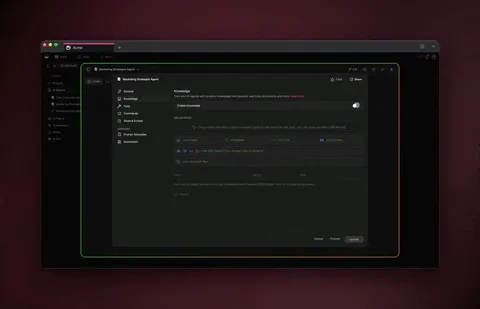
No signup, no credit card. Live AI knowledge base
More to clone: the client portal app, knowledge management agents, and hundreds in the Community Gallery.
What changed in Logseq in 2026
Logseq shipped 2.0 Beta, the database version, on July 13, 2026 (tagged 2.0.1 on GitHub). It is the biggest change in the project's history, and most "best Logseq alternative" articles still describe the pre-2.0 app.
Three facts matter if you are evaluating right now:
- Logseq is splitting into two products, announced April 24, 2026. The file-based app becomes Logseq OG in its own repository, committed to security and dependency upgrades rather than new features. Its last stable release was
0.10.15in December 2025. Nobody is forced to migrate. - Markdown is no longer the storage layer in 2.0. A graph is a local SQLite database file, so notes are not hand-editable in an external text editor. Markdown becomes an export, which Logseq's docs say "is not yet recommended as the only means to backup a graph." A read-only Markdown Mirror shipped in 2026; two-way mirroring is still in development.
- Status is genuinely beta. The docs describe the DB version as beta with the new mobile app and real-time collaboration in alpha, and advise automated backups because "data loss is possible."
The rewrite was long. Tienson Qin's April 2024 post put the database at 85% complete and collaboration at 70%, projecting pre-alpha "in 2 ~ 3 months." Beta arrived roughly two years later. In community threads on Hacker News and r/logseq, that gap — plus losing plain files as the editable layer — drives more migration talk than any missing feature.
To be fair: Logseq is maintained and shipping, not abandoned. The repository has over 44,000 stars, and its Open Collective has raised more than $730,000 from over 12,000 contributors.
Verify this yourself: the db-version docs, the 2.0.1 release, and the Logseq Open Collective are the primary sources above. Checked August 11, 2026.
What is Logseq?
Logseq is a privacy-first, open-source knowledge base created by Tienson Qin and first released October 1, 2020, as a local-first answer to Roam Research. It is an outliner: every line is a block, blocks nest, and blocks can be referenced and embedded anywhere. It ships bidirectional links, a graph view, daily journals, PDF annotation, and a Datalog query engine. Logseq Inc raised over $4.1M, backed by Patrick Collison, Tobias Lütke, and Nat Friedman.
Logseq at a glance: AGPL-3.0 open source. Local-first. Markdown/Org on OG, SQLite on 2.0. Outliner with block references and journals. Free software; Sync and RTC are paid.
Logseq is excellent at one job no managed SaaS can do: a private, file-owned thinking tool that works offline and answers to nobody. If that is the requirement, Logseq is still one of the best picks available.
Open source and local-first vs managed and AI-native
This is the real decision, and pretending it is about price would be dishonest. Logseq costs nothing to run, and Taskade is not cheaper than free. The difference is what the tool does with your knowledge once it is written down. Logseq is a superb place to keep thinking — deliberately single-player, offline, and inert. A managed AI-native workspace treats the same notes as an input: agents read them, automations act on them, teammates edit them at once, and a prompt can turn a section of them into a deployed app.
Neither loop is better in the abstract. If your knowledge work ends when the note is written, the left side is cheaper, more private, and more durable. If the note is supposed to cause something — a summary, a handoff, a client-facing page, a recurring workflow — the right side removes the person who would otherwise carry it there by hand.
Best Logseq alternatives in 2026, compared
People shop for alternatives for four reasons, all documented on Logseq's own forum: mobile is the weakest surface (no plugin support on iOS), sync has a history of losing edits — the team's own 2024 post conceded markdown-file sync causes data loss — collaboration barely existed before 2.0, and large graphs get slow, with long-running threads about typing lag at a few thousand pages.
Searchers usually shortlist the same set. Here is an honest read of who each is for.
| Tool | Model | Best for | Trade-off |
|---|---|---|---|
| Obsidian | Local Markdown vault | Closest like-for-like move; deepest plugins, strong mobile | Single-player at heart; sync is paid |
| Notion | Managed docs + databases | Teams wanting docs, wikis, and databases together | Not an outliner; heavy pages slow down |
| Tana | Outliner with supertags | Typed structure without leaving the outline | Steeper learning curve; smaller ecosystem |
| Roam Research | Hosted outliner | Networked-thought purists | Paid only; slower development pace |
| Capacities | Typed object notes | Structure without building databases by hand | Opinionated model; limited automation |
| Anytype | Local-first, encrypted, open source | Notion-style objects, offline and private | Younger product; smaller ecosystem |
| AppFlowy | Open-source Notion alternative | Self-hosters | Feature depth behind Notion |
| Joplin | Open-source Markdown notes | Encrypted, portable note storage | No outliner or block references |
| RemNote | Outliner + spaced repetition | Students learning material, not just filing it | Study-first; weaker for team work |
| Taskade | Managed AI-native workspace | Teams that need notes to trigger real work | Cloud-based, not local-first |
If you want a local Markdown vault with better mobile and plugins, the honest answer is Obsidian — we say so on our Obsidian comparison. Taskade fits a narrower case: a team where the knowledge base must produce output, not just hold it.
Choose Logseq if
- You want to own your files outright. Logseq OG stores plain Markdown or Org-mode on your disk, and works with Syncthing or git. No vendor can gate, price, or discontinue access. No SaaS can match that guarantee.
- Its outliner is genuinely best-in-class. Indentation, block references, and tag inheritance work together to build linked-reference panes with full surrounding context. Ex-users consistently say this is what they miss most, and that competitors approximate rather than match it.
- PDF annotation and flashcards are exceptional. The PDF annotator with block-anchored references, plus built-in spaced repetition, is a combination students and researchers rarely find elsewhere — alongside journals, whiteboards, and Datalog queries, at zero cost.
Why teams choose Taskade
Taskade keeps the linked-notes model, then adds the layer Logseq intentionally does not have: AI agents that reason over the workspace, automations that execute against it, and real-time collaboration. One prompt in Taskade Genesis turns a knowledge base into a deployed app.
| Capability | Logseq | Taskade |
|---|---|---|
| AI over your notes | Plugins and your own API keys | Agents v2, built-in toolkit, persistent memory |
| Turn notes into a live app | Logseq Publish (static pages) | Taskade Genesis deploys a working app from a prompt |
| Models | Bring your own | 15+ frontier models from OpenAI, Anthropic, and open-weight providers |
| Views on the same content | Outline + Graph | Multiple views, no duplicated data |
Concretely: AI Agents v2 answer questions across a workspace and trigger work; Taskade Genesis returns a deployed app with custom domains, password protection, and app sign-in; 100+ bidirectional integrations pull events in and push data out across Slack, Gmail, Stripe, Salesforce, and GitHub. Taskade runs on macOS, Windows, Linux, iOS, Android, and the web.
Migrating a Logseq graph into Taskade
What carries over cleanly: page content, nested bullet hierarchy (Logseq's outline maps onto Taskade's outline nodes), tags, checkboxes, and links between pages.
What needs rebuilding: block references and embeds are Logseq-specific addressing and do not survive a Markdown export intact. Datalog queries have no equivalent — rebuild them as saved views or an agent prompt. PDF annotations stay in Logseq.
Practical order: export Markdown, import one project area rather than the whole graph, let an AI Generator restructure long reference pages, then train an agent on the result. Guides live in Learn Taskade.
Total cost and effort
Software cost is the wrong axis, because Logseq's software is free. The honest comparison is what each setup asks of you over a year.
| Logseq | Taskade | |
|---|---|---|
| Software | Free, AGPL-3.0 | Free Forever tier |
| Sync across devices | Sync from $5/mo, or wire up iCloud/Dropbox/git yourself | Included |
| Team collaboration | Paid RTC, invite-only at launch, or self-host | Pro $10/mo billed annually, 10 seats |
| Larger teams | Self-managed | Business $25/mo billed annually, unlimited seats |
| Heavy AI generation | Bring your own API keys | Max $100/mo billed annually |
| Custom SLA and support | Community | Enterprise $250/mo billed annually |
| Backups, upgrades, AI wiring | Yours to run | Managed |
Monthly billing is available on every plan (Pro $20, Business $50, Max $200, Enterprise $500), and the Free tier covers up to 3 Taskade Genesis apps with a one-time grant of 1,000 credits on signup verification plus 5,000 on first build. The point is not that Taskade is cheaper — it is that "free" and "no cost" differ once sync, backups, plugin maintenance, and AI wiring count as your time.
Short version: stay on Logseq if you work alone and want files you control. Move to Taskade if more than one person needs the knowledge base at once, you want AI acting on your notes without assembling plugins and API keys, or you want to ship it as a real application.
Frequently asked questions
What is the best Logseq alternative in 2026? Obsidian for a like-for-like local Markdown vault. Tana or Capacities for a structured outliner. Anytype, AppFlowy, or Joplin for open source. Taskade for teams that need AI to act on knowledge rather than just store it.
Is Logseq free, and is it still maintained? Both. The software is free and open source under AGPL-3.0, and 2.0 Beta shipped July 13, 2026. Sync and real-time collaboration are paid via the Open Collective ($5/month Backers, $15/month Sponsors) and can be self-hosted.
Can Taskade replace Logseq for personal knowledge management? For most people, yes. Taskade supports outlining, linked notes, backlinks, tags, custom fields, and full-text plus semantic search, and agents answer questions across it. Mind Map and Org Chart views cover the visual-relationship job Logseq's graph does. The trade-off is cloud-hosted instead of local-first.
The Workspace DNA advantage
Taskade runs on Workspace DNA — Memory feeds Intelligence, Intelligence triggers Execution, and Execution writes results back into Memory. Notes, tasks, files, and structured data become the substrate agents reason over; automations across 100+ integrations carry the output somewhere useful and return the result so the next run starts smarter. Logseq gives you a private, file-owned outliner and stops there, on purpose. Read the Workspace DNA explainer.
Explore Taskade
- AI App Builder — complete apps from one prompt
- AI Agent Platform — teammates with a large built-in toolkit
- AI Second Brain — train agents on your knowledge
- Workflow Automation — workflows across 100+ integrations
- Build with Taskade Genesis →