

See the alternative working — clone in 60 seconds
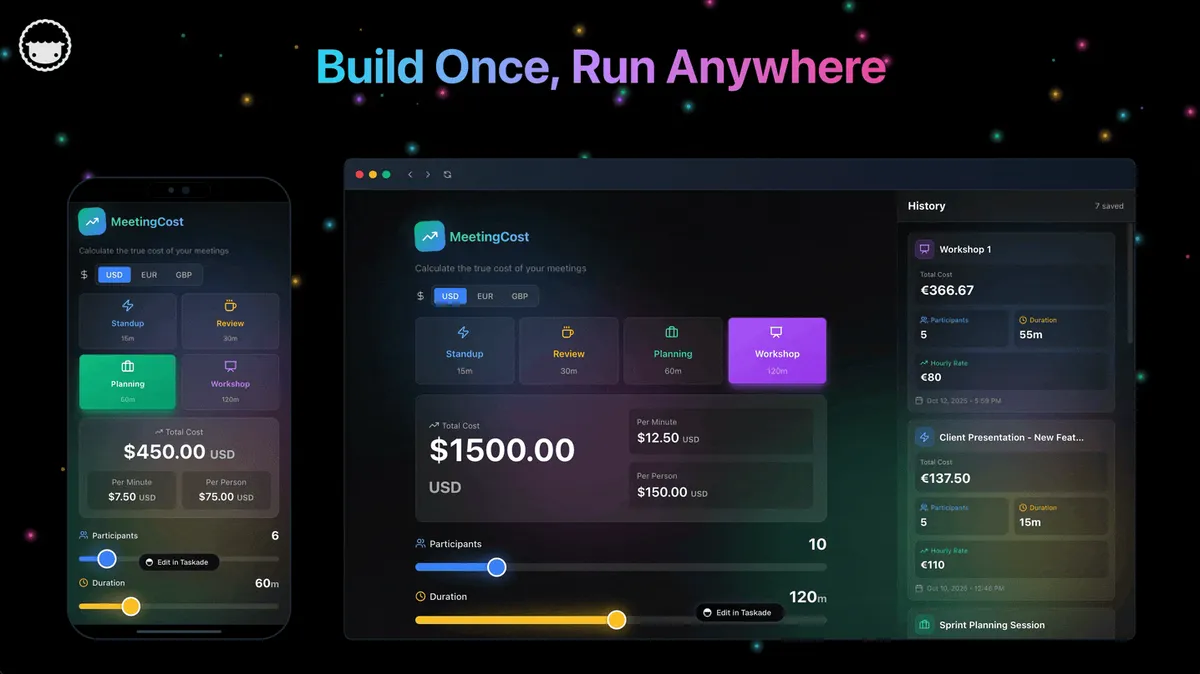
No signup, no credit card. Live AI dev workspace
| Capability | Windsurf (now Devin Desktop) | Taskade Genesis |
|---|---|---|
| Pricing (starting) | Free tier, Pro $20/mo month-to-month, Max $200/mo, Teams $80 base + $40/dev seat | $0 Free · $10/mo Pro billed annually (10 seats) |
| Cloneable live demo | ❌ | ✅ |
| Built-in AI agents | Code agent only | ✅ built-in tools |
| Automation engine | No workspace automation | ✅ Durable runtime, 100+ integrations |
| Workspace DNA loop | ❌ | ✅ ▲ Memory · ■ Intelligence · ● Execution |
Overall winner: ✅ Taskade Genesis — for any team whose goal is shipping a deployed app with agents and automations on flat predictable pricing. Windsurf remains the strongest pick for engineers who want a serious in-IDE agentic refactor surface plus async Devin handoff for long-running work.
Table of Contents
- Quick Comparison Table
- The fundamental difference in 2026
- What is Taskade Genesis?
- What is Windsurf in 2026?
- Feature-by-feature deep dive
- The Workspace DNA advantage
- Pricing and total cost of ownership
- The credit-drain pattern
- Where Windsurf has the edge
- What developers say
- When to choose each
- Frequently asked questions
- Without permission
TL;DR: Taskade Genesis ships a deployed app with AI agents, automations, and 100+ integrations. Pro is $10/mo billed annually for 10 seats. Windsurf is now Devin Desktop, with Pro at $20 per month month-to-month and Max at $200 per month. Try Taskade Genesis free →
The fundamental difference in 2026
Windsurf, renamed Devin Desktop in June 2026, is Cognition Labs' agentic AI IDE. Devin Local, the agent that replaced Cascade, reads your codebase, plans multi-file refactors, runs terminal commands, and produces React or Next.js code the engineer deploys. Wave 13 (December 2025) added Parallel Agents (up to 5 Cascade agents in isolated git worktrees), Arena Mode (blind A/B model voting), and Devin CLI handoff. The product has shipped at remarkable cadence under Cognition: Wave 10 → 13 in roughly six months.
Taskade Genesis is a different shape entirely. You describe what you want and Taskade Genesis returns a deployed, working application with AI agents, real-time data, automation workflows, and team collaboration already wired in. Your workspace is the backend. Your projects are the database. Your agents are the runtime.
Windsurf asks: "What multi-file refactor should I make to your codebase?" Taskade Genesis asks: "What app should exist?"
What is Taskade Genesis?
Taskade Genesis is the AI app builder inside the Taskade workspace. It is built on Workspace DNA — Memory (Projects), Intelligence (AI Agents), and Execution (Automations) — a self-reinforcing loop where what your team does becomes the substrate the agents reason over. Founded by John Xie, Dionis Loire, and Stan Chang in 2017, Taskade is a Y Combinator-backed platform with over a million users and a public Community Gallery of apps anyone can clone.
A single prompt to Taskade Genesis can produce a customer support portal, an ops dashboard, a CRM, a knowledge base, a form-driven intake system, or an internal tool — all with built-in AI agents, automations, custom domains (Business+), password protection (Pro+), and the option to embed publicly with GenesisAuth. No DevOps. No CI/CD. No infrastructure to maintain.
Taskade Genesis is for everyone — founders, marketers, ops, product managers, customer success, and engineers who want to skip plumbing and focus on the idea.
What is Windsurf in 2026?
Windsurf is now Devin Desktop. Cognition folded the IDE into its Devin product line, and windsurf.com redirects to devin.ai — pricing, downloads, and documentation all live on the Devin site now. The editor did not go away and neither did its free tier; the brand was absorbed. If you are reading a comparison that still treats Windsurf as a standalone product with its own price list, that comparison predates the change.
Beyond the rename, here is the context that matters, because the existing comparison surface on the internet is mostly stale on this:
Windsurf at a glance (updated October 2026):
- Now sold as: Devin Desktop (renamed June 2026), on the Devin price list at devin.ai
- Owner: Cognition Labs (Devin's creator), acquired Windsurf July 14, 2025 for ~$250M
- The deal split: OpenAI signed a binding LOI to acquire Windsurf for $3B all-stock in May 2025. The deal collapsed July 11, 2025 when Microsoft refused to grant OpenAI an IP-access exception. Google paid $2.4B in a reverse-acquihire to hire CEO Varun Mohan, co-founder Douglas Chen, and ~40 senior R&D staff plus a non-exclusive tech license. Cognition then acquired the remaining IDE, IP, brand, $82M ARR, 350+ enterprise customers, and ~210 employees three days later.
- Models: Cognition's in-house SWE-2 coding model, plus frontier models from OpenAI, Anthropic, Google and SpaceXAI and leading open-source models on paid plans.
Recent shape changes (late 2025 → October 2026):
- Wave 10 — Built-in Browser Preview (Cascade reads DOM, takes screenshots, captures console logs).
- Wave 11 ("Just Keep Shipping") — Voice commands, named checkpoints, @-mention terminal/past-conversations, OAuth + streamable HTTP MCP support, global
.codeiumignore, Plan Mode + Workflows ported to JetBrains. - Wave 12 ("Devin in Windsurf") — First Devin intelligence integration: always-on Plan Mode, autonomous to-do lists, DeepWiki code-explanation, Vibe + Replace bulk edit, redesigned Chat/Cascade panels.
- Wave 13 ("Merry Shipmas") — Parallel Agents (up to 5 Cascade agents in isolated git worktrees), Arena Mode (blind A/B model voting → leaderboard), Devin CLI in Terminal + Devin cloud handoff. Windsurf 2.0 Agent Command Center ships.
- Pricing overhaul (2026) — Moved off the old monthly credit system to a quota model after sustained user backlash about credit drain, and Pro settled at $20 per month month-to-month.
- Renamed Devin Desktop (June 2026) — The Agent Command Center became the main view, Devin Local replaced the Cascade agent (Cascade stayed available through July), and the Windsurf JetBrains plugin moved to maintenance mode, with Devin over ACP as the recommended path.
- SWE-2 (2026) — Cognition's newest coding model, available in Devin Desktop and the Devin CLI.
- Price list — The IDE is now sold on the Devin price list: a free tier with a light quota, Pro $20/month month-to-month, Max $200/month, and Teams at $80/month base plus $40 per developer seat. Cognition does not publish an annual rate for these plans.
Windsurf is, on its own terms, an excellent product for engineers doing serious multi-file refactor work in an IDE. The question for teams choosing between Windsurf and Taskade Genesis is not "is Windsurf good at code refactoring" — it is "does the team want IDE-based code generation, or a deployed app with agents and automations for any role?"
Feature-by-feature deep dive
App generation and deployment
- Taskade Genesis turns a single prompt into a deployed application with UI, data model, AI agents, and automations connected. The app runs immediately at a shareable URL with custom domain (Business+) and password protection (Pro+) available.
- Windsurf generates source code in your IDE. The in-IDE agent can wire deployments to Netlify or Vercel; Devin CLI handoff (Wave 12) can run async cloud tasks. The deploy step, hosting, database operations, and ongoing operations remain the engineer's job.
AI agents that take action
- Taskade ships AI Agents v2 — first-class digital teammates with persistent memory, built-in tools (web search, file analysis, project management, image generation, code execution, and more), custom tools you define, a hosted MCP server that Claude Desktop and Cursor connect into, and the ability to be embedded publicly inside Taskade Genesis Apps for end-users.
- Windsurf's in-IDE agent (Cascade, now Devin Local) works for a single engineer, and Devin Cloud runs coding tasks from Slack or Microsoft Teams. Both work on code. There are no agents your customers chat with inside a deployed app.
Workflow automations and integrations
- Taskade includes durable Automations with branching, looping, and filtering across 100+ bidirectional integrations. Triggers pull external events in (Slack messages, Gmail, Sheets rows, Calendly events, webhooks). Actions push data out (Stripe checkouts, Shopify orders, Notion syncs, Salesforce updates, GitHub PRs).
- Windsurf has no native automation engine. Every Stripe webhook, Slack notification, HubSpot sync, or scheduled task is code you write yourself.
Team collaboration
- Taskade is workspace-native: real-time multiplayer editing, comments, chat, video calls, and granular role-based access (Owner to Viewer).
- Team plans on Cognition's Devin price list ($80/mo base plus $40 per developer seat) provide centralized billing and a shared quota — but the IDE itself remains a single-user surface. Collaboration happens through git PR review after the fact.
Multi-file refactor
Windsurf wins outright here. Wave 13's Parallel Agents — up to 5 Cascade agents running in isolated git worktrees — is best-in-class for serious multi-file orchestration. Cascade Flows handle multi-step refactors better than most IDE-based agents. Taskade Genesis is not optimized for refactoring an existing repo; it is optimized for shipping new deployed apps.
Agent Command Center
Windsurf wins here. Since the June 2026 rename, Devin Desktop opens on an Agent Command Center that runs and reviews fleets of local and cloud agents from one surface, with a Kanban view of sessions. JetBrains users are the exception: the Windsurf JetBrains plugin is in maintenance mode, and Cognition recommends Devin over ACP. Taskade Genesis is a workspace, not an IDE — different shape entirely.
Code ownership
Windsurf wins outright. Source code lives in your repository. Fork, host, run on your own infrastructure. Taskade Genesis is a managed deployed app — you don't own the source code that runs it, but you own your data, your agents, your integrations, and you can export your projects to Markdown or text.
The Workspace DNA advantage
Windsurf's mental model is "the agent works inside your IDE on your repo, the human reviews and ships." Taskade Genesis's mental model is Workspace DNA: a self-reinforcing loop between three pillars.
- Memory (Projects) — Your team's docs, tasks, files, and structured data become the substrate every agent reasons over. The longer you work, the smarter the workspace gets.
- Intelligence (Agents) — Custom AI Agents with persistent memory, built-in tools, and custom tools you define, plus a hosted MCP server that Claude Desktop, Cursor, and VS Code connect into. Agents are first-class teammates that live in the workspace, not floating IDE sessions, and automations carry the work into the 100+ apps you already use.
- Execution (Automations) — Durable workflows triggered by external events (Slack, Gmail, Stripe, GitHub, Calendly, webhooks, schedules) that read from Memory and act through Intelligence — then write the results back into Memory. The loop closes.
Windsurf is brilliant at one slice of this loop — multi-file refactor on an existing codebase. Taskade Genesis runs the entire loop continuously, so the longer you use it, the more your workspace itself becomes the thing that builds the next app.
Pricing and total cost of ownership
| Plan | Taskade Genesis | Windsurf (now Devin Desktop) |
|---|---|---|
| Free | Free Forever — no AI credits at the start (earn or buy credits), 3 Taskade Genesis apps | Free tier — light quota, limited model availability, unlimited inline edits and Tab |
| Entry | Pro $10 / month (billed annually) — unlimited apps, 10 seats | Pro $20/mo month-to-month |
| Mid | Business $25 / month (billed annually) — unlimited seats, higher AI capacity | Teams $80/mo base + $40 per developer seat |
| High end | Max $100 / month (billed annually) — maximum AI generation capacity | Max $200/mo month-to-month |
| Enterprise | $250 / month (billed annually) with custom SLA | Enterprise pricing not published |
Note that Cognition publishes no annual-billing rate for the Devin Desktop plans, so every figure above for Windsurf is a month-to-month price. Taskade Genesis Pro includes 50,000 AI credits in the base price, and optional packs are additive capacity rather than the price of a normal edit.
The headline math: Taskade Pro is $10/mo (billed annually) for 10 seats with 50,000 AI credits included. The equivalent Cognition team plan for the same 10 developers is $480/mo ($80 base + 10 × $40), month-to-month. The trade-off is real source code in their IDE vs deployed apps in a workspace.
The credit-drain pattern
Worth being honest about because it surfaces in nearly every Windsurf review. Windsurf previously used a monthly credit system widely criticized for "Error Cascade has encountered an internal error in this step. No credits consumed on this tool call" being the exception, not the rule. The 2026 move to a quota model was a direct response, and the plans now sit on the Devin price list. Three documented patterns from the credit era:
- Reddit r/Windsurf credit-burn pattern: "I made a mistake by buying extra usage for $5… Claude Opus 4.6 consumed the entire $5 after one prompt asking for very minor changes to 3 files, without even finishing the prompt before asking for more money."
- Long-session context loss (KEAR AI 2026 long-term review): "One debugging session burned through 100 messages, and by message 80, Cascade thought it was working on a different project entirely."
- Cascade instability with frontier models (GitHub Exafunction/codeium #236): "This interrupts ongoing work, making Claude Sonnet 4 effectively unusable. Restarting Windsurf or clearing cache does not resolve the issue."
Taskade Genesis's pricing model is structurally different: Pro is a flat $10/month (billed annually) that already includes 50,000 AI credits, so the month's ceiling is set before you start and a debugging session does not change it. AI credit packs exist for heavy generation work and feature an auto-top-up + audit log + clone creator attribution, but they are additive capacity, not the basic price of editing your app.
Where Windsurf has the edge
Honest comparison content beats hatchet jobs. Five places where Windsurf is genuinely the better choice:
- Cascade Flows + parallel worktrees (Wave 13) — best-in-class multi-file orchestration with conflict-free parallelism.
- Plan Mode is now always-on — produces structured to-do lists agents actually follow.
- Wave shipping cadence — Wave 10 → 13 in roughly six months. Changelog discipline is excellent.
- Agent Command Center — local and cloud agents planned, delegated and reviewed from one surface.
- Arena Mode — blind A/B model voting on real codebases. Genuinely novel UX in the category.
Taskade's edge is everywhere else: deployed apps, AI agents as teammates with tools and memory, automations across 100+ integrations, flat predictable pricing for 10-seat teams, and a workspace-native team collaboration surface for any role.
What developers say
Windsurf has a vocal community on r/Windsurf, r/Codeium, GitHub Exafunction issues, and Hacker News. Honest themes:
- Pro: "Cascade Flows + parallel worktrees is unmatched for multi-file refactors."
- Mixed: JetBrains users valued the plugin, but it is in maintenance mode since the June 2026 rename, and Cognition points them to Devin over ACP.
- Pro: "Plan Mode actually works — agents follow the to-do list."
- Con: Credit drain on errors (the three documented patterns above).
- Con: Long-session context loss — Cascade can lose track of which project it's in by message 80.
- Con: Common dev consensus emerging in 2026: "Cursor (daily) + Claude Code (refactors)" — Windsurf often the third-choice fallback.
Taskade Genesis users are usually one step removed from these threads. They show up because they want to ship a portal, a dashboard, a CRM, an internal tool, or a customer-facing app — and they want to do it without writing React, without managing IDE state, without watching a prompt meter. Browse the Community Gallery to see the apps people have shipped.
When to choose each
Choose Windsurf if:
- You are an engineer who lives in an IDE and wants serious multi-file refactor capability.
- You want parallel git-worktree agents and an Agent Command Center for big refactors.
- You want Devin CLI handoff for async cloud work.
- The output you need is source code in your repo, not a deployed system with agents.
- You can absorb the per-prompt quota model (and the documented credit-drain risks).
Choose Taskade Genesis if:
- You want to ship a working app, not React/Next.js source code.
- Your team includes non-engineers who need to build alongside engineers.
- You need AI Agents that persist, have tools, and can be embedded for customers.
- You need workflow automations across Slack, Gmail, Stripe, Salesforce, Notion, and 100+ other integrations.
- You want one flat subscription that includes hosting, agents, automations, and team collaboration — without a prompt meter.
Use both if: Many engineering teams use Windsurf for autonomous multi-file refactors on production codebases and use Taskade Genesis to ship internal tools, ops dashboards, customer portals, and AI-powered apps that need to actually run in front of users.
Frequently asked questions
How does Windsurf compare to Cursor and Claude Code in 2026?
The dev consensus emerging in 2026 is "Cursor (daily) + Claude Code (refactors)." Windsurf often lands as the third-choice IDE — strong on multi-file refactor (parallel worktrees) and the Agent Command Center, but Cursor wins inline completion polish and Claude Code dominates terminal-native autonomous work. None of them deploy apps — Taskade Genesis is the layer above all of them.
What was the OpenAI / Google / Cognition story?
In May 2025 OpenAI signed a binding LOI to acquire Windsurf for $3B all-stock. On July 11, 2025 the OpenAI deal collapsed when Microsoft refused to grant OpenAI an IP-access exception. The same day, Google DeepMind announced a $2.4B reverse-acquihire — they hired CEO Varun Mohan, co-founder Douglas Chen, and ~40 senior R&D staff plus a non-exclusive tech license, but did not take the company. Three days later (July 14, 2025), Cognition Labs (Devin's creator) acquired the remaining Windsurf entity — IDE, IP, brand, $82M ARR, 350+ enterprise customers, ~210 employees — for an estimated $250M.
Is Windsurf still called Windsurf?
No. Since June 2026, Windsurf is Devin Desktop, sold on the Devin price list by Cognition. windsurf.com redirects to devin.ai. The editor and its free tier both survived the move — only the branding and the plan lineup changed.
How much does Windsurf actually cost in practice?
There is a free tier with a light quota, Pro is $20/mo month-to-month, Max is $200/mo, and Teams is $80/mo base plus $40 per developer seat. Cognition publishes no annual rate, so those are all month-to-month figures. Heavy users on long Cascade sessions can still work through a quota quickly. Taskade Genesis Pro is a flat $10/mo (billed annually) for 10 seats with 50,000 AI credits included.
Does Windsurf include AI agents like Taskade?
Not in the same way. Devin Local (formerly Cascade) is an in-IDE agent for a single engineer, and Devin Cloud returns pull requests. Taskade ships AI Agents v2 as first-class workspace teammates with persistent memory, built-in tools, custom tools, and public embedding inside Taskade Genesis Apps.
Which AI models does Taskade Genesis use?
Taskade provides access to frontier models from top AI labs.
Can I export code from Taskade Genesis like Windsurf?
No — Taskade Genesis builds deployed managed applications, not source code. Projects export to Markdown and text. The trade-off is hosting, agents, automations, and integrations included in exchange for not owning the codebase.
Build without permission
Windsurf gives engineers a serious in-IDE refactor agent under Cognition. Taskade Genesis gives everyone — engineers and non-engineers alike — a workshop where the apps come out finished, hosted, and ready for users.
- Build with Taskade Genesis → — One prompt, one deployed app
- Browse the Community Gallery — Clone apps shipped by other Taskade Genesis builders
- Read the Workspace DNA explainer — How Memory, Intelligence, and Execution work together
Explore Taskade Genesis
- AI App Builder — Build complete apps from one prompt
- Vibe Coding — Natural-language app creation
- AI Agent Platform — Digital teammates that work 24/7
- AI Website Builder — Sites in seconds
- Workflow Automation — AI-powered business automation
Learn the Taskade Genesis architecture
Your living workspace includes:
- First-app guide — 5-minute tutorial
- Custom AI Agents — The Intelligence pillar
- Projects & Databases — The Memory pillar
- Automations & Workflows — The Execution pillar
Build without code
- AI App Generator — Full apps from prompts
- AI Dashboard Generator — Business dashboards
- AI Website Generator — Sites in seconds
- AI Form Generator — Smart intake forms
- Browse Community Apps — Clone and customize
Related reading
- The Build Without Permission article — Our manifesto
- Best Cursor alternatives in 2026 — AI code editors compared
- Best Claude Code alternatives in 2026 — AI coding agents compared
- Best Devin AI alternatives in 2026 — AI coding agents compared
- Best vibe coding tools in 2026 — Category overview
- Vibe coding for non-developers — Build apps without code
- Vibe coding for teams — Ship 10x faster
- How Workspace DNA works — The architecture
- Origin of living software — The future of apps