

TL;DR: Taskade is the free, cross-platform OmniFocus alternative that runs on Windows, Android, Linux, macOS, iOS, and the web, with AI agents, automations, and real-time collaboration. OmniFocus is Apple-only GTD with no free tier, from $99.99/year or a one-time licence. Taskade Pro is $10/mo billed annually. Try Taskade Genesis free →
Does OmniFocus work on Windows or Android?
No. OmniFocus has no native Windows, Android or Linux application, and none is planned. The Omni Group's own support documentation states it plainly: "At this time, we don't have any plans to create native Windows or Android versions of our apps in the foreseeable future." OmniFocus is built for Mac, iPhone, iPad, Apple Watch and Apple Vision Pro, and the company has said its focus on Apple's ecosystem is a deliberate quality decision rather than an oversight.
There is one route in for non-Apple users, and it is worth describing accurately rather than dismissing. OmniFocus for the Web is a browser client that reaches the same database from a desktop browser on Windows or Linux. Three things constrain it:
- It requires a paid subscription. Omni's reference manual states that "Access to OmniFocus for the Web requires an OmniFocus subscription." That is either the all-inclusive plan at $9.99 per month / $99.99 per year, or a $4.99 per month / $49.99 per year web add-on stacked on top of a licence you already bought.
- It is a companion, not a replacement. Omni describes it as designed to work alongside a full edition of OmniFocus for Mac or iOS. Your database has to exist first, created on an Apple device.
- It is not at feature parity. Omni's documentation lists three features as not currently supported on the web: the Review perspective, notifications and repeat editing. It also notes that attributes added on native apps "may not be completely accessible in OmniFocus for the Web." The Review perspective is the engine of the weekly review — arguably the single most important habit in GTD — so its absence is not a cosmetic gap.
Practically, a Windows or Android user pays a subscription to run a reduced version of a product whose full experience lives on hardware they do not own.
Platform support, side by side
| Platform | Taskade | OmniFocus |
|---|---|---|
| Web (browser) | ✅ Full web app | 🟡 Companion web client, subscription required |
| Windows | ✅ Native desktop app | ❌ None |
| Android | ✅ Native mobile app | ❌ None |
| Linux | ✅ AppImage (x86 and ARM) + Snap | ❌ None |
| macOS | ✅ Native desktop app | ✅ Native, flagship |
| iOS / iPadOS | ✅ Native mobile apps | ✅ Native, flagship |
| Apple Watch | ❌ | ✅ |
| Apple Vision Pro | ❌ | ✅ |
| Browser extensions | ✅ Chrome, Firefox, Edge | ❌ |
| Offline editing | ✅ Syncs when reconnected | ✅ Native apps are offline-first |
That table reads both ways. If your computing life is entirely Apple — especially with an Apple Watch or Vision Pro — OmniFocus covers surfaces Taskade does not. If a single Windows machine, Android phone or Linux box appears in your week, Taskade covers surfaces OmniFocus never will.
See the alternative working — clone in 60 seconds
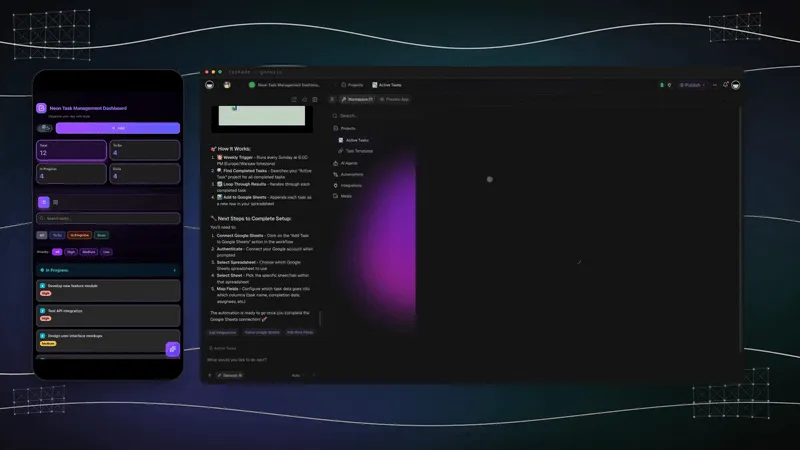
No signup, no credit card. Open the live neon task manager, or browse real apps other people shipped in the Community Gallery and clone one as a starting point. Every one of them runs identically in a browser on Windows, on an Android phone, and on a Mac.
Is OmniFocus free?
No. OmniFocus has no free tier at any level. It offers a 14-day free trial, after which continued use requires a purchase. There is no permanently free version, no free single-project mode, and no free reader.
Here is what OmniFocus actually costs in 2026, taken from Omni Group's own store page:
| Option | Price | What it covers |
|---|---|---|
| Free trial | $0 for 14 days | Full app, then it stops |
| v4 Standard licence | $74.99 one-time | Universal purchase: Mac, iPhone, iPad, Apple Watch, Apple Vision Pro |
| v4 Pro licence | $149.99 one-time | Same devices, plus custom perspectives, focus, Omni Automation |
| Subscription | $9.99/mo or $99.99/yr | OmniFocus Pro on all Apple devices plus web access |
| Web-only add-on | $4.99/mo or $49.99/yr | Browser access for people who already bought a licence |
Two details matter when you compare totals. First, a licence covers the current major version — moving from OmniFocus 3 to 4, for example, was a paid upgrade, so "one-time" means one-time per generation, not forever. Second, the licence does not include web access; if you need a browser, you are back to a recurring $49.99 per year minimum.
What the same money buys in Taskade
| Plan | Taskade | Notes |
|---|---|---|
| Free Forever | $0 | Unlimited projects and tasks with basic views, 2 workspace members, 3 Taskade Genesis apps, 1 AI agent, 10 automation runs per month, 250 MB storage, no AI credits at the start (earn or buy credits), community templates |
| Pro | $10/mo billed annually ($120/yr) | 10 team members, 50,000 AI credits, AI agents and automations, 100 GB storage |
| Business | $25/mo billed annually ($300/yr) | Unlimited seats, 150,000 AI credits, multi-agent workflows, custom domains, API access |
| Max | $100/mo billed annually ($1,200/yr) | Highest credit ceiling for heavy agent and automation use |
| Enterprise | $250/mo billed annually ($3,000/yr) | SCIM user provisioning, dedicated support with a custom SLA |
Monthly billing is available at $20 (Pro), $50 (Business), $200 (Max) and $500 (Enterprise). The free plan is genuinely free forever rather than a trial that expires — which is the direct answer for anyone searching "OmniFocus free". and keep using it at $0 for as long as it serves you.
Solo GTD versus team execution
OmniFocus optimises a loop with exactly one person in it: you capture, you organise, you review, then you personally do every task. For a solo practitioner that loop is close to ideal. It also has a structural ceiling — nothing in the system carries work forward without you, and nobody else can see inside it.
Taskade runs the same capture-organise-review loop, then extends it in two directions OmniFocus does not go: outward to teammates on any operating system, and downward into agents and automations that execute rather than only remind.
Multiple views over the same data
OmniFocus renders your database as filtered lists — perspectives — which is powerful and fast, but it is one visual grammar. Taskade renders the same tasks across multiple views: List, Board, Table and Mind Map as inline tabs, with Docs (Beta), Gantt Chart, Calendar, Actionsheet and Org Chart under the More Views menu. Free covers the basic views; all views come with any paid plan. Switching views does not duplicate or convert anything; a Kanban board and a Gantt chart are two lenses on one dataset. Mind Map is genuinely useful during a GTD project-planning session, where OmniFocus expects you to arrive with the outline already formed.
Real-time collaboration
Multiplayer editing, comments, chat and video meetings live inside every Taskade project, with role-based access from Owner down to Viewer. OmniFocus shares by export. This is the difference between a personal system and a shared one, and it is why "my team is on Windows" is the most common reason people leave OmniFocus rather than any complaint about the app itself.
What Taskade adds on top of structured task management
A task list stores intentions. Taskade's goal is a list that acts on them.
AI agents that run the weekly review
AI Agents v2 come with a large built-in toolkit — web search, website scraping, YouTube transcription, file analysis, image generation, code execution, project management — plus persistent memory and custom tools you define. Point one at a workspace and ask it to surface stale projects, identify tasks with no defined next action, flag blocked dependencies and write a digest. That is the GTD weekly review, running whether or not you sat down on Sunday. It is also the exact ritual OmniFocus supports best on native apps and not at all on the web.
Automations that execute across 100+ integrations
Workflow automations connect Slack, Gmail, Stripe, HubSpot, Salesforce, Notion, Shopify, Google Sheets, GitHub, Calendly and 90+ more. The integrations are bidirectional: triggers pull external events in, actions push data out. A new Stripe charge can open a task; a completed task can update a Salesforce record. OmniFocus's Omni Automation is genuinely capable JavaScript scripting, but it automates inside OmniFocus — it does not reach across your other systems on its own.
Taskade Genesis turns a prompt into a deployed app
Describe a client portal, an ops dashboard, an intake form or a lightweight CRM, and Taskade Genesis returns a deployed application — a live URL, with custom domains, password protection, email-and-password app sign-in, and AI agents embedded inside it. Not a mockup or a prototype. This is the capability gap that has nothing to do with task management at all: your project tracker and the internal tool your team needs come from the same workspace.
Workspace DNA
These pieces are designed as one loop rather than three features. Memory (your projects, files and structured data) is the substrate. Intelligence (AI agents) reasons over it. Execution (automations) acts across 100+ integrations and writes results back into Memory, which makes the next reasoning pass better. Read the Workspace DNA explainer for how the loop closes.
Choose OmniFocus if…
OmniFocus is not a weak product with a platform problem. It is an excellent product with a deliberate platform choice, and for the right person it is the better buy.
- You practise GTD seriously and live entirely on Apple hardware. OmniFocus is the most faithful commercial implementation of Getting Things Done available. Defer dates, sequential and parallel projects, the Forecast view and above all the Review perspective are modelled with a rigour no general-purpose workspace matches. If Apple Watch and Vision Pro are part of your capture habit, nothing else covers that ground.
- You want offline-first native polish above everything else. OmniFocus's apps are fast, keyboard-dense, fully local, and built by a company that has shipped Mac software since 1989. There is no loading spinner because there is no server round-trip. For a solo user who values responsiveness and privacy over connectivity, that architecture is a genuine advantage.
- You prefer to own software outright. The $74.99 Standard and $149.99 Pro licences are real perpetual licences for that major version. If subscriptions bother you on principle, OmniFocus is one of the few serious task managers that still offers a way out — and Omni Automation gives power users deep scripting control on top.
If two or three of those describe you, buy OmniFocus. This page is not trying to talk you out of a good decision.
Why teams choose Taskade
Taskade wins on reach and on what happens after a task is written down. It runs natively on every operating system your team actually uses, so nobody is excluded by their hardware. It adds AI agents, automations and app building that turn a task list into a system that executes. And it starts at $0 rather than $74.99.
| Taskade | OmniFocus | |
|---|---|---|
| Works on every major OS natively | ✅ | ❌ Apple only |
| Free tier | ✅ Free Forever | ❌ 14-day trial |
| Multiple people in one project | ✅ Real-time | ❌ Single-user |
| AI that acts on your tasks | ✅ Built-in toolkit, persistent memory | ❌ |
| Builds and deploys apps | ✅ Taskade Genesis | ❌ |
| Connects to outside systems | ✅ 100+ bidirectional | 🟡 Apple Calendar, Reminders, scripting |
Frequently asked questions
Does OmniFocus work on Windows or Android?
No native app exists on either, and Omni Group has stated it has no plans to build one. Non-Apple access is limited to OmniFocus for the Web, which needs a paid subscription and lacks the Review perspective, notifications and repeat editing. Taskade ships native Windows, Android and Linux apps plus a full web app.
Is there a genuinely free OmniFocus alternative?
Yes. Taskade's Free Forever plan costs $0 indefinitely and includes 2 workspace members, 3 Taskade Genesis apps, 1 AI agent, 10 automation runs per month, 250 MB of storage, and community templates. Free starts with no AI credits: earn credits or buy a credit pack. OmniFocus offers only a 14-day trial with no free tier behind it.
How much does OmniFocus cost?
$99.99 per year or $9.99 per month by subscription, or a one-time licence at $74.99 (Standard) or $149.99 (Pro) covering Mac, iPhone, iPad, Apple Watch and Apple Vision Pro. Web access alone is $4.99 per month or $49.99 per year for licence holders. Major version upgrades are paid.
Can Taskade replace OmniFocus for GTD?
For most workflows, yes. Inbox capture, nested projects, tags as contexts, due dates, recurring tasks and saved filtered views cover the core methodology, and an AI agent can run the weekly review automatically. What Taskade does not replicate one-for-one is OmniFocus's dedicated Review perspective and its defer-date model, both of which are more purpose-built for orthodox GTD.
How does Taskade compare with Nozbe, Todoist and other cross-platform options?
Nozbe, Todoist and TickTick all solve the platform problem — they run on Windows and Android, and if you want a straightforward list manager any of them is a reasonable pick. Taskade differs in what sits on top of the list: multiple project views instead of one, AI agents with a large built-in toolkit, durable automations across 100+ integrations, and an app builder. Choose a list manager if you want a list. Choose Taskade if you want the list to do something.
Does Taskade work offline?
Yes. The native desktop and mobile apps support offline editing and sync changes when you reconnect. OmniFocus's native apps are offline-first by design and remain stronger here for pure solo use; its web client, by contrast, needs an active connection.
Is my data portable?
Yes. Taskade projects export to standard formats and the Community Gallery lets you clone structures in and out freely. There is no proprietary database file you need a specific operating system to open.
Explore Taskade
- AI App Builder — deployed apps from one prompt
- AI Agent Platform — digital teammates with a large built-in toolkit
- Workflow Automation — durable workflows across 100+ integrations
- AI Second Brain — train agents on your own data
- Integrations — 100+ bidirectional connections
- Downloads — Windows, macOS, Linux, iOS, Android and browser extensions
Related reading
- How Workspace DNA Works — the architecture behind Memory, Intelligence and Execution
- Agentic Workflows Explained — what changes when agents execute
- Stop Worshipping Prompts, Start Building Workflows
- Vibe Coding for Teams
- Our manifesto, Build Without Permission
Ready to run the same system on every device your team owns? Build with Taskade Genesis →