





In the Black Mirror episode "Eulogy," a man named Phillip is asked to contribute memories of a woman he once loved. He cannot. Years earlier he cut her face out of every photograph he owned, and what survives is a set of images with a hole where a person used to be.
A guide walks him back into the pictures. He recovers all of it — the birthday call, the proposal in London, the letter he never opened, her face. The reconstruction is total.
Then he attends the funeral, and she nods at him from across the room, and that is the entire yield.
Perfect memory, arrived too late to act on.
TL;DR: We spent a year measuring AI agent memory. A proactive recall feature returned null on 31 of 31 model calls, and an offline replay over 346 stored runs showed why the experiment could never have detected anything. Two identical runs, with nothing changed, differed by 29.6% on average across task types. Two things worked, and neither was a prompt. Build an agent that remembers →
What Failure Mode Are We Actually Naming?
The failure mode is not forgetting. It is remembering perfectly with no path to execution.
That distinction is the whole argument of the Memory Reanimation Protocol essay, and in September 2025 it fit in one line: memory reanimated must mean execution. A system that reconstructs the past beautifully and cannot act on it has not solved the memory problem. It has built a very good archive of a problem it is still having.
This started as a metaphor, and metaphors are cheap. What follows is the part where it met measurement — four results that did not go our way, one noise check that puts them in context, and the two changes that survived.
| # | Negative result | What we observed |
|---|---|---|
| 1 | A written design is not a system | Long memory design documents; none shipped as written |
| 2 | Proactive recall never fired | Null on 31 of 31 model calls |
| 3 | The A/B could not have detected it | The treatment fires about 54% of the time, so a 3 vs 3 test can hold zero treated runs |
| 4 | A prompt rule did not change behavior | A mandated clarifying question fired on 0 of 4 arms |
Why Do AI-Generated Apps Become Unmaintainable?
An AI-generated app becomes unmaintainable because the reasoning behind its shape is discarded at the moment the build completes. The code survives. The decisions do not. Six weeks later someone needs one change, and the file tree offers no answer to the only question that matters: why is it like this?
This is the industrial version of Phillip's outcome. The generation ran. The artifact exists. Nobody can act on it.
Generative builders produce a specific kind of dead shell: a rendered interface over a data model that was never created, an agent with nothing underneath it, an automation that never fires. It looks like an app the way a photograph of a house looks like a house. You find out which parts were never real only when you try to use them.
The standard industry answer is to write a longer specification. Front-load more instruction. Add more rules to the system prompt. The next four sections are why that answer is wrong, measured rather than argued.
What Exactly Evaporates When a Build Finishes?
Four kinds of knowledge die at the same instant, and none of them is the code.
A human engineering team writes all four down as a matter of routine — tickets, commit messages, a design doc, a thread someone can search. A generative build writes down none of them. You can see the consequence at scale in the public app gallery: thousands of working apps, almost none of which carry the reasoning that produced them. That is not a model failure. The model did exactly what it was asked. The loss is structural, and it is the same loss whether the builder is Taskade Genesis, a code generator, or a person working alone at 2am.
What Did We Try First, and Why Did It Not Ship?
We wrote it down. We wrote a great deal of it down: long design documents for a full long-term memory architecture, with a vector store and a knowledge graph.
None of them shipped as written.
What actually shipped was a small fraction of that design: a short instruction and an agreed place to keep the record.
That asymmetry is the first suspicion in this whole story, and it took another eight months to state properly: the thing we wrote was not the thing that changed behavior. A large document describing a memory system is not a memory system. It is a description, and descriptions do not change the starting state of anything.
What Happens When a Memory Feature Never Fires?
It returns null 31 times and produces an experiment with no treatment in it.
We shipped proactive recall — the obvious feature, the one nearly everyone building in this space is building. Whenever older context gets dropped from a long conversation, find the relevant memory and inject it back into the model. Straightforward, defensible, and exactly what an architecture diagram wants.
The recall function returned null on 31 of 31 model calls. Every one. The treated arm of the experiment was byte-identical to its control, because the code path under test never executed. We deleted the module.
That is the embarrassing version. Here is the part that makes it publishable.
Rather than rerun the rounds, we took the real shipped function and replayed it offline across all 346 stored run records we had, at zero model cost, and read off how often it would have fired: 187 of 346, or 54 percent.
Which retroactively invalidated the experiment's own design. A treatment that fires on roughly half of eligible runs is a coin flip, and a three-versus-three A/B on a coin flip has a genuinely good chance of landing zero treated runs — which is precisely what a clean null result looks like from the outside.
The standing rule this produced, which costs nothing to adopt and is the most portable thing in this article:
Any A/B test on a conditionally firing treatment must have its firing rate measured before its sample size is chosen.
Note what the rescue actually was. We did not rerun anything. We read a record of what had already happened, in a different order, and learned something the live experiment could not tell us. Hold that — it comes back in the last section, and it turns out to have a name.
How Much Does an LLM Benchmark Move When Nothing Changes?
More than most published improvements. We ran the same prompt, on the same model, through the same setup, twice, and measured the gap for each task type.
| Measurement | Gap between two identical runs | What it means |
|---|---|---|
| Quietest task type | 10.5% | Even the most stable measurement moved a tenth |
| Mean across task types | 29.6% | A warning sign, not a precise band |
| Noisiest task type | 50.0% | A single arm moved by half on a rerun |
| Aggregate round total | 5.2% | Totals were far tighter than their parts |
That last row is the one that makes the rest credible rather than alarming. Aggregates held steady. Individual measurements did not. If you report a per-arm number from one run, you are reporting a sample from a distribution you have not characterized.
Two runs do not characterize it either. They give one observed gap per task type, which is enough to show the noise is large and not enough to size it precisely. A proper band needs more repeats than we ran.
The consequence, stated once and without any pleasure: most single-run improvements reported in this area sit inside that band.
The working rule we adopted: because the largest gap we saw between two identical runs was 50 percent, we stopped attributing any single-run, per-arm change smaller than that. It is a conservative rule drawn from limited data, not a statistical threshold.
Counts need the same care. Whether one specific build produced a working artifact is a fact about that build. But a count across runs, such as 0 of 4, is an observed count with wide uncertainty, not a zero rate. With four trials, a true rate of more than one half is still consistent with seeing zero.
This is the most generous thing in this article, and we are aware of that. Anyone can take the 29.6 and apply it to our numbers too. Please do. A measuring stick that only measures other people is not a measuring stick.
We Are Not the Only Ones Finding This
Our number comes from one setup and two runs, so it is worth knowing that independent groups measuring completely different things keep landing in the same territory.
METR held the model and the task set constant and changed only the evaluation infrastructure — same model, same tasks, different harness. GPT-4o's measured time horizon went from 9.2 minutes to 6.0 minutes on infrastructure choice alone. Nothing about the model changed.
METR is careful about what that does and does not establish, and the distinction is the whole lesson: the shift that reached statistical significance was in task success rates for two of five models, while the time-horizon estimates themselves still fell inside the earlier bootstrapped confidence intervals. Which is the point. The headline number moved by a third, and the measurement was too noisy to call that move real.
Chroma's context rot research — 18 models, 194,480 LLM calls — found something stranger and more useful: a coherent, well-organized document is harder for a model to search than the same content shuffled into random order. Consistently, across every model they tested. Which quietly invalidates the advice, repeated in almost every context-engineering guide including some of ours, to always organize your context well.
| Who | What they varied | What moved |
|---|---|---|
| Us | Nothing at all | Two-run gap of 10.5–50.0% per task type, mean 29.6% |
| METR | Only the eval harness | GPT-4o: 9.2 min → 6.0 min |
| Chroma | Only haystack structure | Coherent text scored worse than shuffled |
Three groups, three methods, one conclusion: the thing you are measuring moves a lot when you are not touching it. If your evaluation has never been rerun unchanged, you do not have an evaluation — you have an anecdote with a decimal point.
What Actually Worked?
Two things, and neither was a prompt.
The first is that a change to the agent's environment beat a rule written into its instructions in every round where we tested both. One example, because it is the cleanest: we changed what a single tool said when the agent guessed a wrong file path. Nothing else. Tool errors fell from 7 to 3 and steps from 28 to 17. That is one run per arm, so treat the size of the drop with the caution the section above asks for. The direction is the finding.
Against that, a mandated clarifying question — written explicitly into the instructions — fired on 0 of 4 arms across three model families, all four of which hit exactly the ambiguity it was written for. Four arms cannot prove the rule never fires. They do show it failed every time we gave it the chance.
The second is the offline replay that rescued the recall experiment: reading a stored record of past work, in a new order, taught us more than another live run could have. The last section comes back to it.
The agent learns from the environment's response, not from being told in advance.
This finding is large enough, and useful enough outside our own stack, that it gets its own article: Structure Beats Instruction covers the cases in full, the economics of why a prompt rule is expensive and an artifact is cheap, and the independent replication of the same direction in a September 2026 paper from Google and Google DeepMind.
What Does Memory Look Like If Structure Wins?
If structure beats instruction, then memory should be structure rather than instruction. That single move decides the architecture.
Two roots, holding two different substances:
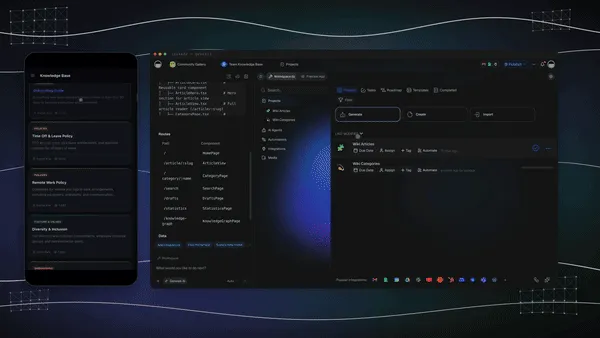
The record is not a log file and not a sidecar service. It is an ordinary Taskade project — same views, same editing, same sharing. You can open it, read it, and argue with it. That last verb is the entire design.
There is also an order to how the layers get built:
     storage  ─────►  intelligence  ─────►  execution  ─────►  interface
   (projects)        (agents grounded      (flows wired      (the app
                      on that storage)      to both)          people see) ▲ build order runs left to right
 ▼ failure mode runs right to left: an interface built first
   is a photograph of the app underneath it
Build the interface first and you get a convincing screen with nothing underneath it. Build the storage first and every later layer has something real to stand on.
Why Does One Record Need Four Consumers?
Because the alternative is four copies that disagree with each other by Thursday.
A single project row is simultaneously read by four different kinds of consumer, without a synchronization layer between them:
There is no sync layer because there is nothing to sync. The agents and the automations are not integrated with the data — they are pointed at it.
Why Is Legibility the Whole Bet?
Because a person can correct legible memory and cannot correct opaque memory.
This is the Bill Atkinson argument, and it is the strongest claim in the architecture. HyperCard's real contribution was never the scripting language. It was that the data model was the thing on the screen. A person who was not a programmer could open a stack, see the cards, change a field, and understand exactly what had changed.
A vector index cannot be corrected by the person it is wrong about. A markdown record can — and it is the only kind of memory you can replay.
Both halves of that sentence carry weight, and the second half is newer than the first.
The humane half: if an agent believes something wrong about a customer, and that belief lives in an embedding inside a vector database, the customer has no route to the mistake. There is no row to edit. If the same belief lives in a readable record of decisions, anyone can open it and fix the line.
The engineering half: a record that is structured, carries outcomes, and can be walked in a different order is replayable. That is what let us score the recall function across 346 run records without paying to rerun a single one. An embedding is not replayable, because "what happened next" was never a field in it.
| Property | Readable record of decisions | Vector index of the same decisions |
|---|---|---|
| A non-technical person can read it | Yes | No |
| The person it is wrong about can fix it | Yes | No |
| You can diff two versions | Yes | Not meaningfully |
| You can walk it in a different order | Yes | No |
| You can score an alternative strategy offline | Yes | No |
| Sub-second similarity search over millions of items | No | Yes |
That last row is real and we are not pretending otherwise. Vector search is excellent at the job it has. It is simply not a memory a human being can argue with, and arguing with it is the requirement.
The discipline that follows: memory is a prior, not an authority. If the record disagrees with what a tool just returned, the tool is right. Fix the entry and move on. A memory system that outranks live evidence is not a memory system, it is a hallucination with a filing cabinet.
What Can We Still Not Prove?
Four things. Stating them is why the rest of this article is believable.
- That the build order reduces dead shells. We observed the defect by hand and observed the fix by hand. We never ran a controlled comparison.
- That describing a task as a story beats describing it as a checklist for the same underlying steps. No ablation exists. It is a hypothesis with a good story attached, which is the most dangerous kind.
- That edit N gets cheaper because edits 1 through N-1 were recorded. This is the compounding claim — the one that would justify the entire architecture commercially — and it is unmeasured. We now know how we would measure it: replay the recorded work and score the alternative offline. We have not built the loop that does it.
- That a legible store beats an opaque one on task outcomes. Argued above, and argued well, but never measured against a vector baseline.
We could cut this section and the article would read stronger. It would also be worth less, because the four negative results above are only credible in the company of the four open questions here.
The Carol Test: One Prompt You Can Run Anywhere
Here is a single acceptance test you can run against any AI builder, including ours, including a competitor's.
Type this:
Help me remember Carol
Pass requires four layers and at least one path that runs end to end:
| Layer | What must exist |
|---|---|
| Memory | Somewhere to put the fragments that persists, and that a person can open and edit |
| Intelligence | Something that reads them and asks the next question instead of waiting to be told |
| Execution | Something that acts before the funeral rather than after it |
| Interface | A place a grieving person can actually use |
Fail is a beautiful memorial page with nothing behind it. A photograph of an app. Phillip's outcome.
Run it against whatever you use. We would rather you checked than believed us. Run it here.
What Compounds From Here
The last section left one thread loose on purpose. When recall came back null, we rescued the experiment by reading a record of work that had already happened, in an order nobody had walked before, at zero cost.
In September 2026 a team at Google and Google DeepMind published that move as a method. Their framing is that a completed run is not merely history — it is a simulator, because every decision in it is stored next to the outcome that decision actually produced. Score an alternative strategy by reading, deploy only the winner. We wrote a plain-English walkthrough of it: Replay Simulators Explained.
We have done that replay four or five times. Every one by hand, every one to settle a single argument. We have not built the loop, and this article is not a claim that we have.
What we have built is the precondition: a record that is structured, legible, and owned by the person it describes. A workspace that remembers how it was built is a workspace that can eventually get better at building. That is a direction, not a roadmap, and it has no date attached to it.
I built the first version of Taskade in a flooded basement on a hand-me-down machine, with nobody around to ask for permission. The point was never that the machine remembers. The point is that you can read what it remembered, and fix it.
▲ ■ ● Memory, Intelligence, Execution — in that order, because the surface needs something underneath it.
Build something that remembers being built →
Deeper Reading
The architecture and the lineage
- Memory Reanimation Protocol — the architectural piece this article is the measured sequel to
- Structure Beats Instruction — the positive finding in full, with the independent replication
- Replay Simulators Explained — the method behind the 346-record rescue
- The Execution Layer — why memory without execution is an archive
- The Genesis Equation — memory as a multiplier rather than a feature
- The Living App Movement — what a system that keeps running looks like
- Which AI App Builder Remembers Why? — 10 builders checked for the record this article argues for
Evaluation and context
- Context Engineering: The Complete Field Guide — the five layers, and the anti-patterns
- A History of Prompt Engineering — how the field arrived at context
- The Frontend Playground Era — why generated interfaces outrun their foundations
- Multi-Agent Systems in Production — what actually survives contact with users
Concepts
- Agent Memory · Memory Types · Persistent Memory
- Context Window · Context Rot · Context Compaction
- Evals · Non-Determinism · LLM as a Judge
- Agent Evaluation · Agent Harness · Agent Loop
- Retrieval-Augmented Generation · Knowledge Graph
Frequently Asked Questions
Does AI agent memory actually improve agent performance?
Not automatically, and not in the way most implementations assume. In our own controlled test, a proactive recall feature that injected relevant memory back into the model whenever older context was dropped returned null on 31 of 31 model calls. The treated arm was byte-identical to its control, so there was no treatment to measure at all. Memory improves agent performance when it changes the starting state of a task. It does not improve performance merely by being present in the architecture diagram.
What is a noise floor in LLM evaluation?
A noise floor is how much a measured result moves when you change nothing. You run the same prompt, on the same model, through the same setup, more than once, and you record how far the results move. We ran ours twice, which gives one observed gap per task type rather than a full distribution. Those gaps ranged from 10.5 percent to 50.0 percent with a mean of 29.6 percent, while aggregate round totals moved only 5.2 percent. Two runs are enough to show that the noise is large, not to size it precisely. Any reported improvement smaller than the gaps you observe with nothing changed is not yet evidence of an improvement.
Why did proactive memory recall return null every time?
The recall function was conditional. It only fired when a specific set of conditions held, and in the three treated runs of the experiment those conditions never held. The failure was not that recall retrieved bad memories. The failure was that recall never ran, so the treated arm and the control arm executed identical code paths. We only discovered this by replaying the shipped function offline across 346 stored run records, where it would have fired for 187 of them, a 54 percent firing rate.
How do you design an A/B test for a conditionally firing feature?
Measure the firing rate before you choose the sample size. A treatment that fires on roughly half of eligible runs behaves like a coin flip, so a three-versus-three design has a real chance of producing zero treated runs and a result that looks like a clean null. The standing rule we adopted is that any A/B test on a conditionally firing treatment must have its firing rate measured first, and the sample size chosen from that rate rather than from convenience.
Is a bigger context window the same as memory?
No. A context window is what a model can attend to in a single call, and it empties when the session ends. Memory is a record that survives the session and changes the starting state of the next one. The distinction matters commercially because context windows are sold as a capability while memory is an architecture decision. A million-token window that resets every session is a larger whiteboard, not a longer memory.
What does it mean to say structure beats instruction for AI agents?
It means a change to the agent's environment usually outperforms a rule written into its prompt. In one of our rounds a mandated clarifying question fired on 0 of 4 arms across three model families, because it competed with other, more general instructions and lost. Four arms is a small sample, but not once in four is hard to call working. In a different round, changing what a single tool said when the agent guessed a wrong path cut tool errors from 7 to 3 and steps from 28 to 17. The agent learns from the environment's response, not from being told in advance.
Why does legible memory matter more than fast memory?
Because a person can correct legible memory and cannot correct opaque memory. If an agent's memory is a markdown record of decisions, anyone can open it, see the wrong entry, and fix it. If the same memory is an embedding in a vector store, the person the memory is wrong about has no way to reach the mistake. Legibility also makes a record replayable, which is the precondition for evaluating a change cheaply instead of paying to rerun it.
What are the four kinds of knowledge lost when an AI build finishes?
Four things vanish the moment generation completes: what the person actually asked for in their own words, what got decided and which alternatives were rejected, what was deliberately left out of scope, and what is still blocked and waiting on a human. A human engineering team records all four as a matter of routine through tickets, commit messages and documents. A generative build typically records none of them, which is why the code works and nobody can safely change it six weeks later.
What is the difference between projects and project memory in Taskade?
They hold two different substances. Projects hold what the app knows, meaning the live data the running system reads and writes. Project memory holds why the app is shaped the way it is, meaning the decisions, the rejected alternatives, the deliberate omissions and the open questions. Both are ordinary Taskade projects with the same views, editing and sharing, so a person can open either one and argue with it.
Should you trust a single-run benchmark result for an AI agent?
No, unless the reported improvement is much larger than the gap you observe between identical runs. Whether one specific build produced a working artifact is a fact about that build. But as soon as you generalize to a rate across runs, categorical outcomes need repeated trials too. An observed 0 of 4 is a count, not a zero rate, and a true rate above one half is still consistent with it. A magnitude, such as a percentage improvement in steps or tokens, needs repeated runs before it means anything.
What is a replay simulator for AI agents?
A replay simulator is a completed run treated as an environment. If a record stores each decision alongside the outcome that decision actually produced, an alternative strategy can be scored by walking the record in a different order and reading the stored results, rather than by paying to run the whole process again. A 2026 paper from Google and Google DeepMind formalizes this idea for long-horizon discovery, and it is the reason a legible record is worth more than a fast one.