Quantum AI is the practice of running many candidate answers in parallel and merging only what survives across all of them — instead of betting everything on a single pass. It's the same math (superposition, interference, measurement) that makes quantum computers work, applied to LLM reasoning. Taskade Genesis Quantum uses this approach to generate apps where wrong answers cancel out and correct ones reinforce — making the result structurally robust by construction, not by luck.
Why Taskade Genesis Quantum Matters
Most AI app builders generate one app per prompt. If the model picks a slightly wrong feature, slightly wrong schema, or slightly wrong agent prompt — that's what you ship. You only know it was wrong once you've used it for an hour.
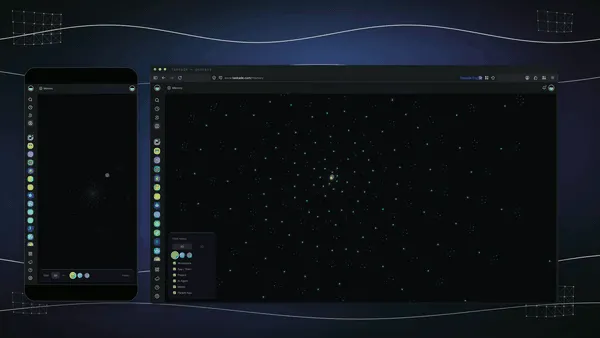
Taskade Genesis Quantum runs N candidate apps in parallel in isolated sandboxes (the "superposition chamber"), then performs a structural diff on Workspace DNA primitives — Project, Agent, Automation, Interface — and:
- Invariants (things every branch agreed on) commit straight to the final app
- Divergences (things branches disagreed on) surface as questions to the user
- Outliers (one branch's wild idea) get discarded
This is exactly how quantum computing works: parallel branches interfere, wrong answers cancel, right answers reinforce. The substrate is different (qubits versus LLM activations), but the skeleton is identical.
The Three Pillars Mapping
| Quantum Concept |
Taskade Genesis Quantum Equivalent |
What It Does |
| Superposition |
N parallel candidate Workspace DNAs |
Each sandbox evolves a complete app independently |
| Interference Merge |
Structural diff on DNA primitives |
Stable identifiers (not whitespace) make merge deterministic |
| Measurement Collapse |
User picks among divergences |
Ask-Questions tool surfaces ambiguity for human decision |
| Decoherence Shield |
Overlay-only branch isolation |
Parent workspace untouched; cross-branch contamination impossible |
| branchTrace |
Real Project preserving reasoning history |
Every branch is forkable, shareable, auditable |
Articles in This Category
Key Reading
How To Get Started
- Open Taskade and prompt the EVE meta-agent: "Build a CRM dashboard for a sales team of 10."
- Taskade Genesis fans out into N parallel branches (auto-tuned: 4 for new spaces, 16 for Deep Think).
- The interference merge surfaces a few divergences — for example: "Two branches added a deals pipeline; two added a contacts inbox. Which is the entry point?"
- You answer; the merge collapses; the final app ships.
- Open the branchTrace Project to see how all candidate apps reasoned. Fork any branch you liked.
This is what people mean by "quantum AI" in 2026: not quantum hardware, but quantum-inspired reasoning architectures running on classical compute.
