







An AI tutor is software that teaches you instead of answering for you. A good one asks you a question before it explains, checks what you understood, changes the next step to fit your answer, and makes you judge your own work. A chatbot does the opposite by default: it gives the answer, fast and complete.
That difference is the whole story of this guide. In 2025 ChatGPT, Gemini and Claude all shipped a "study" or "learning" mode, Khan Academy kept building Khanmigo, and a wave of apps promised a personal tutor for every student. Some of them teach. Some of them do your homework with extra steps.
This guide compares 12 tutoring tools that are available in November 2026 (11 AI tutors, plus Tutor.com as a human-tutor benchmark), from ChatGPT study mode, Gemini Guided Learning and Claude Learning mode to Gemini Notebook (formerly NotebookLM). It explains the research that made "AI tutor" a category, and shows how to build a tutor that knows your own course notes. We compared the tools from their public product pages, pricing pages and documentation in November 2026. We did not run a classroom trial, and we say so where a fact comes from a third party.
TL;DR: Khanmigo leads for US K-12 school subjects at $4/month. ChatGPT study mode, Gemini Guided Learning and Claude's Learning mode are the best free general tutors. Gemini Notebook wins for your own readings. For a tutor that knows your exact syllabus, build a custom tutor agent with your notes as its knowledge.
Quick Answer: The Best AI Tutor for Each Learner in 2026
The best AI tutor in 2026 is the one that matches your subject, your age and the material you study from. Khanmigo is the strongest structured tutor for US school subjects. ChatGPT study mode, Gemini Guided Learning and Claude's Learning mode are the best general tutors, and each one has a free option. Gemini Notebook is the best tutor for your own readings.
| Tool | Best for | Default move | Free option | Paid from (checked Nov 2026) |
|---|---|---|---|---|
| Khanmigo | US K-12 school subjects | Asks guiding questions | Free for teachers in select countries | $4/mo or $44/yr |
| ChatGPT study mode | Any subject, on demand | Asks about your goal, then hints | Yes, on Free | Included in paid ChatGPT plans |
| Gemini Guided Learning | Visual, step-by-step lessons | Questions, diagrams, videos | Yes, signed in | No plan listed by Google |
| Claude Learning mode | Reasoning and writing, adults | Socratic questions | Yes, in the style menu | Included in paid Claude plans |
| Gemini Notebook | Your own readings and notes | Learning Guide questions | Yes | Higher limits on Google AI plans |
| Synthesis Tutor | Ages 5 to 11, elementary math | Adaptive lessons | 7-day trial | $29/mo or $119/yr |
| Duolingo Max | Language conversation | Roleplay and video call practice | Duolingo free tier | Top Duolingo tier |
| Photomath | Math steps from a photo | Shows worked steps | Basic plan, $0 | $9.99/mo or $69.99/yr |
| Google Lens homework | Snap a question, get help | Explains the problem | Yes | None |
| CK-12 Flexi | Free math and science help | Explains and answers questions | Yes, free | None |
| StudyFetch Sparky | Turning lecture files into study sets | Explains your uploads | Free to start | Premium tier |
| Tutor.com | A human tutor, any hour | Live human session | Through some programs | Varies by program |
Prices are only listed where the vendor's own page showed a number on the day we checked. "Included" means the feature is part of the plan, not a separate charge.
What Is an AI Tutor, and How Is It Different From a Chatbot?
An AI tutor is an AI system that is designed to make you learn, not to finish your task. It holds back the answer, asks what you already know, checks your reply, and adjusts. A general chatbot is designed to be helpful in the moment, so it hands over a complete answer. For learning, that "help" often removes the exact effort that builds memory.
The researchers who studied human tutors for decades describe the same pattern. A tutor is not a fast encyclopedia. A tutor is a loop of questions, attempts, feedback and correction. Arthur Graesser and his colleagues recorded real tutoring sessions in the 1990s. They found that ordinary tutors rarely used advanced teaching strategies, and that the sessions ran on a simple loop: the tutor asks, the student answers, the tutor gives feedback, and the two improve the answer together (Graesser, Person and Magliano, 1995, Applied Cognitive Psychology). Their work also showed that the classic tutor question, "Do you understand?", is a weak check, because students often say yes when they do not.
Here are the four moves that separate a tutor from a chatbot:
| Tutor move | What a good tutor does | What a default chatbot does |
|---|---|---|
| Asks before it tells | "What do you think the first step is?" | Writes the full solution |
| Checks understanding | Gives a new problem to test the idea | Asks "Does that make sense?" |
| Adapts | Changes the next question to your mistake | Gives the same depth to everyone |
| Builds self-judgment | "How sure are you? Check your own answer." | Tells you whether you are right |
The fourth move matters most and gets the least attention. Psychologists call it metacognition: your ability to monitor what you know and to control what you do next. Thomas Nelson and Louis Narens described it in 1990 as two flows between a "meta level" and an "object level" in your mind (Nelson and Narens, 1990, The Psychology of Learning and Motivation). Monitoring sends information up ("I am not sure about step two"). Control sends decisions down ("so I will rework step two"). The diagram shows one pass: monitoring goes up from the problem, and control comes back down as your next step on it. Each new step starts the next pass. A good tutor trains both flows. A chatbot that grades your work for you trains neither. Our explainer on what metacognition is covers the full model.
The mathematician Po-Shen Loh, former head coach of the US team at the International Mathematical Olympiad, put this shift in one line in a 2025 interview: people used to go to school to learn how to do the homework, and now everyone needs to learn how to grade the homework. An AI tutor that asks you to grade your own answer is practice for that skill.
Bloom's 2 Sigma Problem: Why AI Tutoring Became a Category
Bloom's 2 sigma problem is the reason the AI tutor category exists. In 1984 Benjamin Bloom reported that students taught one to one with mastery learning scored about two standard deviations above students in a conventional class. The average tutored student did better than about 98 percent of the conventional class. Bloom asked how to get that result without a tutor for every child.
Bloom published the finding in "The 2 Sigma Problem: The Search for Methods of Group Instruction as Effective as One-to-One Tutoring" (Bloom, 1984, Educational Researcher 13(6), 4-16). The data came from dissertations by two of his doctoral students at the University of Chicago, Joanne Anania and Arthur Burke. The studies compared three groups.
| Group | How students were taught | Result Bloom reported |
|---|---|---|
| Conventional | About 30 students per teacher, regular tests | The baseline |
| Mastery learning | About 30 students per teacher, plus short formative tests and corrective work until each student reached a set standard | About 1 standard deviation above conventional |
| Tutoring | One to three students per tutor, with the same formative tests and correctives | About 2 standard deviations above conventional |
Read the table again, because the detail matters for AI. The tutoring group did not get "a tutor" alone. It got a tutor plus mastery learning: frequent checks, and correction before moving on. Half of the 2 sigma came from the mastery structure that the second group also had. An AI tutor that only chats, with no checks and no mastery standard, copies the half that is easier to build.
Citation capsule: Bloom (1984) reported that one-to-one tutoring with mastery learning raised achievement by about two standard deviations over a conventional class, and that mastery learning alone added about one. Paul von Hippel (2024, Education Next) traced the figure to two short experiments with narrow tests, and later reviews found tutoring effects between about 0.3 and 0.8 standard deviations.
What Later Research Found: Smaller Effects, Still Large Enough to Matter
Later research confirmed that tutoring works, but at a smaller size than Bloom's 2 sigma. Kurt VanLehn's 2011 review found an effect of about 0.79 standard deviations for human tutoring and 0.76 for step-based intelligent tutoring systems. A 2020 working paper that pooled 96 tutoring studies found an average of 0.37, and its 2024 peer-reviewed version reports 0.29. Von Hippel notes that none of the 96 studies produced a two-sigma effect.
Here is the evidence in one place, with the caveat each study carries:
| Study | Venue | What it measured | Finding | Caveat |
|---|---|---|---|---|
| Bloom 1984 | Educational Researcher | Tutoring plus mastery learning | About 2.0 SD | Short studies, narrow tests |
| VanLehn 2011 | Educational Psychologist | Human tutors and computer tutors vs no tutoring | Human 0.79 SD, step-based ITS 0.76 SD | Effects vary with study design |
| Kulik and Fletcher 2016 | Review of Educational Research | 50 evaluations of intelligent tutors | Median 0.66 SD | Smaller on standardized tests |
| Nickow, Oreopoulos and Quan 2020 | NBER Working Paper 27476 | 96 PreK-12 tutoring experiments | Pooled 0.37 SD (0.29 SD in the 2024 American Educational Research Journal version) | Mostly human tutors |
| Pane and colleagues 2014 | Educational Evaluation and Policy Analysis | Cognitive Tutor Algebra I in 7 states | No effect in year 1, about 0.21 SD in year 2 (high school) | Real schools, real scale |
The studies above used different tests and different control groups, so the bars are not a strict ranking. They show a direction. The famous 2 sigma is an upper bound from small, short experiments. The everyday effect of good tutoring is a third to four fifths of a standard deviation. That is still large. Von Hippel wrote that a gain of about one third of a standard deviation would be "a huge triumph" if a program delivered it at low cost, at large scale and on a broad test (von Hippel, 2024, Education Next 24(2)).
VanLehn's review also overturned a common belief. Many researchers expected human tutors to be far ahead of computer tutors. In his review, step-based computer tutors were almost as effective as humans (VanLehn, 2011, Educational Psychologist 46(4), 197-221). The key was granularity: a tutor that responds to each step, not only to the final answer, gets most of the benefit.
What the 2025 Studies Add About Large Language Model Tutors
Three studies from 2025 tested tutors built on large language models, and together they explain why "study modes" exist.
| Study | Setting | Result |
|---|---|---|
| Kestin and colleagues, Scientific Reports, 2025 | 194 students in Harvard's largest introductory physics course, crossover design | A purpose-built AI tutor produced median learning gains more than double those of an in-class active-learning lesson |
| Bastani and colleagues, PNAS, 2025 | High school math students in Turkey, randomized | An answer-giving chatbot raised practice grades by 48% and lowered later exam grades by 17%. A hint-only tutor raised practice grades by 127% and largely avoided the exam harm |
| LearnLM team and Eedi, preprint, 2025 | 165 students in five UK secondary schools, expert tutors supervised every AI message | Supervised AI tutoring was at least as effective as human tutors, and students solved new problems 5.5 percentage points more often |
The Harvard tutor was not a general chatbot. Its designers built it on the same teaching practices as the in-class lesson, with structured prompts and step-by-step guidance (Kestin et al., 2025, Scientific Reports 15, 17458). The Turkish study shows the other side: the same underlying model hurt learning when it gave answers, and helped when guardrails made it give hints (Bastani et al., 2025, PNAS 122(26)). The UK preprint is promising, but a human expert approved each AI message, so it does not show how an unsupervised tutor performs (LearnLM Team and Eedi, 2025, arXiv:2512.23633).
The lesson for anyone who picks an AI tutor is short. The design decides the outcome. The same model can raise or lower your exam score, depending on whether it does the thinking for you. Every tool in this guide is judged on that question first.
A Short History of AI Tutors: From PLATO to Study Modes
AI tutors are 65 years old. The first computer-based teaching system, PLATO, started at the University of Illinois in 1960. Intelligent tutoring systems followed in the 1970s, Carnegie Mellon's Cognitive Tutor reached real classrooms in the 1990s, Khan Academy and Duolingo scaled free practice in the 2010s, and large language models turned every chatbot into a possible tutor after 2023.
| Year | Milestone | Why it matters for tutors today |
|---|---|---|
| 1960 | PLATO starts at the University of Illinois, led by Donald Bitzer | The first general system for computer-assisted teaching. Control Data Corporation later sold it to other institutions |
| 1970 | SCHOLAR by Jaime R. Carbonell teaches South American geography in a dialogue | It stored knowledge apart from the program, so it could ask and answer new questions (IEEE, 1970) |
| 1984 | Bloom's 2 sigma problem | Set the goal the whole field still chases |
| 1995 | Cognitive Tutor results published by John Anderson, Albert Corbett, Kenneth Koedinger and Ray Pelletier | Tutors that track each skill a student has mastered, through "knowledge tracing" |
| Late 1990s | AutoTutor from Arthur Graesser's group | A tutor that holds a conversation in natural language |
| 2008 | Khan Academy is founded | Free video lessons and mastery practice at internet scale |
| 2012 | Duolingo opens to the public | Game-style daily practice for language learners |
| 2014 | Cognitive Tutor Algebra I tested in middle and high schools across 7 states | A rare at-scale randomized test of a computer tutor |
| March 2023 | Khanmigo and Duolingo Max launch with GPT-4 | Language models enter tutoring products |
| April 2025 | Claude for Education launches Learning mode | The first major "learning mode" in a general assistant |
| July 29, 2025 | ChatGPT study mode | A tutor setting inside the largest chatbot |
| August 2025 | Gemini Guided Learning (August 6) and Claude Learning mode for all users (August 14) | ChatGPT, Gemini and Claude all have a tutor mode |
| September 2025 | Gemini Notebook adds Learning Guide, flashcards and quizzes | Tutoring grounded in your own sources |
Two ideas from this history still decide whether a tutor works. The first is step-level feedback. The Cognitive Tutor responded to each step of an algebra problem, not only to the answer. The second is a model of the student. Corbett and Anderson's knowledge tracing estimated, skill by skill, what a student had mastered (Corbett and Anderson, 1995, User Modeling and User-Adapted Interaction). Most chat tutors in 2026 still do the first well and the second poorly, because a single chat does not remember which skills you mastered last week. A tutor with persistent memory of your course and your mistakes closes part of that gap.
How We Compared These AI Tutors
We compared each tool on the four tutor moves, on who it is for, on price and on whether it can use your own material. We read each vendor's product page, pricing page and help documentation in November 2026. Where a fact came only from a news report or a third-party review, the text says so. We did not run a controlled learning trial with any of these tools.
| Criterion | The question we asked |
|---|---|
| Asks before it tells | Does the tool hold back the answer and ask a question first by default? |
| Checks understanding | Does it test the idea with a new question, not "does that make sense"? |
| Adapts | Does the next step change based on what you got wrong? |
| Builds self-judgment | Does it ask you to rate or check your own answer? |
| Your own material | Can it teach from your syllabus, notes or readings? |
| Access and price | Who can use it, at what age, and what does the vendor charge? |
The order below runs from structured school tutors, through the general assistants, to specialist tools. It is not a single score, because a seven-year-old learning fractions and a graduate student reading papers need different tutors.
1. Khanmigo: Best Structured Tutor for K-12 School Subjects
Khanmigo is Khan Academy's AI tutor, and it is the strongest structured tutor for US school subjects in 2026. It guides students with questions instead of handing over answers, and it sits on top of Khan Academy's lessons and exercises. Learners and parents pay $4 a month or $44 a year, and teachers in select countries get Khanmigo for Teachers free.
| Fact | Detail (from khanmigo.ai, November 2026) |
|---|---|
| Price | $4/month or $44/year for learners and parents, before sales tax |
| Who can buy | Parents and learners in the United States with a US billing address |
| Age | 18 or older to sign up alone. A parent adds children under 18, up to 10 per account |
| Subjects | Math, science, coding, history, humanities, writing, college admissions and career coaching, from elementary school to college |
How Khanmigo tutors. Khanmigo launched in March 2023 as a limited pilot, alongside the GPT-4 release. Khan Academy designed it from the start to avoid giving answers. A student who asks "what is the answer" gets a question back, such as what they tried and where they got stuck. Because Khanmigo lives inside Khan Academy, it can point a student to the matching lesson or exercise. That pairs the chat with a mastery structure, which is the half of Bloom's result that most chatbots skip.
Strengths. Khanmigo is built for school students, not adapted for them. It has a clear pedagogy, a nonprofit behind it, parent controls, and content that maps to the subjects students take. Teachers get a separate toolset for lesson planning. It is a sensible first tutor for a family that already uses Khan Academy.
Watch for. The learner and parent plans are for the United States only. Khanmigo is strongest inside Khan Academy's own content, so it does not know your teacher's slides or your exact syllabus. A child in an active Khan Academy classroom can have different access, and classroom use goes through school or district programs, not individual teachers. Our AI math tutoring guide compares Khanmigo with math-specific tools.
2. ChatGPT Study Mode: Best Free General Tutor for Any Subject
ChatGPT study mode is a tutor setting inside ChatGPT, and it is the most widely available free AI tutor in 2026. OpenAI launched it on July 29, 2025. In study mode, ChatGPT asks about your goal and level, gives hints and guiding questions instead of finished answers, and quizzes you as you go. OpenAI's pricing page lists study mode on the Free, Go, Plus and Pro plans.
| Fact | Detail |
|---|---|
| Price | Included on every ChatGPT plan listed on chatgpt.com/pricing, including Free |
| How to open it | At launch: the Tools menu, then "Study and learn". Also chatgpt.com/studymode |
| Platforms | Web, desktop, iOS and Android, according to OpenAI's release notes |
| Models | Works with any model available in ChatGPT, according to OpenAI's release notes |
How study mode tutors. ChatGPT study mode changes the assistant's default behavior. It starts with questions about what you want to learn and what you already know. It breaks a topic into parts, checks each part with a question, and holds back the full answer while you work. It can also build a quiz from a topic or from a file you share. Because it sits inside ChatGPT, it works on almost any subject, from organic chemistry to a history essay outline.
Strengths. Study mode is free, fast and familiar. Most students already have ChatGPT, so there is nothing new to install. You can ask follow-up questions, or ask it to go "slower" or make it "harder". For a quick explanation of one idea the night before a test, it is hard to beat.
Watch for. One click turns study mode off, so it depends on your discipline. It has no course structure, no long-term plan and no record of which skills you mastered. Third-party guides reported in 2026 that the menu entry moved or disappeared for some accounts, while OpenAI's pages still list the feature. If you do not see it, try the chatgpt.com/studymode link. For students who want the answer and the steps, our sibling guide to AI homework helpers covers that job.
3. Gemini Guided Learning: Best Visual, Step-by-Step Tutor
Gemini Guided Learning is a learning mode inside Google's Gemini app, and it is the best general tutor for visual, structured lessons in 2026. Google announced it on August 6, 2025. Guided Learning breaks a topic into steps, asks questions as it goes, and adds images, diagrams and YouTube videos. Google's help page says you must be signed in to Gemini to use it.
| Fact | Detail (from Google's Gemini help page) |
|---|---|
| How to open it | On a computer: Add files, then More tools, then Guided Learning |
| Extras | Images and diagrams, YouTube videos (with Gemini Apps Activity on), practice questions with feedback and hints |
| OpenStax | Type @OpenStax to draw on OpenStax textbooks. US, English, not for users under 18 or school accounts |
| Price | Google's help page names no plan requirement. You must be signed in to Gemini |
How Guided Learning tutors. Gemini Guided Learning acts like a patient teacher with a whiteboard. Ask about photosynthesis and it explains one stage, shows a diagram, and asks a question before the next stage. Ask it for practice and it writes multiple-choice or open-ended questions, then gives hints when you miss. Google said at launch that Guided Learning was built to guide learners with questions and step-by-step support instead of the answer alone.
Strengths. The visual layer is the main strength. Diagrams and short videos help learners who struggle with walls of text. Gemini also connects to Google Classroom for schools that use Google Workspace for Education, and the OpenStax option gives adult US learners a citable textbook source.
Watch for. Some features depend on your account type, age and country. Video answers need Gemini Apps Activity turned on, which some families prefer to leave off. Like ChatGPT study mode, Guided Learning does not keep a structured record of your mastery across weeks. Third-party testers disagree on whether Gemini or ChatGPT is the better math tutor, so try both on a problem from your own course.
4. Claude Learning Mode: Best Socratic Tutor for Adult Learners
Claude's Learning mode is a style setting in Anthropic's Claude that makes it guide you with Socratic questions instead of answers. Anthropic first offered it in Claude for Education in April 2025, then opened it to every Claude.ai user on August 14, 2025. It is the best general tutor for adults who want to reason through hard ideas, essays and code.
| Fact | Detail |
|---|---|
| How to open it | Pick "Learning" in the style menu on Claude.ai |
| For coders | Claude Code has a Learning output style that leaves small parts of the code for you to write |
| Schools | Claude for Education is sold to universities |
| Age | Anthropic's consumer apps are for adults, 18 and older |
How Learning mode tutors. Claude in Learning mode answers a question with a question. Ask it to explain why a proof works and it asks which step you find hardest, then walks you toward the reason. Ask it to fix your essay and it asks what your main claim is, then helps you test each paragraph against that claim. In Claude Code, the Learning style works like pair programming: it builds most of a change and leaves a marked piece for you to write.
Strengths. The Socratic style is a style you choose, not a one-time prompt, so you do not have to repeat the rules in every message. It works well for writing, philosophy, law, economics and programming, where the goal is reasoning, not a numeric answer. The coding version is one of the few tutors built for developers who want to learn while they ship.
Watch for. Claude.ai consumer accounts are for adults, so this is not a tool for younger students. The Learning style can feel slow when you only need a fact. Like the other assistants, a chat does not track your mastery of a course over time unless you give it your notes and a structure.
5. Gemini Notebook: Best AI Tutor for Your Own Readings and Notes
Gemini Notebook is Google's research and study notebook, and it is the best AI tutor for studying from material you already have. You upload sources such as PDFs, slides and documents, and Gemini Notebook answers from those sources with citations back to them. In September 2025 Google added a Learning Guide chat style, plus flashcards and quizzes built only from your sources.
| Fact | Detail |
|---|---|
| Price | Free tier. Google AI plans raise limits |
| Tutor features | Learning Guide chat style, flashcards, quizzes, study guide reports |
| Grounding | Answers, flashcards and quizzes link back to your sources |
| Mobile | Flashcards and quizzes arrived in the mobile apps in November 2025 |
How Gemini Notebook tutors. Gemini Notebook starts from your material, not from the open internet. Load a semester of lecture notes and readings, switch the chat to Learning Guide, and it asks open-ended, probing questions about those readings. Google described the Learning Guide as a personal tutor for your sources. The Studio panel builds flashcards and multiple-choice quizzes at the difficulty and length you pick, and each card links to the passage it came from.
Strengths. Grounding is the big advantage. A tutor that quotes your professor's notes is more useful before an exam than a tutor that quotes a general textbook. The citations let you check every claim. Gemini Notebook also turns sources into audio and video overviews, which help some learners review on the move.
Watch for. Gemini Notebook is only as good as the sources you load. It is a strong study companion, but it does not plan a course or hold you to a mastery standard. If your notes are thin, the tutor is thin. For the note-making step, the sibling guide to AI study guide makers covers what to do first.
6. Synthesis Tutor: Best AI Tutor for Young Kids Learning Math
Synthesis Tutor is an adaptive math tutor for children aged 5 to 11, and it is the strongest purpose-built option for elementary math in 2026. It covers the standard K-5 curriculum, from counting to fractions and early algebraic thinking. Plans start at $29 a month or $119 a year, and every plan starts with a 7-day free trial.
| Fact | Detail (from synthesis.com/tutor, November 2026) |
|---|---|
| Ages | Designed for ages 5 to 11 |
| Subject | Elementary math: counting, addition, subtraction, multiplication, division, fractions, algebraic thinking |
| Price | $29 billed monthly, or $119 billed annually. Pro $239/year. Live $480/month with six live human-tutor sessions a month |
| Trial | 7 days on every plan |
How Synthesis tutors. Synthesis describes itself as a child's personal math tutor that adapts to each child and uses AI alongside lessons designed by educators. A session feels like a lesson with a patient teacher, not a chat window. The child works through visual, hands-on problems, and the tutor responds to each attempt. That step-by-step loop is the kind VanLehn found to work almost as well as a human tutor.
Strengths. Synthesis is designed for its age group from the ground up. Young children cannot type long prompts or judge an AI's answer, so a general assistant is a poor fit. Synthesis removes the prompt entirely. The Live plan adds real human tutors for families who want both.
Watch for. Synthesis teaches math only, and it stops at elementary level. The higher plans cost more than most tools in this guide. Families with older students will need a different tutor by middle school. Our AI math tutoring guide lists options for every grade.
7. Duolingo Max: Best AI Tutor for Language Conversation Practice
Duolingo Max is the highest Duolingo subscription tier, and it is the best AI tutor for speaking and conversation practice in a new language. Duolingo announced Max on March 14, 2023, with two features built on GPT-4: Explain My Answer and Roleplay. Max later added Video Call, a spoken conversation with an AI character.
| Fact | Detail |
|---|---|
| Launch | March 14, 2023, in a Duolingo press release |
| AI features | Roleplay chat scenarios, Video Call speaking practice, Explain My Answer |
| Languages | Video Call covers a subset of Duolingo's courses, per third-party reports |
| Price | Varies by country and changed in 2026. Check the plan page in your app |
How Duolingo Max tutors. Duolingo Max wraps AI around Duolingo's lesson path. Roleplay drops you into a scene, such as ordering coffee in Paris, and responds to what you write. Video Call lets you speak with an AI character about topics from your recent lessons, and reviewers report that it keeps a transcript for review. Explain My Answer tells you why your answer was wrong, which turns a red mark into a short lesson.
Strengths. Speaking practice is the hardest thing for a self-taught language learner to find, and Max offers it at any hour. The lesson path supplies structure and spaced review, so the AI conversations sit on top of a real course. The game design keeps many learners coming back daily, which matters more than any single feature.
Watch for. Third-party reviews report that Duolingo moved some Max features to other tiers during 2026, so the exact contents of Max depend on when and where you subscribe. Duolingo is strongest for beginner and intermediate levels. Advanced learners often need a human conversation partner. For a vocabulary tutor you can shape yourself, see the flashcard tutor agent and our sibling guide to AI flashcard makers.
8. Photomath: Best AI Tutor for Math Steps From a Photo
Photomath is a math app that solves a problem from a photo and explains each step. Google completed its purchase of Photomath in 2023. The Basic plan costs $0, and the paid plan costs $9.99 a month or $69.99 a year in the US, according to photomath.com in November 2026. It covers elementary math through calculus.
| Fact | Detail (from photomath.com, November 2026) |
|---|---|
| Price | Basic $0. Monthly $9.99. Annual $69.99 |
| How it works | Scan a printed or handwritten problem, or type it into the smart calculator |
| Subjects | Elementary math, algebra, geometry, trigonometry, statistics, calculus |
| Owner | Google (acquisition completed in 2023) |
How Photomath tutors. Photomath starts with the answer and then explains the path. Each step can expand into a "how" and "why" explanation, and some problems show more than one method. That is closer to a worked example than to Socratic tutoring. Worked examples are a real teaching tool: studying a solved problem step by step helps beginners, especially before they attempt problems alone.
Strengths. Photomath is fast, and it reads printed and handwritten problems, word problems included. For a parent who has forgotten how to factor a quadratic, it is an instant refresher. Each step comes with "how" and "why" tips.
Watch for. Photomath shows the answer first, so it is easy to copy the steps without thinking. The research above suggests that answer-first help raises homework scores and can lower exam scores. Use it to check your work after you try a problem, not before. Photomath fits the homework helper job better than the tutor job, and our sibling guide to AI homework helpers compares it with similar apps.
9. Google Lens Homework Help: The Successor to Socratic
Google Lens homework help is where Google's Socratic app now lives. Socratic was a popular homework app that Google bought in 2018. The standalone app is gone, and on November 10, 2026, socratic.org redirected to lens.google/#homework. You point your camera at a question and Lens explains the problem and links to related material.
| Fact | Detail |
|---|---|
| Status | socratic.org redirects to Google Lens homework help (checked November 10, 2026) |
| Price | Free |
| Where | The Google app and Google Lens on Android and iOS |
| Best paired with | Gemini Guided Learning, for a full lesson on the same topic |
How Lens tutors. Google Lens recognizes the question in a photo, searches for explanations, and shows a step-by-step view for many math and science problems. For a student stuck on a single problem late at night, it gives a fast way in. Third-party sources report that the homework features now use Google's Gemini models, but Google has not published a detailed account of the change.
Strengths. Lens is free, already installed on many phones, and covers many subjects. It is good at the first step of tutoring: understanding what the question is asking. It is also a quick way to find a video or article that explains a concept from another angle.
Watch for. Lens is a search and explanation tool, not a tutor that asks you questions. It does not check your understanding or adapt to your mistakes. Treat it like a smart textbook index. When you need the full tutoring loop, take the topic from Lens into Gemini Guided Learning or another tutor mode.
10. CK-12 Flexi: Best Free AI Tutor for Math and Science
CK-12 Flexi is a free AI tutor for math and science from the CK-12 Foundation, a nonprofit that publishes free online textbooks and practice. Flexi answers questions and explains concepts, and it sits beside CK-12's free lessons. It is the best free option for middle and high school science and math.
| Fact | Detail |
|---|---|
| Price | Free. CK-12 calls Flexi "a FREE science and math AI tutor for every student" |
| Publisher | CK-12 Foundation, a nonprofit |
| Subjects | Math and science |
| Where | ck12.org and inside CK-12 lessons |
How Flexi tutors. CK-12 Flexi sits next to CK-12's lessons, so a student reading about cell division can ask Flexi a question about the exact page. Flexi explains the idea and answers follow-up questions. Because the content and the tutor come from the same nonprofit, the explanations match the lesson the student is reading.
Strengths. CK-12 says Flexi is free for every student, which makes it easy for teachers to recommend. The tie to CK-12's lessons gives it a structure that a bare chatbot lacks. Science coverage is a particular strength, because many AI tutors focus on math alone.
Watch for. Flexi covers math and science, not writing, history or languages. It is strongest inside CK-12 content, so it will not know your teacher's own worksheets. Students who need a tutor for a specific course, with its own slides and past papers, will want a tutor that can read those files. For quizzes from your own PDFs, see the PDF to quiz converter and our sibling guide to AI quiz generators.
11. StudyFetch Sparky: Best AI Tutor for Lecture Files and Recordings
StudyFetch turns course files into study material, and its built-in AI tutor answers questions about those files. You upload PDFs, slides, videos or lecture recordings, and StudyFetch builds notes, flashcards, quizzes and practice tests. The site now calls its tutor Sparky. StudyFetch says getting started is free, and it offers a premium tier.
| Fact | Detail (from studyfetch.com, November 2026) |
|---|---|
| Inputs | PDFs, slides, PowerPoints, videos, lecture recordings |
| Outputs | Notes, flashcards, quizzes, practice tests, audio recaps, study games |
| Tutor | Sparky explains concepts, builds study schedules and takes notes during live lectures |
| Price | Free to start. Premium price not shown on the home page |
How Sparky tutors. StudyFetch makes your uploads the tutor's textbook. After you load a week of lectures, you can ask Sparky to explain a slide, quiz you on a chapter, or plan your study before an exam. A separate "Tutor Me" option offers help at any hour. The model is close to Gemini Notebook, with more study formats built around the files.
Strengths. StudyFetch handles many input types, including recorded lectures, which suits college students who have more audio than notes. The range of outputs means one upload can feed flashcards, a practice test and a schedule. For students who want everything generated from one place, it saves time.
Watch for. A tool that generates everything can tempt you to read summaries instead of practicing recall. Use the quiz and flashcard features more than the summaries. The premium price is not on the home page, so check it before you commit. For exam review sheets built from your files, see the sibling guide to AI reviewer makers.
12. Tutor.com: Best Human Tutor When AI Is Not Enough
Tutor.com is an online tutoring service with human tutors, and it is the benchmark every AI tutor is measured against. Its site lists more than 4,000 vetted tutors across more than 250 subjects, available 24/7. Tutor.com works with The Princeton Review, and its site lists libraries, K-12 schools, colleges, employee benefit programs and the US military among its audiences.
| Fact | Detail (from tutor.com, November 2026) |
|---|---|
| Tutors | 4,000+ vetted and trained experts |
| Subjects | 250+ |
| Hours | 24/7 online tutoring |
| Programs | Libraries, US military and K-12 schools are listed as audiences |
How Tutor.com tutors. Tutor.com connects a student with a live human tutor online. The tutor can hear the hesitation in a reply, notice a misconception the student did not mention, and change approach mid-session. Those are the moves that the research on expert tutors keeps finding, and the ones that AI still does inconsistently.
Strengths. A human tutor brings judgment, care and accountability. For a student who is far behind, anxious, or preparing for a high-stakes exam, a person can matter more than any feature list. Because Tutor.com sells through libraries, schools and the military, check whether your library or school already provides access before you pay.
Watch for. Human sessions cost more per hour than any AI tool, and they need scheduling. Quality depends on the tutor you get. The most effective setup for many students is a mix: a human tutor for the hard sessions, and an AI tutor for daily practice between them.
Retired and Renamed AI Tutors: Where Socratic, Q-Chat and Others Went
Several AI tutors that still appear in older lists have changed name or closed. Google's Socratic app moved into Google Lens, and Quizlet's Q-Chat tutor is no longer offered. If an older article recommends one of these, use the current replacement below.
| Older name | Status in November 2026 | What to use now |
|---|---|---|
| Socratic by Google | The standalone app is gone. socratic.org redirects to Google Lens homework help | Google Lens homework help, or Gemini Guided Learning for a full lesson |
| Quizlet Q-Chat | Quizlet's blog says Q-Chat is no longer available as of June 2025 | Quizlet's other AI study tools, Gemini Notebook, or a custom flashcard tutor |
| StudyFetch Spark.E | Earlier StudyFetch marketing used this name. The site now calls the tutor Sparky | StudyFetch Sparky |
| ChatGPT "Study and learn" menu item | Third-party guides report that the menu entry changed for some accounts in 2026. OpenAI still lists study mode | chatgpt.com/studymode |
How the 12 Tutoring Tools Compare on the Four Tutor Moves
The 12 tools split into three groups: tutors that ask first by design, tools that explain your own material, and tools that show answers and steps. The table below sorts each tool by what its vendor says it does by default. It is a description of design, not a measured learning score.
| Tool | Asks before it tells | Uses your own files | Remembers your progress | Made for |
|---|---|---|---|---|
| Khanmigo | Yes, by design | No, Khan Academy content | Inside Khan Academy | K-12 students |
| ChatGPT study mode | Yes, in study mode | Yes, files you share | Not as a course record | Anyone |
| Gemini Guided Learning | Yes, in Guided Learning | Yes, files you upload | Not as a course record | Anyone signed in |
| Claude Learning mode | Yes, in the Learning style | Yes, files you share | Not as a course record | Adults |
| Gemini Notebook | Yes, in Learning Guide | Yes, that is the point | Per notebook | Students and researchers |
| Synthesis Tutor | Yes, adaptive lessons | No | Yes, lesson path | Ages 5 to 11 |
| Duolingo Max | Partly, in Roleplay | No | Yes, lesson path | Language learners |
| Photomath | No, answer first | Photos of problems | No | Math homework |
| Google Lens homework | No, explains | Photos of problems | No | Quick help |
| CK-12 Flexi | Partly | No, CK-12 content | Inside CK-12 | Math and science students |
| StudyFetch Sparky | Partly | Yes, uploads | Per course | College students |
| Tutor.com | Yes, a human tutor | Depends on the session | Depends on the tutor | Anyone |
Three patterns stand out. First, the general assistants now all have a tutor mode, but none of them holds a course record by default. Second, the tools that use your own files (Gemini Notebook, StudyFetch) are study companions more than tutors with a mastery structure. Third, no single tool does all four moves on your exact course. That gap is why a custom tutor agent, covered below, is worth a look.
How to Choose an AI Tutor: A Decision Guide
Choose an AI tutor by answering three questions in order: how old is the learner, what are they learning from, and do they need structure or quick help. A young child learning math needs a purpose-built tutor. A college student with a full syllabus needs a tutor that reads that syllabus. An adult learning on the side can start with a free assistant mode.
| Learner | Start with | Add later |
|---|---|---|
| Child, 5 to 11 | Synthesis Tutor for math, Khanmigo for other subjects | A human tutor for reading and writing |
| Middle or high school student | Khanmigo or CK-12 Flexi | ChatGPT study mode for subjects outside the curriculum |
| College student | Gemini Notebook or a custom tutor agent with the syllabus | A study planner from our AI study planner guide |
| Graduate student | Claude Learning mode for reasoning, Gemini Notebook for papers | An AI research assistant |
| Language learner | Duolingo Max | A custom tutor for your own vocabulary list |
| Adult learning a new field | Any assistant's learning mode | A custom tutor that keeps your notes and progress |
| Teacher | Khanmigo for Teachers, or a class tutor agent | Our guide to AI tools for teachers |
How to Build Your Own AI Tutor That Knows Your Course
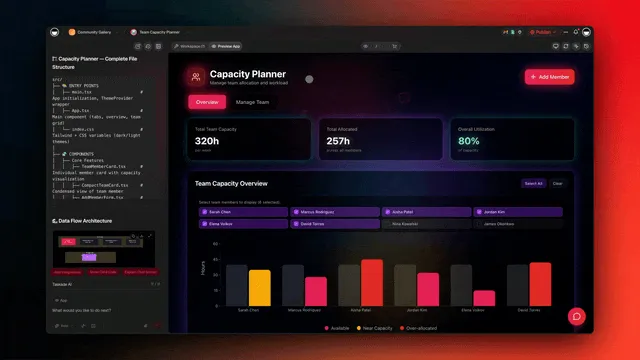
You can build an AI tutor that knows your exact course in Taskade. You create a custom AI agent, add your syllabus and notes as its knowledge, and write instructions that make it ask before it tells. The knowledge is the agent's persistent memory, so the tutor answers from your course in every chat. Then you can wrap a study app around it with Taskade Genesis.
This section exists because of the gap in the comparison table. The general assistants tutor well, but they do not keep your course. The study tools keep your files, but they rarely enforce a tutoring style. A custom tutor agent does both, because you write the style and you choose the knowledge.
The diagram is Workspace DNA applied to studying. Projects hold your course (Memory). The tutor agent reads them and decides what to ask (Intelligence). Automations run the daily review and write the results back (Execution). Each pass adds to the log, so the tutor knows more about your weak spots next time.
What You Can Do on Free, and What Needs a Paid Plan
A tutor agent costs nothing to set up, but a few parts of this build are plan-gated. Know them before you start.
| What you need | Free | Pro and up |
|---|---|---|
| Custom tutor agent | 1 agent | More agents |
| Knowledge sources per agent | 1 source, such as one connected project | A higher limit |
| Upload a PDF or slides as knowledge | Needs a paid plan. Paste your notes into a project instead | Yes |
| Web pages and YouTube videos as knowledge | Needs a paid plan | Yes |
| AI credits for tutor chats | Free starts with 0. You earn credits with referrals and invites | A monthly AI credit allowance |
| Scheduled review automation | 10 automation runs per billing period | More runs |
| Password on a public tutor link | Not available | Pro and up |
On Free, you earn free AI credits with referrals and invites, and you can upgrade any time. For a semester of daily tutoring, Pro at $10/month billed annually is the practical entry point. Current plan details are on the pricing page.
Step 1: Put Your Course in a Project
Create a project for the course and put everything the tutor must know in it: the syllabus, the topic list with exam dates, your lecture notes, and past exam questions if your instructor shares them. On Free, paste the text or write it in Markdown. On a paid plan, upload the PDFs and slides directly. If your notes are in PDFs, our guide to PDF to notes tools shows how to turn them into structured text first.
A connected project syncs when it changes. When you add next week's lecture notes, the tutor reads them in the next chat. You do not retrain anything. That matters more than it sounds: retraining an AI model on new material can make it lose old skills, a problem explained in our sibling post on catastrophic forgetting. Reading your notes as knowledge avoids that problem.
Step 2: Create the Tutor Agent
Open AI Agents in your workspace sidebar. Pick Generate and describe the tutor in plain English, pick Templates to start from a ready-made agent, or pick Create for a blank agent. Taskade's agent catalog includes tutor agents you can study or adapt, such as the math tutor agent, a geography tutor and a music theory tutor. The Custom AI Agents guide shows every screen.
Step 3: Write Tutor Instructions That Ask Before They Tell
Open the agent's Knowledge tab and type the instructions into the Prompt field. This is where you turn a helpful assistant into a tutor. Write it as a brief for a new teaching assistant. Here is a starting point that encodes the four tutor moves:
You are a tutor for my course, BIO 101. Teach from the attached
course notes and syllabus. If a fact is not in the notes, say so.

1. Ask before you tell. When I ask about a topic, first ask me one
   question to find out what I already know. Never give a full
   solution before I have tried.
2. One step at a time. Give a hint before an explanation, and an
   explanation before a full answer.
3. Check understanding with a new question, not "does that make
   sense". Use a different example from the notes.
4. Adapt. If I get it wrong, find the step where I went wrong and
   ask about that step. If I get two in a row right, make the next
   question harder.
5. Make me judge my own work. After each answer, ask: "How sure are
   you, from 1 to 5?" Then ask me to check my answer myself before
   you tell me if it is right.
6. End each session with three questions on my weakest topic.
Why this works: each numbered rule maps to one tutor move from the research above. Rule 1 is the hint-first design that protected exam scores in the PNAS study. Rule 5 trains the monitoring half of metacognition. Rule 6 adds the mastery check that gave Bloom half of his 2 sigma.
Then set Tone and Language, and write the Introduction: the first message, the placeholder in the input box, and the conversation starters. Good starters for a tutor are "Quiz me on this week's lecture", "I'm stuck on a problem" and "Help me plan for the midterm".
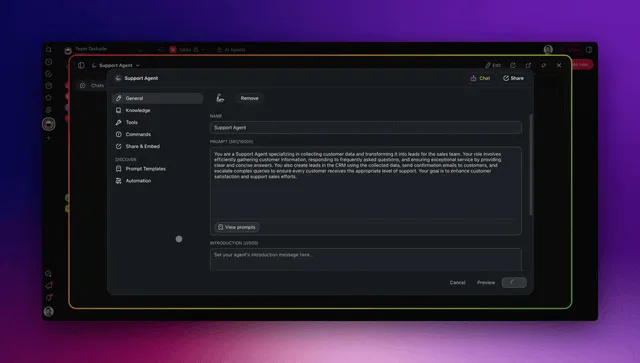
| Part of the instructions | What to write | Tutor move it supports |
|---|---|---|
| Role and scope | The course name, and "teach from the attached notes" | Keeps answers on your syllabus |
| Hold-back rule | "Ask one question before you explain" | Asks before it tells |
| Hint ladder | Hint, then explanation, then answer | Step-level feedback |
| Check rule | "Test with a new example" | Checks understanding |
| Adapt rule | "Find the step where I went wrong" | Adapts |
| Confidence rule | "Ask how sure I am, then ask me to check" | Builds self-judgment |
| Boundary | "If it is not in the notes, say so" | Prevents made-up facts |
Step 4: Connect Your Course as Knowledge
On the same Knowledge tab, open Sources and add the course project with Add Project. On a paid plan you can also upload files, add web pages and YouTube lectures, or import from Google Drive, Dropbox, Box or OneDrive. The Agent Knowledge and Memory guide lists every source type and its plan.
Knowledge is the agent's persistent memory. It stays with the tutor in every chat. Chat history stays with each chat, so you can reopen yesterday's session from Messages and continue it. Put lasting facts, such as "I always mix up mitosis and meiosis", in the course project, and every future chat can use them.
Step 5: Add Slash Commands for the Moves You Repeat
Open Actions, then Commands, and click Add command for each study move you use often. A command is a saved prompt that runs when you type its name after /.
| Command | What the saved prompt tells the tutor |
|---|---|
/quiz-me |
Ask five questions on the topic I name, one at a time, and wait for each answer |
/explain-back |
Ask me to explain the concept in my own words, then point out what I left out |
/check-my-work |
Ask how confident I am, ask me to check my answer, then grade it with the reason |
/exam-week |
Read the syllabus dates and pick the three topics I should review today |
/wrong-on-purpose |
Give me a worked solution with one error, and ask me to find it |
The /explain-back command is the Feynman technique as a button: explaining an idea in your own words exposes the gaps that re-reading hides. The /wrong-on-purpose command trains the "grade the homework" skill directly.
Step 6: Test the Tutor With a Wrong Answer
Open Messages and run three real study questions from your course. Then give a wrong answer on purpose. A tutor that says "Correct!" to a wrong answer, or that hands you the solution after one try, needs firmer instructions. Check four things:
| Test | Pass when the tutor... | If it fails |
|---|---|---|
| Ask-first test | Asks you a question before it explains | Move the hold-back rule to the top of the instructions |
| Wrong-answer test | Finds the step you got wrong and asks about it | Add "never confirm an answer before you check it step by step" |
| Off-syllabus test | Says the topic is not in your notes | Strengthen the boundary rule |
| Confidence test | Asks how sure you are after each answer | Repeat the confidence rule in each command prompt |
An AI tutor can still be wrong. Check any surprising fact against your notes or your instructor, and treat the tutor's grading as a second opinion, not the final word.
Step 7: Run a Daily Review on a Schedule
A tutor that waits for you to open it only helps on the days you remember. Open Actions, then Automation, and add an automation that runs the tutor on a schedule. A simple recipe: every morning, read the practice log, pick the topic with the lowest confidence scores, and add three review questions to today's list in the course project. The Custom AI Agents guide covers the Automation tab.
Spacing those reviews over days, instead of cramming them into one night, is one of the best-supported findings in learning science. Our sibling explainer on spaced repetition covers the schedule, and the study schedule generator builds a first plan from your exam dates.
Step 8: Build a Study App Around the Tutor With Taskade Genesis
A chat is one surface. A study app gives the tutor a home with a topic tracker, a practice log and progress views. With Taskade Genesis, you describe the app in one prompt and Taskade EVE builds it in your workspace, with the data, the agent and the automation connected. Start at /create with a prompt such as:
Build a study app for my organic chemistry course. Keep topics in a
table with name, exam date and status. Log each practice question
with my answer, my confidence from 1 to 5, and whether I was right.
Add a tutor agent that reads my notes and asks a question before it
explains. Add an automation that adds three review questions from my
weakest topics every morning.
The practice log is the part most tutors skip. It is the "model of the student" from the Cognitive Tutor era, written as a plain table you can read.
When confidence is high and the answer is wrong, you have found an illusion of knowing, the most valuable thing a study session can reveal. When confidence is low and the answer is right, you know more than you think, and you can move on. The same data appears in multiple project views, so you can see topics as a list, a board by status, a table, or on a calendar by exam date.
You can also start from an app someone already built. The Taskade App Factory has study kits such as the Exam Study Portal, a PDF Study Hub that makes notes, flashcards and a quiz from any PDF, and a Flash Deck Maker. Each of these kits holds automations, so each one is free to open and preview, and cloning it needs a paid plan.
A ready-made tutor. The AI Math Tutor below is a live Taskade Genesis app built by the Taskade team. It shows each student one hint at a time from your own worked examples and shows which topics keep tripping them. The kit holds 5 projects, 1 AI agent and 3 automations (checked 2026-11-12). It is free to open and preview, and cloning it needs a paid plan because it holds automations. For coding, the Learn Python Course kit holds 20 short beginner lessons in 5 units, each with 3 practice questions (5 projects, 1 AI agent and 2 automations, also a paid plan to clone).
Clone the AI Math Tutor into your workspace (a paid plan is needed to clone a kit with automations).
Step 9: Share the Tutor With a Study Group or a Class
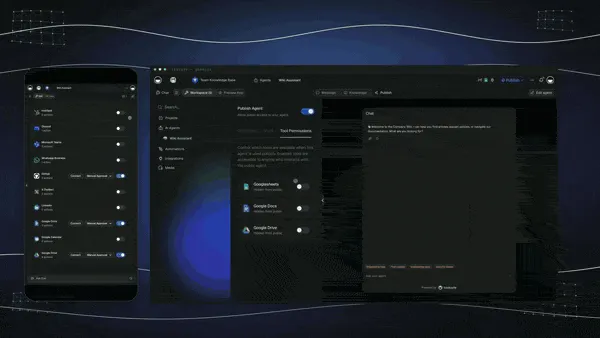
To share the tutor, open the agent's Publish tab, turn on Publish Agent, and copy the share link. Visitors chat with the tutor without entering your workspace, and every conversation appears in the agent's Visitor Inbox, so a teacher or a study group lead can see which questions come up most. You can also embed the tutor on a course website. A password on the link needs Pro or a higher plan. The public agents guide covers every setting.
What a Custom Tutor Agent Does Not Do
A custom tutor agent is a strong fit for a learner with a defined course. It is a weaker fit in some cases, and it is fair to name them:
| Situation | Better choice |
|---|---|
| A young child who cannot type or read well yet | Synthesis Tutor, or a human tutor |
| A family that wants a ready-made K-12 curriculum | Khanmigo |
| Speaking practice in a new language | Duolingo Max, or a conversation partner |
| A one-off question with no course behind it | Any assistant's study or learning mode |
| A student who is far behind or anxious | A human tutor first |
Taskade does not ship a built-in "tutor mode" switch. The tutoring behavior comes from the instructions you write, so the quality of the tutor depends on the quality of the brief. The template above is a strong start, and the test in Step 6 tells you whether it holds.
Prompts That Turn Any AI Assistant Into a Better Tutor
You can make any AI assistant tutor you better with one well-built opening message. Turn on the built-in study or learning mode first, then tell the assistant your course, your level, your exam date and the rules of the session. The prompt below works in ChatGPT, Gemini and Claude, and it encodes the same four tutor moves.
Be my tutor for [course] at [level]. My exam is on [date].
Rules for this session:
- Ask me one question at a time and wait for my answer.
- Before you explain anything, ask what I already know.
- Give a hint before a worked solution. Never give the full answer
  until I have tried twice.
- After each answer, ask how confident I am from 1 to 5, then ask me
  to check my own answer.
- If I am wrong, ask about the exact step where I went wrong.
- Every five questions, summarize what I got wrong and why.
Start by asking me what topic I want to work on.
| Prompt add-on | When to use it |
|---|---|
| "Use only the notes I pasted below" | Keeps the tutor on your syllabus |
| "Give me a worked example with one mistake for me to find" | Practice in grading work |
| "Explain it as if I am 12, then as if I am in college" | When an idea will not click |
| "Mix questions from last week's topics into today's" | Interleaving and spaced review |
| "Stop and ask me to teach it back to you" | The Feynman check |
| "Do not tell me if I am right yet. Ask me to verify it" | Builds self-judgment |
Give the tutor a wrong answer on purpose in the first few minutes. If it agrees with you, the session rules did not stick. Our sibling guide to studying with AI has more session plans by subject.
The Learning Science Every AI Tutor Should Use
The best AI tutors apply a short list of learning techniques with strong evidence: retrieval practice, spacing, self-explanation, scaffolding and calibration. A 2013 review of ten common study techniques rated practice testing and distributed practice as the two with the highest utility (Dunlosky et al., 2013, Psychological Science in the Public Interest 14(1), 4-58). A good tutor builds these into every session.
| Technique | The evidence | What a tutor does with it |
|---|---|---|
| Retrieval practice | Recalling material beats re-studying it on delayed tests (Roediger and Karpicke, 2006, Psychological Science) | Asks questions instead of re-explaining |
| Spacing | Practice spread over time beats massed practice (Cepeda et al., 2006, Psychological Bulletin) | Brings back old topics days later |
| Self-explanation | Students who explain worked examples to themselves learn more (Chi et al., 1989, Cognitive Science) | Asks "why does this step work?" |
| Scaffolding | Support that fades as skill grows helps learners do what they could not do alone (Wood, Bruner and Ross, 1976) | Gives hints first, and fewer hints over time |
| Calibration | People with weak skills often cannot judge their own weakness (Kruger and Dunning, 1999) | Asks for confidence, then compares it with results |
| Desirable difficulty | Effortful learning feels slower but lasts longer (Bjork and Bjork, 2011) | Resists making every step easy |
The state diagram shows one pass of the tutoring loop. In a real session, a wrong answer or a low-confidence answer sends the student back to a new question at the same level, and two confident correct answers move them to a harder one. A tutor that skips the self-check state can still raise practice scores, but it leaves the student unable to judge their own work when the tutor is gone.
The class diagram makes the contrast concrete. A chatbot has one method: answer. A tutor has several, and half of them give work back to the student. When you evaluate any AI tutor, count how often the student does the thinking. That number predicts more about learning than the quality of the explanations.
Is Using an AI Tutor Cheating?
Using an AI tutor to learn is not cheating. Submitting work that an AI produced as your own usually is. The line is whether you did the thinking. A tutor that asks you questions, gives hints and checks your understanding helps you learn. A tool that writes your answers for you can break your school's academic integrity policy, even when the tool calls itself a tutor.
| Use | Usually fine | Usually not fine |
|---|---|---|
| Explaining a concept | "Teach me how photosynthesis works" | Copying the explanation into an essay |
| Practice | "Quiz me on chapter 4" | Using AI during a closed-book test |
| Feedback | "What is weak in my argument?" | "Rewrite my essay so it gets an A" |
| Homework | "Give me a hint on question 3" | Submitting the AI's solution as yours |
Every school sets its own policy, and many courses now state one. Read it, and ask your instructor when you are not sure. Teachers who want to design assignments that work with AI can find ideas in our guide to AI exam generators.
AI Tutor FAQ
What is the best AI tutor in 2026?
There is no single best AI tutor. Khanmigo is the strongest structured tutor for K-12 school subjects in the United States. ChatGPT study mode, Gemini Guided Learning and Claude's Learning mode are the best general tutors, and all three have a free option. Gemini Notebook is best when you want to study from your own readings. Synthesis Tutor is built for elementary math. If you want a tutor that knows your exact course, build a custom agent with your syllabus and notes as its knowledge.
Is there a free AI tutor?
Yes. OpenAI lists study mode on every ChatGPT plan, including Free. Gemini Guided Learning works when you are signed in to Gemini. Gemini Notebook has a free tier, CK-12 Flexi is a free math and science tutor, and the basic Photomath app costs nothing. Khanmigo for learners and parents costs $4 a month or $44 a year in the United States, and it is free for teachers in select countries.
What is ChatGPT study mode?
ChatGPT study mode is a setting that makes ChatGPT act like a tutor. It asks about your goal and level, gives hints and guiding questions in place of finished answers, and quizzes you as you go. OpenAI launched it on July 29, 2025, and its pricing page lists study mode on the Free, Go, Plus and Pro plans.
Can an AI tutor replace a human tutor?
Not fully. Well-designed AI tutors can match or beat some forms of instruction in controlled studies, such as a 2025 Harvard physics trial. A good human tutor still notices confusion, motivation and context that a chat window misses. The best use of an AI tutor is more practice and faster feedback between sessions with a teacher or tutor.
What is Bloom's 2 sigma problem?
In 1984 the educational psychologist Benjamin Bloom reported that students taught one to one with mastery learning scored about two standard deviations above students in a conventional class. He called the challenge of getting that result for a whole class the 2 sigma problem. Later research found smaller but still useful effects, for example about 0.79 standard deviations for human tutoring in a 2011 review by Kurt VanLehn.
How is an AI tutor different from an AI homework helper?
An AI homework helper gives you the answer and the steps. An AI tutor asks you a question first, checks what you understand, adjusts the next step to your answer, and asks you to judge your own work. A 2025 study in PNAS found that students who practiced with an answer-giving chatbot scored lower on a later exam, while a hint-only tutor version largely avoided that harm.
What is the best AI tutor for kids?
For children aged 5 to 11 learning math, Synthesis Tutor is built for that age group. Khanmigo covers many school subjects, and a parent must add a child under 18 to the parent account. CK-12 Flexi is a free math and science option. Read each tool's age rules before a child uses a general assistant.
Can I build an AI tutor that knows my course material?
Yes. In Taskade you create a custom AI agent, add your syllabus and notes as its knowledge, and write instructions that tell it to ask a question before it explains. The knowledge is the agent's persistent memory, so it answers from your course in every chat. Free includes one custom agent with one knowledge source. On Free, you earn free AI credits with referrals and invites, and you can upgrade any time.
How do I turn ChatGPT, Gemini or Claude into a better tutor?
Turn on the built-in learning mode first. Then tell the assistant your course, your level and your exam date, ask it to give one question at a time, to wait for your answer before it explains, to give a hint before a solution, and to ask how confident you were after each answer. Give it a wrong answer on purpose to check that it corrects you.
Do AI tutors actually improve grades?
They can, when they are designed to teach. A 2025 randomized trial at Harvard found more than double the median learning gains with a purpose-built AI physics tutor compared with an active-learning class. A 2025 PNAS study found that unrestricted chatbot help raised practice scores but lowered exam scores. The design of the tutor, and how you use it, decide the result.
The Verdict: Pick the Tutor That Makes You Do the Thinking
The best AI tutor in 2026 is the one that makes you do the thinking. Forty years of research, from Bloom's 2 sigma to the 2025 PNAS study, point the same way: tutoring works when it asks, checks, adapts and makes the student judge their own work, and it backfires when it hands over answers.
For school subjects in the United States, start with Khanmigo. For a free general tutor, turn on ChatGPT study mode, Gemini Guided Learning or Claude's Learning mode, and use the session prompt above. For your own readings, use Gemini Notebook. For young children learning math, use Synthesis Tutor. For a tutor that knows your exact syllabus, keeps your practice log and runs a daily review, build a custom tutor agent in Taskade. Your course lives in projects ▲, the tutor agent reads it and asks the questions ■, and automations bring the review back every morning ●.
Related Reading
- AI Math Tutoring: The Best Tools for Step-by-Step Math Help
- What Are AI Agents?
- What Is Metacognition?
Sources
- Bloom, B. S. (1984). The 2 sigma problem: The search for methods of group instruction as effective as one-to-one tutoring. Educational Researcher, 13(6), 4-16.
- VanLehn, K. (2011). The relative effectiveness of human tutoring, intelligent tutoring systems, and other tutoring systems. Educational Psychologist, 46(4), 197-221.
- von Hippel, P. T. (2024). Two-sigma tutoring: Separating science fiction from science fact. Education Next, 24(2), 22-31.
- Nickow, A., Oreopoulos, P., and Quan, V. (2020). The impressive effects of tutoring on PreK-12 learning: A systematic review and meta-analysis of the experimental evidence. NBER Working Paper 27476.
- Nickow, A., Oreopoulos, P., and Quan, V. (2024). The promise of tutoring for PreK-12 learning: A systematic review and meta-analysis of the experimental evidence. American Educational Research Journal, 61(1), 74-107.
- Kulik, J. A., and Fletcher, J. D. (2016). Effectiveness of intelligent tutoring systems: A meta-analytic review. Review of Educational Research, 86(1), 42-78.
- Pane, J. F., Griffin, B. A., McCaffrey, D. F., and Karam, R. (2014). Effectiveness of Cognitive Tutor Algebra I at scale. Educational Evaluation and Policy Analysis, 36(2), 127-144.
- Kestin, G., Miller, K., Klales, A., Milbourne, T., and Ponti, G. (2025). AI tutoring outperforms in-class active learning. Scientific Reports, 15, 17458.
- Bastani, H., Bastani, O., Sungu, A., Ge, H., Kabakcı, Ö., and Mariman, R. (2025). Generative AI without guardrails can harm learning: Evidence from high school mathematics. PNAS, 122(26), e2422633122.
- LearnLM Team and Eedi (2025). AI tutoring can safely and effectively support students: An exploratory RCT in UK classrooms. arXiv:2512.23633.
- Anderson, J. R., Corbett, A. T., Koedinger, K. R., and Pelletier, R. (1995). Cognitive tutors: Lessons learned. Journal of the Learning Sciences, 4(2), 167-207.
- Corbett, A. T., and Anderson, J. R. (1995). Knowledge tracing: Modeling the acquisition of procedural knowledge. User Modeling and User-Adapted Interaction, 4, 253-278.
- Carbonell, J. R. (1970). AI in CAI: An artificial intelligence approach to computer-assisted instruction. IEEE Transactions on Man-Machine Systems, 11(4), 190-202.
- Graesser, A. C., Person, N. K., and Magliano, J. P. (1995). Collaborative dialogue patterns in naturalistic one-to-one tutoring. Applied Cognitive Psychology, 9(6), 495-522.
- Nelson, T. O., and Narens, L. (1990). Metamemory: A theoretical framework and new findings. The Psychology of Learning and Motivation, 26, 125-173.
- Dunlosky, J., Rawson, K. A., Marsh, E. J., Nathan, M. J., and Willingham, D. T. (2013). Improving students' learning with effective learning techniques. Psychological Science in the Public Interest, 14(1), 4-58.
- Roediger, H. L., and Karpicke, J. D. (2006). Test-enhanced learning. Psychological Science, 17(3), 249-255.
- Vendor pages checked in November 2026: khanmigo.ai, chatgpt.com/pricing, support.google.com/gemini, synthesis.com/tutor, photomath.com, studyfetch.com, tutor.com, ck12.org/flexi, quizlet.com/blog/meet-q-chat.
- Duolingo, "Duolingo Max" Shows the Future of AI Education, March 14, 2023.
- Google, 6 ways to use NotebookLM to master any subject, September 8, 2025.