Track Every Lead. Close More Deals. (Free AI Sales Pipeline Template, 2026)
Own a pipeline that enriches every lead, drafts the follow-up, books the call, and marks the deal closed-won. The free AI sales pipeline template, plus five live apps you can clone in three seconds.
Here is the thing you get to keep at the end of this page: a pipeline that does the work between the leads. Nobody re-types a name into a second tool. Nobody exports a CSV on Friday to find out what happened this week. The enrichment, the first draft, the stage change, the calendar hold, and the close-won receipt all happen on one surface, and every one of them leaves a record the next agent run reads.
That is a different object from a "sales pipeline template." A template is a schema — columns, stage names, a Kanban board. It is the shape of the work. What a revenue team actually wants is the work itself: lead enrichment, scoring, cold email drafting, follow-up sequences, Slack alerts, Calendly auto-confirm, Stripe close-won, and pipeline analytics, wired by default. Five live Taskade Genesis apps below do exactly that, embedded so you can click inside them before you decide anything. Five more cloneable workflows follow.
The static-template search results are why this post exists. Type "free CRM template" or "AI sales pipeline template" into Google and the top ten are Notion, Airtable, and Google Sheets files. They are good schemas. They are not systems, and the distance between the two is the distance between a board you maintain and a pipeline that maintains itself. The same shift is playing out across every internal tool — see running a whole business from one workspace and what an owner-operated stack looks like end to end.
What Makes a Sales Pipeline Template "AI"?
A modern AI sales pipeline template needs four properties code generators and static templates can't combine:
Glyph order is fixed: ▲ ■ ● = Memory · Intelligence · Execution. Notion templates ship Memory only. Pipedrive ships Memory + light Execution. Apollo ships Execution + light Memory. Taskade Genesis is the only template that ships all three primitives + the loop.
The capability check works as a 7-row rubric. Every row is something an "AI sales pipeline template" search visitor was already going to ask:
Capability
Notion CRM
Airtable Sales
Pipedrive
HubSpot CRM
Taskade Genesis
Persistent contact + deal data
Yes
Yes
Yes
Yes
Yes
Pipeline view (Board/Kanban)
Board only
Yes
Yes
Yes
Yes (multiple views)
AI lead scoring inside the template
No
No
No
Paid add-on
Yes (Sales Coach)
AI cold-email drafting from contact data
No
No
Paid add-on
Paid sequences
Yes (Outreach Drafter)
Native Apollo / Gmail / Slack integrations
Manual Zapier
Zapier
Workflow add-on
Paid
Yes (100+ bidirectional)
Multi-agent collaboration (Research + Score + QA)
No
No
No
No
Yes
Cloneable live demo (not a static template)
Static
Static
No
No
Yes (inline below)
Score
2 / 7
2 / 7
3 / 7
4 / 7
7 / 7
A genuine "AI sales pipeline template" needs all 7. Taskade Genesis ships all 7, on the entry plan, with a single agent calling concrete API verbs across the stack: Apollo.enrich → Gmail.send → Slack.postMessage → Activity.log, native, no Zapier, no per-action credit meter. The AI agents do the reading and writing; the automations do the firing; both ship inside the same app you cloned.
The Five Live AI Sales Pipeline Demos
Every iframe is a real Taskade Genesis app. Click inside, hit "Use this app," clone into your free workspace.
1. Sales Pipeline Workflow: the canonical AI pipeline
▲ ■ ● This is live. 4 projects, 2 AI agents, 3 automations.
Lead capture — a web form, a Calendly invitee, or a pasted event list lands in Contacts already enriched, not as a row someone has to clean up later.
Deal stages — Lead → Qualified → Proposal → Closed on a Board view that moves itself when Gmail sees a reply or Stripe sees a payment.
Follow-up automations — Sales Coach drafts the email, Gmail sends it, Slack announces the stage change with the deal context attached.
What's inside when you clone: Contacts (Table view, custom fields for email/phone/company/status/score), Deals Pipeline (Board view, 4 stages: Lead → Qualified → Proposal → Closed), Activity Log (List view of touchpoints), Forecasting (Table view of weighted pipeline). Sales Coach drafts follow-ups; CRM QA flags duplicates and missing fields; 3 automations fire on stage changes. The multiple project views mean the same deal data renders as a board for the rep and a Gantt for the forecast, without a second tool.
This is the Pipedrive/HubSpot replacement, at $10/mo on Taskade Genesis Pro billed annually vs $49/seat Pipedrive Premium or $100/seat HubSpot Pro. Ready-made variants live under /templates/sales-pipeline.
2. Sales Agent Studio: the AI SDR layer
▲ ■ ● This is live. The agent layer that runs cold outreach.
Research — every prospect arrives with a title, a company size, and a recent funding or hiring signal attached, before a human reads the name.
Drafting — the Outreach Drafter writes the first email against that enriched profile and your tone doc, in two variants, so the A/B is free.
Reply routing — a reply pauses the sequence, logs to Activity Log, and pings the owning rep instead of sending step 3 into a live conversation.
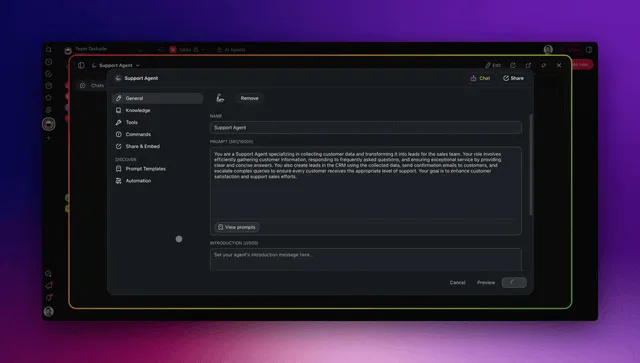
What's inside: Prospect List project, Research agent that enriches each lead from Apollo + LinkedIn signals, Scoring agent that runs the rubric, Outreach Drafter agent that writes personalized first emails (with A/B variants), Gmail send automation, reply-detection automation that logs replies back to Activity Log. Tuning any of them is the walkthrough at /learn/agents/custom-agents; pre-built variants live under /agents/sales.
This is the Outreach.ai / Salesloft replacement, without the 6-week implementation and without per-seat enterprise pricing.
3. Sales Pipeline Dashboard: pipeline visibility + AI analyst
▲ ■ ● This is live. Pipeline analytics with AI interpretation.
Weighted forecast — stage volumes and win-rate trend recomputed from the deal records themselves, not from a slide someone rebuilt on Sunday.
Written commentary — the Pipeline Analyst agent explains why the number moved, by deal name, in plain sentences leadership can read.
Read-only publishing — leadership gets the dashboard URL, not a seat, via role-based access.
What's inside: stage-by-stage volumes, win-rate trend, weighted forecast, plus a Pipeline Analyst agent that explains why the forecast moved ("Q2 dropped 18%, driven by 3 stalled deals in Proposal: Acme, Globex, Initech"). Publish it and the whole org can read it through role-based access; putting it on pipeline.yourdomain.com is a custom domain, available on Pro and above.
4. Neon CRM Dashboard: modern CRM front-end
▲ ■ ● This is live. CRM dashboard with multi-view persistence.
Contact cards — a person, not a row: profile, deal value, last touch, and the agent's read on where the relationship stands.
Value rollups — pipeline totals that recalculate as deals move, so the number on the wall is the number in the system.
Client-facing view — the same records, published as a portal an outside stakeholder can open without a workspace seat.
What's inside: Contact list with rich profile cards, deal value rollups, recent-activity stream, and an embeddable customer portal view. Designed for teams that want a modern Folk/Attio look with Taskade Genesis's agent + automation layer underneath. If the CRM front end is the piece you care about most, the AI CRM builder breakdown compares this pattern against the dedicated CRM tools, and /agents/crm collects the agents that run on top of it.
5. Multi-Platform Publisher: outbound on LinkedIn + email
▲ ■ ● This is live. Cross-channel outbound from one workspace.
One calendar — every outbound post lives on a single Calendar view instead of three tools with three notions of "scheduled."
Tone adaptation — the Tone Adapter agent rewrites one message into the voice each channel actually rewards.
Scheduled sends — publishing runs on automation schedules, so the week ships whether or not anyone opens the app.
What's inside: Content Calendar project, Channel Map (which posts go where), Tone Adapter agent that rewrites a single post for each channel's voice, scheduling automations across LinkedIn, email, and Slack.
The read here is not that the incumbents are expensive. It is that a five-person team can own the whole loop for the price of one lunch. A 5-person team running Pipedrive Premium = $245/month. Same team running HubSpot Sales Pro = $500/month + $1,500 onboarding. Same team running Salesforce Pro + Outreach + Clay Growth = $1,376/month before onboarding. Same team running Taskade Genesis Pro = $10/month billed annually, flat.
The 10-CRM Comparison Table
This is the matrix sales-ops buyers actually care about: not just price, but whether the tool ships the four AI primitives an SDR team needs in 2026, agent inside the CRM, enrichment built-in, cold-email engine, and pipeline that auto-updates from real-world events (calendar bookings, payments, replies).
5-tool stack at 5 SDRs/mo (Pipedrive + Clay + Outreach + HubSpot Pro + Calendly Teams): $245 + $446 + $500 + $500 + $80 = $1,771/month, with Calendly Teams at $16/seat × 5 added in. Taskade Genesis Pro alone:$10/month billed annually (10 seats included). Cost asymmetry: ~177× cheaper for the same 5-seat AI-pipeline capability matrix, before adding the five-figure onboarding fees Salesforce / Outreach / HubSpot Pro ship with.
Per-Deal Cost Math (ASCII)
The headline price hides the per-deal economics. Once you map seat fees + credit meters + enrichment burn against the deals an SDR team actually moves through, the asymmetry is brutal. The block below is the real per-deal cost across a 4-tool stack vs Taskade Genesis Pro at three SDR-team scales.
ASYMMETRY: ~169× ────────────────── ~169× ──────────────────────────── ~169× ───────────────────────────────────────────────────────────── Year-1 onboarding burden: 4-tool stack: HubSpot Pro $1,500 + Outreach $5,000-15,000 = $6,500-16,500 Genesis Pro: $0 ───────────────────────────────────────────────────────────── At 1,000 deals/mo a 5-SDR team pays $20,292/yr for the 4-tool stack, vs $120/yr for Taskade Genesis Pro. Difference: $20,172. That is one full SDR salary.
The bars above are not rhetoric. They are the math of replacing four tools with one Workspace DNA loop. Every credit meter you remove is an hour your RevOps team gets back.
The AI Sales Pipeline Workflow, Visualized
The Pipeline-as-Living-System Architecture
The traditional sales stack is a relay race: Clay enriches, exports to Salesforce, syncs to HubSpot, fires Outreach. Each handoff is a copy, a credit, and a chance for drift. The Workspace DNA model collapses the relay into a single living system, Memory, Intelligence, and Execution sharing one substrate.
Read the diagram top to bottom. Memory is one project, Contacts, Deals, Activity Log, Forecasting, rendered across 4 of the Taskade view types. Intelligence is the agent layer reading from Memory. Execution is the trigger/action layer: Calendly bookings create Deals records, Gmail replies write to Activity Log, HubSpot stage changes update Deals, Stripe checkouts close-won. Actions go the other direction: Apollo enriches, Slack alerts, Markdown exports archive forecasts. Every arrow back into Memory is a free agent context refresh, no copy, no sync, no drift.
The 5 AI-Powered Sales Workflows You Can Clone Today
The five iframes above are full Taskade Genesis apps. The five workflows below are the named SDR-team primitives, each one is a slice of the bigger pipeline, each one cloneable in three seconds, each one solving a single SDR-team pain point that costs thousands a month elsewhere.
Workflow 1: Inbound Lead Triage Agent
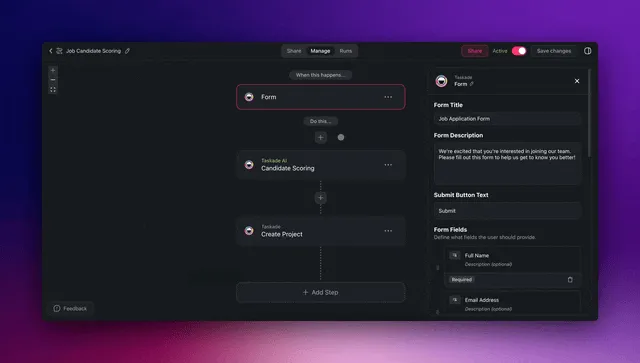
What it does: Captures form submissions (web form, Calendly intake, Apollo signals), enriches every record via Apollo on intake, runs the lead through a scoring rubric (ICP fit, company size, intent signals), and assigns to the right SDR via Slack DM with one-click "claim" buttons. Runs in under 90 seconds per lead. Replaces the "form submission → spreadsheet → manual triage → forgotten lead" funnel that loses ~30% of inbound at SaaS companies. The 90-second number is the point: the speed-to-lead rules behind a sub-five-minute first touch explain why the clock matters more than the scoring rubric.
Replaces Apollo + Clay + custom Zapier — saves $250-450/mo at 5 SDRs
Workflow 2: Cold Outbound Sequence Agent
What it does: Pulls a curated prospect list (filtered by industry, headcount, role, recent funding), drafts a 4-step personalized sequence per contact using Cold Email Agent (with personalization tokens for company, role, recent news, mutual connections), schedules sends via Gmail, A/B-tests subject lines and opening lines, detects replies and routes to SDR, auto-pauses on out-of-office. Replaces the "Outreach.io for sequences + Apollo for data + Clay for enrichment" stack.
Replaces Outreach $100/seat + Apollo $79/seat + Clay $446 — saves ~$1,425/mo at 5 SDRs
Workflow 3: Deal Health Monitor Agent
What it does: Runs nightly across the Deals Pipeline. Flags every deal where last_activity > 7 days, deal_value > threshold but stage stale, or required field missing. Posts a daily digest to a #deal-health Slack channel with deal name, owner, stage, days-since-activity, and one-click "ping owner" buttons. The agent reads the Activity Log, not just the deal record. So it catches "the last email was opened twice but never replied to" patterns that simple stage-change rules miss. Replaces Salesforce Process Builder + a $3K/quarter RevOps consultant.
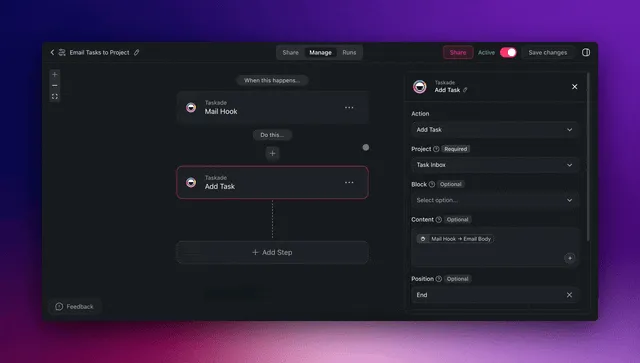
What it does: Two flows in one. (a) Calendly invitee → creates a Deals record at Qualified stage with all enriched profile data, sends Slack alert to assigned SDR, drafts a personalized Gmail prep doc; (b) Stripe checkout session completed → moves the Deals record to Closed-Won, posts a celebration Slack message, fires the Markdown export action to write a deal recap into a wins/ folder for next quarter's pipeline review. Closes the loop most CRMs leave open: the moment money moves, the pipeline updates without a single manual click.
Replaces Zapier Pro ($30/mo) + Calendly Teams ($16/seat) + custom dev
Workflow 5: Quarterly Pipeline Health Dashboard
What it does: Renders the full pipeline across the Taskade views. Org Chart shows account hierarchy and SDR ownership. Gantt shows close-date timeline with stalled-deal callouts. Table shows weighted forecast. Mind Map shows ICP segments. The Pipeline Coach agent runs at the start of each week and writes a 200-word commentary at the top, "Q2 weighted pipeline is up 14% week-over-week, driven by 3 new Qualified deals in fintech; one watch-out is Acme has slipped 11 days in Proposal." Publishes to a custom domain so leadership can read it without a Taskade login. Replaces a Looker dashboard + a RevOps weekly slide deck.
Custom-domain publish, Gmail digest to leadership, Slack #revenue post
Cost vs alternative
Replaces Looker ($60-100K/yr) + RevOps deck-prep time
What Each CRM Gets Right vs Where Taskade Genesis Wins
Every tool below has earned its market share. Pretending otherwise is unserious. The comparison that matters is what each one nailed and where Taskade Genesis delivers something structurally different, not feature parity, but a substrate change.
Pipedrive
What they nailed: the cleanest, most focused pipeline-board UX in the market, and a price point ($14 Lite, $49 Premium) that an SDR can adopt without finance approval. Pipedrive is the gold standard for "drag a deal across stages and move on." If you only need a board, it is the right answer.
Where Taskade Genesis wins: the AI agent and enrichment layer is native, not a $39/seat add-on. Pipedrive's AI Sales Assistant is a paid SKU that recommends next-step actions; Taskade's Sales Coach drafts the actual email and fires the actual Gmail send. The views (Board, Table, Calendar, Mind Map, Gantt, Org Chart, List) replace 3 separate Pipedrive add-ons.
HubSpot
What they nailed: the largest integration marketplace in CRM (1,500+), Breeze AI as a serious agent SKU, and a free CRM tier that has onboarded a generation of GTM teams. HubSpot Sales Pro is genuinely powerful for inbound-led teams with $100K+ ACV deals and a marketing org that already runs HubSpot.
Where Taskade Genesis wins: the price ladder. $100/seat × 5 SDRs = $500/month + $1,500 onboarding before a single email is sent. Taskade Genesis Pro is $10/month billed annually, flat, 10 seats. Breeze costs extra; Taskade's multi-agent layer is included. And HubSpot can't ship a cloneable live demo URL, every prospect has to "request a demo" first.
Folk
What they nailed: the prettiest CRM UI shipped in the last five years, plus three legitimately useful AI features (Follow-up Assistant, Recap Assistant, Research Assistant) that save 5-10 minutes per contact. Folk is the right answer for relationship-led teams (founder GTM, agency client books, investor-relations) where every contact is a person, not a row.
Where Taskade Genesis wins: Folk locks email sequences and API access behind the $48/member Premium tier, and there's no multi-agent collaboration. Taskade Genesis ships the same relationship UX (Neon CRM Dashboard demo above) with sequences, the API, and 4 agents working together, at roughly a fifth of Folk's per-seat price and without per-member metering.
Attio
What they nailed: the data model. Attio's custom-objects engine is the most flexible CRM data layer on the market. You can model anything, link anything, query anything. Attio Pro at $69/seat is what RevOps teams pick when they've outgrown Pipedrive's rigidity but don't want HubSpot's bloat.
Where Taskade Genesis wins: automation credits. Attio's hybrid pricing (seat + credits) means every AI run, every workflow, every enrichment chips a meter. Taskade's flat-rate Pro, with a monthly credit allowance, makes agent-heavy workflows safe to run at SDR scale. Plus Taskade ships Mind Map, Gantt, and Org Chart views, Attio is table-and-list-only.
Clay
What they nailed: the waterfall enrichment model. Clay can hit 75+ data providers in a single workflow, fall through them in priority order, and stitch the best record from all of them. For pure prospect-data enrichment at scale, Clay is the most powerful tool in the category.
Where Taskade Genesis wins: Clay is a data-prep tool, not a CRM. The output of a Clay workflow has to live somewhere, Salesforce, HubSpot, Pipedrive, a sheet, and that "somewhere" is where the actual sales work happens. Clay Growth at $446/month annual ($495 monthly post-March-2026) is a line item on top of your CRM, not a replacement. Taskade Genesis is the CRM and the enrichment and the sequencer and the dashboard, in one Workspace DNA loop.
Salesforce, Outreach, Salesloft
What they nailed: the enterprise feature set and the integration depth that 1,000-seat orgs need. If you have a CFO who already approved a Salesforce contract, you keep your Salesforce contract. There is no scenario where a 500-rep sales org rips out Salesforce for any other tool.
Where Taskade Genesis wins: for the 5-50 seat SDR team that isn't an enterprise. Salesforce Pro at $100/seat + Outreach at $100/seat + Salesloft Cadences = $300/seat/month before onboarding fees that run $5K-$15K. A 5-SDR team paying that stack is at $18,000+ annual cost to do what Taskade Genesis Pro does for $120/year. The asymmetry isn't fairness. It's that the enterprise stack was priced for enterprise, and the SDR team in 2026 doesn't have to pay enterprise prices anymore.
Salesflare, Close, Copper
What they nailed: the "easier-than-Salesforce, fuller-than-Pipedrive" middle. Close ships built-in calling at every plan, Salesflare auto-builds contact records from Gmail, Copper integrates natively with Google Workspace. Each is a sensible answer if your team's bottleneck is one of those specific axes.
Where Taskade Genesis wins: none of them ship a multi-agent layer. Close has a single AI feature; Salesflare has light enrichment; Copper has none. Taskade Genesis ships Lead Enrichment + Cold Email + Deal Health + Pipeline Coach as four agents collaborating across the same Memory layer, the AI primitive these tools are catching up to, not leading.
The Workspace DNA Loop, Mapped to Sales
Memory is the substrate, not a side-effect. Every Apollo enrichment writes back to the Contacts project. So the next agent run reads enriched data, not stale lead lists. Compare to Clay/Salesforce/Outreach: enrichment writes to Clay → exports to Salesforce → syncs to HubSpot → triggers Outreach. Each hop is a copy and a potential drift. Taskade Genesis collapses the loop into one source of truth.
Taskade Genesis Pro (10 seats included, agents native, enrichment via Apollo HTTP) Year-1 TOTAL: ▏ $120 ───────────────────────────────────────────────────────────── Delta vs Salesforce stack: $34,832/yr saved · ~291× cheaper. Delta vs HubSpot stack: $17,472/yr saved · ~147× cheaper. Delta vs Pipedrive stack: $10,440/yr saved · ~88× cheaper.
That delta is a full junior SDR salary.
The bars above exist to make the per-deal economics legible to the founder or RevOps lead who has been told "you need the enterprise stack." You need it at 100+ seats. Below that, the money is better spent on the pipeline itself — and the loop you get for $120 a year is the same loop, running the same enrichment, on the same Workspace DNA substrate.
Pricing Trap Decoder
Three patterns hide the real cost of the alternatives. Recognize them before you sign.
TRAP 1 · CREDIT METER MULTIPLIERS
─────────────────────────────────
Clay ─→ Data Credits + Actions (two meters, since Mar 2026)
Attio ─→ Automation credits (cap at the $69 tier)
HubSpot ─→ Breeze credits (separate from Sales Hub seats)
Salesforce ─→ Agentforce credits (the $550 SKU)
Apollo ─→ Enrichment credits (Org plan = 3-seat min)
Result: published price × 1.4× to 2.5× by month 3.
Result: Year-1 cost ≠ Year-2. Pricing pages show Year-2.
TRAP 3 · SEAT-MIN HOSTAGES ────────────────────────── Apollo Org 3-seat minimum ($357/mo at Pro tier) Salesloft 10-seat typical minimum Outreach Annual upfront, no monthly Clay Enterprise $30K/yr starting, year commit
Result: even a solo founder pays for a "team." ───────────────────────────────────────────────────── Genesis Pro: $10/mo billed annually · 10 seats included · no onboard · no credit meter multipliers · pay-as-you-grow.
The three traps above are why CRM buyers spend a quarter on procurement. The Workspace DNA model removes all three, flat seat price, no onboarding, one credit meter (the AI credits you already understand).
The Founder Dinner CRM Callout
If you're a founder running a relationship-led GTM motion, the Sales Pipeline Workflow pairs with the Event Management Portal for the founder-dinner pattern: pre-event invite tracking → day-of Slack alerts → post-event follow-up sequencing. Read more in GTM Engineering System.
The mechanics are simple. Calendly intake fires a trigger; the Lead Enrichment Agent looks up each invitee's company, role, and recent funding; the Cold Email Agent drafts a "great to see you next Thursday" note; day-of, the Slack channel fills with one-line context cards for each guest; day-after, follow-up sequences fire on intent signals (which guests RSVP'd, who showed up, who skipped). The whole loop runs on a single project, Memory holds the guest list, Intelligence holds the agents, Execution fires the calendar/Slack/Gmail actions. Founder GTM stops being a part-time spreadsheet job and becomes a pipeline.
How Teams Actually Migrate (15-Minute Setup)
The clone-and-customize loop is faster than reading the Pipedrive onboarding doc. Concrete order, with the memory writes explicit:
T+0     Click any iframe above → "Use this app" → app appears in your workspace.
T+1     Open Contacts project → import your existing CSV (or Pipedrive/HubSpot export).
T+2     Open Deals Pipeline → rename the 4 stages to match your funnel
        (e.g., Lead / SQL / Demo Booked / Closed-Won).
T+5     Settings → Integrations → connect Gmail (OAuth), Slack (workspace),
        Apollo (API key), Calendly (token).
T+8     Open the Sales Coach agent → paste your tone-of-voice doc into the
        agent's persistent memory ("Reply concise, no exclamation points,
        first email always references their company's recent news").
T+10    Run the Lead Enrichment Agent on your imported contacts.
        Watch Apollo signals + LinkedIn data populate the Contacts table.
T+12    Set roles: Owner = you, Editor = SDR team, Viewer = leadership.
        (Custom domain crm.yourdomain.com: Pro plan and above.)
T+15    Done. First lead enrichment is already running. Sales Coach has
        drafted the first 3 follow-up emails for review. Pipeline is live.
15 minutes. No onboarding fee. No procurement cycle. No "schedule a demo." That is the gap between a static template and a Workspace DNA app.
These four cover the revenue cycle end to end. Each is a live app, not a screenshot. Open it, hit "Use this app," and it lands in your workspace with its projects, agents, and automations attached.
What is the best AI sales pipeline template in 2026?
Taskade Genesis ships a free AI sales pipeline template with Contacts + Deals + Activity Log + Forecasting projects, two core agents (Sales Coach + CRM QA) and three automations including Apollo enrichment, Gmail follow-ups, and Slack alerts, at $10/month on Pro billed annually for up to 10 seats. The companion Sales Agent Studio app adds Research + Outreach + Scoring agents on top.
How much does an AI sales pipeline template cost?
Free with Taskade Genesis. Pipedrive Premium $49/seat, HubSpot Sales Pro $100/seat + $1,500 onboarding, Salesforce Sales Cloud Pro $100/seat, Folk Premium $48/member, Salesflare Pro $49/seat, Close Growth $99/seat. None include AI lead enrichment or multi-agent collaboration in the base price.
Can I add AI lead enrichment to my sales pipeline?
Yes. Taskade Genesis automations call Apollo, LinkedIn signals, Sheets, Webhooks, or any HTTP endpoint. The Sales Pipeline Workflow ships with a CRM QA agent for hygiene; the Sales Agent Studio app adds a dedicated Research agent that enriches contacts on intake. Clay's Growth plan does the enrichment alone for $446/month annual ($495 monthly post-March-2026).
Does the template include a cold email agent?
Yes. Sales Coach agent drafts personalized first emails. Gmail/SMTP-relay automation sends. Reply detection logs back to Activity Log. Multi-variant A/B drafting is available via the Sales Agent Studio companion app.
What is Workspace DNA in a sales context?
Memory is the CRM (Contacts, Deals, Activity Log, Forecasting). Intelligence is the agent layer across the cluster, Sales Coach + CRM QA in the core pipeline; Research, Outreach, and Pipeline Coach via the companion Sales Agent Studio + Sales Pipeline Dashboard apps. Execution is the automation layer (Apollo, Gmail, Slack, Calendly, weekly digest, Stripe close-won, Markdown export). The loop compounds.
Can multiple sales reps share the same pipeline?
Yes. RBAC (Owner to Viewer). Pipedrive/Folk have 2-3 tier perms; HubSpot Pro requires the higher tier for granular permissions; Salesforce uses custom profiles requiring admin work.
How long does it take to set up an AI sales pipeline?
6 minutes from prompt to live URL. 3 seconds to clone the embedded demo above. 15 minutes to fully customize stages, import a CSV, connect Gmail/Slack/Apollo/Calendly, and tune the Sales Coach agent's tone-of-voice memory.
Can the pipeline trigger Slack alerts and Gmail follow-ups?
Yes. Built-in automations include stage-change Slack notifier, Gmail follow-up sender (drafts via Sales Coach), weekly digest, Calendly auto-confirm, and Stripe close-won.
How does Taskade Genesis compare to Salesforce or Outreach?
Salesforce Sales Cloud Pro is $100/seat annual; Enterprise is $175; Agentforce 1 is $550. Outreach Standard is $100/seat plus $5,000-15,000 onboarding. Salesloft Advanced lists $125-150/seat. A 5-SDR team paying Salesforce Pro + Outreach + Clay Growth crosses $34,000/year before onboarding. Taskade Genesis Pro is $10/month billed annually ($120/year), 10 seats included.
Can I close the deal cycle without leaving the pipeline?
Yes. Calendly bookings flow into the Deals Pipeline as Qualified records, Stripe checkout sessions can mark deals Closed-Won via the built-in Stripe checkout action, and the export-to-Markdown action lets you ship a deal recap into a Notion-ready file. The closed-won event becomes Memory the Pipeline Coach reads next quarter when forecasting.
Which live sales apps can I clone right now?
Four cover the whole revenue cycle: Neon CRM Dashboard (contacts and deals), Sales Agent Studio (outbound agents), Client Connect (the client portal after the win), and Invoice Generator (billing, and the most-used app in the Taskade community at roughly 10,000 sessions a month). Each clones in about three seconds and keeps working on the Free plan.
Do I need a credit card to run the pipeline?
No. The Free plan runs the cloned pipeline and its agents. On Free, you earn free AI credits as you go, and you can upgrade any time. The pipeline's automations — Slack stage alerts, the Gmail follow-up sequencer, the weekly digest — start on Pro at $10/month billed annually, which also adds unlimited generation, live web hosting, and 10 seats. Publishing the pipeline on your own domain starts on Pro.