






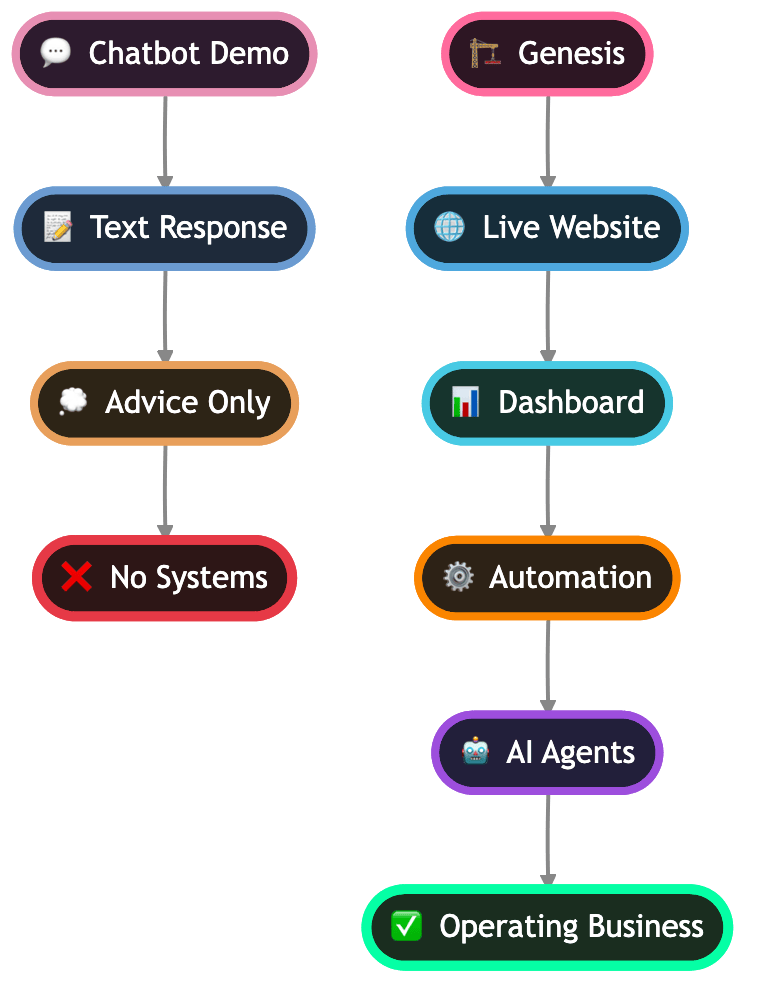
TL;DR: Bolt, Lovable, v0, and Cursor produce code, file trees you must deploy, host, and operate. Taskade Genesis produces a living workspace, Projects, Agents, Automations, Interface, from a single prompt. Verified May-2026 pricing across all 5, with 4 live cloneable demos embedded inline. Taskade Genesis Pro: $10/mo flat for 10 seats.
This post is the head-to-head every founder, ops lead, and PM running a 2026 build-or-buy decision deserves. No theatrical "Cursor is dead" headline. No marketing-deck claims about ten-thousand-person teams. Just verified pricing, an honest comparison matrix, and four live Taskade Genesis apps you can clone before you finish reading.
If you want the broader landscape across every code generator, see Best Vibe Coding Tools 2026. If you want the SERP-level decision framework, you're in the right place.
⚖️ The Headline Distinction: Code Repo vs Living Workspace
The four code generators converge on the same output unit (text in a repo) and the same downstream burden (deploy + auth + DB + ops). Taskade Genesis takes a different turn at the start, its output is not a file tree, it's a workspace with primitives that already know how to act, remember, and integrate.
ASCII view of the same idea:
   Code generators                         Taskade Genesis
   ───────────────                         ───────────────
   prompt                                  prompt
       │                                       │
       ▼                                       ▼
   ┌─────────┐                           ┌─────────────┐
   │ React   │                           │ ▲ MEMORY    │  Projects
   │ Vite    │                           │ ■ INTELLIG. │  Agents
   │ Next.js │                           │ ● EXECUTION │  Automations
   └────┬────┘                           │ ◆ INTERFACE │  Taskade Genesis App
        │                                └──────┬──────┘
   You: deploy + DB +                         │
        auth + RBAC +                         ▼
        agents + auto +                    Live URL
        integrations                       custom domain
        (5-day yak shave)                  one-click clone
The five-day yak shave is the wedge. We close it before the third H2 of this post.
💰 The Verified May-2026 Pricing Card
Every number below is taken from the vendor's own pricing page on the date of publication. All annual-billing monthly equivalents.
| Tool | Lowest paid | Most popular | Highest tier | Pricing meter |
|---|---|---|---|---|
| Taskade Genesis | Free | $10/mo Pro (≤10 seats) | $25/mo Business · $100/mo Max · $250/mo Enterprise | Flat (no token meter) |
| Bolt.new (StackBlitz) | $25/mo Pro (10M tokens) | $25/mo Pro | Pro 50 $50 · Pro 100 $100 · Pro 200 $200 · Teams $30/seat · Enterprise custom | Tokens |
| Lovable | $25/mo Pro (≈100 credits) | $25/mo Pro | Business $50/mo (SSO + RBAC) · Enterprise custom | Credits |
| Vercel v0 | $20/mo Premium | $30/user/mo Team | $100/user/mo Business · Enterprise custom | Credits |
| Cursor | $20/mo Pro | $20/mo Pro | Pro+ $60 · Teams $40/seat · Ultra $200 · Enterprise custom | Credits |
| Replit Core | $25/mo Core (≈$25 credits) | $25/mo Core | Teams $35/seat · Enterprise custom | Effort credits |
| Windsurf | $15/mo Pro (50 prem/day) | $15/mo Pro | Pro Plus $35 · Teams $25/seat · Enterprise custom | Daily quota |
Two things jump out immediately:
- Pricing meter is the second-biggest source of buyer regret after capability mismatch. Token and credit meters bite hardest exactly when an app gets traction.
- Taskade Genesis is the only flat-billed tier in the table. A SaaS-shaped business can predict its monthly bill regardless of how busy the app gets. That predictability is itself a moat for solo founders, small teams, and education users.
For more context on how flat pricing changes the math, see End of App Store: Living Software.
📊 The Twelve-Dimension Comparison Matrix
| Dimension | Taskade Genesis | Bolt.new | Lovable | Vercel v0 | Cursor |
|---|---|---|---|---|---|
| Output unit | Workspace DNA (Project · Agent · Automation · Interface) | Source (browser-runnable) | Source (Lovable-hosted) | React component | Source (your repo) |
| Live cloneable demo | ✅ inline below | ❌ | ❌ | ❌ | ❌ |
| AI agents inside the app | ✅ Agents v2 (memory, built-in tools) | ❌ | ❌ | ❌ | ❌ |
| Native automations | ✅ Durable runtime, 100+ integrations | ❌ | ❌ | ❌ | ❌ |
| Bidirectional integrations | ✅ 100+ (triggers + actions) | ❌ | ❌ | ❌ | ❌ |
| Database | ✅ Projects (7 view types) | Bring Supabase | Bring Supabase | ❌ | Bring your own |
| Auth | ✅ Taskade Genesis Auth (OIDC/SSO) | Bring your own | Bring your own | ❌ | Bring your own |
| Custom domain + SSL | ✅ | ✅ Netlify-style | ✅ Lovable-style | ✅ Vercel | Bring your own |
| RBAC | ✅ Owner → Viewer | Repo perms | Pro+ basic roles | Vercel team | Repo perms |
| Persistent memory across runs | ✅ Workspace DNA | ❌ | ❌ | ❌ | ❌ |
| Multi-agent collaboration | ✅ Native | ❌ | ❌ | ❌ | ❌ |
| Free tier (substantive) | ✅ Up to 6,000 one-time credits + full DNA | 300K daily tokens | 5 daily credits | $5 credit, 7 msgs/day | Hobby Free |
Every "✅" in the Taskade Genesis column corresponds to a Workspace DNA primitive, not an extra subscription, not a wired-up Zapier, not a purchased add-on.
🎬 Four Live Taskade Genesis Demos: Embedded Right Here
Four working Taskade Genesis apps. Click inside any iframe, then "Use this app" to clone it into your free workspace.
1. SaaS Landing Page: 4 minutes from prompt to live URL
▲ ■ ● This is live. Hero/Features/Pricing/FAQ projects, a Conversion Copywriter agent, plus deploy-Slack and lead-capture automations.
2. Sales Pipeline Workflow: multi-agent CRM
▲ ■ ● This is live. 4 projects, 2 AI agents (Sales Coach + CRM QA), 3 automations including stage-change Slack notifier and weekly digest.
3. Invoice Generator: Stripe + Gmail wired
▲ ■ ● This is live. Customers + Invoices + Line Items projects, Billing Assistant agent, Stripe checkout + Gmail send automations.
4. Customer Health Dashboard: internal tool
▲ ■ ● This is live. Accounts (with health-score) + Touchpoints + Renewals projects, CS Analyst + Customer-Reach agents, threshold-alert automation.
For the full seven-app build-day, see I Built 7 AI Apps in 1 Day With Live Cloneable Demos.
🎯 Vs Bolt.new: Browser-Runnable vs Workspace-Native
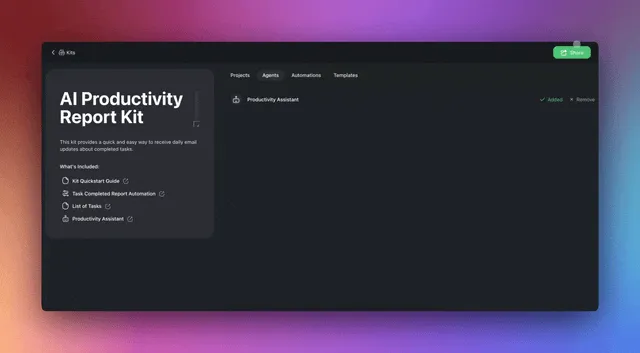
Bolt.new is genuinely novel. The browser-as-runtime via WebContainers is the cleanest in-browser fullstack experience anywhere. You see your app running in the browser tab as it generates. Pro is $25/month with 10M tokens. Pro 50 is $50/month with 50M tokens. There's a Pro 200 at $200/month for the heaviest users.
The token meter is real. Heavy users have reported exhausting 10M tokens within a week of focused building. The math: a single chat-with-AI debug loop on a 1,000-line app can spend 200K tokens. Twenty loops in a week is 4M tokens. Hit that pattern twice and you've burned the month.
The architectural ceiling: Bolt outputs a codebase, and the resulting app is a single web app, not an integrated workspace. No persistent data tier across sessions outside what you wire up, no AI agents inside the app, no automation engine, no role-based access at the app primitive level.
When to choose Bolt: you want a runnable full-stack prototype in your browser within seconds, you understand the token math, and the deliverable is a codebase you'll fork.
When to choose Taskade Genesis: you want a deployed working business system, not a prototype, not a codebase you have to host yourself, not a single web app, but the full Memory + Intelligence + Execution + Interface loop, on a flat monthly bill.
💖 Vs Lovable: React Codebase vs Living Workspace
Lovable generates React/Vite applications from prompts and provides Lovable-hosted preview deployments. Pro is $25/month with ~100 credits. Business is $50/month with SSO + RBAC. The deploy-to-Lovable flow is seamless, custom domains are on Pro+, and GitHub two-way sync is solid.
The credit meter, 100 credits/month on Pro, translates to about one serious project. A five-step debug loop can burn five credits. Heavy users adopt Business at $50/month for room to breathe.
The architectural ceiling: Lovable produces a stateless web app. There is no built-in data layer (you wire Supabase by hand), no AI agents that act inside the app, no automation engine connecting to Slack/Gmail/Stripe, and no built-in role-based access at the app primitive level. If you need any of those, you wire them up after the fact through external services.
| Lovable | Taskade Genesis | |
|---|---|---|
| Output | React/Vite codebase | Workspace DNA |
| Database | Bring Supabase | ✅ Built-in (Projects, 7 view types) |
| AI agents | ❌ | ✅ Agents v2 (memory, built-in tools) |
| Automations | ❌ (Zapier glue) | ✅ 100+ bidirectional integrations |
| RBAC | Pro+ basic roles | ✅ Owner → Viewer |
| Pricing meter | 100 credits/$25 | Flat $10/mo Pro (10 seats) |
When to choose Lovable: you want a deployable React/Vite codebase you can fork and extend in your own pipeline.
When to choose Taskade Genesis: you want a complete living app with built-in data, agents, automations, and access control, without wiring it up across five separate services and without the credit-meter anxiety. For the deeper head-to-head, see Taskade Genesis vs Lovable 2026.
🎨 Vs Vercel v0: Component vs Complete App
Vercel v0 is a UI generator that produces React component code from prompts. Free is $5 credits with 7 messages/day. Team is $30/user/month with $30 credits each. Business is $100/user/month. The component code is clean, the design system (Tailwind + shadcn/ui) is opinionated, and the iteration loop is tight.
The architectural ceiling: v0 produces components, not apps. You take the component code and embed it in your existing app. There is no data layer, no agents, no automations, no integration with the rest of your stack beyond the Vercel deploy lane.
When to choose v0: you are a designer iterating on UI components in isolation, with a backend already in place that the components attach to.
When to choose Taskade Genesis: you want a working app, not a component. A complete app costs $10/mo on Taskade Genesis Pro, vs $30/user/mo just for components on v0 Team, the Taskade Genesis bill is lower and covers more.
🤖 Vs Cursor: Code Editor vs App Builder
Cursor is an AI-augmented code editor. Pro is $20/month. Pro+ is $60/month. Ultra is $200/month. The output is text written into your codebase. You run the code, deploy the code, and maintain the code.
For developers writing software in a familiar language, Cursor is excellent. The Composer agent ships clean diffs, the Tab completion is best-in-class, and the IDE integration is tight. But the output unit is a line of code, not a primitive of an app.
The architectural ceiling: Cursor "thinks" about code, not architecture. Multi-agent reasoning happens in pre-commit, not in the app you build. There's no data layer the AI can reason about, no agents the resulting app deploys with, no automations connected to external services. Mid-2025 also saw a switch from request-based to credit-based metering that drew real complaints from heavy users.
When to choose Cursor: you are an engineer; the output you want is code; you have hosting and deployment already.
When to choose Taskade Genesis: you are anyone, engineer, founder, ops lead, teacher; the output you want is a working business system that runs immediately. For the head-to-head, see Taskade Genesis vs Cursor 2026 and Best Cursor Alternatives.
🧬 Why Workspace DNA Beats a Repo, Visualized
Three things this diagram captures that a code-repo output cannot:
- The loop closes. Execution writes back to Memory. Agents persist what they learned. The next agent run is smarter than the last.
- Tools are bundled. built-in tools come with every agent. No wiring.
- Interface inherits the substrate. RBAC is a Workspace DNA primitive, not an afterthought. Custom domain + SSL deploys without a separate platform.
For more, see Workspace DNA: The Context Engineering Blueprint.
📐 The Six-Axis Architecture Comparison (Master Table)
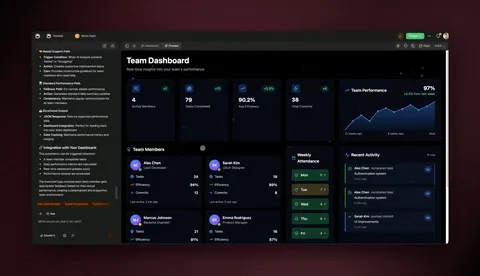
Twelve architectural axes across the six builders most founders shortlist in May 2026. Source: each vendor's pricing and product pages, verified on the date of publication. ✅ = built into the output unit · ➖ = available via add-ons or wiring · ❌ = not part of the product.
| Axis | Taskade Genesis | Bolt.new | Lovable | Vercel v0 | Cursor | Replit Agent |
|---|---|---|---|---|---|---|
| Output unit | Workspace DNA primitives | Code repo | Code repo (Lovable-hosted) | React component | Code edits in your repo | Code repo + Replit container |
| AI agents inside the app | ✅ Agents v2 | ❌ | ❌ | ❌ | ❌ | ❌ |
| Built-in database | ✅ Projects (7 view types) | ➖ Bring Supabase | ➖ Bring Supabase | ❌ | ➖ Bring your own | ➖ Replit DB or BYO |
| Automation engine | ✅ Durable runtime | ❌ | ❌ | ❌ | ❌ | ❌ |
| Bidirectional integrations | ✅ 100+ | ❌ | ❌ | ❌ | ❌ | ❌ |
| Deploy + host | ✅ Built-in | ✅ StackBlitz hosting | ✅ Lovable-hosted | ✅ Vercel | ➖ Bring your own | ✅ Replit hosting |
| Custom domain + SSL | ✅ Business+ | ✅ | ✅ Pro+ | ✅ Vercel | ➖ BYO | ✅ Core+ |
| Multi-seat pricing | ✅ Pro $10 / 10 seats | ✅ Teams $30/seat | ✅ Business $50 flat | ✅ Team $30/seat | ✅ Teams $40/seat | ✅ Teams $35/seat |
| Free tier | ✅ Up to 6,000 one-time credits + full DNA | ✅ 300K daily / 1M monthly tokens | ✅ 5 daily credits | ✅ $5 credit, 7 msgs/day | ✅ Hobby Free | ✅ Limited Agent |
| Persistent memory across runs | ✅ Workspace DNA | ❌ | ❌ | ❌ | ❌ | ❌ |
| Multi-agent collaboration | ✅ Native | ❌ | ❌ | ❌ | ❌ | ❌ |
| Inference-time reasoning | ✅ Multi-pass via Agents v2 | ❌ Single-pass | ❌ Single-pass | ❌ Single-pass | ✅ Composer multi-step | ✅ Agent 3 plan-execute |
Why "Output Unit" is the meta-axis. Every other axis is downstream of this one. If your output unit is a file tree (Bolt, Lovable, v0, Cursor), you carry the deployment + database + auth + agent + automation + RBAC burden yourself, five separate vendors and six weeks of wiring to ship one app. If your output unit is Workspace DNA (Taskade Genesis), those primitives ship inside the artifact. The fight isn't "which AI generates better code." The fight is "what does the AI generate?" Code generators picked the wrong primitive for prompt-to-app.
💸 Pricing Math: True Cost-Per-App in 2026 (ASCII)
Headline pricing hides the real cost. The honest comparison is "what does it cost to ship and operate N apps for 12 months?" This table normalizes all six builders against that question. Token / credit / quota meters become real money the moment you ship more than one app.
   TRUE COST PER YEAR — ANNUAL BILLING
   ────────────────────────────────────────────────────────────────
   Builder           Meter            1 app    5 apps   10 apps
   ────────────────────────────────────────────────────────────────
   Taskade Genesis   FLAT             $120     $120     $120
     (Pro $10/mo, 10 seats, no per-prompt cap, 100+ integrations)   Bolt.new          10M tok/$25      $300    $1,200    $2,400
     (heavy users hit Pro 50 / Pro 100 by app 3 — extra $25-$75/mo each)
   Lovable           ~100 cr/$25      $300    $1,500    $3,000
     (5-step debug = 5 cr; complex apps push Business $50/mo or top-ups)
   Vercel v0         $30 cr/$30/seat  $360    $1,200    $2,400
     (Team only — Business $100/seat for no-train; UI components, not apps)
   Cursor            $20 cr/$20       $240    $1,200    $2,400
     (Pro+ $60 or Ultra $200 once you exceed Pro credit pool)
   Replit Agent      $25 cr/$25 Core  $300    $1,500    $3,000
     (effort-based — agent run + always-on deploy can drain Core in days)
   Windsurf          50 prem/day      $180    $900      $1,800
     (Pro $15; Teams $25/seat; quota refresh, not credits since Mar 2026)
   ────────────────────────────────────────────────────────────────
   AT 5 APPS, TASKADE GENESIS IS 7×–12× CHEAPER THAN ALTERNATIVES.
   AT 10 APPS, THE GAP IS 15×–25× — AND TASKADE GENESIS STILL INCLUDES
   AGENTS, AUTOMATIONS, DATABASE, RBAC, AND 100+ INTEGRATIONS.
   ────────────────────────────────────────────────────────────────
The math shifts the moment you build more than one app. Code generators charge per-app via their meter; Taskade Genesis is flat per-account regardless of how many apps you publish. A single Taskade Genesis Pro seat at $10/mo can host the SaaS landing page, the sales pipeline, the invoice generator, and the customer health dashboard from the four iframes above, all at the same flat bill. That's the wedge.
🧱 Architectural Diff: Files vs Workspace DNA (Mermaid)
Code generators and Taskade Genesis disagree at layer one, what is the substrate the AI generates into? The diff is easier to see than to argue.
Why "files" is the wrong substrate for AI app generation. Files are the right substrate for human coding, text editors, version control, and deployment toolchains all assume a file tree. But AI doesn't need files. AI needs primitives that already know how to act. A Project knows how to render a list, a board, a calendar. An Agent knows how to call tools, persist memory, and chain reasoning. An Automation knows how to listen for triggers and dispatch actions. When the AI generates against those primitives directly, the deploy-host-wire step disappears. Code generators force the AI to LARP as a human writing a file tree. That detour is the entire 5-day yak shave the TL;DR named.
🧠 Reasoning Depth Comparison
Inference-time reasoning is the new arms race. As of May 2026, multi-agent worktrees and best-of-N sampling have replaced "bigger model" as the primary frontier. Most code generators still ship single-pass reasoning; only a few have invested in inference-time scaling.
| Builder | Single-pass | Best-of-N | Multi-agent | Interference merge | Inference-time scaling? |
|---|---|---|---|---|---|
| Taskade Genesis | ✅ baseline | ✅ Quantum mode | ✅ Agents v2 collaborative | ✅ via Workspace DNA | ✅ Multi-pass on Pro+ |
| Bolt.new | ✅ | ❌ | ❌ | ❌ | ❌ |
| Lovable | ✅ | ❌ | ❌ | ❌ | ❌ |
| Vercel v0 | ✅ | ❌ | ❌ | ❌ | ❌ |
| Cursor | ✅ | ✅ Composer 3 Agents Window | ➖ Worktrees (preview) | ❌ | ✅ Composer multi-step |
| Replit Agent | ✅ | ✅ Agent 3 plan-execute | ❌ | ❌ | ✅ Plan-execute loop |
| Windsurf | ✅ | ✅ Cascade multi-step | ➖ Wave 13 worktrees | ❌ | ✅ Cascade multi-file |
| OpenAI Codex CLI | ✅ | ✅ | ✅ multi-agent v2 | ❌ | ✅ |
Cursor's 3 Agents Window, Windsurf's Wave 13 worktrees, and OpenAI Codex multi-agent v2 are the best-known recent examples, all of them target "fan out N candidate solutions, pick the best one." Taskade Genesis takes the same idea further: instead of merging code candidates, Agents v2 fan out across architectural candidates, different choices for which Projects, Agents, and Automations the app needs. Then converge on the highest-utility Workspace DNA tree. That's the inference-time advantage of generating into primitives instead of files. For broader landscape, see Best Agentic Engineering Platforms 2026.
🥇 What Each Builder Gets Right (and Where Taskade Genesis Wins)
Every tool in this comparison has a real strength. Pretending otherwise insults the reader. Below: one sentence on what each one nailed, then the specific axis where Taskade Genesis pulls ahead for prompt → working business system.
Bolt.new: nailed in-browser fullstack via WebContainers
Bolt's WebContainer runtime is the most impressive in-browser dev environment in the category, your Next.js app boots inside the browser tab while it generates. The ceiling shows up the moment the app needs to remember state across sessions, run agents, or fire automations on external events. Taskade Genesis ships those primitives inside the output, not as a "bring your own Supabase / Resend / Zapier" downstream wiring problem.
Lovable: nailed deploy-flow polish
Lovable's prompt-to-preview-deploy lane is the cleanest in the category, push a prompt, get a live URL, with GitHub two-way sync if you want the codebase. The ceiling is the credit meter (~100/$25 Pro burns through one serious project) and the React stateless-app architecture. Taskade Genesis ships built-in data, agents, automations, and RBAC at $10/mo flat, fewer tools to wire, no per-prompt budget anxiety. Full head-to-head: Taskade Genesis vs Lovable 2026.
Vercel v0: nailed component design
v0's Tailwind + shadcn/ui design system is the most opinionated and cleanest UI generator on the market, designers iterate on component code in seconds. The ceiling is that v0 stops at the component. No DB, no agents, no automations, no integration with the rest of the stack beyond the Vercel deploy lane. Taskade Genesis ships complete apps (Memory + Intelligence + Execution + Interface) at $10/mo Pro vs $30/seat Team for components only on v0.
Cursor: nailed engineer ergonomics
Cursor's Tab completion, Composer agent, and IDE integration are best-in-class for engineers who already know what they want to build. The ceiling is that the output unit is a line of code, engineers are the audience, and the resulting app still needs deploy, database, RBAC, agent, and automation wiring outside Cursor. Taskade Genesis targets the prompt-only persona where the deliverable is a working business system, not a forkable codebase. See Best Cursor Alternatives.
Replit Agent: nailed sandbox-to-deploy continuity
Replit's container-as-runtime plus Agent 3's plan-execute loop ships small full-stack apps in minutes, and the deployment surface is integrated. The ceiling is effort-based credits (Core $25/mo can drain in days with always-on deploys) and a single-app-per-Repl architecture. Taskade Genesis offers flat pricing across unlimited apps in one workspace, with shared agents and shared memory across the app catalog.
Windsurf: nailed flagship-model access
Windsurf's Pro Plus at $35/mo gives priority access to flagship models with unlimited Cascade, the best per-dollar access to top-tier reasoning models in the IDE category. The ceiling is that Cascade still writes into your codebase; the output is text edits, not deployed primitives. Taskade Genesis ships the same multi-pass reasoning depth via Agents v2 but applies it to Workspace DNA generation, so the reasoning produces a live app, not a diff.
🧪 The Same Prompt, Different Outputs
Imagine pasting the same prompt into all five tools:
"Build a SaaS customer onboarding flow with a welcome email, a tour, and a feedback form."
What each one produces:
| Tool | What you get |
|---|---|
| Bolt.new | A Next.js codebase. You wire your Supabase. You wire your email provider. You deploy. |
| Lovable | A Vite codebase. You wire your Supabase. You wire your email provider. You deploy. |
| Vercel v0 | Three React components: WelcomeEmail.tsx, OnboardingTour.tsx, FeedbackForm.tsx. You build the rest. |
| Cursor | Text edits in your existing repo. You write the routes. You wire the DB. |
| Taskade Genesis | A live workspace: Onboarding Tasks project, Welcome-Email automation (Gmail), Tour project (with Mind Map view of 5 onboarding steps), Feedback Form project (linked to a Smart Feedback agent that summarizes responses). Deployed at a custom URL, password-protected option, ready for end users. |
The first four are 5–10x the integration work after the prompt. The fifth is done.
The shape difference is easier to see than to read:
The wedge is the output unit, not the feature list. Bolt/Lovable/v0/Cursor optimize for "we made the codebase faster." Taskade Genesis optimizes for "the codebase isn't the deliverable, the deployed living system is."
For a real working version of that exact use case, browse the Community Gallery for live cloneable customer-onboarding apps.
The stack-tax problem
The ranking pieces in the SERP recommend stacks, "v0 for UI, Lovable for the app, Claude Code for backend, Cursor for everything else" is the prevailing 2026 advice from practitioner Medium posts. Stacks have a hidden cost:
| Stack tax | What it adds |
|---|---|
| Per-tool subscription | $30 v0 Team + $25 Lovable Pro + $20 Cursor + $20 Anthropic Claude API meter ≈ $95+/mo per developer, before deploy / hosting / observability |
| Context-switch tax | Every primitive crossing a tool boundary loses metadata. The code in v0 doesn't know about your Cursor commit history. The Lovable build doesn't know about your Supabase schema until you wire it. |
| Stitch-fail rate | The handoff between tools is where every demo eventually breaks. Production launch is the integration of N tools, not the use of N tools. |
| Onboarding tax | A 4-tool stack is 4 sets of docs, 4 keyboard shortcuts, 4 billing dashboards, 4 incident response surfaces |
Workspace DNA collapses the chain. One workspace = one billing surface, one identity, one set of agents that share memory across the entire app. That is a different category of product than a code generator + a host + a CI + a chat, and it's why the $10/mo price holds against $95+/mo stacks.
🏆 The Decision Framework: Three Questions
If you are evaluating AI app builders in 2026, three questions decide the choice:
Question 1: What is your unit of output?
| Answer | Right tool |
|---|---|
| Source code (you'll host it) | Bolt, Lovable, v0, Cursor |
| A working business system (deployed, integrated, with agents) | Taskade Genesis |
Question 2: Is your business app driven by usage or by team headcount?
| Answer | Right tool |
|---|---|
| Bursty / heavy AI usage (token meter risk) | None of Bolt/Lovable/v0/Cursor (token meters bite); choose Taskade Genesis (flat) |
| Light usage but many seats | Cursor (per-seat) or Taskade Genesis (10 seats included on Pro) |
| Predictable monthly cost regardless of busy seasons | Taskade Genesis (flat) |
Question 3: Will the app need to remember things, do things, and integrate with other tools?
| Answer | Right tool |
|---|---|
| No — pure UI | v0 |
| Yes — but I'll wire up the data + automations + RBAC myself | Bolt, Lovable, Cursor |
| Yes — and I want it built in | Taskade Genesis |
🎯 The Long-Tail Wedges Where Taskade Genesis Wins Organic Search
Verified May-2026 SERP analysis across the AI app builder cluster:
| Long-tail keyword | Taskade Genesis advantage |
|---|---|
| "AI app builder with built-in agents" | Agents v2 in every app — none of Bolt/Lovable/v0/Cursor includes agents in the output unit |
| "AI app builder with workflow automation" | 100+ bidirectional integrations on durable runtime — none of the four code generators have an automation engine |
| "AI app builder no token limits" | Taskade Genesis Pro $10/mo flat — Bolt at 10M tokens, Lovable at 100 credits, v0 at $30 credits all bite at scale |
| "multi-agent AI app builder" | Taskade Genesis is the only commercial multi-agent app builder — see Best Agentic Engineering Platforms 2026 for the broader space |
| "AI app builder with persistent memory" | EVE and per-app agents store memory as real Taskade Projects |
| "clone a working AI app" | 150,000+ live cloneable apps in the Community Gallery |
| "AI app builder with bidirectional integrations" | Triggers pull events in, actions push data out, on Workspace DNA |
| "AI app builder with team roles" | Built-in RBAC ships with every Taskade Genesis app |
| "vibe coding without code" | Non-developer slice of the vibe coding movement |
| "AI app builder for non-developers" | Taskade Genesis is the only platform built for the prompt-only persona |
For broader landscape, see Best Vibe Coding Tools 2026, Best Cursor Alternatives, and Best Agentic Engineering Platforms 2026.
🤔 FAQ
What is the best AI app builder in 2026: Bolt, Lovable, v0, Cursor, or Taskade Genesis?
For a deployed living app from a single prompt: Taskade Genesis ($10/mo Pro flat, agents + automations + 100+ integrations included). For a forkable React codebase: Lovable or Bolt.new. For a UI component: Vercel v0. For text edits in your codebase: Cursor.
Is Bolt.new better than Taskade Genesis?
For browser-runnable prototypes, Bolt is excellent. For deployed business systems with persistent data, agents, and bidirectional integrations, Taskade Genesis ships the same use case at a flat $10/mo with primitives Bolt does not include.
How is Lovable different from Taskade Genesis?
Lovable produces React/Vite source code at $25/mo Pro with 100 credits. Taskade Genesis produces a complete living workspace at $10/mo Pro with 10 seats, no credit meter, and built-in agents/automations/integrations.
Is Vercel v0 a real app builder?
v0 is a UI component generator at $30/user/mo Team. It does not include data, agents, automations, or integrations. For complete apps, choose Taskade Genesis or another full-stack tool.
How does Cursor compare to AI app builders?
Cursor is an AI-augmented code editor at $20/mo Pro. Different audience (engineers writing code) and different output unit (text edits) than AI app builders.
Can Taskade Genesis apps run AI agents inside the app?
Yes. Every Taskade Genesis app ships with one or more AI agents with persistent memory, built-in tools, and frontier-model auto-routing across OpenAI, Anthropic, and Google.
How many integrations does Taskade Genesis support?
100+ bidirectional integrations across 10 categories. Triggers pull events in, actions push data out.
Do Taskade Genesis apps have role-based access control?
Yes. RBAC (Owner to Viewer) plus Taskade Genesis Auth (password protection, public anonymous, OIDC/SSO).
Are Taskade Genesis apps cloneable?
Yes. Every /share/apps/{id} clones to a free Taskade workspace in one click. 150,000+ live cloneable apps in the Community Gallery.
🚀 Try Taskade Genesis Today
The four Taskade Genesis apps embedded above are four of one hundred and fifty thousand. Pick one to clone:
| App | Direct clone |
|---|---|
| SaaS Landing Page | share/apps/mce6bquyb3gp57a9 |
| Sales Pipeline Workflow | share/apps/dry36084slddvvrh |
| Invoice Generator | share/apps/v71ywf2zs5bu9a5m |
| Customer Health Dashboard | share/apps/564685gvoq7j7oua |
Or build your own from a fresh prompt at taskade.com/create, Free Forever plan, no card.
Read the rest of the cluster:
- I Built 7 AI Apps in 1 Day, full build-day with 7 live demos
- Best Vibe Coding Tools 2026, broader code-generator landscape
- GTM Engineering System, Clay alternative
- Internal Tools Dashboard Builder, Retool alternative
- AI Sales Pipeline Template, sales-team flavor
- Founder Operating System, founder-OS flavor
- Best Agentic Engineering Platforms 2026, multi-agent landscape
- Workspace DNA: Context Engineering Blueprint, the substrate
- End of App Store: Living Software, why deployed living systems beat installed apps
- Best Cursor Alternatives, code-editor side of the cluster
For step-by-step setup, see /learn/genesis/faq · /learn/agents/custom-agents · /learn/automation/triggers.
The five-day yak shave was the bug, not the feature. Taskade Genesis is the answer. Try it free →