






There are 9 main types of note-taking. Each type is a fixed way to lay out notes on the page so you can find, review and use them later. This guide compares the 9 types, shows an example of each, and helps you choose one in 30 seconds.
TL;DR: The best note-taking method depends on the material. Use Cornell notes for lectures you must review, the outline method for structured talks, mind mapping for ideas that branch, charting for facts you compare, and Zettelkasten or PARA for notes you keep for years. See the AI note-taking apps that fit each method.
What Is the Best Note-Taking Method?
The Cornell method is the best general method for students, because it builds review into the page: a cue column for questions, a notes column for the lecture, and a summary at the bottom. For work notes, the outline method is the fastest. For notes you keep for years, use Zettelkasten links or PARA folders.
Pick by the job, not by the method's fame:
- Lecture you must review for a test: Cornell method
- Talk or chapter with clear headings: outline method (and its strict form, hierarchical notes)
- Brainstorm, plan or a topic with many branches: mapping method (mind maps)
- Several items compared on the same points: charting method
- Fast, unstructured lecture: sentence method, then rewrite the same day
- Ideas you want to connect over months: Zettelkasten
- Notes you must act on at work: PARA
- Daily tasks, events and quick notes in one place: bullet journal
Note-Taking Methods at a Glance
The 9 methods split into two groups. Five methods shape a single page while you listen or read (Cornell, outline, mapping, charting, sentence). Four methods organize notes across many pages and many months (boxing, bullet journal, Zettelkasten, PARA).
| Method | Best for | Effort during class | Review value |
|---|---|---|---|
| Cornell | Lectures you will be tested on | Medium | Very high |
| Outline | Structured talks, chapters, essay plans | Low | High |
| Mapping (mind map) | Brainstorms, topics that branch | Medium | Medium |
| Charting | Comparing items on the same points | High (needs a plan) | High |
| Sentence | Fast lectures with no clear structure | Low | Low until rewritten |
| Boxing | Tablet notes grouped by topic | Medium | Medium |
| Bullet journal | Daily tasks, events and notes | Low | Medium |
| Zettelkasten | Research you build on for years | High | Very high over time |
| PARA | Work notes linked to projects | Low | High for action |
1. The Cornell Method
The Cornell method splits a page into 3 parts: a narrow cue column on the left, a wide notes column on the right, and a summary strip at the bottom. Walter Pauk, a Cornell University education professor, created it and described it in his book How to Study in College, according to Cornell's Learning Strategies Center.
How to use it:
- During class, write notes in the right column. Use short phrases, not full sentences.
- After class, write a question or a keyword in the left column next to each block of notes.
- At the bottom, write a summary of the page in 2 or 3 sentences.
- To review, cover the right column and answer each cue from memory.
Example (biology lecture):
+----------------------+-------------------------------------------+
| CUES                 | NOTES                                     |
|                      |                                           |
| What does the        | Mitochondria: make ATP (cell energy)      |
| mitochondrion do?    | - inner membrane folds = cristae          |
|                      | - more cristae = more ATP                 |
| Why are muscle cells | Muscle cells: many mitochondria           |
| full of them?        | - high energy demand                      |
|                      |                                           |
| Where does mtDNA     | Own DNA (mtDNA), passed down from mother  |
| come from?           |                                           |
+----------------------+-------------------------------------------+
| SUMMARY: Mitochondria make ATP. Cells that need more energy,     |
| such as muscle cells, have more of them. They carry their own    |
| DNA, inherited from the mother.                                  |
+------------------------------------------------------------------+
When it fails: Cornell notes take time after class. If you skip the cue column and the summary, you have an ordinary page with a wide margin. The full guide, with a free digital template, is our page on Cornell note-taking methods.

2. The Outline Method
The outline method arranges notes as a tree: main topics on the left margin, supporting points indented under them, and details indented one more level. It is the fastest method for a talk or a chapter that follows clear headings, and it converts directly into an essay plan or a slide deck.
Example (history reading):
1. Causes of World War I
   a. Alliances
      - Triple Entente: France, Russia, Britain
      - Triple Alliance: Germany, Austria-Hungary, Italy
   b. Militarism
      - Naval race between Britain and Germany
   c. Trigger
      - Assassination of Archduke Franz Ferdinand, June 1914
2. Effects
   a. Treaty of Versailles, 1919
When it fails: a lecturer who jumps between topics breaks the tree. Use the sentence method in class, then rebuild the outline the same day. A stricter form, with fixed levels for each idea, is hierarchical note-taking. The step-by-step guide is the outline method of note-taking.
Digital outliners make this method faster, because you can fold a branch, drag it to a new parent and search the whole tree. In Taskade, every project starts in List view, which is an outline with unlimited nesting.

3. The Mapping Method (Mind Maps)
The mapping method puts the main topic in the center of the page and draws each subtopic as a branch, with details as smaller branches. Tony Buzan made mind maps popular in the 1970s. The history of mind mapping goes back much further, to tree diagrams drawn centuries earlier.
Use it for: brainstorms, project plans, essay ideas and any topic where ideas connect in more than one direction. Mind maps are weaker for linear content, such as the steps of a proof. They also take more page space than an outline.
How to use it:
- Write the topic in the center.
- Add one branch for each main idea. Use one or two words for each branch.
- Add details as smaller branches, and draw a dashed line between ideas on different branches that connect.
- Review by redrawing the map from memory.
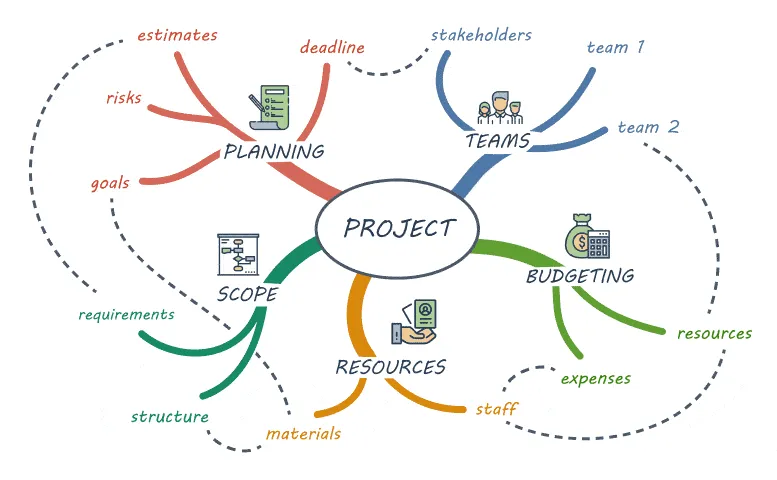
An outline and a mind map hold the same tree, drawn two ways. In Taskade, Mind Map view shows the same project data as List view, so you can take outline notes in class and switch to a map to review. The mind mapping wiki entry explains the method in more depth.
4. The Charting Method
The charting method records notes in a table: one column for each category and one row for each item. It needs a plan before class, because you draw the columns first. When the material fits, it gives the fastest review of any method, because the comparison is already done.
Example (comparing three planets):
| Planet | Distance from Sun | Type | Notable fact |
|---|---|---|---|
| Mars | 1.5 AU | Rocky | Largest volcano, Olympus Mons |
| Jupiter | 5.2 AU | Gas giant | Great Red Spot storm |
| Saturn | 9.5 AU | Gas giant | Visible ring system |
Use it for: history (events by date, cause and effect), science (elements, organisms), literature (characters by trait), and product research (tools by price and features). If the lecture does not compare items, charting forces a structure that does not exist.
5. The Sentence Method
The sentence method writes each new fact as a short, numbered sentence on its own line. It is the method to use when a lecture moves fast and has no clear structure, because you never stop to decide where a point belongs.
Example:
1. Inflation = general rise in prices over time.
2. The central bank targets about 2% a year.
3. Higher interest rates slow borrowing and spending.
4. Example: US inflation peaked near 9% in 2022, and rates rose.
5. Deflation can be worse: people wait to buy.
When it fails: the sentence method records facts but not their relations. Rewrite the sentences into an outline, a Cornell page or a chart the same day, while you still remember how the facts connect.
6. The Boxing Method
The boxing method groups related notes inside a drawn box, one box for each topic, with a short title on top. The page reads as a set of separate blocks, so you can review one topic at a time. The method became popular with tablet note apps, where you can move, resize and recolor a box with a stylus.
Use it for: subjects with clear, separate topics, such as the parts of a cell or the chapters of a book. Write a one-line summary under each box after class. The boxing method is close to Cornell notes without the cue column, so add a question to each box if you want the same review value.
7. The Bullet Journal Method
The bullet journal, created by designer Ryder Carroll, is a method for daily notes called rapid logging. Each line starts with a symbol: a dot for a task, a circle for an event, and a dash for a note. At the end of each month, you move open tasks forward or drop them.
Monday, 19 October
  .  Email the study group about Friday
  o  Biology lab, 2 pm
  -  Lab partner prefers outline notes
  x  Finish the reading for history       (x = done)
  >  Draft the essay plan                 (> = moved to tomorrow)
Use it for: a mix of tasks, events and short notes in one place. It is a weaker fit for long lecture notes. Our guide to the digital bullet journal shows the method in an outliner, and the digital bullet journal template is free to copy. If you also journal for reflection, see how to journal daily.
8. The Zettelkasten Method
Zettelkasten ("slip box" in German) stores each idea on its own short note, gives it an ID, and links it to related notes. The sociologist Niklas Luhmann built a slip box of about 90,000 index cards from the early 1950s. He credited it for his output of about 50 books and 550 articles, according to Wikipedia's Zettelkasten article.

The core rules:
- One idea for each note. Write it in your own words.
- Give each note an address, such as a number or a date stamp.
- Link each new note to at least one older note, and say why they connect.
- Keep an index of entry points for each topic.
When it fails: Zettelkasten pays off only after months of notes. For one exam next week, it is too slow. Our guide to the Zettelkasten method for teams shows how a group can share a slip box, and linking your thinking explains why links help you remember.
9. The PARA Method
PARA, created by Tiago Forte of Forte Labs, files every note into one of 4 folders: Projects (short efforts with a goal), Areas (responsibilities that need ongoing attention), Resources (topics you are interested in) and Archives (anything from the other three that is no longer active), as Forte Labs defines them.
| Folder | What goes in it | Example for a student |
|---|---|---|
| Projects | Work with a goal and a deadline | History essay due 12 November |
| Areas | Ongoing responsibilities | Biology course, part-time job, health |
| Resources | Topics you want to keep | Study techniques, recipes, career ideas |
| Archives | Finished or paused items | Last semester's courses |
PARA does not tell you how to write a note. It tells you where to put it. So use it with one of the page methods above: take Cornell or outline notes, then file the page under its project or area. Our full guide to the PARA method covers the weekly review, and the Building a Second Brain review covers the wider system that PARA belongs to.
5 More Note-Taking Methods Worth Knowing
Five more note-taking methods appear in university study guides: flow notes, the split page method, the Q/E/C method, sketchnoting and rapid logging. Each one is a variation of the nine above, so learn the main nine first. The University of Rochester's note-taking guide describes the first four.
| Method | How it works | Closest main method | Use it for |
|---|---|---|---|
| Flow notes | Free-form page with arrows, questions and doodles that show how ideas connect | Mapping | Fast lectures and brainstorms |
| Split page | Main ideas on the left, details on the right, cover one side to self-quiz | Cornell, without the summary | Exam review |
| Q/E/C | Write a Question, record the Evidence, write a Conclusion | Cornell cue column | History, science and English essays |
| Sketchnoting | Simple drawings, icons and keywords on one page | Mapping | Visual learners and talks |
| Rapid logging | Short lines with a symbol for each type of entry | Bullet journal | Meetings, day plans, quick notes |
The Q/E/C method is the most useful of the five for essay subjects, because the conclusion line is already a draft argument. Flow notes and sketchnotes are best rewritten into an outline or a mind map the same day, the same rule as the sentence method.
Which Note-Taking Method Fits Each Subject?
The best note-taking method changes with the subject, because each subject has a different shape. Math and science follow steps, history follows causes and dates, languages repeat patterns, and work meetings end in actions. The table below pairs each common subject with a page method and a review habit.
| Subject or setting | Page method | Why it fits | Review habit |
|---|---|---|---|
| Math and physics | Outline with worked examples | Each step depends on the one above | Redo one example from memory |
| Biology and chemistry | Cornell | Many terms to recall for a test | Cover the notes, answer the cues |
| History | Charting or Q/E/C | Events compare on date, cause and effect | Fill a blank chart from memory |
| Literature and essays | Q/E/C or mapping | Arguments need evidence and links | Write the thesis in one sentence |
| Languages | Charting | Verb tables and word lists | Quiz one column at a time |
| Work meetings | Outline plus rapid logging | Decisions and tasks must stand out | Move each task to a project |
| Research reading | Sentence, then Zettelkasten | Ideas build over months | Link each new note to an old one |
THE SAME LECTURE, TWO WAYSSentence method (in class) Outline method (same evening)
- Rates up = less borrowing 1. Interest rates
- Inflation target about 2% a. Higher rates
- Higher rates slow spending - less borrowing
- Deflation: people wait - slower spending
b. Target: inflation near 2%
2. Deflation risk
- people delay purchases
How to Choose a Note-Taking Method in 30 Seconds
Choose a method with 3 questions: Will you be tested on it? Does the material have a clear structure? Will you use the notes again after this month? The decision tree below turns those 3 answers into a method.
Most people combine two methods: one page method for the moment (Cornell, outline or mapping) and one storage method for the long term (PARA or Zettelkasten). The table below shows common pairs.
| Situation | Page method | Storage method |
|---|---|---|
| University courses | Cornell | PARA (one area for each course) |
| Research or a thesis | Sentence or outline while reading | Zettelkasten |
| Work meetings | Outline | PARA (one project for each client or launch) |
| Personal learning | Mapping | Zettelkasten-style links |
Handwritten vs Digital Notes: Which Is Better?
Handwritten notes help understanding when they force you to summarize. A 2014 study by Pam Mueller and Daniel Oppenheimer, "The Pen Is Mightier Than the Keyboard", found that students who typed tended to copy the lecture word for word and did worse on conceptual questions. Digital notes win on search, sharing, backup and reorganizing.
The research is less settled than the headline. A 2019 replication by Kayla Morehead, John Dunlosky and Katherine Rawson in Educational Psychology Review found that test scores did not consistently differ between longhand and laptop groups. The safe lesson from both studies is about the method, not the tool: notes in your own words beat a transcript.
| Handwritten | Typed | |
|---|---|---|
| Speed | Slower, so you summarize | Faster, so you tend to transcribe |
| Search | Only after you scan the page | Instant |
| Diagrams and maps | Easy | Easy in a mind map tool |
| Edit and reorganize | Hard | Easy |
| Share with a group | Photo or scan | One link |
A practical rule: if you type, summarize in your own words as you go. If you write by hand, scan or photograph the page and file it under PARA so you can find it later. Every method in this guide works on paper and in an app, and the best note-taking apps guide compares the plain note apps that most people start with.
Taking Notes With AI
AI changes the second half of note-taking, the review and reuse, more than the first half. An AI note app can summarize a PDF, turn a lecture recording into an outline, write quiz questions from your Cornell cues, or answer a question from your own notes. Our list of the best AI note-taking apps compares 12 tools with checked prices, and the PDF study tools guide covers AI for readings.
Use a method first and AI second. A summary of your own outline keeps your structure and your words. A summary of a raw transcript gives you someone else's structure, which you will remember less well. The Feynman technique is a good test: if you cannot explain your notes in plain words, an AI summary will not fix that.
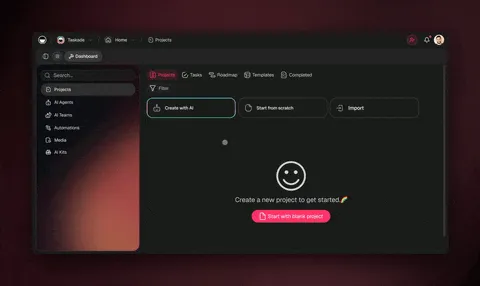
In Taskade, you can take outline notes in List view, switch the same notes to Mind Map view, and ask an AI agent that reads your projects to make flashcard questions or a summary. The free reading list template is a simple start for the charting method.
Notes can also become a working tool. In Taskade Genesis, one prompt builds a live app with its own database, such as a flashcard app, a reading tracker or a course dashboard, and Taskade EVE edits it with you in chat. Your notes are the memory, an AI agent with knowledge and tools is the intelligence, and automations with 100+ integrations are the execution. You can also clone a ready-made app kit from the Community Gallery and share it with a link. See mind mapping in Taskade Genesis for a study example.
Taskade Free includes unlimited projects, 2 workspace members, 3 Taskade Genesis apps and 1 AI agent. It starts with no AI credits, so you earn credits through referrals or buy a credit pack. Pro is $10 a month billed yearly and adds 50,000 AI credits a month. See plans and prices.
Limitations: When Taskade Is Not the Right Fit
Taskade is an outliner and workspace, not a handwriting app. If you take notes with a stylus on an iPad, a handwriting app such as Goodnotes or Notability fits the boxing and Cornell methods better, because you draw the page yourself. If you want a dedicated slip box with backlinks as the main feature, a linked-notes app built for Zettelkasten is a closer fit. Our AI second brain tools guide compares those apps.
Frequently Asked Questions
What are the main note-taking methods?
The most used note-taking methods are the Cornell method, the outline method, the mapping (mind map) method, the charting method and the sentence method. Two newer methods organize notes over years: Zettelkasten, which links short notes to each other, and PARA, which files notes by Projects, Areas, Resources and Archives. The boxing method and the bullet journal are popular on paper and on tablets.
What is the most effective note-taking method?
No single method is best for every subject. The Cornell method is the strongest choice for lectures you must review for a test, because the cue column turns your notes into self-quiz questions. The outline method suits talks with a clear structure, mind mapping suits ideas that branch, and charting suits facts you compare side by side.
Which note-taking method is best for lectures?
Use the Cornell method for lectures that end in an exam, and the outline method for lectures that follow a clear agenda. If the lecturer jumps between topics, use the sentence method during class and turn the sentences into an outline or a Cornell page the same evening.
What is the boxing method of note-taking?
The boxing method groups related notes inside a drawn box, one box for each topic, so the page reads as a set of separate blocks. It works well on a tablet with a stylus, because you can move and resize the boxes. Review one box at a time, and write a one-line summary under each box.
What is the charting method of note-taking?
The charting method puts notes in a table. Each column is a category, such as date, cause, effect or price, and each row is one item. Use it when the lecture or the reading compares several things on the same points, for example historical events, products or chemical elements.
Cornell vs outline notes: which is better?
Cornell notes are better for review, because the cue column and the summary make you test yourself. Outline notes are faster to take during a well-structured talk and easier to turn into an essay plan. Many students take outline notes in the right column of a Cornell page, which gives them both.
What is the difference between Zettelkasten and PARA?
Zettelkasten organizes ideas: each note holds one idea and links to related notes, so a network grows over time. PARA organizes actions: you file every note under a Project, an Area, a Resource or the Archive, based on when you will use it. Many people use PARA for folders and Zettelkasten-style links inside them.
Is handwritten or digital note-taking better?
A 2014 study by Mueller and Oppenheimer found that students who wrote by hand did better on conceptual questions, because typists tended to copy the lecture word for word. A 2019 replication did not find a reliable advantage. Digital notes are easier to search, share and reorganize. Type if you summarize as you go, and write by hand if you tend to transcribe.
What is the Q/E/C note-taking method?
Q/E/C stands for Question, Evidence, Conclusion. You write a question about the topic, record the evidence from the lecture or reading that answers it, and finish with a conclusion in your own words. It suits analysis subjects such as history, science and English, because the conclusion line is already a draft argument.
What is the best note-taking method for math?
Use an outline with worked examples for math. Write each rule or theorem as a heading, then copy one solved example under it, step by step, with a short note on why each step works. To review, cover the solution and redo the example from memory. Mind maps and charts suit math less, because proofs are linear.
Can AI take notes for me?
Yes. AI meeting assistants record and summarize calls, and AI note apps can summarize a PDF, a video or your own notes. AI works best after you take notes with a method, because a summary of your own Cornell page or outline is more useful than a summary of a raw transcript. Taskade Free starts with no AI credits, and Pro is $10 a month billed yearly.
Related Reading
- Best AI Note-Taking Apps
- Best AI Journaling Apps
- The Cornell Note-Taking Method
- The Outline Method of Note-Taking
- The PARA Method
- What Is a Second Brain?
- Taskade Genesis AI Apps and the Community Gallery
- Custom AI Agents and AI automations
- Taskade home
Good notes follow the same loop as a good workspace: capture what you learn (▲ memory), make sense of it (■ intelligence), and act on it (● execution). Pick one page method and one storage method this week, and keep them for a month before you judge them.