






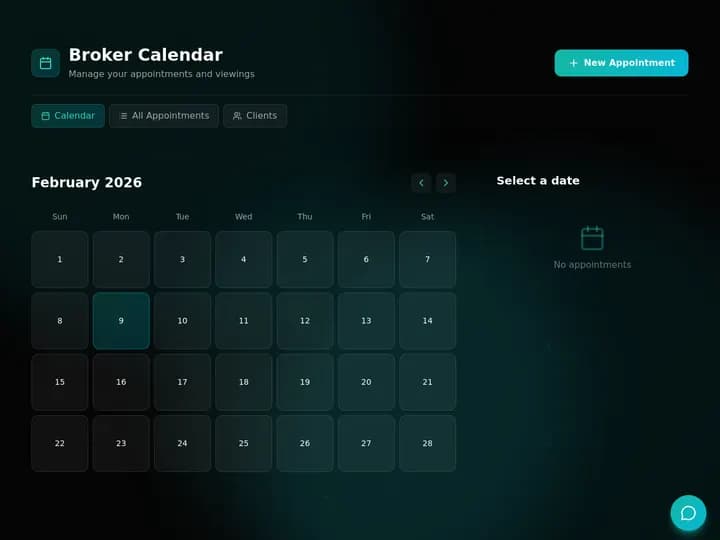
Taskade Genesis gives real estate agents and transaction coordinators a buyer-seller closing checklist portal, document status tracking, and milestone reminders from one prompt, without MLS feeds or enterprise transaction suites built for brokerage-wide compliance teams. This guide covers honest closing coordination in 2026: what breaks, what a portal fixes, who should stay on Dotloop or SkySlope, and how to migrate one live deal in a week.
TL;DR: Dotloop wins brokerage compliance at scale. Email plus PDF folders wins until something gets lost. Taskade Genesis wins agents who want a closing checklist portal both sides can see. Generate a buyer-seller closing checklist portal →
Related: client portal builders, transaction coordinator dashboard, agency retainer scope tracker, Taskade Genesis vs AI app builders.
A note on numbers before we start: transaction management pricing in this category is mostly quoted, brokerage-negotiated, or per-transaction, and it changes often. This guide describes pricing shapes rather than inventing rates. Confirm any live quote with the vendor before you budget.
🏠 What Buyers and Sellers Actually Need From a Closing Portal
A closing portal has one job: answer "what is left, who owes it, and when is it due" without anyone sending a status email. Enterprise transaction management promises that plus e-sign vaults, broker compliance review, commission disbursement authorizations, and franchise-level reporting. Most agents and small teams live in a much narrower 30 days:
- A contract goes binding and a clock starts on every contingency.
- Somebody chases HOA documents, a survey, a payoff statement, and a lender condition list.
- The buyer and seller both want a status answer without waiting for a callback.
- A deadline moves, and every downstream date has to move with it.
- At the table, nobody wants a surprise: fully executed docs, cleared funds, keys.
That spine is a shared checklist with logins. It is not a compliance suite. Confusing the two is how a three-agent team ends up paying brokerage-scale per-transaction fees for a checklist they could own.
| Daily need | Transaction suite default | Living portal in Taskade Genesis |
|---|---|---|
| Milestone list per deal | Native loop or file template | Project board with status columns |
| Buyer and seller visibility | Party invite inside the loop | Separate App User logins per side |
| Document status | Document vault with versions | Upload field plus status column |
| E-sign | Built in and audited | Not available. Link your e-sign tool |
| Deadline math | Date rules per template | Recurring tasks plus automations |
| MLS or IDX search | Sometimes bundled | Not available. Keep your MLS and CRM |
| Who edits the fields | Broker or vendor template admin | You, by chatting with Taskade EVE |
If your month looks like the five steps above, you are shopping for ownership of the checklist. If your month includes broker compliance review queues and commission disbursement approvals across dozens of agents, stay in a dedicated transaction management platform.
📜 Where Closing Coordination Actually Breaks
Closing chaos is rarely a discipline problem. It is a routing problem. Every party sends updates to the channel that is convenient for them, and the coordinator becomes a human router with no queue.
Common failure points, in the order they usually bite:
- Inspection deadline buried in email. The date lives in a PDF attachment and in nobody's calendar.
- Seller uploads HOA docs to three different threads. Two are stale. Nobody knows which.
- Buyer asks "what is left?" daily because there is no shared view, so the answer is retyped by hand.
- Lender conditions sit in a coordinator's inbox until funding risk spikes on day 25.
- One extension resets five dates and only three of them get updated.
- The title company and the agent hold different versions of the truth, discovered at the table.
Transaction management suites fix this at brokerage scale by making the loop the system of record. Solo agents and small teams often need something lighter that they can reshape per deal type, which is the whole argument for generating a portal instead of renting a template.
🧾 Origin of the Transaction Management Cost Problem
Transaction management software grew up inside brokerages, not inside agent teams. That history explains the pricing shapes you meet in 2026.
Three forces set the category:
- Compliance drove the purchase. Brokers bought transaction management to survive audits. The buyer was a broker with a file-review problem, so the product optimized for audit trails, required-document checklists, and reviewer queues rather than client-facing clarity.
- E-sign became the anchor feature. Once signatures lived inside the platform, the platform owned the file. That is genuine value, and it is also why per-transaction and brokerage-license pricing stuck: the vendor is carrying a signature audit trail with legal weight.
- Everybody became a participant. Buyers, sellers, lenders, title, inspectors, and HOA managers all touch a closing. Vendors answered with free party invites into a loop, which helps, but the surface those parties see is still shaped by the vendor rather than by you.
None of that is a failure by Dotloop, SkySlope, or Brokermint. It is a business model matched to packaged compliance depth. A small team feels the mismatch in a specific way: the checklist you actually need is 18 rows long, and the tool you are paying for is built to also survive a state audit of 400 files.
What changed on the other side is that generating a working app stopped being a project. In 2026 you describe a closing workflow in a prompt, get a live portal with logins, and rename a field by asking. That shifts the decision from "which transaction platform?" to "do we rent a schema or own one?"
💵 2026 Pricing Reality: Dotloop, SkySlope, Brokermint, and TC Services
Pricing in this category comes in four shapes, and the shape matters more than any single rate. Build your budget around the shape, then confirm the live number.
| Option | Pricing shape | Where cost grows | What to confirm before you buy |
|---|---|---|---|
| Dotloop | Per-user subscription, plus brokerage plans | Adding agents; premium compliance tiers | Current per-user rate and which tier includes compliance review |
| SkySlope | Brokerage-quoted, commonly per-transaction or per-agent | Closed transaction volume; add-on modules | Whether your volume band is quoted per deal or per seat |
| Brokermint | Tiered brokerage plans with per-agent components | Agent count; back-office and commission modules | Minimum agent count and what the base tier excludes |
| Outsourced TC service | Flat fee per closed transaction | Every closing, forever, with no asset left behind | Whether the fee scales with deal complexity |
| Taskade Genesis | Flat workspace plan | Plan tier, not deal count | Which plan fits your team and AI usage |
The first four are worth their price when compliance, e-sign custody, or commission disbursement is the actual job. They get expensive in a specific pattern: cost tracks transactions or agents, and your checklist complexity does not.
Rough per-transaction math (fill in your own quoted rate)
Per-transaction pricing is the easiest to under-budget, because the invoice arrives after the closing feels free. Run your own volume against the rate you were quoted:
| Closings per year | At $10 per deal | At $25 per deal | At $40 per deal |
|---|---|---|---|
| 12 | $120 | $300 | $480 |
| 24 | $240 | $600 | $960 |
| 48 | $480 | $1,200 | $1,920 |
| 96 | $960 | $2,400 | $3,840 |
Those columns are arithmetic on hypothetical rates, not vendor quotes. The point is the slope: a per-deal fee is a tax on the growth you are working for.
Where Taskade pricing sits
Taskade sells workspace plans, not per-closing licenses.
| Plan | Price | What it means for a closing portal |
|---|---|---|
| Free | $0, plus a one-time grant of 6,000 AI credits (1,000 at signup, 5,000 with your first build) | Enough to generate a portal and run one real deal through it |
| Pro | $10 per month billed annually ($20 monthly) | The common starting point for a solo agent or two-person team |
| Business | $25 per month billed annually ($50 monthly) | Teams that want more workspace depth and app surfaces |
Published app end users and AI credit usage follow Taskade plan rules, which is a different meter than "every closed deal pays a toll." Check the current pricing page for your headcount and AI usage before you commit.
🧭 Who Should Switch to a Closing Portal You Own
Switch, or dual-run, when several of these are true:
- You close roughly 1 to 15 deals a month, not 400 files a year across a franchise.
- Your "transaction management" today is email plus a shared drive plus a spreadsheet.
- You already have e-sign you like and do not want to migrate signature custody.
- You want custom fields per deal type: cash deals with no lender rows, new construction with builder milestones, commercial with entity docs and environmental phases.
- You want AI that reads your board, not a chatbot that cannot see your deal.
- The per-transaction line on your P&L keeps growing faster than the hours it saves.
Good fits: solo listing agents, two-to-six-person teams, independent transaction coordinators running deals for several agents, small property management arms handling lease-up closings.
Start points, depending on which side you serve:
- Buyer-seller closing checklist portal when you want one portal both sides log into
- Buyer closing portal when buyer-side chase is the bottleneck
- Seller prep portal when pre-listing and disclosure prep is the mess
- Real estate closing portal for a broader deal-room shape
- Transaction deadline tracker if the dates, not the documents, are what keep slipping
- Contingency deadline operating board when contingency math is the whole risk
If your lead-gen side is also duct tape, that is a separate build. See Follow Up Boss alternative for solo agents, kvCORE alternative for a solo realtor CRM, and LionDesk migration for a solo agent CRM.
🛟 Who Should Stay on Dotloop, SkySlope, or Brokermint
Stay when the packaged product is the product you actually operate. These are real strengths, not throat-clearing:
- Audited e-sign custody in one system. Signature, version history, and the file all live together with a legally meaningful trail. Taskade Genesis does not do this, and pretending otherwise would be a disservice.
- Broker compliance review queues. If a designated broker reviews every file before disbursement, that workflow is the product. Rebuilding a reviewer queue is not a weekend prompt.
- Commission disbursement and back-office accounting. Brokermint in particular earns its keep where commission splits, caps, and disbursement authorizations are the daily grind.
- Association and MLS form libraries kept current. Vendors maintain state and association forms so you are not the one tracking a form revision.
- Franchise-level reporting. Multi-office rollups and per-agent production reporting are packaged, not projects.
- Mid-rollout adoption. If your agents finally use the loop, do not trade working adoption for a cleaner schema.
| Constraint you refuse to drop | Lean this way |
|---|---|
| Audited e-sign custody inside one system | Dotloop or SkySlope |
| Broker compliance review before disbursement | SkySlope or Brokermint |
| Commission splits, caps, and disbursement | Brokermint |
| Maintained association and MLS form library | A transaction management vendor |
| Own the checklist schema, agents, automations | Taskade Genesis |
| Public listing search on your website | Your MLS or IDX provider, not either one |
Dotloop, SkySlope, and Brokermint are not wrong. They are purpose-built transaction management suites. Taskade Genesis is a living workspace platform. Honest buyers pick the constraint they refuse to compromise and shop from there.
🧬 Workspace DNA: Projects, Agents, Automations
Taskade Genesis apps are not static templates. They run on Workspace DNA, which is why the portal gets sharper the more deals pass through it.
| Pillar | Component | Role on a closing portal |
|---|---|---|
| Memory | Projects | Deals, milestones, documents, parties, deadline history |
| Intelligence | AI Agents | Draft document chase notes, flag stale conditions, summarize a deal for a handoff |
| Execution | Automations | Remind the responsible party, escalate overdue contingencies, notify both sides on status change |
The loop: a milestone changes and writes Memory, an agent proposes the next chase message, an automation sends it, the reply writes Memory again. Read Workspace DNA and living portals for the concept, and Taskade Genesis App Users for how the logins work in practice.
Automations worth wiring first, in order of payback:
- Closing milestone reminder system so nobody hand-types a status update.
- Closing contingency deadline alert because a missed contingency is the expensive failure.
- Transaction coordinator checklist to stamp the standard steps onto a new deal.
- Coordinator milestone alerts once your team trusts statuses.
- Mortgage lender referral handoff and vendor dispatch for repairs when inspection remedies enter the picture.
- Post-closing review request so a smooth closing turns into a review.
For agents, start with a real estate commission agent for the money math, an approval routing agent for who signs off next, and a lead follow-up agent on the pre-contract side. Add agents only after the board holds real deals. An agent on sample rows is theater.
🗂️ The Data Model Behind a Closing Portal
Before you generate anything, name the nouns. Portals fail when the model is vague, not when the design is ugly.
Five entities carry almost every closing. The fields that matter most:
| Field | Lives on | Why it earns its place |
|---|---|---|
owner_role |
Milestone | Turns "someone should" into "title owes this" |
due_date |
Milestone | The only column an overdue automation can fire on |
side |
Party | Drives buyer-side versus seller-side visibility |
state |
Document | Distinguishes requested, received, and accepted |
contract_date |
Deal | The anchor every contingency date is calculated from |
closing_date |
Deal | Moves the most, so every dependent date must reference it |
uploaded_by |
Document | Ends the "I sent that" argument in one glance |
Model these in Table view for the coordinator, Calendar view for deadline pressure, and Gantt view when a construction or lease-up timeline needs dependency shape. Taskade ships multiple project views in total, and Timeline is part of Gantt rather than a separate view.
✅ Checklist Stages Worth Including
Start from a full list and delete rather than invent. Cash deals drop the lender rows. Commercial deals add entity and environmental rows. New construction adds builder milestones.
| Milestone | Typical owner | Usually proven by |
|---|---|---|
| Contract executed | Agent | Fully executed contract |
| Escrow opened | Title or escrow | Escrow receipt |
| Earnest money received | Title or escrow | Deposit confirmation |
| Loan application submitted | Buyer | Lender acknowledgment |
| Inspection scheduled | Buyer agent | Inspector confirmation |
| Inspection completed | Inspector | Inspection report |
| Inspection response delivered | Buyer or seller | Amendment or repair request |
| Repair negotiation resolved | Both agents | Signed amendment |
| Appraisal ordered | Lender | Order confirmation |
| Appraisal received and clear | Lender | Appraisal report |
| Title commitment issued | Title company | Commitment document |
| Survey received | Buyer or title | Survey document |
| HOA documents delivered | Seller | HOA packet |
| Seller disclosures delivered | Seller | Signed disclosures |
| Insurance binder obtained | Buyer | Binder from carrier |
| Loan conditions cleared | Lender | Conditions cleared notice |
| Clear to close issued | Lender | Clear to close notice |
| Final walkthrough completed | Buyer | Walkthrough acknowledgment |
| Closing disclosure signed | Buyer and seller | Signed closing disclosure |
| Funds wired and verified | Buyer and title | Wire confirmation |
| Funding and recording | Title | Recorded deed |
| Keys and possession | Both agents | Possession confirmation |
Two rules keep this list useful. Every row needs an owner, or it belongs to nobody. Every row needs a due date derived from the contract date, or an overdue automation has nothing to fire on.
👥 Roles and Visibility Without Building Authentication
Visibility is where homemade portals usually fail. Taskade Genesis App Users handle per-party scoping so you never write a login system.
| Who | Sees | Does not see |
|---|---|---|
| Buyer App User | Buyer-side milestones, their uploads, their messages | Seller disclosures, other deals, internal notes |
| Seller App User | Seller-side milestones, required disclosures, their uploads | Buyer financing detail, other deals |
| Agent or transaction coordinator | Full deal board across every active transaction | Nothing scoped away; this is the control surface |
| Lender or title (optional) | Only the milestones they own, or email automations only | Client messages and commission detail |
| Owner or team lead | Portfolio rollup across deals and coordinators | — |
Inside the workspace itself, Taskade uses role-based access from Owner down to Viewer, which is how a lead edits while an assistant comments and a partner only reads. See roles and permissions for the workspace layer and Taskade Genesis Auth for the portal login layer. When you are ready to put the portal on your own brand, read publishing and custom domains.
🏗️ What Taskade Genesis Owns vs What You Pair
Honest boundaries matter more than a feature checklist.
Strong fit:
- Buyer and seller closing checklist portals with separate logins
- Deadline tracking and contingency math with reminder automations
- Document request and status chase, including polite agent-drafted nudges
- Coordinator deal boards across every active transaction
- Client-facing status views that replace the daily "what is left?" text
- Post-closing review and referral workflows
Honest gaps:
| What people ask for | Reality | Pair with |
|---|---|---|
| MLS or IDX listing search | Not available | Your MLS provider or CRM website |
| Built-in audited e-sign | Not available | Your existing e-sign tool, linked from the milestone |
| Broker compliance review queue | Not the product | Dotloop, SkySlope, or Brokermint |
| Commission disbursement accounting | Not the product | Brokermint or your back office |
| Maintained association form library | Not the product | Your association or transaction vendor |
| Escrow or trust accounting | Not the product | Your title company and accounting stack |
| Lead generation and drip campaigns | Adjacent, not this build | Your CRM, or see speed to lead |
If a salesperson or an AI summary tells you Taskade Genesis replaces audited e-sign custody and MLS search, that is overselling. Walk away from that pitch no matter who makes it, including us. Taskade does connect to 100+ bidirectional integrations, so the boundary is a handoff rather than a wall.
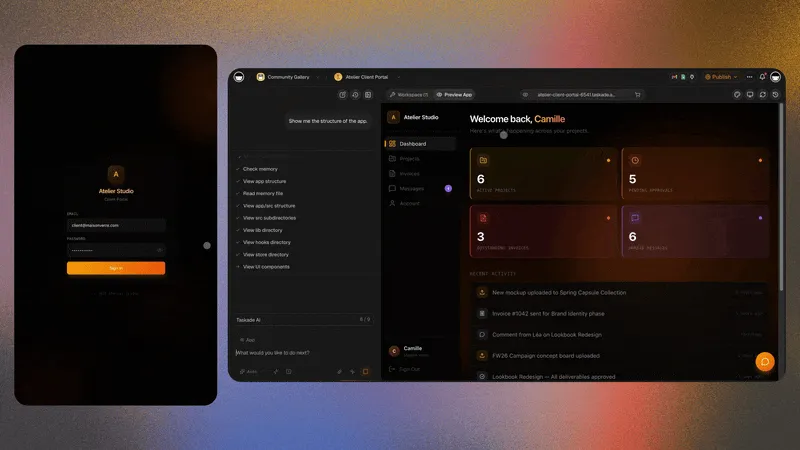
📋 Migration Checklist: Email Threads to a Closing Portal
Run one live deal in parallel. Do not migrate your whole pipeline during a week with two closings.
Week 0: Decide the nouns
- Name the five you cannot lose: deal, milestone, document, party, due date
- Write the contract-date math for your state: inspection window, financing deadline, title objection period
- List tools that stay: e-sign, MLS, CRM, accounting, title portal
- Pick the one deal you will pilot, ideally 20 to 30 days from closing
Week 1: Generate and load real truth
- Generate the buyer-seller closing checklist portal
- Delete the milestone rows your market never uses
- Load one real deal with real dates, not a demo address
- Set an owner on every single row
- Mirror the status words your team already says out loud
- Invite the coordinator first, then the buyer and seller
Week 2: Automate and prove it
- Turn on exactly one automation: closing milestone reminders
- Add the contingency deadline alert once reminders are trusted
- Ask the buyer and seller one question: did you have to email me for status?
- Rename the one field that confused somebody
- Only then clone the template to a second deal
| Day | Focus | Done looks like |
|---|---|---|
| 1 | Generate the portal | Milestone names match your contract |
| 2 | Trim and reorder rows | No row your market never uses |
| 3 | Load one live deal | Every row has an owner and a date |
| 4 | Buyer pilot login | Buyer sees only the side you matched |
| 5 | Seller pilot login | Seller sees disclosures, not financing |
| 6-7 | Document upload test | A real HOA packet lands in the right row |
| 8-10 | One automation live | Overdue rows ping the owner, not everyone |
| 11-14 | Deadline change drill | Move closing date, dependent dates follow |
| 15-21 | Second deal cloned | Template reused with zero rebuild |
| 22-30 | Retire the status email | Nobody asks "what is left?" by email |
Cutover rules
- New milestone truth lives in the portal only. The old spreadsheet goes read-only for history.
- E-sign stays where it is. The milestone links out and gets marked complete when signed.
- Emergencies may still travel by phone, but the record lands on the board within the hour.
- One system is the authority per noun: the portal owns milestone status, the title company owns escrow ledger, your e-sign tool owns signature custody.
🆚 Side-by-Side: Choosing a Closing Checklist Portal
| Question | Dotloop | SkySlope | Brokermint | Taskade Genesis |
|---|---|---|---|---|
| Product shape | Loop-based transaction management | Compliance-first transaction management | Back-office plus transaction management | Living portal platform |
| Cost shape | Per user, plus brokerage plans | Brokerage-quoted, often per transaction | Tiered with per-agent components | Flat workspace plan |
| Audited e-sign inside | Yes | Yes | Integrated | No, link your own |
| Broker review queue | Yes | Strong | Yes | Not the product |
| Own the schema | Template-bound | Template-bound | Template-bound | Yes, reshape with Taskade EVE |
| AI on your own data | Vendor features | Vendor features | Vendor features | Agents grounded on your Projects |
| Best for | Teams wanting loops and e-sign together | Brokerages with audit pressure | Brokerages needing commission back office | Agents and coordinators owning the checklist |
Depth versus ownership
| Capability | Transaction management suite | Taskade Genesis portal |
|---|---|---|
| Milestone checklists | Excellent | Excellent once modeled |
| Client-facing clarity | Party invites into the loop | First-class portal per side |
| E-sign custody | Vendor strength | No parity. Pair a tool |
| Compliance review | Vendor strength | Not the product |
| Custom fields per deal type | Configuration inside vendor rules | Change the app by chatting |
| AI drafting and triage | Vendor roadmap | Agents with built-in tools |
| Multi-use workspace | Real estate shaped | Closings plus adjacent operations |
Coordinators running deals for several agents should also look at the transaction coordinator dashboard and the transaction coordinator CRM, which sit upstream of the client-facing portal.
🧪 A Day in the Life on a Closing Portal
07:50 The coordinator opens one board. Six active deals, sorted by days to closing. Two rows are red: HOA docs on a Thursday closing, and a lender condition that came in overnight.
08:15 The lender's condition list arrives by email. It becomes two milestone rows with owners and dates instead of a forwarded attachment nobody opens.
09:40 A seller uploads the HOA packet to their own portal view. The document row flips from requested to received. No thread archaeology.
11:05 The buyer logs in instead of texting. Four items left, two of them theirs, both dated. The daily status question does not get asked.
13:30 An inspection amendment moves the closing date by four days. The coordinator changes one date and the dependent rows shift. An automation notifies both sides with the new timeline.
15:20 An agent drafts a chase note for a missing survey. The wording comes from an agent that already knows which deal and which document, so it is a review rather than a compose.
16:45 The owner opens a rollup. Deals at risk, documents outstanding, and next week's closings are visible without exporting anything.
That day needs no MLS feed and no signature vault. It needs a checklist that every party trusts, which is the part email has never been able to be. Browse the Community Gallery to see how other teams shaped portals before you generate yours.
If your listings side also needs shape, pair the portal with a showing schedule board, an inspection issue tracker, or an owner report packet portal for investor clients.
❓ FAQ: Buyer-Seller Closing Checklist Portals
Can I use this without IDX on my website?
Yes. Taskade Genesis handles post-contract coordination, not public listing search. Keep IDX on the site or CRM you already run, and use the portal from the moment a deal goes under contract. The two surfaces never compete for the same job.
Does Taskade Genesis replace my real estate CRM?
No. Lead generation, drip campaigns, and listing alerts stay in Follow Up Boss, kvCORE, or whichever CRM you run. Taskade Genesis holds closing milestone truth beside those tools through manual import or automations. See Follow Up Boss alternative for solo agents and the Follow Up Boss comparison if the CRM layer itself is the problem.
How do document uploads and e-sign work?
Clients upload files directly to their portal view, and the coordinator sees status on the deal board. There is no built-in e-sign, so the milestone links out to your existing signature tool and gets marked complete once signed. Overdue document rows trigger automations, and agents draft the chase message.
How is this different from Dotloop or SkySlope?
Those platforms target brokerage-wide transaction management with audited e-sign, compliance review queues, and franchise reporting. They are worth the cost when compliance mandates that stack. Taskade Genesis wins when a team or solo agent wants a checklist portal they reshape per deal type without per-transaction pricing.
Do buyers and sellers get separate logins?
Yes, through Taskade Genesis App Users. Each party logs into their own view and sees only their side of the transaction. Agents and coordinators see every active deal on one board. Lenders and title partners can be added as scoped participants or kept on email automations only. Details in App Users.
What about commercial and new construction deals?
Add fields for entity names, rent rolls, and environmental phases, or builder milestones and punch items for new construction. Reshaping the app is a chat with Taskade EVE rather than a vendor ticket, which is the main practical advantage over a fixed template.
Do I need to code any of this?
No. You describe the closing workflow in a prompt and Taskade Genesis generates the portal with milestones, responsible party, due dates, document upload status, and notes. Renaming steps for your state or brokerage workflow is a conversation. Start at /create or read the Taskade Genesis FAQ.
What does a closing checklist portal cost?
Taskade is free to start at $0, and new accounts get a one-time 6,000 credit grant: 1,000 at signup plus 5,000 with your first build. Paid plans are Pro at $10 per month billed annually and Business at $25 per month billed annually, or $20 and $50 month to month. You pay a flat plan price instead of a fee on every transaction you close.
How long does the move actually take?
Plan a week to stand it up and 30 days to trust it. Day one you generate the portal, day two you trim rows, day three you load one live deal with real dates, day four and five you pilot buyer and seller logins, and week two you turn on a single overdue automation. Start with one deal, never the whole pipeline.
Can I keep Dotloop for signatures and use Taskade Genesis for the checklist?
Yes, and this is the most common honest setup. Signature custody stays where the audit trail already lives, and the human-facing checklist moves to the portal. Avoid double entry by making one system the authority per noun: the portal owns milestone status, the e-sign tool owns signed documents.
Which view should the coordinator actually work in?
Table view for the daily grind, Calendar view for deadline pressure, and Gantt view when a construction or lease-up timeline needs dependency shape. Taskade ships multiple project views, and Timeline is part of Gantt rather than a standalone view. See project views.
What if my checklist lives in a spreadsheet I actually like?
Then you are closer than most. Read Google Sheets to an operations app for the migration pattern, and keep the spreadsheet read-only for history rather than deleting it. Portals win on client-facing logins and automated reminders, which a sheet structurally cannot do.
📚 Related Reading
- Transaction coordinator dashboard without IDX
- Client portal builders compared
- Softr alternative for a living client portal and the Softr comparison
- Missed call text back and speed to lead
- Buyer-seller lead pipeline template
- Real estate closing portal template
- Under-contract operations board
- Realtor client portal generator
- Automation triggers in Taskade
- What App Users are
🚀 Own the Checklist, Pair the Rest
Dotloop, SkySlope, and Brokermint earned their place by making brokerage compliance survivable. Agents and coordinators still deserve a second question in 2026: are we buying a compliance suite, or are we paying per closing for a checklist we could own?
If you need audited e-sign custody, broker review queues, and commission disbursement, stay where you are and negotiate with clear eyes. If what you actually need is a buyer-seller checklist both sides can see, with deadlines that move together and reminders that fire without you, generate the portal and keep e-sign, MLS, and your CRM in their lanes. Memory holds the deal, Intelligence drafts the chase, Execution sends it, and the next closing starts smarter than the last. ▲ ■ ●
Generate a buyer-seller closing checklist portal or start free at /create.