Moonshot AI is a Beijing artificial intelligence company that builds the Kimi family of models with one stubborn belief: open models can be as good as the closed frontier — and everyone should be able to download them. In three years it went from a long-context chatbot nobody outside China had heard of to Kimi K3, a 2.8-trillion-parameter open-weight model that trades blows with the best proprietary systems on Earth, released through the API on July 16, 2026, with full open weights on July 27.
How does a startup named after a Pink Floyd album end up shipping one of the most capable open models in the world? Who is Yang Zhilin, and why did Alibaba lead a billion-dollar round in his company before it was a year old? And what actually changed between Kimi K2, K2.5, and K3? Let's wind back the clock. 🌘
TL;DR: Moonshot AI was founded in March 2023 in Beijing by Yang Zhilin, Zhou Xinyu, and Wu Yuxin. Its Kimi chatbot broke out on long context; Kimi K2 (July 2025) became the "open-weight DeepSeek moment"; Kimi K3 (July 16, 2026) is a 2.8-trillion-parameter open-weight flagship at frontier level. A July 2026 round reportedly valued the company at about $35 billion. Clone a live AI-lab tracker → and follow every model launch yourself.
Moonshot AI history in one paragraph: Moonshot AI started in Beijing in March 2023, on the 50th anniversary of The Dark Side of the Moon. It launched the Kimi chatbot in October 2023 with a 200,000-character context window, raised a $1 billion Alibaba-led round in February 2024, open-sourced the 1-trillion-parameter Kimi K2 in July 2025, and shipped the 2.8-trillion-parameter Kimi K3 in July 2026.
What is Moonshot AI's Chinese name? Moonshot AI's Chinese name is 月之暗面 (Yuè Zhī Ànmiàn), "the dark side of the moon," after Pink Floyd's 1973 album The Dark Side of the Moon, a nod to founder 杨植麟 (Yang Zhilin). The registered company is 北京月之暗面科技有限公司 (Beijing Moonshot AI Technology Co., Ltd.), founded in Beijing in March 2023.
The TSK-1 Benchmark sends the same app request to each model and records whether the app worked, and the Kimi results show how Kimi did.
For the other labs that shaped open-weight AI in China, read the DeepSeek history and the Qwen history.
What Is Moonshot AI?
Moonshot AI is a Chinese AI company founded in March 2023 in Beijing, best known for the Kimi family of large language models. It is counted among China's "six AI Tigers" — the cohort of well-funded startups racing to build frontier models — and it is the one that bet hardest on open weights: models whose parameters you can download, run locally, and fine-tune, rather than only rent through an API.
That bet is the whole story. Where much of the industry raced to lock capability behind paid endpoints, Moonshot's founder framed the mission differently at NVIDIA's GTC 2026 keynote:
"One of our major pursuits is to build better open models and we believe in democratizing intelligence. Open models cannot be just open. They have to also be great."
— Yang Zhilin, GTC 2026 keynote

Don't just read Moonshot's history — clone a living dashboard that tracks any AI lab's models, funding rounds, and releases in minutes. One click, no code, free.
Moonshot AI at a Glance (2026)
| Fact | Detail |
|---|---|
| Founded | March 2023, Beijing, China |
| Founders | Yang Zhilin (CEO), Zhou Xinyu, Wu Yuxin |
| Headquarters | Haidian District, Beijing (registered April 17, 2023) |
| Flagship product | Kimi model family + Kimi chatbot (kimi.com) |
| Latest model | Kimi K3 (July 16, 2026) — 2.8T-parameter open-weight MoE |
| Chinese name | 月之暗面 ("Dark Side of the Moon") |
| Largest outside backer | Alibaba (~36% stake taken in 2024, diluted since) |
| Latest valuation | ~$35 billion (round closed July 2026, per Bloomberg) |
| Total funding | More than $8 billion across reported rounds |
| Revenue | Reported ARR of about $300 million by June 2026, per TechNode, citing Bloomberg |
| License | Modified-MIT open weights (K2 family); Kimi K3 License (K3) |
| Context window | Up to 1 million tokens (K3) |
Last updated: October 2026 — refreshed for the July 16 Kimi K3 launch, the July 27 open-weight release, and the K3 architecture and serving details in the tech report. Model generations, benchmark positions, and valuations in this space move fast and diverge across sources; where figures are disputed we say so. Check Moonshot's blog before quoting any number in a deal memo.
Who Owns Moonshot AI?
Moonshot AI is a private company controlled by its founders, with co-founder and CEO Yang Zhilin at the top and Alibaba as the largest outside investor. Alibaba's annual report disclosed about US$0.8 billion for an approximately 36% stake taken in its 2024 fiscal year. Every round since has diluted that share, so the current figure is lower and undisclosed.
The structure has three layers, according to company records reviewed by The Wire China: the founders hold the Beijing operating company directly, other operations sit under a Hong Kong holding company, and that holding company's only shareholder is the Cayman Islands-registered Moonshot AI Ltd. Outside capital arrives at the offshore level. Some profiles also list Zhang Yutao as a co-founder alongside the three names on the founding record.
The diagram shows the reported structure, not share counts. Moonshot AI does not publish its cap table, so no outside stake after 2024 is confirmed.

The Moonshot AI logo. Image: Wikimedia Commons, CC0.
What Is Kimi?
Kimi is both a chatbot (the consumer app at kimi.com) and a family of models (Kimi v1 through Kimi K3). The two share a name because they share an origin: Kimi is founder Yang Zhilin's English nickname. The chatbot launched on October 9, 2023, opened to the public on November 16, 2023, and made its name on one feature nobody else did as well at the time — reading enormous documents without losing the thread.
Think of it this way: the chatbot is the product a person opens in a browser; the model is the engine underneath, which Moonshot also publishes so developers can run it themselves. When people say "Kimi beat the previous best open model," they mean the model. When they say "I asked Kimi to summarize a 200-page contract," they mean the chatbot.
Why the Names "Moonshot" and "Kimi"?
Moonshot AI's Chinese name is 月之暗面 (Yuè Zhī Ànmiàn), which literally means "Dark Side of the Moon" — a direct nod to the 1973 Pink Floyd album. The English name "Moonshot" carries the Silicon Valley meaning: an audacious, long-odds project aimed at a giant payoff. Put the two together and you get the company's self-image — an ambitious shot at something most people think is out of reach.
The timing was deliberate too. The Dark Side of the Moon came out in March 1973, it is Yang's favorite album, and Moonshot AI launched in March 2023, on the album's 50th anniversary. The legal entity followed on April 17, 2023, which is why a few registries list April as the founding month.
The model name is more personal. Kimi is Yang Zhilin's own English nickname, and it stuck to the chatbot and then to the whole model line. It's a rare case where the founder's name literally became the product — and a small reminder that behind the benchmark tables sits a specific person with a specific research history.
Who Founded Moonshot AI? Meet Yang Zhilin
Moonshot AI was founded in March 2023 by Yang Zhilin (杨植麟, CEO), Zhou Xinyu, and Wu Yuxin. Yang is the technical center of gravity, and his research pedigree is the reason serious investors took the company seriously from day one.
Yang earned his PhD at Carnegie Mellon University, advised by Ruslan Salakhutdinov and William Cohen, and did stints connected to Google Brain and Meta AI. Crucially, he co-authored two papers that anyone who studies language models will recognize:
- Transformer-XL — an architecture that extended how far a model could "remember" across long inputs, foreshadowing Moonshot's later obsession with long context.
- XLNet (NeurIPS 2019) — a pretraining method that outperformed Google's BERT on 20 tasks and became one of the most-cited NLP papers of its era.
Moonshot AI's Chinese name, 月之暗面, means "Dark Side of the Moon" — a Pink Floyd reference. Founder Yang Zhilin's English nickname, Kimi, became the model line's name. Photo: NASA / public domain.
The takeaway for the history: Moonshot didn't stumble into long context and efficient architectures. Those were Yang's research themes years before the company existed. When Kimi's first breakout feature turned out to be reading enormous documents, it was a founder building the thing he'd studied his whole career.
Yang Zhilin, Year by Year
Yang Zhilin was born in Shantou, Guangdong, in 1992 (some Chinese profiles say 1993), and won a first prize in the National Olympiad in Informatics in Guangdong on his way to Tsinghua University. He graduated in computer science in 2015 and finished his Carnegie Mellon PhD in four years. His CMU adviser Ruslan Salakhutdinov later told The Wire China that Yang was an "absolutely brilliant student" who said he would always regret not starting a company.
| Year | Yang Zhilin milestone | Why it matters for Kimi |
|---|---|---|
| 2015 | B.S. in computer science, Tsinghua University | Where he met his future co-founders |
| 2015–2019 | PhD at Carnegie Mellon; research time at Google Brain and Meta | Built his long-context research record |
| 2016 | Co-founds Recurrent AI, a sales-analytics startup, while still a student | First company; it later shaped a 2024 investor dispute |
| 2019 | Transformer-XL (ACL) and XLNet (NeurIPS) published | Long memory across segments, the seed of Kimi's long context |
| 2020–2021 | Works on Huawei's early PanGu model and leads a team on BAAI's Wu Dao model | Hands-on large-model training in China |
| Mar 2023 | Co-founds Moonshot AI after ChatGPT's launch convinced him to pursue generative AI | The company and Kimi begin |
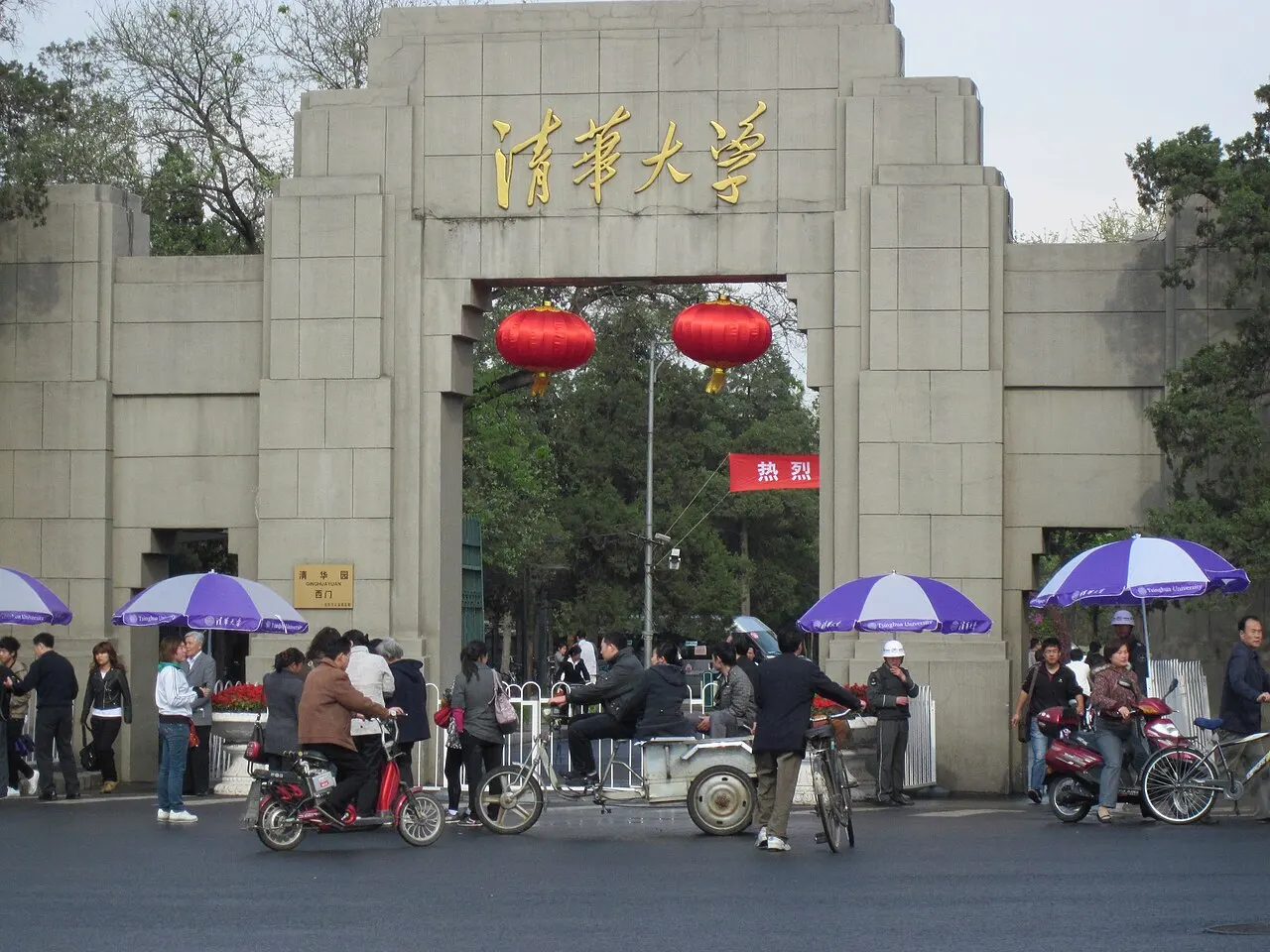
The west gate of Tsinghua University in Beijing. All three Moonshot AI founders studied here. Photo: Huangdan2060 / Wikimedia Commons, CC0.
Zhou Xinyu and Wu Yuxin: The Other Two Founders
Moonshot AI's two other founders bring the engineering half of the story, and both came from computer vision rather than language. Here is what each one did before 2023.
- Zhou Xinyu studied computer science at Tsinghua and then spent years at Megvii, the Beijing vision company, after earlier work at Hulu and Tencent. He co-authored ShuffleNet (CVPR 2018), a network designed to run on phones, plus DoReFa-Net for low-bit training and the EAST text detector. His record is about making large networks cheap enough to run, a theme that returns in K3's 4-bit weights.
- Wu Yuxin studied at Tsinghua and Carnegie Mellon, then joined Meta's AI research lab (FAIR). With Kaiming He he co-authored Group Normalization, he co-authored MoCo (Momentum Contrast), and he created Detectron2, one of the most used open-source vision libraries. He also worked on foundation models at Google Brain before Moonshot.
| Founder | Background | Known for | Moonshot role |
|---|---|---|---|
| Yang Zhilin (杨植麟) | Tsinghua, CMU PhD, Google Brain, Meta | Transformer-XL, XLNet | Co-founder, CEO |
| Zhou Xinyu (周昕宇) | Tsinghua, Megvii, Hulu, Tencent | ShuffleNet, DoReFa-Net, EAST | Co-founder |
| Wu Yuxin (吴育昕) | Tsinghua, CMU, Meta FAIR, Google Brain | Group Normalization, MoCo, Detectron2 | Co-founder |

The Gates and Hillman Centers, home of computer science at Carnegie Mellon University, where Yang Zhilin did his PhD from 2015 to 2019. Photo: Sdkb / Wikimedia Commons, CC BY-SA 4.0.
Moonshot AI History, Era by Era (2023–2026)
Moonshot AI's history falls into five eras: a founding sprint in 2023, a consumer long-context boom in 2024, an open-weight pivot after the DeepSeek shock in 2025, the agent-swarm and funding surge of early 2026, and the Kimi K3 frontier era from July 2026. Each era changed what the company sold and who paid for it.
Era 1: The Founding Sprint (March to December 2023)
Moonshot AI went from zero to a shipped product in seven months. Yang, Zhou and Wu started the company in March 2023, registered it on April 17, and closed a seed round from HongShan (the former Sequoia China) and ZhenFund that valued it near $300 million, according to PitchBook data cited by the South China Morning Post. Reported seed totals range from about $60 million to $200 million.
On October 9, 2023, Kimi Chat launched with a context window of 200,000 Chinese characters, about 128,000 tokens, at a time when most Chinese chatbots handled a few thousand. It opened to everyone on November 16, 2023. The pitch was concrete: paste a contract, a thesis or a codebase, and ask questions about all of it.
| Date | Event |
|---|---|
| Mar 2023 | Moonshot AI founded in Beijing |
| Apr 17, 2023 | Company formally registered |
| Mid-2023 | Seed round from HongShan and ZhenFund, ~$300M valuation |
| Oct 9, 2023 | Kimi Chat launches with 200,000-character context |
| Nov 16, 2023 | Kimi opens to the general public |
Era 2: The Long-Context Boom (2024)
2024 was the year Kimi became a household name in China and Moonshot became one of the "AI Tigers." In February 2024 Moonshot raised more than $1 billion in a round led by Alibaba and HongShan at about a $2.5 billion valuation, the largest single round for a Chinese LLM startup on public record at the time, per TechCrunch. Alibaba put in about $800 million of it.
In March 2024 Moonshot announced a 2-million-character context window, ten times the launch figure. The demand spike that followed briefly overwhelmed Kimi's servers. In August 2024, Tencent and Gaorong Capital joined a round of more than $300 million at about $3.3 billion, according to Bloomberg. Kimi Explore, an autonomous search mode, followed in October.
Behind the chatbot, Moonshot published Mooncake in June 2024, the serving system that splits prompt processing (prefill) from token generation (decode) and pools a shared cache across CPU, DRAM and SSD. Mooncake later won the Erik Riedel Best Paper Award at USENIX FAST 2025. It is the same disaggregation idea that hosts use to serve K3 today, covered in the K3 serving section below.
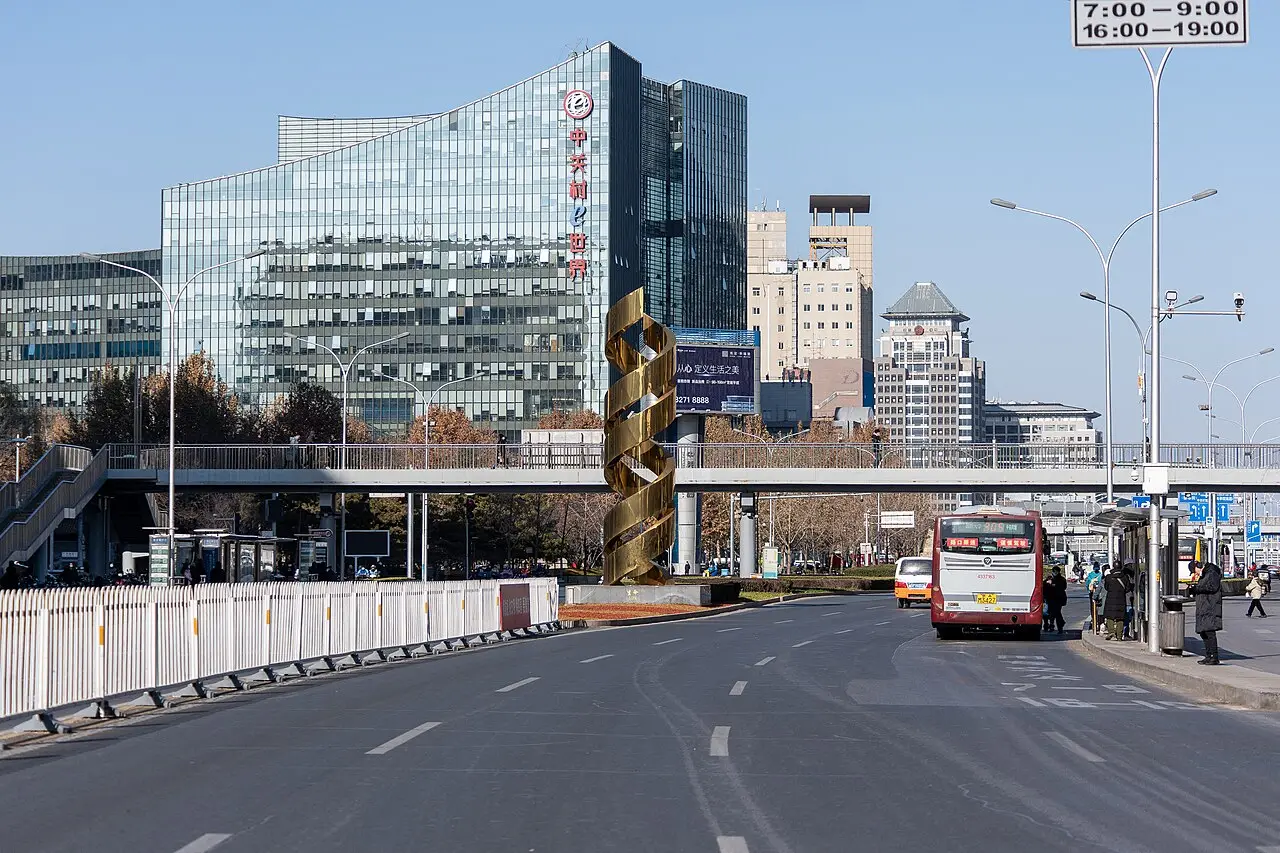
Zhongguancun Street in Haidian District, Beijing's technology district and home to Moonshot AI's headquarters. Photo: N509FZ / Wikimedia Commons, CC BY-SA 4.0.
Era 3: The DeepSeek Shock and the Open-Weight Pivot (2025)
The year began badly. On January 20, 2025, Moonshot released Kimi K1.5, a reasoning model it said matched OpenAI's o1 on math and code. DeepSeek released R1 within hours of it. R1 shipped open weights, and K1.5 did not, so R1 took the world's attention. Analyst Tony Peng told The Wire China that Moonshot "lost steam" after the DeepSeek splash, and Kimi's rank among Chinese AI apps by monthly active users slipped through the first half of the year.
Moonshot answered by opening up. In February it published "Muon is Scalable for LLM Training" (arXiv 2502.16982) with an open 16B-parameter model. Open-weight vision, audio and coding models followed between April and June, and the Kimi-Researcher agent arrived in June. Then, on July 11, 2025, came Kimi K2: 1 trillion parameters, 32 billion active, trained on 15.5 trillion tokens with zero loss spikes, and released under a modified MIT license. It ranked as the top open model on the LMSYS Arena leaderboard within a week, according to the K2 technical report.
The rest of 2025 was a release cadence most labs could not match: K2-Instruct-0905 in September with a 256K context, the OK Computer agent mode the same month, Kimi Linear on October 30, and K2 Thinking on November 6. CNBC reported, citing one source, that K2 Thinking cost about $4.6 million to train. Moonshot researchers later said that was not an official figure. On December 31, Yang told staff in an internal letter that Moonshot had closed a $500 million round led by IDG Capital at a $4.3 billion valuation.
Era 4: Agent Swarms and the Funding Surge (January to June 2026)
Kimi K2.5, released on January 27, 2026, added native vision and the agent swarm and became a favorite base for coding products. In March, after a developer found the model ID in Cursor's API, a Moonshot researcher questioned the credit. Cursor then confirmed that its Composer 2 coding model was built on K2.5, and Cursor co-founder Aman Sanger called the missing credit "a miss." Moonshot's account later said the use was part of an authorized commercial partnership through Fireworks AI.
The money moved faster than the models. Reports put a round of more than $700 million at a $10 billion valuation in February. At NVIDIA GTC in March, Yang presented the three scaling dimensions behind K2.5 and previewed Attention Residuals (arXiv 2603.15031, March 16, 2026). K2.6 shipped on April 20, and on May 7 Moonshot closed about $2 billion at more than $20 billion, led by Meituan's Long-Z Investments, per TechCrunch. TechCrunch reported annual recurring revenue above $200 million in April. K2.7 Code followed on June 12.
Era 5: Kimi K3 and the Frontier (July 2026 to Today)
On July 16, 2026, Moonshot launched Kimi K3 through its API and app, and on July 27 it released the weights and the technical report. Artificial Analysis then called K3 "the leading open weights model" with a score of 57 on its Intelligence Index. Two days later, on July 29, Bloomberg reported that Moonshot had closed about $3.5 billion at a $35 billion valuation, nearly twice its target, with China's National Artificial Intelligence Industry Investment Fund among the leads, per TechNode. TechNode, citing Bloomberg, reported that annual recurring revenue rose from $100 million in March to $300 million in June.
The same weeks brought the sharpest scrutiny the company has faced: a White House accusation of distillation, then an Anthropic threat report in September. Both are covered in Controversies and Open Questions below.
Every Kimi Model Explained (v1 → K3)
Here is the single most useful reference in this piece: a clean, dated map of the Kimi lineage. Every competitor lists some versions; the point is to see the whole arc at once. (Parameter and context figures are Moonshot's reported specs; benchmark positions are discussed, and caveated, further down.)
| Model | Released | Total / active params | Context | What changed |
|---|---|---|---|---|
| Kimi v1 | Oct 9, 2023 | — | 200K chars, 2M chars from Mar 2024 | The long-context chatbot breakout |
| Kimi K1.5 | Jan 20, 2025 | — | 128K | Reasoning ("thinking") arrives, same day as DeepSeek R1 |
| Kimi-VL | Apr 2025 | 16B / ~3B (MoE) | 128K | Open-weight vision-language model |
| Kimi K2 | Jul 11, 2025 | 1T / ~32B (MoE) | 128K | Open-weight breakout; agentic + coding |
| K2-Instruct-0905 | Sep 2025 | 1T / ~32B | 256K | Better agentic coding, context doubled |
| Kimi Linear | Oct 30, 2025 | 48B / ~3B | 1M | Research model that debuts Kimi Delta Attention |
| K2 Thinking | Nov 6, 2025 | 1T / ~32B | 256K | Reasoning agent, native INT4, 200-300 tool calls |
| Kimi K2.5 | Jan 27, 2026 | 1T / ~32B | 256K | Native vision (early fusion) + agent swarm |
| Kimi K2.6 | Apr 20, 2026 | 1T / ~32B | 256K | Long-horizon agentic coding; swarm up to 300 sub-agents |
| K2.7 Code | Jun 12, 2026 | 1T / ~32B | 256K | Coding specialist, fewer reasoning tokens |
| Kimi K3 | Jul 16, 2026 | 2.8T / ~104B (MoE) | 1M | Frontier-level open-weight flagship; 16 routed + 2 shared of 896 experts per token |
Kimi v1 (2023): The Long-Context Breakout
The original Kimi chatbot launched in late 2023, and its calling card was long context — the ability to read and reason over very large documents in a single go. In a market where most assistants choked on anything past a few thousand words, "paste a whole book and ask questions" was a genuine differentiator, and it earned Moonshot an early, loyal Chinese user base. If you want the deeper mechanics of why context length matters so much, see how large language models actually work.
Kimi K1.5 (January 2025): Reasoning Arrives
K1.5 brought explicit reasoning — the model "thinks" through a problem in intermediate steps before answering, the same shift that reshaped the whole field around reasoning models. It was Moonshot signaling that it intended to keep pace with the reasoning wave, not just win on document length.
Kimi K2 (July 2025): The Open-Weight "DeepSeek Moment"
Kimi K2, released July 11, 2025, is where Moonshot became a global name. It was a 1-trillion-parameter mixture-of-experts model with roughly 32 billion active parameters, and it shipped with open weights under a modified-MIT license. The reaction echoed the earlier shock of DeepSeek: here was near-frontier agentic and coding capability that anyone could download, not merely rent. Commentators called it an "open-weight DeepSeek moment," and it reframed Moonshot from "the long-context lab" into "the lab pushing the open frontier."
Under the hood, K2 was a deliberately conservative design. Its technical report describes an architecture similar to DeepSeek-V3: 61 layers, Multi-head Latent Attention (MLA), 384 experts with 8 routed per token plus 1 shared expert, and a 160K-token vocabulary. The new part was the optimizer. Moonshot trained K2 on 15.5 trillion tokens with MuonClip, its version of the Muon optimizer, and reported zero loss spikes across the whole run. K2 reported 65.8% on SWE-bench Verified in single-attempt agentic mode, a strong open-model result in July 2025.
Kimi K2 Instruct & K2 Thinking (September–November 2025)
Through late 2025 Moonshot iterated fast, shipping instruction-tuned and reasoning variants of K2 and extending context toward 256K tokens. This is the period where the K2 family hardened into a serious tool for agentic workflows rather than a research demo.
K2-Instruct-0905 (September 2025) doubled the context window from 128K to 256K tokens and improved agentic coding. K2 Thinking (November 6, 2025) was the bigger step. Moonshot trained it with quantization-aware training so it runs natively in INT4, which roughly doubled generation speed, and it kept a coherent plan across 200 to 300 consecutive tool calls, where earlier models drifted after 30 to 50. On its own model card Moonshot reported 44.9% on Humanity's Last Exam with tools, 60.2% on BrowseComp and 71.3% on SWE-bench Verified.
Kimi K2.5 (January 2026): Multimodal + the Agent Swarm
K2.5 is the pivot most competitors under-cover, and it's the technical heart of everything that followed. Two things changed at once.
First, native vision through "early fusion." Instead of training a text model and bolting on an image module later ("late fusion"), K2.5 trained on vision and text tokens together from the start, giving one shared understanding. Moonshot described it as the first open model with native joint vision-and-text capabilities, and reported a striking result: with a strong text base, it needed essentially zero vision fine-tuning data to reach near-state-of-the-art on vision tasks.
Second, the agent swarm. Rather than one agent grinding through a task step by step, a lead orchestrator spawns many parallel sub-agents — researchers, coders, fact-checkers — that work simultaneously and report back. Yang's analogy in the GTC keynote was a company: "if we build a company, we need maybe a CEO to decompose and assign the task to different roles." We'll visualize it in a moment.
K2.5 kept the K2 skeleton (1 trillion parameters, 32 billion active, 384 experts) and added a 400-million-parameter vision encoder called MoonViT. Moonshot continued pre-training from a K2 checkpoint on about 15 trillion more mixed vision and text tokens, on NVIDIA H800 GPUs, as Yang described at GTC. At launch Moonshot said the swarm could run up to 100 sub-agents and 1,500 tool calls in parallel, cutting wall-clock time by up to 4.5 times on wide search tasks. The model shipped with a command-line coding agent, Kimi Code, and four app modes: Instant, Thinking, Agent and Agent Swarm (beta).
Kimi K2.6 & K2.7 Code (April–June 2026): The Agentic-Coding Push
The K2.6 and K2.7 Code releases specialized hard on agentic coding — long, multi-step programming tasks run with minimal supervision. On Moonshot's reported evaluations, the K2 family climbed to the top of open-weight agentic-coding leaderboards, and K2.6 became one of the models teams reached for when they wanted a cheap, capable open coder. (Kimi's K2.6 is one of the Moonshot models available in Taskade's model stack today.)
K2.6 (April 20, 2026) raised the swarm ceiling to 300 sub-agents and 4,000 coordinated steps and was released under the same modified MIT license. K2.7 Code (June 12, 2026) was a coding specialist built on K2.6. Moonshot reported a 21.8% gain on its own Kimi Code Bench v2 and about 30% fewer reasoning tokens than K2.6, and made it the default model in Kimi Code. Both kept the 1-trillion-parameter, 256K-context design that K3 would replace a month later.
Kimi K3 (July 2026): The 2.8T Open-Weight Flagship
Kimi K3, released July 16, 2026, is the payoff. It is a 2.8-trillion-parameter mixture-of-experts model that activates 16 routed + 2 shared of its 896 experts per token — about 104B of its 2.8T parameters, roughly 3.7% — so a model that huge runs at a fraction of the compute a dense 2.8T model would need. It has native vision and a 1-million-token context window, and Moonshot reports roughly 2.5× better scaling efficiency than K2.
The API went live immediately, and the full open weights were released on July 27, 2026, together with the tech report. Moonshot publishes per-token pricing for the K3 API on its API platform.
Independent reviewers who stress-tested K3 at launch reached a consistent verdict: it is at or near frontier level for agentic coding and long-horizon autonomy, trading blows with the strongest proprietary models on many tasks — while still showing rough edges (it can be slow and token-hungry). One reviewer's summary captured the moment: "Open-source AI is no longer a few months behind the closed frontier models." Moonshot's own release note is honest about the gap that remains — the model "still trails the most powerful proprietary models" on the very hardest tasks — but the direction is unmistakable. (Exact benchmark numbers vary by source. The benchmark section below separates Moonshot's own model-card scores from independent measurements.)
How Kimi's Agent Swarm Works
The agent swarm is Moonshot's answer to a simple problem: some tasks are too big for one agent to finish in a reasonable time. Instead of a single model working sequentially, a lead orchestrator decomposes the goal and spawns parallel sub-agents — Yang described scaling to 100 or even 1,000 of them — each handling a slice of the work, then reports get merged into one result.
To train this behavior, Moonshot shaped three rewards so the swarm doesn't cheat or collapse: an instantiation reward (pay the model for spawning sub-agents so it doesn't quietly revert to a single agent), a finish reward (pay it only when sub-tasks actually complete, so it can't spawn junk it never finishes), and an outcome reward (did the overall task succeed). If the "orchestrator plus specialists" pattern sounds familiar, it's the same idea behind multi-agent platforms and inter-agent communication patterns — Moonshot just baked it into the model's training.
Kimi's Architecture in Plain English
You don't need a PhD to understand what makes Kimi efficient. Moonshot's whole pitch, laid out in Yang's GTC 2026 keynote, is that scaling is the main driver of progress — and that you can scale along more than just "train on more data." Kimi pushes three dimensions:
- Token efficiency (MuonClip). The optimizer decides how to nudge a model's weights each training step. Moonshot invested heavily in the Muon optimizer and its own MuonClip variant, which stabilizes training at trillion-parameter scale (past a certain size, internal scores "explode" and training diverges; a clipping trick caps them without hurting accuracy). Moonshot reports roughly 2× the token efficiency of the long-standing Adam optimizer — meaning the same limited pile of high-quality data teaches the model about twice as much. As Yang put it: "Token efficiency is not just about efficiency. It's actually also about improving the upper bound of intelligence."
- Long context (Kimi Linear + Kimi Delta Attention). A more efficient way to relate words across a very long input, so the model can hold a 1-million-token window (about 700,000 words) without the cost exploding. This is the through-line from the original 2023 chatbot to K3.
- Attention residuals. A next-generation architectural idea Moonshot previewed at GTC, reported to add ~24% more token efficiency. Combined with MuonClip, it's much of where K3's ~2.5× scaling gain comes from.
The important context-setting caveat: these efficiency figures (2×, 24%) are Moonshot's own reported results from its papers and keynote, not independent consensus — and the underlying Muon optimizer originated outside Moonshot (with researcher Keller Jordan in late 2024). Moonshot's contribution is scaling it. For a broader tour of these building blocks, our open-source LLM history walks the full lineage.
Yang's own 40-minute walkthrough is the best primary source on these three ideas. He explains the QK-Clip fix that stopped K2's attention scores from exploding past 1,000, the per-channel forgetting in Kimi Delta Attention, the three swarm rewards, and the first public look at Attention Residuals.
| Scaling idea | Moonshot paper | First shipped in | Moonshot-reported gain |
|---|---|---|---|
| MuonClip optimizer | Muon is Scalable for LLM Training (arXiv 2502.16982), K2 report (arXiv 2507.20534) | Kimi K2, Jul 2025 | About 2× token efficiency over AdamW |
| Kimi Delta Attention | Kimi Linear (arXiv 2510.26692) | Kimi Linear, Oct 2025; K3 at scale | Beats full attention on short and long tasks in Moonshot's tests |
| Agent swarm (PARL) | Kimi K2.5 report (arXiv 2602.02276) | Kimi K2.5, Jan 2026 | Up to 4.5× faster on wide search |
| Attention Residuals | Attention Residuals (arXiv 2603.15031) | Kimi K3, Jul 2026 | About 24% better token efficiency |
Kimi K3 Architecture, Under the Hood
Kimi K3 is a 2.8-trillion-parameter model that computes about 104B parameters per token, built on four design choices from its model card and the K3 tech report (arXiv 2607.24653). The table reads one axis at a time.
| Axis | K3 design | What it does |
|---|---|---|
| Width | Stable LatentMoE: 896 experts, 16 routed + 2 shared per token | Keeps per-token compute near a ~100B model |
| Depth | 93 layers: 69 Kimi Delta Attention + 24 Gated MLA, a 3:1 pattern | Linear attention keeps a 1M-token window affordable |
| Residuals | Attention Residuals in place of the plain residual sum | Lets each layer pick which earlier layers to read |
| Serving | Native MXFP4 weights, about 1.56 TB | Fits one 8× B300 node, not 8× B200 or 8× H100 |
The serving row is where the size shows. Total parameters, not active ones, set the GPU memory, because every expert has to stay loaded to keep latency steady. The hybrid design also splits the cache: the 24 MLA layers keep a per-token cache, while the 69 Kimi Delta Attention layers keep a fixed-size state per conversation. Our AI inference explainer walks through how hosts serve a model like this, and no-code builders that run open-weight models lists the ways to use K3 without owning a B300 node.
The diagram follows one token through K3. Each block stacks three Kimi Delta Attention layers and one Gated MLA layer, every layer feeds a mixture-of-experts layer, and Attention Residuals let later blocks read earlier block outputs by learned weight instead of a plain sum.
Simplified from the K3 model card: 23 blocks of 3 KDA + 1 Gated MLA give 92 layers, plus one final MLA layer for 93. The model card also lists one dense layer.
Kimi Delta Attention: How K3 Holds a Million Tokens
Kimi Delta Attention (KDA) is a linear attention that stores a fixed-size memory per conversation instead of a cache that grows with every token. Standard softmax attention keeps a key and a value for every past token, so a 1-million-token conversation means a huge cache that the GPU must read for each new token. KDA keeps one small matrix per attention head and edits it as tokens arrive.
KDA is the latest step in a line of research that started outside Moonshot. Each step fixed the weakness of the one before it:
| Step | Year | What it stores | What it fixed |
|---|---|---|---|
| Softmax attention | 2017 | A key and value for every past token | The original Transformer design |
| Linear attention (Katharopoulos et al.) | 2020 | One fixed d × d state per head | Constant memory, but recall fades as the state fills |
| DeltaNet / delta rule | 2021–2024 | Same state, edited instead of summed | Overwrites the value stored under a key |
| Parallel delta rule (Yang et al., NeurIPS 2024) | 2024 | Same | Rewrites the recurrence as big matrix multiplies that GPUs run fast |
| Gated DeltaNet (ICLR 2025) | 2025 | Same, plus one forget gate | Forgets old context when the topic changes |
| Kimi Delta Attention (Moonshot) | 2025 | Same, with a forget rate per channel | Some channels hold long memory while others refresh fast |
A pure linear model forgets details that a full-attention model keeps, which is why K3 is a hybrid. One layer in four is a Gated MLA full-attention layer that can still look back at any exact token. Moonshot's Kimi Linear paper reported that a 3-to-1 mix of KDA and MLA beat full attention on short-context, long-input and long-output tasks while decoding long contexts much faster. For the basics of attention and caching, see the wiki entries on the attention mechanism, the KV cache and the context window, plus our history of the context window.
Attention Residuals: Attention Turned 90 Degrees
Attention Residuals replace the residual connection, the plain "add the previous layer's output" step that every Transformer has used since ResNet. In a normal model, layer 50 receives the equal-weight sum of everything before it and cannot choose. With Attention Residuals each layer has a learned query that scores earlier block outputs and mixes them by score, for example 90% from one block and 10% from another.
Yang described it at GTC as attention "rotated by 90 degrees": attention across depth instead of across tokens. To keep the memory cost down, Moonshot groups layers into blocks and attends only over block outputs, which it calls Block AttnRes. The Attention Residuals paper (March 16, 2026) reported the gain held across model sizes, and Yang put it at about 24% better token efficiency.
Stable LatentMoE: 896 Experts Without Collapse
A mixture-of-experts layer sends each token to a few specialist sub-networks, called experts, instead of the whole model. The risk is a rich-get-richer loop: an expert that wins a few early tokens trains faster, wins more tokens, and ends up doing most of the work while others sit idle. K3's Stable LatentMoE balances load across 896 experts and normalizes the very wide hidden activations that would otherwise overflow low-precision math. The mixture of experts wiki entry covers the basics.
The jump in sparsity is large. K2 picked 8 of 384 experts (about 1 in 48), and K3 picks 16 of 896 (about 1 in 56), plus 2 shared experts every token uses. That is how a 2.8-trillion-parameter model computes only about 104 billion parameters per token.
Kimi K2 vs K3: What Changed
Kimi K3 is not a bigger K2. It keeps the mixture-of-experts idea and replaces almost everything else: the attention, the residuals, the expert layer, the weight format, the context and the license. The table compares the K2 line's shared design with K3, using the two model cards.
| Spec | Kimi K2 line (K2 to K2.7 Code) | Kimi K3 |
|---|---|---|
| Total / active parameters | 1T / 32B | 2.8T / ~104B |
| Layers and attention | 61 layers, all MLA | 93 layers: 69 KDA + 24 Gated MLA |
| Experts per token | 8 of 384 + 1 shared | 16 of 896 + 2 shared |
| Residuals | Standard residual sum | Attention Residuals |
| Context window | 128K (K2), then 256K | 1,048,576 tokens |
| Vision | Added in K2.5 (MoonViT) | Native |
| Reasoning | Separate Thinking variants | Always on, effort low / high / max |
| Weight format | FP8, native INT4 from K2 Thinking | Native MXFP4 weights, MXFP8 activations |
| License | Modified MIT | Kimi K3 License |
KIMI K2 (Jul 2025)                     KIMI K3 (Jul 2026)
───────────────────────────────        ───────────────────────────────
1T params, 32B active                  2.8T params, ~104B active
61 layers, all MLA                     93 layers, 69 KDA + 24 Gated MLA
384 experts, 8 per token               896 experts, 16 per token
128K context (256K later)              1M context
text only (vision from K2.5)           native vision
thinking = separate model              thinking always on
FP8 / INT4 weights                     MXFP4 weights
modified MIT license                   Kimi K3 License
fits 8x H200-class node (INT4)         needs 8x B300 node
The K2 hardware line assumes the INT4 K2 Thinking checkpoint of about 594 GB. The full-precision FP8 K2 checkpoint needs about 1 TB.
How to Serve Kimi K3: Total Parameters Set the Bill
Serving Kimi K3 is a memory problem first. The native checkpoint is about 1.56 TB in MXFP4, and every expert must stay in GPU memory, because at production batch sizes every expert is in use at some instant and swapping experts in and out breaks latency targets. Total parameters, not the ~104 billion active ones, decide how many GPUs you need.
KIMI K3 CHECKPOINT: ~1.56 TB (MXFP4 weights)
────────────────────────────────────────────────────────────
8 x H100  (80 GB each)   =   640 GB   NO   (less than half)
8 x B200  (180 GB each)  = 1,440 GB   NO   (about 120 GB short)
8 x B300  (288 GB each)  = 2,304 GB   YES  (~740 GB left for cache)
────────────────────────────────────────────────────────────
Per B300 at TP8:  ~183 GB experts + 9 GB attention
                  + 6 GB other weights + ~90 GB free
                  = 288 GB
The per-GPU budget above is the one Baseten's engineers drew on a whiteboard in their walkthrough of K3 serving. Their talk is the clearest public explanation of how a trillion-parameter model actually runs, from the linear-attention math to the two caches.
Two Ways to Split K3 Across Eight GPUs
Hosts choose between two layouts. Tensor parallelism (TP8) slices every layer evenly across eight GPUs: best single-user latency, but the most cross-GPU traffic. Tensor plus expert parallelism (TP + EP) keeps attention sliced but places whole experts on specific GPUs, which raises total throughput. Hosts then add expert load balancing, extra copies of the busiest experts, because real traffic never matches the training mix. Baseten's day-zero K3 post (July 27, 2026) describes running K3 on GB300 NVL72 systems with 8 GPUs per replica.
The Hybrid Cache: Two Allocators, Not One
K3's hybrid attention forces a new kind of cache. The 24 MLA layers keep a per-token cache, and the 69 KDA layers keep a fixed-size state per conversation, so the inference engine runs two allocators with different eviction rules.
| Cache pool | Layers | Size | Grows with tokens? |
|---|---|---|---|
| MLA KV cache | 24 Gated MLA layers | 576 values per layer, about 13.5 KiB per token in FP8 | Yes, linearly |
| KDA recurrent state | 69 KDA layers | About 217 MB per conversation in BF16, about 27 MB per GPU at TP8 | No, fixed size |
The catch is prefix caching. When two requests share a long prompt, the MLA cache can be reused up to the exact token, but a KDA state is valid only at the exact token where it was saved. The engine must resume from the nearest saved checkpoint, so prefix caching on a hybrid model is coarser than on a pure-attention model.
Hosts also split prefill (reading the prompt) and decode (writing the answer) onto separate GPU pools, the same disaggregation Moonshot's Mooncake paper described in 2024. For agentic and long-context traffic they add more prefill capacity. Decode speed is limited by memory bandwidth, because every new token reads the cache from HBM: a B300 moves about 8 TB/s per GPU, against 3.35 TB/s for an H100. Speculative decoding with draft models such as EAGLE-3, DFlash and DSpark then raises per-user tokens per second, but a draft model trains on the target model's hidden states, so it only arrives after the main model runs in production.
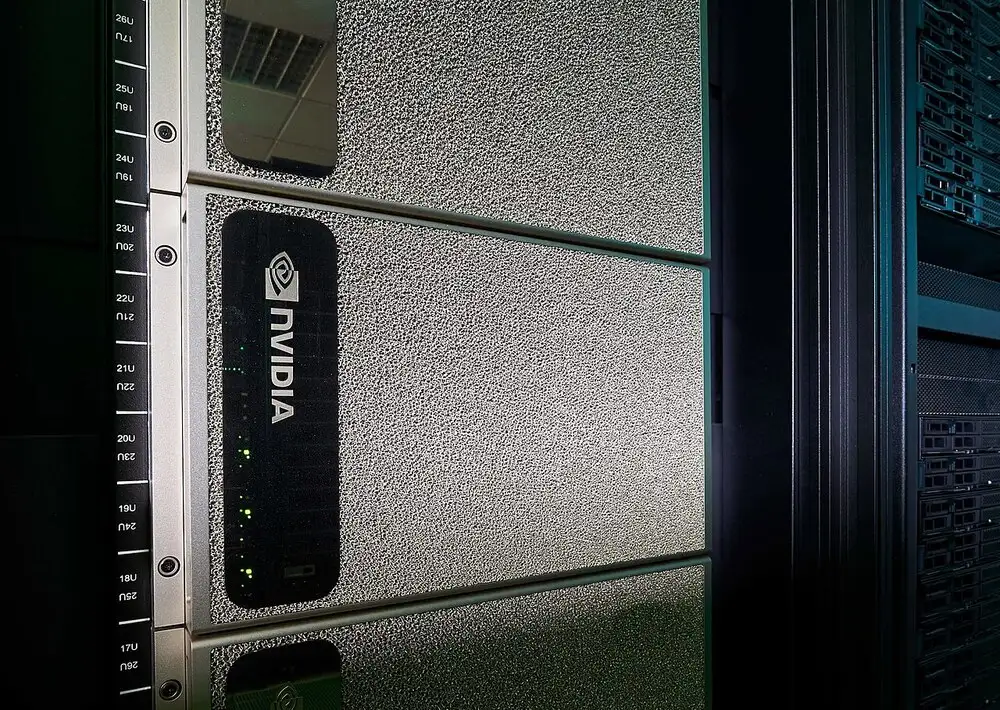
An NVIDIA Blackwell B200 board. Eight B200s hold about 1.44 TB, short of K3's 1.56 TB checkpoint, so hosts use B300 or GB300 systems. Photo: Javils00 / Wikimedia Commons, CC0.
Same Weights, 10× Different Speed: Kimi K3 Providers
Because K3's weights are open, many companies host it, and their speeds differ by roughly ten times for the same model. Artificial Analysis measures each provider's output speed on a 10,000-token input workload. The figures below are a snapshot fetched on October 20, 2026, and they change daily.
| Provider (Kimi K3 max) | Output speed | Note |
|---|---|---|
| LithosAI (Ultra Chat) | ~422 tokens/s | Fastest measured |
| Nebius | ~192 tokens/s | |
| Amazon Bedrock | ~142 tokens/s | |
| Fireworks | ~112 tokens/s | |
| Baseten | ~96 tokens/s | Day-zero host |
| Together AI | ~57 tokens/s | Kimi K3 BYOK path in Taskade |
| Kimi (Moonshot first-party) | ~42 tokens/s |
Speed is not the only variable. Providers also differ in quantization choices, cache pricing and reliability, and Moonshot publishes a vendor verifier so developers can check whether a host serves the model correctly. Our guides to AI inference, inference as a service and cutting LLM costs go deeper.
How Moonshot AI Got Funded: Investors & Valuation
Moonshot AI is one of the best-funded startups in China, and the cap table reads like a who's-who of Chinese tech. Alibaba is the largest outside backer, with an approximately 36% stake bought for about $800 million in 2024 and diluted by later rounds, alongside Tencent, HongShan (the former Sequoia China), IDG Capital, 5Y Capital, Gaorong, Meituan, and China Mobile.
| Round / date | Approx. amount | Lead or notable backers | Reported valuation |
|---|---|---|---|
| Seed, mid-2023 | ~$60M to $200M (reports vary) | HongShan, ZhenFund | ~$300M |
| Feb 2024 | $1B+ | Alibaba (lead), HongShan, Meituan, Xiaohongshu | ~$2.5B |
| Aug 2024 | $300M+ | Tencent, Gaorong, Alibaba | ~$3.3B |
| Dec 31, 2025 (Series C) | $500M | IDG Capital (lead), Alibaba, Tencent | $4.3B |
| Feb 2026 | $700M+ | Alibaba, 5Y Capital, Tencent | ~$10B |
| May 7, 2026 | ~$2B | Meituan Long-Z (lead), Tsinghua Capital, China Mobile | $20B+ |
| Jul 29, 2026 | ~$3.5B | National AI Industry Investment Fund among leads, Alibaba, Tencent, IDG, 5Y | ~$35B |
The curve tells the story better than any single number. For almost two years the valuation crept from $2.5 billion to $4.3 billion, through the DeepSeek shock and Kimi's slide in the app rankings. Then, in seven months from January to July 2026, it rose about eight times as K2.5, K2.6 and K3 landed and ARR tripled.
Valuations in this sector move fast and diverge across sources. The figures are as reported by TechCrunch, Bloomberg, the South China Morning Post and TechNode, and Moonshot AI confirms few of them. Bloomberg also reported talks for a further round at up to $50 billion. The strategic subtext matters: Alibaba's large stake ties Moonshot to one of China's biggest cloud and commerce platforms — distribution and compute in exchange for a frontier model partner. If you like tracking this kind of thing, it's exactly the sort of living dashboard you can build from a single prompt.
Is Kimi Open Source? The Modified-MIT License, Explained
Here's the nuance almost every write-up gets muddy. The Kimi K2 family shipped with open weights under a modified-MIT license — you can download the parameters, run them locally, and fine-tune them. The single condition is an attribution clause: commercial products that cross 100 million monthly active users or $20 million in monthly revenue must display "Kimi" prominently in their interface.
Two precisions worth keeping straight:
- Open weight ≠ fully open source. Moonshot releases the weights, not the full training data or pipeline. "Open weight" is the accurate term; it's more open than an API-only model and less open than a fully reproducible release.
- License varies by version. The headline modified-MIT terms apply to the K2 open-weight line. Kimi K3 ships under Moonshot's own Kimi K3 License, a separate document, not modified MIT. So check the specific license attached to each model version before you build on it. When in doubt, read the model card.
What the Kimi K3 License Changes
The Kimi K3 License keeps the broad MIT-style grant to use, modify, fine-tune and redistribute the model. It adds one new condition aimed at hosting companies. A business that offers K3 as a model-as-a-service API, and whose combined revenue tops $20 million in any 12 months, must sign a separate agreement with Moonshot AI first. Artificial Analysis labels the license "Commercial Use Restricted" for that reason.
| Clause | K2 family (modified MIT) | Kimi K3 License |
|---|---|---|
| Use, modify, fine-tune, redistribute | Yes | Yes |
| Show the model name in the product UI | Over 100M MAU or $20M monthly revenue | Same thresholds, shows "Kimi K3" |
| Selling the model as an API (MaaS) | No extra condition | Separate agreement above $20M revenue in 12 months |
| Internal use | Covered by the grant | Exempt from the display and MaaS clauses |
| Use through Moonshot or certified partners | Covered by the grant | Exempt from the display and MaaS clauses |
The practical reading: a company building a product on K3, or using it internally, works much as it did under K2. A large inference reseller now needs a deal with Moonshot. Cursor's Composer 2 episode in March 2026, when a Moonshot researcher questioned the credit after a developer found the model ID, showed how much value an open base model can pass to other companies.
This is also why the open-weight bet is more than ideology. When a model is downloadable, no single government or vendor decision can switch it off for you — a point that turned concrete in mid-2026, when export-control action briefly suspended a US frontier model and self-hostable alternatives suddenly looked like insurance rather than idealism.
Kimi vs DeepSeek: China's Two Open-Weight Leaders
Kimi and DeepSeek are the two names that come up whenever anyone discusses China's open-weight frontier, and the honest answer to "which is better" is it depends on the job.
| Dimension | Kimi (K3) | DeepSeek (V4) |
|---|---|---|
| Signature strength | Agentic coding, long-horizon autonomy | Code generation, math reasoning |
| Context window | Up to 1M tokens | ~1M tokens |
| Scale | 2.8T total (MoE) | ~1.6T (Pro) |
| Vibe | The agent that runs for hours | The cheap, sharp coder |
| License | Kimi K3 License (K2 family: modified MIT) | MIT open weights |
The productive takeaway isn't to crown a winner — it's that you shouldn't have to pick permanently. Teams increasingly keep both available and route each task to whichever model is strongest, a pattern we cover in AI agent cost optimization. For a head-to-head, see our Kimi vs DeepSeek comparison and Kimi vs Claude.
Where Kimi Stands Against the Global Frontier
On the closed-vs-open axis, Kimi K3 is the strongest evidence yet that the gap has nearly closed. Independent reviewers who ran K3 through real agentic-coding and long-horizon build tasks at launch placed it at or near frontier level — competitive with the best proprietary models on many tasks, and clearly ahead of the previous best open model. Moonshot's own framing is measured: K3 "demonstrates frontier-level performance across their evaluation suite" while still trailing the very top proprietary systems on the hardest problems.
Two caveats keep this honest. First, exact benchmark numbers diverge across sources, and most published K3 scores come from Moonshot itself, so the next section labels every figure by who measured it. Second, capability isn't the same as reliability — reviewers consistently noted K3 can be slow, token-hungry, and occasionally flaky on long runs. The frontier is close; the polish still favors the incumbents. That reliability-vs-capability gap is exactly the theme of why AI-generated apps break.
Kimi K3 Benchmarks: What Moonshot Reports and What Others Measured
Kimi K3's benchmark story has two layers: Moonshot's own model card, which is long and impressive, and a shorter list of independent measurements. Read the first as a claim and the second as evidence. Our history of AI benchmarks explains why every lab's launch chart looks like a win.
Moonshot-reported scores (Kimi K3 at max reasoning effort, from the Hugging Face model card):
| Area | Benchmark | Kimi K3 score |
|---|---|---|
| Reasoning | GPQA Diamond | 93.5 |
| Reasoning | Humanity's Last Exam (full, with tools) | 56.0 |
| Coding | Terminal-Bench 2.1 | 88.3 |
| Coding | DeepSWE | 67.5 |
| Agentic | BrowseComp | 91.2 |
| Agentic | OSWorld-Verified | 84.8 |
| Vision | MMMU-Pro (with tools) | 83.4 |
Independent measurements:
- Artificial Analysis scored K3 at 57 on its Intelligence Index when the weights shipped on July 27, 2026, and called it the leading open-weights model. The same lab measured a higher hallucination rate than K2.6. Its index has been rebuilt since, so the 57 is a launch reading, not today's figure.
- Taskade's TSK-1 test builds the same apps with every model inside Taskade Genesis. Kimi K3's verdict reads: "Builds more than almost any model and finishes later than all of them." In one round only 7.2% of its build actions went wrong, the most reliable result of that test, while in later rounds it hit the 40-minute limit before a closing summary. The full record is on the Kimi results page, and the method is in our TSK-1 benchmark methodology.
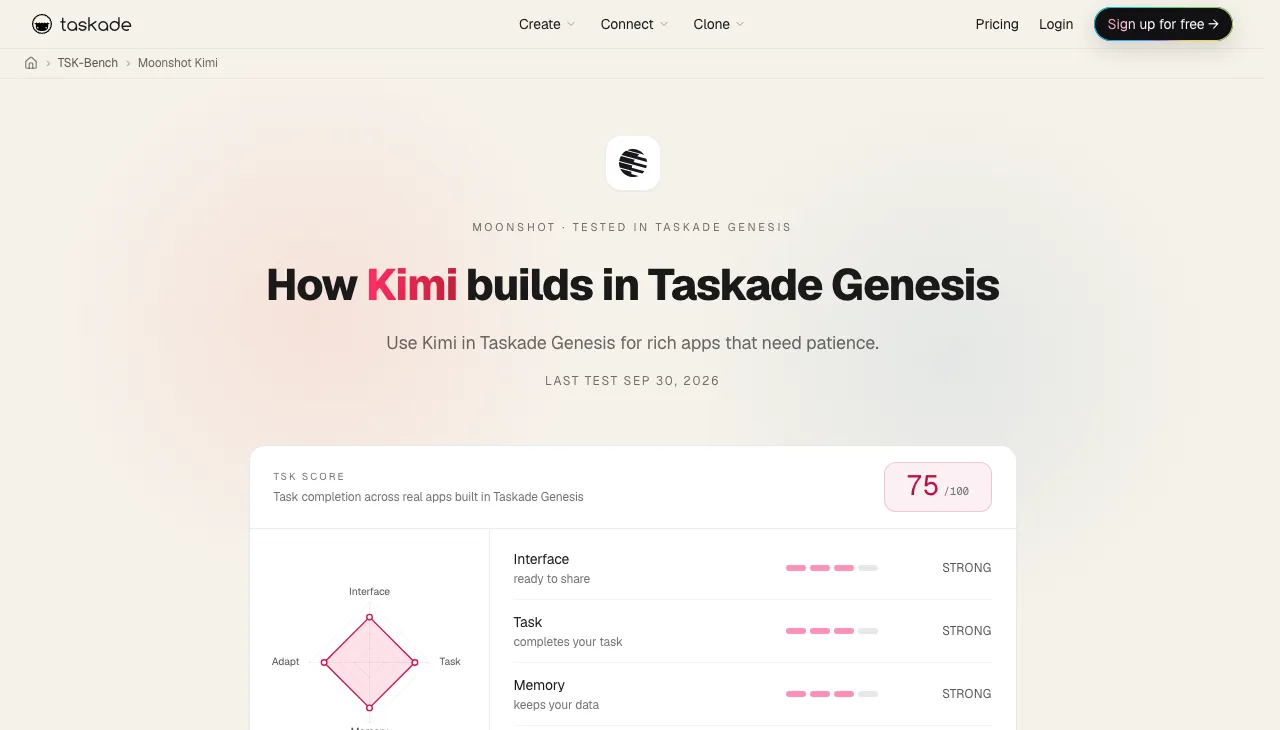
The Kimi page of Taskade's TSK-1 benchmark, which records how Kimi models build real apps in Taskade Genesis. Last test September 30, 2026.
Creator reviews from launch week capture the same split between peak capability and rough edges. Theo of t3.gg spent a day building with K3 and titled his verdict "the best model ever made (sometimes)."
Kimi's Products Today: Chat, Agents, and the API
Beyond the raw models, Moonshot ships a real product surface:
- Kimi chatbot at kimi.com — a free tier plus paid subscription tiers named after musical tempos: Moderato, Allegro, Allegretto, and Vivace.
- Agent modes — including an autonomous "computer-use" style agent and a desktop agent for longer, tool-using work.
- The API — billed per token, with rates published on Moonshot's API platform, plus open weights for teams that want to self-host.
| Product | Launched | What it does |
|---|---|---|
| Kimi Chat | Oct 2023 | Long-context assistant, 200,000 characters at launch |
| Context caching (API) | Jul 2024 | Cheaper repeat reads of long prompts |
| Kimi Explore | Oct 2024 | Autonomous web search mode |
| Kimi-Researcher | Jun 2025 | Research agent that browses and writes reports |
| OK Computer | Sep 2025 | Agent mode that builds multi-page sites and editable slides |
| Kimi Code | Jan 2026 | Command-line coding agent, default model K2.7 Code from June 2026 |
| Kimi K3 API | Jul 2026 | Per-token API access to K3, with rates on the API platform |
For most people the fastest way to use Kimi isn't to stand up GPUs — it's to pick it inside a platform that already routes to it, which brings us to the part where this history becomes something you can act on.
Use Kimi (and Any Frontier Model) Inside Taskade Genesis
Here's the connect-the-dots move. The lesson of the last three years — Kimi K2's open-weight breakout, K3 reaching the frontier, an export order briefly pulling a closed model overnight — all points to the same conclusion: you don't want to be locked to one model. You want the workspace to be the constant and the model to be swappable.
That's exactly how Taskade Genesis works. It gives you frontier models from top AI labs — including Moonshot's Kimi models on the Max and Enterprise plans — selectable per agent. Route one agent to a Kimi model for long-context or agentic-coding work, another to a different model for reasoning, all in one place, with Auto picking a sensible default when you'd rather not choose.
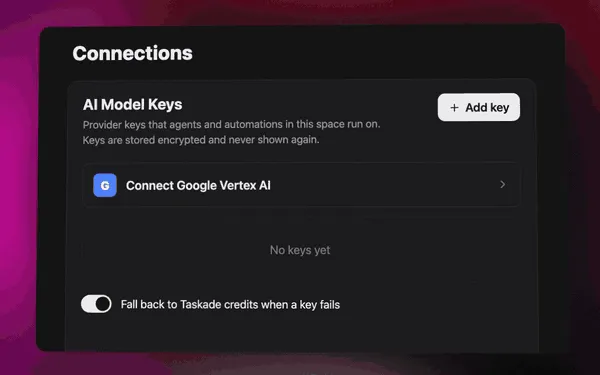
There is a second path to Kimi K3. On Business and up, add your own Together AI key under AI Model Keys, then pick Kimi K3 for custom agents and Ask Agent. An agent chat on your own key uses no Taskade credits, because Together AI bills the model calls. The key walkthrough shows the steps, /models/providers lists which models each key serves, and AI builders with your own key compares the same setup on other platforms. The Kimi K3 model page and the Moonshot lab page carry the current plan and test results.
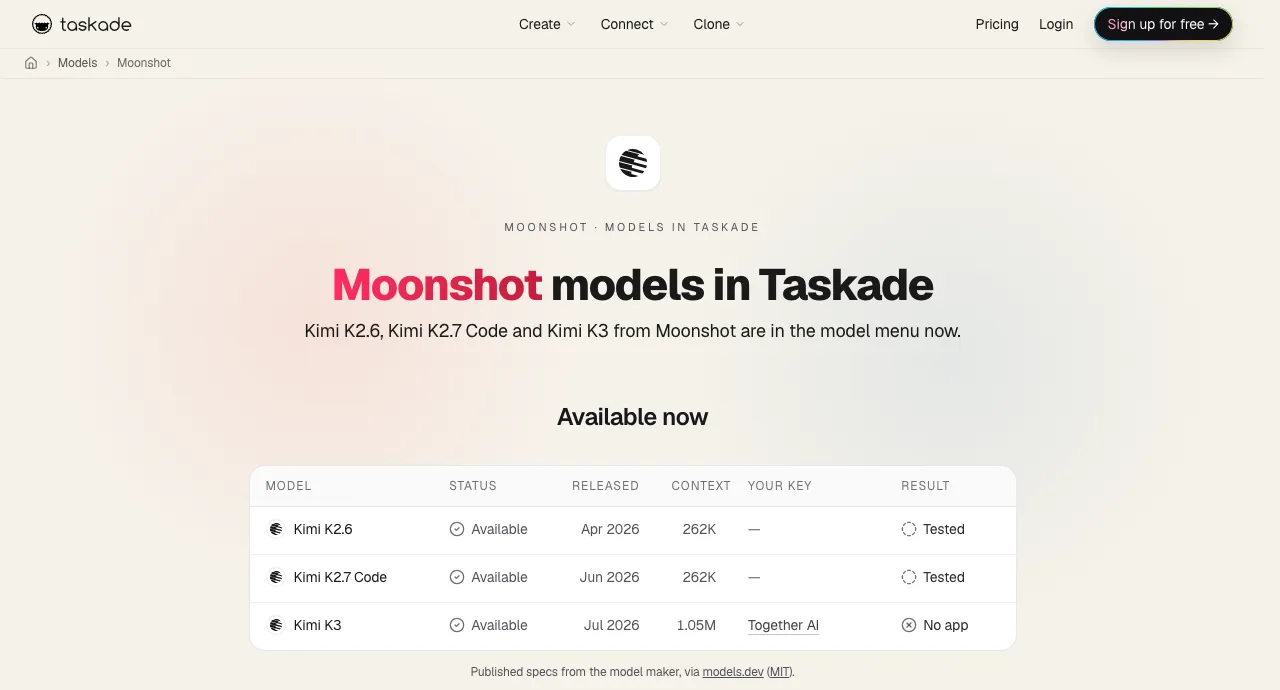
The Moonshot lab page in Taskade lists each Kimi model, its context window, and whether your own key can serve it.
| Path to Kimi in Taskade | Plan | Who pays for model calls | Where it works |
|---|---|---|---|
| Kimi on Taskade credits (K3, K2.7 Code, K2.6) | Max and Enterprise | Taskade credits | Model picker for agents and apps |
| Kimi K3 on your Together AI key | Business and up | Together AI bills you, no Taskade credits for agent chat | Custom agents and Ask Agent |
| Auto (default model) | The default on every plan | Taskade credits | Taskade picks the model for each task |
WHICH KIMI SHOULD I PICK IN TASKADE?
────────────────────────────────────────────────────────────
Long documents, research, rich multi-page apps?
    └── Kimi K3  (1M context, slow, frontier intelligence)
Code-heavy agent work, faster turnaround?
    └── Kimi K2.7 Code  (coding specialist)
General open-weight model for everyday agents?
    └── Kimi K2.6
Not sure, or speed matters most?
    └── Auto  (Taskade routes each task for you)
Already pay Together AI on Business and up?
    └── Add your key, pick Kimi K3 for custom agents
────────────────────────────────────────────────────────────
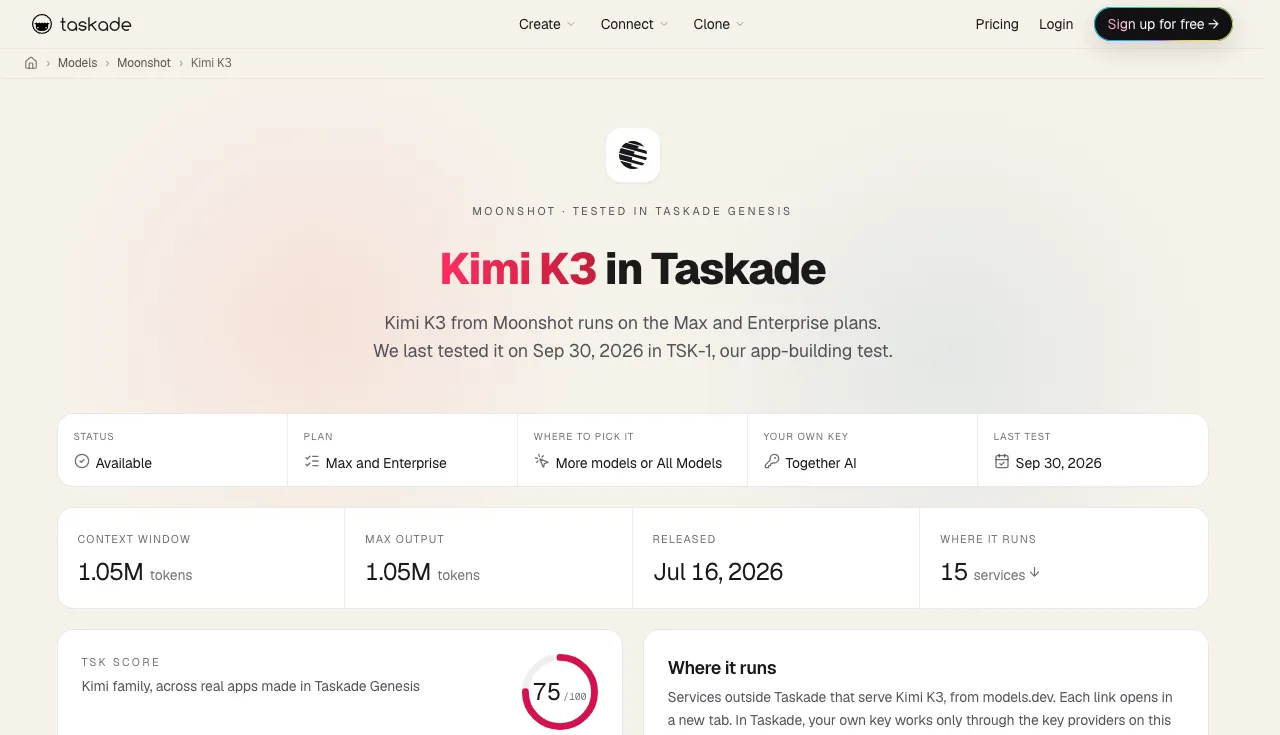
The Kimi K3 page shows plan, where to pick the model, your own-key option, and the latest TSK-1 test date. The Kimi docs page rates K3 as slow, with frontier intelligence and medium cost.
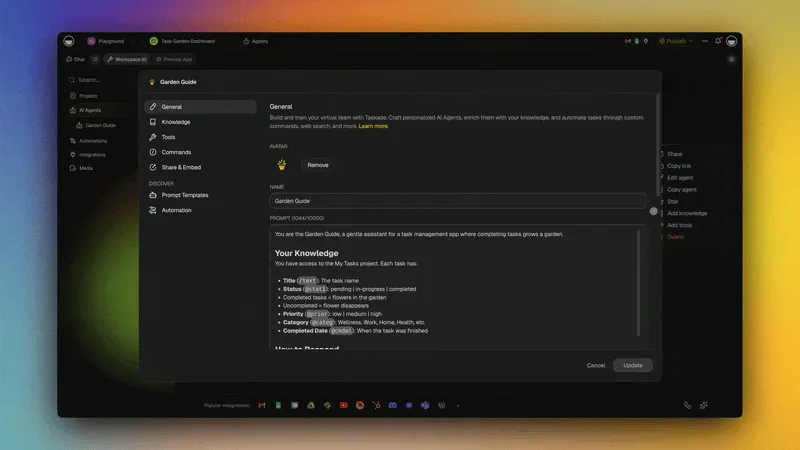
Underneath, every AI agent gets built-in tools, persistent memory, and 100+ bidirectional integrations — triggers pull events in, actions push data out. Your projects become the memory, your agents become the intelligence, your automations become the execution:
And because a workspace has multiple project views, the same underlying data reshapes to whatever lens the task needs — no re-entry, no export:
   WHAT YOU'RE DOING            →   BEST TASKADE VIEW
   ─────────────────────────────────────────────────
   Tracking model releases      →   Table
   Planning a research sprint    →   Board
   Mapping a model family tree   →   Mind Map
   Scheduling a content series   →   Calendar
   Sequencing a launch           →   Gantt (with Timeline)
   Triaging tasks                →   List
   Org-charting an AI team       →   Org Chart
   ─────────────────────────────────────────────────
   Same data. Many lenses. Zero re-entry.
Build your own model-and-lab tracker from a prompt → — describe it once, and Taskade Genesis builds it as living software you can clone, share, and keep updated.
Controversies and Open Questions
No honest history skips the hard parts. A few worth naming:
- Open weights vs. safety. A downloadable frontier model can't be recalled. That's the whole appeal — and the whole worry. The debate over how open the frontier should be is genuine, and it's the same tension behind AI guardrails and Scientist AI.
- How fast the valuation ran up. Going from a 2023 seed near $300 million to a reported ~$35 billion valuation in about three years is extraordinary — and, like every AI valuation right now, it prices in a future that hasn't fully arrived.
- Benchmark trust. Many of K3's headline numbers come from Moonshot's own slides or early third-party runs. The direction (open models reaching the frontier) is well-supported; specific leaderboard positions are not yet settled. Treat any single benchmark screenshot with the skepticism you'd apply to any vendor's launch chart.
The Distillation Dispute (2026)
The most serious open question is whether Moonshot used outputs from American models to train Kimi without permission. Training one model on another model's answers is called model distillation, and it is legitimate when the owner allows it. Every claim below is an allegation from one side, and none has been tested in court or by an independent audit.
| Date | Claim or response | Source |
|---|---|---|
| Feb 23, 2026 | Anthropic says DeepSeek, Moonshot AI and MiniMax used over 24,000 fraudulent accounts for more than 16 million Claude exchanges | Anthropic on X |
| Jul 22, 2026 | White House science adviser Michael Kratsios says Moonshot distilled Anthropic's Fable model to build K3 and accessed restricted NVIDIA systems | CyberScoop |
| Jul 2026 | Moonshot staff push back: Fable went public on July 1 and K3 launched two weeks later, too soon to have been trained on it | South China Morning Post |
| Sep 10, 2026 | Anthropic's threat report alleges Moonshot routed some Kimi requests to Claude and showed users Claude's answers | CNBC |
Two things are true at once. Distillation from rival models is a real, industry-wide concern, and US labs have documented attempts against their APIs. And no public evidence yet proves that K3 itself was built from Claude Fable outputs. Kratsios disclosed no logs or training-data evidence, and independent researchers quoted by the South China Morning Post questioned the claim. Treat this as an open file, and read our Claude Fable and Mythos explainer for the US side of the story.
Other Disputes and Setbacks
- The Recurrent AI arbitration. In December 2024 the South China Morning Post reported that GSR Ventures China and four other firms that had invested in Recurrent AI, Yang's first startup, took a dispute with him to arbitration in Hong Kong. The firms claim that he has an "uncleared liability".
- The 2025 stall. After DeepSeek R1, Kimi slipped in China's consumer AI app rankings, from third by monthly active users in August 2024 to seventh by June 2025, according to tracker aicpb. The open-weight K2 release reversed the story.
- Growing pains. The March 2024 jump to a 2-million-character context brought so many new users that Kimi went down for parts of two days, and Moonshot apologized.
What's Next for Moonshot AI
Two things shape the near horizon: the full Kimi K3 open weights (released July 27, 2026), which let the community host, fine-tune, and pressure-test the model directly; and a possible Hong Kong listing. Bloomberg reported in July 2026 that Moonshot was in talks to raise again at up to a $50 billion valuation before a potential IPO, while the company had not announced a filing as of October 2026. The bigger arc is the one Yang keeps returning to — that open models won't just catch the frontier, they'll set part of it:
"Agent swarms is not the end. And we are glad that we can move forward with the entire open source community to achieve better and better intelligence."
— Yang Zhilin, GTC 2026 keynote
Whether or not any single benchmark holds, the structural point stands: the frontier is becoming a commodity input. The durable advantage is moving up a layer — to the workspace, the memory, and the routing that decide which model runs which task.
▲ ■ ● Moonshot builds the models. You build the trackers, research workspaces, and apps that run on them. Don't just read a Kimi K3 story — clone a living AI-lab tracker, point it at any company, and own a research workspace in minutes. Memory feeds Intelligence, Intelligence triggers Execution. Clone the live tracker → or build your own from a prompt →.
🔗 Related Reading
AI labs & model history:
- Open-source LLM history: from GPT-2 to Kimi K3
- The 10 best open-source LLMs, ranked
- Anthropic & Claude history
- OpenAI & ChatGPT history
- Google Gemini history
- NVIDIA & Jensen Huang history
- DeepSeek history
- Alibaba Qwen history
- xAI and Grok history
How the tech works:
- How large language models work
- What are reasoning models?
- What are world models?
- AI thinking modes explained
- Context engineering
- History of the context window, from 4K to 1M tokens
- AI inference explained
- Why every model claims to be the best: AI benchmark history
Models in Taskade:
- Kimi K3 in Taskade · Moonshot lab page · Kimi docs
- TSK-1 Kimi results · Kimi vs GPT · Qwen vs Kimi
- AI builders that take your own key · No-code builders for open-weight models
Agents & building:
- Best multi-agent platforms
- AI agent cost optimization
- What is an AI agent harness?
- Best AI agent platforms · AI agent builders · Free AI app builders
🐑 Before you go — the frontier is a moving target, but your workspace doesn't have to move with it. Inside Taskade Genesis you get:
- Frontier models from top AI labs, selectable per agent
- built-in tools and persistent memory on every AI agent
- 100+ bidirectional integrations to automate the busywork
- Multiple project views on the same data — no re-entry
💬 Frequently Asked Questions About Moonshot AI & Kimi
What is Moonshot AI?
Moonshot AI is a Chinese AI company founded in March 2023 in Beijing, best known for the Kimi family of large language models. It's one of China's "six AI Tigers" and the lab that bet hardest on open weights, culminating in the 2.8-trillion-parameter Kimi K3 in July 2026.
Who founded Moonshot AI?
Yang Zhilin (CEO), Zhou Xinyu, and Wu Yuxin founded the company in March 2023. Yang holds a PhD from Carnegie Mellon and co-authored the influential Transformer-XL and XLNet papers, the latter of which beat Google's BERT on 20 tasks in 2019.
Why is it called Moonshot and Kimi?
The Chinese name 月之暗面 means "Dark Side of the Moon," a Pink Floyd reference; "Moonshot" is the English rendering of an audacious goal. "Kimi" is founder Yang Zhilin's English nickname, which became the name of the chatbot and model family.
What was Kimi K2 and why did it matter?
Kimi K2 (July 11, 2025) was a 1-trillion-parameter open-weight mixture-of-experts model that delivered near-frontier agentic and coding performance you could download and run. It was widely called an "open-weight DeepSeek moment" and made Moonshot a global name.
What is Kimi K3?
Kimi K3 (July 16, 2026) is Moonshot's flagship: a 2.8-trillion-parameter MoE model activating 16 routed + 2 shared of 896 experts per token (about 104B active, roughly 3.7%), with native vision and a 1-million-token context window. The API launched immediately, and the full open weights were released on July 27, 2026, under the Kimi K3 License.
Is Kimi open source or open weight?
Open weight. The K2 family shipped under a modified-MIT license — you can download and fine-tune the model — with an attribution clause for very large commercial products. The training data and full pipeline aren't released, so "open weight" is more accurate than "fully open source." The license varies by version: Kimi K3 ships under Moonshot's own Kimi K3 License.
How much is Moonshot AI worth?
A roughly $3.5 billion round that closed in late July 2026 reportedly valued the company at about $35 billion, after about $20 billion in May 2026 and $4.3 billion at the end of 2025. Reported rounds since 2023 add up to more than $8 billion. Alibaba is the largest outside backer, with an approximately 36% stake taken in 2024 and diluted since. AI valuations move fast, so treat that figure as a dated snapshot.
Who owns Moonshot AI?
Moonshot AI is private and controlled by its founders, led by CEO Yang Zhilin. Alibaba is the largest outside investor, and Tencent, HongShan, IDG Capital, 5Y Capital, Gaorong Capital, Meituan's Long-Z Investments, China Mobile and China's National AI Industry Investment Fund also hold stakes.
Is Kimi a Chinese AI?
Yes. Kimi is built by Moonshot AI, headquartered in Haidian District, Beijing. Its operating company is Beijing Moonshot AI Technology Co., Ltd. (北京月之暗面科技有限公司). The open-weight Kimi models can be downloaded and hosted anywhere, including by US cloud providers.
Who are Zhou Xinyu and Wu Yuxin?
They are Moonshot AI's other two founders, both Tsinghua graduates. Zhou Xinyu co-authored ShuffleNet during years at the vision company Megvii. Wu Yuxin co-authored Group Normalization with Kaiming He and created the Detectron2 library at Meta's AI research lab.
When was Kimi K3 released, and what is its architecture?
Kimi K3 launched through the API on July 16, 2026, and its open weights and technical report followed on July 27. It is a 2.8-trillion-parameter mixture-of-experts model with about 104 billion active parameters, 93 layers (69 Kimi Delta Attention plus 24 Gated MLA), Attention Residuals, 16 of 896 experts per token plus 2 shared, a 1-million-token context, and native MXFP4 weights.
What hardware does Kimi K3 need?
The checkpoint is about 1.56 TB, so it fits one 8-GPU NVIDIA B300 node but not an 8-GPU B200 or H100 node. Every expert must stay loaded, so total parameters, not active ones, set the hardware bill. Most teams use K3 through a hosted API instead.
Was Kimi K3 distilled from Claude?
That is disputed. Anthropic and the White House have accused Moonshot of distilling US models, and Moonshot staff rejected the claim about K3 and Claude Fable. No public evidence settles it as of October 2026.
Is Kimi better than DeepSeek or Claude?
It depends on the task. Kimi K3 leans into agentic coding and long-horizon autonomy; DeepSeek is prized for cheap code and math; Claude and other proprietary models still lead on the hardest reasoning and on polish. The practical move is to keep several available and route per task — which is exactly what Taskade Genesis lets you do.
Can I use Kimi inside Taskade?
Yes. Taskade Genesis offers frontier models from top AI labs, including Moonshot's Kimi models on the Max and Enterprise plans, selectable per agent, with Auto as a sensible default. On Business and up you can also add a Together AI key and pick Kimi K3 for custom agents and Ask Agent, with no Taskade credits for an agent chat on your key. Route long-context work to Kimi and reasoning to another model, all in one workspace, with paid plans from $10/month billed annually.