






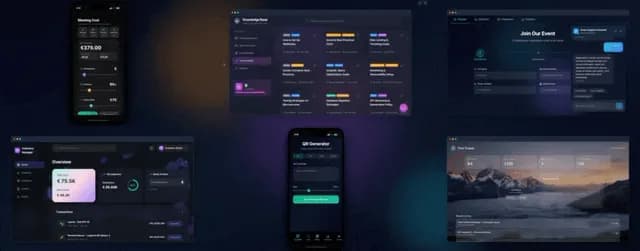
Every AI app builder now says the same sentence. Open five landing pages side by side and you can watch the words converge: turn your idea into a working app in hours.
I should know. I say a version of it too. Taskade Genesis turns one prompt into a working app, and I am proud of how well it does that. But when an entire category — brilliant teams, billions in freshly raised capital — lands on the identical promise, that is not a coincidence. It is a signal that the promise is finished. What all of us made cheap is the moment of creation. What none of that capital made cheap is everything after: the app on day 8, the data that goes stale, the workflow nobody re-prompts, the software slowly turning back into a screenshot.
This essay is the case for what comes next. We call it living software: software that remembers, reasons, and runs. We did not invent the dream. Forty years of software history has been reaching for it. We built the workspace where it finally works.
TL;DR: Software is crossing from its build-time era (write or generate, ship, decay) into its run-time era (memory, agents, and workflows keep it alive). Gartner projects 40% of enterprise apps will carry task-specific agents by end of 2026, up from under 5% in 2025. Taskade builds living software on TSK-1, the Taskade System Kernel — 150,000+ apps so far. Clone a living one free.
What Is Living Software?
Living software is software that stays alive after it is built. It holds its own memory, reasons over that memory with AI agents, and keeps executing workflows when nobody is prompting it. It is a system, not an artifact — the structural opposite of generate-then-static, where an app is born finished and frozen the moment the prompt ends.
The definition has three load-bearing verbs, and each one maps to a concrete mechanism:
| The verb | What it means | The mechanism |
|---|---|---|
| Remembers | The app knows its own state: your customers, jobs, decisions, history | Persistent memory in connected projects |
| Reasons | The app understands goals and acts on current context, not a snapshot | AI agents working over living data |
| Runs | The app keeps executing after the chat ends, on schedules and triggers | Automations across 100+ integrations |
Honesty about the lineage matters, because the term has one. Vanderbilt professor Jules White made the academic case in Building Living Software Systems with Generative & Agentic AI (arXiv 2408.01768, August 2024): task-oriented systems where AI absorbs the digital plumbing humans currently do by hand. In April 2026, writer Jack Cheng published a lovely essay at Every exploring living software as a relationship — software that adapts to you as much as you adapt to it. We planted our own flag in October 2025 with the origin of living software, and by December the pattern was clear enough to name the year honestly in our 2025 review.
So no, we are not claiming the coinage. We are claiming something more specific: the architecture. White described the destination and Cheng described the feeling; what has been missing is the mechanism — why an app keeps living. The answer this essay defends is one kernel and one memory, and Taskade is the first workspace engineered around living software as its native output. The living software wiki entry keeps the working definition current.
The Two Eras: Build-Time vs. Run-Time Software
Here is the frame the whole essay hangs on. For its entire history, software has been a build-time discipline: value was created in the act of making, and everything after making was a cost called maintenance. The living software era inverts that. In run-time software, value compounds after the making, because the system keeps accumulating memory and keeps doing work.
| Build-time software | Run-time software | |
|---|---|---|
| Where value lives | The moment of creation | Every day after creation |
| The output | An artifact: code, a binary, a deploy | A system: memory + agents + workflows |
| State | Frozen at ship; drifts from reality | Continuously updated by the loop |
| Maintenance | A human cost center | The system's own behavior |
| Failure mode | Decay, staleness, abandonment | Needs a clear owner and goals |
| Who could own it | Whoever could code or hire coders | Anyone who can describe their work |
Andrej Karpathy's Software 3.0 framing is the reigning map of how software authorship changed: 1.0 was hand-written code, 2.0 was learned neural weights, 3.0 is prompts and context as the program. It is a genuinely useful map, and living software does not compete with it — it completes it. Software 3.0 answers how software gets written now. The two-era frame answers the question Software 3.0 leaves open: when is software alive? A vibe-coded app is authored in the 3.0 style and still dies a 1.0 death, generated in a minute and frozen in the next. Authoring changed first. Runtime is changing now.
Notice what the right side requires. It is not a better generator. Automation platforms have half of it — flows that keep running, but no app; we map that gap in our n8n comparison. Generators have the other half — an app, but frozen. The right side needs both in one loop, which is why it could not come from either camp. It had to come from an agentic workspace — a place where the work, the data, and the intelligence already live together — because only there do both halves share one memory. That is the execution layer thesis we have argued since before it had a market to point at.
How Did We Get Here? Forty Years of Software Almost Living
Every era of software solved the previous era's bottleneck and exposed a new one. Trace the line and you can see the industry reaching, decade after decade, for the same dream: software that ordinary people own, that stays current on its own. Each era got one half. None got both — until now.
1979–1987: the first taste of ownership. VisiCalc turned accountants into programmers who never knew they were programming — a spreadsheet was a small custom app you built yourself. Bill Atkinson's HyperCard, shipped free with every Mac in August 1987, went further: ordinary people built full applications — stacks with buttons, cards, and scripts — and passed them around on floppy disks. The dream of user-owned software is not new. It is HyperCard's dream, and it has been waiting for a runtime worthy of it. (We told a piece of this story in your workspace is a computer.)
1999–2020: aliveness without ownership. Salesforce launched in 1999 marketing "the end of software," and SaaS genuinely solved staleness: the vendor maintains it, so the software is always current. But the trade was steep — the software is generic, it does not know your business, and you rent it forever. SaaS software is alive the way a hotel room is clean: continuously, professionally, and never yours. We traced this arc in how SaaS quietly evolved into living software.
2012–2021: assembly without programming. No-code builders returned some ownership — you could click together a real tool — but you were still the assembler, the maintainer, and the integrator, inside someone else's box.
2022–2025: creation becomes a sentence. ChatGPT's launch in November 2022 — then the fastest-growing consumer app in history — made natural language the interface to computation, and by February 2025 Karpathy had coined "vibe coding" for the practice of prompting entire apps into existence. The generation wave that followed was real and enormous — we measured it in the state of vibe coding, and its market data now lives in the state of AI app building. Creation was finally cheap for everyone. And then everyone met the same wall.
| Era | What got cheap | What stayed expensive |
|---|---|---|
| Personal computing (1979–1995) | Making small software yourself | Distribution, connectivity, upkeep |
| SaaS (1999–2020) | Always-current software | Ownership, customization, your context |
| No-code (2012–2021) | Assembly without code | Maintenance, integration, logic changes |
| Generated apps (2022–2025) | The moment of creation | Everything after creation |
| Living software (2025→) | Creation and continuation | — the loop closes |
Read the last column top to bottom. Every era pushed the expensive part one step downstream. The generated-apps era pushed it to the very edge: the only thing left expensive is keeping the thing alive. That is exactly where the living software era begins.
Why Do AI-Generated Apps Break After Launch?
AI-generated apps break because the tools that generate them have no memory of what they decided and no process that keeps the output current. This is not an opinion; as of mid-2026 it is one of the best-documented failure patterns in software. Engineering analyses of vibe coding find that because AI "doesn't remember previous decisions," codebases accumulate an 8x increase in code duplication as the model re-solves problems it already solved (Builder.io's engineering analysis of vibe-coding limitations). Most tools, in the same analysis's words, are "great at demos, bad at production."
The receipts pile up from every direction:
| Signal | What happened | Source |
|---|---|---|
| "Vibe slop" warnings | Engineers warn companies are trading near-term speed for buggy software, outages, security holes, and technical debt | Industry coverage compiled on Wikipedia's vibe coding entry, May 2026 |
| App Store rejections | Vibe-coded app updates rejected from Apple's App Store; one builder booted twice | TechCrunch, April 2026 |
| The rescue economy | Developers who repair vibe-coded apps report a recurring pattern: exposed API keys, fake auth, zero error handling, race conditions, broken payments | Developer Justin McKelvey's published teardowns of rescued vibe-coded apps, 2026 |
| Code duplication | 8x increase in duplicated code; AI re-solves solved problems because it cannot remember them | Builder.io engineering analysis of vibe-coding limitations |
When a repair industry forms around a category's output, the category has a lifecycle problem, not a creation problem. Here is the lifecycle, drawn honestly:
The loop on the left of that diagram — re-prompt, regenerate, re-ship — is the build-time era's only answer to drift, and it throws away the app's accumulated context every cycle. The difference shows up about a week after launch:
DAY 1                            DAY 8
─────                            ─────
The build-time era:
  "It works!"                    Your data changed. The app didn't.
  Demo shipped.                  Nobody re-prompted the fix.
  Screenshot posted.             The app is a fossil.The run-time era:
"It works!"                    Agents kept reasoning all week.
App is live.                   Memory is seven days richer.
The loop begins.               The app is a colleague.
None of this is an indictment of the builders. Generation tools solved their half of the problem magnificently — the head-to-head view in Taskade vs Lovable shows real strengths on their side of the line. The point is where the line sits. We wrote the full diagnosis in why AI-generated apps break; the one-sentence version is that a codebase without memory cannot notice that the world changed.
Is the Shift to Living Software Actually Happening? The Market Evidence
Yes — and you do not need my word for it, because the three most load-bearing numbers come from Gartner, Deloitte, and the funding market, not from Taskade. As of July 2026, the capital, the analyst forecasts, and the pricing models are all moving from the build-time column to the run-time column.
The demand side, from Gartner. Gartner projects that 40% of enterprise applications will feature task-specific AI agents by the end of 2026, up from less than 5% in 2025 — an eightfold jump in a single year (Gartner press release, August 2025). In Gartner's best-case scenario, agentic AI drives roughly 30% of enterprise application software revenue by 2035, surpassing $450 billion, up from 2% in 2025. Buyers are no longer asking "can you generate an app?" They are asking "will it keep working next quarter?"
The business-model side, from Deloitte. Deloitte's TMT Predictions 2026 lays out the post-SaaS pricing shift, citing Gartner projections that by 2030 at least 40% of enterprise SaaS spend moves to usage-, agent-, or outcome-based pricing and that 35% of point-product SaaS tools will be replaced by or absorbed into agent ecosystems by 2030. Already, 83% of AI-native SaaS companies use usage-based pricing (per Maxio data in the same report), and up to half of organizations are expected to dedicate the majority of their digital-transformation budgets to AI automation in 2026. Seat-priced, hand-operated software is being repriced around what work actually gets done — a debate we covered when it was still contrarian in will vibe coding kill SaaS.
The capital side, from the generation wave itself. Lovable, the fastest-growing app generator, reached a $500 million annualized revenue run rate in June 2026 and is reportedly in talks to raise $300 million at a $13.2 billion valuation — double its December 2025 mark (TechCrunch, July 8, 2026). Read that as I do: enormous, validated demand for the front half of the loop. Hundreds of thousands of people are generating apps every week. Every one of those apps will face day 8. The generation wave is not the competitor of living software. It is the supply line.
| Metric | Number | Source, date |
|---|---|---|
| Enterprise apps with task-specific agents, end of 2026 | 40% (from <5% in 2025) | Gartner, Aug 2025 |
| Agentic AI share of enterprise app software revenue by 2035 (best case) | ~30%, >$450B | Gartner, Aug 2025 |
| Enterprise SaaS spend on usage/agent/outcome pricing by 2030 | ≥40% | Gartner, via Deloitte TMT 2026 |
| Point-product SaaS absorbed into agent ecosystems by 2030 | 35% | Gartner, via Deloitte TMT 2026 |
| AI-native SaaS companies already on usage-based pricing | 83% | Maxio, via Deloitte TMT 2026 |
| Lovable annualized revenue, June 2026 | $500M | TechCrunch, Jul 8 2026 |
| Lovable reported valuation talks, July 2026 | $13.2B | TechCrunch / Sifted, Jul 8 2026 |
| Apps built with Taskade Genesis | 150,000+ | Taskade platform data, Jul 2026 |
We keep the running dataset — adoption curves, revenue mixes, retention patterns — continuously updated in the state of AI app building.
Memory Is the Organ That Keeps Software Alive
If living software has a single anatomical secret, it is memory. Not a chat history — an actual, persistent, structured record of what the system knows: your customers, your jobs, your decisions, what happened yesterday. In 2026, memory stopped being a nice-to-have and became a benchmark-tracked component of the AI stack, which is the clearest possible sign that an architectural era is turning.
The evidence, translated for non-engineers: Mem0's State of AI Agent Memory report (July 2026) tracks dedicated memory layers scoring 92.5 on LoCoMo and 94.4 on LongMemEval — the two standard tests of whether an AI system actually remembers things across long spans of conversation — while consuming about 6,900 tokens per query versus roughly 26,000 for the brute-force alternative of re-reading everything every time. That is a ~4x efficiency gain, and in plain terms it means remembering is now cheaper than re-reading. The economic excuse for amnesiac software is gone.
| Approach | LoCoMo score | LongMemEval score | Tokens per query | Plain-English meaning |
|---|---|---|---|---|
| Dedicated memory layer | 92.5 | 94.4 | ~6,900 | The system recalls what matters, cheaply |
| Full-context re-reading | comparable at best | comparable at best | ~26,000 | Re-read everything, every time, at 4x the cost |
Here is the translation that matters for this essay: the developer world builds memory as infrastructure — frameworks, vector stores, retrieval pipelines — and that work is excellent. But an operator does not want a memory framework. An operator wants their app to simply know things. In Taskade, memory is not a component you wire up; your connected projects are the memory. The customer list, the job board, the invoice log — those are simultaneously the app's interface and the app's remembered state, organized in whichever of the project views fits the question. We covered how agent memory works in depth, and compared how the major builders handle it in AI app builders with memory.
Watch what memory does to a returning user. This is the moment living software stops being a metaphor:
In the build-time era, week 3 is when the app starts lying to you — the data on screen and the data in reality have quietly diverged. In the run-time era, week 3 is when the app starts earning: three weeks of accumulated memory is three weeks of context no regenerated artifact could ever have.
How Does Living Software Work? One Kernel, One Memory, One Loop
Living software needs two things no generator ships: a kernel to coordinate intelligence, and a loop to keep state flowing. In Taskade, the kernel is TSK-1, the Taskade System Kernel, and the loop is Workspace DNA.
TSK-1 is not another AI model, and the distinction is the whole point. It is the intelligence layer above the models: it coordinates 15+ frontier models from OpenAI, Anthropic, Google, and open-weight providers, holds your context in one memory, hands work to the right agent, and fires the automation that keeps things moving. You talk to Taskade EVE, the shell; the kernel coordinates underneath. If your workspace is a computer, TSK-1 is the part that makes it one — one kernel, one memory, every app. The TSK-1 wiki entry is the reference card.
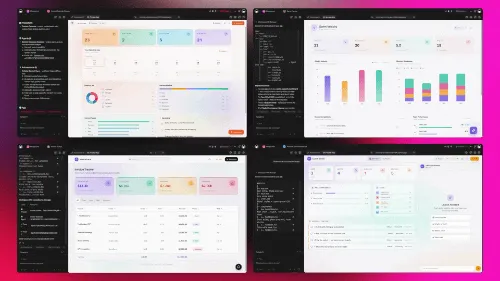
The loop the kernel drives is Workspace DNA:
- ▲ Projects remember. Your customers, jobs, and history stay connected, so the system knows its own state. Projects are the memory.
- ■ Agents reason. Multi-agent teams understand goals and act on your living context, not just autocomplete. Each agent carries built-in tools. Meet them at /agents.
- ● Workflows run. Agentic workflows keep executing across 100+ bidirectional integrations after the chat ends — triggers pull events in, actions push data out. Browse them at /automate.
Stated as a sentence: memory feeds intelligence, intelligence triggers execution, execution updates memory. Remember. Reason. Run. That loop is why a Taskade app does not have a day-8 problem — there is no static artifact to drift, because the app and its data are the same living workspace. For the full teardown of one, read the anatomy of a Taskade Genesis app.
What Does the Living Software Era Mean for Operators?
It means the most important sentence in this essay: you can now own software. Not rent it by the seat, not commission it from an agency, not generate a demo of it — own a running system that knows your business, the way a previous generation of operators owned a spreadsheet. The build-time era made software creation a profession. The run-time era makes software ownership a literacy.
Put the three ways an operator can get software today side by side, and the shape of the era is obvious:
| Traditional SaaS | Vibe-coded app | Living app | |
|---|---|---|---|
| Made for you? | No — generic, you adapt to it | Yes — generated from your prompt | Yes — generated from your prompt |
| Knows your data? | Only what you type into it | Snapshot at generation time | Continuously, projects are the memory |
| Stays current? | Yes, vendor-maintained | No — drifts from day 1 | Yes — agents and automations keep state moving |
| Who maintains it? | The vendor | You, or an agency, or nobody | The loop, with you as owner |
| You own it? | Never | The code, if you can wield it | The running system, no export step |
| Cost shape | Per-seat forever | Credits, then repair bills | Free plan, paid tiers from $10/month billed annually |
The people already operating in the right column mostly never called it anything. Taskade's first self-serve Enterprise customer is an IT program manager, not a developer. He described his field-service business to Taskade Genesis in plain language — customers, jobs, invoices, team — and it became a production dashboard built from connected projects, live in days. His own math: what he shipped in a few weeks would have taken a 40-person team about eighteen months in his Fortune 500 days. But the detail that matters for this essay is what happened after the build: nothing froze. The dashboard kept remembering every customer and running every job, because there was no handoff to decay. The platform's most prolific builder — a solo consultant running 300+ apps on custom domains — went deep enough into how living systems behave that his debugging framework became first-party Taskade documentation. That is the mark of a real era: practitioners start writing its manuals.
And the economics compound in the operator's favor. The people actually making money with prompt-built software all report the same discovery: the build was the easy part; the system is the product. A living app that has been accumulating memory for six months is not replaceable by a fresh generation, however good the generator — the memory is the moat, and it belongs to the operator who owns the workspace.
Understanding Is the New Bottleneck
There's a catch the run-time era has to answer honestly: if the loop keeps your software alive, what keeps you able to steer it? As AI writes and maintains more of the system, the scarce human resource stops being labor and becomes understanding. Design engineer Geoffrey Litt named this in a 2026 talk, "Understanding Is the New Bottleneck": the reason to stay in the loop isn't only to verify the AI's work — it's to participate, because the understanding you build in one loop is what lets you take the creative leap in the next. Lose it, and you accrue cognitive debt — you can direct the software for a while, then wake up unable to reason about your own system.
This is exactly why a living app has an owner, not just a generator. Ownership in this era is not possessing the code; it's holding the mental model of what the system does and why — the thing that lets you keep giving it good goals. The operators who thrive in the right column of that table aren't the ones who understand less because AI does more. They're the ones who stay close enough to keep understanding more: they read what the loop proposes, they keep the memory legible, they steer. As Litt puts it, used well, AI can "put ourselves more deeply in loops than we ever have before." A living system rewards the owner who stays in the loop, and quietly punishes the one who checks out.
What Living Software Is Not
A manifesto earns trust by drawing its own boundaries, so here are ours.
It is not autonomy theater. Living software keeps running; it does not wander off. A living app has an owner — you — who sets the goals, approves the judgment calls, and steers. The loop removes the drudgery of keeping software current, not the human from the work. Anyone selling you software with no owner is selling you an outage with a delay on it.
It is not a claim that generators are doomed. The generation wave is the supply line of this era, and the best generators are extraordinary at their half of the loop. If your job ends at a handed-off codebase, a dedicated generator may serve you well. The two-era frame is about where value settles, not about who deserves to exist.
It is not a coinage grab. White published the academic case in 2024. Cheng wrote the experiential case in April 2026. Karpathy mapped the authoring shift the whole industry builds on. Our contribution is the working architecture — kernel, memory, loop — and 150,000+ apps that run on it. The term should belong to everyone building toward it; the wiki definition is open on purpose, and the broader living app movement is bigger than any one company.
The Era Ahead
Categories do not announce their endings. They just quietly stop being where the interesting problems are. The interesting problem in 2026 is not generating an app — everyone can do that now, and the biggest names in the category have made it magnificently cheap. The interesting problem is the one Gartner's enterprise-agent curve, Deloitte's pricing forecasts, the repair economy, and every day-8 support thread all point at: keeping the thing alive.
HyperCard's dream was ownership. SaaS's achievement was aliveness. For forty years, software made you choose. The living software era is the first one that refuses the choice — owned and alive, described into existence and then left running, on one kernel with one memory. That is the problem Taskade is built for, on every plan, including free.
You can test the thesis in about a minute:
- Clone a living app from the community gallery and point it at your own data.
- Build one by describing it — one prompt, one living workspace.
- Read the TSK-1 announcement to see the kernel underneath.
The build-time era gave everyone the moment of creation. The living software era gives everyone what comes after.
▲ Projects remember. ■ Agents reason. ● Workflows run.
Remember. Reason. Run.
Frequently Asked Questions
What is living software?
Living software is software that stays alive after it is built. It holds its own memory in connected projects, reasons over that memory with AI agents, and keeps executing workflows when nobody is prompting it. The opposite is build-time software: an app generated once, shipped as a static artifact, and left to drift the moment the prompt ends.
What is the difference between living software and SaaS?
SaaS is rented software: the vendor keeps it current, but it is generic and it never knows your business. Living software is generated for your exact workflow and stays current, because the app and its data share one workspace. Deloitte's TMT Predictions 2026 cites Gartner projections of at least 40% of enterprise SaaS spend shifting to usage-, agent-, or outcome-based pricing by 2030 as this model spreads — the trajectory we traced in how SaaS evolved into living software.
Why do AI-generated apps stop working?
Because generation tools have no memory of prior decisions. Engineering analyses of vibe coding document an 8x increase in code duplication as AI re-solves already-solved problems, and rescued vibe-coded apps show a recurring pattern of exposed keys, fake auth, and unmaintainable code. When your data changes, a static codebase does not know. The full diagnosis: why AI-generated apps break.
Will AI agents replace SaaS applications?
Analysts expect absorption more than replacement. Gartner projects 40% of enterprise applications will include task-specific AI agents by the end of 2026 (from under 5% in 2025), and Deloitte cites projections that 35% of point-product SaaS tools will be absorbed into agent ecosystems by 2030. The surviving apps will be the ones agents can remember, reason over, and run — the debate we covered in will vibe coding kill SaaS.
What is the difference between build-time and run-time software?
Build-time software is optimized for the moment of creation: write or generate, ship, then decay until someone maintains it by hand. Run-time software is optimized for everything after: persistent memory holds state, agents reason over the latest context, and workflows keep executing. The living software era is the shift of value from build time to run time.
What is Software 3.0, and how is living software different?
Software 3.0 is Andrej Karpathy's framing for prompts and natural language becoming the program — a shift in how software is authored. Living software is the complementary shift in when software is alive: kept running by memory, agents, and automations after the generation ends. A vibe-coded app is authored 3.0-style and still dies a build-time death; living software closes that gap.
How do AI apps remember things?
Through agent memory, now a benchmark-tracked part of the AI stack: Mem0's State of AI Agent Memory report (July 2026) shows dedicated memory layers scoring 92.5 on LoCoMo and 94.4 on LongMemEval at roughly 4x the token efficiency of re-reading everything. In Taskade, connected projects are the memory, so your app recalls customers, jobs, and history natively. Comparison across builders: AI app builders with memory.
Who coined the term living software?
Nobody owns it, and we do not claim the coinage. Jules White made the academic case in 2024 (arXiv 2408.01768), Jack Cheng explored it as a user experience in April 2026, and Taskade has published its own thesis since October 2025. What we claim is the build: the first workspace engineered around living software as its native output.
What is TSK-1?
TSK-1 is the Taskade System Kernel, the intelligence layer that coordinates AI models, memory, agents, and workflows into one running workspace. It is a kernel, not a model: it coordinates 15+ frontier models from OpenAI, Anthropic, Google, and open-weight providers, and every app built with Taskade Genesis runs on it.
What is Workspace DNA?
Workspace DNA is the loop that keeps a Taskade app alive: Memory, Intelligence, and Execution. Projects remember your data, agents reason over that living context, and workflows execute after the chat ends. Memory feeds intelligence, intelligence triggers execution, and execution updates memory.
Do I need to know how to code to build living software?
No. You describe the work in plain language — your customers, jobs, and invoices — and Taskade Genesis turns the description into a working app on TSK-1. Non-technical operators already run production systems this way, including an IT program manager who shipped a field-service dashboard in days without an engineering team.
How can I try living software today?
Clone a live app from the community gallery in one click, point it at your own data, and watch it keep running. Or describe your own and build it free. The gallery includes 150+ cloneable app kits — CRMs, client portals, dashboards, and trackers — all running on TSK-1, with a free plan and paid tiers from $10/month billed annually on pricing.