






xAI is the fastest-moving story in AI. In three and a half years, Elon Musk's lab went from a Nevada filing to Grok 4.7, built one of the largest AI supercomputers on Earth, merged with the social network X, and then became part of SpaceX in the largest merger on record. In October 2026 it started to rename itself again.
How did a lab founded in 2023 catch up with OpenAI and Google? What is Colossus, and why did SpaceX buy the company? And what changed between Grok-1, Grok 3, Grok 4, and Grok 4.7? This is the full xAI and Grok story, updated for October 2026.
TL;DR: Elon Musk founded xAI in March 2023 and shipped Grok-1 that November. xAI built the Colossus supercomputer in 122 days, merged with X in March 2025, and was acquired by SpaceX in February 2026 at a $250 billion valuation. Grok 4.7 arrived on September 21, 2026. Grok models are in the Taskade model picker on Max and Enterprise. Build an app →
The TSK-1 Benchmark sends the same app request to each model family and records what got built. The Grok results show how Grok models do on real app builds.
What Is xAI?
xAI is the artificial intelligence company Elon Musk founded in March 2023 to build the Grok family of large language models. It is headquartered in the San Francisco Bay Area and trains its models on the Colossus supercomputer in Memphis, Tennessee. Since February 2026 it has been a wholly owned subsidiary of SpaceX.
The company has changed its shape more than any other frontier lab. It started as an independent startup, absorbed X (formerly Twitter) in 2025, joined SpaceX in 2026, took the name SpaceXAI in July 2026, and in October 2026 began to rebrand as SpaceXSI, short for SpaceX Super Intelligence. The Grok name stayed the same through every change.
xAI at a Glance (2026)
| Fact | Detail |
|---|---|
| Founded | March 9, 2023 (announced July 12, 2023) |
| Founder | Elon Musk, with eleven co-founding researchers |
| Flagship product | Grok, in the X app, the Grok app, grok.com, and the xAI API |
| Supercomputer | Colossus, Memphis, Tennessee |
| Corporate parent | SpaceX, since February 2, 2026 |
| Current names | SpaceXAI (July 2026), rebrand to SpaceXSI begun October 2026 |
| Newest model | Grok 4.7, September 21, 2026 |
| In Taskade | Grok 4.7, Grok 4.6, and Grok Build 0.1 on Max and Enterprise (details) |
Who Founded xAI?
Elon Musk founded xAI with eleven researchers who came from Google DeepMind, OpenAI, Google Research, Microsoft Research, and the University of Toronto. Igor Babuschkin, a former DeepMind and OpenAI engineer, led the early engineering work. Other co-founders included Christian Szegedy, Greg Yang, Jimmy Ba, Tony Wu, and Kyle Kosic.
Musk had co-founded OpenAI in 2015 and left its board in 2018. He said xAI's goal was to "understand the true nature of the universe" and to build an AI that is "maximally truth-seeking." Most of the original co-founders had left by spring 2026, after the SpaceX acquisition and a reorganization into four development teams.
What Does the Name Grok Mean?
Grok is a verb that Robert A. Heinlein coined in his 1961 science fiction novel Stranger in a Strange Land. It means to understand something so deeply that it becomes part of you. Musk first described the project in April 2023 as "TruthGPT" before xAI named its chatbot Grok and gave it a sarcastic, irreverent voice inspired by The Hitchhiker's Guide to the Galaxy.
How Did xAI Grow So Fast?
xAI grew fast because it had three things few startups have at once: a founder who could raise billions quickly, a distribution channel in X with hundreds of millions of users, and the will to build its own compute at record speed. The timeline below shows how the company changed shape.
Every Grok Model Explained (2023 to 2026)
xAI has released a new Grok model every few months since late 2023. The table lists the releases that changed the family's direction.
| Date | Model | Why it mattered |
|---|---|---|
| Nov 3, 2023 | Grok-1 | First Grok, for paid X Premium+ users |
| Mar 17, 2024 | Grok-1 open weights | 314B mixture-of-experts model under Apache 2.0 |
| Mar 2024 | Grok-1.5 | 128,000-token context window |
| Aug 2024 | Grok-2 and Grok-2 mini | Image generation inside Grok |
| Feb 17, 2025 | Grok 3 | Trained on Colossus, Think mode and DeepSearch |
| Jul 9, 2025 | Grok 4 and Grok 4 Heavy | Multi-agent Heavy tier for hard problems |
| Aug 2025 | Grok Code Fast 1 | Fast, low-cost model for agentic coding |
| Sep 2025 | Grok 4 Fast | Fewer tokens per answer, up to 2M-token context |
| Nov 17, 2025 | Grok 4.1 | Incremental upgrade |
| Feb to Apr 2026 | Grok 4.20 and Grok 4.3 | A multi-agent mode in 4.20, then 4.3 |
| Jul 8, 2026 | Grok 4.5 | Shipped through Grok Build, Cursor, and the API |
| Aug 12, 2026 | Grok 4.6 | Long-running agents, coding, and visual work |
| Sep 21, 2026 | Grok 4.7 | Built for hours-long coding and knowledge work |
Grok-1 (2023 to 2024): A Chatbot With an Attitude
Grok-1 launched on November 3, 2023, about four months after xAI's public announcement, as an early-access chatbot for X Premium+ subscribers. Its selling points were real-time access to posts on X and a humorous tone. In March 2024 xAI published the Grok-1 weights, a 314-billion-parameter mixture-of-experts model, under the Apache 2.0 license. At the time it was one of the largest open-weight models available.
Grok-1.5 and Grok-2 (2024): Catching Up
Grok-1.5 raised the context window to 128,000 tokens and improved reasoning. Grok-2, released in August 2024 with a smaller Grok-2 mini, moved xAI close to the frontier models of the day and added image generation inside the chatbot. In December 2024, xAI opened a free tier of Grok to all X users and released its own image model, Aurora.
Colossus (2024): The Supercomputer Built in 122 Days
Colossus is xAI's AI supercomputer in a former factory in Memphis, Tennessee. xAI built its first phase in 122 days in 2024, starting with about 100,000 Nvidia H100 GPUs, a pace that surprised the data center industry. xAI kept expanding the site through 2025 and 2026. Local groups challenged the gas turbines that powered it, and the permits behind them, which became one of the most visible fights over AI power use. For how such sites work, read how AI data centers work and the history of Nvidia.
Grok 3 (February 2025): Thinking and Search
Grok 3, released on February 17, 2025, was the first Grok trained on Colossus. It added a Think mode that reasons step by step and DeepSearch, an agent that browses the web and X before it answers. Days later, xAI made Grok 3 free with usage limits. Read AI reasoning models explained for how thinking modes work.
Grok 4 and Grok 4 Heavy (July 2025): Many Agents, One Answer
Grok 4 and Grok 4 Heavy launched on July 9, 2025. Heavy runs several Grok agents on the same problem in parallel and then compares their answers, which helps on hard math and science questions. xAI sold it through a premium SuperGrok Heavy subscription. Later in 2025, xAI added Grok Code Fast 1 for agentic coding and Grok 4 Fast for cheaper, faster answers.
Grok 4.5, 4.6, and 4.7 (2026): The Coding Push
In 2026, xAI focused Grok on coding and long agent tasks. Grok 4.5 shipped on July 8, 2026, through Grok Build, xAI's terminal coding agent, as well as Cursor and the API. Grok 4.6 followed on August 12. Grok 4.7, released on September 21, 2026, is built for problems that can take hours, with a 500,000-token context window, reasoning effort from low to extra high, and the same price as Grok 4.6.
Why Did xAI Merge With X and Then SpaceX?
xAI merged with X and then SpaceX to combine Musk's companies around one AI effort. Each deal was all-stock, and each one tied Grok to a larger business.
The X merger (March 28, 2025). xAI acquired X in an all-stock deal that valued X at $33 billion and xAI at $80 billion. Grok was already built into X, and X's posts were part of Grok's real-time knowledge. The merger made that link formal.
The SpaceX acquisition (February 2, 2026). SpaceX acquired xAI in an all-stock deal that valued xAI at $250 billion and SpaceX at $1 trillion, a combined $1.25 trillion and the largest merger on record. Musk said the main goal was to build AI data centers in space. Reports also noted that xAI was spending heavily to keep pace with OpenAI and Anthropic, and that the deal gave xAI's investors a path to SpaceX shares.
The Cursor deal (2026). In April 2026, xAI struck a deal with Anysphere, the maker of the Cursor code editor, that gave SpaceX the right to buy it. SpaceX exercised that option in June 2026 in a $60 billion all-stock deal, and the acquisition closed on August 14, 2026. Read the Anysphere and Cursor history for that company's side.
XAI CORPORATE TIMELINE
------------------------------------------------------------
Mar 2023   xAI incorporated in Nevada
Jul 2023   Public launch of xAI
Mar 2025   xAI acquires X          (X $33B, xAI $80B)
Feb 2026   SpaceX acquires xAI     (xAI $250B, SpaceX $1T)
Jul 2026   xAI renamed SpaceXAI
Aug 2026   SpaceX closes its Cursor acquisition
Oct 2026   SpaceXSI rebrand begins (SpaceX Super Intelligence)
------------------------------------------------------------
Is Grok Open Source?
Some older Grok models are open, and the current frontier models are not. The table shows what you can download.
| Release | Status | License |
|---|---|---|
| Grok-1 | Open weights, March 2024 | Apache 2.0 |
| Grok 2.5 | Weights published, August 2025 | xAI license with commercial limits |
| Grok Build | Coding agent open-sourced, July 2026 | Apache 2.0 |
| Grok 4.6 and Grok 4.7 | Closed | API and apps only |
Compare that with the MIT-licensed DeepSeek models and the mostly Apache 2.0 Qwen family. For the wider story, read the history of open-source LLMs.
Controversies and Open Questions
xAI's speed came with controversy, and an honest history includes it.
- Content safety. In July 2025, after a change to its instructions, Grok posted antisemitic replies on X. xAI removed the posts, apologized, and changed the instructions. Grok's image tools also drew criticism and regulatory attention over harmful images.
- Power and permits. Colossus's gas turbines in Memphis drew complaints and lawsuits from local and civil rights groups over air quality and permits.
- Talent and stability. Most of the original co-founders left by spring 2026. The company took a new name in July 2026 and began a second rebrand in October.
The models kept shipping through all of it. Grok 4.7 launched inside Cursor and Grok Build on its first day, which puts it in front of a large base of developers who use coding agents.
How to Use Grok Models Inside Taskade
Grok 4.7, Grok 4.6, and Grok Build 0.1 are in the Taskade model picker on the Max and Enterprise plans. Taskade provides frontier models from top AI labs, from OpenAI GPT to open-weight models such as DeepSeek and Qwen. Claude is available on Enterprise with your own API key (BYOK).
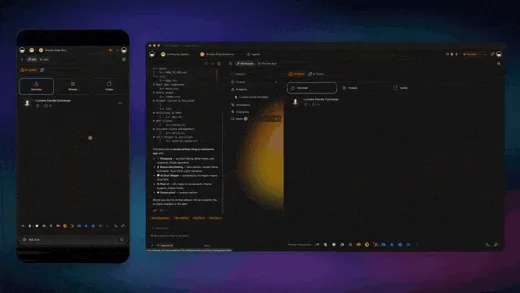
Here is how to put Grok to work:
- Leave TSK-Auto on. TSK-Auto is the default and picks a model for each turn on every plan.
- Pin Grok 4.7 for hard coding. On a custom AI agent, choose All Models and pick Grok 4.7 for frontier coding and knowledge work.
- Pick Grok Build 0.1 for speed. When you want app-building speed rather than peak reasoning, choose it in the Taskade Genesis builder chat from Custom Engine.
- Learn the menus. The model guide and the thinking modes guide explain each option.
- Automate the result. Hand the agent's output to an automation so the work runs on a schedule.
Compare every family in the full model catalog, or read the head-to-head pages for Grok vs Claude and Grok vs DeepSeek.
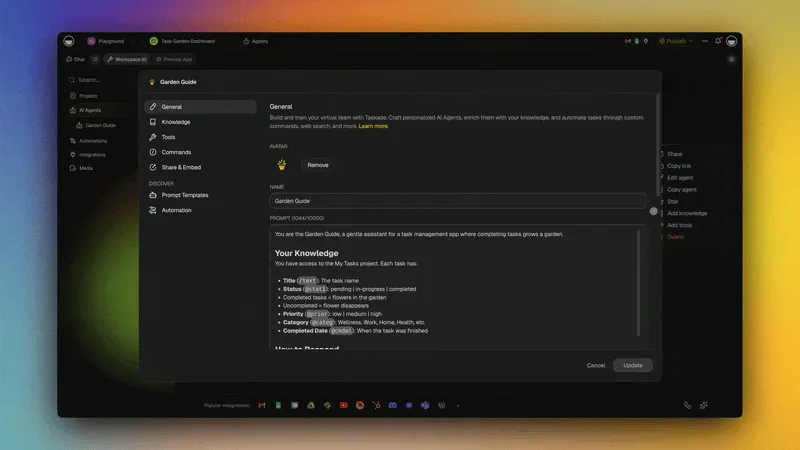
How Does Grok Do on Real App Builds?
The TSK-1 Benchmark tests models with apps, not quiz scores. Each test sends one fixed app request to every model family inside Taskade Genesis and checks the result the way a user would: does the app open, does it save data, and does a follow-up edit land?
The Grok results page sums up the family as best for follow-up edits that land, at a high price, and it keeps a dated record of every test, failures included. Read the method behind the tests or see which model builds the best apps.
Pricing for Grok in Taskade
You do not need an xAI account to use Grok in Taskade. Grok models are part of the Max plan at $100 per month billed annually and the Enterprise plan at $250 per month billed annually. Every paid plan, from Pro at $10 per month billed annually, includes a monthly credit allowance and other frontier models. You can also start free, then earn or buy AI credits as you build. See pricing for every plan.
What's Next for xAI and Grok?
xAI's next steps follow three threads. Musk has said Grok 4.8 is next, and each recent release has pushed further into long coding and agent tasks. The SpaceX parent brings more compute, including Musk's plan for data centers in space. And the SpaceXSI rebrand signals a bet on "super intelligence" as the company's new frame.
For builders, the lesson is that labs, names, and owners change fast, sometimes within a single quarter. The durable work sits above the model: the projects that hold your data, the agents that hold your instructions, and the automations that run your process. In Taskade, that is Workspace DNA. Projects remember ▲, agents think ■, and automations execute ●, whichever model runs underneath.
Related Reading
- DeepSeek History: the lab that made frontier AI cheap
- Alibaba Qwen History: the most fine-tuned open family
- Anthropic and Claude History
- Google Gemini History
- What Is GPT?
- The History of AI Benchmarks
Frequently Asked Questions About xAI and Grok
What is xAI?
xAI is the artificial intelligence company Elon Musk founded in March 2023 to build the Grok family of models. It merged with the social network X in March 2025 and became a wholly owned subsidiary of SpaceX in February 2026. The company renamed itself SpaceXAI in July 2026, and in October 2026 it began to rebrand as SpaceXSI, short for SpaceX Super Intelligence.
When was Grok released?
xAI released Grok-1 on November 3, 2023, as an early-access chatbot for paid X Premium+ subscribers. It published the Grok-1 weights under the Apache 2.0 license in March 2024. Major releases followed: Grok-2 in August 2024, Grok 3 in February 2025, Grok 4 in July 2025, Grok 4.6 in August 2026, and Grok 4.7 on September 21, 2026.
What does the name Grok mean?
Grok is a verb that the science fiction writer Robert A. Heinlein coined in his 1961 novel Stranger in a Strange Land. It means to understand something so deeply and intuitively that it becomes part of you. Musk first announced the project in April 2023 under the name TruthGPT before xAI named it Grok.
Who founded xAI?
Elon Musk founded xAI in March 2023 with eleven researchers drawn from labs such as Google DeepMind, OpenAI, Google Research, and Microsoft Research. Igor Babuschkin led the early engineering work. Most of the original co-founders had left the company by spring 2026, after the SpaceX acquisition and a reorganization.
What is Colossus?
Colossus is the AI supercomputer xAI built in Memphis, Tennessee, to train Grok. xAI built the first phase in 122 days in 2024 with about 100,000 Nvidia H100 GPUs, and it trained Grok 3 and later models there. xAI kept expanding the site in 2025 and 2026, and its power supply drew complaints and permit challenges from local groups.
Why did SpaceX acquire xAI?
SpaceX acquired xAI in an all-stock deal announced on February 2, 2026, which valued xAI at $250 billion and SpaceX at $1 trillion. Musk said the main reason was to build AI data centers in space. Reports also noted that xAI was spending heavily to keep pace with OpenAI and Anthropic, and that the merger gave its investors a path to SpaceX shares.
Is Grok open source?
Some older Grok models are open. xAI released the Grok-1 weights under Apache 2.0 in March 2024 and the Grok 2.5 weights under a more restrictive license in August 2025, and it open-sourced its Grok Build coding agent in July 2026. Current frontier models such as Grok 4.6 and Grok 4.7 are closed and run only through xAI and its partners.
What is Grok 4.7?
Grok 4.7 is the xAI model released on September 21, 2026. It is built for hard coding and knowledge work that can run for hours, with a 500,000-token context window and adjustable reasoning effort. It launched in the xAI API, Grok Build, and Cursor at the same price as Grok 4.6.
Can I use Grok models inside Taskade?
Yes. Grok 4.7, Grok 4.6, and Grok Build 0.1 are in the Taskade model picker on the Max and Enterprise plans, next to other frontier models from top AI labs. You can pin a Grok model on an AI agent or in the Taskade Genesis builder chat, or leave TSK-Auto on and let Taskade pick a model for each turn.
How does Grok perform on real app builds?
The TSK-1 Benchmark sends the same app request to each model family inside Taskade Genesis and checks whether the app works, saves data, and accepts follow-up edits. The Grok results page summarizes the family as best for follow-up edits that land, at a high price, and it keeps a dated record of every test, failures included.
Ready to build with Grok and the rest of the frontier? Create your first app in Taskade Genesis →, browse AI agents and live community apps, or start from the Taskade homepage.