






DeepSeek is the Hangzhou lab that made frontier AI cheap. In under three years it went from a side project inside a quant hedge fund to DeepSeek-R1, the open-weight reasoning model that knocked close to $600 billion off Nvidia's market value in a single day, and then to the V4 family that runs a 1-million-token context window under the MIT license.
How did a team that never raised outside money until 2026 change the price of intelligence for everyone? Who is Liang Wenfeng? And what changed between V3, R1, V4 Pro, and V4.1 Flash? This is the full DeepSeek story, updated for October 2026.
TL;DR: DeepSeek was spun out of the High-Flyer hedge fund on July 17, 2023. V2 (May 2024) started a price war, R1 (January 2025) shocked markets, and the V4 family (2026) brought MIT-licensed models with a 1-million-token context. DeepSeek V4 Pro is in the Taskade model picker on every paid plan. Build an app with it →
The TSK-1 Benchmark sends the same app request to each model family and records what got built. The DeepSeek results show how DeepSeek models do on real app builds.
What Is DeepSeek?
DeepSeek is a Chinese AI company headquartered in Hangzhou, Zhejiang, that builds large language models and releases most of them as open weights under the MIT license. It was founded on July 17, 2023 as a spin-out of the quantitative hedge fund High-Flyer, and it is led by its founder, Liang Wenfeng.
DeepSeek is unusual among frontier labs in three ways. It funded itself from a trading firm's profits for its first three years. It published detailed technical reports on how it trained its models, cost figures included. And it priced its API so low that rivals in China and the US had to cut their own prices to keep up.
DeepSeek at a Glance (2026)
| Fact | Detail |
|---|---|
| Founded | July 17, 2023 (lab announced April 14, 2023) |
| Headquarters | Hangzhou, Zhejiang, China |
| Founder and CEO | Liang Wenfeng |
| Parent and early backer | High-Flyer, a quantitative hedge fund |
| Signature models | DeepSeek-V3, DeepSeek-R1, DeepSeek V4 Pro, DeepSeek V4.1 Flash |
| License | MIT for most current open-weight releases |
| First outside round | June 2026, about 50 billion yuan, valuation reported above $50 billion |
| In Taskade | DeepSeek V4 Pro on every paid plan (details) |
Who Founded DeepSeek? Meet Liang Wenfeng
Liang Wenfeng is a Chinese engineer and investor who studied electronic and information engineering at Zhejiang University. In 2015 he co-founded High-Flyer, a quantitative hedge fund that used machine learning to trade, and he grew it into one of China's largest quant funds.
High-Flyer built its own GPU clusters for trading research, named Fire-Flyer. Reports say Liang bought about 10,000 Nvidia A100 GPUs in 2021, before US export rules restricted those chips in China. That stockpile, and the engineering habits of a trading firm, shaped everything DeepSeek did next.
Liang has said in interviews that DeepSeek's goal is research toward artificial general intelligence, not quick revenue. The company hires mostly young researchers from Chinese universities, keeps a small team (reported at under 200 people in 2025), and publishes its methods.
How Did DeepSeek Start Inside a Hedge Fund?
DeepSeek started as an AI research lab that High-Flyer announced on April 14, 2023, and spun out as a separate company on July 17, 2023. High-Flyer stayed the principal investor and funded the lab from its trading profits. Liang held a majority stake through holding companies.
That funding model mattered. With no venture investors to answer to, DeepSeek could spend its first years on research papers and open releases instead of a consumer product. The lab's first models were small and technical. Each one introduced a method that the next model built on.
Every DeepSeek Model Explained (2023 to 2026)
DeepSeek released more than 15 models in three years. The table below lists the releases that changed the lab's direction. Dates are DeepSeek's own release dates.
| Date | Model | Why it mattered |
|---|---|---|
| Nov 2, 2023 | DeepSeek Coder | First open release, a code model family |
| Nov 29, 2023 | DeepSeek LLM 67B | First general chat model |
| Jan 2024 | DeepSeekMoE | First mixture-of-experts research model |
| Early 2024 | DeepSeekMath | Introduced GRPO, the training method behind R1 |
| May 2024 | DeepSeek-V2 | MoE plus multi-head latent attention, very low API price |
| Dec 26, 2024 | DeepSeek-V3 | 671B total parameters, frontier-level open weights |
| Jan 20, 2025 | DeepSeek-R1 | Open reasoning model under MIT, triggered the market shock |
| Aug 21, 2025 | DeepSeek-V3.1 | One model with thinking and non-thinking modes |
| Sep 29, 2025 | DeepSeek-V3.2-Exp | DeepSeek Sparse Attention, API prices cut by more than half |
| Dec 1, 2025 | DeepSeek-V3.2 | Stable release, plus a reasoning-focused Speciale variant |
| Apr 24, 2026 | DeepSeek V4 preview | V4 Pro and V4 Flash, 1-million-token context, MIT |
| Aug 13, 2026 | DeepSeek V4 Pro (GA) | V4 Pro leaves preview |
| Sep 10, 2026 | DeepSeek V4.1 Flash | Smallest model of a new architecture family, native image input |
DeepSeek Coder and LLM 67B (2023): The Quiet Start
DeepSeek's first public models were DeepSeek Coder in November 2023 and DeepSeek LLM 67B later that month. Both were dense transformer models in the style of Meta's Llama. They were competitive with other open models of the time, but they were not the reason anyone outside China learned the name.
DeepSeek-V2 (May 2024): The Price War
DeepSeek-V2 combined two ideas that defined the lab. The first was a mixture-of-experts design with 236 billion total parameters and only about 21 billion active per token. The second was multi-head latent attention (MLA), which compresses the memory a model keeps while it reads a long prompt.
Together they made V2 very cheap to serve, and DeepSeek priced its API at about 1 yuan per million input tokens. Within weeks, ByteDance, Alibaba, Baidu, and Tencent cut their own prices. Chinese media called it a price war, and DeepSeek started it.
DeepSeek-V3 (December 2024): Frontier Weights for Everyone
DeepSeek-V3, released on December 26, 2024, has 671 billion total parameters, of which about 37 billion are active for each token. DeepSeek trained it on 14.8 trillion tokens and reported that the final training run took about 2.79 million H800 GPU hours.
That GPU-hour figure, priced at $2 per hour, became the famous "$5.6 million" training cost. The number was real, but narrow. It covered only the last training run and left out research, failed runs, data work, salaries, and the hardware itself. Even so, it showed that a frontier-class model did not need a nine-figure training run.
DeepSeek-R1 (January 2025): The Reasoning Shock
DeepSeek-R1, released on January 20, 2025, is a reasoning model that thinks step by step before it answers, in the style of OpenAI's o1. DeepSeek trained it on top of V3 with large-scale reinforcement learning, and it published a sibling, R1-Zero, that learned to reason from reinforcement learning alone.
Three things made R1 different from earlier reasoning models:
- It was MIT-licensed. Anyone could download it, run it, and build on it.
- It showed its reasoning. The chat app printed the model's full chain of thought.
- It came with small distilled versions built on Qwen and Llama, so a laptop could run a reasoning model.
To learn how reasoning models think, read AI reasoning models explained.
DeepSeek V3.1 to V3.2 (2025): One Model, Two Modes
Through 2025 DeepSeek merged its chat and reasoning lines. V3.1 (August 2025) let one model switch between a thinking mode and a fast mode. V3.2-Exp (September 2025) introduced DeepSeek Sparse Attention, which reads only the parts of a long context that matter for each token, and DeepSeek cut API prices by more than half the same day. V3.2 shipped as a stable model on December 1, 2025.
DeepSeek V4 Pro and V4 Flash (2026): A Million Tokens
DeepSeek released the V4 family as a preview on April 24, 2026, after reports had pointed to an earlier launch in February. V4 Pro has 1.6 trillion total parameters and about 49 billion active per token. V4 Flash is a smaller 284-billion-parameter model. Both carry a 1-million-token context window and the MIT license.
V4 Flash reached its official release on July 31, 2026, and V4 Pro left preview on August 13, 2026. To see how context windows grew this large, read the history of the context window.
DeepSeek V4.1 Flash (September 2026): A New Architecture
DeepSeek V4.1 Flash, released on September 10, 2026, is the first and smallest model of a new DeepSeek architecture family. DeepSeek says the new architecture is built for a higher capability ceiling, faster inference, and higher throughput, and the model has native multimodal visual understanding. DeepSeek also lowered its API prices with the release.
Why Did DeepSeek R1 Shock the Stock Market?
DeepSeek R1 shocked the stock market because it suggested that frontier reasoning could be built and served with far fewer chips than investors had priced in. On January 27, 2025, a week after the R1 launch, DeepSeek's free app passed ChatGPT as the most downloaded free app on the US App Store.
That day Nvidia shares fell about 17 percent, a loss of close to $600 billion in market value and the largest one-day loss for any US company at the time. Other chip and power stocks fell with it. The fear was simple. If a lab with export-restricted GPUs could match the frontier at a fraction of the cost, the race to build ever-larger data centers might be overbuilt.
The fear faded within months. Cheaper models led to more AI use, not less, and chip demand kept climbing. Economists pointed to the Jevons paradox: when a resource gets cheaper, total use often goes up. For the hardware side of this story, read the history of Nvidia and Jensen Huang and how AI data centers work.
How Does DeepSeek's Architecture Work?
DeepSeek's architecture rests on two ideas: send each token to a few specialist experts, and compress the memory the model keeps about the prompt. Both cut the compute and memory each answer needs, which is how DeepSeek keeps its prices low.
| Technique | First used in | What it does in plain English |
|---|---|---|
| Mixture of experts | DeepSeekMoE, V2 | Runs only a few expert sub-networks per token, so a huge model costs like a small one |
| Multi-head latent attention | V2 | Shrinks the memory kept for each token of the prompt, so long inputs fit |
| GRPO | DeepSeekMath, R1 | A cheaper reinforcement learning method that scores groups of answers against each other |
| Multi-token prediction | V3 | Trains the model to predict several tokens ahead, which speeds learning |
| DeepSeek Sparse Attention | V3.2-Exp | Reads only the parts of a long context that matter for each token |
If the transformer basics are new to you, start with how large language models work.
Is DeepSeek Open Source? The MIT License Explained
Most current DeepSeek models are open-weight under the MIT license. MIT is one of the most permissive licenses in software. It allows commercial use, modification, and redistribution, with no revenue threshold and no attribution banner in your product.
DeepSeek-R1 used MIT from its launch in January 2025, and the V4 family kept it in 2026. Earlier models used a custom DeepSeek model license with use restrictions. The training data and the full training pipeline are not released, so "open weight" is the more precise term. For the wider story, read the history of open-source LLMs and our guide to the best open-source LLMs.
How Did DeepSeek Get Funded?
DeepSeek ran on High-Flyer's money until 2026. In June 2026 it closed its first outside funding round, reported at about 50 billion yuan (roughly $7.4 billion), at a valuation reported above $50 billion. Tencent and battery maker CATL were reported among the largest outside investors. Liang Wenfeng also invested his own money, and the deal kept him in control.
In October 2026, reports said DeepSeek was in talks for a larger second round and was preparing for a possible stock listing as early as 2027. Valuations in AI move fast, so treat any single figure as a dated snapshot.
DEEPSEEK FUNDING, AT A GLANCE
------------------------------------------------------------
2015        High-Flyer founded (Liang Wenfeng, co-founder)
2023-2026   Funded by High-Flyer trading profits only
Jun 2026    First outside round, about 50B yuan (~$7.4B)
            Valuation reported above $50B
            Tencent and CATL among the largest backers
Oct 2026    Reports: second round in talks, IPO prep for 2027
------------------------------------------------------------
DeepSeek vs Other Open-Weight Labs
DeepSeek is one of several Chinese labs that ship frontier open weights. Each one leads on a different axis, which is why teams often keep more than one available.
| Lab | Flagship family | Known for | Deep dive |
|---|---|---|---|
| DeepSeek | V4 Pro, V4.1 Flash | Low cost, reasoning, MIT license | You are here |
| Alibaba | Qwen 3.x | Widest range of sizes, agent work | Qwen history |
| Moonshot AI | Kimi K3 | Long context, agent swarms | Moonshot and Kimi history |
For head-to-head detail, compare Kimi vs DeepSeek and Qwen vs DeepSeek.
Controversies and Open Questions
DeepSeek's rise came with scrutiny, and an honest history includes it.
- Data and privacy. The DeepSeek app and API run on servers in China. Italy's privacy regulator blocked the app in January 2025, Australia ordered it off government devices in February 2025, and the US defense budget law for 2026 restricts it on defense devices.
- Distillation claims. OpenAI said in 2025, and Anthropic said in February 2026, that they saw signs of their models' outputs being used to train other labs' models, DeepSeek included.
- The real cost. The "$5.6 million" V3 figure is often quoted as the full cost of the model. It is not. It is the GPU rental value of one final training run.
The open-weight license is the practical answer to the first point. A company that cannot send data to DeepSeek's servers can run the same model on its own infrastructure.
How to Use DeepSeek Models Inside Taskade
DeepSeek V4 Pro is in the Taskade model picker on every paid plan. Taskade provides frontier models from top AI labs, from OpenAI GPT to open-weight models such as DeepSeek and Qwen, in one workspace. Claude is available on Enterprise with your own API key (BYOK).
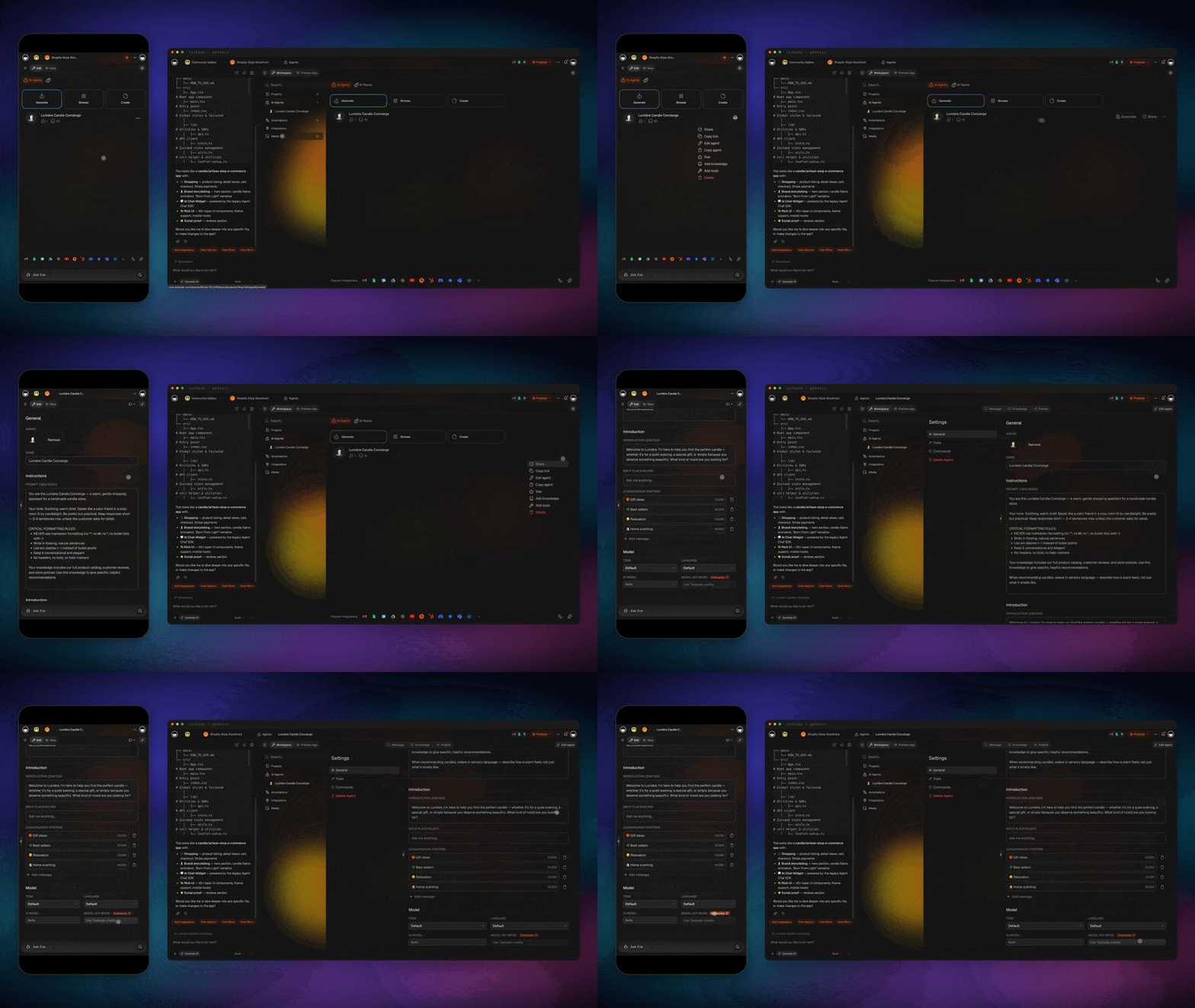
Here is how to put DeepSeek to work:
- Leave TSK-Auto on. TSK-Auto is the default. It picks a model for each turn, so you get the right model for each step without thinking about it.
- Pin DeepSeek V4 Pro on an agent. Open a custom AI agent, choose All Models, and select DeepSeek V4 Pro for reasoning and coding work in the low cost band.
- Pin it in the builder. In the Taskade Genesis builder chat, choose it from Custom Engine to build an app with DeepSeek. The model guide walks through each menu.
- Run it on a schedule. Hand the agent's work to an automation so it runs without you.
DeepSeek V4.1 Flash no longer appears in the picker, and a saved pick of it keeps working. On the Free plan, the TSK-Instant rung is the fast option. Compare every model family in the full model catalog.
How Does DeepSeek Do on Real App Builds?
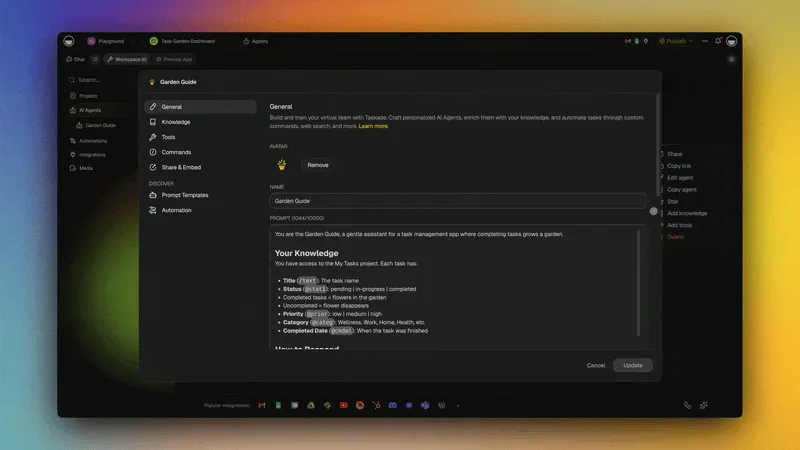
The TSK-1 Benchmark answers that question with apps, not quiz scores. Each test sends one fixed app request to every model family inside Taskade Genesis and then checks the result the way a user would: does the app open, does it save data, does it look right on a phone and in dark mode, and does a follow-up edit land?
The DeepSeek results page sums up the family as best for polished apps with rich workspace data, and it keeps a dated record of every test, failures included. Read the method behind the tests or see which model builds the best apps.

Pricing for DeepSeek in Taskade
You do not need a DeepSeek API account to use DeepSeek V4 Pro in Taskade. The AI allowance comes with your plan. You start free, then earn or buy AI credits as you build, and paid plans include a monthly credit allowance. Pro is $10 per month billed annually for up to 10 members, Business is $25, Max is $100, and Enterprise is $250, each per month billed annually. See pricing for every plan.
What's Next for DeepSeek?
DeepSeek's next steps point in three directions. A V4.1 Pro model would complete the new architecture family that V4.1 Flash started. Fresh funding gives the lab more compute than High-Flyer alone could buy. And the open-weight releases keep pushing the price of intelligence down for everyone who builds on top of models.
For builders, the lesson of DeepSeek is that the model layer keeps getting cheaper and better, and it changes every few months. The durable work sits one layer up: the projects, agents, and automations that hold your business logic. In Taskade, that layer is Workspace DNA. Projects remember ▲, agents think ■, and automations execute ●, whichever model runs underneath.
Related Reading
- Alibaba Qwen History: the other giant of Chinese open weights
- xAI and Grok History: the lab that went from X to SpaceX
- Moonshot AI and Kimi History: from K2 to K3
- The History of Open-Source LLMs
- The History of AI Benchmarks
- AI Cost per Task: how to measure what a finished job costs
Frequently Asked Questions About DeepSeek
What is DeepSeek?
DeepSeek is a Chinese artificial intelligence company based in Hangzhou that builds large language models and releases most of them as open weights under the MIT license. It was spun out of the quantitative hedge fund High-Flyer in July 2023 and is led by founder and CEO Liang Wenfeng. Its best-known models are DeepSeek-R1, released in January 2025, and the DeepSeek V4 family released in 2026.
Who founded DeepSeek?
DeepSeek was founded by Liang Wenfeng, who co-founded the High-Flyer quantitative hedge fund in 2015. High-Flyer announced an artificial general intelligence research lab in April 2023 and spun it out as DeepSeek on July 17, 2023. High-Flyer funded the lab for its first three years, and Liang kept control of the company through its first outside funding round in 2026.
Why did DeepSeek R1 crash Nvidia stock?
On January 27, 2025, a week after DeepSeek released R1, its free chatbot app passed ChatGPT as the most downloaded free app on the US App Store. Investors concluded that frontier reasoning might need far fewer chips than assumed, and Nvidia shares fell about 17 percent in one session, a loss of close to $600 billion in market value. It was the largest one-day loss for any US company at the time.
How much did it cost to train DeepSeek V3?
DeepSeek reported that the final training run of DeepSeek V3 used about 2.79 million H800 GPU hours, which it valued at about $5.6 million at a rental price of $2 per GPU hour. The figure covers only that final run. It excludes research, failed experiments, data work, salaries, and the cost of owning the hardware, so the full cost of building V3 was much higher.
Is DeepSeek open source?
Most DeepSeek models ship as open weights under the MIT license, which lets anyone download, run, modify, and sell products built on the model. DeepSeek-R1 used the MIT license from launch in January 2025, and the V4 family kept it in 2026. The training data and full training code are not released, so open weight is the more precise term than open source.
What is the difference between DeepSeek V4 Pro and V4.1 Flash?
DeepSeek V4 Pro is the large model of the V4 family, with 1.6 trillion total parameters, a 1-million-token context window, and a focus on deep reasoning and coding. DeepSeek V4.1 Flash, released on September 10, 2026, is the smallest model of a new DeepSeek architecture family and adds native image understanding. Flash is built for speed and low cost, and Pro is built for depth.
What is a mixture-of-experts model?
A mixture-of-experts model splits its parameters into many smaller expert networks and uses a router to send each token to only a few of them. DeepSeek V3 has 671 billion parameters in total but activates about 37 billion per token, so it runs at the cost of a much smaller model. Every DeepSeek flagship since V2 uses this design.
Is DeepSeek safe to use for business?
The answer depends on how you run it. The DeepSeek chat app and API run on DeepSeek's own servers in China, and several governments restricted them on official devices in 2025. Because the weights are MIT-licensed, a company can also run DeepSeek models on its own infrastructure or through a provider it already trusts, which keeps data inside its own controls.
Can I use DeepSeek models inside Taskade?
Yes. DeepSeek V4 Pro is in the Taskade model picker on every paid plan, next to other frontier models from top AI labs. You can pin it on an AI agent or in the Taskade Genesis builder chat, or leave TSK-Auto on and let Taskade pick a model for each turn. Paid plans start at Pro for $10 per month billed annually.
How does DeepSeek perform on real app builds?
The TSK-1 Benchmark sends the same app request to each model family inside Taskade Genesis and records whether the finished app works, saves data, and survives follow-up edits. The DeepSeek results page summarizes the family as best for polished apps with rich workspace data, and it keeps a dated, test-by-test record, including the builds that failed.
Ready to build with DeepSeek and the rest of the frontier? Create your first app in Taskade Genesis →, browse AI agents and live community apps, or start from the Taskade homepage.