





Last reviewed 24 September 2026. The explanations below hold across model generations. Everything specific to the current generation lives in clearly dated sections, which are refreshed at each release.
GPT is the most famous acronym in artificial intelligence and one of the least explained. It is a type of model, a family of OpenAI products, the engine inside ChatGPT, and — to disk utilities — a partition table. Most explanations stop at "generative pre-trained transformer" and leave you where you started.
This guide goes further. It explains what GPT is, how it differs from an LLM and from ChatGPT, how a GPT model writes and learns, why every generation now ships in tiers, and how to read the next launch — using GPT-6, released in September 2026, as the running example.
TL;DR: GPT means generative pre-trained transformer: a large language model that writes text one token at a time. GPT is one kind of LLM, and ChatGPT is the app built on GPT models. The current generation, GPT-6, ships in three tiers — Astra, Sol and Luna — with a 100× spread in input price. Build with frontier models →
🧠 What Is GPT? The Short Answer
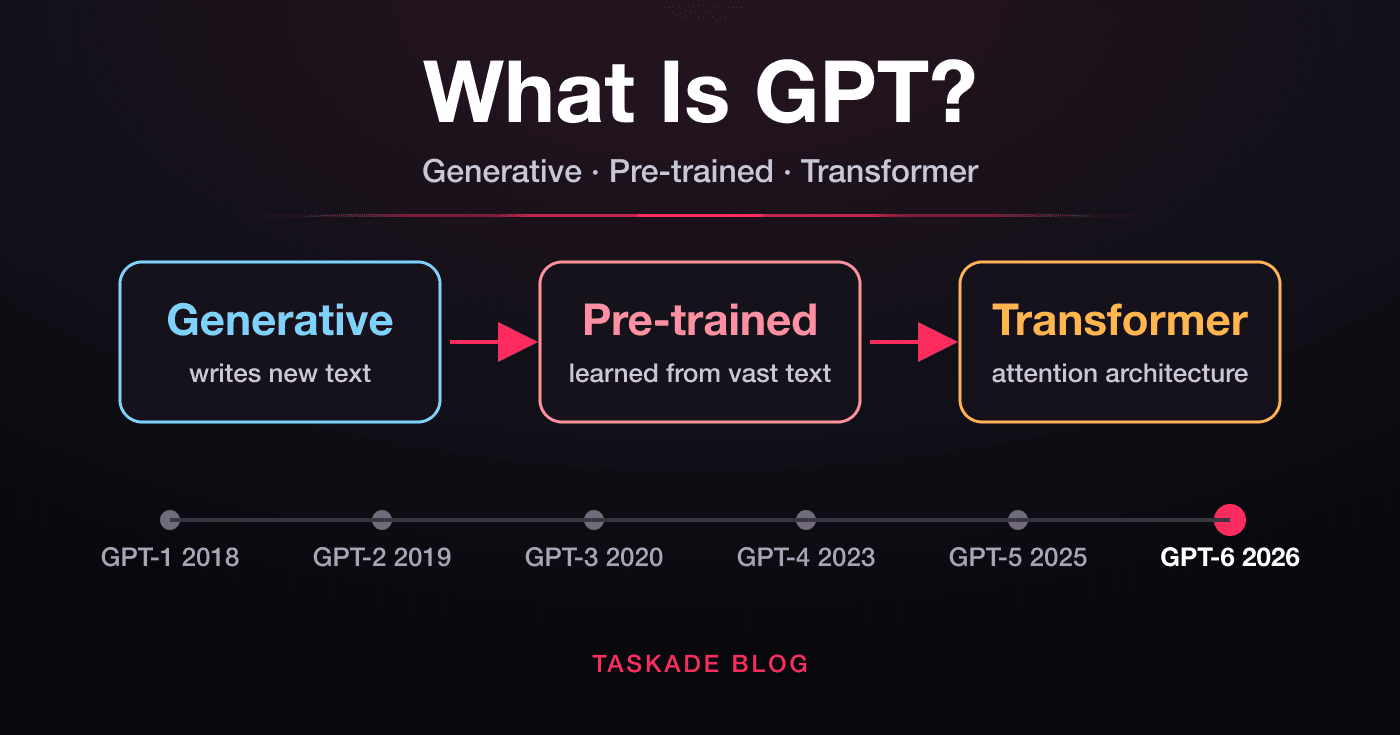
GPT is a large language model that writes text by predicting the next word-piece, one at a time, after learning patterns from a vast amount of text. The name stands for generative pre-trained transformer. In everyday use, GPT also means OpenAI's model family, which started with GPT-1 in 2018 and reached its sixth generation in 2026. ChatGPT is the app built on those models.
Three sentences cover the whole idea:
- It is a language model. It has learned, from enormous amounts of text, how words and ideas tend to follow one another.
- It generates. Given a prompt, it produces a continuation one small piece of text at a time.
- It is general-purpose. The same model can write, summarize, translate, reason through a problem or write code, because all of those are text in, text out.
Current generation (as of September 2026): OpenAI's newest family is GPT-6 — Astra (September 3), Sol and Luna (September 22). See the current generation below for prices, benchmarks and availability.
For the deep mechanics — neurons, attention and training math — read our companion guide, how do large language models work. This guide stays at the level of what GPT is, how it behaves, and how to choose and use it.
🔤 What Does GPT Stand For?
GPT stands for generative pre-trained transformer: generative because it produces new text, pre-trained because it first learns general language from a vast text corpus, and transformer because of the neural network architecture it uses. OpenAI's own documentation describes its text models as "often referred to as generative pre-trained transformers or 'GPT' models for short."
| Letter | Word | What it means | Where it came from |
|---|---|---|---|
| G | Generative | Produces new text rather than only labeling it | The goal of the model: write the next piece |
| P | Pre-trained | Learns general language first, then is adapted to tasks | OpenAI's 2018 paper, Improving Language Understanding by Generative Pre-Training |
| T | Transformer | A neural network design built around "attention" | Google's 2017 paper, Attention Is All You Need |
The key idea is in the P. Before 2018, most language systems were trained from scratch for one job each — one model to classify sentiment, another to answer questions. GPT-1 showed that a single model, first trained to predict text on thousands of unpublished books, could then be adapted to many jobs with far less task-specific data. Every GPT since has kept that recipe and scaled it up.
🗂️ Six Things People Mean by "GPT"
The word "GPT" has at least six common meanings, and most confusion about it comes from mixing them up. Context usually tells you which one is meant.
| When someone says "GPT"… | They mean | Example |
|---|---|---|
| The technology | Any generative pre-trained transformer model | "GPT-style models predict the next token" |
| OpenAI's model family | A specific OpenAI model generation | GPT-4o, GPT-5, GPT-6 Sol |
| ChatGPT | OpenAI's chat app, loosely | "Ask GPT to draft it" |
| Custom GPTs | Assistants built inside ChatGPT (since November 2023) | A custom GPT for company policies |
| gpt-oss | OpenAI's open-weight models (August 2025, Apache 2.0) | gpt-oss-120b, gpt-oss-20b |
| GUID Partition Table | A disk partitioning standard — unrelated to AI | "Convert the drive to GPT" |
Two footnotes explain why the term is so loose. In 2024 the United States Patent and Trademark Office refused OpenAI a trademark on "GPT," finding the letters merely descriptive. OpenAI's brand guidance, in turn, asks others not to use "GPT" in the names of their own apps, products or companies. So "GPT" is both a generic technical term and the name of a specific product line — which is exactly how the confusion starts.
🧩 GPT vs LLM vs ChatGPT: How the Layers Fit
An LLM is the category, GPT is one kind of LLM (and OpenAI's model family), and ChatGPT is the app built on GPT models. Every GPT model is an LLM, but not every LLM is a GPT: Claude, Gemini and open-weight models such as Llama are large language models too.
| LLM | GPT | ChatGPT | |
|---|---|---|---|
| What it is | A category of AI model | One kind of LLM, and OpenAI's model family | An app |
| Made by | Many labs | OpenAI (the brand); many labs build GPT-style models | OpenAI |
| You use it through | An API, an app, or your own hardware | OpenAI's API, ChatGPT, Codex, and partner clouds | Web, desktop and mobile apps |
| Examples | GPT-6, Claude Opus 5.5, Gemini, Llama | GPT-4o, GPT-5, GPT-6 Astra | ChatGPT Free, Plus, Pro, Business |
| Adds on top | — | OpenAI's training and safety work | Memory, files, search, tools, plans |
Is Claude a GPT, then? Not in the everyday sense. Claude is Anthropic's large language model family. It generates text one token at a time like GPT does, but it is a separate model trained by a separate company. Our Anthropic and Claude history covers that lineage, and the open-source LLM history covers the open-weight families.
✍️ How GPT Writes Text, One Token at a Time
GPT writes by repeatedly predicting the next token — a word-piece of about four characters of English — adding it to the text, and predicting again until the answer is done. OpenAI's rule of thumb is that one token is roughly four characters, or three-quarters of a word, in English text.
Three consequences of this loop explain most of what you see when you use GPT:
- Answers appear word by word because the model literally produces them that way. Long answers take longer and cost more, which is why output tokens are priced higher than input tokens.
- The same prompt can give different answers because the model samples from a range of likely next tokens. A setting called temperature controls how adventurous that sampling is.
- The model can be confidently wrong because it predicts plausible text, not verified facts. It has no built-in way to check a claim unless you give it one, such as a document to read or a tool to search.
The explainers on next-token prediction, the tokenizer and tokens go one level deeper; the transformer explainer and our LLM mechanics guide go all the way down.
🏗️ How a GPT Model Is Built: Four Training Stages
Modern GPT models are built in four stages: pre-training on vast text, instruction tuning on examples of good answers, preference tuning from human and AI feedback, and — for the newest models — reinforcement learning that teaches them to reason before they answer. Each stage adds a behavior the one before could not produce.
| Stage | What the model learns | Landmark result |
|---|---|---|
| 1. Pre-training | Language, facts and patterns, by predicting text | GPT-3 was trained on 300 billion tokens (2020) |
| 2. Instruction tuning | To follow instructions instead of just continuing text | Supervised examples written by people |
| 3. Preference tuning | Which answers people prefer | InstructGPT (2022): a 1.3B-parameter tuned model was preferred over the 175B GPT-3 |
| 4. Reasoning training | To work through a problem before answering | OpenAI's o1 (2024) was its first model trained to think before answering |
The third row is one of the most important results in the field. A model with a hundred times fewer parameters beat a much larger one simply because it had been trained to be helpful. Size alone does not make a model useful; alignment does. Our explainer on RLHF and the guide to AI reasoning models cover stages three and four in depth.
📈 What Changes Between GPT Generations
Each GPT generation has added a new kind of ability on top of more scale: GPT-2 and GPT-3 proved that bigger models generalize, GPT-3.5 made them follow instructions, GPT-4 added images, the o-series added reasoning, and GPT-5 and GPT-6 turned the flagship into a family of tiers. The pattern is more durable than any single release.
| Generation | Released | What it added | Scale detail |
|---|---|---|---|
| GPT-1 | June 2018 | Pre-training then adapting one model to many tasks | About 117M parameters; trained on 7,000+ unpublished books |
| GPT-2 | February 2019 | Fluent long-form text; a staged public release | 1.5B parameters; 40GB of web text |
| GPT-3 | May 2020 | Few-shot learning from examples in the prompt | 175B parameters; 300B training tokens |
| GPT-3.5 / ChatGPT | November 2022 | Instruction-following and chat for everyone | ChatGPT launched November 30, 2022 |
| GPT-4 | March 2023 | Images as input; a large jump in reasoning | Parameter count not disclosed |
| GPT-4o | May 2024 | One model for text, audio and vision | Parameter count not disclosed |
| o1 / o3 | September / December 2024 | Thinking before answering | Reasoning trained with reinforcement learning |
| GPT-5 | August 2025 | One flagship with built-in reasoning | 400K-token context |
| GPT-5.x | November 2025 – July 2026 | Rapid updates; three tiers from GPT-5.6 | Up to 1.05M-token context |
| GPT-6 | September 2026 | A new top tier, then cheaper tiers at half price | Astra, Sol and Luna |
GPT-1's parameter count is widely cited as 117M, but the GPT-1 paper itself gives no number; the figure comes from later OpenAI work.
Two research results explain why scale mattered so much. In January 2020, OpenAI's scaling laws paper found that model quality improves predictably as a power law of model size, data and compute. In March 2022, DeepMind's Chinchilla paper refined the recipe: its 70B-parameter model, trained on 1.4 trillion tokens, outperformed much larger models such as the 280B Gopher — implying roughly 20 training tokens per parameter for compute-efficient training. Since then, labs have competed less on raw size and more on data, training methods and efficiency.
The context window — how much text the model can read at once — shows the same arc:
GPT-3 read about 2,000 tokens at a time; GPT-5.4 and every GPT-6 model read about 1.05 million. GPT-5 dipped to 400,000 after GPT-4.1's million, a reminder that each generation trades context, speed and cost differently. For the full release-by-release catalog, see ChatGPT models explained; for the company story behind it, the history of OpenAI.
🎚️ Why Every Generation Now Ships in Tiers
Every major lab now releases its models as a family of tiers — a frontier model for the hardest work, a workhorse for most work, and a fast, cheap model for volume — because most work does not need the most expensive model. The tiers usually share one training recipe, and the smaller ones are often distilled from the larger.
| Lab | Frontier tier | Workhorse tier | Fast tier |
|---|---|---|---|
| OpenAI (GPT-6) | Astra — $10 / $50 | Sol — $2 / $10 | Luna — $0.10 / $0.50 |
| Anthropic (Claude) | Fable 5.1 — $10 / $50 · Opus 5.5 — $4 / $20 | Sonnet 5 — $2 / $10 | Haiku 4.5 — $1 / $5 |
| Google (Gemini) | Pro | Flash | Flash-Lite |
Input / output price per million tokens from each vendor's pricing page, September 2026. Google tier names shown without prices.
The economics are the reason. Within one family the quality gap between tiers is usually a few points on a benchmark, while the price gap can be 20× to 100×. Model distillation and mixture-of-experts designs are two of the techniques that make the smaller tiers cheap to serve. Choosing the right tier, not the "best" model, is where most of the savings in AI work come from. To see how the families compare head to head, read GPT vs Claude and Gemini vs GPT.
🌟 The Current Generation: GPT-6 Astra, Sol, and Luna (September 2026)
Facts in this section were checked on 22–24 September 2026 against OpenAI's announcements, model pages and pricing page. It is refreshed at each release.
GPT-6 is OpenAI's sixth-generation family: GPT-6 Astra, released September 3, 2026, and GPT-6 Sol and GPT-6 Luna, released September 22, 2026 at half the price or less of the GPT-5.6 Sol and Luna tiers they replace. OpenAI calls Astra "the world's most intelligent and aligned model" and says it trained Sol and Luna "with similar methods as GPT-6 Astra."
| GPT-6 Astra | GPT-6 Sol | GPT-6 Luna | |
|---|---|---|---|
| Role (OpenAI's words) | "Most capable" | "Complex coding and agentic workflows" | "Most efficient" |
| API ID | gpt-6-astra |
gpt-6-sol |
gpt-6-luna |
| Price per 1M (in / cached / out) | $10 / $1 / $50 | $2 / $0.20 / $10 | $0.10 / $0.01 / $0.50 |
| Context / max output | 1.05M / 128K | 1.05M / 128K | 1.05M / 128K |
| Knowledge cutoff | April 30, 2026 | April 20, 2026 | May 18, 2026 |
Astra is also the first OpenAI model rated Critical in cybersecurity under OpenAI's Preparedness Framework, which is why OpenAI delayed parts of its release. GPT-6 Astra Pro (listed in ChatGPT as "GPT-6 Pro") is available on the Pro, Business and Enterprise plans.
How the three tiers score. On OpenAI's own charts, Astra leads every benchmark in the Sol and Luna announcement, Sol trails by a few points at a fraction of the cost, and Luna trails further at a sliver of it:
| Benchmark | GPT-6 Astra | GPT-6 Sol | GPT-6 Luna |
|---|---|---|---|
| FrontierCode (agentic coding, max effort) | 53.3% · $4.59/task | 49.3% · $2.14/task | 42.4% · $0.11/task |
| DeepSWE v1.1 (software engineering) | 74.1% (xhigh) | 68.8% | 66.6% · $0.22/task |
| OSWorld 2.0 (computer use) | 73.5% | 64.4% | 52.7% |
| Agents' Last Exam (professional workflows) | 59.3% | 56.4% | — |
| Factual error rate (lower is better) | 3.9% | 4.6% | 7.6% |
From Luna to Astra the score rises 11 points while the cost per task rises 42×. That single fact is the best argument for choosing a tier per task instead of one model for everything.
Where GPT-6 is not better than GPT-5.6. GPT-6 is a price-performance release, not a clean upgrade on every axis. On OpenAI's own charts, GPT-6 Sol scores below GPT-5.6 Sol on DeepSWE (68.8% vs 72.7%) and OSWorld 2.0 (64.4% vs 66.2%), and Artificial Analysis measured it lower on GDPval-AA (1,487 vs 1,588 Elo). Its gains are in price, factuality and speed.
How it compares with Claude. Anthropic released Claude Opus 5.5 the same morning as Sol and Luna. On Anthropic's table, Opus 5.5 scores 66.4% on Terminal-Bench 4.0 against GPT-6 Astra's 57.9%, and Artificial Analysis ranks it first on its Intelligence Index at max effort (58 against Astra's 53) — at $4/$20 per million tokens, 60% below Astra. GPT-6 Astra leads narrowly on AutomationBench (41.4% vs 40.0%), and Sol and Luna undercut every Claude model on price. Each lab reports its own numbers on its own test setup, so treat gaps of a few points as noise.
What hands-on testers found. In Arena AI's side-by-side runs, GPT-6 Sol finished a 3D scene in 11 minutes that took GPT-5.6 Sol about an hour. In a 15-task field test, Nate Herk found GPT-6 Astra won 10 of 15 tasks against Claude Fable 5.1 and cost $186 less in total, while taking 1 hour 43 minutes longer. Both are single-run field reports, not benchmarks.
❓ Why There Is No GPT-6 Terra
OpenAI has not announced a GPT-6 Terra: the GPT-5.6 generation shipped as Luna, Terra and Sol, but GPT-6 launched as Astra, Sol and Luna. Neither GPT-6 announcement mentions Terra, and OpenAI's pricing page lists only gpt-5.6-terra.
The likely reason is price. GPT-6 Sol costs $2 per million input tokens — the same as GPT-5.6 Terra — and $10 per million output tokens, less than Terra's $12. Sol already covers the middle of the range, so a new Terra would have little room to sit in. The pattern is worth remembering for future launches: a lab fills the tiers its prices leave open, not a fixed set of names.
🧠 Reasoning Effort: The Thinking Dial
Reasoning effort is the setting that controls how long a GPT model thinks before it answers — typically none or low, medium, high, and one or two higher levels — and it is the biggest quality-and-cost dial most users control. Reasoning tokens are billed as output tokens even though you do not see them, so more thinking always costs more.
| Effort | What the model does | Good for |
|---|---|---|
| None / low | Answers quickly with little planning | Formatting, extraction, routing |
| Medium | Plans briefly and checks key steps | The default for most real work |
| High | Plans in depth and tests more cases | Complex coding and analysis |
| xhigh / max | Explores alternatives and re-checks heavily | The hardest problems |
On GPT-6, Sol and Luna accept none through max and default to medium; Astra accepts low through max. The returns fall steeply: GPT-6 Sol scores 45.9% on FrontierCode at medium effort for $0.80 a task and 49.3% at max for $2.14, so the last 3.4 points cost 2.7× more. Start at medium and move up only when a check you can measure fails. Our AI cost per task guide measures this curve across models, and the reasoning effort explainer covers the mechanics.
📏 Context Windows: What Fits in One Request
A context window is the maximum amount of text — prompt, documents, conversation history and answer — a model can consider in one request, measured in tokens. Every GPT-6 model accepts about 1.05 million tokens, roughly the length of several long novels, with up to 128,000 tokens of output.
A large window is not the same as a cheap or reliable one. Three rules keep long contexts useful:
- Price changes past a threshold. On GPT-6, a request with more than 272,000 input tokens is billed at 2× input and 1.5× output for the whole request.
- Repeated beginnings are cheap. Prompt caching bills a repeated prompt prefix at about a tenth of the fresh price, so put stable instructions and documents first.
- More text is not always better recall. Models can miss details buried in very long inputs. Give the model the relevant passage rather than the whole library — the idea behind retrieval, covered in our LLM vs RAG vs agents guide.
The context window and KV cache explainers cover the mechanics, and our context engineering guide covers the practice.
💵 Price per Token vs Cost per Task
Price per token is what a vendor charges; cost per task is what finished work actually costs, after you multiply the price by the tokens a model uses and the attempts it needs. The second number is the one that matters, and it can flip rankings.
A clear example from September 2026: Claude Opus 5.5's tokens cost 60% less than GPT-6 Astra's, yet at max effort it spent about 4.4× as many output tokens per task on Artificial Analysis's index, so it cost $5.98 per task against Astra's $3.26. At its default medium effort, Opus 5.5 cost $1.34 per task. The price list alone would have pointed the wrong way twice.
cost per task = price per token × tokens per attempt × attempts per accepted result
For the formula line by line, the hidden multipliers and a 20-task test to measure your own number, read AI cost per task. For tactics once you know it, see how to reduce LLM costs.
🧭 How to Choose a GPT Model (or Any LLM)
Choose by the cost of a wrong answer and the volume of work, not by the newest name: fast tiers for high-volume, checkable work, workhorse tiers at medium effort for most work, and frontier tiers only when a mistake is expensive. The same rule works for GPT, Claude, Gemini or open-weight models.
| Use case | Tier | GPT-6 example (Sept 2026) | Why |
|---|---|---|---|
| Tagging, routing, extraction at scale | Fast | Luna, low → medium | Cheap, checkable, high volume |
| Sub-steps inside an agent | Fast | Luna, medium | 66.6% on DeepSWE for $0.22 a task |
| Writing, analysis, research summaries | Workhorse | Sol, medium | 4.6% factual error rate at max |
| Everyday coding and automations | Workhorse | Sol, medium → high | 45.9–49.3% FrontierCode at $0.80–$2.14 |
| Computer use and browser tasks | Frontier | Astra, medium | 73.5% on OSWorld 2.0 |
| Legal, financial, security-sensitive work | Frontier | Astra, high | Lowest error rate; verify every output |
Two habits make any choice safer: start one tier lower than your instinct, and keep a check at the end of anything that matters — a cheaper model plus a second pass often beats an expensive model's first draft. If you build apps rather than call APIs, our guide to the best AI model for building apps and the TSK-1 benchmark show how nine models handled the same build.
⚠️ What GPT Still Gets Wrong: Hallucinations, Cutoffs, and Bias
GPT models still state false things with confidence, know nothing after their knowledge cutoff unless given it, and reflect biases in their training data — and every generation reduces these problems without removing them. Knowing the failure modes is what makes the model safe to rely on.
| Limitation | What it looks like | What helps |
|---|---|---|
| Hallucination | A fluent, specific, wrong answer | Give the model a source to read; ask it to cite; check key claims |
| Knowledge cutoff | Missing or outdated facts about recent events | Retrieval or web search; state the date in the prompt |
| Bias | Skewed defaults in examples, tone or judgments | Clear instructions, diverse examples, human review |
| Instruction drift | Long tasks that wander from the brief | Short steps, explicit checklists, a final check |
The numbers show real progress and a clear limit. On OpenAI's test of difficult prompts, GPT-6 Sol's share of answers with any factual error fell from 8.5% to 4.6% compared with GPT-5.6 Sol, and Astra reached 3.9%. But GPT-6 Luna at low effort still made factual errors on 27.7% of the same prompts. Fast settings are fine for formatting and routing; for facts, give the model the facts.
One oddity from the current generation is worth remembering: the cheapest GPT-6 model has the latest knowledge cutoff (Luna, May 18, 2026, versus April for Sol and Astra). Newer is not always bigger. The AI hallucinations explainer goes deeper.
🌍 Where You Use GPT: ChatGPT, the API, and Apps
You can use GPT models in three ways: in OpenAI's ChatGPT app, through OpenAI's API and developer tools, or inside other products built on them. Which models you get depends on the surface and the plan. If you are choosing between chat apps rather than models, Claude vs ChatGPT compares the two.
| Surface | Who it is for | GPT-6 availability (Sept 2026) |
|---|---|---|
| ChatGPT | Everyone | Astra in Chat on Pro; Astra in Work and Codex on Plus; Sol and Luna in Work and Codex on paid plans; Luna in the desktop app on Free and Go |
| OpenAI API | Developers | gpt-6-astra, gpt-6-sol, gpt-6-luna |
| Codex | Software teams | Astra, Sol and Luna on paid plans |
| GitHub Copilot | Developers | Sol on Pro+ and above; Luna on Pro and above |
| Microsoft Azure, Amazon Bedrock | Enterprises | Astra announced for both |
| Apps built on the API | Everyone | Depends on each product |
The third way — products built on top of the models — is where most people will meet GPT-class models from now on, often without choosing one. That is the problem Taskade is built around. Taskade gives you 15+ frontier models from OpenAI, Anthropic, and open-weight providers in one workspace. Auto handles the default model choice, and you can still pin a specific model to any AI agent when a task needs it.
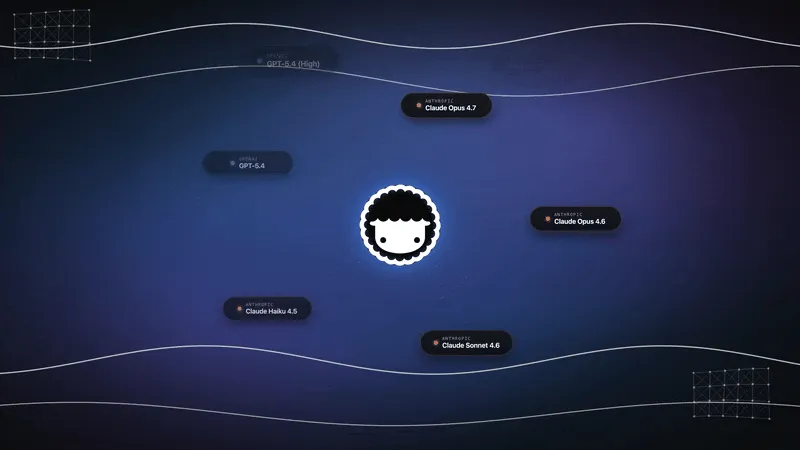
The model is only one layer of a working system. With Taskade Genesis, one prompt builds a live app with its own data, AI agents and automations — Workspace DNA, where projects remember, agents think, and automations execute. The model underneath can change without your app changing with it.
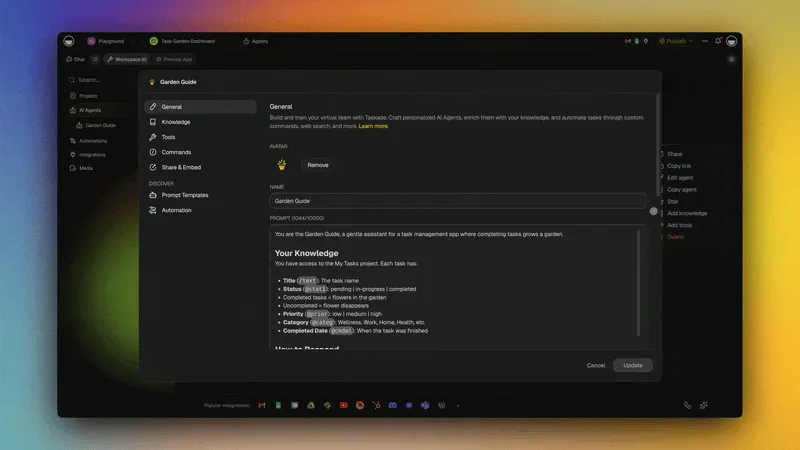
Browse live community apps to see what people build, compare the free AI app builders, or create your first app.
🔭 How to Read the Next GPT Launch
Every GPT launch can be read with the same eight questions, and they matter more than the headline benchmark. Keep this checklist; it will outlive every model named on this page.
| Question | Why it matters |
|---|---|
| Which tier is this — frontier, workhorse or fast? | Compare like with like, not a new fast model with an old flagship |
| What is the price per token, including cached input? | Caching often decides the real bill |
| What does one task cost at medium effort? | Cost per task, not per token, is what you pay |
| Which benchmarks, which versions, whose setup? | Vendor charts favor the vendor; index versions change scales |
| What got worse? | Every release trades something; look for the regressions |
| What is the context window and the long-context price rule? | A big window can come with a price cliff |
| What is the knowledge cutoff? | Newer models are not always more current |
| Where is it available, and on which plans? | A model you cannot reach in your tools does not help you |
Apply it to GPT-6 and the story is clear: cheaper tiers at half price, better factuality, faster finishes, and slightly weaker scores than GPT-5.6 Sol on two agentic benchmarks. Apply it to the next launch and you will read it just as quickly.
💬 Frequently Asked Questions About GPT
What is GPT?
GPT is a large language model that writes text by predicting the next word-piece, one at a time, after learning patterns from vast amounts of text. The name stands for generative pre-trained transformer, and in everyday use it also means OpenAI's model family, now in its sixth generation.
What does GPT stand for?
Generative pre-trained transformer. Generative: it produces new text. Pre-trained: it first learns general language from a huge corpus. Transformer: the neural network architecture it uses, introduced in the 2017 paper Attention Is All You Need.
What is the difference between GPT and an LLM?
An LLM is the whole category of large language models. GPT is one kind of LLM and, in everyday speech, OpenAI's model family. Every GPT is an LLM, but Claude, Gemini and Llama are LLMs that are not GPTs.
What is the difference between GPT and ChatGPT?
GPT is the model; ChatGPT is the app. OpenAI's GPT models power ChatGPT, which adds a chat interface, memory, files, search, tools and plans. Developers can use GPT models directly through the API.
Is Claude a GPT?
No. Claude is Anthropic's large language model family. It works in a broadly similar way — generating text one token at a time — but it is a separate model from a separate company. In 2024 the USPTO refused OpenAI's application to trademark the letters, finding them merely descriptive.
What is GPT-6?
OpenAI's sixth-generation family: GPT-6 Astra (September 3, 2026, $10/$50 per million tokens), GPT-6 Sol ($2/$10) and GPT-6 Luna ($0.10/$0.50), both released September 22, 2026. All three accept about 1.05 million tokens of context.
Is there a GPT-6 Terra?
No. GPT-6 launched as Astra, Sol and Luna. GPT-6 Sol already costs the same per input token as GPT-5.6 Terra and less per output token.
How does GPT work?
It splits text into tokens, predicts the most fitting next token again and again, and was trained in stages: pre-training on vast text, instruction tuning, preference tuning, and for newer models, reasoning training. Our guide to how LLMs work covers the mechanics.
What is gpt-oss?
OpenAI's open-weight models, released August 5, 2025 as gpt-oss-120b and gpt-oss-20b under the Apache 2.0 license. Anyone can download and run them on their own hardware.
What are custom GPTs?
Assistants people build inside ChatGPT by giving a GPT model instructions, files and tools, without code. OpenAI introduced them in November 2023. They are configurations of OpenAI's models, not separate models.
Why do GPT models come in different sizes and tiers?
Because most work does not need the most expensive model. Labs release a frontier model plus cheaper tiers built with similar methods; the quality gap is usually a few points, while the price gap can be 100×.
How do I choose between GPT and other AI models without re-testing every release?
Use a tool that routes work across models for you. Taskade gives you 15+ frontier models from OpenAI, Anthropic, and open-weight providers in one workspace, with Auto handling the default and per-agent model choice when you need it. Try it free →
🔗 Related Reading
- How Do Large Language Models Work? Transformers Explained
- ChatGPT Models Explained: Every Version
- What Is OpenAI? The Complete History
- AI Cost per Task: What AI Work Really Costs
- Anthropic and Claude History
- AI Reasoning Models Explained
- The History of Open-Source LLMs
- LLM vs RAG vs AI Agent vs Agentic AI
- What Are AI Agents?
- Large Language Models · Transformer · Inference Cost
GPT began as a bet that one pre-trained model could learn many jobs. Six generations later, the bet has become a family of tiers, a thinking dial and a price list that changes every season. Learn the patterns once — tiers, effort, context, cost per task — and every new release becomes easy to read. ▲ ■ ●