






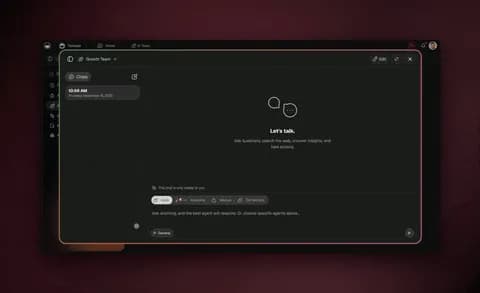
import IFrame from '@/components/ui/IFrame';
TL;DR: Taskade Genesis ranks first among 2026 multi-agent platforms because it ships a multi-agent workspace, memory, agents, and workflows together, without code. CrewAI, AutoGen, and LangGraph are developer-only Python frameworks. Taskade includes the runtime, the UI, the integration layer, and 100+ bidirectional integrations. Clone a working multi-agent app below in about 30 seconds. Build a multi-agent system free →
▲ ■ ● This is live. Click "Use this app" inside the iframe to clone a working multi-agent system into your free workspace.
Compare with: need a single agent instead of a team? See how to build a custom AI agent from scratch or AI agent platforms ranked by deployment and workforce features.
Multi-Agent Workspace: Memory, Agents, Workflows
The best multi-agent platform in 2026 is Taskade Genesis, the only one that gives you a running multi-agent workspace, not a Python script you still have to host. You describe a team of agents in plain language, EVE (the Taskade meta-agent) spins them up, and they share one memory, coordinate through orchestration mode, and trigger real work across 100+ integrations. Clone a working one in about 30 seconds.
That "workspace, not a script" difference is the Workspace DNA loop: Memory (your Projects) feeds Intelligence (your agent team), Intelligence triggers Execution (your automations and integrations), and Execution writes new state back into Memory. CrewAI, AutoGen, and LangGraph give you the Intelligence layer and leave you to build Memory and Execution yourself.
Clone a Working Multi-Agent App Right Now
You do not have to build from a blank prompt. Each app below is a live, published Genesis app, open it, click Use this app, and a running copy lands in your free workspace. Customize the agents, tools, and integrations for your own workflow.

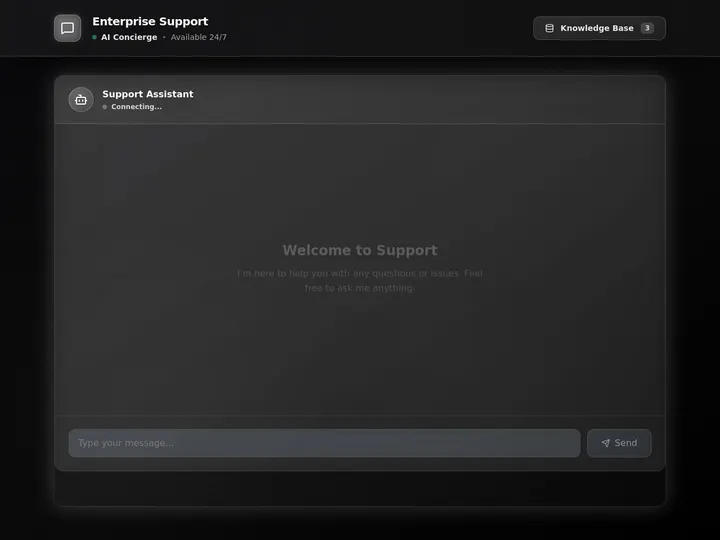
The Sales Agent Studio runs a lead-qualifier, a follow-up writer, and a CRM-updater as one coordinated team. The Support Agent triages incoming messages, drafts answers from your docs, and routes anything it can't resolve. Both are the multi-agent pattern that no OSS framework ships ready-to-run, clone either and watch the agents coordinate.
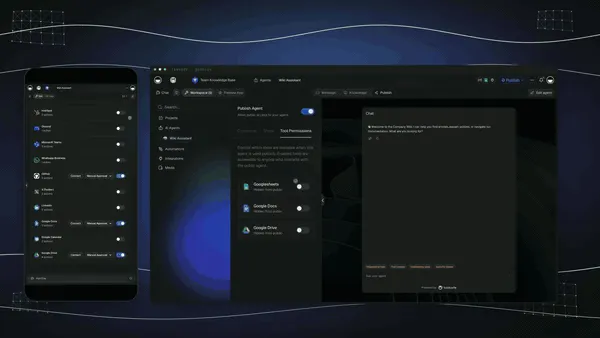
The view above shows agents reaching for the built-in tools, web search, file analysis, code execution, integration actions, inside a live workflow. This is what "agents with tools" looks like when the runtime is already built for you.
How EVE Delegates to a Sub-Agent Team
When you ask for a multi-agent system, you do not wire the orchestration by hand. EVE decomposes the goal, spins up specialist sub-agents, scopes each one's tools, and integrates their results. Then triggers the workflow that ships the outcome.
This is the loop the Python frameworks make you assemble: in CrewAI or AutoGen you write the delegation, the tool scoping, the memory store, and the integration wiring. In Taskade Genesis it is the substrate, describe the outcome and the team runs.
What Makes a Multi-Agent Platform "Best" in 2026?
The multi-agent category in 2026 is dominated by open-source Python frameworks (CrewAI, AutoGen, LangGraph, OpenAI Swarm) and cloud vendor platforms (Google Vertex AI Agent Builder, AWS Bedrock Agents, Azure AI Studio). These tools are designed for AI engineers building production pipelines. They require Python expertise, self-hosting (for OSS) or vendor lock-in (for cloud), and substantial engineering work to make production-grade.
The category gap is "what about non-developers and teams that just want multi-agent workflows running?" That gap is what Taskade fills. Multi-agent collaboration is built into the platform, configure agents in the UI, assign roles and tools, run orchestration mode, and the system handles delegation, state management, and reliability.
The ranking weighs seven dimensions: ease of use (does a non-developer build a working system?), persistent memory across agents, integration depth, orchestration patterns supported, total cost at production scale, reliability infrastructure (retry, durable execution), and observability (can you debug a multi-agent run?).
┌─────────────────────────────────────────────────────────────────┐
│         Multi-Agent Platform Category Split                     │
├─────────────────────────────────────────────────────────────────┤
│                                                                 │
│  DEVELOPER FRAMEWORKS         PRODUCTION PLATFORM               │
│  ──────────────────────       ──────────────────────            │
│  Python code required         Configure in UI                   │
│  Self-host or cloud lock-in   Hosted runtime                    │
│  Build your own UI            UI built in                       │
│  Wire integrations yourself   100+ native integrations          │
│  Build reliability layer      Durable retry included            │
│                                                                 │
│  CrewAI · AutoGen             Taskade                           │
│  LangGraph · OpenAI Swarm     (only no-code entry)              │
│  Vertex · Bedrock · Azure                                       │
│                                                                 │
└─────────────────────────────────────────────────────────────────┘
The 10 Multi-Agent Platforms Ranked
1. Taskade: Best No-Code Multi-Agent Platform
Verdict: The only no-code production-ready multi-agent platform. Configure agents through the UI, run orchestration mode, ship to customers via public embedding. Top pick for teams that want multi-agent workflows running without an engineering team.
Taskade AI Agents v2 is built around multi-agent collaboration as a first-class primitive, not an extension. Every agent has persistent memory stored as real Taskade Projects (a projects/memories folder per agent). Every agent has access to built-in tools (web search, code execution, file operations, integration actions). Every agent can call other agents, define a coordinator agent that delegates to specialist agents, or define a flat crew where agents negotiate among themselves.
The orchestration mode added in 2025 lets you run a multi-agent workflow with one prompt. The coordinator agent decomposes the task, dispatches sub-tasks to specialists, and integrates the results. Each agent's tool access can be scoped (public agents have internal-integration filtering and public-agent opt-out tool controls). Custom tools are added via Custom Bash Commands.
The integration layer is what makes multi-agent systems useful in production. Agents trigger automations across 100+ bidirectional integrations, a research agent's output triggers a Slack post, a Gmail follow-up, a Salesforce update, a Stripe checkout session. All durable, all retryable, no glue code.
Pricing: Free $0 · Pro $10/mo (10 seats, billed annually) · Business $25/mo (unlimited) · Max $100/mo · Enterprise $250/mo. Multi-agent collaboration included at every tier, starting with Free.
Where it wins: No-code UI, persistent agent memory, built-in tools, 100+ integrations, durable runtime, public embedding.
Where it has ceilings: If you need millisecond-level latency or exotic orchestration patterns (graph cycles, custom retry logic), the developer frameworks have more control surface.
2. CrewAI: Best Role-Based Multi-Agent Framework
Verdict: Most popular Python framework for role-based agent crews. Strong abstractions for hierarchical agent teams. Requires development work to productionize.
CrewAI (by João Moura) is the Python framework that popularized the "crew of specialized agents" pattern. You define agents with roles ("Senior Researcher", "Technical Writer", "Reviewer"), goals, and tool access. You define tasks with descriptions and expected outputs. The crew runs sequentially or hierarchically.
CrewAI's strength is the abstraction quality. The Agent / Task / Crew model is intuitive and maps cleanly to how humans think about specialist teams. The community is large, the docs are good, and the GitHub stars (50k+) reflect genuine adoption among AI engineers.
The ceiling is the lifecycle gap. CrewAI gets you to a working multi-agent script. To productionize, you build the API layer, the UI, the integration layer, the auth, the persistence, the observability, everything around the framework. For a team with AI engineers, that work is feasible. For a non-developer team, CrewAI is not the right starting point.
Pricing: Free (open source). LLM API costs are yours. Enterprise tier (CrewAI Enterprise) starts at custom pricing.
Where it wins: Role-based abstraction, large community, Python ecosystem.
Where it has ceilings: Developer-only, no built-in UI, no integration layer, self-hosting required.
3. Microsoft AutoGen: Best Conversational Multi-Agent Framework
Verdict: Strong framework for conversational multi-agent patterns where agents negotiate. Backed by Microsoft Research. Same productionization ceiling as CrewAI.
AutoGen (by Microsoft Research) frames multi-agent systems as conversations between agents. Agents have roles, tools, and termination conditions. They send messages to each other; the conversation continues until a termination condition is met. The pattern works well for tasks like code generation where one agent writes, another reviews, and they iterate until both agree the code is correct.
AutoGen Studio (the GUI) provides a no-code surface for defining agents and running them, closer to what Taskade does, but rougher and developer-oriented. The underlying framework is more mature than the GUI.
Pricing: Free (open source). Azure OpenAI or external LLM API costs are yours.
Where it wins: Conversational patterns, Microsoft Research backing, AutoGen Studio GUI experiment.
Where it has ceilings: Developer-oriented, GUI is experimental, productionization is your job.
4. LangGraph: Best Graph-Based Orchestration
Verdict: Powerful graph-based orchestration framework from the LangChain team. Strong for production AI pipelines. Steepest learning curve.
LangGraph models multi-agent workflows as state graphs, nodes are agents or tool calls, edges are transitions, state is the workflow's working memory. The model is more general than CrewAI's crew abstraction and more controlled than AutoGen's conversation abstraction. For production AI pipelines with branching, cycles, and human-in-the-loop steps, LangGraph is the most expressive.
The cost of expressiveness is learning curve. You think in graph terms, you debug in graph terms, and you ship in graph terms. For teams already invested in LangChain, LangGraph is the natural extension. For teams new to multi-agent, the graph model is a meaningful upfront investment.
Pricing: Free (open source). LangSmith (the observability platform) is paid. LLM API costs are yours.
Where it wins: Graph expressiveness, integration with LangChain ecosystem, LangSmith observability.
Where it has ceilings: Steep learning curve, developer-only, productionization is your job.
5. OpenAI Swarm: Best Lightweight OpenAI-Native Framework
Verdict: Minimalist multi-agent framework from OpenAI. Strong for OpenAI-only stacks. Limited scope by design.
OpenAI Swarm (released as an educational reference in late 2024) is OpenAI's minimal framework for multi-agent patterns built on top of the OpenAI API. The core abstraction is "handoffs", agents can hand off the conversation to other agents with context. The codebase is small and readable; it is closer to a teaching tool than a production framework.
For OpenAI-only stacks and prototyping, Swarm is approachable. For production deployments, the lack of features around persistence, observability, and reliability makes Swarm a starting point rather than a finishing point.
Pricing: Free (open source). OpenAI API costs are yours.
Where it wins: Minimal and readable codebase, OpenAI-native.
Where it has ceilings: Educational by design, OpenAI lock-in, missing production features.
6. Google Vertex AI Agent Builder: Best for Google Cloud Shops
Verdict: Managed multi-agent platform on Google Cloud. Strong if you already run on GCP. Heavy lock-in.
Vertex AI Agent Builder is Google's managed multi-agent platform. It integrates with Gemini models, Vertex Search, and the broader Google Cloud ecosystem. For shops already on GCP, the integration is convenient, your data, your auth, your billing are already there.
The lock-in is significant. Agent definitions are tied to Vertex; moving to another platform is a rewrite. Pricing is consumption-based and can be hard to predict. The UI is improving but still feels developer-oriented.
Pricing: Pay-as-you-go (token-based). Enterprise contracts available.
Where it wins: GCP integration, managed runtime, Gemini access.
Where it has ceilings: GCP lock-in, complex pricing, less mature than the alternatives.
7. AWS Bedrock Agents: Best for AWS Shops
Verdict: Managed multi-agent platform on AWS. Strong if you already run on AWS. Same lock-in concerns as Vertex.
Bedrock Agents is AWS's managed multi-agent platform. It integrates with Anthropic Claude (via Bedrock), Mistral, Cohere, and AWS services (Lambda for actions, S3 for storage). For AWS shops, the integration depth is meaningful, your IAM, your VPC, your billing are unified.
Same lock-in trade-off as Vertex. Agent definitions are AWS-specific. Pricing combines per-invocation costs with model token costs. The console UI is functional but oriented to AWS engineers.
Pricing: Pay-as-you-go (per invocation + model tokens). Enterprise contracts.
Where it wins: AWS integration, model variety (Claude, Mistral, Cohere via Bedrock), Lambda actions.
Where it has ceilings: AWS lock-in, complex pricing, engineer-oriented UI.
8. Microsoft Azure AI Studio (Multi-Agent): Best for Microsoft Shops
Verdict: Managed multi-agent platform on Azure. Strong if you already run on Azure with M365. Familiar Microsoft DX.
Azure AI Studio extends with multi-agent capabilities backed by AutoGen and Azure OpenAI. For Microsoft 365 shops, the integration with Teams, SharePoint, and Power Platform is real. The DX is familiar to .NET and Microsoft developers.
Same managed-vendor trade-off. Azure-specific definitions, Azure-specific pricing, Azure-specific observability.
Pricing: Pay-as-you-go. Enterprise contracts via Microsoft.
Where it wins: Microsoft 365 integration, AutoGen backing, .NET DX.
Where it has ceilings: Azure lock-in, complex pricing, engineer-oriented.
9. Flowise: Best Open-Source No-Code (Visual)
Verdict: Open-source visual builder for LangChain-style flows. Approachable for non-developers. Self-hosted only.
Flowise is an open-source no-code visual builder for LangChain workflows including multi-agent patterns. You drag nodes onto a canvas, connect them, and run the flow. For developers who want a visual interface over LangChain, Flowise is the natural pick.
The trade-off is self-hosting. You run the Flowise instance, manage the database, handle scaling, and build any production features yourself. The UI is approachable but the surrounding infrastructure work is real.
Pricing: Free (self-hosted). Cloud option in early access. LLM API costs are yours.
Where it wins: Visual canvas, open source, LangChain compatibility.
Where it has ceilings: Self-hosted, no managed runtime, smaller ecosystem.
10. Relevance AI: Best Vertical-Focused Agent Builder
Verdict: Managed agent builder focused on sales and customer ops verticals. Strong vertical templates. Smaller ecosystem.
Relevance AI is a managed multi-agent platform aimed at sales and customer operations use cases. The vertical templates (sales SDR agents, customer success agents) are useful starting points. The UI is friendly to non-developers.
The vertical focus is the strength and the ceiling. For sales and customer ops, Relevance is purpose-built. For broader use cases, the surface area is narrower than Taskade or the open-source frameworks.
Pricing: Pro $19/mo · Team $199/mo · Enterprise custom.
Where it wins: Sales/CS vertical templates, friendly UI for non-developers.
Where it has ceilings: Vertical focus, smaller integration library, smaller community.
Pricing Wedge: Production Multi-Agent at 10 Users
The pricing comparison for multi-agent platforms is uniquely tricky because open-source frameworks have zero license cost but real infrastructure cost. The table below estimates all-in annual cost for a team running production multi-agent workflows at modest scale (1M token/day workload, 10 team users).
| Tool | License | Infrastructure | LLM API | All-in / year |
|---|---|---|---|---|
| Taskade Pro | $10/mo flat for 10 seats | Included | Included (15+ models) | $120/year |
| CrewAI (OSS) | Free | Self-host ~$2,400/year | OpenAI API ~$3,000/year | ~$5,400/year |
| AutoGen | Free | Self-host ~$2,400/year | OpenAI API ~$3,000/year | ~$5,400/year |
| LangGraph | Free | Self-host ~$2,400/year | LangSmith $300 + API ~$3,000 | ~$5,700/year |
| OpenAI Swarm | Free | Self-host ~$1,200/year | OpenAI API ~$3,000/year | ~$4,200/year |
| Vertex AI Agent Builder | Per-token | Managed (included) | ~$5,000/year | ~$5,000/year |
| AWS Bedrock Agents | Per-invocation | Managed (included) | ~$5,000/year | ~$5,500/year |
| Flowise (OSS) | Free | Self-host ~$1,800/year | API ~$3,000/year | ~$4,800/year |
| Relevance AI Team | $199/mo | Managed | Included up to limits | ~$2,388/year |
Taskade Pro at $10/mo for 10 seats includes the multi-agent runtime, 15+ frontier models, persistent memory, and 100+ bidirectional integrations. The OSS frameworks are "free" until you account for the infrastructure to run them in production, at which point Taskade is 35-47x cheaper for a team of 10.
When to Pick Which: Decision Matrix
| Your situation | Best pick | Why |
|---|---|---|
| Non-developer team, production multi-agent now | Taskade | No code, hosted runtime, integration layer |
| AI engineering team, custom production pipeline | CrewAI / LangGraph | Maximum control, Python ecosystem |
| Need conversational agent negotiation | AutoGen | Best abstraction for conversations |
| OpenAI-only experimental prototype | OpenAI Swarm | Minimal, readable, learn the patterns |
| GCP shop with Vertex investment | Vertex AI Agent Builder | Native GCP integration |
| AWS shop with Bedrock investment | Bedrock Agents | Native AWS integration |
| Microsoft shop with M365 | Azure AI Studio | M365 integration |
| Visual canvas preference, self-hosted OK | Flowise | OSS visual builder |
| Sales/CS vertical, want templates | Relevance AI | Vertical-purpose templates |
| Public-facing agent embed for customers | Taskade | Public embedding + tool controls built in |
Multi-Agent Orchestration Patterns
The three canonical multi-agent patterns are:
Coordinator + Specialists, one agent decomposes the task and delegates to specialists. Each specialist has focused tools and bounded context. Best for tasks where the decomposition is clear (research → write → review).
Sequential Pipeline, agents pass state through a fixed pipeline. Each agent transforms the state and passes to the next. Best for well-defined workflows like data processing.
Negotiation, agents converse until they agree on a conclusion. Best for tasks where neither agent has the complete picture (e.g., one agent proposes, one critiques, iterate).
Taskade supports all three patterns through the orchestration mode and agent-to-agent calls. CrewAI excels at the first pattern. AutoGen excels at the third. LangGraph supports all three but requires you to model them explicitly as graphs.
Workspace DNA: Multi-Agent Through the Loop
The loop is what differentiates Taskade multi-agent from a Python framework script. In CrewAI or AutoGen, agents run and produce output; the loop back into Memory is your job to wire. In Taskade, the loop is the substrate, agents read from Projects, write to Projects, and Projects feed the next agent run.
The compounding effect is real. Every multi-agent run leaves traces in Memory. The next run starts with better context. The workspace gets smarter over time.
What an Operator Ships With a Multi-Agent Workspace
The clearest proof that a multi-agent workspace beats a framework is what one person can ship with it. Taskade's first self-serve Enterprise customer, an IT program manager with no engineering team, built a production field-service dashboard on Taskade Genesis, four connected Projects (Customers, Jobs, Invoices, Team) with agents and automations running across them. His own words:
"What I was able to accomplish in a few weeks would have taken me and a team of 40+ people 18 months or longer in the Fortune 500 space."
That is the outcome frame. Not "I wrote a multi-agent orchestration script," but "I have a running system my business uses every day." The agents read from his Projects, act through integrations, and write results back, the Workspace DNA loop doing real work. With CrewAI or LangGraph, he would have shipped the agent logic and then spent the next several months building the dashboard, the database, the auth, and the integration layer around it. The multi-agent workspace is what collapses 18 months into a few weeks.
Clone a working multi-agent app and ship your version →
What the GIFs Show
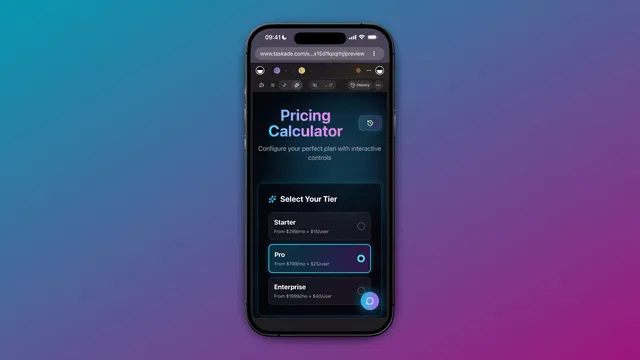
The "agents anywhere" view above shows the agent layer accessible across the workspace, from Project pages, from automations, from public embedded surfaces. Multi-agent collaboration runs inside any of these contexts without setup.
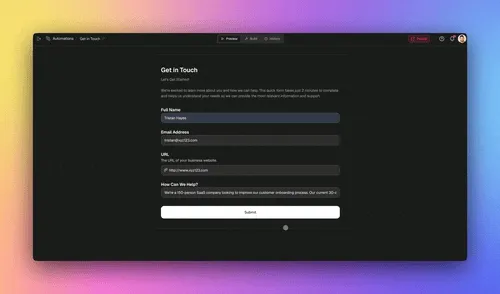
The "AI teams in automations" view above shows multi-agent crews triggered by automation events, a new Slack message triggers a team of agents that research, draft a response, route it for review, and post. This is the integration of multi-agent into the automation layer that no OSS framework provides natively.
FAQ
What is the best free multi-agent platform?
Taskade Free, up to 6,000 credits with multi-agent collaboration available, all built-in tools, 100+ integrations. The OSS frameworks (CrewAI, AutoGen, LangGraph) are "free" but require self-hosting and API costs that add up fast in production.
Are multi-agent systems better than single agents?
For complex workflows, yes. Single agents struggle with tasks that require different specializations (research, writing, review). Multi-agent systems decompose complex tasks into focused sub-tasks where each agent has bounded context and the right tools. Reliability improves because each agent's output can be validated by the next.
What is the difference between CrewAI and AutoGen?
CrewAI uses a role-based crew abstraction (agents have roles and tasks, hierarchical or sequential coordination). AutoGen uses a conversational abstraction (agents exchange messages until a termination condition). Both are Python frameworks; both require self-hosting and your own LLM API budget.
How do I debug a multi-agent system?
Taskade provides agent run history and the Runs tab (added v6.150) for automation traces. CrewAI and AutoGen output traces to the console; LangGraph integrates with LangSmith for visual debugging. Production debugging is meaningfully easier on Taskade because the full run is captured and inspectable in the UI.
Can agents call each other recursively?
Yes, with all production frameworks (Taskade, CrewAI, AutoGen, LangGraph). Recursion depth limits prevent infinite loops; Taskade's render queue prevents resource exhaustion from runaway agent chains.
What is the largest agent count in a working system?
Taskade tested multi-agent crews of 20+ agents collaborating on complex tasks (e.g., a research crew with researchers, writers, fact-checkers, editors, formatters). CrewAI and AutoGen support similar scale. The practical ceiling is usually context window and cost rather than framework limit.
How does memory work across multi-agent runs?
Taskade stores agent memory as real Projects in a projects/memories folder per agent. Memory persists across sessions, can be queried, and feeds the next run's context. CrewAI and AutoGen support memory through vector stores you configure (Chroma, Pinecone), more flexibility, more wiring work.
Can I run multi-agent systems on-premise?
Taskade runs as managed SaaS with SOC 2 aligned practices, SAML SSO from Business, and SCIM user provisioning on Enterprise; it is not self-hosted. CrewAI, AutoGen, LangGraph, OpenAI Swarm are OSS and can run on-prem out of the box. Vertex, Bedrock, Azure are cloud-only.
What is MCP and how does it relate to multi-agent?
MCP (Model Context Protocol) is a standardized way for AI clients (Claude Desktop, Cursor, custom) to call tools and access data. Taskade runs a hosted MCP server, so external clients connect into your workspace and work with your projects and tasks directly. MCP turns multi-agent into a federated capability, agents in different systems can interoperate. The hosted MCP server is available on every paid plan. The outbound direction is federated too: an MCP Client step in a Taskade automation calls tools on external servers, on every plan including Free. The agent supplies the reasoning and the automation makes the call.
Are there safety guardrails for multi-agent systems?
Taskade includes tool access controls per agent, public-agent opt-out tool controls, internal-integration filtering for public agents, and Enterprise BYOK for keeping API keys in your control. CrewAI, AutoGen, LangGraph leave guardrails to your implementation.
Can multi-agent systems handle long-running tasks?
Yes. Taskade's durable execution infrastructure handles tasks that span hours or days with automatic retry on failures. OSS frameworks require you to build durable execution yourself (or run them on Temporal, Airflow, etc.).
What's the difference between agents and automations?
Agents reason and act; automations are deterministic workflows triggered by events. In Taskade, agents can call automations (and vice versa), agents handle ambiguity, automations handle reliable repeatable execution. The combination is more powerful than either alone.
Related Reading
- How to Build a Custom AI Agent From Scratch — for a single agent instead of a team
- AI Agent Platforms Ranked by Deployment and Workforce Features — the broader agent-platform category
- The Best Individual AI Agents Ranked — ready-made agents, from Devin to Genspark
Build your first multi-agent system in minutes. Try Taskade free →, up to 6,000 credits, multi-agent collaboration, built-in tools, 100+ bidirectional integrations.
▲ ■ ● Memory · Intelligence · Execution.