





In most industries, a project slip-up might hurt timelines or stretch budgets. But when human life is at stake, the gap between "important" and "critical" narrows to a fine line. Healthcare project management demands precision, compliance, and interdisciplinary coordination that few other fields require.
This guide covers proven strategies, AI-powered tools, and regulatory considerations that healthcare project managers need in 2026.
TL;DR: Healthcare project management requires HIPAA-compliant workflows, interdisciplinary coordination, and continuous quality improvement. Taskade provides multiple project views, AI agents with built-in tools for compliance tracking, role-based access control (Owner to Viewer), and 100+ integrations for connecting clinical and administrative systems. Start managing healthcare projects smarter.
Getting started? Read project management basics first.
Understanding Healthcare Project Management
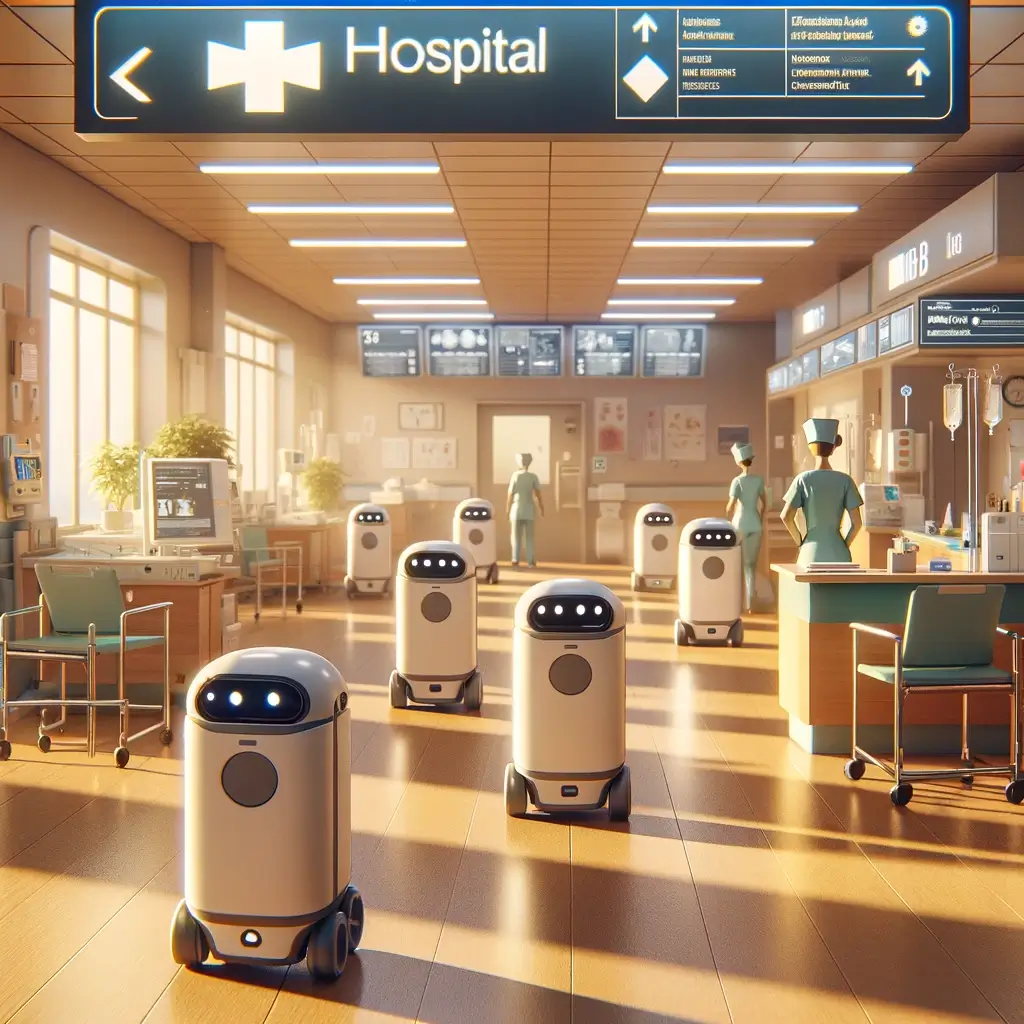
Healthcare project management applies structured planning, execution, and oversight to initiatives that directly or indirectly affect patient care. These projects range from implementing new electronic health records (EHR) systems to rolling out cutting-edge patient care protocols.
What makes healthcare projects distinct are their unique objectives:
- Enhancing outcomes of healthcare services
- Compliance with healthcare laws and standards (HIPAA, FDA, Joint Commission)
- Minimizing risks and ensuring safe care practices
- Increasing the availability of medical services
- Introducing new treatments and technologies
- Optimizing resources for faster, more effective service
- Protecting sensitive health information against breaches
- Fostering teamwork among healthcare professionals
Healthcare PM by the Numbers
The stakes and scale of healthcare project management become clear when you look at the data:
| Metric | Value | Source |
|---|---|---|
| Annual healthcare IT spend (US) | $185 billion | Gartner 2025 |
| EHR implementation failure rate | 30-40% | HIMSS Analytics |
| Medical errors (annual, US) | 250,000+ deaths | Johns Hopkins |
| Checklist-driven complication reduction | Up to 36% | WHO Surgical Safety |
| PM-related project failures | 29% due to poor communication | PMI |
| Average healthcare project timeline | 18-36 months | KPMG Healthcare |
These numbers underscore why structured project management is not optional in healthcare, it is a patient safety imperative.
Key Challenges in Healthcare Project Management
Healthcare projects face obstacles that go far beyond typical budget and scope concerns:
Following Laws and Regulations
Healthcare changes fast, and so do its rules. Medical billing codes, health insurance policies, workforce regulations, building codes, and standards all create a challenging environment for PMs to navigate.
HIPAA Compliance in Project Management: The Health Insurance Portability and Accountability Act requires healthcare organizations to protect patient health information (PHI) in every workflow, including project management. This means:
- Using tools with role-based access control and audit trails
- Ensuring no PHI appears in task descriptions, meeting notes, or shared documents without authorization
- Maintaining encryption for data at rest and in transit
- Documenting all access to sensitive information
Taskade provides role-based access control (Owner to Viewer) that gives healthcare teams granular control over who sees what.
Resource Allocation and Staff Management
Healthcare institutions often operate under tight budgets and timelines. Making all available resources count is essential. The fight for top talent is fierce, and keeping teams motivated under pressure is a skill in itself.
Maintaining Patient Privacy and Data Security
Healthcare projects often involve handling sensitive data. They need to stay compliant with laws regulating the handling of patient data like HIPAA in the US or GDPR in the European Union.
Adapting to New Technology
Medicine has always been a field where technology evolves non-stop: telemedicine, AI diagnostics, robotic surgery, genomic analysis. But blending cutting-edge technology without sidelining what already works can be difficult.
Overcoming these obstacles takes a mix of tools, techniques, individual expertise, and team coordination.
Essential Project Management Skills for Healthcare
In 2009, Atul Gawande's book "The Checklist Manifesto" showed that something as simple as a checklist can improve outcomes in high-stakes environments. Gawande, a respected surgeon, documented how checklists improve outcomes and cut down errors in operating rooms and ICUs.
Implementing a simple checklist can reduce surgical complications by up to 36% and decrease mortality rates by 47%.(1)
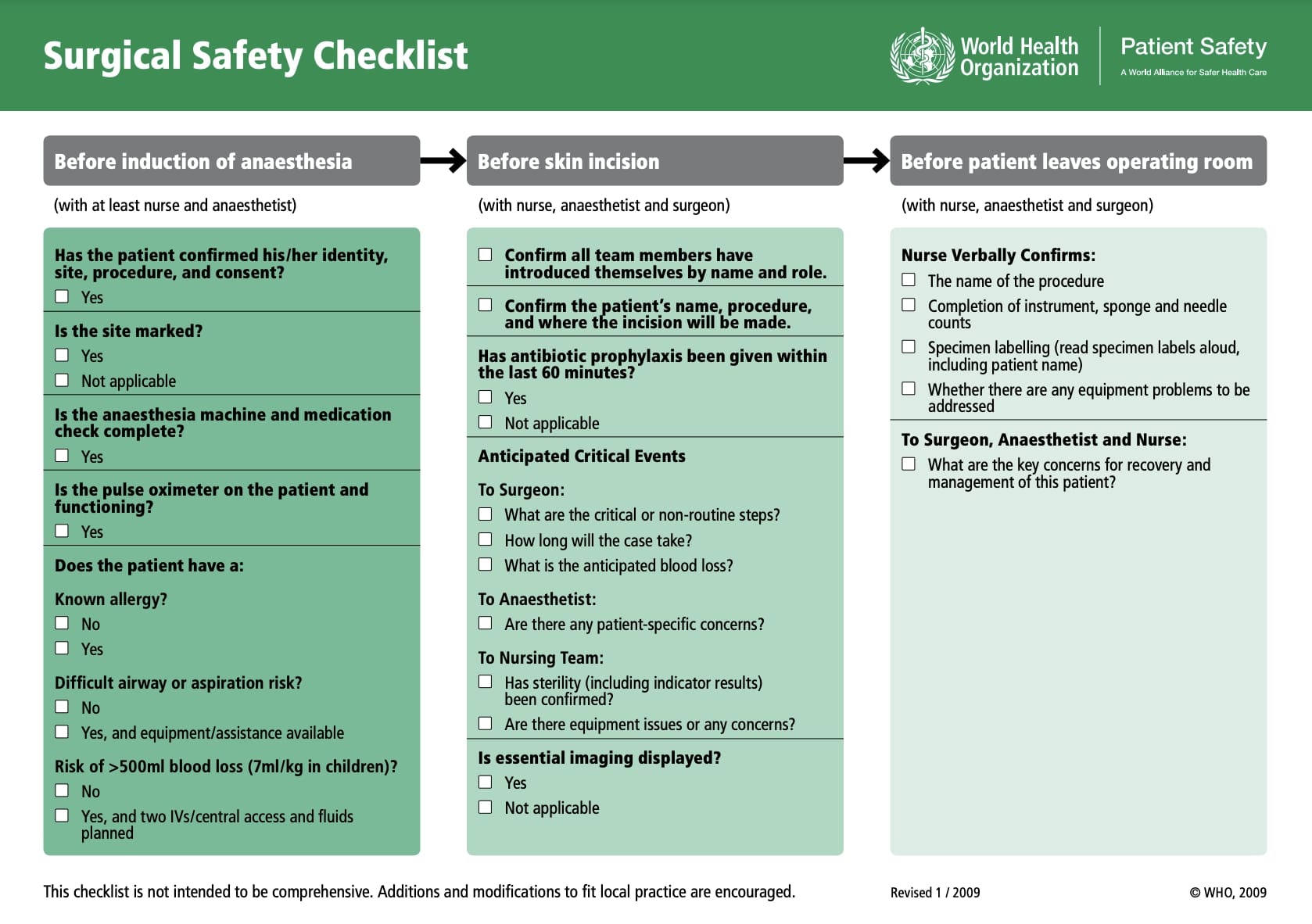
Surgical Safety Checklist. Source: WHO
The Cleveland Clinic Improvement Model, championed by Dr. Lisa Yerian, empowers caregivers to solve problems themselves, improving efficiency and patient care. It implements strategies from the project management world to help staff identify, discuss, and tackle issues directly.
The result? Reduced pharmacy delivery times (from 10-14 days to under three days) and improved patient response times in a nursing unit by 23%.(2)
Core Skills for Healthcare PMs
Beyond problem-solving, healthcare project managers need a specific skill set:
| Skill | Healthcare Application | Impact |
|---|---|---|
| Clinical Awareness | Understanding how changes affect patient workflows | Prevents disruption to care delivery |
| Regulatory Knowledge | Navigating HIPAA, FDA, Joint Commission requirements | Ensures compliance throughout project lifecycle |
| Stakeholder Management | Balancing clinician, administrator, and patient needs | Builds consensus across diverse groups |
| Risk Assessment | Identifying patient safety implications of changes | Prevents adverse events during transitions |
| Change Management | Guiding clinical staff through new processes | Drives adoption and sustains improvements |
| Data Literacy | Interpreting clinical outcomes and operational metrics | Enables evidence-based decision making |
Communication skills bridge gaps between departments, leadership rallies medical staff through emergencies, and time management helps coordinate the life of a hospital facility. The skill transfer from general PM to healthcare PM is more common than it may seem.
Implementing Project Management in Healthcare
1. Building a Project Management Toolbox
Imagine you are launching a telehealth platform. The conventional approach would involve a chaotic blend of emails, spreadsheets, and whiteboards smothered with deadlines. The results? Project creep, budget overruns, and deadlines slipping through the cracks.
A centralized platform combining collaboration, communication, and planning brings all of that into focus. A consolidated view of tasks, milestones, and communications gives you a one-stop solution for:
- Staff management and scheduling
- Compliance tracking and documentation
- Resource allocation and budget monitoring
- Sharing documentation securely
- Event planning and coordination
- Internal communication across departments
- R&D coordination for clinical trials
All in one place, accessible 24/7 from any device, ensuring seamless integration and a unified approach to managing every aspect of your project.
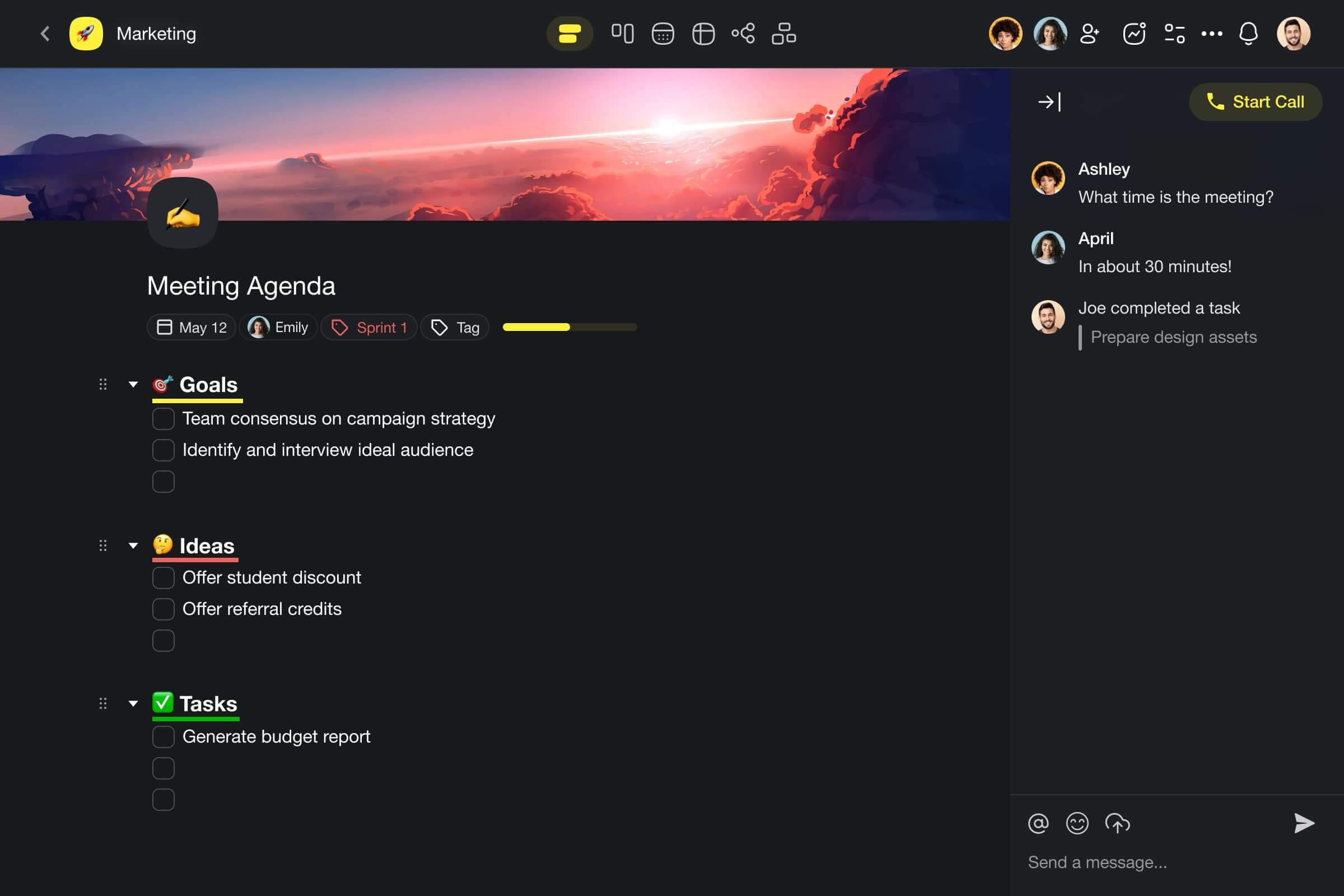
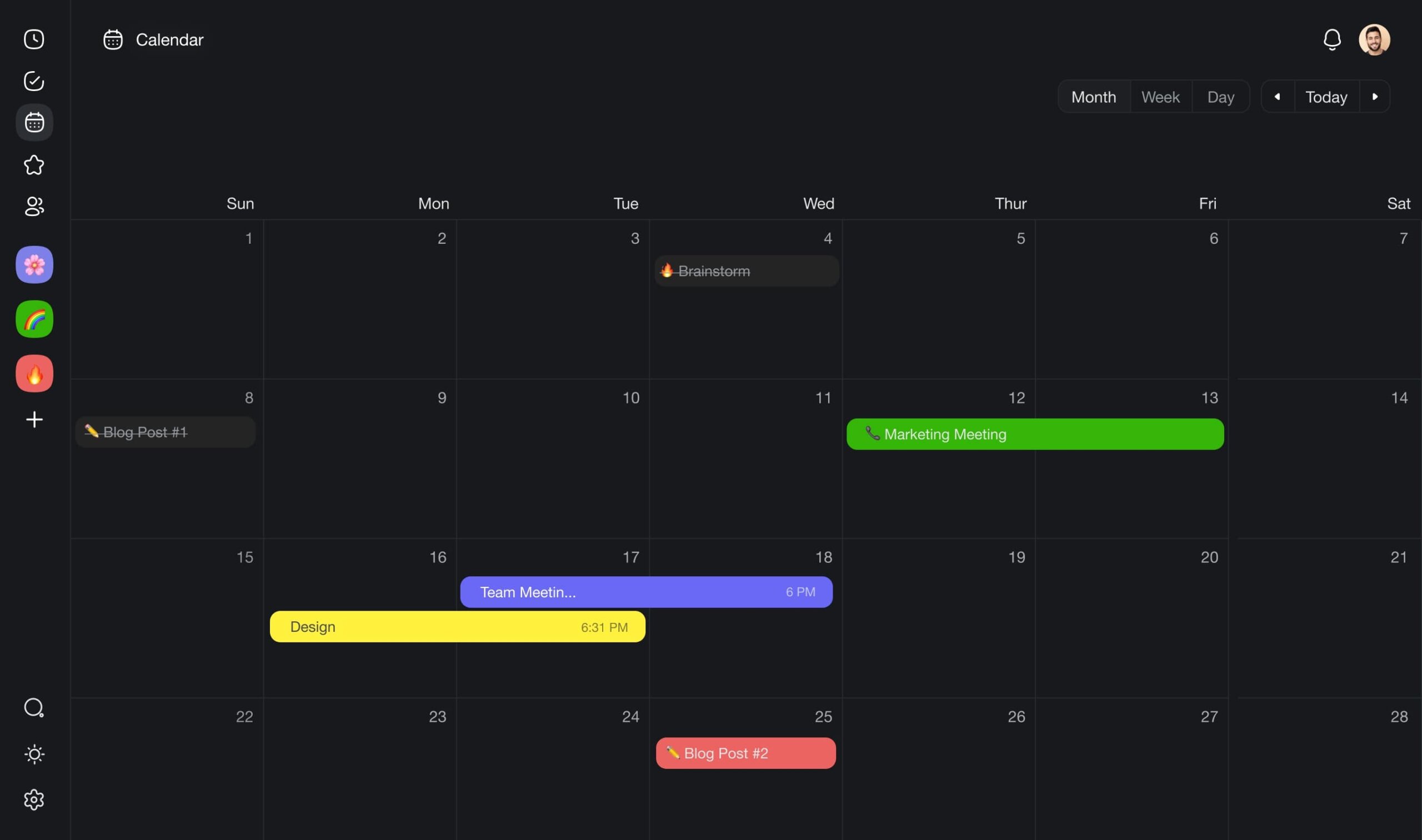
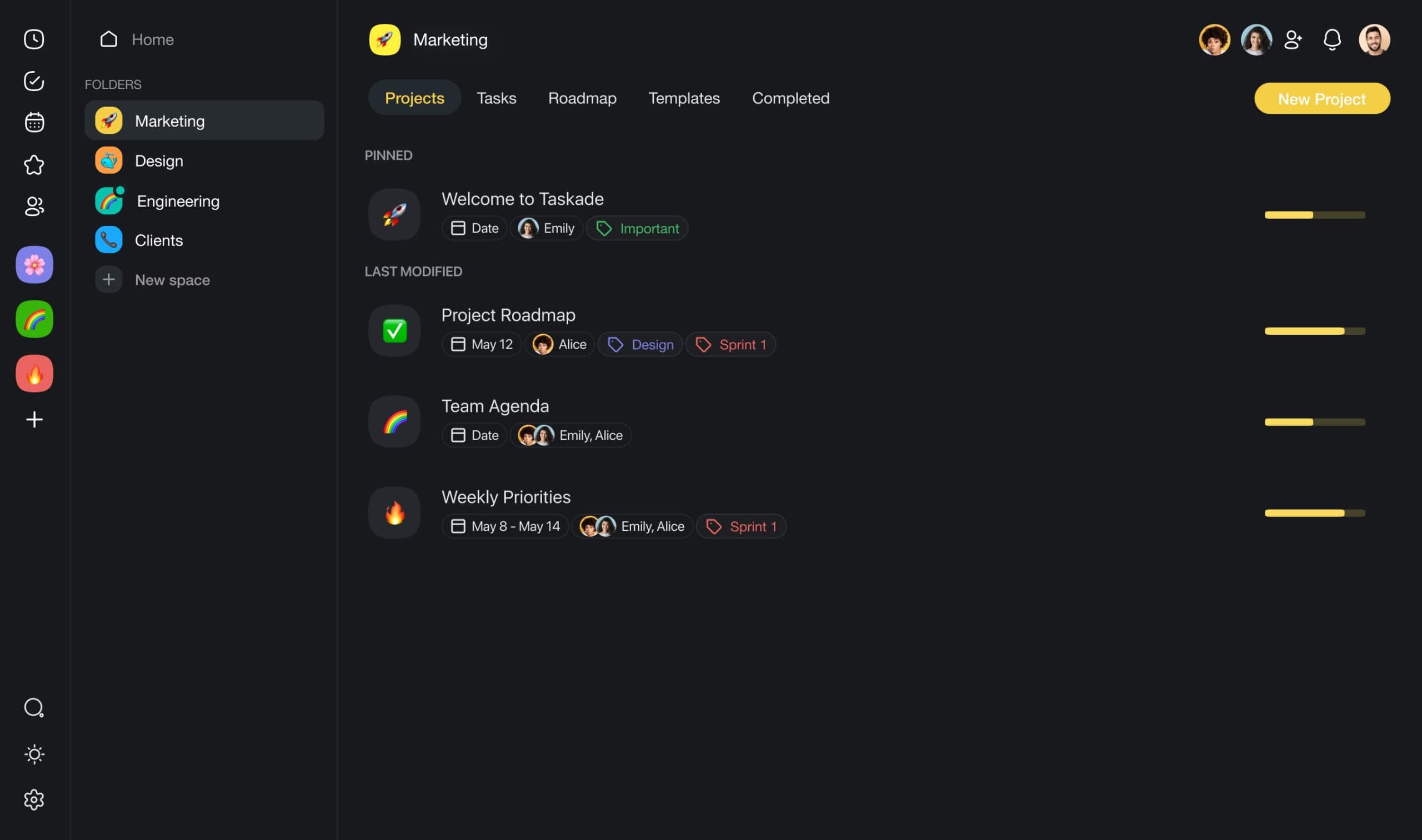
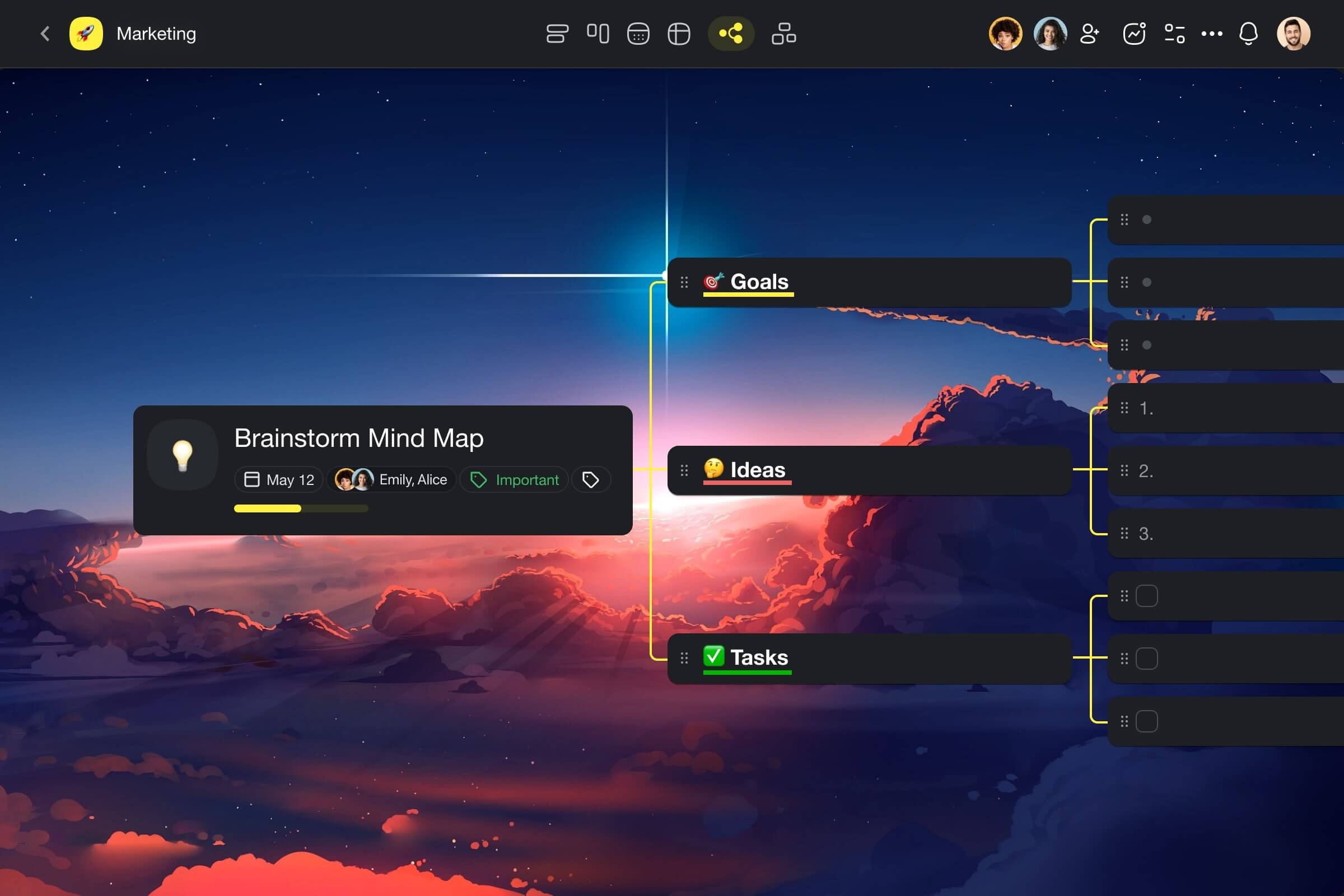
Taskade is an AI-powered project management platform designed to streamline healthcare project workflows. It offers a unified space for managing tasks, tracking progress, and facilitating team communication.
With multiple project views (List, Board, Calendar, Table, Mind Map, Gantt, and Org Chart), Taskade supports real-time collaboration across clinical and administrative teams.
Sign up to transform your healthcare projects with Taskade AI
2. Planning and Prioritization
With a project management toolbox in place, the next step is to lay out a detailed project plan. This involves breaking down the project into manageable tasks, assigning responsibilities, and setting clear deadlines.
Key questions to guide healthcare project planning:
- "How will the project enhance organization and patient care?"
- "Which medical staff roles are pivotal in the early phases?"
- "How do we prioritize compliance with healthcare regulations?"
There are project management techniques that make the process faster:
Eisenhower Matrix: Identifies which tasks need immediate attention (urgent and important), which need planning (important but not urgent), which can be delegated (urgent but not important), and which should be eliminated. Use Taskade's Table view to visualize this matrix.
Pareto Analysis (80/20 Rule): Focus on the 20% of tasks that have the biggest impact on patient care and operational goals. In healthcare, this often means prioritizing safety protocols and regulatory compliance above cosmetic improvements.
Priority Matrix: Sorts tasks into four sections to help decide what to focus on first. Identifies tasks with big impact but low effort, making it easier to manage time and get things done efficiently.
Kano Model: Groups features into must-be, one-dimensional, and delighters based on patient or stakeholder satisfaction. Particularly useful for patient-facing technology projects.
3. Clearing Communication Hurdles
Effective communication is the heartbeat of successful project management. According to the Project Management Institute (PMI), 29% of project failures are caused by poor communication.
When you are dealing with a multidisciplinary project team, clear, concise, and continuous communication is essential.
Common communication obstacles in healthcare:
- Silos between departments: Specialized units often work in their own bubbles, causing information to slip through the cracks
- Language barriers: Medical staff use clinical terminology while project managers have their own vocabulary
- Resistance to change: Healthcare professionals may view new projects, especially those requiring changes to routines, with skepticism
- Overreliance on email: Important messages get lost in crowded inboxes
- Lack of real-time communication tools: Without tools that let people talk and make decisions quickly, projects stall
Addressing these challenges requires breaking down silos with cross-departmental meetings, simplifying language, and introducing change management techniques. Real-time collaboration tools like Taskade enable instant communication across departments.
How AI Agents Transform Healthcare Project Management
Since ChatGPT's debut in late 2022, AI has found its way into every industry. In healthcare project management, AI works in subtle but powerful ways.
Staffing Optimization
Overstaffing generates costs, while understaffing might compromise patient outcomes. AI project management agents can optimize staffing by analyzing past shift patterns and predicting busy times.
Taskade's AI Agents are designed to streamline work and
automate repetitive parts of project workflows.
Compliance Tracking
AI agents trained on HIPAA guidelines, Joint Commission standards, and FDA requirements can automatically flag compliance issues in project documentation. They can:
- Scan project plans for potential PHI exposure
- Alert teams when regulatory deadlines approach
- Generate compliance reports for audits
- Track training completion across staff members
Personalized Training and Onboarding
AI-powered L&D platforms offer personalized experiences based on roles and skills. A nurse might receive updates on patient care protocols, while a radiologist gets insights into new imaging techniques, all with instant feedback and support.
Resource Forecasting
AI agents can analyze historical project data to predict resource needs, identify potential bottlenecks before they occur, and recommend optimal resource allocation across concurrent healthcare projects.
New tools like project management generators can support all kinds of healthcare projects, from clinical trials and supply chain optimization to public health initiatives.
Want to learn more? Read AI predictive project management next.
Utilizing Project Management Methodologies in Healthcare
Whether developing a new medical device, implementing an IT system, or improving patient care processes, each project requires a tailored approach. The project management world gives us several proven options.
Agile in Healthcare
Agile leverages flexibility, making it ideal for projects with shifting requirements. This includes developing EHR systems, patient portal apps, and telemedicine platforms. Its iterative nature allows for adaptation and continuous refinement.
Waterfall in Healthcare
Waterfall offers a sequential, phase-based structure. It is ideal for projects with clear, predictable stages and fixed requirements like building a healthcare facility or standardizing medical procedures across an organization.
Lean Six Sigma in Healthcare
Lean Six Sigma focuses on improving processes by systematically eliminating defects and reducing variation. It combines principles from Lean manufacturing (efficiency and waste reduction) with Six Sigma (statistical quality control).
Methodology Comparison
| Attribute | Agile | Waterfall | Lean Six Sigma |
|---|---|---|---|
| Philosophy | Adaptability and flexibility. Iterative and incremental. | Sequential and linear phases with no overlap. | Eliminating waste and defects. Combines Lean efficiency with Six Sigma quality. |
| Process | Divided into sprints for regular reassessment. | Distinct phases: Requirements, Design, Implementation, Testing, Deployment, Maintenance. | Five phases: Define, Measure, Analyze, Improve, Control (DMAIC). |
| Flexibility | High. Changes can be made late in development. | Low. Changes are difficult once advanced. | Moderate. Changes encouraged early, less feasible later. |
| Feedback Loop | Continuous through sprint reviews. | Gathered after completion or at phase end. | Continuous during Measure and Analyze phases. |
| Best Healthcare Use | EHR implementations, digital health apps, telemedicine | Facility construction, regulatory submissions | Clinical workflow optimization, quality improvement |
| Timeline | Flexible, iterative | Fixed, determined at start | Varies by process complexity |
No single methodology fits all types of projects. Healthcare projects often benefit from hybrid approaches: organizing a project with Waterfall but using Agile sprints to complete individual phases.
Visit Agile vs. Waterfall for a detailed comparison.
Building a Healthcare PM Dashboard with Taskade Genesis
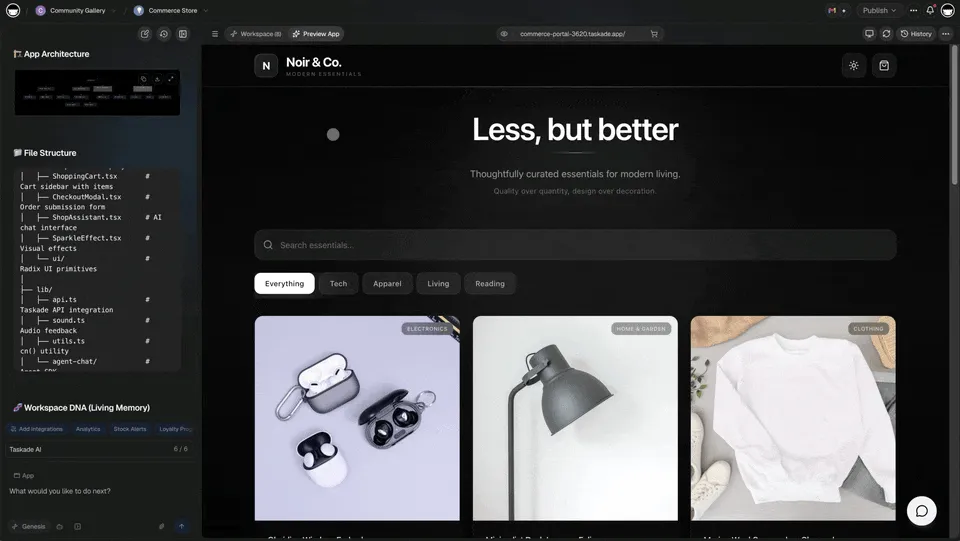
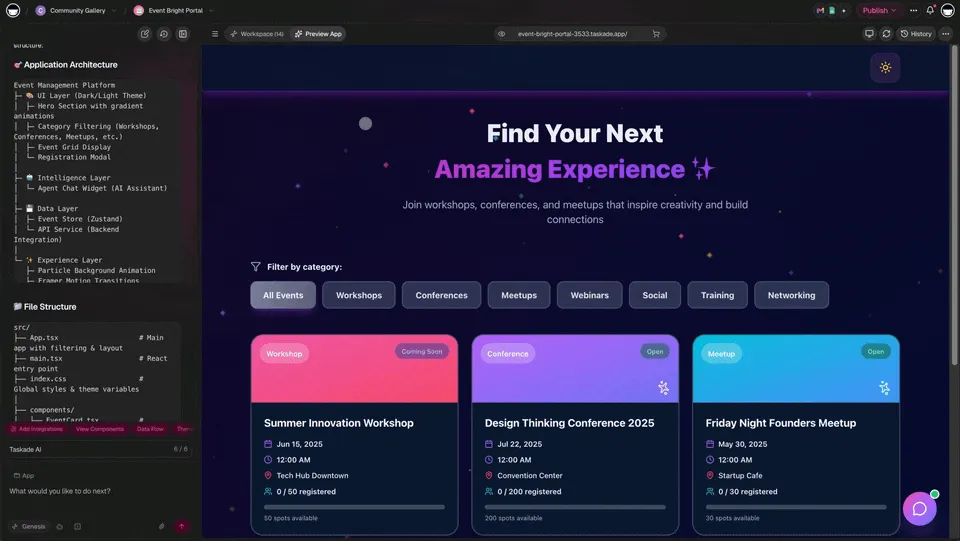
You can build a complete healthcare project dashboard using Taskade Genesis. Describe your requirements in natural language:
"Build a healthcare project management dashboard that tracks compliance milestones, resource allocation, and patient outcome metrics across multiple departments."
Genesis creates a working application with databases, automated alerts, and role-based access, all within your Taskade workspace. Build your first healthcare app.
Frequently Asked Questions
Why is project management important in healthcare?
Healthcare project management is critical because delays or miscommunication can directly impact patient safety and outcomes. Healthcare projects face additional complexity: strict regulatory compliance (HIPAA, FDA), interdisciplinary teams, long approval cycles, and the need to maintain ongoing patient care while implementing changes. Effective PM reduces medical errors, improves care coordination, and ensures regulatory compliance.
What project management methodologies work best in healthcare?
Healthcare benefits from hybrid approaches: Lean for eliminating waste in clinical workflows and reducing patient wait times, Six Sigma for reducing variability in treatment outcomes, Agile for health IT implementations and digital health projects, and Waterfall for facility construction and regulatory submissions requiring sequential approvals. Many health systems use Lean Six Sigma as their primary improvement methodology supplemented with Agile for technology projects.
What are common challenges in healthcare project management?
Key challenges include stakeholder complexity (physicians, nurses, administrators, patients, regulators all have different priorities), HIPAA and regulatory compliance requirements that constrain timelines, resistance to change in clinical settings, difficulty measuring project success since patient outcomes take time to manifest, budget constraints in non-profit health systems, and maintaining 24/7 patient care while implementing changes.
What tools help with healthcare project management?
Healthcare PM tools need strong security, collaboration features, and compliance support. Taskade offers real-time collaboration across multiple project views, AI agents with built-in tools that can generate project documentation and track compliance tasks, role-based access control (Owner to Viewer) for data governance, and 100+ integrations for connecting clinical and administrative workflows.
How can AI improve healthcare project management?
AI agents can optimize staffing by analyzing shift patterns and predicting busy times, automate compliance tracking and documentation, generate project plans tailored to healthcare regulations, monitor project risks in real time, and facilitate cross-departmental communication. Taskade AI agents can be trained on regulatory guidelines to flag compliance issues automatically.
What is HIPAA compliance in project management?
HIPAA (Health Insurance Portability and Accountability Act) requires healthcare organizations to protect patient health information (PHI) in all workflows including project management. This means using tools with role-based access control, audit trails, encryption, and data governance policies. Project managers must ensure that no PHI is exposed in task descriptions, meeting notes, or shared documents without proper authorization.
How do you manage stakeholders in healthcare projects?
Healthcare stakeholder management requires mapping all groups (clinicians, administrators, IT, patients, regulators), understanding their priorities and concerns, establishing regular communication cadences, using clinical champions to drive adoption, and maintaining transparency through shared project dashboards. AI agents can automate stakeholder updates and track engagement levels.
What is Lean Six Sigma in healthcare?
Lean Six Sigma combines Lean methodology (eliminating waste and improving flow) with Six Sigma (reducing variation and defects). In healthcare, it reduces patient wait times, minimizes medical errors, improves surgical outcomes, and optimizes resource allocation. The DMAIC framework (Define, Measure, Analyze, Improve, Control) provides a structured approach to continuous improvement in clinical settings.
How do you measure success in healthcare projects?
Healthcare project success metrics include patient outcome improvements, regulatory compliance rates, staff adoption and satisfaction scores, cost savings or revenue impact, process efficiency gains (reduced wait times, faster discharge), error reduction rates, and patient satisfaction scores. Track these through dashboards that combine clinical and operational data.
What role does technology play in healthcare project management?
Technology enables real-time collaboration across departments, AI-powered resource optimization and risk prediction, automated compliance monitoring and documentation, data-driven decision making through integrated dashboards, and streamlined communication between clinical and administrative teams. Taskade provides multiple project views, AI agents, and 100+ integrations for comprehensive healthcare PM.
Conclusion
Healthcare projects are about making every decision count, because at the end of the day, it is people's lives that are at stake. This comes with unique challenges, but it also leads to remarkable outcomes when done right.
The combination of proven PM methodologies with AI-powered tools like Taskade creates a powerful foundation for managing complex healthcare initiatives. With multiple project views, AI agents with built-in tools, role-based access, and 100+ integrations, healthcare teams have everything they need to plan, execute, and deliver projects that improve patient outcomes.
Resources
Sign up to transform your healthcare projects with Taskade AI
Healthcare PM Resources:
- AI Project Management Agents — Build custom PM assistants
- Project Management Generators — Auto-generate project plans
- Workflow Automations — Automate compliance tracking
- Role-Based Access Control — permissions for data governance
Related Guides:
- Best AI Project Management Tools — Complete comparison
- AI Predictive Project Management — Forecasting with AI
- Agile vs. Waterfall Methodology — Which is right?
- What Are Cross-Functional Teams? — Healthcare team structures
- How to Write a Project Plan — Step-by-step template
- What Are OKRs? — Goal-setting for healthcare
- RACI Model Explained — Responsibility mapping
- Project Management Basics — Beginner's guide
- Best AI Productivity Tools for Teams — Full toolkit
- What Are AI Agents? — The intelligence behind automation
- Real-Time Collaboration — Work together across departments
- How to Build AI Agents — Create custom healthcare agents
Explore Taskade:
- AI Agents — Custom AI assistants for healthcare workflows
- Automate — Connect clinical and administrative systems
- Community — Browse healthcare PM templates
- AI Apps — Build healthcare dashboards and tools
- Pricing — Plans starting at Free, with Pro at $10/mo