





How many project managers does it take to change a lightbulb? None, they are all still discussing the best way to do it. Funny? Barely, but it perfectly captures the current state of the Agile vs. Waterfall methodology debate. The truth is that both approaches have their strengths, successes, and a place in the PM world. Even if some project managers think otherwise.
But that means you need to make some tough decisions when starting a new project with one or the other. If you still can’t decide, then this article is for you. Here’s a quick breakdown of the differences between Agile and Waterfall, complete with pros, cons, and use cases.
🤸♀️ What Is Agile Project Management?
Agile is a flexible, iterative approach favored by software development teams. Developed in 2001 as a response to the rigid and outdated Waterfall, Agile prioritizes team collaboration and quick delivery; momentum is more important than writing documentation or the process itself.
Agile project teams are cross-functional and self-organizing; they can plan, execute, and iterate with a great deal of autonomy. Work in Agile projects unfolds in increments called sprints. These are time-boxed events that represent units of work, e.g. a new feature in an app.
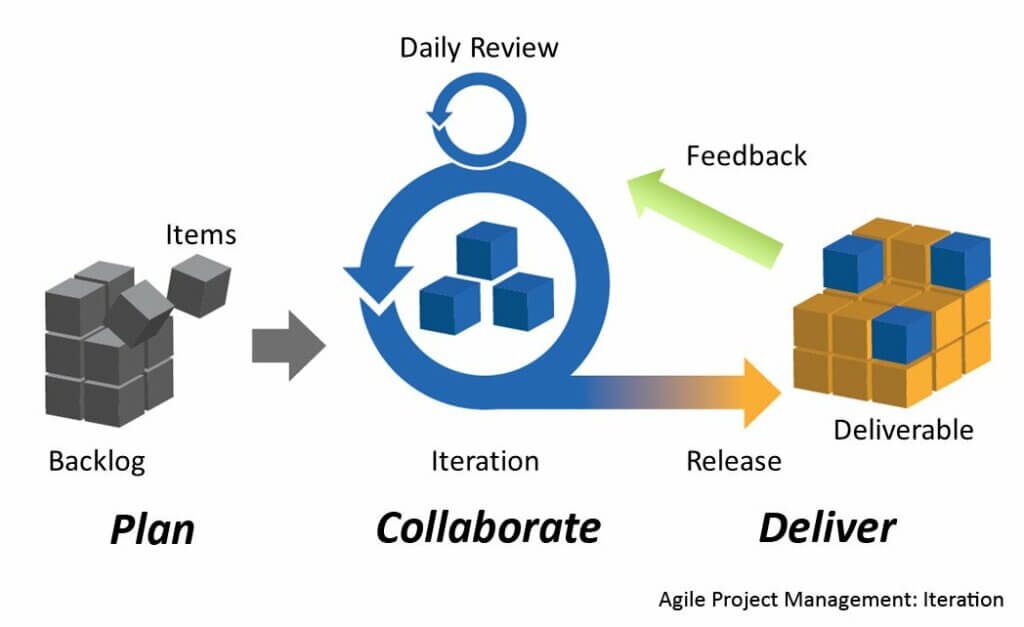
Agile project management iteration by Planbox(1)
Unlike Waterfall, Agile project management relies on the empirical process model. Agile teams often start working on a project without knowing complete customer requests, i.e. how the final product will look like. This opens the door to innovation and allows a great deal of flexibility.
🏔️ What Is Waterfall Project Management?
When you look at a natural waterfall (or a cascade to be precise), you’ll see water running down a series of rocky steps. The water can only go in one way, and that’s down. It can’t skip a step or change its direction. That’s what Waterfall project management is like.
In Waterfall project management, teams work sequentially through several project phases. Every phase—Requirements, Design, Implementation, Testing, and Deployment—is self-contained; the project team can only move on once they've completed the previous phase.
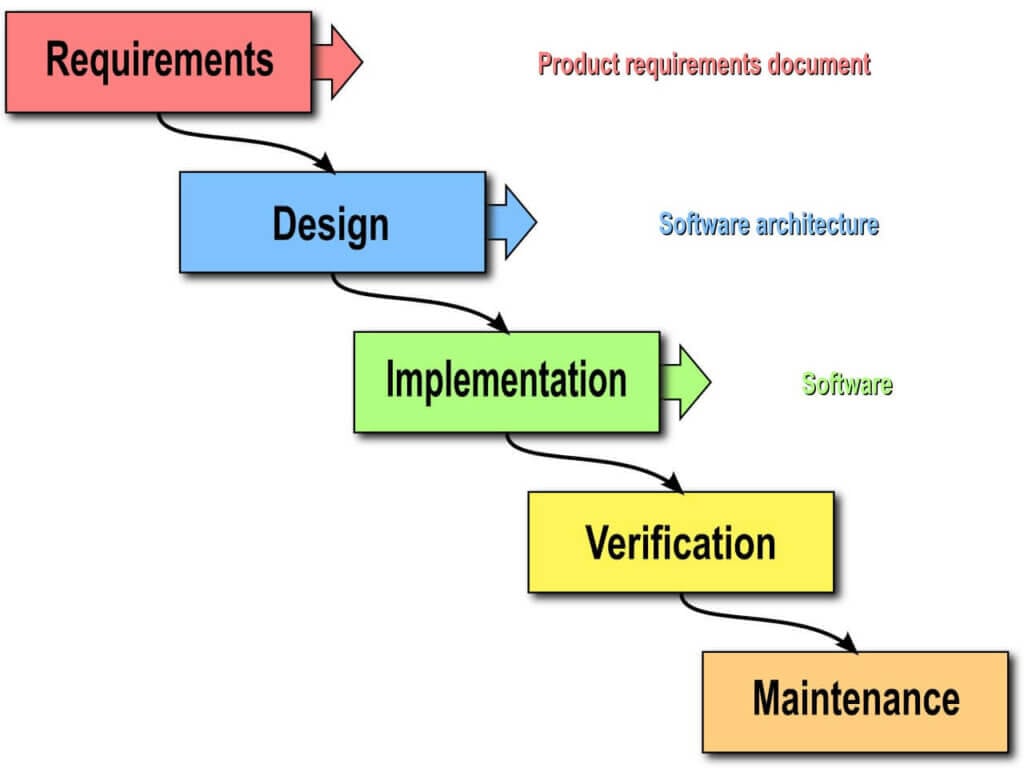
Waterfall model of system development
by Peter Kemp / Paul Smith(2)
The Waterfall model is popular in construction, engineering, manufacturing, and to some degree software development projects. It has also been the leading methodology in heavily-regulated industries like the military and critical infrastructure (banking, healthcare).
🥊 Key Differences Between Agile and Waterfall
We’ve said that once, we’ll say it again. It’s not that Waterfall or Agile is inherently good or bad. It’s more a question of choosing the right (or wrong) tool for the job. Think using a sledgehammer where a much more precise tool would do, and vice versa.
Ok, that’s a shoddy analogy. But you get the idea.
The main difference between Waterfall and Agile is flexibility. Agile project management invites innovation and constant feedback. Waterfall, on the other hand, is much more rigid and linear.
In the Waterfall model, project teams expect all requirements upfront. That’s not as unreasonable as it may sound, especially in “templatized” and regulated industries like construction. There’s also a great deal of research and planning involved.
| Agile | Waterfall | |
|---|---|---|
| 🚀 Workflow | Projects break down into time-boxed, iterative sprints. Each sprint represents a task, milestone, or deliverable. A Sprint usually takes between 1 and 4 weeks to complete. | Projects are divided into sequential, linear phases. Development teams must complete a phase before moving to another. Waterfall projects usually take longer to deliver usable deliverables. |
| 📑 Documentation | An Agile development team seeks balance between planning and action. It puts less effort into documenting every aspect of a project and more into delivering a working product. | Waterfall highlights the importance of writing documentation. That's always preceded by extensive research and planning. |
| ✅ Project Requirements | Requirements are flexible and can change as the project unfolds. Modifying requirements doesn't affect implementation; it occurs naturally during iterations. | Change is undesirable. Customers are expected to provide final requirements at the beginning of a project. It's much more difficult to accommodate change requests in an advanced project phase. |
| 🤝 Customers | Customers are involved in key project activities from day one. They work with the Agile development team to create and refine requirements. | Customers are involved in the Analysis and Requirements phases. They don't collaborate with the project team outside key milestones. |
Key differences between Agile and Waterfall in Project Management
Clear business objectives and structured processes make it easier to build momentum. But painstaking research and the call for comprehensive documentation come at a price. Waterfall limits innovation, which can be detrimental in fast-paced software development projects.
Agile is much more forgiving and open to change; projects have a higher tolerance to risk and unknowns. The iterative approach and close collaboration with customers make Agile much more responsive to change, so it’s easier to innovate and change course when needed.
Of course, the choice is not black or white. For instance, the automotive industry has been considered waterfall-oriented for ages. But when you think about Tesla’s OTA software updates for in-car systems, that’s more like a full-blown Agile if we’ve ever seen one.
🤹 When to Use Agile Vs. Waterfall
Imagine you’re sitting on a beach and building a sand castle.
The castle is your software development project. The stuff laying around—seashells, seaweed, driftwood —are individual features, your building blocks. There are also the odd bits and pieces the tide washes up. These are unexpected customer requirements you need to accommodate.
The bottom line?
If you want to innovate and work closely with customers, choose Agile. The same is true for projects where innovation and discovery happen daily. Agile plays well with projects with flexible requirements and prioritizes releasing working products as quickly as possible.
We’re not saying that Agile is only for PMs who want to act first and think later. Quite the contrary. Feedback loops built into Agile help save time/money by A) skipping features that are no longer relevant and B) functionality that underperforms/doesn’t make customers happy.
| 🟢 When to Use Agile | 🔵 When to Use Waterfall |
|---|---|
| Requirements are incomplete or likely to change; the project calls for flexibility. | Requirements are clearly defined from the start. Projects need to unfold sequentially. |
| Budget/scope creep is not an issue. | Projects have a fixed budget and timeline. |
| Clients want to be involved and actively collaborate with the project team. | The project doesn't require client involvement outside key milestones. |
| You want to deliver a working product as quickly as possible and iterate later. | The final product has to be complete according to specification on delivery. |
When to use Agile vs. Waterfall
Agile focuses on shipping a working product. It doesn’t matter if it has a few blemishes because you can fix them on the go. Waterfall is a different kind of animal.
You can’t design and build 50% of a car and ship it to your customers to get feedback. They simply can't wait for you to test and manufacture the bodywork, safety belts, and other components. Once you’re past R&D, you need to deliver a safe and usable product.
With that in mind, the Waterfall methodology is a great fit for projects where requirements are 100% clear from day one and unlikely to change. It’s also the right choice for projects with fixed budgets/timelines where customers prefer not to be involved outside key milestones.
💬 Frequently Asked Questions (FAQ)
What is the difference between a Waterfall requirement and an Agile requirement?
The traditional and Agile approaches share similar project requirements activities. Both require the project team to interact with customers/stakeholders and prepare documentation before starting.
The key difference is the amount of time spent on research and planning. An agile team moves from research to implementation faster. In Waterfall, gathering requirements and planning project phases is more time-consuming. Waterfall also produces better documentation.
There’s also a factor of redundancy. What’s relevant to the customer and stakeholders today can become obsolete a year from now when the product ships to end customers, especially in software development. In that sense, Agile requirements don’t have to be as precise, simply because they can be modified later in the project.
What are requirements in Agile?
Gathering requirements in Agile starts with formulating business requirements in coordination with the customer. After that, the team needs to gather functional requirements. These are the solutions to the problem or the outcomes that should emerge throughout the project.
Requirements in Agile revolve around user stories, small units of work written in natural language. They chart the course for the project team by describing user goals, usually in a pre-defined format, e.g.: As [user] I can [action], so that [goal/benefit].
What is a Waterfall requirement?
In Waterfall, the project team conducts research and writes documentation in the initial “Requirements” phase. This includes business requirements—the overarching organizational goals—and technical requirements, e.g. programming language or target OS.
The process is similar to Agile projects, except it’s much longer and produces more comprehensive documentation. Project requirements in Waterfall are unlikely to change.
What are the 3 main differences between Agile and Waterfall methodologies?
The three main differences between Agile and Waterfall methodologies are:
Breakdown of projects into linear phases (Waterfall) vs. iterative sprints (Agile). In Waterfall, this happens sequentially, so the project team has to complete a phase before the next one can begin. In Agile, the team can work on tasks in parallel.
Documentation is much more important in Waterfall than it is in Agile. Waterfall highlights the value of knowing everything from day one. Agile, on the other hand, accepts a degree of uncertainty and risk because of how flexible it is.
Agile projects involve close customer collaboration. In Waterfall, customers are not involved outside key milestones. The testing phase is also moved to the end of the project lifecycle as opposed to simultaneous implementation and testing in Agile.
Is Agile easier than Waterfall?
Agile is not easier or inherently better than Waterfall. These are two completely different approaches to project management that are suitable for different situations.
However, Agile may be easier to implement in smaller, cross-functional teams. The rapidly changing project landscape is best served by self-organizing units that can rapidly debrief and respond. An agile team can also work on tasks in parallel which reduces bottlenecks.
In that sense, Agile is much more forgiving and flexible. It’s harder to make critical decisions only with initial requirements, so if you want to move fast and iterate often, it may be considered “easier” to pull off. Involving customers from day one is also a plus.
Where is the Waterfall model not suited?
Waterfall isn’t compatible with projects that don’t have clear-cut and fixed requirements. A good example is a customer who wants to build an app but doesn’t have a clear vision of the final product (features, onboarding flow). In this case, Agile would be a much better choice.
Waterfall is also not suitable for creative projects where getting there first is key; taking too much time to plan and document everything before starting can stifle innovation. If you want to release working products quickly and iterate often, choose Agile instead.
What are the disadvantages of the Waterfall method over Agile projects?
Waterfall projects lack the flexibility of Agile. They’re often time-consuming and usually more expensive to take off the ground. Agile projects can be cheaper—although that’s not always the case—and may start generating revenue as soon as the product is ready to go live.
Finally, fixing design flaws or production mistakes is much more difficult in Waterfall. Everything has to be pitch perfect from day one. Any mistakes in the early phases mean the project team has to break the cycle and go back to the drawing board.
What is the difference between Waterfall and Agile testing?
In Waterfall, testing and acceptance come at the very end of the project; the testing phase follows implementation. In Agile, that happens during each iteration, with implementation and testing performed in parallel. Testers also work closely with the rest of the team.
🐑 Parting Words
The difference between Agile and Waterfall isn’t as obvious as it may seem. Both approaches have their merits. So, whether you're working on a software development or construction project, your primary criterion should be “which one is the right tool for the job?”
It’s not an easy choice. But the tips from this article should put you on the right path. And if you still need some help, why don't you try one of the best project management tools out there? 🎉
Meet Taskade! 🐑
Taskade is an all-in-one organization and collaboration platform that take the stress out of project management. It's a simple but powerful solution that lets you kickstart all kinds of projects in minutes. All that without lengthy onboarding and with just minimal setup required.
Watch this short walkthrough video and sign up for a free account today! 👈