






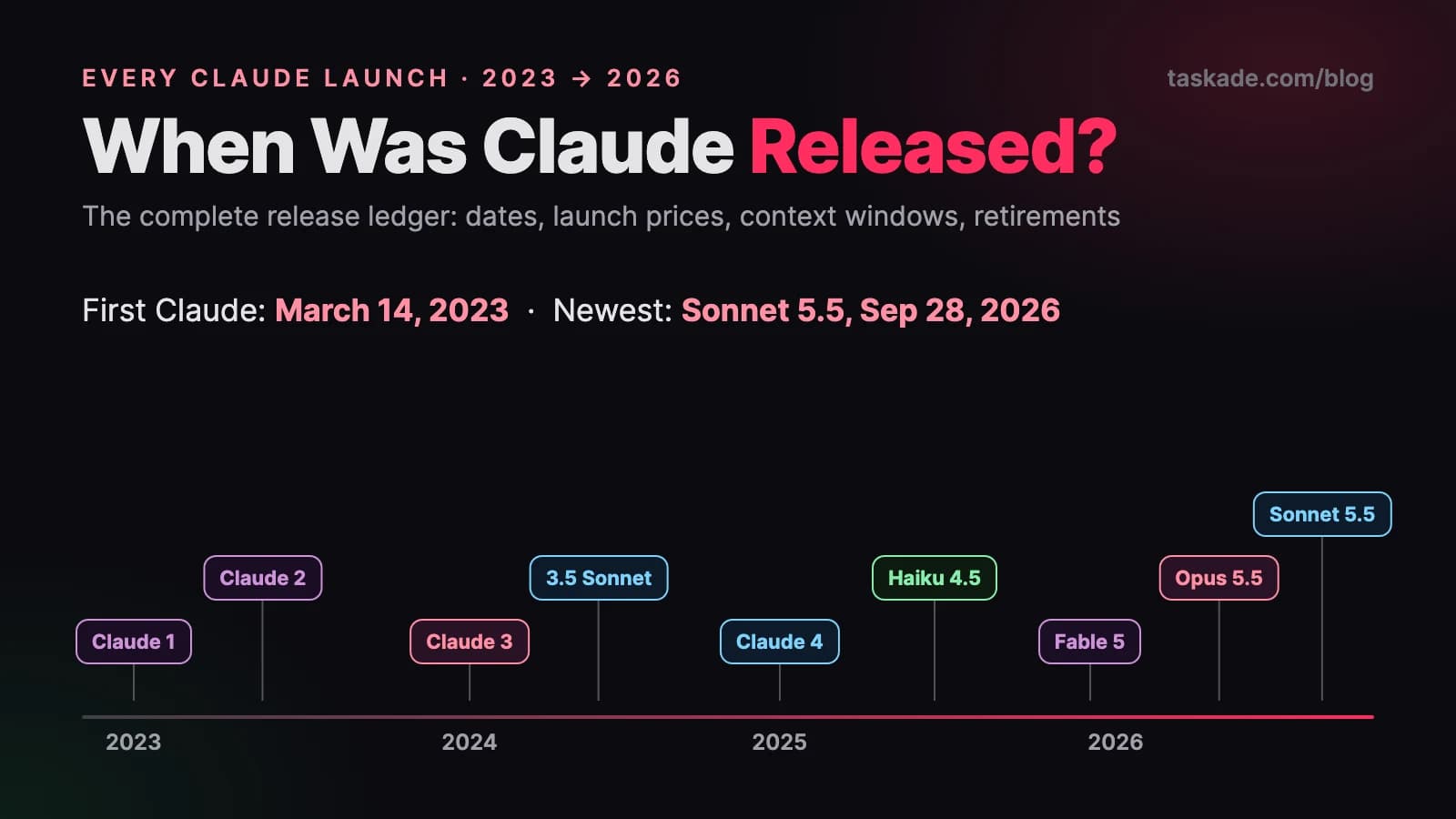
Claude was first released on March 14, 2023, when Anthropic opened early access to Claude and Claude Instant through a chat interface and an API. The newest Claude, Claude Sonnet 5.5, came out on September 28, 2026, and between those two dates Anthropic shipped a new Claude model on 24 separate days.
That is the whole answer to "when was Claude released?" The rest of this guide is the reference behind it. It holds the dated ledger of every Claude release, the price and context window each model launched with, which launches still work today, and how fast the cadence is accelerating. Every date below comes from Anthropic's own announcement pages, its model deprecations page, or its pricing and models documentation, checked on September 29, 2026.
TL;DR: Claude first launched on March 14, 2023 with limited access, opened to the public at claude.ai with Claude 2 on July 11, 2023, and has had 24 dated launches since, most recently Sonnet 5.5 on September 28, 2026. Opus 5.5 shipped September 22. Haiku 5.5 is next. Jump to the ledger ↓
When Was Claude Released? The Quick Answer
Claude was first released on March 14, 2023, first opened to the public on July 11, 2023, and most recently updated on September 28, 2026 with Claude Sonnet 5.5. Which date you mean depends on what "released" means to you: the first announcement, the first time a stranger could sign up, or the newest model on the API today.
| Question | Date | Model | What happened |
|---|---|---|---|
| First Claude ever released | March 14, 2023 | Claude 1 and Claude Instant | Early access through a chat interface and an API after a closed alpha with partners |
| First Claude open to the public | July 11, 2023 | Claude 2 | Beta chat at claude.ai for the US and UK, plus API access for businesses |
| First Claude with a 200K context window | November 21, 2023 | Claude 2.1 | 200,000 tokens, tool use in beta and system prompts |
| First three-tier family | March 4, 2024 | Claude 3 Opus, Sonnet and Haiku | Opus and Sonnet the same day, Haiku on March 13 |
| Claude Code first appears | February 24, 2025 | Claude 3.7 Sonnet | Limited research preview of the command-line agent |
| Claude 4 family | May 22, 2025 | Opus 4 and Sonnet 4 | Claude Code became generally available the same day |
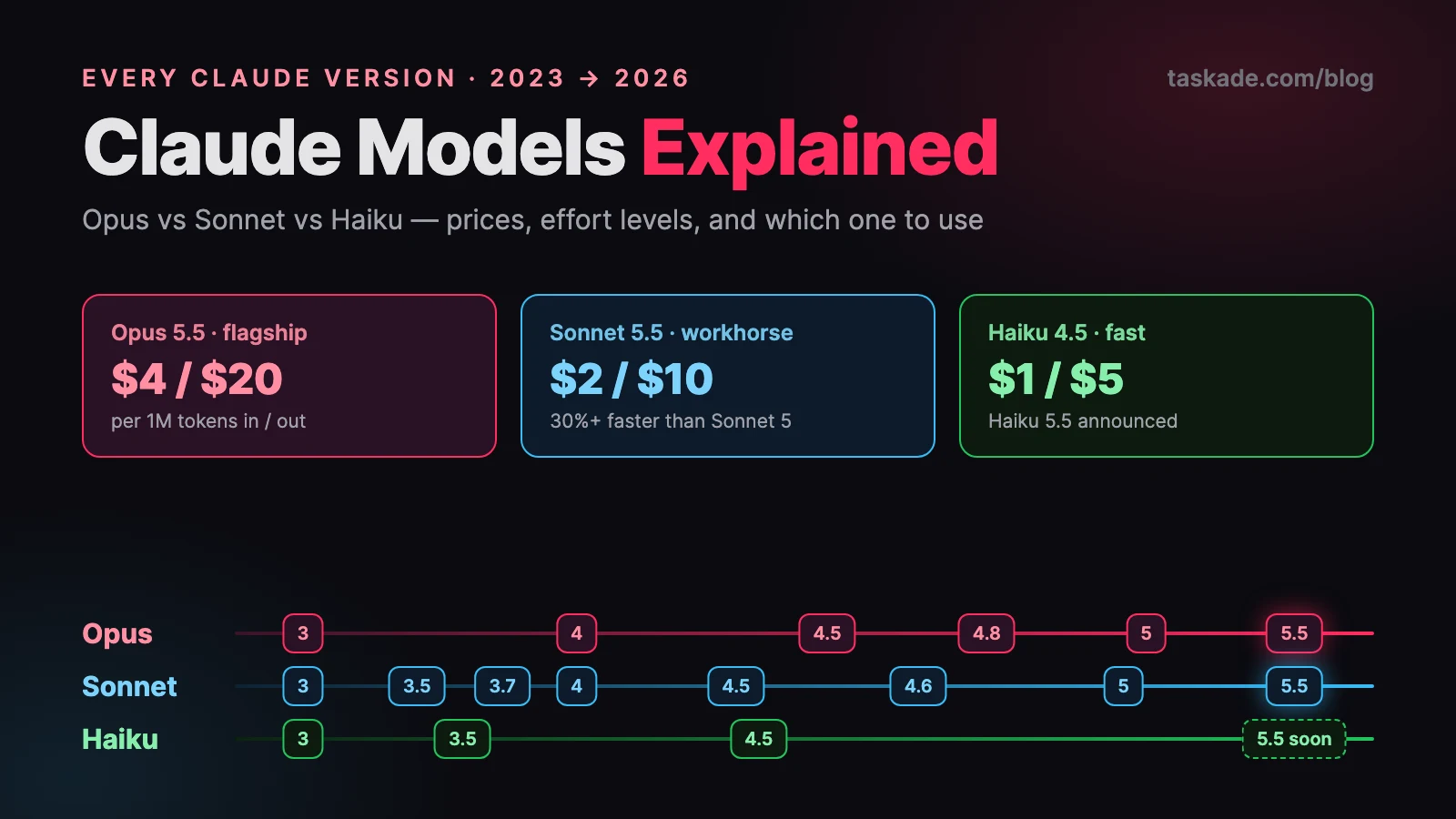
| Latest Opus | September 22, 2026 | Claude Opus 5.5 | $4 input and $20 output per million tokens |
| Latest Sonnet | September 28, 2026 | Claude Sonnet 5.5 | $2 input and $10 output per million tokens |
| Latest Haiku | October 15, 2025 | Claude Haiku 4.5 | $1 input and $5 output. Haiku 5.5 is announced for the coming weeks |
| Latest Mythos-class public model | September 1, 2026 | Claude Fable 5.1 | $10 input and $50 output. Mythos 5.1 is restricted |
Sources: Anthropic announcement pages for each model, linked in the year sections below, and the models overview.
Why the answer is not one date
Anthropic did not launch Claude once. It launched a research assistant to a short list of partners in March 2023, a consumer product four months later, a tiered product line a year after that, and a coding agent in 2025. Each of those moments is a defensible answer, which is why the search results for this question disagree with each other.
The plain rule is this. If you need one date, use March 14, 2023. If you are citing when ordinary people could first chat with Claude, use July 11, 2023. If you are choosing a model to build on, use the ledger below and read the "status today" column.
CLAUDE, IN FOUR DATES  2023-03-14   Claude 1 + Instant    Limited access, chat + API
|
2023-07-11   Claude 2              Public beta at claude.ai (US, UK)
|
2024-03-04   Claude 3 family       Opus / Sonnet / Haiku tiers begin
|
2026-09-28   Sonnet 5.5            Newest model on the API today
For the company behind those dates, including how Anthropic was founded and why it split from OpenAI, read the full Anthropic and Claude company history. This guide stays on the models.

The Master Release Ledger: Every Claude Model by Date
Anthropic released 30 Claude models across 24 launch days between March 14, 2023 and September 28, 2026. The ledger below lists every launch this guide could verify against a primary source, in date order, with the context window and launch price where the announcement or current documentation states them.
Three reading rules apply. A "not stated" cell means the launch post did not print the number, and this guide does not fill gaps from memory. Prices are dollars per million tokens, input then output, at launch. "Status today" comes from the model deprecations page, and "not sooner than" is Anthropic's tentative retirement floor for a model that is still active.
| Date | Model | Context | Launch price (in / out) | Status today |
|---|---|---|---|---|
| Mar 14, 2023 | Claude 1 and Claude Instant | not stated | not stated | Retired Nov 6, 2024 |
| Jul 11, 2023 | Claude 2 | 100K | same as Claude 1.3 | Retired Jul 21, 2025 |
| Nov 21, 2023 | Claude 2.1 | 200K | not stated | Retired Jul 21, 2025 |
| Mar 4, 2024 | Claude 3 Opus | 200K | $15 / $75 | Retired Jan 5, 2026 |
| Mar 4, 2024 | Claude 3 Sonnet | 200K | $3 / $15 | Retired Jul 21, 2025 |
| Mar 13, 2024 | Claude 3 Haiku | 200K | $0.25 / $1.25 | Retired Apr 20, 2026 |
| Jun 20, 2024 | Claude 3.5 Sonnet | 200K | $3 / $15 | Retired Oct 28, 2025 |
| Oct 22, 2024 | Claude 3.5 Sonnet (upgraded) | not stated | not stated | Retired Oct 28, 2025 |
| Oct 22, 2024 | Claude 3.5 Haiku | not stated | $0.80 / $4 (set Dec 3, 2024) | Retired Feb 19, 2026 |
| Feb 24, 2025 | Claude 3.7 Sonnet | not stated | $3 / $15 | Retired Feb 19, 2026 |
| May 22, 2025 | Claude Opus 4 | not stated | $15 / $75 | Retired Jun 15, 2026 |
| May 22, 2025 | Claude Sonnet 4 | not stated | $3 / $15 | Retired Jun 15, 2026 |
| Aug 5, 2025 | Claude Opus 4.1 | not stated | same as Opus 4 | Retired Aug 5, 2026 |
| Sep 29, 2025 | Claude Sonnet 4.5 | not stated | $3 / $15 | Active, not sooner than Sep 29, 2026 |
| Oct 15, 2025 | Claude Haiku 4.5 | 200K | $1 / $5 | Active, not sooner than Oct 15, 2026 |
| Nov 24, 2025 | Claude Opus 4.5 | 200K | $5 / $25 | Active, not sooner than Nov 24, 2026 |
| Feb 5, 2026 | Claude Opus 4.6 | 1M (beta) | $5 / $25 | Active, not sooner than Feb 5, 2027 |
| Feb 17, 2026 | Claude Sonnet 4.6 | 1M (beta) | $3 / $15 | Active, not sooner than Feb 17, 2027 |
| Apr 7, 2026 | Claude Mythos Preview | not stated | $25 / $125 (Project Glasswing partners) | Deprecated Jun 9, 2026 |
| Apr 16, 2026 | Claude Opus 4.7 | not stated | $5 / $25 | Active, not sooner than Apr 16, 2027 |
| May 28, 2026 | Claude Opus 4.8 | not stated | $5 / $25 | Active, not sooner than May 28, 2027 |
| Jun 9, 2026 | Claude Fable 5 | 1M | $10 / $50 | Active, not sooner than Jun 9, 2027 |
| Jun 9, 2026 | Claude Mythos 5 | 1M | $10 / $50 | Active, Project Glasswing only |
| Jun 30, 2026 | Claude Sonnet 5 | 1M | $2 / $10 (introductory, now standard) | Active, not sooner than Jun 30, 2027 |
| Jul 24, 2026 | Claude Opus 5 | 1M | $5 / $25 | Active, not sooner than Jul 24, 2027 |
| Sep 1, 2026 | Claude Fable 5.1 | 1M | $10 / $50 | Active, not sooner than Sep 1, 2027 |
| Sep 1, 2026 | Claude Mythos 5.1 | 1M | $10 / $50 | Active, restricted access |
| Sep 22, 2026 | Claude Opus 5.5 | 1M | $4 / $20 | Active, not sooner than Sep 22, 2027 |
| Sep 28, 2026 | Claude Sonnet 5.5 | 1M | $2 / $10 | Active, not sooner than Sep 28, 2027 |
Sources: Anthropic announcement pages, pricing, models overview, and model deprecations. The Claude 3.5 Haiku row uses the announcement date. Anthropic's post said the model would arrive later that month.
Some rows deserve a footnote.
- Claude 3 Sonnet's context window matches Opus because Anthropic's Claude 3 post says all three models "will initially offer a 200K context window upon launch."
- The Opus 4.6 and Sonnet 4.6 rows say beta because Anthropic launched the 1M window in beta on the developer platform, at a premium price above 200K tokens for Opus 4.6. Anthropic's pricing page now says Claude 4.6 and later models carry the full 1M window at standard rates.
- The Mythos Preview row shows the price Project Glasswing participants pay. Anthropic said it did not plan to make Mythos Preview generally available.
- The Sonnet 5 row launched at $2 / $10 as introductory pricing with a planned rise to $3 / $15 on September 1, 2026. Anthropic's pricing page now says that rise "will not occur."
The lineage at a glance
The ledger is easier to read as five tracks. Opus, Sonnet and Haiku are the three tiers that Claude 3 introduced. Mythos-class models, the Mythos Preview and then Fable and Mythos, sit above Opus. The track lengths show which tier Anthropic updates most often.
Two things stand out. The Opus and Sonnet tracks moved together for most of the timeline, and the Haiku track is the slow one: three releases in more than two years, with Haiku 4.5 still current as of this writing. To choose between the tiers today, use the sibling guide, Claude models explained, which covers effort levels, fallbacks and which model fits which job.
2023: From a Closed Alpha to a 200K Context Window
Claude spent 2023 moving from a partner-only assistant to a public product with the largest context window on the market, in three launches: March 14, July 11 and November 21. The year set the pattern that still holds. Anthropic launches a model, names its context window as the headline, and frames safety as the differentiator.
| 2023 launch | Date | What shipped | Headline claim |
|---|---|---|---|
| Claude 1 and Claude Instant | Mar 14 | Chat interface and API, early access | Helpful, honest and harmless assistant |
| 100K context window | May 11 | Context grew from 9,000 to 100,000 tokens in the API | Roughly 75,000 words in one prompt |
| Claude 2 | Jul 11 | Public beta at claude.ai, API for businesses | 76.5% on the bar exam multiple-choice section |
| Claude 2.1 | Nov 21 | 200K context, tool use beta, system prompts | 2x fewer false statements than Claude 2.0 |
Sources: Anthropic's announcements for Claude, 100K context windows, Claude 2 and Claude 2.1.
March 14, 2023: Claude and Claude Instant
Anthropic's first announcement called Claude "a next-generation AI assistant based on Anthropic's research into training helpful, honest, and harmless AI systems." It came in two versions: Claude, the high-performance model, and Claude Instant, "a lighter, less expensive, and much faster option." The company said it had run a closed alpha with partners and was now ready to offer Claude more broadly through early access requests.
That word "broadly" is easy to over-read. Claude in March 2023 was not something a curious person could sign up for that afternoon. It reached users through partners and early-access requests, which is why most timelines call it a limited launch. The announcement listed summarization, search, creative and collaborative writing, question answering and coding as the target jobs. It did not print a context window or a price in the text of the post.
The safety framing was already there. Anthropic described Claude as "much less likely to produce harmful outputs, easier to converse with, and more steerable." The method behind that claim, training a model against a written set of principles, is explained in our Constitutional AI wiki entry.
May 11, 2023: the first big context jump
Two months later, Anthropic announced that Claude's context window had grown from 9,000 tokens to 100,000 tokens in the API. Its own gloss was roughly 75,000 words, or about six hours of audio, and it said Claude could digest hundreds of pages of material in under a minute. This is the first of three big context steps in Claude's history, and the timeline of that whole race is in our history of the context window.
July 11, 2023: Claude 2 and the public launch
Claude 2 is the release that made Claude a consumer product. Anthropic opened a beta chat experience at claude.ai for users in the US and UK, and it made the API available to businesses at the same price as Claude 1.3. The company said global expansion would follow in the coming months.
Anthropic put numbers behind the upgrade. Claude 2 scored 76.5% on the multiple-choice section of the bar exam, up from 73.0%. It scored 71.2% on the HumanEval coding test, up from 56.0%, and 88.0% on the GSM8k math set, up from 85.2%. It accepted up to 100,000 tokens of input, and Anthropic called it twice as good as Claude 1.3 at giving harmless responses.
Treat those scores as launch-day claims from the vendor, not as neutral measurements. The tradition of every lab reporting its own best benchmark is a story of its own, told in why every model claims to be best.
November 21, 2023: Claude 2.1
Claude 2.1 doubled the context window to 200,000 tokens, which Anthropic put at about 150,000 words or more than 500 pages. It also introduced two features developers now take for granted: system prompts, so a builder can set standing instructions, and tool use in beta, so Claude could call developer-defined functions and APIs. Anthropic reported a 2x decrease in false statements compared with Claude 2.0.
The 200K window came with a catch that the announcement stated plainly. On claude.ai, the full window was reserved for Claude Pro subscribers. Free users kept the smaller one. That split, a bigger model or bigger window for paying subscribers first, has repeated in nearly every release since.
What 2023 taught the market
By the end of 2023 Claude had a public chat product, a paid tier with a 200K window, system prompts and a tool-use beta. Each of those became a standard feature of the category. For the other side of that race, the parallel record is in our OpenAI and ChatGPT history and the ChatGPT model list.
The retirement record for 2023 is short and complete. Anthropic told developers on September 4, 2024 that Claude 1 and the Instant models would retire on November 6, 2024, and on January 21, 2025 that Claude 2, Claude 2.1 and Claude 3 Sonnet (a 2024 model) would retire on July 21, 2025. Both retirements have happened. No 2023 model still answers on Anthropic's API.
2024: Claude 3 Turns One Model Into a Product Line
In 2024 Anthropic replaced the single Claude with a three-tier family, Opus, Sonnet and Haiku, and released four times: March 4, March 13, June 20 and October 22. The naming and the price ladder set in March 2024 are still the structure of the lineup, even though every 2024 model has since retired.
| 2024 launch | Date | Launch price (in / out) | Headline claim |
|---|---|---|---|
| Claude 3 Opus and Sonnet | Mar 4 | $15 / $75 and $3 / $15 | 200K context, three tiers |
| Claude 3 Haiku | Mar 13 | $0.25 / $1.25 | Fastest and cheapest of the family |
| Claude 3.5 Sonnet | Jun 20 | $3 / $15 | 2x the speed of Claude 3 Opus, plus Artifacts |
| Upgraded 3.5 Sonnet, 3.5 Haiku, computer use beta | Oct 22 | Haiku $0.80 / $4 (set Dec 3) | Claude can operate a computer, in public beta |
Sources: Anthropic's announcements for Claude 3, Claude 3 Haiku, Claude 3.5 Sonnet and the 3.5 models and computer use.
March 4, 2024: Claude 3
The Claude 3 announcement introduced three models in one post: Haiku, the fastest and most cost-effective, Sonnet, the balanced one, and Opus, the most intelligent. All three launched with a 200K context window, and Anthropic said some customers could get up to 1 million tokens. Prices set the ladder: Haiku at $0.25 and $1.25, Sonnet at $3 and $15, and Opus at $15 and $75 per million input and output tokens.
Opus and Sonnet were available on March 4. The announcement said Haiku would be available soon, and it arrived on March 13. That nine-day gap is the first example of a pattern that keeps recurring: a family announced together and shipped in stages, which is one reason a single "release date" for a model generation is often ambiguous.
The three-tier design is the lasting contribution. Before Claude 3 you picked Claude or Claude Instant. After it, you chose a point on a price and intelligence curve, which is exactly the decision the Claude models explained guide walks through and the Opus versus Sonnet comparison prices out.
June 20, 2024: Claude 3.5 Sonnet and Artifacts
Anthropic announced Claude 3.5 Sonnet on June 20, 2024, US time, as the first model in a 3.5 family. It kept Sonnet pricing at $3 and $15 per million tokens, kept the 200K window, and ran at twice the speed of Claude 3 Opus. It was free on claude.ai and the iOS app, with higher limits for Pro and Team subscribers.
It also launched Artifacts, a workspace that shows generated code and documents in a window beside the conversation so you can edit them live. Artifacts is the first time Claude's output lived beside the conversation instead of inside it. The same instinct, output that stays alive and editable after the chat ends, is what Taskade Genesis builds around.
This is the row where the date is worth a footnote. Anthropic's announcement is dated June 20 in US time, and some pages and time zones show June 21. The ledger uses June 20.
October 22, 2024: an upgraded Sonnet, Haiku 3.5 and computer use
Anthropic announced three things in one post: an upgraded Claude 3.5 Sonnet, a new Claude 3.5 Haiku, and a public beta of computer use, a capability that lets Claude perceive and interact with computer interfaces. Developers got computer use on the Anthropic API, Amazon Bedrock and Google Cloud's Vertex AI the same day.
Anthropic was candid about its state. It called computer use "experimental, at times cumbersome and error-prone," and said it expected the capability to improve as developers gave feedback. Claude 3.5 Haiku was to be released "later this month." Its price was revised on December 3, 2024 to $0.80 input and $4 output per million tokens, which is the number the ledger shows.
Computer use was small at the time and large in hindsight. It set the direction for agent products: a model that acts, not just answers. Our AI agents guide covers what that shift means in practice.
What 2024 taught the market
Four launches in a year gave buyers a stable ladder. Opus was the ceiling, Sonnet the workhorse, and Haiku the cheap tier. The retirement notes for these models are on the deprecations page: Claude 3 Opus retired on January 5, 2026, both 3.5 Sonnet versions on October 28, 2025, and Claude 3.5 Haiku on February 19, 2026. Claude 3 Haiku lasted longest, retiring on April 20, 2026, more than two years after launch.
2025: Claude Code, Extended Thinking and the Claude 4 Series
In 2025 Anthropic shipped six launches, February 24, May 22, August 5, September 29, October 15 and November 24, and turned Claude from a chat assistant into a coding agent. The year's defining events were a command-line tool called Claude Code, the Claude 4 family, and a price cut on Opus that reset what a flagship model costs.
| 2025 launch | Date | Launch price (in / out) | Headline claim |
|---|---|---|---|
| Claude 3.7 Sonnet and Claude Code preview | Feb 24 | $3 / $15 | Visible step-by-step thinking, up to 128K thinking tokens |
| Claude Opus 4 and Sonnet 4 | May 22 | $15 / $75 and $3 / $15 | Opus 4 at 72.5% on SWE-bench, Claude Code generally available |
| Claude Opus 4.1 | Aug 5 | same as Opus 4 | 74.5% on SWE-bench Verified |
| Claude Sonnet 4.5 | Sep 29 | $3 / $15 | 61.4% on OSWorld, Claude Agent SDK released |
| Claude Haiku 4.5 | Oct 15 | $1 / $5 | Sonnet 4-level coding at one-third the cost |
| Claude Opus 4.5 | Nov 24 | $5 / $25 | Opus price cut, new effort parameter |
Sources: Anthropic's announcements for Claude 3.7 Sonnet, Claude 4, Opus 4.1, Sonnet 4.5, Haiku 4.5 and Opus 4.5.
February 24, 2025: Claude 3.7 Sonnet and the Claude Code preview
Claude 3.7 Sonnet kept the $3 and $15 price, which Anthropic said includes thinking tokens. Its new trick was a choice between near-instant responses and extended, step-by-step thinking that is made visible to the user. API users could set how long the model thinks, up to 128K tokens of reasoning. For a plain-language tour of what that means, see our guide to AI thinking modes.
The same post introduced Claude Code as a limited research preview: a command-line tool that lets developers delegate substantial coding tasks. Anthropic said early testing showed it completing in one pass tasks that would normally take 45 minutes or more of manual work. That is the launch date of the product whose whole story is told in What is Claude Code?.
May 22, 2025: Claude 4
Claude Opus 4 and Claude Sonnet 4 launched together. Anthropic called Opus 4 "the world's best coding model" and reported 72.5% on SWE-bench and 43.2% on Terminal-bench. Prices carried over from Claude 3: $15 and $75 for Opus, $3 and $15 for Sonnet. Both models added extended thinking with tool use in beta, so Claude could alternate between reasoning and calling tools such as web search, and both could run tools in parallel.
Claude Code moved from preview to general availability the same day, with new VS Code and JetBrains integrations and GitHub Actions support through the Claude Code SDK. If you want one date for "when did Claude become an agent product," May 22, 2025 is the strongest candidate.
August 5, 2025: Opus 4.1
Opus 4.1 was a point release. Anthropic reported 74.5% on SWE-bench Verified, said the strengths were multi-file code refactoring and pinpointing precise corrections in large codebases, and kept pricing the same as Opus 4. It was the last Opus released at the $15 and $75 price. Anthropic's pricing page lists Opus 4.1 as retired on the Claude API, except on Amazon Bedrock and Google Cloud, which set their own schedules.
September 29, 2025: Sonnet 4.5 and the Agent SDK
Sonnet 4.5 kept the $3 and $15 price and posted 77.2% on SWE-bench Verified. Anthropic said it led the OSWorld computer-use benchmark at 61.4%, up from Sonnet 4's 42.2%, and that it could maintain focus for more than 30 hours on complex, multi-step tasks. The launch also released the Claude Agent SDK, the same infrastructure Anthropic uses inside Claude Code, as a public toolkit.
There is a date to watch here. The deprecations page lists Sonnet 4.5's tentative retirement as "not sooner than September 29, 2026," which is one year after launch. That floor date arrived on September 29, 2026. As of that date, Anthropic lists the model as Active and has announced no deprecation, and the policy is at least 60 days of notice before any retirement of a publicly released model.
October 15, 2025: Haiku 4.5
Haiku 4.5 arrived two weeks after Sonnet 4.5 at $1 input and $5 output. Anthropic said it delivers coding performance similar to Sonnet 4 at one-third the cost and more than twice the speed, and it scored 73.3% on SWE-bench Verified. It also framed a new orchestration pattern: a stronger model such as Sonnet 4.5 breaks a problem apart while several Haiku 4.5 instances handle the subtasks in parallel.
As of this writing, it is still the newest Haiku. Its own retirement floor is October 15, 2026, and the announced Haiku 5.5 is the model that will succeed it.
November 24, 2025: Opus 4.5 and the price reset
Opus 4.5 launched at $5 input and $25 output, down from $15 and $75. That is one-third of the previous Opus price on both sides. Anthropic described it as "the best model in the world for coding, agents, and computer use," gave it a 200K context window, and introduced an effort parameter on the API so developers can trade speed and cost against capability. It launched across Claude apps, the API and all three major cloud platforms on the same day.
The price cut is the most consequential number in the 2025 ledger, because every Opus since has stayed at or below it. The full price history is charted in the pricing section below.
THE 2025 PRICE RESET (Opus, per million tokens, input / output)  Opus 4    May 2025    $15 / $75   ##############################
Opus 4.1  Aug 2025    $15 / $75   ##############################
Opus 4.5  Nov 2025    $ 5 / $25   ##########
___ one-third of the old price
What 2025 taught the market
The release count rose from four to six, but the more important change was the target customer. The 2023 launches spoke to writers and researchers. The 2025 launches spoke to developers, then to anyone who wanted an agent to run for hours. If you compare how the rivals moved in the same year, the best Claude alternatives guide ranks the field. By the end of 2025, Claude 1, Claude 2, Claude 2.1, Claude 3 Sonnet and both Claude 3.5 Sonnet versions had left the API, and the current family was the 4.5 generation.
2026: The Year the Cadence Broke
Anthropic released eleven times between February 5 and September 28, 2026, more than in 2023 and 2024 combined. Three things happened at once. The context window jumped to 1 million tokens, a new tier called Mythos-class appeared above Opus, and the gap between launches shrank to a matter of days.
| 2026 launch | Date | Launch price (in / out) | Headline claim |
|---|---|---|---|
| Claude Opus 4.6 | Feb 5 | $5 / $25 | 1M context in beta, 128K output, adaptive thinking |
| Claude Sonnet 4.6 | Feb 17 | $3 / $15 | Default model for Free and Pro on claude.ai |
| Claude Mythos Preview | Apr 7 | $25 / $125 (Glasswing) | Not generally available, released to security partners |
| Claude Opus 4.7 | Apr 16 | $5 / $25 | Images up to 2,576 pixels, new tokenizer |
| Claude Opus 4.8 | May 28 | $5 / $25 | Fewer overlooked flaws in its own code |
| Claude Fable 5 and Mythos 5 | Jun 9 | $10 / $50 | First public Mythos-class model |
| Claude Sonnet 5 | Jun 30 | $2 / $10 | Sonnet at a lower price than Sonnet 4.6 |
| Claude Opus 5 | Jul 24 | $5 / $25 | Fast mode at 2.5x speed |
| Claude Fable 5.1 and Mythos 5.1 | Sep 1 | $10 / $50 | Lower cost at the same price, fewer false refusals |
| Claude Opus 5.5 | Sep 22 | $4 / $20 | Cheaper than Opus 5, 30%+ faster output |
| Claude Sonnet 5.5 | Sep 28 | $2 / $10 | 30%+ faster than Sonnet 5 |
Sources: Anthropic's announcements for Opus 4.6, Sonnet 4.6, Opus 4.7, Opus 4.8, Sonnet 5, Opus 5, Fable 5.1 and Mythos 5.1, Opus 5.5 and Sonnet 5.5, plus Project Glasswing.
February 2026: Opus 4.6 and Sonnet 4.6 bring the 1M window
Opus 4.6 launched on February 5 at the same $5 and $25 price as Opus 4.5. Its headline change was a 1 million token context window in beta on the developer platform, with premium pricing of $10 and $37.50 for prompts above 200K tokens. It supported up to 128K output tokens, added adaptive thinking that the model chooses to use, offered four effort levels, and brought agent teams to Claude Code. Anthropic reported a 76% score on the 8-needle 1M variant of MRCR v2, against 18.5% for Sonnet 4.5.
Twelve days later, Sonnet 4.6 arrived on February 17 at an unchanged $3 and $15 with the same beta 1M window. Anthropic said early-access developers preferred it over Opus 4.5 about 59% of the time, and it became the default model for Free and Pro users on claude.ai. The context history behind this jump, from 4K tokens to 1M, is in our history of the context window and the context window wiki entry.
April 7, 2026: Claude Mythos Preview, the model Anthropic held back
Anthropic announced Claude Mythos Preview on April 7 alongside Project Glasswing, an effort to secure critical software. It described a general-purpose model that was strikingly capable at computer security, and said that over the prior few weeks it had used the model to identify thousands of zero-day vulnerabilities across every major operating system and web browser.
Launch partners included Amazon Web Services, Apple, Broadcom, Cisco, CrowdStrike, Google, JPMorganChase, the Linux Foundation, Microsoft, NVIDIA and Palo Alto Networks, and more than 40 additional organizations got access. Participants paid $25 and $125 per million tokens, and Anthropic committed $100 million in usage credits. It said it did not plan to make Mythos Preview generally available.
This is the first Claude model that Anthropic said it would not release generally, which is why the ledger lists it but a "latest model you can call" list does not. The tier it started is covered in Claude Fable and Mythos explained.
April 16 and May 28, 2026: Opus 4.7 and Opus 4.8
Opus 4.7 on April 16 held the $5 and $25 price and improved advanced software engineering. It accepted images up to 2,576 pixels on the long edge, more than three times what earlier Claude models accepted. It also shipped a new tokenizer: the same input can consume roughly 1.0 to 1.35 times more tokens, depending on content. Anthropic's pricing page says the tokenizer produces about 30% more tokens for the same text, so a price that did not change can still mean a bill that did.
Opus 4.8 on May 28 kept the price again. Anthropic said it was about four times less likely than Opus 4.7 to overlook flaws in its own code, added dynamic workflows for parallel subagents, offered fast mode at $10 and $50, and said it planned to release Mythos-class models "in the coming weeks" once cybersecurity safeguards were ready.
June 9, 2026: Fable 5 and Mythos 5
Anthropic kept that promise on June 9. Claude Fable 5 is a Mythos-class model made safe for general use, with safety classifiers that can decline requests. Claude Mythos 5 is the same underlying model without those classifiers, offered only to approved Project Glasswing customers. Both carry a 1M token context window, up to 128K output tokens, and a price of $10 input and $50 output, less than half of Mythos Preview's $25 and $125.
What followed is the only launch in Claude's history that was suspended by a government. The sequence below comes from Anthropic's own timeline.
Anthropic said the controls required it to restrict access to foreign nationals, and because it could not verify nationality in real time, it suspended access for everyone on June 12. It said the trigger was a jailbreak found by Amazon researchers that let the model identify software vulnerabilities, a behavior the safeguards were meant to prevent, and that it trained improved classifiers in response. Fable 5 returned on July 1 across the Claude Platform, claude.ai, Claude Code and Claude Cowork.
For a release-date ledger, the lesson is that "released" and "available" can differ. Fable 5 was released on June 9, unavailable from June 12 to June 30 for most users, and back on July 1. The ledger keeps June 9, and this paragraph keeps the gap on the record.
June 30, 2026: Sonnet 5 and the price that did not go up
Sonnet 5 launched on June 30 at $2 input and $10 output, below Sonnet 4.6's $3 and $15. Anthropic called it "the most agentic Sonnet model yet," said its performance approached Opus 4.8 at a lower cost, and made it the default for Free and Pro plans. It announced the $2 and $10 as introductory pricing through August 31, with a planned rise to $3 and $15 on September 1.
The rise never happened. Anthropic's pricing page now says the introductory price is the standard price and that the scheduled increase "will not occur." The launch price for Sonnet 5 is therefore still in force three months later.
July 24, 2026: Opus 5
Opus 5 launched on July 24 at $5 and $25, with a fast mode that Anthropic described as 2.5 times faster at twice the base price. It said Opus 5 became the default model on Claude Max and the strongest model on Claude Pro. It also claimed state-of-the-art results on several benchmarks. As with every launch-day benchmark, read those as vendor claims, and check the history of AI benchmarks for how to weigh them.
September 1, 2026: Fable 5.1 and Mythos 5.1
Fable 5.1 and Mythos 5.1 launched on September 1 at the same $10 and $50 price. Anthropic said lower effort levels could match or beat Fable 5's results at much lower cost, cut the cache-read price to $0.25 per million tokens, and cut false positives in cybersecurity contexts by 60%. Fable 5.1 went to all platforms. Mythos 5.1 stayed restricted to vetted cyberdefenders and life scientists through trusted access programs.
September 22 and 28, 2026: the 5.5 family
Claude Opus 5.5 launched on September 22 at $4 input and $20 output, 20% below Opus 5, with cache reads at $0.20 per million tokens and a fast mode at $8 and $40. Anthropic called it the first model in the Claude 5.5 family, said it performs at Fable 5.1 levels while costing substantially less, and raised the five-hour usage limits on the Pro, Max, Team and seat-based Enterprise plans.
Claude Sonnet 5.5 followed six days later, on September 28, at $2 and $10. Anthropic said it runs more than 30% faster than Sonnet 5 and costs up to 30% less for most work, and it scored 70.6% on Terminal-Bench 4.0, against 10.3% for Sonnet 5. Both 5.5 posts say the same thing about the last tier: Claude Haiku 5.5 will join the family "in the coming weeks."
Launch-day reaction was mixed, as developer reaction usually is. Hacker News commenters on Sonnet 5.5 noted it landed within two points of Opus 5.5 on CursorBench, at 55.5% and 57.8%. Another said Sonnet 5 had been poor value through the API next to cheaper open models. A third group complained that cybersecurity safeguards routed legitimate security work back to Opus 4.8, even with the Cyber Verification Program. Treat those as sentiment from commenters, not measurements.
That diagram shows a typical launch day in 2026, based on how the Sonnet 5.5 and Opus 4.5 announcements describe availability. The order of steps is illustrative. The verified fact is that recent models ship to the API, the major clouds and the apps on the same day.
What 2026 taught the market
The 2026 ledger shows three shifts. Price stopped tracking capability upward: the Opus price fell from $15 to $5 to $4 across 2025 and 2026, and Sonnet fell from $3 to $2. Cadence collapsed: the shortest gap in the whole ledger, six days, sits at the end. And the top of the lineup became conditional. Fable classifiers, Mythos gating and cyber fallbacks mean the model that answers is not always the model you picked, which is the subject of the fallback section in Claude models explained.
How Often Does Anthropic Release a New Claude?
Anthropic released a new Claude model on 24 separate days between March 14, 2023 and September 28, 2026, an average gap of 56 days, and the pace has risen every year: 3 launch days in 2023, 4 in 2024, 6 in 2025 and 11 in 2026 so far. Counting models rather than days, the ledger holds 4 models in 2023, 6 in 2024, 7 in 2025 and 13 in 2026.
The 2026 bar covers only nine months. At the 2026 pace of one launch every 23 days, the year would finish near 15, but that is arithmetic and not a forecast. Anthropic has published no schedule.
A quarterly view shows where the acceleration actually happened. The second quarter of 2026 alone holds five launch days: Mythos Preview, Opus 4.7, Opus 4.8, Fable 5 and Mythos 5, and Sonnet 5.
| Year | Launch days | Models | Average gap between launches in that year |
|---|---|---|---|
| 2023 | 3 | 4 | 126 days |
| 2024 | 4 | 6 | 77 days |
| 2025 | 6 | 7 | 55 days |
| 2026 (to Sep 28) | 11 | 13 | 24 days |
Method: launch days and models come from the ledger above. The average gap counts only days between launches inside the same year. The overall figure of 56 days is 1,294 days divided by 23 gaps.
Some extremes are worth knowing. The longest gap in the whole ledger is 133 days, from Claude 2 on July 11, 2023 to Claude 2.1 on November 21, 2023. The shortest is six days, from Opus 5.5 on September 22, 2026 to Sonnet 5.5 on September 28, 2026. Two gaps are nine days: Claude 3 Opus and Sonnet to Haiku in March 2024, and Mythos Preview to Opus 4.7 in April 2026.
LAUNCH DAYS, 2023 TO SEP 2026  (each # is one launch day)  2023  ###
2024  ####
2025  ######
2026  ###########   (through Sep 28)
One caution on comparing the counts. A launch day is a launch day whether it ships one model or two, and this ledger counts the rows it could verify. Point releases such as Claude Instant 1.2 on August 9, 2023, which the deprecations page lists as claude-instant-1.2, are not in the ledger because this guide did not verify their launch date against a primary source. Any count that includes them will run slightly higher.
Claude Price History: What Each Model Cost at Launch
Claude's flagship price fell by 73% in two years, from $15 input and $75 output per million tokens for Claude 3 Opus in March 2024 to $4 and $20 for Opus 5.5 in September 2026, while Haiku moved the other way. Every number below is the price printed in the announcement or on Anthropic's current pricing page, in dollars per million tokens.
| Tier | First launch price (in / out) | Price today (in / out) | Change |
|---|---|---|---|
| Opus | $15 / $75 (Opus 3, Mar 2024) | $4 / $20 (Opus 5.5) | 73% lower |
| Sonnet | $3 / $15 (Sonnet 3, Mar 2024) | $2 / $10 (Sonnet 5.5) | 33% lower |
| Haiku | $0.25 / $1.25 (Haiku 3, Mar 2024) | $1 / $5 (Haiku 4.5) | 4x higher |
| Mythos-class and Fable | $25 / $125 (Mythos Preview, Apr 2026) | $10 / $50 (Fable 5.1) | 60% lower |
Sources: Anthropic announcements and the pricing page. Mythos Preview's $25 / $125 applied to Project Glasswing participants only.
Opus: two cuts, one big and one small
Opus held $15 and $75 through Opus 4.1 in August 2025, dropped to $5 and $25 with Opus 4.5 in November 2025, held there through Opus 5, and fell to $4 and $20 with Opus 5.5.
Sonnet: flat for two years, then one cut
Sonnet stayed at $3 and $15 from Claude 3 Sonnet in March 2024 through Sonnet 4.6 in February 2026, a run of six launches. Sonnet 5 then dropped it to $2 and $10, and Sonnet 5.5 kept that price.
Haiku: cheaper to start, pricier as it improved
Haiku is the one tier whose price rose. Claude 3 Haiku launched at $0.25 and $1.25. Claude 3.5 Haiku was revised to $0.80 and $4 on December 3, 2024. Haiku 4.5 launched at $1 and $5. Anthropic's Haiku 4.5 post said it matches Sonnet 4's coding performance at one-third of the cost, so the higher price bought a much stronger model.
The tiers converged
In March 2024 the Opus input price was 60 times the Haiku input price. In September 2026 it is 4 times. The ladder compressed from both ends.
INPUT PRICE PER MILLION TOKENS, MAR 2024 VS SEP 2026  Opus     $15.00 ############################  ->  $4  ########
Sonnet   $ 3.00 ######                         ->  $2  ####
Haiku    $ 0.25 #                              ->  $1  ##
(Fable 5.1 sits above Opus at $10 input, launched in 2026)
Two caveats keep the price story honest. First, the per-token price is not the per-task price, because a model at higher effort spends more tokens, and a newer tokenizer can spend about 30% more tokens on the same text. Second, prompt caching and batch processing change the effective price: cache reads cost 10% of the base input price on most models, and batch requests are 50% off. For the arithmetic of cost per finished job, read AI cost per task, and for tactics that lower the bill, how to cut LLM costs and the prompt caching wiki entry.
Context Window Growth: From 9K to 1M Tokens
Claude's context window grew from about 9,000 tokens to 1 million tokens in three jumps: 100K in May 2023, 200K in November 2023, and 1M in 2026. The 1M window then became standard rather than premium, and it now ships by default on Fable 5.1, Opus 5.5 and Sonnet 5.5.
| Date | Milestone | Window | Source |
|---|---|---|---|
| Before May 2023 | Claude's window before the 100K announcement | 9,000 tokens | Anthropic 100K post |
| May 11, 2023 | 100K context in the API | 100,000 tokens | Anthropic 100K post |
| Jul 11, 2023 | Claude 2 | 100,000 tokens | Claude 2 post |
| Nov 21, 2023 | Claude 2.1 | 200,000 tokens | Claude 2.1 post |
| Mar 4, 2024 | Claude 3 family, up to 1M for select customers | 200,000 tokens | Claude 3 post |
| Feb 5 and 17, 2026 | Opus 4.6 and Sonnet 4.6 | 1M tokens in beta | Opus 4.6 and Sonnet 4.6 posts |
| Jun 9, 2026 | Fable 5 and Mythos 5 | 1M tokens by default | Fable 5 documentation |
| Sep 2026 | Fable 5.1, Opus 5.5, Sonnet 5.5 | 1M tokens, 128K output | Models overview |
Two details prevent misreading. First, Haiku 4.5 still has a 200K window and a 64K output limit, so "Claude has a 1M window" is true of the top three tiers and not of the whole lineup. Second, a token is not a fixed number of words. Anthropic says 1M tokens is roughly 555,000 words on the current tokenizer, introduced with Opus 4.7, against about 750,000 words on earlier models. A 200K window in 2023 therefore held more words per token than a 200K window would today.
The full race across every lab, and why long context did not fix long-document recall, is in the history of the context window. The context window wiki entry covers the mechanics.
Retired Claude Models: What Still Works and What Does Not
Fifteen Claude models are active on Anthropic's API as of September 29, 2026, one is deprecated, and every model from Claude 1 through Opus 4.1 is retired. A retired model fails: requests to it return an error, so any application pinned to one has to migrate. Amazon Bedrock and Google Cloud set their own retirement schedules, so a model that is retired on Anthropic's API can still run on a partner cloud.
Anthropic uses four lifecycle terms, and they only move forward.
Active means fully supported and recommended. Legacy means the model no longer gets updates and may be deprecated later. Deprecated means still functional but not recommended, with a replacement and a retirement date. Retired means requests fail.
The retirement ledger
| Model | Notice sent | Retired | Recommended replacement |
|---|---|---|---|
| Claude 1 and Instant | Sep 4, 2024 | Nov 6, 2024 | Haiku 4.5 |
| Claude 2, Claude 2.1, Claude 3 Sonnet | Jan 21, 2025 | Jul 21, 2025 | Opus 4.8 and Sonnet 4.6 |
| Claude 3.5 Sonnet (both versions) | Aug 13, 2025 | Oct 28, 2025 | Sonnet 4.6 |
| Claude 3.7 Sonnet | Oct 28, 2025 | Feb 19, 2026 | Sonnet 4.6 |
| Claude 3.5 Haiku | Dec 19, 2025 | Feb 19, 2026 | Haiku 4.5 |
| Claude 3 Opus | Jun 30, 2025 | Jan 5, 2026 | Opus 4.8 |
| Claude 3 Haiku | Feb 19, 2026 | Apr 20, 2026 | Haiku 4.5 |
| Claude Opus 4 and Sonnet 4 | Apr 14, 2026 | Jun 15, 2026 | Opus 4.8 and Sonnet 4.6 |
| Claude Opus 4.1 | Jun 5, 2026 | Aug 5, 2026 | Opus 4.8 |
Source: Anthropic's model deprecations page, September 29, 2026. Claude Mythos Preview was deprecated on June 9, 2026 with a retirement date still to be announced.
How long a Claude model lasts
From launch to retirement, a Claude model has lived between roughly 12 and 25 months.
Method: months from the launch date in the ledger to the retirement date on the deprecations page. The Claude 1 bar measures Claude 1.3 against its November 6, 2024 retirement, and the 3.5 Haiku bar starts at its October 22, 2024 announcement.
The longest-lived model is Claude 3 Haiku at about 25 months. The shortest are Claude 3.7 Sonnet and Opus 4.1 at about 12 months. The trend since 2025 is about one year, and Anthropic's current commitment matches it: every active model's earliest possible retirement is exactly one year after its release.
How much notice you get
Anthropic promises at least 60 days of notice before retiring a publicly released model, and recent notices have run right at that floor.
| Notice | Days between notice and retirement |
|---|---|
| Claude 3 Opus (Jun 30, 2025) | 189 |
| Claude 2 family (Jan 21, 2025) | 181 |
| Claude 3.7 Sonnet (Oct 28, 2025) | 114 |
| Claude 3.5 Sonnet (Aug 13, 2025) | 76 |
| Claude 1 and Instant (Sep 4, 2024) | 63 |
| Opus 4 and Sonnet 4 (Apr 14, 2026) | 62 |
| Claude 3.5 Haiku (Dec 19, 2025) | 62 |
| Claude Opus 4.1 (Jun 5, 2026) | 61 |
| Claude 3 Haiku (Feb 19, 2026) | 60 |
NOTICE WINDOWS, RECENT RETIREMENTS  Opus 3      |==========================================| 189 days
Sonnet 3.7  |=======================|                     114 days
Opus 4.1    |============|                                 61 days
Haiku 3     |===========|                                  60 days
^ policy floor: 60 days
The practical advice is short. Pin the exact model ID in production, note its "not sooner than" date, and watch the deprecations page, because a notice can arrive with only two months of lead time. As of September 29, 2026, the three nearest floors are Sonnet 4.5 on September 29, 2026, Haiku 4.5 on October 15, 2026 and Opus 4.5 on November 24, 2026. A floor is not an announcement, and none of the three was deprecated on that date.
What Comes Next: Haiku 5.5 and the Rest of the 5.5 Family
Claude Haiku 5.5 is the next announced Claude model, and Anthropic has given no date beyond "in the coming weeks." Both the Opus 5.5 post on September 22, 2026 and the Sonnet 5.5 post on September 28, 2026 say it will join the Claude 5.5 family, built for high-volume and cost-sensitive applications.
Here is what the ledger supports, and what it does not.
- Supported: Haiku 5.5 is announced and unreleased. The 5.5 family is releasing top-down, Opus first and Sonnet six days later. The Haiku track has the slowest cadence of the three tiers.
- Not supported: a release date, a price, or a context window for Haiku 5.5. Any article that states them is guessing.
- Watch: the three retirement floors in the section above, and whether Fable and Mythos follow the 5.5 pattern after Fable 5.1 and Mythos 5.1 in September.
The competitive backdrop moved in the same weeks. OpenAI's GPT-6 family launched in September 2026, and the prices sit close to Claude's: OpenAI lists Sol at $2 and $10 per million tokens, the same as Sonnet 5.5. The what is GPT guide explains that family's tiers, and Claude versus ChatGPT compares the products.
When Haiku 5.5 does ship, expect this page to gain one row. The definitive version of any release ledger is the one that keeps getting updated.
How to Track New Claude Releases
The four primary sources for a Claude release are Anthropic's news page, its models overview, its pricing page and its model deprecations page. Together they answer when a model launched, what it costs, what context it has and when it retires. This ledger is built from those pages and nothing else.
| Source | What it tells you | How to use it |
|---|---|---|
| Anthropic news | Launch date, launch price, launch claims | Record the date and price at launch |
| Models overview | Current lineup, context, output limit, retirement floor | Check before you choose a model ID |
| Pricing | Current price, cache and batch rates | Check before you budget |
| Model deprecations | Lifecycle status and retirement dates | Check before you pin a model in production |
Keep your own ledger in a workspace
A ledger is only useful if it stays current, and copying rows by hand does not scale across a 24-launch history. A simple pattern works in Taskade: keep a project with one row per model and columns for date, price, context and retirement floor, and let an automation do the extraction. The Anthropic Claude connector has an Extract Structured Data action, so an automation can take the text of a release post and return the date, price and context as fields, which you then add to the project. You bring your own Anthropic key, so the usage bills to your Anthropic account and spends no Taskade credits. The setup guide is Bring your own AI key.
You can browse what Taskade itself shipped recently in the Taskade changelog.
Track every AI model release in a live Taskade Genesis app
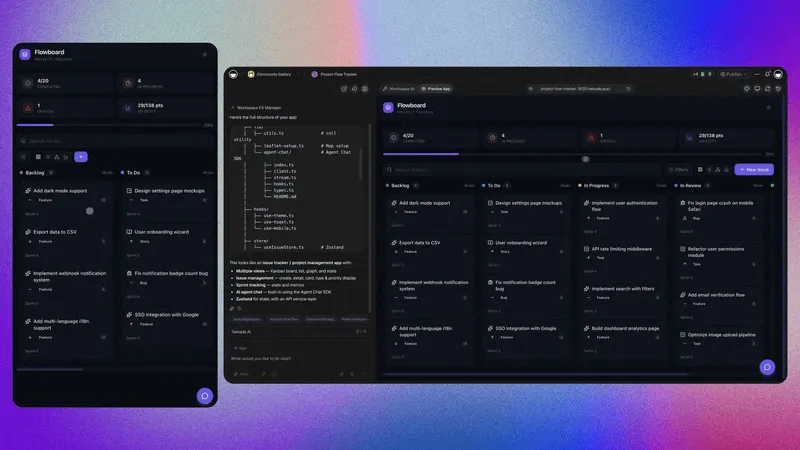
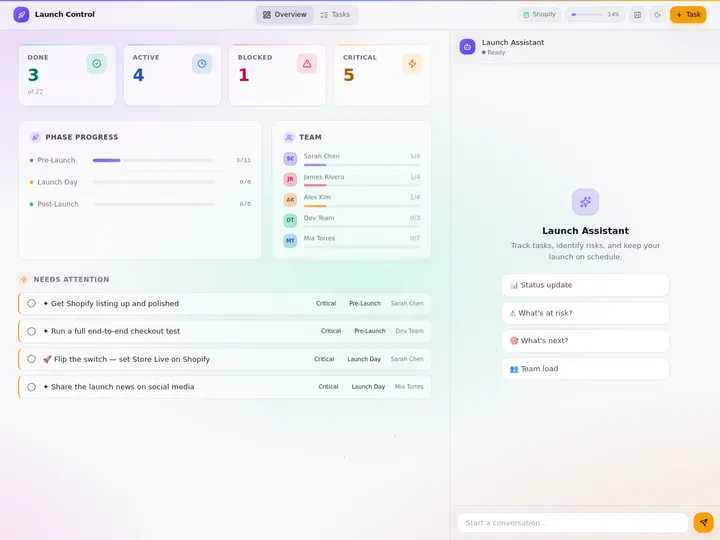
One prompt can build a live Claude release tracker in Taskade Genesis: a table of launches, a calendar of dates, an AI agent that answers "when did X launch?", and an automation that adds new releases as they appear. It is the ledger above, kept current without copying rows by hand.
Try a prompt like this in Taskade Genesis: "Build a release tracker for AI models. Add a Table with model, vendor, launch date, price and context window. Add a Calendar of launch dates. Add an AI agent that answers questions like when did a model launch. Add an automation that watches a feed for new releases and adds a row." Taskade EVE asks clarifying questions, then builds the app. The table shows what each part does.
| Part of the app | What it does | Built from |
|---|---|---|
| Launch table | One row per model with date, price, context and retirement floor | Projects in Table view |
| Date calendar | Every launch on a calendar, so gaps and clusters are visible | Calendar view of the same project |
| "When did X launch?" agent | Answers from your table, with the row as the source | Custom AI agent with project knowledge |
| Release watcher | Adds a row when a tracked feed publishes something new | RSS automation |
The watcher uses the RSS trigger, which fires when a tracked feed publishes new content and works on every plan, Free included. Point it at a vendor's news feed, and an action adds the new item to your table. The setup guide is RSS feed automation. If you want to push releases in from another system, a webhook trigger does the same job on Pro and above.
RELEASE TRACKER, ONE PROMPT  feed publishes  -->  automation  -->  new row in Table
|
Calendar  <-------+------->  Agent answers
(dates on a grid)            "when did X launch?"
Want the ledger to read the release post for you? The Anthropic Claude connector has an Extract Structured Data action, so an automation can turn a post into date, price and context fields. It runs on your own Anthropic key, bills to your Anthropic account and spends no Taskade credits.
When the app works, publish it with a shareable URL (publishing guide) and share the link with your team. You can also start from a finished app instead of a blank prompt. The Community Gallery lets you clone a live tracker and adapt it.

Using Claude With Taskade
Taskade Genesis builds apps, agents and automations on frontier models from top AI labs, and Auto is the default model. You do not have to track this ledger to build with it, because Auto picks a model for the work.
If you specifically want Claude, there are two supported routes, and both use your own Anthropic API key.
- Automations, on every plan including Free. The Anthropic Claude integration adds three actions to any automation: Ask Claude, Ask About an Image and Extract Structured Data. Usage bills to your Anthropic account.
- Enterprise BYOK. Enterprise workspaces can add their own Anthropic key so AI agents that name a Claude model run on it. The guide is Enterprise BYOK.
Claude Code and Claude Desktop can also connect to Taskade through the Taskade MCP server, so a coding agent can read and write your workspace.
To go from a model list to something running, start at the AI apps hub, browse ready-made AI agents and automations, or explore what other people built in community apps. Plans start free, and Pro is $10 per month billed annually on the pricing page.
Frequently Asked Questions
When was Claude AI released?
Claude was first released on March 14, 2023, when Anthropic opened early access to Claude and Claude Instant through a chat interface and an API. Anyone in the US and UK could use it on claude.ai from July 11, 2023, with the launch of Claude 2. The newest Claude models are Claude Opus 5.5, released September 22, 2026, and Claude Sonnet 5.5, released September 28, 2026.
When did Claude come out?
Claude came out in four steps. Claude 1 and Claude Instant launched with limited access on March 14, 2023. Claude 2 opened claude.ai to the public in the US and UK on July 11, 2023. The Claude 3 family followed on March 4, 2024, and the Claude 4 family on May 22, 2025. The Claude 5 generation began with Fable 5 on June 9, 2026.
When did Claude launch to the public?
Claude launched to the public on July 11, 2023, when Anthropic released Claude 2 with a beta chat experience at claude.ai for users in the US and UK and made the API available to businesses. Claude 2 accepted up to 100,000 tokens of input. Claude 1 and Claude Instant, launched on March 14, 2023, were limited to partners and early-access requests.
What is the Claude launch date for each model?
Key launch dates are Claude 2 on July 11, 2023, Claude 2.1 on November 21, 2023, Claude 3 Opus and Sonnet on March 4, 2024, Claude 3.5 Sonnet on June 20, 2024, Claude 3.7 Sonnet on February 24, 2025, Claude 4 on May 22, 2025, Sonnet 4.5 on September 29, 2025, Opus 4.5 on November 24, 2025, Opus 4.6 on February 5, 2026, Sonnet 5 on June 30, 2026, Opus 5 on July 24, 2026, Opus 5.5 on September 22, 2026 and Sonnet 5.5 on September 28, 2026.
What is the newest Claude model?
As of September 29, 2026, the newest Claude model is Claude Sonnet 5.5, released September 28, 2026 at 2 dollars per million input tokens and 10 dollars per million output tokens. Claude Opus 5.5 arrived six days earlier on September 22, 2026 at 4 and 20 dollars. Claude Fable 5.1 is the top public tier at 10 and 50 dollars. Claude Haiku 5.5 is announced for the coming weeks, and Haiku 4.5 is the current Haiku.
What is the Claude model timeline?
The Claude timeline runs from Claude 1 in March 2023 to Sonnet 5.5 in September 2026. The main stages are Claude 2 and 2.1 in 2023, the Claude 3 family in March 2024, Claude 3.5 Sonnet in June 2024, Claude 3.7 Sonnet and Claude Code in February 2025, the Claude 4 family from May 2025, Mythos Preview in April 2026, Fable 5 and Mythos 5 in June 2026, and the Claude 5.5 family from September 22, 2026.
When was Anthropic founded?
Anthropic was founded in 2021 by former OpenAI staff led by the siblings Dario Amodei, now CEO, and Daniela Amodei, now president. Its first Claude model launched about two years later, on March 14, 2023. Sources disagree on whether the founding team had seven or eight people, so this guide states only the founding year.
How often does Anthropic release a new Claude model?
Anthropic has released a new Claude model on 24 separate days between March 14, 2023 and September 28, 2026, an average gap of 56 days. The pace rose each year: 3 launch days in 2023, 4 in 2024, 6 in 2025 and 11 in 2026 so far. The average gap in 2026 is about 23 days, and the shortest gap, between Opus 5.5 and Sonnet 5.5, was 6 days.
Which Claude models are retired?
Retired models fail when called on Anthropic's API. They include Claude 1 and Instant (retired November 6, 2024), Claude 2, 2.1 and Sonnet 3 (July 21, 2025), both Claude 3.5 Sonnet versions (October 28, 2025), Opus 3 (January 5, 2026), Sonnet 3.7 and Haiku 3.5 (February 19, 2026), Haiku 3 (April 20, 2026), Opus 4 and Sonnet 4 (June 15, 2026) and Opus 4.1 (August 5, 2026).
How much did Claude cost at launch compared with now?
Claude Opus launched at 15 dollars input and 75 dollars output per million tokens in March 2024 and stayed there through Opus 4.1. Opus 4.5 cut the price to 5 and 25 dollars in November 2025, and Opus 5.5 now costs 4 and 20 dollars. Sonnet held at 3 and 15 dollars from March 2024 until Sonnet 5 dropped it to 2 and 10 dollars in June 2026.
When is Claude Haiku 5.5 coming out?
Anthropic has not given a date. The Opus 5.5 announcement on September 22, 2026 and the Sonnet 5.5 announcement on September 28, 2026 both say Claude Haiku 5.5, built for high-volume and cost-sensitive applications, will join the Claude 5.5 family in the coming weeks. Until it ships, Claude Haiku 4.5, released October 15, 2025 at 1 and 5 dollars per million tokens, is the current Haiku.
Can I use Claude in Taskade?
Yes, with your own Anthropic API key. The Anthropic Claude automation connector can ask Claude a question, read an image or extract structured data inside any Taskade automation, on every plan including Free, and it bills to your Anthropic account. Enterprise workspaces can add their own Anthropic key so AI agents that name a Claude model run on it. Taskade Genesis itself runs on frontier models from top AI labs, with Auto as the default.
Related Reading
- Claude models explained: Opus vs Sonnet vs Haiku
- Anthropic and Claude history: the full company timeline
- Best Claude alternatives in 2026, ranked
- ChatGPT models explained: every GPT version
- Claude Fable and Mythos explained
- What is Claude Code?
- The history of the context window
- Why every model claims to be best: a history of AI benchmarks
- AI cost per task: what AI work really costs
- Constitutional AI explained
- Opus vs Sonnet: the Claude tier cost guide
- Taskade home
Every model ledger goes stale, and the durable skill is knowing which page to check. Anthropic changed the Claude lineup 24 times in 42 months, and the next change is already announced. Keep your own ledger where your work lives, and let the model behind it change without breaking the workflow. Build your first AI app free with Taskade Genesis → ▲ ■ ●