






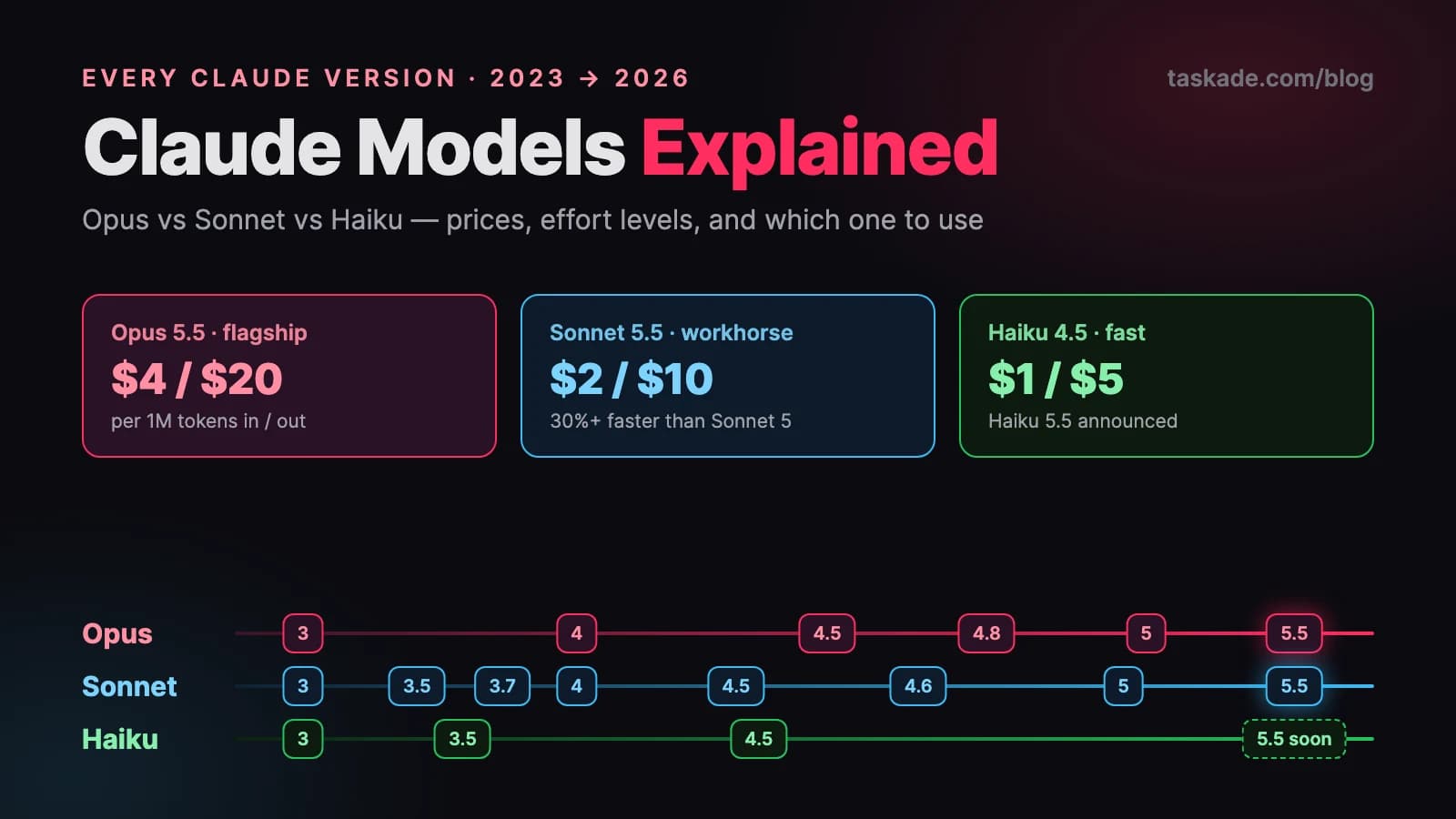
Anthropic now sells four Claude tiers at four price points, updates them on four separate clocks, and lets you run each one at five effort levels. That is 20 configurations before you pick a version. It is no surprise that "is Sonnet or Opus newer?" is one of the most searched Claude questions of 2026.
This guide untangles the whole family in one place: every Claude model from Claude 1 (March 2023) to Claude Sonnet 5.5 (September 28, 2026), which ones still work, what each tier is for, what they cost per token and per task, and why a Claude model sometimes answers with a different model's voice.
TL;DR: The current Claude lineup is Fable 5.1 ($10/$50 per million tokens), Opus 5.5 ($4/$20), Sonnet 5.5 ($2/$10, released September 28, 2026) and Haiku 4.5 ($1/$5), with Haiku 5.5 coming soon. Opus is the judgment tier, Sonnet the fast workhorse, Haiku the high-volume tier. Effort level moves your bill more than the model name does. See the full timeline ↓
🧭 What Are the Current Claude Models? (September 2026)
Anthropic's current Claude lineup is Fable 5.1, Opus 5.5, Sonnet 5.5 and Haiku 4.5. Three of them share a 1 million token context window, a 128,000 token output limit and a June 2026 knowledge cutoff. Anthropic's own guidance is to start with Opus 5.5 for most workloads and to move up to Fable 5.1 only when Opus 5.5 at higher effort still falls short.
| Model | API ID | Price per 1M tokens (in / out) | Context / max output | Default effort |
|---|---|---|---|---|
| Claude Fable 5.1 | claude-fable-5-1 |
$10 / $50 | 1M / 128K | high |
| Claude Opus 5.5 | claude-opus-5-5 |
$4 / $20 | 1M / 128K | medium |
| Claude Sonnet 5.5 | claude-sonnet-5-5 |
$2 / $10 | 1M / 128K | medium in apps, high on the API |
| Claude Haiku 4.5 | claude-haiku-4-5-20251001 |
$1 / $5 | 200K / 64K | no effort setting |
Source: Anthropic's models overview, pricing page and the Sonnet 5.5 announcement, checked September 28, 2026.
Two numbers in that table are easy to misread:
- Cache pricing is where long agent sessions spend their money (see prompt caching). Cache reads cost $0.20 per million tokens on both Opus 5.5 and Sonnet 5.5, so the two models cost the same to re-read a long conversation. Cache writes differ: $5 on Opus 5.5 and $2.50 on Sonnet 5.5. Developers in the Opus 5.5 launch thread on Hacker News reported that cache reads made up 95 to 98 percent of their interactive-session tokens.
- Opus has a fast mode. Opus 5.5, Opus 5 and Opus 4.8 support fast mode, a research preview with up to 2.5× higher output speed at premium pricing ($8 / $40 per million tokens on Opus 5.5).
- Fable 5.1 cut its cache price. It keeps Fable 5's $10 / $50 rates, with cache reads at a quarter of Fable 5's cost.
- The context window counts tokens, not words. Anthropic's overview notes that the tokenizer used since Claude 4.7 fits roughly 555,000 English words into 1 million tokens, against roughly 750,000 words on older models. The same document costs more tokens than it used to.
📋 Claude Model Specs: Knowledge Cutoffs, Vision, Retirement Dates and Cloud IDs
Every current Claude model accepts text and image input, returns text, and supports tool use and multilingual work. The differences that matter are the knowledge cutoff, the thinking mode, the context window and the earliest retirement date. Anthropic's models overview lists all of them, and we checked it on September 29, 2026.
| Model | Reliable knowledge cutoff | Training data cutoff | Thinking | Earliest retirement |
|---|---|---|---|---|
| Fable 5.1 | Jun 2026 | Jun 2026 | Adaptive, always on | Not before Sep 1, 2027 |
| Opus 5.5 | Jun 2026 | Jun 2026 | Adaptive, always on | Not before Sep 22, 2027 |
| Sonnet 5.5 | Jun 2026 | Jun 2026 | Adaptive | Not before Sep 28, 2027 |
| Haiku 4.5 | Feb 2025 | Jul 2025 | Extended (optional) | Not before Oct 15, 2026 |
Three details deserve a second look:
- Haiku 4.5 knows about 16 months less. Its reliable cutoff is February 2025, so it misses most of 2025 and all of 2026. Pair it with search or retrieval for anything recent. Our guide to context windows explains how to feed a model fresh facts.
- Haiku 4.5 has the nearest retirement date. Anthropic's commitment is "not sooner than October 15, 2026", one year after release. Pinned Haiku 4.5 users must watch the deprecations page as Haiku 5.5 arrives.
- Vision is universal. All four models read images, so tier choice does not depend on whether a task includes screenshots, charts or scans. Images are billed as input tokens. Our multimodal AI entry covers how that works.
Claude model IDs on every platform
Model IDs differ by platform, and a typo returns an error instead of a fallback. The IDs below come straight from the same overview page.
| Model | Claude API | Amazon Bedrock | Google Cloud |
|---|---|---|---|
| Fable 5.1 | claude-fable-5-1 |
anthropic.claude-fable-5-1 |
claude-fable-5-1 |
| Opus 5.5 | claude-opus-5-5 |
anthropic.claude-opus-5-5 |
claude-opus-5-5 |
| Sonnet 5.5 | claude-sonnet-5-5 |
anthropic.claude-sonnet-5-5 |
claude-sonnet-5-5 |
| Haiku 4.5 | claude-haiku-4-5-20251001 |
anthropic.claude-haiku-4-5 |
claude-haiku-4-5@20251001 |
Microsoft Foundry and Claude Platform on AWS use the Claude API IDs. Bedrock and Google Cloud set their own lifecycle dates, and both charge a 10 percent premium for regional endpoints over global ones on 4.5-generation and later models. Fast mode runs on the Claude API only.
🪜 Opus vs Sonnet vs Haiku (and Fable): The Four Claude Tiers
Claude comes in four tiers that trade capability for speed and price: Fable, Opus, Sonnet and Haiku. Each tier is a separate model, trained separately and priced separately. From Haiku 4.5 to Fable 5.1 the per-token price spread is 10×, which is wider than the quality gap between most frontier labs. That makes tier choice, not vendor choice, the decision that moves your bill.
| Tier | What it is built for | Where it is the wrong pick |
|---|---|---|
| Fable | The hardest reasoning and research, when Opus at xhigh or max effort still falls short | Everyday work, because it costs 2.5× Opus per token |
| Opus | Complex, open-ended work: system design, long analyses, agent orchestration | High-volume steps where speed matters more than judgment |
| Sonnet | Well-scoped tasks: bug fixes, documents, slides, spreadsheets, sub-agents | Ambiguous problems that need sustained judgment |
| Haiku | Classification, routing, extraction, the small steps inside larger pipelines | Anything that needs deep reasoning |
The tiers also overlap more than their names suggest. A new Sonnet has matched or beaten the previous Opus more than once: Sonnet 3.5 outran Opus 3 in 2024, and Sonnet 5.5 scores within two points of Opus 5.5 on GDPval-AA, a test of real work across 44 occupations. The reverse is also true: Opus 5.5 at low effort often beats Sonnet 5.5 at high effort for a similar cost. We come back to that in the effort section.
❓ Is Sonnet or Opus Newer? Why Claude Version Numbers Confuse Everyone
Neither tier name means "newer." Opus, Sonnet and Haiku update on separate schedules, and the version number carries the date. In September 2026 the newest release is Sonnet 5.5 (September 28), six days after Opus 5.5 (September 22), while the newest Haiku is still 4.5 from October 2025. Fable updated on its own date, September 1.
                2025                          2026
          ─────────────────────────────────────────────────────▶
OPUS      4 ──── 4.1 ──── 4.5 ──── 4.6 ── 4.7 ── 4.8 ── 5 ── 5.5
SONNET    4 ──────── 4.5 ─────────── 4.6 ──────── 5 ───────── 5.5  ◀ newest
HAIKU                    4.5 ──────────────────────────────── (5.5 announced)
FABLE                                         5 ─────── 5.1
Three naming rules decode almost every Claude question:
- The number is the generation, the word is the size. "Claude Sonnet 5.5" means the Sonnet-size model of the 5.5 generation.
- Not every tier gets every number. There was an Opus 4.7 and 4.8, but no Sonnet 4.7 or 4.8, and no Haiku 5. Anthropic ships a tier when that tier is ready.
- Newer beats bigger surprisingly often. A new Sonnet regularly matches the previous Opus, so "the most expensive model" and "the best model for this task" are different questions.
🔁 Is Claude Fable Replacing Opus?
No. Anthropic sells Fable 5.1 and Opus 5.5 side by side, and tells most teams to start with Opus. Its models overview says to begin with Opus 5.5 for most workloads and to use Fable 5.1 for demanding reasoning and long-horizon agentic work, or when your own evals on Opus 5.5 at higher effort still fall short. Opus 5.5 also shipped three weeks after Fable 5.1, at 40 percent of the price.
Read the ladder left to right as an escalation path. Move one step right only when an eval on your own tasks shows the cheaper model falls short.
| Question | Opus 5.5 | Fable 5.1 |
|---|---|---|
| Price per million tokens | $4 in, $20 out | $10 in, $50 out |
| Default effort | medium | high |
| Anthropic's advice | Start here for most workloads | Use when Opus at higher effort falls short |
| Best fit, per Claude Academy | Live, back-and-forth sessions | Autonomous, long-horizon work |
| Fast mode | Yes, research preview | No |
Sources: the models overview, the fast mode docs and Anthropic's Claude Academy guide to choosing a model.
📜 Claude Version History: Every Claude Model, 2023–2026
Anthropic has released more than 25 Claude models since Claude 1 in March 2023. The table below lists each release with its date and its API status on September 28, 2026, taken from Anthropic's model deprecations page. "Retired" means requests to that model now fail. "Active" means it still works on the Claude API, even if a newer model replaced it.
| Released | Model | What it introduced | API status (Sep 2026) |
|---|---|---|---|
| Mar 14, 2023 | Claude 1 and Claude Instant | First Claude, trained with Constitutional AI | Retired Nov 6, 2024 |
| Jul 11, 2023 | Claude 2 | 100K-token context, public claude.ai | Retired Jul 21, 2025 |
| Nov 21, 2023 | Claude 2.1 | 200K-token context | Retired Jul 21, 2025 |
| Mar 4, 2024 | Claude 3 Opus and Sonnet | First three-tier family, image input | Retired (Opus Jan 5, 2026, Sonnet Jul 21, 2025) |
| Mar 13, 2024 | Claude 3 Haiku | Fast, low-cost tier | Retired Apr 20, 2026 |
| Jun 20, 2024 | Claude 3.5 Sonnet | Beat Claude 3 Opus at a lower price, Artifacts | Retired Oct 28, 2025 |
| Oct 22, 2024 | Claude 3.5 Sonnet (upgraded) and 3.5 Haiku | Computer use beta | Retired (Sonnet Oct 28, 2025, Haiku Feb 19, 2026) |
| Feb 24, 2025 | Claude 3.7 Sonnet | First hybrid reasoning model, with a toggle between standard and extended thinking | Retired Feb 19, 2026 |
| May 22, 2025 | Claude Opus 4 and Sonnet 4 | Claude 4 generation | Retired Jun 15, 2026 |
| Aug 5, 2025 | Claude Opus 4.1 | Coding and instruction-following gains | Retired Aug 5, 2026 |
| Sep 29, 2025 | Claude Sonnet 4.5 | Mid-tier coding leader | Active (retirement no sooner than Sep 29, 2026) |
| Oct 15, 2025 | Claude Haiku 4.5 | Near-Sonnet 4 quality at a third of the cost | Current Haiku |
| Nov 24, 2025 | Claude Opus 4.5 | Coding benchmark lead | Active |
| Feb 5, 2026 | Claude Opus 4.6 | 1M-token context (beta), agent teams | Active |
| Feb 17, 2026 | Claude Sonnet 4.6 | Near-Opus computer use | Active |
| Apr 7, 2026 | Claude Mythos Preview | Cyber-defense research model, Project Glasswing only | Deprecated Jun 9, 2026 |
| Apr 16, 2026 | Claude Opus 4.7 | Incremental frontier gains | Active |
| May 28, 2026 | Claude Opus 4.8 | Fast mode, effort control | Active (the cyber fallback for Opus 5.5) |
| Jun 9, 2026 | Claude Fable 5 and Mythos 5 | First Mythos-class public tier | Active |
| Jun 30, 2026 | Claude Sonnet 5 | Sonnet joins the 5 generation | Active (the cyber fallback for Sonnet 5.5) |
| Jul 24, 2026 | Claude Opus 5 | Opus joins the 5 generation | Active |
| Sep 1, 2026 | Claude Fable 5.1 and Mythos 5.1 | Mythos-class refresh | Current Fable |
| Sep 22, 2026 | Claude Opus 5.5 | Fable 5.1-level work at $4 / $20 | Current Opus |
| Sep 28, 2026 | Claude Sonnet 5.5 | 70.6% Terminal-Bench 4.0, 30%+ faster | Current Sonnet |
Release dates from Anthropic announcements and the retirement dates on its deprecations page. For launch-by-launch detail, including launch prices and context windows, see every Claude release date. Claude 3.5 Haiku was announced October 22, 2024 and reached the API in early November. For the company story behind each launch, from the OpenAI exodus to the $965B valuation, read our complete history of Anthropic and Claude.
Two patterns stand out in that table. First, Anthropic now ships a new Claude model more than once a month: 11 releases between February and September 2026. Second, retirement is real. Anthropic gives at least 60 days of notice, and a pinned model ID stops working on its retirement date. Anthropic has also committed to preserving the weights of retired models long term, but you cannot call them.
🆕 Claude Sonnet 5.5: What Changed on September 28, 2026
Claude Sonnet 5.5 is Anthropic's new mid-tier model: the same $2 / $10 price as Sonnet 5, more than 30 percent faster, and a large capability jump. Anthropic positions it as the faster, lower-cost complement to Opus 5.5, strongest at well-scoped everyday tasks, fixing bugs, and creating polished documents, slides and spreadsheets.
| Benchmark | Sonnet 5.5 | Sonnet 5 | Opus 5.5 | GPT-6 Sol |
|---|---|---|---|---|
| Terminal-Bench 4.0 (agentic coding) | 70.6% | 10.3% | 66.4% | - |
| CursorBench 4.0 | 55.5% | 34.1% | 57.8% | - |
| GDPval-AA v2.1 (real work, 44 jobs) | 1844 | 1449 | 1846 | 1487 |
| OSWorld 2.1 (computer use) | 80.1% | 57.0% | 81.8% | - |
| Humanity's Last Exam (with tools) | 64.5% | 54.9% | 67.7% | - |
| Chartography (no tools) | 61.6% | 15.6% | 64.4% | 53.6% |
Source: Anthropic's Sonnet 5.5 announcement. GPT-6 Sol figures are Anthropic's reporting.
What else shipped with it:
- Speed. Output is 30%+ faster than Sonnet 5, which makes it the fastest Sonnet Anthropic has released.
- Efficiency. Anthropic reports it costs up to 30 percent less per task than Sonnet 5, because it batches tool calls and finishes in fewer steps. Slack reported about 14 percent fewer output tokens on its offline Slackbot evaluations with no prompt changes.
- Safeguards. It is the first Sonnet with cyber safeguards and a fallback model, and the first with classifiers that block reasoning-extraction attempts.
- Behavior. On its system card, over-refusal of benign requests on the API fell to 0.02 percent from 0.59 percent on Sonnet 5 (0.20 percent against 1.54 percent on claude.ai).
- Haiku 5.5 is next. Anthropic says it will join the 5.5 family "in the coming weeks."
⚖️ Claude Sonnet 5.5 vs Opus 5.5: Which One Should You Run?
Opus 5.5 is the stronger model. Sonnet 5.5 is the faster and cheaper one at low and medium effort. Anthropic's own verdict: "Opus 5.5 remains clearly stronger at complex, open-ended work requiring sustained judgment," while Sonnet 5.5 "complements Opus 5.5 best when running at lower effort settings." At high effort and above, the two cost about the same per task.
Why Sonnet "beats" Opus on Terminal-Bench (and why that is not the whole story)
Sonnet 5.5's 70.6 percent against Opus 5.5's 66.4 percent on Terminal-Bench 4.0 is the most quoted number of launch day. The Sonnet 5.5 system card shows why it is not a like-for-like result:
- Sonnet 5.5 ran at max effort. Opus 5.5 is reported at xhigh (it scores 64.8 percent at max).
- Safeguards sent 1.5 percent of Sonnet's trials to a fallback model, against 10 percent of Opus's trials.
- The standard error is ±2.5 points for Sonnet and ±2.6 points for Opus.
A 4-point gap that is roughly one combined standard error, with one model partly answered by an older model, does not show that Sonnet is the better coder. It shows that a benchmark measures a configuration, safeguards included.
Tokens per task: where Sonnet's price advantage goes
Sonnet 5.5 costs half as much as Opus 5.5 per token. At max effort it also spends far more tokens. Artificial Analysis measured about 193,000 output tokens per task for Sonnet 5.5 at max effort, roughly 60 percent more than Opus 5.5 at max, and put its cost at $7.60 per index task against $5.98 for Opus 5.5 at max.
Source: Artificial Analysis Intelligence Index, max effort with default fallback. The GPT-6 Astra figure is derived from Artificial Analysis's statement that Sonnet 5.5 used about 7 times Astra's tokens. Fable 5.1 and Opus 5.5 figures are from Artificial Analysis Intelligence Index v4.3.2.
| Question | Pick | Why |
|---|---|---|
| Fast iteration on a well-defined change | Sonnet 5.5, low or medium | Fastest Sonnet, cheapest good-enough answer |
| Sub-agents under an orchestrator | Sonnet 5.5, medium | Speed and price matter more than peak judgment |
| Anything you would run at high effort or above | Opus 5.5, low or medium | Similar cost per task, stronger judgment |
| System design, audits, long analyses | Opus 5.5 | Anthropic's own recommendation for open-ended work |
| The hardest research and reasoning | Fable 5.1 | Only when Opus 5.5 at xhigh or max effort falls short |
🎚️ Claude Effort Levels Explained: The Dial That Moves Your Bill
Effort levels control how long Claude reasons before it answers, and on the 5.5 models they change your cost more than the model name does. The five levels are low, medium, high, xhigh and max. Anthropic's charts for Sonnet 5.5 show that at low or medium effort it beats Sonnet 5's best score on several benchmarks for about a tenth of the cost per task.
| Model | Default effort | Can thinking be turned off? |
|---|---|---|
| Fable 5.1 | high | No, adaptive thinking is always on |
| Opus 5.5 | medium (Opus 5 defaulted to high) | No. Use low effort instead |
| Sonnet 5.5 | medium in the Claude apps, high on the Claude Platform | Not fully. between_tools is the lowest setting |
| Haiku 4.5 | not supported | Extended thinking is optional |
Simon Willison's well-known pelican test on launch day shows the curve in one table. He asked Sonnet 5.5 for the same SVG at every effort level:
| Effort | Output tokens | Cost | Time |
|---|---|---|---|
| low | 1,623 | 1.6¢ | 10 s |
| medium | 1,796 | 1.8¢ | 11 s |
| high | 2,334 | 2.3¢ | 17 s |
| xhigh | 5,730 | 5.7¢ | 42 s |
| max | 128,000 | $1.28 | 15 min 40 s, no answer |
Source: Simon Willison's measurements, posted in the Hacker News launch thread on September 28, 2026.
At max effort the model spent the entire 128,000-token output limit on thinking and never produced the SVG. He reported the same behavior on Opus 5.5 a week earlier. Three rules follow:
- Start at the default and measure. Anthropic's own advice for Opus 5.5 is to start at medium and set the level explicitly.
- Treat max as a special tool, not a quality setting. It can fail outright on a simple task.
- Compare cost per task, not price per token. Our AI cost per task guide shows how to run a 20-task test on your own work. The reasoning effort wiki entry explains the mechanism.
💵 Claude API Pricing Explained: Base, Batch, Cache and Fast Mode
Claude API pricing has four levers: the base token price, the 50 percent Batch API discount, prompt caching, and fast mode. All prices below are per million tokens and come from Anthropic's pricing page, checked September 29, 2026.
| Model | Input | Output | Batch (in / out) | Cache read |
|---|---|---|---|---|
| Fable 5.1 | $10 | $50 | $5 / $25 | $0.25 |
| Opus 5.5 | $4 | $20 | $2 / $10 | $0.20 |
| Sonnet 5.5 | $2 | $10 | $1 / $5 | $0.20 |
| Haiku 4.5 | $1 | $5 | $0.50 / $2.50 | $0.10 |
Cache writes cost 1.25 times the base input price for a 5-minute cache and 2 times for a 1-hour cache. A cache read costs 0.1 times the input price, except 0.05 times on Opus 5.5 and 0.025 times on Fable 5.1. Discounts stack, so the arithmetic for one Opus 5.5 input token looks like this:
OPUS 5.5 INPUT, PER MILLION TOKENS (our arithmetic from Anthropic's multipliers)Standard input .................. $4.00   ████████████████████
Batch API, 50% off .............. $2.00   ██████████
Cache read, 0.05x ............... $0.20   █
Batch + cache read, stacked ..... $0.10   ▌
Other pricing facts worth knowing:
- Long context costs the same per token. Claude 4.6 and later models include the full 1 million token window at standard pricing, so a 900,000-token request is billed at the same rate as a 9,000-token one.
- The newer tokenizer adds tokens. Claude 4.7 and later models produce roughly 30 percent more tokens for the same text than older ones. Compare cost per task, not just price per token.
- US-only inference costs 10 percent more. The
inference_geo: "us"setting applies a 1.1 times multiplier on Claude 4.6 and later models. - Web search is $10 per 1,000 searches on the Claude API, on top of token costs. Web fetch has no extra charge.
What 120 million tokens cost on each model
A worked example makes the tier spread concrete. Take a monthly workload of 100 million input tokens and 20 million output tokens, and assume every model uses the same number of tokens (real models do not, as the effort section shows).
Arithmetic from the list prices above. The Batch API halves each bar for work that can wait. Anthropic's own worked example is smaller: 10,000 support tickets at about 3,700 tokens each cost roughly $37 on Haiku 4.5. For the full method on measuring cost per task, see AI cost per task and how to cut LLM costs. The prompt caching entry explains the cache mechanics.
What is Claude fast mode?
Fast mode runs the same Opus model on a faster inference setup, for up to 2.5 times higher output tokens per second at premium pricing. It is a research preview, so you request access from your account manager or join the waitlist. Anthropic's fast mode docs list these rules:
| Rule | Detail |
|---|---|
| Models | Opus 5.5, Opus 5 and Opus 4.8 only |
| Price on Opus 5.5 | $8 input, $40 output per million tokens |
| Price on Opus 5 and 4.8 | $10 input, $50 output |
| What gets faster | Output tokens per second, not time to first token |
| Where it runs | Claude API only, not Bedrock, Google Cloud or the Batch API |
You opt in per request with speed: "fast" and a beta header:
POST /v1/messages
anthropic-beta: fast-mode-2026-02-01{ "model": "claude-opus-5-5", "speed": "fast", ... }
The intelligence does not change, because Anthropic says it is the same weights and behavior. Switching between fast and standard speed invalidates the prompt cache, so pick one speed per session. Sonnet 5.5 and Fable 5.1 have no fast mode.
🛡️ Why Claude Sometimes Switches Models: Safeguards and Fallbacks
Claude's newest models screen some requests with safety classifiers, and a flagged request can be answered by an older model. In the Claude apps the switch is visible: you see a notice, and the reply is labeled with the model that answered. On the Claude API, fallback is off by default, so a flagged request returns stop_reason: "refusal" with a category, and the developer decides what happens next.
| Flag category | Opus 5.5 | Sonnet 5.5 |
|---|---|---|
Cybersecurity (cyber) |
Falls back to Opus 4.8 | Falls back to Sonnet 5 |
Frontier-model development (frontier_llm) |
Falls back to an earlier Opus (Opus 5 or Opus 4.8) | Falls back to Sonnet 5 |
Biology (bio) |
Falls back to an earlier Opus (Opus 5 or Opus 4.8) | Hard block, no fallback |
| Reasoning extraction | Blocked, no fallback | Blocked, no fallback |
Sources: Anthropic's Sonnet 5.5 migration guide, the Sonnet 5.5 system card (section 1.5), the Opus 5.5 developer notes, and the help center article on model switching with Sonnet 5.5.
The diagram shows the API path. In the Claude apps, the retry happens automatically and the reply carries a label with the model that answered.
What this means in practice:
- Routine coding is unaffected. Anthropic's policy allows vulnerability discovery in source code and blocks it in compiled binaries.
- False positives happen. Developers in the launch threads reported blocks on write-ahead-log durability checks, Bluetooth presence detection and 30-year-old C code.
- The Cyber Verification Program does not cover the 5.5 models yet. Anthropic says it will "soon" expand the program to Opus 5.5, Sonnet 5.5 and Mythos-class models.
- A new model family blocks one more category. The API's
frontier_llmrefusal covers requests that "could assist the development of competing AI models," such as kernel work on certain ML accelerators.
🔐 The Hidden Difference: Prompt Injection Resistance
Sonnet 5.5 is far harder to hijack with hidden instructions than Opus 5.5, according to Anthropic's own testing. In the system card's coding test, where an attacker hides instructions inside content an agent reads, attacks succeeded on 3.01 percent of attempts against Sonnet 5.5 and 54.61 percent against Opus 5.5, both measured without extra safeguards.
| Model (with thinking) | Attack success, no safeguards | Attack success, probes on |
|---|---|---|
| Claude Sonnet 5.5 | 3.01% | 2.63% |
| Claude Sonnet 5 | 19.47% | 15.76% |
| Claude Fable 5.1 | 51.93% | 8.70% |
| Claude Opus 5.5 | 54.61% | 11.13% |
Source: Claude Sonnet 5.5 System Card, Table 5.2.2.1.A (Shade indirect prompt injection, coding environments). Lower is better.
In browser use, Anthropic reports Sonnet 5.5 as the first model it has tested with no successful attacks in its red-team evaluation. If your agent reads email, web pages or uploaded files, that is a reason to consider Sonnet 5.5 for the reading step, and to add structural protections either way.
🧰 For Developers: Five API Settings That Return a 400 on Claude 5.5
The Claude 5.5 models reject five request settings with a 400 error, and two of them worked on Sonnet 5 and Opus 5. Anthropic's migration guides say existing prompts carry over. Existing requests often do not.
REQUEST SETTING               BEFORE 5.5                    SONNET 5.5 / OPUS 5.5
────────────────────────────  ────────────────────────────  ─────────────────────────
thinking: {type: "disabled"}  accepted on Sonnet 5, Opus 5  400 → use effort "low"
                                                            (Sonnet 5.5:
                                                            "between_tools")
tool_choice: "any" or "tool"  accepted on Sonnet 5          400 → name the tool in
                                                            the prompt instead
thinking budget_tokens: N     deprecated since Sonnet 4.6   400 → use effort levels
temperature / top_p / top_k   400 since Opus 4.7            400 on non-default values
assistant prefill             400 since Sonnet 4.6          400 → move it into
                                                            the prompt
Two quieter changes matter for anyone who routes across models:
- Thinking does not cross families. Sonnet 5.5 cannot read thinking blocks produced by Opus 5, Opus 5.5, Fable or Mythos. The API drops them silently and returns a normal response, so a conversation that moves from Opus 5.5 to Sonnet 5.5 loses its earlier reasoning with no error.
- History must be append-only. On accounts created on or after August 31, 2026, each thinking block is signed over the conversation before it. Editing earlier messages and replaying the block returns a 400. Anthropic's fix is to change instructions with mid-conversation system messages instead.
In Claude Code, /claude-api migrate this project to claude-sonnet-5-5 applies the model swap and these breaking changes, then lists what to check by hand. For how the software around a model shapes its results, see our guide to the AI agent harness.
🗺️ Which Claude Model Should You Use?
For most work, start with Opus 5.5 at medium effort, drop to Sonnet 5.5 for speed-sensitive or high-volume steps, and reserve Fable 5.1 for the problems Opus cannot crack. That matches Anthropic's own guidance and the cost curves above.
Anthropic's own model selection matrix starts most workloads on Opus 5.5 and maps each tier to a kind of work:
| When you need | Anthropic's starting pick | Example use cases |
|---|---|---|
| The highest available capability | Claude Fable 5.1 | Agent sessions that run for hours, multistep deep research, finished documents and decks |
| Complex agentic coding and enterprise work | Claude Opus 5.5 | Multihour coding agents, large refactors, systems engineering, vision-heavy work, computer use |
| Speed and capability for everyday work | Claude Sonnet 5.5 | Code generation, data analysis, content creation, visual understanding, agentic tool use |
| The lowest latency and price | Claude Haiku 4.5 | Real-time apps, high-volume processing, sub-agent tasks |
Anthropic describes two ways to start. Efficiency-first begins on Haiku 4.5 and upgrades only where a capability gap shows up in testing, which suits prototypes, tight latency budgets and high-volume tasks. Capability-first begins on Opus 5.5, then lowers effort or downgrades the model as the workflow matures, which suits complex reasoning and high-autonomy agents. Either way, tuning effort is often a better lever than switching models.
Our job-by-job view, from the benchmarks and cost curves above:
| Job | Best Claude model | Runner-up |
|---|---|---|
| Writing and editing | Opus 5.5 | Sonnet 5.5 |
| Coding: well-scoped fixes | Sonnet 5.5 | Opus 5.5 |
| Coding: architecture and audits | Opus 5.5 | Fable 5.1 |
| Slides, documents, spreadsheets | Sonnet 5.5 | Opus 5.5 |
| Research with sustained reasoning | Opus 5.5 | Fable 5.1 |
| Classification and routing at scale | Haiku 4.5 | Sonnet 5.5, low effort |
| Agents that read untrusted content | Sonnet 5.5 | Opus 5.5 with safeguards on |
One real-world data point from the Opus 5.5 launch thread is worth keeping in mind: a developer who runs a patch-review harness reported Opus 5.5 finding 8 of 14 seeded issues for $15.40, against Fable 5.1 at 7 of 14 for $66.34. The most expensive model is not always the best one for the job. Measure on your own tasks.
Which Claude models can you use in the Claude apps?
The Free plan includes Haiku and Sonnet, and paid plans add Opus. Fable depends on the plan: Anthropic's help center says Max plans and premium Team and Enterprise seats include Fable within up to 50% of weekly usage limits, while Pro and standard seats use usage credits for it. The choosing-a-model tutorial also notes that upgrading raises the rate limit. Opus and Fable spend more tokens per task, so using them on work that Sonnet or Haiku can finish uses up your limit faster. Plan access changes, so check the picker in your own account.
Claude vs ChatGPT tiers, by price position
Claude and OpenAI now sell three comparable price rungs. The table pairs each Claude tier with the OpenAI GPT-6 model at the nearest price. Price position is not benchmark parity, so treat the pairing as a starting point for your own tests. OpenAI's side of the story, with release dates and context windows, is in ChatGPT models explained.
| Price rung | Claude (per 1M tokens, in / out) | OpenAI GPT-6 (per 1M tokens, in / out) |
|---|---|---|
| Top tier | Fable 5.1, $10 / $50 | Astra, $10 / $50 |
| Workhorse | Sonnet 5.5, $2 / $10 | Sol, $2 / $10 |
| Volume tier | Haiku 4.5, $1 / $5 | Luna, $0.10 / $0.50 |
| Between top and workhorse | Opus 5.5, $4 / $20 | No matching price rung |
Haiku 4.5 costs ten times Luna per token, which is a real gap for classification-style work. It is also a gap that Haiku 5.5 may or may not close, because Anthropic has not published its price.
Choosing a model is also only half the decision. The other half is whether one chat assistant is the right tool at all. If you are weighing Claude against ChatGPT, Gemini, Perplexity and workspace tools, our ranked guide to the best Claude alternatives compares them on price, free tier and use case. For OpenAI's side of the same story, see ChatGPT models explained and what GPT means.
🧬 Using Claude Models in Taskade
Taskade Genesis runs on frontier models from top AI labs, with Auto as the default, so a model release changes your results without changing your workflow. Auto chooses the model for you, which means you do not have to track which tier shipped this week. To run Claude specifically, bring your own Anthropic key.
- Claude inside automations, on every plan. The Anthropic Claude connector adds three actions to any automation: Ask Claude, Ask About an Image, and Extract Structured Data. It uses your own Anthropic API key, bills to your Anthropic account, spends no Taskade credits, and works on every plan, including Free. Setup is in Learn Taskade.
- Claude inside AI agents, on Enterprise. Enterprise workspaces can add their own Anthropic key under Connections, so AI agents that name a Claude model run on the company's own account, pricing and governance. See Bring your own AI keys.
- Everything around the model stays the same. Agents keep built-in tools, persistent memory and custom slash commands. Automations reach 100+ bidirectional integrations. Taskade Genesis turns a prompt into a live app backed by your workspace data.
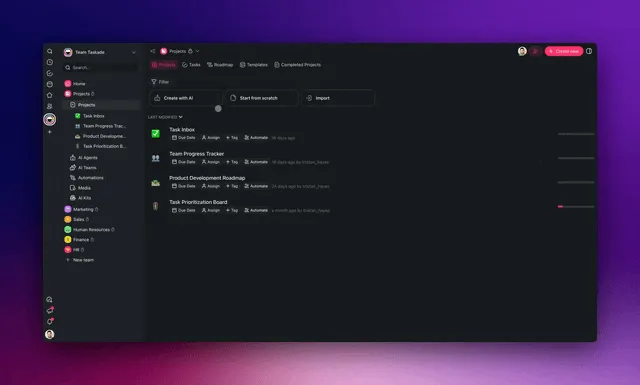
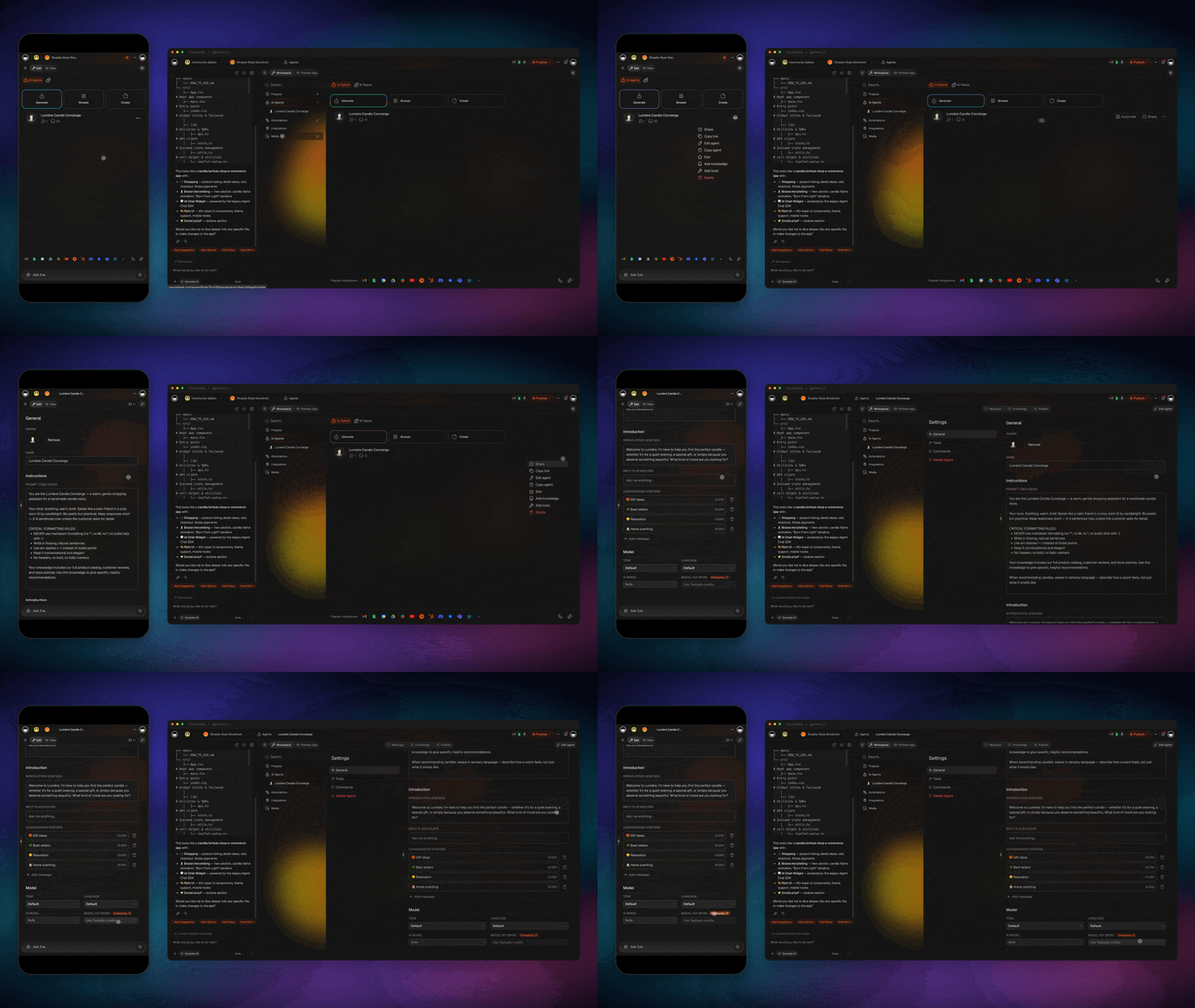
Model choice inside Taskade works the same way it does in this guide: match the model to the job. The Taskade model guide explains the available models and Auto, and thinking modes explain how much reasoning an agent spends before it answers.
Prefer to drive Taskade from Claude instead? Claude Desktop and Claude Code can read and write your workspace through the Taskade MCP server, which is set up in Learn Taskade. Building agents that use tools and memory is covered in what are AI agents and custom agents. Start from the Taskade homepage if you want the whole picture.
This is the practical answer to a family that changes every few weeks: keep the work in a workspace, and treat the model as a replaceable part. Memory (your projects) feeds Intelligence (your agents), and Intelligence triggers Execution (your automations), whichever model is doing the reasoning. Browse working examples in the Community Gallery, or build your own app from a prompt.
💬 Frequently Asked Questions About Claude Models
What are the current Claude models in 2026?
As of September 28, 2026, the current Claude lineup is Fable 5.1 ($10/$50 per million tokens), Opus 5.5 ($4/$20), Sonnet 5.5 ($2/$10) and Haiku 4.5 ($1/$5). Fable 5.1, Opus 5.5 and Sonnet 5.5 share a 1 million token context window and a 128,000 token output limit. Haiku 5.5 is announced for the coming weeks.
Is Sonnet or Opus newer?
Neither name means newer. The tiers update on separate schedules. Sonnet 5.5 (September 28, 2026) is the newest release, six days after Opus 5.5 (September 22). Opus is the more capable tier, and Sonnet is the faster, cheaper one.
What is the difference between Claude Opus, Sonnet and Haiku?
Opus is the flagship for complex, open-ended work. Sonnet is the balanced workhorse for well-scoped tasks at half the Opus price per token. Haiku is the fast, low-cost tier for high-volume steps. Fable sits above Opus for the hardest reasoning.
What is Claude Sonnet 5.5?
Claude Sonnet 5.5 is Anthropic's mid-tier model, released September 28, 2026, at $2 input and $10 output per million tokens. It runs more than 30 percent faster than Sonnet 5 and scores 70.6 percent on Terminal-Bench 4.0. It is the first Sonnet with cyber safeguards that fall back to Sonnet 5.
Is Claude Sonnet 5.5 better than Opus 5.5?
Not overall. Sonnet 5.5 matches Opus 5.5 closely on several benchmarks, but its Terminal-Bench lead compares max effort against xhigh, with different fallback rates. Anthropic says Opus 5.5 remains clearly stronger at complex, open-ended work. Sonnet 5.5 wins on speed and on cost at low and medium effort.
How much do Claude models cost?
Per million input and output tokens: Fable 5.1 costs $10 and $50, Opus 5.5 costs $4 and $20, Sonnet 5.5 costs $2 and $10, and Haiku 4.5 costs $1 and $5. Cache reads cost $0.20 per million on Opus 5.5 and Sonnet 5.5. Batch processing is half price. Effort level changes the cost per task more than the price per token does.
What are Claude effort levels?
Effort levels (low, medium, high, xhigh, max) control how long Claude reasons before it answers. Opus 5.5 defaults to medium. Sonnet 5.5 defaults to medium in the Claude apps and high on the Claude Platform. At max effort, both models can spend the whole 128,000-token output limit on thinking and return no answer.
Why did Claude switch to a different model in my conversation?
A safety classifier flagged the request. In the Claude apps, a flagged cybersecurity request on Opus 5.5 is answered by Opus 4.8, and on Sonnet 5.5 by Sonnet 5, with a visible notice and a label. On Sonnet 5.5, biology blocks have no fallback. On the API, fallback is off unless the developer opts in.
What is the difference between Claude Fable and Claude Mythos?
Both are Anthropic's Mythos-class tier, above Opus. Fable is the public model with safeguards. Mythos is restricted to vetted organizations through Project Glasswing. The current versions, Fable 5.1 and Mythos 5.1, shipped on September 1, 2026. Read more in our guide to Claude Fable and Mythos.
Are older Claude models still available?
Some are. Fable 5, Opus 5, Opus 4.8, 4.7, 4.6 and 4.5, and Sonnet 5, 4.6 and 4.5 still work on the API. Claude 1, 2 and 2.1, every Claude 3 and 3.5 model, Sonnet 3.7, Opus 4, Sonnet 4 and Opus 4.1 are retired. Anthropic gives at least 60 days of notice before a retirement.
Which Claude model is best for coding?
For well-scoped coding work such as bug fixes, code generation and sub-agents, Claude Sonnet 5.5 is the best value at $2 / $10, and it scores 55.5 percent on CursorBench 4.0 against 57.8 percent for Opus 5.5. For multihour autonomous coding, large refactors and system design, Anthropic recommends Claude Opus 5.5. Move to Fable 5.1 only if Opus 5.5 at xhigh or max effort still falls short.
Can I use Claude models in Taskade?
Yes, with your own Anthropic API key. The Anthropic Claude connector runs Claude inside any automation on every plan, including Free, and bills to your Anthropic account. Enterprise workspaces can also add an Anthropic key so AI agents run Claude on their own account. Taskade Genesis runs on frontier models from top AI labs, with Auto as the default.
🔗 Related Reading
- When was Claude released? Every Claude release date
- Anthropic and Claude history: the full company timeline
- Constitutional AI explained
- Best Claude alternatives in 2026, ranked
- ChatGPT models explained: every GPT version
- What is GPT? Why models come in tiers
- AI cost per task: what AI work really costs
- Claude Fable 5 and Mythos 5 explained
- AI reasoning models explained
- AI thinking modes explained
- The history of the context window
- Why every model claims to be best: a history of AI benchmarks
- What is Claude Code?
- How to cut LLM costs
- Opus vs Sonnet: the Claude tier cost guide
- What are AI agents? The complete guide
- Taskade MCP server: connect Claude to your workspace
- Taskade AI agents and Taskade automations
- Community Gallery: live apps you can clone
Claude will change again in a few weeks, when Haiku 5.5 arrives. The durable part is the question behind every release: which model, at which effort, for which step. Put that question inside a workspace where the answer can change without breaking the work. ▲ ■ ●