






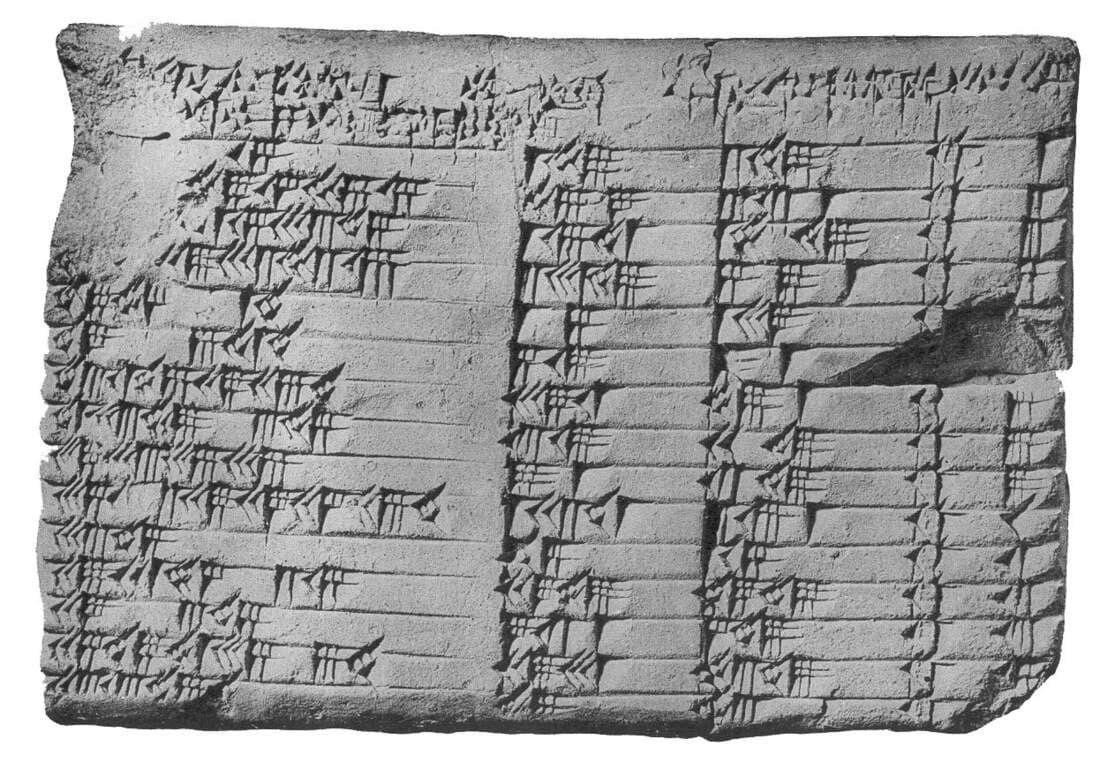
The oldest tables in the world are made of clay. The most famous is Plimpton 322, a Babylonian tablet from about 1800 BCE, small enough to hold in one hand, with four columns and fifteen rows of numbers pressed into it. A scribe built a grid, filled the cells, and let the rows do the work. People have been organizing the world that way ever since.
About 3,800 years later, two founders in Brooklyn took the same grid and asked a new question: what if every cell could go out to the internet and bring back an answer? They called the company Clay, because you can shape it into anything. It took them five years to find the customer who cared, and four more to reach a $7.1 billion valuation, $100 million in recurring revenue, 17,000 customers, and a job title they say they coined: the GTM engineer.
This is the complete history of Clay.com, the go-to-market platform, not the material and not the personal CRM that shared its name. It covers the founders' first startup, the wilderness years, the pivot, every funding round, Claygent, the 2026 pricing split, both Sculpt conferences, and what the story teaches anyone building with AI agents. 🧭
TL;DR: Clay, founded in 2017 by Kareem Amin and Nicolae Rusan, spent five years without product-market fit, then, by its own account, grew from $1M to $100M ARR in about two years. It raised a $115M Series D at $7.1B in September 2026 and says it coined the GTM engineer role. Build your own sales agents →
What Is Clay? The GTM Platform Worth $7.1 Billion in 2026
Clay is a New York software company whose product lets go-to-market teams find, enrich, and act on data about companies and people. It combines 150+ data providers, an AI research agent called Claygent, and workflow automation in one spreadsheet-like workspace. Clay was founded in 2017, is led by CEO Kareem Amin, and was valued at $7.1 billion in September 2026.
In plain terms: a sales or marketing team describes who it wants to reach and why, and Clay assembles the list, fills in the missing facts from many vendors, researches each account with AI, and sends the result to the tools that do the outreach. Clay calls itself "GTM infrastructure to grow in ways your competitors can't."
Clay at a Glance (November 2026)
| Fact | Detail |
|---|---|
| Founded | 2017, Brooklyn, New York |
| Founders | Kareem Amin (CEO) and Nicolae Rusan. Varun Anand joined in 2021 and is a co-founder. |
| Legal entity | Clay Labs, Inc. |
| Latest valuation | $7.1B (Series D, September 9, 2026) |
| Total primary funding | About $317M in priced rounds |
| Lead investors | First Round, Sequoia, Meritech, CapitalG, Wellington |
| Revenue | $100M ARR in December 2025. About $200M annualized by Q3 2026, per press reports. |
| Customers | 17,000+, including about 80% of the Forbes AI 50 |
| Flagship products | Tables, waterfall enrichment, Claygent, Audiences, Sequencer, Sculptor, Workflows |
| Pricing | Free, Launch at $185 a month, Growth at $495 a month, Enterprise |
| Category it named | GTM engineering |
Facts checked: November 12, 2026. Funding, revenue, and customer figures come from Clay, its investors, and press reports. Clay ships fast, so check clay.com before you quote a number in a memo.
Is Clay.com the same as the Clay personal CRM? No. A separate company used the name Clay for a personal relationship manager at clay.earth, and Automattic acquired that product in June 2025. Several company databases mix the two. Everything on this page is about Clay.com, legal name Clay Labs.
The Clay Timeline at a Glance
Clay Timeline: Every Key Date, 2010 to 2026
| Date | Milestone |
|---|---|
| 2010 | Kareem Amin and Nicolae Rusan leave Microsoft and start The Shared Web |
| May 2012 | Sailthru acquires their second product, Frame |
| 2013 to 2015 | Amin runs product at The Wall Street Journal, Rusan at Dow Jones |
| January 2017 | Earliest public trace of Clay: a developer tool on AWS Lambda |
| 2017 | $2.5M seed led by First Round Capital |
| 2019 | $13.5M Series A led by Sequoia, not announced |
| January 2020 | Clay becomes "the spreadsheet that fills itself" |
| September 2021 | Amin's ten-day retreat, per Forbes, then the refocus on go-to-market |
| February 8, 2022 | Relaunch hits number one on Product Hunt |
| May 2022 | Waitlist returns for 15 months |
| April 25, 2023 | Pricing 2.0: free tier and unlimited seats |
| August 15, 2023 | Clay 2.0 launches and the waitlist ends |
| September 2023 | Claygent launches |
| 2023 | Clay names its customer engineers GTM engineers and, by its own account, coins the title |
| June 27, 2024 | $46M Series B at $500M, the first round Clay ever announced |
| January 2025 | $40M expansion at $1.25B. Clay acquires Avenue. |
| June 5, 2025 | Claygent passes 1 billion runs |
| August 5, 2025 | $100M Series C at $3.1B, led by CapitalG |
| September 17, 2025 | First Sculpt conference: Sculptor, Audiences, Sequencer |
| December 8, 2025 | $100M ARR |
| January 28, 2026 | Employee tender offer at $5B |
| March 11, 2026 | Pricing split into Data Credits and Actions |
| June 23, 2026 | Audiences reaches general availability |
| September 9, 2026 | $115M Series D at $7.1B, led by Wellington |
| October 8, 2026 | Sculpt 2026: agent-first building, Workflows, Inbound SDR Agent |
🏺 The Prehistory: From Clay Tablets to "Data Is the Moat" (3000 BCE to 2017)
Every sales-data company before Clay sold the same thing: a list. The business model was to own contact data that competitors did not have, and the industry's history is a series of better lists. Clay's founding insight was that by the late 2010s, the list had become a commodity, and the valuable part was what you did with it.
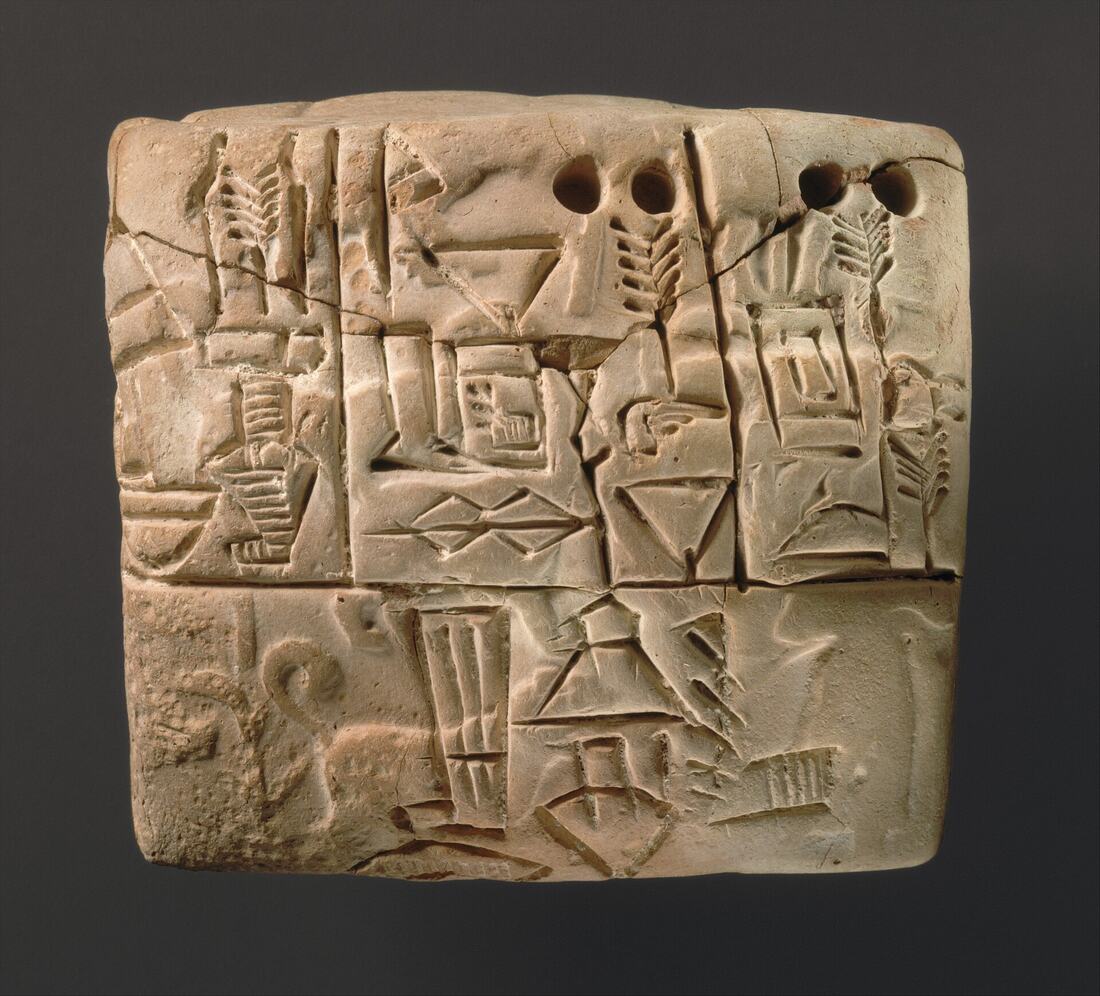
Rows, quantities, and a seal of approval: a Mesopotamian clay tablet from about 3100 to 2900 BCE that records barley distribution. Photo: The Metropolitan Museum of Art, CC0, via Wikimedia Commons.
The table itself is one of the oldest tools people have. Mesopotamian scribes kept accounts in rows and columns pressed into clay, and the ledger, the Rolodex, and the spreadsheet are its descendants. The modern chapter of that story is in our history of spreadsheets. The sales chapter looks like this.
| Year | Milestone | Why it matters to Clay |
|---|---|---|
| c. 3000 BCE | Mesopotamian scribes record grain accounts on clay tablets | The table is older than paper |
| c. 1800 BCE | Plimpton 322, a clay tablet with a four-column number table | Rows and columns as a tool for calculation |
| 1841 | The Mercantile Agency, later Dun & Bradstreet, sells credit reports on businesses | Company data becomes a product |
| 1950s | The Rolodex puts a contact list on every desk | A salesperson's value is the names they hold |
| 1979 | VisiCalc, the first electronic spreadsheet | Non-programmers start to compute |
| 1999 | Salesforce launches CRM in the browser | The system of record moves online |
| 2000 | ZoomInfo's predecessor starts crawling the web for contacts | Contact data scales past the phone book |
| 2003 | LinkedIn launches | People publish their own professional data |
| 2006 | Google Sheets makes the spreadsheet collaborative | Many people in one grid at once |
| 2010 | Salesforce buys Jigsaw, a crowdsourced contact database | Data is treated as a strategic moat |
| 2011 to 2015 | SalesLoft, Outreach, Clearbit, and Apollo arrive | Sequencers and enrichment APIs for the SDR era |
| 2017 | Clay is founded in New York | A spreadsheet meets the internet's data |
By 2017 a typical revenue team paid for a contact database, an enrichment API, a sequencer, a CRM, and a RevOps hire to keep them in sync. Each data vendor claimed the most complete records. Each customer bought two or three of them anyway, because none was complete.
Kareem Amin saw the pattern from outside the sales world, and he described the incumbent logic years later: "Everybody else in sales and marketing was thinking that the data is the moat." More users meant more data, which meant a bigger company. Clay, he said, "flipped it on its head. Data isn't the moat. Data is a commodity. We get data from wherever is needed."
That flip did not start as a sales idea. It started as a programming idea, and it took the founders years to connect the two.
👤 Who Founded Clay? Kareem Amin, Nicolae Rusan, and Varun Anand
Clay was founded in 2017 in Brooklyn, New York, by Kareem Amin and Nicolae Rusan, two McGill graduates who had already built and sold one startup together. Varun Anand joined as an advisor in late 2021, ran operations through the turnaround, and is now recognized as a co-founder. Amin has been CEO since day one. Rusan left in 2022 to start another business, and he was still on Clay's board in 2024.
Several company databases list the wrong founders for Clay, or confuse it with an unrelated personal CRM that used the same name. The record below comes from Clay's own posts, its investors, and interviews with the founders.
| Person | Role at Clay | Before Clay |
|---|---|---|
| Kareem Amin | Co-founder and CEO, 2017 to today | McGill, Microsoft, co-founder of Frame, Sailthru, VP of Product at The Wall Street Journal |
| Nicolae Rusan | Co-founder, 2017 to 2022, then a board member | McGill, Microsoft, co-founder of Frame, Sailthru, VP of Product at Dow Jones |
| Varun Anand | Advisor from late 2021, then head of operations, now co-founder | Political communications, Google's Jigsaw, insurance startup Newfront |
Kareem Amin: from Dhahran to McGill to Microsoft
Kareem Amin was born in Egypt and grew up in Dhahran, Saudi Arabia, where his father was a hospital doctor. As a teenager he fixed computers for cash. "It was mostly reinstalling Windows," he told Forbes. He studied electrical engineering at McGill University in Montreal, with a serious side interest in physics, and joined Microsoft as a program manager.
The physics never left. He still describes go-to-market as a system with laws, and he quotes Hegel and Feuerbach to explain product strategy. Later in life he added a meditation practice, including ten-day silent retreats, and one of them marks the turning point of this story.
The first company: The Shared Web, Frame, and a sale he regrets
Amin and Rusan both studied at McGill and both worked at Microsoft. In 2010 they left to start The Shared Web, a social news reader, and went through the Techstars Seattle program. The reader did not take off. In 2011 they pivoted to Frame, a Shopify app that turned an online store into a tablet storefront.
Email marketing company Sailthru acquired Frame in May 2012. The founders spent a year there, then moved to Dow Jones, where Amin became VP of Product at The Wall Street Journal and Rusan held the same title at the parent company. Both left by the end of 2015.
Amin does not count the exit as a win. Asked in 2026 why he kept going through Clay's lean years when he had sold a company before, he said: "That was just my first attempt, and I think I learned that was a mistake. I wouldn't want to do that." Clay was built by someone who had already taken the early exit and decided not to take it twice.
Nicolae Rusan: the co-founder who found the use case
Nicolae Rusan is Canadian, studied computer science, political science, and economics at McGill, and was Clay's product lead in the early years. He wrote the earliest public description of Clay we could find, in January 2017. He also made the call that saved the company. Amin has said so more than once: "It was actually my co-founder Nicolae who identified this segment and use case." Amin himself resisted: "We didn't know much about outbound outreach, but Nicolae decided to try it out."
Rusan left in 2022 to start another business, and he was still on Clay's board in 2024. Amin gave that account to BetaKit in July 2024. By June 2023 he was posting about a new AI coding project. Clay's current press materials name Amin and Anand, which is why Rusan is missing from many summaries. He belongs in any honest one.
Varun Anand: the operator who found the customers
Varun Anand came from outside tech's usual pipeline: a political science degree, a stint as a press aide on a presidential campaign, communications at Google's Jigsaw unit, then operations at the insurance startup Newfront. He found Clay as a customer. By one account he joined a Clay webinar and was the only attendee.
He started advising the company in late 2021 and moved into operations in 2022. What he did next is the subject of the "unscalable" chapter below: he joined WhatsApp groups and Slack communities where cold-email agency owners traded tactics, ran about eight calls a day, and sent invoices by hand because, as he later admitted, "as recently as January 2023, we didn't have billing in the product."
🏜️ The Wilderness Years: Five Products in Search of a User (2017 to 2021)
Clay did not begin as a sales tool. It began in January 2017 as a developer tool for cloud functions, guided by a mission to "give the power of programming to an order of magnitude more people." For roughly five years it had funding, smart founders, and no committed customer. Kareem Amin's own accounting of that stretch is two years of building, two years of confusion, and then a decision.
The earliest public description of Clay we could find comes from co-founder Nicolae Rusan, in a post dated January 23, 2017: "Clay is a layer on top of AWS Lambda" that makes it easier to get APIs and functions running. A month later Amin published a tutorial that piped those functions into Google Sheets, so live data from an API appeared in a cell. The whole future product is visible in that one demo. It took five years to find out who wanted it.
What Clay called itself, year by year
| Period | How Clay described itself | Who it was for |
|---|---|---|
| 2017 | "Create cloud hosted microservices" | Developers |
| 2018 | "The GitHub/Heroku for serverless development" | Developers |
| 2019 to 2020 | "Workflows, simple DB, and serverless code" for team tools | Technical teams |
| 2020 | "The spreadsheet that fills itself" | Anyone with a list |
| 2021 | "Automate your prospecting, enrich your customers" | Sales and growth teams |
| 2022 | "Create spreadsheets that fill themselves, without code" | Growth and outbound teams |
The team also built and dropped two other ideas along the way: a rebuilt terminal for piping data between tools, and a front-end builder.
Why a spreadsheet
The founders started with a question about who should get the power. They could make engineers faster, or they could give programming to people who were not engineers. They chose the second. A Clay hiring post from January 2020 states the math: "about 20 million developers in the world, but over 1 billion spreadsheet users."
Amin calls the spreadsheet "the world's most popular programming environment." One Excel feature fascinated him: programming by example. Fix one badly formatted phone number, and the spreadsheet fixes the rest. Correct its one mistake, and it learns the exception. The machine infers the program from what you show it.
From there the idea came as a sequence, each step adding one property to the grid.
| Step | Product | What it added to the spreadsheet |
|---|---|---|
| 1 | VisiCalc and Excel | Calculation without code |
| 2 | Google Sheets | Many people in one grid at once |
| 3 | Clay | Cells connected to all of the internet's data |
"Google made it collaborative," Amin told journalist Eric Newcomer, "but the next step was to make it connected to all of the internet's data." He remembers the first version as a feeling: "It's a spreadsheet where, suddenly, data pops up in a cell from somewhere else on the internet."
Bill Atkinson chased the same goal thirty years earlier with HyperCard, software built to put the power of the personal computer in the hands of people who do not program. The spreadsheet, the stack of cards, and the connected table are one family of tools: software that non-programmers can still shape.
Two years building, two years confused
A general tool invites every use case. Recruiters used early Clay. So did salespeople, front-end engineers who wanted a low-code backend, and one customer who used it to transform accounting data. By 2021 about 20 customers paid between $30 and $200 a month. Amin's verdict: "We had a customer, but it was the wrong customer."
Investors kept faith. First Round Capital led a $2.5 million seed in 2017, with boldstart and BoxGroup. Sequoia led a $13.5 million Series A in 2019. Clay announced neither round at the time. An investor at boldstart recalled the questions he got from colleagues: "Who are those guys you keep visiting out in Brooklyn? What are they doing?"
The trap, as Amin describes it, was ambition itself. With venture funding and a big mission, the founders kept asking what the largest possible outcome was, and the answer kept moving as the technology moved. "We would switch from one manifestation of the idea to another," he told Forbes. And to Halligan: "We would keep changing it to be like, well, if we pointed here, it would be even bigger."
Brian Halligan, who took HubSpot from zero to a public company, noted that people call Clay "a seven-year overnight success" and asked the obvious question: why not quit? Amin's answer was about telling a dip from a dead end. The moment you feel bored, or sure you belong somewhere else, is often "the cusp of actually getting to the point where it gets interesting." The voice that says otherwise he called a shape-shifter: it always sounds reasonable, and it is usually avoidance.
🔁 The Commitment: Five Decisions That Never Changed
Clay found product-market fit when its founders stopped optimizing for the biggest possible idea and committed to one use case: building lists and researching accounts for go-to-market teams. The decision came between September 2021 and January 2022, and the relaunch on February 8, 2022 hit number one on Product Hunt. Kareem Amin says that once they committed, "it almost worked instantaneously. It just took some time for everybody else to hear about it."
The turn has a date. In September 2021, by Forbes's account, Amin went on a ten-day silent meditation retreat with the company at a crossroads. He came back and cut. The code tool went. The workflow product went. Nearly all of the 20 paying customers churned, and some early employees left. Amin describes the feeling precisely: "When you narrow the scope, it feels claustrophobic."
The hard part, in Amin's telling, was not technical. Friends considered the two founders among the smartest people they knew. Investors had funded them. Customers were impressed in meetings. Nothing worked, and every month a new technology made a bigger vision possible, so they kept re-aiming. What finally changed was courage: "We're just going to pick this thing. I don't care how silly it sounds. I don't care about the shame if it fails publicly." He stopped taking advice, including from customers, because "if you listen to the wrong people at the time when it's a small idea, you kill it."
"Instantaneously" needs a footnote. In spring 2022, months after the relaunch, revenue was still close to zero. In May 2022 Clay put its waitlist back up and kept it for 15 months, onboarding users by hand. Revenue then grew about tenfold in 2022 and tenfold again in 2023.
With the use case chosen, Clay locked in five decisions. Amin says they have not changed since, and that almost every later product choice follows from them.
| Decision | The market norm in sales software | What Clay chose |
|---|---|---|
| User | Sell to the frontline rep | Build for a technical user |
| Name | Call that user an admin or an ops person | Call that user a go-to-market engineer |
| Product | One button, as simple as possible | The most powerful and most flexible tool |
| Data | Own a proprietary database | Own no data. Be a marketplace for everyone's. |
| Pricing | Per seat | Per usage |
A sixth choice mattered as much to Amin: the product had to be product-led, so a person could sign up and use it without a demo.
Amin credits the method to philosophy class. Hegel described history as thesis, antithesis, and synthesis. Feuerbach took Hegel's system and turned it upside down. The technique, Amin says, is to take what everybody believes, flip it, and follow the flipped version to its natural conclusion: "Flip everything around, you have a new product."
Power over simplicity
The decision that drew the most resistance was the second one. Clay's internal rule is power and flexibility over simplicity. Amin is careful about the wording: the team wants simplicity, but "when they conflict, we give you power, because it's a technical user."
He explains it with two objects. A microwave should work for anyone: press one minute, press start. A guitar is a tool you learn for life, and someone who has played jazz for ten years still cannot play flamenco. "If you said, let's build a guitar with three strings because it's easier to use, it seems obviously bad to everyone." Every "easier Clay" that has launched since is, in his framing, a three-string guitar.
The product-led requirement made everything slower. A powerful tool and a self-serve signup rarely fit together, and Amin says insisting on both is one reason the search took so long. It also explains the customer Clay went looking for first: someone technical enough to "pick it up and hack around with it."
🧱 How Does Clay Actually Work? Tables, Waterfalls, and Claygent
Clay works like a spreadsheet where every column can run a job. A row is a company or a person. A column fetches data from a provider, runs an AI model, calls an API, or pushes the row to another tool. You build a workflow by adding columns from left to right, then you run it on ten rows, check the output, and run it on ten thousand.
Agency operators who teach the product describe it the same way. One calls Clay "a canvas where I can interact with all the different tools in my go-to-market tech stack" in one place. The value is not any single data source. The value is that more than 150 data providers and tools sit one click away from the same row.
The canonical Clay workflow
| Step | What the column does | Why it exists |
|---|---|---|
| 1. Find | Pull a list of companies or people from Clay's search, a CRM, a CSV, or Google Maps | Start with a narrow, specific audience |
| 2. Enrich | Run a waterfall across email or phone providers | No single vendor covers everyone |
| 3. Validate | Check each email before it is used | Bad addresses wreck sender reputation |
| 4. Qualify | An AI agent reads the company website and answers a yes or no question | Vendor categories are too coarse |
| 5. Act | Push qualified rows to a sequencer, a CRM, or Slack | The table is a means, not the end |
 A CLAY TABLE, READ LEFT TO RIGHT

 +---------+-----------+--------------+-----------+-------------+-------------+
 | Company | Contact   | Work email   | Valid?    | B2B?        | Push to     |
 | (input) | (input)   | (waterfall)  | (checker) | (AI agent)  | sequencer   |
 +---------+-----------+--------------+-----------+-------------+-------------+
 | Acme    | J. Rivera | found, #2    | valid     | true        | sent        |
 | Bolt Co | S. Chen   | found, #1    | catch-all | false       | skipped     |
 | Cedar   | M. Okafor | not found    | skipped   | skipped     | skipped     |
 +---------+-----------+--------------+-----------+-------------+-------------+
     data in        each column runs only if its condition is true      action out
What is waterfall enrichment?
Waterfall enrichment is Clay's signature mechanic: it asks several data providers the same question in sequence and stops at the first good answer. If provider one has no email for a contact, Clay tries provider two, then three, and validates between steps. You pay for the hit, not for every vendor contract.
The idea sounds obvious now, and every competitor has copied it. It was not what buyers asked for. Kareem Amin recalls customers telling him: "I just want the number of people that work at a company. I don't care where you're getting it from." His answer was a travel analogy: you can ask to fly from New York to London in one hour, "but I can't do that for you. So what's the next best thing?" The next best thing was every vendor in one place, full transparency, and speed.
The tricks power users learn first
Three habits separate a Clay beginner from an operator, and all three are about spending less.
- Run conditions. Every column can carry a rule such as "only run if the email is valid." A wasted lookup is a wasted credit.
- Cheap model reads, strong model judges. Operators scrape a website with an inexpensive model, save the summary, and send only the summary to a stronger model for the decision.
- Bring your own keys. Clay lets a customer plug in an existing vendor contract or model key. As Amin told journalist Eric Newcomer, once a customer grows big enough, "we prefer that they actually have a direct contract" with the data provider.
That last habit says more about the company than any feature. Most data vendors lock customers in. Clay built an exit ramp into the product on purpose, because its bet was never the data.
🤝 Doing Things That Don't Scale: WhatsApp Groups, Reverse Demos, and the First Clay Agencies
Clay's first real market was not software companies. It was the small lead-generation agencies that run outbound campaigns for other businesses. They had the hardest version of the problem, because they solved it for dozens of clients at once, and when Clay worked for them they told everyone. Clay reached them one WhatsApp thread at a time.
Varun Anand did most of the reaching. He joined WhatsApp groups with names like SaaS Yacht Club and Sales Technicians, plus a dozen Slack communities, and answered questions. He ran about eight calls a day. By his count it took roughly seven demos to win one customer paying $200 to $300 a month. Clay removed chat support from the product so that every user had to join one shared Slack, and the support queue became a community.
Amin describes the logic as concentric circles. Agencies sat at the frontier with "the most complicated set of problems," and the same product, with the same features, could then be sold directly to companies. The use case did not change between circles, so each success sold the next one.
The reverse demo
Clay's early sales call inverted the usual demo. The prospect shared their screen and tried to build something. The Clay team watched, guided when the person got lost, and fixed bugs live. Amin's summary: "If something broke, we were fixing it in real time while you were on the call." One call did three jobs: user research, onboarding, and proof that the team cared.
The care was not staged. Co-founder Varun Anand was once helping an agency owner over WhatsApp, and the fix was not landing. Anand said he was coming over to the man's house. The man said not to. Anand went anyway. Amin's telling: "They became really good friends." He also explains why it worked: the team was not selling Clay. The pitch was that Clay would help the agency grow, by any means, and "people are very good people readers."
Employee number 11 and the first Clay agency
The clearest picture of this era comes from Eric Nowoslawski, who found Clay early, saw what it could do, and pushed it past its pricing model. As Nowoslawski remembers it, plans were limited by rows before credits existed, so he ran 2,000 rows, exported them, deleted them, and ran 2,000 more. Clay's own pricing history says its first plans were already credit-based, so treat the detail as one user's memory. Anand noticed. His message, as Nowoslawski recalls it: "The way you're using the product is the way we want everyone to be using the product," minus the row-limit trick. He was asked to teach others, then hired. Clay's social lead introduces him as employee number 11. First Round's history of the company calls him its third business hire and one of its first ten employees.
Nowoslawski also ran what is described as the first Clay agency, Growth Engine X, and left Clay to scale it. Clay calls him its first agency owner to reach $1 million in annual revenue. By June 2024 Amin counted "dozens of Claygencies," and by January 2026 Clay counted about 150 agencies in its ecosystem. The numbers he shared in 2026 show why an ecosystem formed around the product.
| Agency metric | Figure Nowoslawski reports |
|---|---|
| Peak monthly revenue | About $340,000 |
| Peak client count | 60 to 65, which he calls "actually horrible" |
| Team at peak revenue | About 8, down from 15, after AI coding agents took over routine tasks |
| Margin targets | 80% gross, 50% net |
| Tooling cost per lead | About $7 on some accounts |
| Price charged per lead | About $300 |
| Cold email volume | About 8 million a month |
Those are one operator's self-reported figures, not audited results. They still explain the flywheel. A tool that lets one technical person turn seven dollars of data and compute into a three-hundred-dollar outcome will produce agencies, and agencies produce tutorials, templates, case studies, and referrals. Amin compares the pattern to HubSpot, where by his account about half of revenue is touched by a partner.
The oddest customer story Amin tells has nothing to do with sales. A user going through a divorce filmed every item in his house, then used Clay to price each one and estimate its depreciation. It reportedly became a top post on a divorce forum. A general-purpose tool finds uses its makers never planned, which is the point of building one.
🤖 What Is Claygent? When LLMs Met the Spreadsheet (2023)
Claygent is Clay's AI research agent. It visits websites, reads them, and returns an answer into a cell, so a team can ask any question about any company and get a structured column back. Clay launched Claygent in September 2023 on OpenAI's GPT-4, and it passed one billion runs in June 2025.
Clay could move that fast because of a choice it made years earlier. Its very first product, in 2017, was a layer on top of AWS Lambda, and the habit stuck: every integration in Clay ran as its own function, spun up on demand. Amin's reason was mundane. Junior engineers could write integrations, and "if they made mistakes, whatever, it won't take the whole product down." When large language models arrived, a model was one more integration. The developer tool nobody wanted in 2017 became the reason Clay could ship AI research within months of the first capable models.
The product reason mattered more. Data vendors sell a fixed menu, "here's 50 properties about a company," in Amin's words. An agent that researches on demand has no menu. Does this company mention AI in its support docs? Does its site show the logos of our customers? Does it have a remote office in South America? Each answer is a data point no competitor can buy, which is the definition of an edge.
| Fixed data vendor | Research agent in a cell |
|---|---|
| A set list of fields | Any question you can phrase |
| The same data sold to every buyer | A signal only you thought to ask for |
| Updated on the vendor's schedule | Checked at the moment you run it |
| Wrong data is the vendor's fault | Wrong data is expected, shown, and reviewed |
"The data is going to be wrong"
Clay's most counterintuitive principle is that its data will be wrong, and the product should be designed around that from the first day. Competitors claimed complete, accurate data. Amin's view: "Everybody knows that's a lie." Clay promised tools to get data and tools to check it fast.
That one assumption explains a string of product decisions.
- Session replay was a P0. Users can watch how Claygent reached an answer, because trust that cannot be assumed has to be earned by showing the work. Collecting feedback on a bad run came with it. Acting on that feedback well was the next priority.
- A playground and prompt versions. Users test which prompts work and see which ones stopped working.
- A second agent can check the first. One agent collects, another verifies or flags the rows most likely to be wrong.
- A narrow job. Claygent researches companies and people, not everything. Amin calls the use case a "fat long tail," narrow enough to write evaluations for.
Amin compared the stance to design software: "Here's a design tool. You know how to use the line, circle, and a square and you can draw anything." He also made a philosophical claim that still frames the company. There is no complete, canonical data set of companies and people, "because they're living entities" seen from different perspectives. A firm can be B2B, B2C, or both, depending on who is asking.
What breaks at a billion runs
The failures at scale were not the ones outsiders expect. Amin listed them at a LangChain event in October 2025.
- Rate limits are measured in tokens, not requests, and they differ by model.
- Customers bring their own API keys, which may also be in use somewhere else.
- Each tool an agent calls has its own limit, so "why is this slow?" has many possible answers.
- Long plans fail in the middle. A seven-step plan that dies at step three needs to resume, not restart.
The most common user complaint, he said, was simply "what is going on right now?" By mid-2026 the scale had grown again. The live counter on Clay's site read more than 5 billion runs on November 12, 2026. Clay's head of AI, Jeff Barg, told a conference audience that Claygent ran more than 350 million times a month. We cover that talk and its four production problems in our wiki entry on Clay's go-to-market agents at scale.
In August 2025 Clay added Claygent Navigator, a browser-using agent for the pages a simple fetch cannot reach: an old site with a form to fill, or a state government directory that has to be clicked through. The goal stayed the same. It was still research, and the browser was one more way to get the answer into the cell. The wider story of agents that click and type is in our history of Browserbase.
🏷️ Naming the Wave: How Clay Created the GTM Engineer
A GTM engineer is a technical operator who treats go-to-market as a system to build, test, and improve, instead of a list of tasks to perform. Clay says it coined the title for its own customer-facing team, and it taught agencies to use it, and stayed quiet while it spread. By 2026 companies including OpenAI, Cursor, Notion, and Lovable employed people with GTM engineering titles.
The title began as an internal naming problem. Clay had people who helped customers design their workflows, and called them customer engineers. Kareem Amin and Varun Anand wanted a name that belonged to Clay. Mike Vernal, the Sequoia partner who led Clay's Series A, had been telling Amin for a while that the company should own a title. Amin's answer in the room: "Let's just call them go-to-market engineers."
His theory of category creation is short, and it contradicts most advice on the subject.
- You cannot create a category. You can name one. "You can take something that is happening and name it." The team noticed that the most forward-looking buyers already said "GTM" instead of "sales."
- Two words stuck together. The best new terms join two familiar words. Amin's example: try naming a Roomba before the phrase "robot vacuum" exists.
- Title first, category later. Clay wanted people to call themselves GTM engineers. A person will put a title on a LinkedIn profile long before a market agrees a category exists.
- Give it fuzzy boundaries. Clay never published a strict definition. Amin says the meaning is broadening as it should: use a coding agent for go-to-market work and you are doing GTM engineering.
- Earn the right to claim it. "If you go too early and start telling the story, people push back against you." Clay waited until agencies and operators had made real money under the title.
Brian Halligan, who built the "inbound marketing" category at HubSpot, compared notes with Amin in 2026. HubSpot wrote the book, ran the conference, and attacked an enemy called outbound. Clay did the opposite and stayed in the background. Both companies armed agencies first, for the same reason: an agency needs clients, so it will teach the method in public. A company will not tell you how it grew.
Did Clay invent the GTM engineer?
Clay says it coined the job title in 2023, and the manifesto that made it famous, The Rise of the GTM Engineer, appeared on June 18, 2025. Critics point to earlier uses of the phrase, including a 2021 job posting at another AI company, and argue that the work is older than the name. Clay did not invent the work. It popularized the name, taught it, and built the tool most often listed in the job description.
| Signal | Figure | Source |
|---|---|---|
| Job listings analyzed, October 2025 | 1,000+, median pay $127,500 | Bloomberry |
| Share of those listings that name Clay | 61% | Bloomberry |
| Open roles in 2026 | 3,000+ | GTME Pulse |
| Scholarship fund for new GTM engineers | $1 million, announced September 2026 | Clay |
These are third-party counts with different methods, so read them as direction, not census. The direction is clear.
Why "engineer" and not "ops"
The word carries the product's mission. Clay began as an attempt to bring programming to more people, and Amin says that goal "still lives on in the fact that we called it go-to-market engineering." The practice he describes is an engineer's loop: do we have the right data, did we run the right tactic, did it work, and if so, do more of it.
Critics call the title fancy RevOps. Clay's own team concedes part of the point: the best RevOps teams already worked this way. Their argument is that AI moved the job from defense to offense. When data cleanup and tool plumbing get ten times easier, maintenance becomes table stakes, and building new plays becomes the job.
The role also pays. Amin told Newcomer in 2025 that people who learned Clay were "getting promoted really quickly, starting agencies as well." A tool that gets its users promoted does not need much advertising.
💰 How Much Is Clay Worth? Funding and Valuation From a $2.5M Seed to $7.1B
Clay is valued at $7.1 billion after a $115 million Series D led by Wellington Management, announced on September 9, 2026. The company has raised about $317 million in priced rounds since 2017, plus about $1 million from its community. Its valuation rose more than fourteenfold in about 26 months, from $500 million in June 2024.
The most unusual fact about Clay's funding is how long nobody knew about it. Clay raised a seed in 2017 and a Series A in 2019 and announced neither. When the Series B came out in June 2024, Kareem Amin wrote that it was "the first time Clay has announced any of its funding." Seven years of silence is why databases still disagree about the early rounds.
| Round | Date | Amount | Lead investor | Valuation |
|---|---|---|---|---|
| Pre-seed | Before the seed | Undisclosed | BoxGroup | Undisclosed |
| Seed | 2017 | $2.5M | First Round Capital | Undisclosed |
| Series A | 2019, announced 2024 | $13.5M | Sequoia Capital | Undisclosed |
| Series B | June 27, 2024 | $46M | Meritech Capital | $500M |
| Series B expansion | January 2025 | $40M | Meritech Capital | $1.25B |
| Community round | February 19, 2025 | About $1M | Clay's community | $1.25B |
| Employee tender offer | May 8, 2025 | Up to $20M, secondary | Sequoia Capital | $1.5B |
| Series C | August 5, 2025 | $100M | CapitalG | $3.1B |
| Employee tender offer | January 28, 2026 | Up to $55M, secondary | DST Global | $5B |
| Series D | September 9, 2026 | $115M | Wellington Management | $7.1B |
Sources: Clay's funding announcements, Forbes, TechCrunch, and BusinessWire. Tender offers are secondary sales, where employees sell existing shares and the company raises no new money.
Other investors across the rounds include boldstart ventures, Maple VC, Sapphire Ventures, StepStone, Andreessen Horowitz, Bloomberg Beta, and Evolution. In February 2025 Clay also opened a community round so that users, agency owners, and creators could invest at the same price as the venture funds. Amin's explanation: the company gets its ideas from the community, "so they should share our ability to grow."
Who owns Clay?
Clay is a private company owned by its founders, employees, and venture investors. It is not owned by another company, and it has not filed to go public. The two employee tender offers, nine months apart, let staff sell shares without an IPO. Early employee Eric Nowoslawski said in November 2026 that one reason he returned was his early equity and the prospect of a public offering someday. That is an employee's expectation, not a company announcement.
How fast did Clay's revenue grow?
Clay says it went from $1 million to $100 million in annual recurring revenue in about two years, a milestone it announced on December 8, 2025. By its own count, revenue grew about 10x in 2022, 10x in 2023, 6x in 2024, and about 4x in 2025.
| Year | Revenue signal | Source |
|---|---|---|
| Spring 2022 | "Still close to $0" | First Round Review |
| 2022 | About 10x growth, from a tiny base | Clay, First Round Review |
| 2023 | About 10x growth, past $1M ARR. About $5M by year end, per one estimate. | Clay, First Round Review, Sacra |
| 2024 | 6x growth to about $30M | Forbes |
| 2025 | $100M ARR by December. "More than 3.5x" in one Clay post, "4x" in another. | Clay |
| 2026 | About $200M annualized by the third quarter | Press reports at the Series D |
A third-party estimate for 2023, Forbes for 2024, Clay for 2025, and press reports for 2026. The public numbers do not reconcile exactly: first-hand accounts put the $1 million mark in 2023, and a year-end figure near $5 million is what makes the 6x growth to $30 million add up. Treat the first bar as an order of magnitude.
Two details in Clay's own announcement explain the valuation better than the top line. Enterprise net revenue retention was over 200%, which means existing large customers more than doubled their spending in a year. And Clay claimed it had never lost an enterprise customer. A usage-priced tool that customers keep feeding is the business model investors pay the most for.
Clay kept its capital efficiency through the run. Forbes reported about $30 million in 2024 revenue at a minimal loss.
📣 How Clay Grew Without Ads: The Storytelling Machine
Clay grew revenue about 10x, 10x, 6x, and 4x in four consecutive years, and its social lead, Peter Kang, says the company ran no real ad spend for most of that run. Growth came from inbound and word of mouth. The engine behind it was a deliberate content and community system built on one idea: match the channel to the shape of the product.
The framework came from Bruno Estrella, who joined from Webflow to lead growth marketing and now runs marketing. Before picking channels he assessed product-channel fit. Clay sits in the sales-tools market next to HubSpot and ZoomInfo, but the product behaves like Notion, Webflow, Figma, or Lego: configurable primitives that you assemble yourself. That shape has consequences.
| Product trait | Consequence | What Clay invested in |
|---|---|---|
| Configurable, built from primitives | Harder to learn and activate | Clay University, cohorts, tutorials |
| You build something of your own | Pride of ownership, people show their work | User-generated content, creators |
| Tactics change constantly | Users need to trade knowledge | Community Slack, local Clay Clubs |
| A creative tool, not a utility | Brand has to feel creative | Early brand, design, and social hires |
Five moves that made the narrative
- Product-channel fit first. Clay skipped cold outbound and ads for its own growth and went where a builder audience learns: LinkedIn, community, education.
- Creative hires before it was normal. The first marketer, Mishti Sharma, started as a contract writer in January 2023, when Clay had about ten employees. A social lead and a web and design lead joined in early 2024, both around hire number 30 by Kang's count.
- LinkedIn, quadrupled down. One person posted about 2,000 times in two years and spent the rest of the day commenting on customers, creators, and partners. The voice was human, playful, and never unhinged.
- Two tentpole essays. Finding GTM Alpha and The Rise of the GTM Engineer (published June 18, 2025, by Mishti Sharma and Varun Anand) each took the better part of a quarter, with rounds of edits from the founders, enterprise customers, and power users.
- Everything, everywhere, all at once. The same language went through the company page, executives, teammates, creators, integration partners, sales decks, and QBRs, until competitors used Clay's vocabulary to describe the market.
The community numbers show the result. As of November 2026, Clay's site counts 35,000 members in its Slack community and Clay Clubs in more than 90 cities across 50 countries, run by volunteers. In February 2025 Clay let that community invest alongside its venture backers at the same $1.25 billion valuation.
The lesson Clay's team draws is not "write better thought leadership." It is that AI changed what buyers want from a vendor. Executives are not shopping for a bolt-on tool that lifts revenue a few points. They want guidance on how to rebuild the machine, and the company that supplies the map gets to name the territory.
The hiring model: business acumen, taste, craft
Clay's content team was assembled from unusual backgrounds: a former product manager who was the best writer the co-founder had met, a former banker with a spreadsheet channel on TikTok, a co-founder of a Brooklyn performance venue who now runs events. The hiring rule is a three-circle diagram: business acumen, taste, and craft. Hire the first two and add craft last, because craft is the expensive one and it scales whatever taste you already have, good or bad.
🧩 From Tables to a Platform: Sculpt, Audiences, Sequencer, and Sculptor (2025 to 2026)
Between September 2025 and October 2026, Clay changed from a spreadsheet that enriches lists into a go-to-market platform with its own data model, its own outbound channel, and its own agents. Most of that change was announced at two editions of Sculpt, the company's user conference in San Francisco.
Kareem Amin laid out the logic the day after the first Sculpt. The original product was "the best data enrichment in the world" in a spreadsheet. The ambition was larger: "Every single idea you have for growing your company should be executed by Clay." Each launch since then removes one reason to leave the product.
| Sculpt 2025 (September 17, 2025) | Sculpt 2026 (October 8, 2026) |
|---|---|
| Sculptor, an agent that builds in Clay and answers questions about your tables | An agent that plans, runs, and improves plays from a stated outcome |
| Audiences, with companies and people as first-class objects | Workflows, a visual canvas that can branch, loop, run code, or call agents |
| Sequencer, built to send messages that are partly written by AI | Inbound SDR Agent, a preview that qualifies inbound leads by voice |
| Claygent Builder, MCP connectors, and web intent signals | A Skills Marketplace for coding agents and 24 new or updated integrations |
| Clay's first user conference | Pier 48, about 2,000 attendees from 30 countries |
The 2025 launches rolled out over the following year, and 2026 became the busiest shipping year in the company's history.
| Date | What shipped |
|---|---|
| January 26, 2026 | Clay inside Claude, through a hosted MCP server |
| February 25, 2026 | Clay Ads, for building ad audiences from Clay data |
| March 11, 2026 | New pricing: Data Credits and Actions |
| April 15, 2026 | Functions, reusable groups of steps |
| June 23, 2026 | Audiences reaches general availability, with no row caps |
| July 9, 2026 | API, CLI, and a plugin for Claude Code, Codex, and Cursor |
| July to August 2026 | Account Agents, and Workflows in open beta |
| September 1, 2026 | Sequencer reaches general availability |
| October 8, 2026 | Sculpt 2026 |
| October 27, 2026 | Claygent auto-mode, which picks the model for each task |
Sequencer does not send the mail itself. Clay's own documentation says it runs on Smartlead's sending infrastructure, which fits the pattern: Clay integrates the specialist and owns the workflow.
Why Audiences mattered more than it looked
A Clay table is a list you made. An Audience is a company or a person that exists once, across every list, with every signal attached. That sounds like plumbing. It is the difference between a tool and a system.
Signals are data that changes: a new CFO, a funding round, a competitor who rewrote their homepage, a prospect who visited your pricing page three times. With one signal, a table is enough. With five, you need a place to add them up. Amin is explicit that this is not a CRM: "We are a system of action, not a system of record." In his picture of the future, Salesforce, HubSpot, or a data warehouse stores the facts, and Clay decides what to do about them.
Peter Kang, Clay's social lead, gives the cleanest mapping of old Clay to new Clay.
| Old Clay | New Clay | What changed |
|---|---|---|
| A row in a table | A record in Audiences | One source of truth across the workspace |
| A column (enrich, clean, send) | A node in a workflow | Steps become visible and auditable |
| A person building in the grid | A coding agent building through the CLI or MCP | The interface becomes optional |
| A list you refresh by hand | A trigger that fires on a signal | Plays run when something changes |
In the product, results flow back into Audiences, which is what makes the loop learn. The diagram draws the forward path only.
Sculptor: three steps toward not needing to know Clay
Amin describes Sculptor as a staircase. Step one: you understand Clay and you have an idea, and Clay helps you build it. Step two: you have an idea but do not understand Clay, and Sculptor builds it for you. Step three: you do not know what to do and you do not understand Clay. You connect your CRM, and the system finds your best customers, the properties that predict them, lookalike accounts, and the message that worked last time.
The surprise, he said, was which use caught on. People wanted to ask questions of tables they had already built, for example which product to pitch to each company on a list, more than they wanted help building. To answer well, Clay started collecting business context from a customer's website, CRM, and documents.
By 2026 the same builder could live outside Clay entirely. Clay shipped an API, a command-line tool, and an MCP server, so a coding agent such as Claude Code or Codex can build and run Clay workflows directly. The canvas then becomes a place to audit what the agent built. Our history of MCP explains the protocol that makes that possible.
What customers report
Clay publishes results from named customers. These are vendor-reported figures with no public baseline.
| Customer | Result Clay reports |
|---|---|
| Anthropic | 3x enrichment coverage |
| Rippling | 2x cold email performance |
| Hex | 50% higher inbound win rate |
| ElevenLabs | 50% more sales-qualified leads |
| Intercom | 140% growth in outbound-sourced pipeline |
Clay says it serves more than 17,000 customers, including about 80% of the Forbes AI 50. The AI labs that changed what Clay could build are also among its best-known buyers.
🏷️ Clay Pricing History: From Credits to Data Credits and Actions
Clay has always charged for usage, never for seats, and it has had four pricing models. The largest change came on March 11, 2026, when Clay split its single credit into two meters: Data Credits for third-party data and Actions for the work Clay's platform does. As of November 2026, paid plans start at $185 a month.
| Version | Date | What changed |
|---|---|---|
| 1.0 | 2022 | Three credit tiers, starting at $349 a month. No per-seat fee. |
| 2.0 | April 25, 2023 | A free tier, a $129 entry plan, unlimited seats on every plan |
| 3.0 | May 8, 2024 | Credit top-ups and rollovers |
| 4.0 | March 11, 2026 | One credit becomes two: Data Credits and Actions |
Usage pricing was itself a contrarian call. Varun Anand recalled that in 2022, "our customers were shocked that we weren't a per-seat company and investors thought we were leaving so much money on the table." The bet was that a tool priced per seat is a tool people ration, and Clay wanted whole teams inside it.
What changed in March 2026
Under the old model, one credit paid for everything: the vendor's data and Clay's own compute. A customer who brought their own API key for a data provider used Clay's orchestration at no charge. The new model separates the two costs.
| Meter | What it pays for | Who sets the cost |
|---|---|---|
| Data Credits | Emails, phone numbers, and firmographics bought through Clay's marketplace | Mostly the data vendors |
| Actions | Running a column, an AI step, an enrichment with your own key, a workflow node | Clay |
| Plan (November 2026) | Monthly | Billed annually | Included each month |
|---|---|---|---|
| Free | $0 | $0 | 100 Data Credits, 500 Actions |
| Launch | $185 | $167 a month | 15,000 Actions, about 2,500 Data Credits |
| Growth | $495 | $446 a month | 6,000 Data Credits, 40,000 Actions |
| Enterprise | Custom | Custom | Custom |
Source: clay.com/pricing, checked November 12, 2026. Plans change, so confirm before you budget.
Three mechanics soften the split. Failed lookups are free. Marketplace data prices fell by 50% to 90%. And AI models are passed through at token cost with no markup.
Kareem Amin explained the reasoning to Brian Halligan. Clay had bundled data cost and platform value into one number. It was now large and well known enough to "break it up into two axes," make each one legible, and lower the price of data. He said the company calculated that the change was cheaper for customers in the short term.
The backlash, and the memo
Some power users objected, loudly. The operators most affected were the ones who ran huge volumes through their own vendor keys, because that path used to cost nothing and now consumed Actions. One widely shared LinkedIn post asked whether Clay had committed harakiri. Consultant Jordan Crawford summed up the critics' case: "Clay became worse for small GTM shops, but better for enterprises."
Amin's read of the reaction was calm. Clay ran sentiment analysis on the posts and found them about 70% neutral, and he said the negativity did not show up in the revenue numbers. He also noted that the loudest critics "had some self-interest."
What stands out is how Clay communicated. Alongside the announcement it published the internal memo, written by head of finance Karan Parekh. The memo admits that Clay set one plan's credit price too low in 2022 and ran that segment at or below breakeven for years. It calls the change "intentionally revenue and profit negative" in the near term. It lists six risks, and names reduced experimentation as the one the company takes most seriously. Amin says the published text was "literally word for word what we were saying internally in our meetings." His own post that week was less polished: "We're anxious (pricing changes are scary) but we are doing it because we genuinely believe it's better in the long term." His theory: everyone wants a company to speak in bite-sized pieces, and a long, honest explanation treats the reader as an adult. Halligan's verdict on the same episode was that transparency does not merely correlate with trust. It equals it.
 OLD: ONE METER                      NEW: TWO METERS (MARCH 2026)

 +---------------------------+       +-------------+   +----------------+
 |          CREDITS          |       | DATA CREDITS|   |    ACTIONS     |
 |  vendor data + Clay work  |  -->  | vendor data |   | Clay's compute |
 +---------------------------+       +-------------+   +----------------+
   own API key = free to run           priced lower      charged on every
                                       than before       run, own key or not
For teams comparing costs, our Clay vs Taskade Genesis breakdown walks through what each plan includes.
🧭 GTM 1.0 to 4.0: The Theory Behind Clay's Bet
The clearest map of Clay's bet is a four-era model of go-to-market that Peter Kang, Clay's social lead, laid out on his own channel in 2026. In each era a new technology makes one resource cheap, and whatever is still scarce becomes the edge. Clay was built for the third era, where data is cheap and judgment is scarce, and it is now building for the fourth. The numbering is Kang's framing, not an official Clay taxonomy.
| Era | Trigger | What got cheap | What is scarce | Who wins |
|---|---|---|---|---|
| GTM 1.0 | Phone, Rolodex, field reps | Nothing | The data itself | Whoever holds the lead list |
| GTM 2.0 | The internet and SaaS | Contact data | Coordination and clean data | Teams with strong RevOps |
| GTM 3.0 | LLMs and research agents | Research, cleanup, glue code | Judgment and ideas | Teams that iterate weekly |
| GTM 4.0 | Agents on first-party and third-party data | Analysis and campaign builds | Agent-ready systems and human time | Teams whose system learns |
The first shift is the one Hollywood recorded. In Glengarry Glen Ross, the salesmen fight over a stack of index cards because the leads are the business. After the internet, every vendor sold the same contacts to everyone, and the fight moved to plumbing: SDRs, AEs, a CRM, and a dozen tools that RevOps had to keep in sync.
The claim that matters is about where ideas come from. In the 2.0 model, a rep with a good idea files a request with RevOps, RevOps negotiates with engineering, and a quarter later the idea ships or dies. Kang describes what that does to people: it "trains everyone in the GTM org to not bother." In the 3.0 model the rep builds a rough version over a weekend, proves it on live deals, and a GTM engineer rebuilds it for scale. Kang calls this distributed innovation, and compares it to Darwinism: a hundred campaign ideas a quarter instead of a dozen.
Kareem Amin's three laws of go-to-market
Amin studied physics, and he describes go-to-market as a system with laws. They were a theme of Sculpt 2025, he walked through them at a LangChain fireside chat the next day, and Clay later published them as The Three Laws of GTM.
| Law | Statement | Consequence |
|---|---|---|
| 1. Be unique | You cannot win by doing what everybody else does | A playbook that can be written down is already a commodity |
| 2. Success decays | Scaling a tactic raises the baseline until it stops working | Every winning play has a half-life |
| 3. Keep changing | You always have to change what you are doing | The durable asset is the system that produces plays |
He borrows a word from finance for the result: GTM alpha, an edge your competitors do not have. He also borrows a warning from biology. Asked whether Clay only feeds an arms race between senders and spam filters, Amin pointed to the Red Queen effect, where everyone runs to stay in place, and said Clay's answer is the opposite of volume: "do deeper research ahead of time, send fewer messages."
The fourth era is not finished. In June 2026 Clay described its product as four layers of GTM infrastructure: data, orchestration, execution, and agents. In Kang's description of where that leads, agents sit on top of a company's first-party data (calls, product usage, event attendance) and third-party data (funding, job changes, tech stack), spot patterns a person would miss, and ask permission to run the next play, the way a coding agent asks before it runs a command. Each campaign's results feed the next. Kang calls the end state a self-learning engine: "Just like LLMs predict the next best token, Clay will start to predict your next best GTM action."
🧘 The Philosopher CEO: How Kareem Amin Runs Clay
Kareem Amin runs Clay with a management style that contradicts most startup folklore: no standing executive team meeting, few weekly one-on-ones, an open calendar for "just in time" decisions, and a stated refusal to build from a chip on his shoulder. HubSpot co-founder Brian Halligan, who interviewed him in 2026, called him a "philosopher monk-like CEO."
Halligan also admitted he got Amin wrong. He met Amin while he was on the Sequoia team, and his read was negative: "Kareem's not motivated. He's too laid back. He doesn't have a chip on his shoulder." Amin's reply was that the calm is deliberate. He decided to "create from a place of wholeness," because building from lack works but "you create a lot of damage along the way."
| Conventional startup wisdom | What Amin does instead | His reasoning |
|---|---|---|
| Weekly executive team meeting | No exec meeting. "Call me whenever." | People wait for the meeting instead of deciding |
| Weekly one-on-ones with every report | Monthly at most, plus one-on-ones on top priorities | Standing meetings drain energy without moving work |
| Hire slow, fire fast | Assume context before blaming the person | Rules of thumb make leaders stop thinking |
| Motivate with fear, greed, discipline | Add devotion and fun to the toolkit | "Devotion is as good as discipline" |
| Listen to every customer | Stop listening while the idea is small | "You need to pick the right hill," then customers tune it |
| The CEO is always right | Apologize, in public if needed | Once people feel heard, the real problem can be solved |
The momentum detective
Amin describes his job with a phrase of his own: he is a "momentum detective." He walks the company looking for the place where momentum is fading, because momentum is "so hard to get if you lose it," and that is where a CEO's attention changes the outcome. The teams that are already running hot do not need him.
His example is Audiences, the 2025 feature that made companies and people first-class objects in Clay. The team resisted it. He stopped arguing for it and instead asked for signals, data that changes over time, which everyone agreed was valuable. Once the team had five signals and nowhere to aggregate them, they asked for the object model themselves. The feature shipped because the builders reached the conclusion, not because the CEO ordered it.
Decisions that do not change
The calm sits on top of a short list of decisions Amin treats as fixed. He says living in ambiguity is how you find clarity, and once found, clarity is not up for debate. When a product choice pits power against simplicity, power wins, "because it's a technical user." He applies the same rule to himself: employees are told that "Kareem told me to" is not an argument for building a feature.
He is also blunt about the industry's performance of hard work. He says he has worked extremely hard for a long time and values consistency over intensity. On the 996 schedule that some founders celebrate: "Maybe you don't have a moat."
The management philosophy and the product philosophy are the same idea. Clay gives customers tools and trusts them to find the play. Amin gives employees context and trusts them to find the decision. He compares building a company to tending a garden: "We threw a few things into the garden and if some of them grow, we start watering the ones that grow."
⚔️ Clay vs the Field: Apollo, ZoomInfo, and the Coding Agents
Clay competes with three kinds of products at once: contact databases such as ZoomInfo and Apollo, workflow builders such as n8n and Gumloop, and, since 2026, general coding agents that can script a go-to-market workflow from a prompt. Clay's position is the layer between them: it does not try to own the data or the model.
| Category | Examples | What they do best | How Clay differs |
|---|---|---|---|
| Contact databases | ZoomInfo, Apollo, Cognism | One large proprietary data set | Aggregates 150+ providers and lets you compare them |
| Enrichment inside a CRM | HubSpot with Clearbit, Salesforce | Data where the rep already works | Sits upstream of the CRM and feeds it |
| Signal and intent tools | Common Room, Unify | Detecting who is in market | Treats signals as one input to a workflow |
| Workflow builders | n8n, Gumloop, Zapier | General automation across any app | Ships the GTM data and the research agent with the canvas |
| Coding agents | Claude Code, Codex, Cursor | Building any workflow from a prompt | Supplies the data, the MCP server, and the audit trail |
The newest row is the interesting one. In 2026 GTM engineers began asking whether a coding agent could replace Clay. The working consensus among operators is that an agent can replace the table logic and the orchestration, and cannot replace the data marketplace underneath. Clay's response was to move toward the agents instead of away from them: an MCP server in January, then an API, a CLI, and a plugin for the major coding agents in July.
Kareem Amin's view of build versus buy has not changed since before the agent wave. Building was never the hard part: "It's about maintaining. Everybody knows this." Requirements gathering, knowing what to build, is "most of the work." His prediction is that easy-to-customize software with deep integrations stays in demand even when code is cheap.
The honest list of weaknesses comes from customers and from independent research. Clay is hard to learn, and reviewers say onboarding takes weeks. Credits can disappear quickly on a careless run. The company depends on an agency ecosystem it does not control. And every incumbent with a database can copy the waterfall. Those are the same trade-offs the founders chose in 2021, seen from the buyer's side.
For the automation half of this landscape, see our histories of Zapier, n8n, and Claude Code.
🔍 Where the Clay Story Gets Told Wrong
Most pages about Clay repeat at least one error: the wrong founding year, the wrong founders, a Series A dated four years late, a retired price, or a mix-up with another company called Clay. Seven years without a funding announcement left a gap, and databases filled it with guesses. This table lists the claims we found next to what the primary record says.
| Common claim | What the record says | Source of record |
|---|---|---|
| Clay was founded in 2019, or in 2021 | Founded in 2017. Clay posts exist from January 2017, and most sources give June 2017. | Clay's 2017 posts, Clay's about page |
| Clay is the personal CRM app | That was a different company at clay.earth, acquired by Automattic in 2025 | Product listings, Automattic |
| Two other people founded Clay | Kareem Amin and Nicolae Rusan founded it. Varun Anand joined in 2021. | First Round, Sequoia, Clay |
| Sequoia led the Series A in 2023 | Sequoia led it in 2019. Clay disclosed it in June 2024. | Clay's Series B post, Forbes |
| The 2026 round was $150 million | The Series D was $115 million at a $7.1B valuation | Clay's Series D post |
| Clay was an overnight success | Five years to product-market fit. Revenue was near zero in spring 2022. | First Round Review |
| Clay invented GTM engineering | Clay says it coined the job title in 2023. The work, and scattered uses of the phrase, are older. | Clay, independent essays |
| Sculptor and Audiences launched in 2026 | Both were announced at Sculpt in September 2025. Audiences became generally available in June 2026. | Clay's launch posts |
| Clay starts at $149 a month | That plan was retired on March 11, 2026. Paid plans start at $185. | Clay pricing page |
| Clay has 220 data providers | Clay's own pages say 150+, 200+, and 250+ at the same time | Clay pricing page, Sculpt recap |
Two lessons come out of the table. A company that stays quiet for seven years does not control its own record, because someone else writes it. And a company that ships this fast outruns its coverage: most reviews in 2026 still describe the 2024 product and the 2025 price list.
Clay by the Numbers, 2023 to 2026
| Metric | 2023 | 2024 | 2025 | 2026 |
|---|---|---|---|---|
| Revenue | About $1M ARR by late 2023 | About $30M | $100M ARR in December | About $200M annualized by Q3 |
| Customers | About 120, then about 1,000 | 2,500 in June | 5,000+ in January | 17,000+ in September |
| Valuation | Not disclosed | $500M | $1.25B, then $3.1B | $5B, then $7.1B |
| Team | About 10 early in the year | 50+ in June | About 100 in January | About 300 in January, by Clay's count |
| Claygent runs | Launched in September | Hundreds of millions | 1 billion in June | 5 billion+ in November |
Sources: Clay's announcements, Forbes, First Round Review, Contrary Research. Third-party headcount estimates for 2026 run higher, between 700 and 800.
🔭 Nine Lessons From the History of Clay
The Clay story compresses into nine lessons for anyone building a product, a category, or a go-to-market team in the age of AI. The common thread is that Clay won by inverting what its market believed, then holding the inversion long enough for the market to catch up.
- Commitment beats the biggest idea. Clay wandered for years chasing the largest possible vision. It worked once the founders picked the opportunity in front of them and stopped re-aiming.
- Flip the assumptions and follow them through. Sell to operators instead of reps, power instead of simplicity, usage instead of seats, a marketplace instead of owned data.
- Design for wrong answers. A product that assumes its data is wrong ships review tools, replays, and transparency. A product that claims perfection ships none of them.
- Architecture is strategy in slow motion. Isolated integrations were built for safety in the 2010s and let Clay ship AI research within months of GPT-4.
- Name the wave, do not invent it. "GTM engineer" described work people were already doing. Clay gave it a title, then earned the right to call it a category.
- Serve the hardest users first. Agencies had the most complex problems and the loudest megaphones.
- Match the channel to the product. A configurable product needs education and community. A creative product needs a creative brand.
- Transparency is a pricing strategy. Clay published its internal reasoning when it changed prices, and treated customers as people who would read it.
- A playbook that can be written down is already expiring. The durable asset is a system that produces the next play.
| Lesson | Evidence from Clay | What it means for your team |
|---|---|---|
| Commitment | Years of drift ended when the founders committed to one use case | Pick the hill before you tune the climb |
| Inversion | Five fixed decisions, each the opposite of the market norm | List your category's assumptions and flip them |
| Wrong by default | Session replay shipped as a P0 | Show how the AI got its answer |
| Slow strategy | One function per integration | Favor designs that make the next integration cheap |
| Naming | Title first, category later | Label what your users already do |
| Hard users | WhatsApp groups with agency owners | Find the people with the worst version of the problem |
| Channel fit | Almost no paid ads for years | Let the product's shape choose the channel |
| Transparency | The pricing memo matched the internal one | Publish the reasoning, not only the price |
| Expiring plays | The three laws of GTM | Measure how fast you can change, not what you run today |
There is a tenth lesson that Amin states outright and most company histories leave out. He once imagined the end state, the company a success and the money made, and found that it felt empty. So he decided to enjoy the building itself. A five-year search is easier to survive when the search is the point.
🧠 What Clay Means for Teams Building With AI Agents
Clay proves that a flexible tool plus a clear point of view can create a job title. It also draws a line that every team should understand before buying anything: Clay is a system of action for go-to-market data. It finds and enriches accounts and triggers plays. It is not where the rest of the work lives after the lead arrives.
This is where Taskade fits, and the fit deserves precision. Taskade is not a data-enrichment marketplace. It has no waterfall across 150+ data providers, and a team whose bottleneck is verified emails and phone numbers at scale needs a tool like Clay. Taskade is the workspace where the enriched account becomes a deal, a task, a follow-up, a client portal, and a record the whole team can see. Taskade AI agents can search the web and read pages, and Taskade automations connect to 100+ bidirectional integrations, including Apollo, HubSpot, and Salesforce. Premium integrations need a paid plan.
| Job | Clay | Taskade workspace |
|---|---|---|
| Find and enrich accounts across many data vendors | ✅ Core product | ➖ Pair a data tool, or use an enrichment integration |
| Research a company with an AI agent | ✅ Claygent | ✅ AI agents with web search and page reading |
| Keep the pipeline where the team works | ➖ Pushes to your CRM | ✅ Projects with multiple project views |
| Remember context between runs | ➖ Tables and Audiences | ✅ Agents with persistent memory |
| Act across the rest of the business | ➖ GTM actions | ✅ Automations with 100+ bidirectional integrations |
| Ship a customer-facing app | ➖ Not the product | ✅ Taskade Genesis apps from a prompt |
That loop is Workspace DNA: projects hold the memory, agents turn it into intelligence, and automations execute on it, then write results back so the next run starts smarter. Clay's own roadmap points the same way. The "self-learning engine" its team describes is a memory, an intelligence, and an execution layer for revenue teams. Taskade applies the same loop to the whole business, for people who will never call themselves engineers.
The shared lineage: programming for everyone else
Clay and Taskade started from the same sentence. Amin set out to "give the power of programming to an order of magnitude more people." Bill Atkinson said nearly the same thing about HyperCard in 1987, and the spreadsheet delivered it before either of them. The two companies then chose different users. Clay chose a technical operator and gave that person maximum power. Taskade chose the person who will never open a formula bar: describe the system in a sentence, and Taskade Genesis builds the app, the agents, and the automations.
Amin's kitchen analogy makes the split clear. A guitar rewards ten years of practice. A microwave works the first time. Most businesses need both, and the mistake is expecting one to be the other.
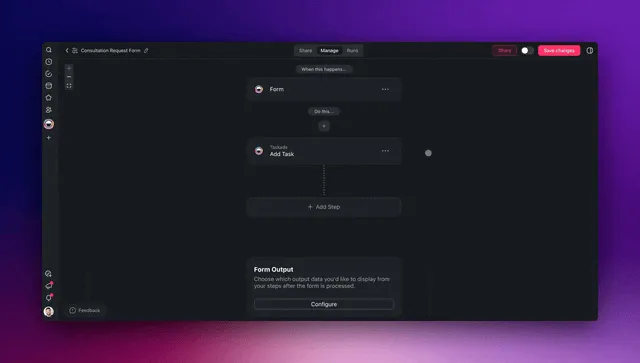
A Taskade automation enriches a new lead through an integration, then hands it to an agent and a pipeline.
Build the system around the list
A lead list is the start of the work. The pipeline, the follow-up, the meeting notes, and the client record still need a home. You can describe that home in plain language, for example "a sales pipeline with a research agent that scores new leads, a follow-up agent that drafts replies, and an automation that posts stage changes to Slack," clone one that already runs, or start from a lead enrichment agent.

Clone a live sales pipeline from the Taskade App Factory, then connect it to the tools your team already uses.
For the side-by-side view, read Clay vs Taskade Genesis and the GTM engineering system walkthrough. Taskade runs on frontier models from top AI labs, with role-based access from Owner to Viewer, and Pro is $10 a month billed annually. Explore Taskade AI agents →
🔮 What's Next for Clay? The $100 Billion Question
Clay enters 2027 as the category leader in go-to-market tooling, with fresh capital, a new agent-first product, and a public debate about whether it can grow fifteenfold again. The open questions are whether agents expand the market the way bulls expect, whether Clay stays the tool those agents choose, and whether a company this flexible can stay simple enough to buy.
The bull case. In September 2026, SaaStr founder Jason Lemkin said on the 20VC podcast that he had been "a Clay skeptic for two years" and had changed his mind, because "our agents will only use Clay." Host Harry Stebbings framed the episode as the bull case for Clay as a $100 billion company. The argument is about the size of the market, not the product. If agents run go-to-market work around the clock, the budget they draw on is not the software budget. It is the payroll budget.
Clay's own odds. Peter Kang responded on his channel with a list of what has to be true. Agentic go-to-market has to expand the market by ten to a hundred times, and Clay has to keep winning it, which means agents have to keep preferring Clay on cost, security, reliability, and ease of use. He put the chance, jokingly, at one in fourteen million, and added that nobody inside the company talks about the number. The culture, in his words, is "let's see how far we can take this."
The risks. Four are visible from outside.
- Commoditization. Every data vendor now offers a waterfall, and a coding agent can rebuild table logic in an afternoon.
- Complexity. Power over simplicity wins operators and loses everyone else. Sculptor and the agent-first builder are Clay's attempt to have both.
- Trust with small builders. The pricing split favored enterprises. The indie operators who made Clay famous noticed.
- The Red Queen. If every team runs the same plays with the same agents, the plays stop working. Clay's own second law says so.
The model question. Amin has said that many AI predictions assume models that are one or two orders of magnitude better, and that he has no strong intuition about how close that is. His operating rule is 90% execution and 10% reflection: "Regardless of what the options are, we will be in a better place the more successful we are right now."
The founder's answer. Asked what he will do when he is old, Amin did not say run a public company. He said he wants to make generative ambient music, sound you cannot quite predict that is still good. It is a fitting ambition for someone who spent five years on a product nobody could predict either. 🔮
🔗 Related Reading
- Clay vs Taskade Genesis: where a GTM data tool ends and a workspace begins
- The GTM Engineering System: a pipeline, agents, and automations you can clone
- History of Spreadsheets: from VisiCalc to the grid Clay wired to the internet
- History of HyperCard: Bill Atkinson's software for people who do not program
- History of Airtable: the other company that rebuilt the spreadsheet as a platform
- History of Zapier and History of n8n: the automation layer Clay's workflows sit beside
- History of Workflow Automation: from punch cards to agents
- History of Browserbase: the browsers that research agents drive
- History of OpenAI and ChatGPT and History of Anthropic and Claude: two Clay customers that changed what Clay could build
- What Are AI Agents?: the perceive, reason, act loop behind every research agent
- How to Automate Sales With AI Agents and Build an AI Sales Pipeline
- One-Person Companies: what happens when one operator has a team of agents
- History of Mermaid.js: the diagrams-as-code story behind every diagram on this page
- Wiki: Clay's go-to-market agents at scale, Apollo's sales assistant, Vercel's lead qualification agent
- Hubs: AI agents, automations, AI apps, Taskade App Factory, integrations
📚 Sources
- Clay: Series B announcement (June 2024), Series B expansion (January 2025), community round (February 2025), $100M ARR (December 2025), 2026 tender offer, and Series D (September 2026)
- Clay: Claygent passes 1 billion runs, Sculpt 2025 launches, Sculpt 2026 recap, The Three Laws of GTM, and pricing
- Clay pricing history: 2023 pricing post, Pricing 3.0, and the 2026 internal memo
- First Round Review: Clay's Path to Product-Market Fit (June 2024), The GTM Inflection Points That Powered Clay (January 2025), and Firsthand: Clay (May 2026)
- Sequoia: The Philosopher CEO, with Kareem Amin and Brian Halligan (July 2026) and the video
- LangChain: How We Built It: Clay, a fireside chat with Kareem Amin (October 2025)
- Newcomer: Interview with Kareem Amin, CEO of Clay (April 2025)
- Forbes profile of Clay (January 2025), as republished by boldstart ventures
- TechCrunch: the 2025 tender offer and the Series C
- BetaKit: Clay closes its Series B (July 2024), the source for Nicolae Rusan's 2022 exit and board seat
- SiliconANGLE: Clay boosts valuation to $7.1B (September 2026)
- SaaStr: 20VC x SaaStr on Clay at $7B (September 2026)
- OpenAI case study on Clay and Contrary Research: Clay
- Early Clay: a January 2017 post by Nicolae Rusan and a January 2020 hiring post
- Peter Kang, Clay's social lead: Why the fastest growing tech companies are rebuilding GTM, This is how we dominated the market, Our path to $100B?, I work at Clay. Here's what it does., and his interview with Eric Nowoslawski (August to November 2026)
- Matt Lucero: Clay.com crash course (May 2026)
- Image credits: Plimpton 322, public domain, via Wikimedia Commons. Cuneiform tablet with a barley account, The Metropolitan Museum of Art, CC0, via Wikimedia Commons.
💬 Frequently Asked Questions About Clay
What is Clay.com?
Clay is a New York software company that makes a go-to-market platform. Sales and marketing teams use it to build lists of companies and people, enrich them with data from more than 150 providers, research each account with an AI agent called Claygent, and send the results to outreach and CRM tools. The product looks like a spreadsheet where every column can run a job. Clay was founded in 2017 and was valued at 7.1 billion dollars in September 2026.
Who founded Clay and when?
Kareem Amin and Nicolae Rusan founded Clay in 2017 in Brooklyn, New York. Both studied at McGill University and worked at Microsoft, and they had earlier built Frame, a Shopify app that Sailthru acquired in May 2012. Varun Anand joined Clay as an advisor in late 2021, ran operations through the turnaround, and is now a co-founder. Kareem Amin has been CEO since the start. Nicolae Rusan left in 2022 to start another business, and he was still on Clay's board in 2024.
Who is Kareem Amin?
Kareem Amin is the co-founder and CEO of Clay. He was born in Egypt, grew up in Dhahran, Saudi Arabia, studied electrical engineering at McGill University, and worked at Microsoft as a program manager. He co-founded The Shared Web and Frame, which Sailthru acquired in 2012, then served as VP of Product at The Wall Street Journal from 2013 to 2015 before starting Clay in 2017.
Is Clay.com the same as the Clay personal CRM?
No. The personal relationship manager at clay.earth was a separate company with the same name, and Automattic acquired it in 2025. Clay.com, legal name Clay Labs, is the go-to-market data and automation platform led by Kareem Amin. Several company databases mix the two, which is one reason founder names and funding figures for Clay are often wrong.
How much is Clay worth in 2026?
Clay was valued at 7.1 billion dollars in a 115 million dollar Series D led by Wellington Management, announced on September 9, 2026. Earlier marks were 500 million dollars at the June 2024 Series B, 1.25 billion in January 2025, 1.5 billion in a May 2025 employee tender offer, 3.1 billion at the August 2025 Series C, and 5 billion in a January 2026 tender offer.
How much revenue does Clay make?
Clay announced 100 million dollars in annual recurring revenue on December 8, 2025, about two years after it passed 1 million dollars. The company says revenue grew about 10 times in 2022, 10 times in 2023, 6 times in 2024 to roughly 30 million dollars, and about 4 times in 2025. Press reports at the September 2026 Series D put annualized revenue near 200 million dollars.
How much money has Clay raised and who are its investors?
Clay has raised about 317 million dollars in priced funding rounds. The rounds are a 2.5 million dollar seed led by First Round Capital in 2017, a 13.5 million dollar Series A led by Sequoia in 2019, a 46 million dollar Series B and a 40 million dollar expansion led by Meritech, a 100 million dollar Series C led by CapitalG in August 2025, and a 115 million dollar Series D led by Wellington Management in September 2026. Clay did not announce any funding until June 2024.
Who owns Clay?
Clay is a private company owned by its founders, its employees, and its venture investors, including First Round Capital, Sequoia Capital, Meritech Capital, CapitalG, and Wellington Management. It is not a subsidiary of another company and it has not filed to go public. Clay ran two employee tender offers, in May 2025 and January 2026, so staff could sell shares without an IPO.
Did Clay invent the GTM engineer role?
Clay says it coined the GTM engineer job title in 2023. Kareem Amin and Varun Anand first used it for Clay's own customer-facing team, agencies adopted it, and Clay popularized it in a June 2025 essay called The Rise of the GTM Engineer. The underlying work existed earlier in RevOps and growth teams, and critics point to scattered earlier uses of the phrase. Clay popularized the name and built the tool most often listed in its job descriptions.
What is Claygent?
Claygent is Clay's AI research agent. It visits websites, reads them, and returns a structured answer into a table cell, so a team can ask any question about a company or a person. Clay launched Claygent in September 2023, it passed one billion runs in June 2025, and Clay's head of AI reported more than 350 million runs a month in mid-2026. A browser-using version called Claygent Navigator arrived in August 2025.
What is waterfall enrichment in Clay?
Waterfall enrichment asks several data providers the same question in sequence and stops at the first valid answer. If the first provider has no work email for a contact, Clay tries the next one and validates the result between steps. The method raises data coverage without a separate contract with every vendor. Clay popularized it, and most sales data tools now offer a version.
How much does Clay cost in 2026 and what changed in March 2026?
As of November 2026, Clay has a Free plan, a Launch plan at 185 dollars a month, a Growth plan at 495 dollars a month, and custom Enterprise pricing, with lower rates on annual billing. On March 11, 2026, Clay split its single credit into two meters: Data Credits for third-party data and Actions for the work the platform does. Clay retired its older Starter, Explorer, and Pro plans for new buyers on the same day.
What is Clay Sculpt and what launched at Sculpt 2026?
Sculpt is Clay's annual user conference in San Francisco. The first edition, on September 17, 2025, launched Sculptor, Audiences, and Sequencer. Sculpt 2026, on October 8, 2026, drew about 2,000 attendees from 30 countries and introduced agent-first building, where an agent plans, runs, and improves plays, plus the Workflows canvas and a preview of an Inbound SDR Agent.
Why did Clay take so long to find product-market fit?
Clay spent about five years, from 2017 to 2021, as a general-purpose tool with no committed customer. It was a developer tool for cloud functions, then a workflow and database product, then a spreadsheet that fills itself. Kareem Amin says the founders kept re-aiming at bigger ideas. In late 2021 they committed to go-to-market teams, relaunched on February 8, 2022, and revenue grew about ten times in each of the next two years.
What is the difference between Clay and Taskade?
Clay is a go-to-market data platform for finding and enriching accounts and triggering outreach. Taskade is an AI workspace where projects, AI agents, and automations run together, with 100+ integrations and apps built from a prompt with Taskade Genesis. Taskade does not offer a data marketplace or waterfall enrichment. Teams use Taskade to run the pipeline, the follow-ups, and the client work that begin after a lead is found.
Clay began with a table and a question about who gets to program. The answer it found was a new kind of operator, and a product that turns an idea for growth into a running system. Taskade asks the same question for the rest of the business: a workspace that remembers ▲, agents that reason ■, and automations that act ●. Describe the system you need and build it →