Best AI Story Games 2026: 20 Tools to Play, Write, Build
20 AI story games and interactive fiction tools sorted by what you get: an AI game master, a co-writer, or a story game you publish. Free plans checked.
An AI story game is a story you play by typing. You say what your character does, and an AI writes what happens next, so no two runs end the same way. In 2026 the category splits three ways: AI game masters you play in (AI Dungeon, Friends & Fables, Hidden Door), co-writers that help you steer the prose (NovelAI), and engines that let you build and publish your own interactive fiction (Twine, ink, Ren'Py). We checked the free plan of all 20 tools below on November 7, 2026, and we flag each page that did not load.
The hard part has not changed since Colossal Cave Adventure: a story game is only as good as its memory and its rules. A model that forgets your sword after twenty turns breaks the spell, and a game master with no rules lets you win every fight. So we sorted these tools by what they give you at the end of an evening, and by how well they keep the story straight.
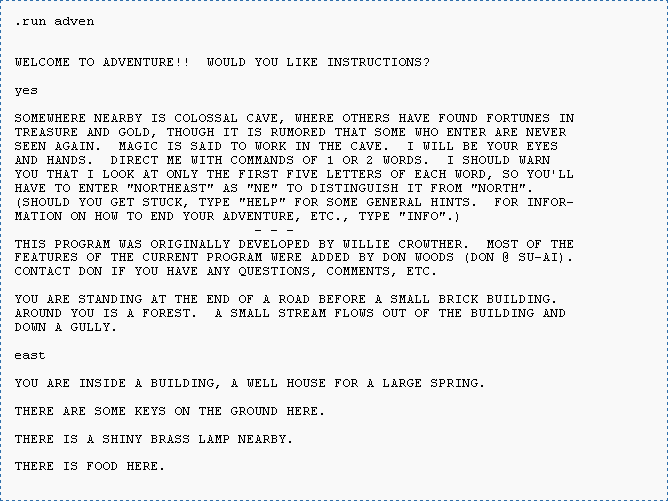
Cover image: Colossal Cave Adventure (1977) running on a PDP-10. Screenshot via Wikimedia Commons, public domain.
TL;DR: We sorted 20 AI story games and interactive fiction tools by what you get: an AI game master (AI Dungeon, Friends & Fables, Hidden Door), a co-writer (NovelAI), or a game you build and publish (Twine, ink, Ren'Py, Rosebud AI). Free plans checked November 7, 2026. Plan your plot first with the free AI story game generator.
Facts checked on 2026-11-07. Every price and free limit below comes from the vendor's own page on that day.
Quick Answer: The Best AI Story Game by What You Want
The best AI story game depends on whether you want to play a story, write one with help, or publish one for other people. For an open-ended text adventure, AI Dungeon has the largest library and community. For a campaign with rules and tactical combat, Friends & Fables runs a game master built on D&D 5e rules. For your own published game, Twine is free and exports plain HTML.
A story bible your team edits, and an app around it
Yes
What Is an AI Story Game?
An AI story game is interactive fiction where a language model writes the next scene in response to anything the player types, instead of picking from branches an author wrote in advance. Classic interactive fiction, such as Zork, Choice of Games titles and Twine stories, uses authored branches. AI story games generate the branch on demand, which is why you can try an action no writer planned for.
That one difference splits the category. A writer who builds a branching story in Twine knows every ending, because they wrote every ending. A player in AI Dungeon does not, and neither does the AI. A research team led by Mark Riedl described the hard version of the problem in the 2025 paper Story2Game: a model can draft a story, but a playable game also needs world state that tracks what each action requires and changes, so that a new action the player invents still obeys the world's logic.
So "AI story game" now means five different products. Each hands you something different at the end of an evening:
WHAT YOU GET BACK                  EXAMPLE TOOLS                       WHO WRITES THE STORY?
────────────────────────────────   ─────────────────────────────────   ─────────────────────
A game master you play with        AI Dungeon, Friends & Fables,       The AI, turn by turn
                                   Hidden Door, FableAI, Perchance
A co-writer for your own prose     NovelAI, general assistants         You, with AI drafts
A game you build and publish       Twine, ink, Ren'Py, ChoiceScript,   You author it, AI helps
                                   Rosebud AI, Gameer, Talefy
An AI character in a game you own  Mantella                            The AI, inside the mod
A story bible before any build     Taskade game generators             You and your team
If you want a playable arcade, platformer or 3D game from a prompt rather than a story, see our guide to AI game generators. This page covers the narrative side: text adventures, AI game masters, interactive fiction engines and the tools that plan a story before it is built.
How an AI Game Master Runs a Turn
Every turn, an AI game master reads your action, the recent story and any saved facts, then writes the next scene. Saved facts are things like AI Dungeon story cards, a NovelAI lorebook entry or a Friends & Fables long-term memory. Platforms built on tabletop rules add one more step: they resolve the action against a rules engine, such as a combat turn, before they narrate the result.
Open-ended platforms such as AI Dungeon and Perchance skip the rules step and let the model decide what happens. That is why they feel free and surprising, and also why a determined player can talk their way past any obstacle. Friends & Fables keeps the rules step: its homepage describes "tactical turn-based combat based on D&D 5e rules," with battlemaps, spells and monsters. Neither approach is better. They are built for different evenings.
Memory works in three layers, and knowing them explains most of the frustration players report:
The recent context. The last stretch of the story that the model reads every turn. How much it can read depends on the model and, on several platforms, on your plan.
Saved facts you write. Story cards, lorebook entries and pinned notes. The platform injects them when a trigger word appears.
Memories the platform writes. Summaries and long-term memories the system saves on its own as the story goes on.
The same three layers show up in every AI agent, not only in games. Our history of agent memory traces why models forget, and the history of the context window shows how much recent text a model can read. If the idea of an AI that plans, remembers and acts is new, start with what an AI agent is. An AI game master is an agent with one job: keep the story going.
Why AI Story Games Forget, and Which Tools Remember
AI story games forget because a language model sees only a fixed amount of recent text, so early details fall out of view in a long run. Tools fight this with saved facts, summaries and structured world state. Authored engines such as Twine never forget, because the writer stores every fact in a variable.
Tool
How it remembers
Who maintains it
Source
AI Dungeon
A base context tied to your membership tier, plus story cards and a memory bank
You write story cards, the platform saves memories
AI Dungeon pricing FAQ, checked Nov 7, 2026
Friends & Fables
"Long-term Memories" on every plan, Free included
The platform
fables.gg/pricing, checked Nov 7, 2026
NovelAI
Lorebook entries that load when a keyword appears
You
NovelAI docs, Lorebook page
Altworld
Structured state for "factions, rumors, prices, relationships" that "updates first," and saved runs
The platform
altworld.io, checked Nov 7, 2026
Perchance AI RPG
Memory you can read and edit, saved in your browser
You and the page
Perchance page title and third-party guides
Twine, ink, Ren'Py
Variables in the author's script
The author
Engine docs
Taskade
A story bible in workspace projects that an agent reads as knowledge
Three habits keep a long run straight on any platform:
Keep a "story so far" paragraph. Every few sessions, ask the AI to summarize the plot, then paste that summary into a pinned note or story card.
Pin the facts that matter. Names, items, promises and injuries belong in saved facts, not only in the chat history.
End a chapter on purpose. Start a fresh run with a recap instead of pushing one story past several hundred turns.
The "Drift" state is where most AI story games lose players. A character you killed walks back in, or the AI forgets the quest you accepted. The tools that handle it best either keep world state outside the model (Altworld, Friends & Fables) or hand the player clear tools to pin facts (AI Dungeon story cards, NovelAI lorebooks). A "start a new chapter" habit works on every tool.
Is the Free Plan Actually Free?
Most AI story games are free to start, but the free plan is a daily allowance, a trial or a currency, not unlimited play. Free and open-source engines (Twine, ink, Ren'Py, SillyTavern) cost nothing, but you write the story or bring your own model. We read every number below on the vendor's own page on November 7, 2026. Where a page did not publish a number, the table says so.
Tool
Free plan, in the vendor's unit
Best for
Entry paid price
Checked
AI Dungeon
Base model playable "endlessly without needing to spend anything." Voyage public multiplayer free
Open-ended text adventure
Not verified (plan list did not load)
Nov 7, 2026
Friends & Fables
Up to 25 turns a day, long-term memories, friends play free
D&D-style campaigns
Starter $19.95/mo
Nov 7, 2026
Hidden Door
Free plan, "Jump into any world, without limits"
Licensed story worlds
Creator, price not published
Nov 7, 2026
NovelAI
Trial: 50 text, 30 image and 100 text-to-speech generations
Prose and style control
Tablet $10/mo
Nov 7, 2026
FableAI
"Forever free" plan, gems unlock more play
Co-op stories with voice
Subscriptions and gem packs, prices not published
Nov 7, 2026
Perchance AI RPG
Free, no sign-up, "no daily usage restrictions" (page description)
Instant free play
Free
Nov 7, 2026, page title and description only
Altworld
10 guest turns, daily Candles on a free account
A world that keeps state
Top-ups, prices not published
Nov 7, 2026
Character.AI
Free to start
One-on-one character chat
c.ai+, price not on a public page
Not verified
ChatGPT
Free plan with "unlimited text chats," subject to guardrails
Quick chat adventures
Go, Plus, Pro, no price shown on page
Nov 7, 2026
Claude
Free plan with limits every 5 hours and every week
Long campaigns, story artifacts
Pro $17/mo billed annually, $20 monthly
Nov 7, 2026
SillyTavern
Free, open source (AGPL-3.0). Bring a model
Self-hosted control
Free
Nov 7, 2026
Twine 2.12.1
Free, open source, commercial use allowed
Branching HTML fiction
Free
Nov 7, 2026
ink and Inky
Free, MIT license
Narrative in Unity or Unreal
Free
Nov 7, 2026
Ren'Py 8.5.3
Free, commercial use allowed
Visual novels to sell
Free
Nov 7, 2026
ChoiceScript
Free download, non-commercial license
Interactive novels for Choice of Games
Commercial license on request
Nov 7, 2026
Rosebud AI
Newbie plan, 10,000 credits a week
Prompt-to-interactive story
Indie Dev $15/mo
Nov 7, 2026
Gameer
"Free Forever," basic character generation, limited templates
Branching game in minutes
Pro $1.99/mo
Nov 7, 2026
Talefy
Free account
Read, play and publish stories
"From $1.99," unit not stated
Nov 7, 2026
Mantella
Free mod (AGPL-3.0). Needs a model key
AI NPCs in Skyrim and Fallout 4
Free, model cost separate
Nov 7, 2026
Taskade
3 Taskade Genesis apps, 1 AI agent, 10 automation runs per billing period, 0 AI credits to start
Story bible and story-game apps
Pro $10/mo billed annually
Nov 7, 2026
Prices on monthly billing from each vendor's own page. Taskade Pro is $10 a month billed annually. Twine, ink, Ren'Py, SillyTavern and Mantella cost nothing. AI Dungeon, Hidden Door, FableAI and Character.AI did not publish a price we could verify on November 7, 2026.
One more fact a reader deserves: most "best AI story game" lists on the web are written by one of the games on the list, and each ranks itself first. We are a vendor too. Taskade sits in the design and build-your-own group, where it fits, and the method section below explains how we sorted everything else.
Also considered. We looked at several more tools and left them out of the ranked list. ISEKAI ZERO is an anime story app with daily free play. OOC is a story-chat app. Sekai, StoryZone and LlamaGen Story turn prompts into visual stories. KoboldAI and KoboldCpp run models locally and pair well with SillyTavern. Inworld voices NPCs and is covered in the game post. And if you searched for "Storygame AI" by name: the closest product is StoryGames.AI, a visual-novel assistant that Buildbox described in a 2023 guide for Buildbox Classic. We could not confirm that it is still offered in 2026.
Who Owns the Story You Make?
The authoring engines (Twine, ink, Ren'Py) give you full rights to what you write, and hosted AI platforms set rights in their terms, which differ by plan. ChoiceScript is the surprise in this list: its license bars commercial use unless Choice of Games publishes your game or grants you a commercial license.
Tool
Your rights, in the vendor's words
Export
Source
Twine
"Anything you create with it is completely free to use any way you like, including for commercial purposes."
HTML
twinery.org
ink and Inky
Core, editor and Unity plugin "freely available under the MIT license"
JSON or a web page
inklestudios.com/ink
Ren'Py
"open source and free for commercial use"
Windows, macOS, Linux, Android, iOS, HTML5 (beta)
renpy.org
ChoiceScript
"may not use the ChoiceScript interpreter or code written for use with the ChoiceScript interpreter for any commercial purposes." Hosted Games share revenue with the author
Web, via Choice of Games
ChoiceScript license on GitHub
NovelAI
"You... retain all rights and ownership of your Content."
Story files
novelai.net/terms
Rosebud AI
"complete commercial rights to your games" from the 10x Dev plan ($30/mo). Code download from Pro ($50/mo)
Browser link, desktop code download
rosebud.ai/pricing
Gameer
"Export capabilities" on Pro ($1.99/mo)
Not specified
gameer.io/pricing
SillyTavern, Mantella
AGPL-3.0 for the software. Story rights follow your model provider's terms
Local files
GitHub repos
AI Dungeon, Friends & Fables, Hidden Door, FableAI, Talefy
Terms not checked for this post
Varies
Read each terms page before you sell
Save a copy of the terms page on the day you publish a story you plan to sell. Terms change, and a dated copy shows what you agreed to. If you plan to sell a Twine or Ren'Py game on itch.io, you own the work outright. If you wrote it in ChoiceScript, contact Choice of Games first.
How We Compared These Tools
We grouped the 20 tools by what they produce, then checked each one's free plan, price, memory, export and rights on the vendor's own page on November 7, 2026. A game master and a Twine editor are not competitors, so we did not rank them against each other.
We did not run an identical-prompt bake-off. Most platforms meter free turns, several put their stronger models behind paid plans, and story quality depends heavily on the player. A single prompt would have measured luck as much as quality. Instead we answered five questions for every tool:
Question
What counts as a yes
Where we looked
What do you get back?
A clear output: a played story, prose, a game file or a plan
Product pages
Can you play or make something on $0?
A free plan, trial or free software that produces a result
Pricing pages
Does it remember?
A stated memory system: cards, lorebook, memories or variables
Product pages and docs
Can you take it with you?
An export, a file or a public link you control
Product pages and docs
Can you sell it?
A license or terms line that allows commercial use
Terms, licenses and pricing
Where a vendor page did not load or did not publish a number, this post says "not published" or "not verified" and quotes no third-party figure. Every entry names at least one real strength, because every tool here is the right choice for someone. Taskade appears in the design group, because it is not an AI game master platform and does not compete on turn-by-turn play.
Play: AI Game Masters and Text Adventures
These tools write the story with you, one turn at a time.
AI Dungeon brought AI text adventures to a mass audience. Nick Walton built the first version at a hackathon in March 2019, and AI Dungeon 2 launched in December 2019 and passed 100,000 players within a week. Latitude now runs it alongside Voyage, its multiplayer story product, which opened to everyone in August 2026.
Key features: a large community library of scenarios; story cards that inject facts when a keyword appears; a memory bank; several AI models; public multiplayer through Voyage.
Free plan (checked Nov 7, 2026): the pricing FAQ says "You can use the model at this base amount endlessly without needing to spend anything," and "Voyage public multiplayer is free for everyone and does not require a subscription." The plan list itself did not load, so we do not quote free-tier limits.
Pros:
The largest scenario library and community in the genre
Free play has no stated turn cap on the base model
Story cards give you real control over memory
Cons:
Larger context and stronger models sit on paid tiers
Long runs need steering to stay coherent
Pricing: paid memberships "include a monthly Credit allowance that refreshes each billing cycle," and credits do not expire. Tier prices were not visible on the vendor page on November 7, 2026.
Bottom line: the first stop for an open-ended text adventure tonight, especially if you like to write your own scenarios.
2. Friends & Fables: Best AI Game Master for D&D-Style Campaigns
Friends & Fables is an AI game master for tabletop-style campaigns. Its homepage promises "tactical turn-based combat based on D&D 5e rules," with battlemaps, spells, abilities and monsters, and it states that it is not affiliated with Wizards of the Coast. It says more than 100,000 players and world builders use it.
Key features: an AI game master that narrates and runs 5e-based combat; long-term memories on every plan; world-building tools such as map makers and character generators; parties of up to 6 players on the top plan; public and featured worlds.
Free plan (checked Nov 7, 2026): "Up to 25 turns per day," "Long-term Memories," "Unlimited Campaign Slots," "Your friend can play for free," and "3 player campaigns."
Pros:
Rules and combat instead of free-form narration
Friends join your campaign for free
Memories are included on Free, not saved for paid plans
Cons:
25 turns a day ends a long session early on Free
Text to Speech starts on paid plans
Pricing: Starter $19.95/month (unlimited standard turns, 4-player campaigns), Pro $29.95/month, Legend $39.95/month. Yearly billing is advertised as "2 Months Free."
Bottom line: the best choice when you want an AI dungeon master that respects rules, especially for a group.
3. Hidden Door: Best for Stories in Worlds You Already Know
Hidden Door builds story games on licensed and classic worlds. Its homepage lists Dracula, The Land of Oz, The Call of Cthulhu, Pride & Prejudice, Sherlock Holmes and more. Creators model a world in Atlas, its world-building studio, and one world can feed "interactive fiction, character chat, social games, microdramas, comics, and audio series."
Key features: licensed and public-domain story worlds; play as your own character; character chat; profiles and achievements; content ratings per world, from All ages to Mature; a Creator MCP that lets you build worlds from AI assistants.
Free plan (checked Nov 7, 2026): "Enjoy unlimited play across the whole catalog, free," with "Jump into any world, without limits."
Pros:
Worlds with real authors and real canon behind them
Unlimited free play across the catalog
Content ratings help parents and teachers choose
Cons:
The Creator tier price is not published
You play inside worlds Hidden Door hosts, so open sandbox play is narrower
Pricing: a Creator tier for making and sharing worlds of your own, price not published. Accepted partners get Creator at no cost.
Bottom line: the best pick if you want to walk into Oz or Dracula's castle, not an empty fantasy map.
4. NovelAI: Best Co-Writer for Prose and Style Control
NovelAI is a writing tool first and a game second. Its tagline is "Write worlds that remember everything." Writers use it to draft fiction with tight control over style, and its Text Adventure mode turns the same editor into a game: a Do input adds "You" to the front of an action, and a Say input turns your line into dialogue.
Key features: a story editor with style controls; a Lorebook that loads facts when keywords appear; Text Adventure mode with Do, Say and Story inputs; image generation; text to speech.
Free plan (checked Nov 7, 2026): a Paper trial with "50 free Text generations," 30 image generations and 100 text-to-speech generations for an email-verified account. There is no permanent free plan.
Pros:
The most control over prose in this list
Lorebook is a mature, well-documented memory tool
Its terms say you "retain all rights and ownership" of your content
Cons:
The trial runs out fast in a long adventure
It feels like a writing app, so players who want a game master may prefer AI Dungeon
Pricing: Tablet $10/month, Scroll $15/month, Opus $25/month.
Bottom line: the best fit for writers who want to steer every sentence, with adventure play as a bonus.
FableAI is a story app built for playing together. Its tagline is "Live inside any story," and the site advertises "real-time multiplayer adventures across 5,000+ stories" on iOS, Android and the web. The mobile apps add voice narration and push notifications for multiplayer turns.
Key features: solo and real-time multiplayer stories; a large library of community stories; voice narration in the mobile apps; gems that unlock more play and faster responses.
Free plan (checked Nov 7, 2026): "a forever-free plan and no credit card needed to start," with "Free plan, no time limit." Gems and optional subscriptions unlock more play.
Pros:
Built around co-op play from the start
Works in a browser and on both mobile platforms
A forever-free plan with no card
Cons:
Subscription and gem prices are not published on the site
Gems cap how much you play on the free plan
Pricing: "Optional subscriptions and gem packs unlock more play, faster responses, and extra features." Prices appear only in the app. Link only fableai.app: the fableai.io domain is unrelated.
Bottom line: the best pick for a story night with friends on their phones.
Perchance AI RPG is a free web page that runs a text adventure with no account. Its page title reads "AI RPG - Text Adventure - free, unlimited, no sign-up," and its description says it has no daily usage restrictions. Perchance is a platform of user-made generators, so several community versions exist, including an "Enhanced RPG" with a lorebook and story forking.
Key features: instant play in the browser; editable memory; saves in your browser's storage; community remixes of the generator with extra features.
Free plan (checked Nov 7, 2026): free, no sign-up, and no daily limit by the page's own description. The page body blocked our fetch, so we checked the title and description only.
Pros:
Zero cost and zero friction
Memory you can read and change yourself
Community versions add lorebooks and branching
Cons:
Saves live in one browser, so clearing it or switching devices loses a run
Long runs drift, and there is no account to sync progress
Pricing: free.
Bottom line: the fastest way to try an AI text adventure, and a good test of whether you like the genre before you pay anyone.
7. Altworld: Best for a Persistent World That Keeps State
Altworld treats the world as data. Its site says the world "keeps state," and that "structured state (factions, rumors, prices, relationships) updates first," before the AI writes the scene. Runs are saved as you play, and you can return later or branch from an earlier point.
Key features: structured world state; saved runs and branching; guest play in the browser; daily Candles for free accounts.
Free plan (checked Nov 7, 2026): "Your first 10 turns work as a guest with no account," and "Free accounts receive daily Candles that fuel continued play." Optional top-ups exist for long sessions.
Pros:
World state lives outside the model, so facts drift less
You can try 10 turns before you sign up
Branching lets you replay a choice
Cons:
Top-up prices are not on the homepage
Altworld publishes its own "best of" list, like several vendors in this category
Pricing: daily Candles on a free account, with optional paid top-ups. The homepage lists no amounts.
Bottom line: a strong pick for players who care most about a world that remembers what they did.
8. Character.AI: Best for Talking to One Character, Not Running a Story
Character.AI is one of the largest character-chat platforms, and many players use it as a story game. It works best as a conversation with one character, not as a structured adventure with quests and endings. In late 2025 it removed open-ended chat for users under 18 and pointed teens to Stories, a guided format with choices.
Key features: a huge library of user-made characters; casual one-on-one chat; a guided Stories format with choices; a c.ai+ subscription.
Free plan (checked Nov 7, 2026): free to start with an account. Open-ended chat is for adults only since the late-2025 change.
Pros:
One of the largest character libraries on the web
Fast, casual, and easy to start
Stories add structure for younger users
Cons:
No rules, quests or endings in open chat
No public pricing page, so the c.ai+ price is hard to check before you buy
Pricing: a c.ai+ subscription, sold in the app. We could not verify the price on a public Character.AI page on November 7, 2026.
Bottom line: the right choice when you want to talk to a character, and the wrong one when you want a story with stakes.
General AI Assistants as a Free Game Master
A general AI assistant runs a decent text adventure if you give it a clear game-master prompt. The prompts section below has five to copy.
ChatGPT is the assistant most people already have open, which makes it the fastest way to try a story game. Paste a game-master prompt, name a genre and a character, and it will narrate. Its memory feature can also carry preferences between chats, and the free plan includes limited memory and context.
Key features: chat with any genre or style; memory across chats, limited on Free; image creation for scenes; voice chat; projects that keep a campaign's files together.
Free plan (checked Nov 7, 2026): "Unlimited text chats," with a footnote that they are "subject to abuse guardrails." Uploads, images, voice and memory are limited on Free.
Pros:
No new account if you already use it
Flexible enough for any genre, rule set or tone
Images and voice add atmosphere
Cons:
No built-in game rules, so you must police the game master
The story lives in a chat thread, not a game you can share
Pricing: Go, Plus and Pro plans. The pricing page showed no dollar amounts on November 7, 2026.
Bottom line: the quickest free test of an AI game master, with the least structure.
10. Claude: Best Free Assistant for Long Campaigns and Playable Story Artifacts
Claude by Anthropic handles long, consistent campaigns well, and it can do something chat-only tools cannot: turn a story into a small playable artifact. Ask it for a branching story as a single HTML file, and you get a page with clickable choices that you can share by link. That is the same single-file HTML pattern many browser games use.
Key features: long conversations; memory across conversations; artifacts that render playable HTML; projects that hold a campaign's notes; free plan access.
Free plan (checked Nov 7, 2026): "Free for everyone," with limited usage that resets every 5 hours and every week, and up to 5 projects.
Pros:
Strong at keeping a long campaign's details consistent
Artifacts turn a story into a playable page
Projects keep a campaign's world notes in one place
Cons:
Free usage limits interrupt long sessions
No rules engine, so combat and items are on the honor system
Pricing: Pro $17/month billed annually ($200 up front) or $20 billed monthly. Max $100/month. Ultra $200/month.
Bottom line: the best free assistant for a story you want to turn into something other people can click through.
11. SillyTavern: Best Self-Hosted Option for Full Control
SillyTavern is "a locally installed user interface that allows you to interact with text generation LLMs." It is the power-user front end of the story game world. It connects to local backends such as KoboldCpp and to hosted APIs such as OpenRouter, NovelAI, Mistral and others, and it adds lorebooks, character cards, group chats and image generation.
Key features: character cards and world info; group chats with several characters; local or hosted model backends; image generation through Automatic1111 or ComfyUI; text-to-speech voices; deep prompt control.
Free plan (checked Nov 7, 2026): free and open source under AGPL-3.0. The project says it provides no online or hosted services. It runs on "anything that can run NodeJS 20 or higher."
Pros:
Full privacy when paired with a local model
The deepest control over prompts, memory and characters
No vendor can change your plan or delete your stories
Cons:
Setup takes time, and a local model needs a capable GPU
Hosted APIs bill you separately
Pricing: free software. Your model provider bills its own usage.
Bottom line: the best choice for technical players who want to own every part of the stack.
Build: Interactive Fiction Engines and Story Game Builders
These tools help you make a story game other people play.
12. Twine: Best Free Tool to Write and Publish Branching Fiction
Twine is the most common tool in the interactive fiction community. Chris Klimas released it in 2009. You write passages, link them with choices, and Twine draws the story as a map. The latest version is 2.12.1, released October 6, 2026, and "Twine publishes directly to HTML, so you can post your work nearly anywhere."
Key features: a visual story map; story formats such as Harlowe, SugarCube and Chapbook; variables and conditions for state; a browser or desktop app; one-file HTML output.
Free plan (checked Nov 7, 2026): free and open source. "Anything you create with it is completely free to use any way you like, including for commercial purposes."
Pros:
Free forever, with full commercial rights
HTML output posts to itch.io or any web host
A huge community, tutorials and story formats
Cons:
No built-in AI, so you draft passages elsewhere
Large stories need discipline to keep the map readable
Pricing: free. Twine's homepage mentions no AI feature. Draft passages with any assistant or a Taskade generator, then paste them in. The prompts section shows how to get Twine-ready output.
Bottom line: the best place to publish authored branching fiction, and the safest choice for rights.
13. ink and Inky: Best for Narrative Inside a Unity or Unreal Game
ink is "a narrative scripting language for games" from inkle, the studio behind 80 Days and the Sorcery! series. Inky is its editor. ink is designed to "slot into a game engine," so you write the story in ink and your game engine handles art, sound and input. inkle shipped TR-49 in January 2026, a detective game that met a generally favorable reception.
Key features: a plain-text scripting language for branching dialogue and state; the Inky editor with live preview; export to JSON or a web page; an official Unity plugin that recompiles as you edit; Inkpot for Unreal Engine, made by The Chinese Room.
Free plan (checked Nov 7, 2026): the ink core, Inky and the Unity plugin are "freely available under the MIT license."
Pros:
Proven in shipped, award-winning games
Clean separation of story and engine
MIT license, so no fees or revenue share
Cons:
A scripting language, so there is a short learning curve
You need a game engine for anything beyond a web page
Pricing: free.
Bottom line: the best choice when your story lives inside a real game made in Unity or Unreal.
14. Ren'Py: Best Free Engine for Visual Novels You Can Sell
Ren'Py is the standard engine for visual novels. Tom Rothamel released it in 2004, and its site says it has been used to make "over 8,000 visual novels, games, and other works," including Doki Doki Literature Club and Slay the Princess. Version 8.5.3 is the latest stable release (May 15, 2026), and an 8.6.0 prerelease was updated November 1, 2026.
Key features: a Python-based script for dialogue, choices and state; sprites, backgrounds and music; save and load; translations; builds for Windows, macOS, Linux, Android, iOS and HTML5 (beta).
Free plan (checked Nov 7, 2026): "Ren'Py is open source and free for commercial use."
Pros:
The engine behind some of the best-known visual novels
Exports to desktop, mobile and the web
Free for commercial use
Cons:
No built-in AI generation, so art and drafts come from other tools
The HTML5 build is still marked beta
Pricing: free. Use AI for character sheets, first drafts and background ideas, then write the final script yourself.
Bottom line: the best free path to a visual novel you can sell on Steam or itch.io.
15. ChoiceScript: Best Path to a Published Interactive Novel
ChoiceScript is "a simple programming language for writing interactive novels," made by Choice of Games, the company Dan Fabulich and Adam Strong-Morse founded in 2009 with Choice of the Dragon. Authors submit finished games to be hosted, and Choice of Games says "we'll give you a share of the revenue your game produces."
Key features: a text-first scripting language built for writers; stat tracking for characters; a publishing path through Hosted Games; a community of authors and a large catalog of published titles.
Free plan (checked Nov 7, 2026): a free download from GitHub. The ChoiceScript License allows non-commercial use. It says users "may not use the ChoiceScript interpreter or code written for use with the ChoiceScript interpreter for any commercial purposes," and points commercial requests to Choice of Games.
Pros:
Built for writers with no programming experience
A real publishing and revenue path
Stats make choices feel like they matter
Cons:
No commercial use on your own without a license
Text-only by design, with no art pipeline
Pricing: free to write. Revenue share when Choice of Games hosts your game. The share is not published on the intro page.
Bottom line: the best route if you want a publisher and an audience for a text-only interactive novel.
16. Rosebud AI: Best AI Builder for a Playable Visual Novel From a Prompt
Rosebud AI offers an interactive story builder that promises to "Transform your ideas into a interactive fiction where every choice matters." You describe the story, the AI writes the code, and you refine it by chat. The result is a browser game you can share with a link. Rosebud also builds arcade and 3D games, which our AI game generators guide covers.
Key features: prompt-to-interactive-story generation; branching choices and character design; editing by chat; browser publishing with a share link; a community of remixable games.
Free plan (checked Nov 7, 2026): the Newbie plan is free with "10000 credits per week." The story page reads "TRY IT FREE: NO PAYMENT NEEDED."
Pros:
The fastest route from a premise to a playable, shareable story
Code stays editable, so the first draft is not final
A clear path to commercial rights
Cons:
Commercial rights start on the $30 plan, and code download on the $50 plan
The story page also mentions beta access for some features, so expect changes
Pricing: Indie Dev $15/month (100,000 credits a month), 10x Dev $30/month with commercial rights, Pro $50/month with downloadable code, Scale $100/month.
Bottom line: the best choice when you want a playable visual story tonight and do not want to write code.
17. Gameer: Best for a Branching Story Game in Minutes
Gameer says it can "generate playable story games from a prompt, outline, or scene concept," with "branching paths, scene-based progression, AI-driven characters." It aims at decision points "without manually wiring every branch in a traditional tool," and its genre pages invite visitors to play story games free in the browser.
Key features: prompt-to-story-game generation; branching paths; AI characters; game templates; play in the browser with no sign-up; reviewed publishing access.
Free plan (checked Nov 7, 2026): "Free Forever," with "Basic AI character generation" and "Limited game templates."
Pros:
The lowest paid price in this list
Players can try games with no sign-up
Built specifically for branching story games
Cons:
Public publishing needs an application and review
The pricing page lists no credit or usage amounts
Pricing: Pro $1.99/month (unlimited character generation, all templates, export). Enterprise $99/month.
Bottom line: a low-cost way to turn a premise into a branching story game you can test with friends before you commit to a full engine such as Twine or Ren'Py.
18. Talefy: Best for Readers Who Also Want to Publish Stories
Talefy is "a platform that allows users to read interactive AI stories or generate their own unique plots." Readers can browse stories others have made or jump into a story game and make choices. Creators get "tools designed for creators" to craft an interactive story game for others to play.
Key features: a library of interactive stories; story games with choices; creator tools for characters, settings, plots and tone; sign-up by email or social account.
Free plan (checked Nov 7, 2026): "Just create a free account on our interactive story website and jump in."
Pros:
Reading and creating live on one site
A built-in audience for the stories you publish
Easy start with a free account
Cons:
The price unit is not stated
Ownership terms were not checked for this post
Pricing: the FAQ says "The price start from just $1.99," with no unit stated. Its pricing page returned a 404 on November 7, 2026.
Bottom line: a good fit for readers who want to try writing a story game for an audience that already reads there.
Mod: AI Characters Inside Games You Already Own
19. Mantella: Best AI Story Mod for Skyrim and Fallout 4
Mantella is "a Skyrim and Fallout 4 mod which allows you to naturally speak to NPCs" through a speech-to-text, language model and text-to-speech pipeline. You talk into a microphone, an AI model writes the NPC's reply, and a voice model speaks it. The story stops being a list of dialogue options and becomes a conversation inside a world you already know.
Key features: speech-to-text with Moonshine or Whisper; text-to-speech with Piper, xVASynth or XTTS; NPCs that respond in character; stable releases on Nexus Mods; a development branch on GitHub.
Free plan (checked Nov 7, 2026): a free mod under AGPL-3.0. Setup asks for a secret key file for a language model service, so the model bills you separately.
Pros:
New stories inside a game with decades of lore
Voice in and voice out
Open source and free
Cons:
You need to own the game and set up mods
Model costs and latency depend on your provider and hardware
Pricing: free mod. Model usage billed by your provider.
Bottom line: the best way to make the NPCs of a game you love part of a new story. For other mod ideas, try the free AI mod maker.
Design: The Story Bible Before Any Build
20. Taskade: Best for Writing the Story and Building the App Around It
Taskade is not an AI game master platform, and it does not compete with AI Dungeon or Friends & Fables on turn-by-turn play. It fits one stage earlier. The free AI story game generator returns "a three-act plot, world lore, factions, main and side quests, and branching choices with their outcomes," and every beat becomes an editable task.
Key features: free generators for game worlds, game lore and D&D content; a shared story bible; AI agents that read it as knowledge; Taskade Genesis apps with an AI narrator.
Free plan (checked Nov 7, 2026): a free account includes 3 Taskade Genesis apps, 1 AI agent, 10 automation runs per billing period and 2 workspace members, with no credit card. Free starts with 0 AI credits. On Free, you earn free AI credits with referrals and invites, and you can upgrade any time.
Pros:
Covers the design stage every play platform skips
One workspace for the plot, the team and the app
The AI Story Game kit shows a narrator that "remembers the run and keeps your lore"
Cons:
No combat rules engine
That kit holds 2 agents and 3 automations, so cloning it needs a paid plan
Pricing: Pro $10/month billed annually ($20 monthly).
Bottom line: the best place to write the world, the cast and the branch map before any tool plays it.
The Story Game Pipeline, Mapped to Tools
Every story game passes through the same stages: premise, world, cast, branches, scenes, a playable build, playtest and publish. No single tool covers every stage. Play platforms start at the scene and skip the plan. Engines start at the build and assume you have a script. Mapping the stages shows where each tool helps.
itch.io, Choice of Games, a share link, app stores
A public page
The green stages are where most story games are decided, and where a one-line prompt gives you the least. The worldbuilding generators guide goes deeper on stage 2.
How to Make Your Own AI Story Game in Five Steps
You can make a playable story game in an afternoon if you plan the premise, the cast and the branch map before you write a single scene. The five steps below work with any build tool, from Twine to a Taskade Genesis app.
Step 1: Write a one-page premise
Name the player's role, their goal, the setting, the tone and one twist. Keep it to one page. A short premise keeps the AI and your co-writers aligned. Draft it with the free game world generator, then cut it down by hand.
Step 2: Build a cast with goals and secrets
Give every major character a goal, a secret and one thing they want from the player. Characters with secrets create choices the player cares about. If you want an AI helper that stays inside one workspace, the Interactive Story Creator agent template is a single agent, so it fits the Free plan's 1-agent limit.
Step 3: Map the branches before you write scenes
Sketch three acts, two choices per beat and three endings: one good, one bad and one strange. Draw the map first, because rewriting a map takes minutes and rewriting fifty scenes takes days. The Branching Scenario Maker kit shows one way to store scenes, choices and outcomes.
Step 4: Choose the build path
Authored fiction: Twine or ink. You write every branch, and you keep every right.
A visual novel: Ren'Py, or Rosebud AI if you want to start from a prompt.
Open play: an AI game master platform such as AI Dungeon or Friends & Fables, with your premise as a custom scenario.
A live app with an AI narrator: Taskade Genesis, described in the next section.
Step 5: Playtest with three people, then publish
Watch three players run the story. Log where they get stuck, which choices lead to the same place, and which characters appear once and never again. Cut the dead branches. Then publish: itch.io for Twine and Ren'Py, Choice of Games for ChoiceScript, or a share link for a Taskade Genesis app.
For a family version, the Choose Your Own Adventure Story Maker for Families kit lets "a parent and kids write a branching story and play it like a storybook." It holds 1 agent and 2 automations, so cloning it needs a paid plan.
Build an AI Story Game in Taskade Genesis
Taskade Genesis turns one prompt into a live web app, and a story game fits that shape: data for scenes and characters, an AI narrator, and an automation that saves each run. Paste this prompt into Taskade Genesis:
Build a story game studio: a Scenes table with scene text, two to four choices, and the scene each choice leads to, plus a Characters table with goals and secrets. Add an AI narrator agent that reads the scenes and characters, runs the story one turn at a time, and remembers what the player chose. Add an automation that saves each finished playthrough to a Playthroughs project and emails the author a weekly summary of the most chosen paths.
Each part of the prompt maps to one layer of Workspace DNA:
Memory: the Scenes, Characters and Playthroughs tables become projects. The narrator reads them as knowledge, so your lore stays the source of truth. See agent knowledge.
Intelligence: the narrator is one AI agent that writes each scene from your tables and remembers the player's choices.
Execution:automations save each finished run and send the weekly summary. Taskade's built-in Send Email step reaches you or a verified member of your workspace, which covers an email to the author.
The prompt asks for one agent, so the app fits the Free plan's limits on agents and apps. Two limits still matter on Free. Building the app and every narrator turn draw on AI credits, and Free starts with 0 AI credits. Automations run 10 times per billing period on Free, and the playthrough saves and the weekly emails share that count, so a busy game saves fewer than 10 playthroughs before the count resets. On Free, you earn free AI credits with referrals and invites, and you can upgrade any time.
If you would rather start from a finished app, the AI Story Game kit has no price, but it holds 2 agents and 3 automations, so cloning it needs a paid plan. On Free, the kit that fits is Novel Creator, a community kit with 2 projects, 1 AI agent and no automations. It is a writing workspace, not a game, so it suits the planning stages.
Taskade App Kits: preview a working app, then clone it into your workspace.
Five Prompts to Run a Story Game in Any AI Assistant
A clear game-master prompt turns any free AI assistant into a usable text adventure. These five prompts cover the common jobs: running a game, writing a branching story, exporting to Twine, carrying memory between sessions and playtesting. Paste each one as your first message.
1. Game master with rules. Use this when you want the AI to track your state and stop making your choices for you.
You are the game master of a dark fantasy text adventure. I play a disgraced knight. Keep a short status block after every reply: health, inventory, location, open quests. Never decide my actions. End each reply with a question about what I do next.
2. Branching story author. Use this to get a complete choose-your-own-adventure story you can read or rebuild in an engine.
Write a choose-your-own-adventure story in 12 short scenes. Each scene ends with two choices. Number every scene and say which scene each choice leads to. Include three endings: one good, one bad, one strange.
3. Twine-ready output. Use this after prompt 2 to paste the story straight into Twine's Harlowe format.
Convert this outline into Twine Harlowe passages. Use [[link]] syntax for each choice. Keep each passage under 120 words.
4. Story so far summary. Use this at the end of a session. Paste the result at the start of the next one, or into a story card or lorebook.
Summarize our adventure so far in one paragraph, then list every named character, item and promise I made. I will paste this at the start of the next session.
5. Playtest pass. Use this before you publish. It finds the problems three human testers would find, faster.
Read this branching story and list every dead end, every choice that leads to the same place, and every character who appears once and never again.
Results vary by assistant and by plan, so treat the first output as a draft. The writing prompt generators guide has more story starters if you need a premise.
From Colossal Cave to AI Game Masters: A Short History
AI story games are the newest branch of a 50-year line that started with Colossal Cave Adventure in 1976. Each step changed who writes the story: first programmers, then studios, then writers with free tools, and now a language model that writes the next room on demand.
Year
Milestone
What it changed
1976
Will Crowther finishes Colossal Cave Adventure on a PDP-10
A story you play by typing commands
1977
Don Woods expands Adventure, and an MIT team starts Zork
Richer parsers, puzzles and worlds
1979 to 1980
Infocom is founded, and Zork I ships commercially in December 1980
Interactive fiction becomes a business
2004
Tom Rothamel releases Ren'Py
A free engine for visual novels
2009
Twine is released, and Choice of Games launches Choice of the Dragon
Free authoring and a publishing path for writers
2014
inkle ships 80 Days, written in its ink language
Narrative scripting inside commercial games
2019
AI Dungeon 2 launches in December on GPT-2
The AI writes the branch on demand
2025
Story2Game paper describes generated actions grounded in world state
Research on keeping AI stories playable
2026
inkle releases TR-49, and AI Dungeon opens Voyage to everyone
Authored and AI-driven story games grow side by side
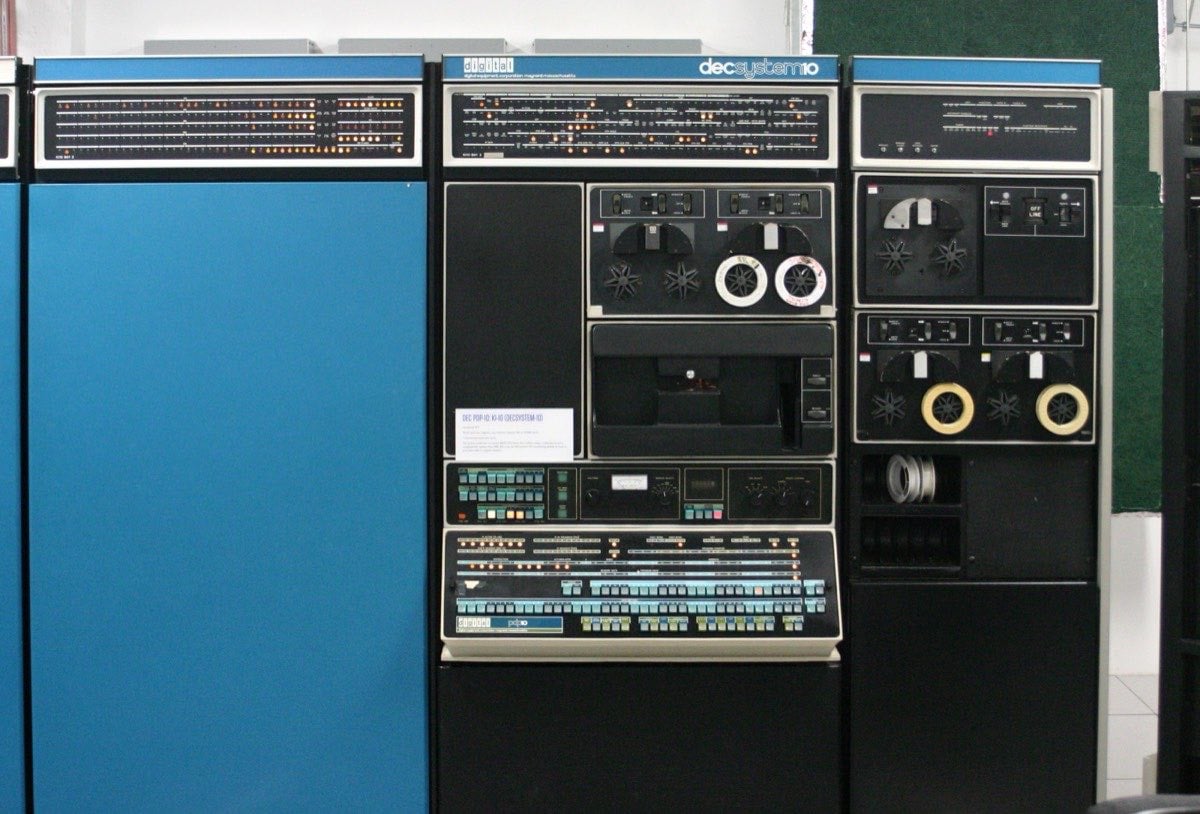
A DEC PDP-10 (KI10), the machine family that ran Colossal Cave Adventure and the first Zork. Photo: Gah4 via Wikimedia Commons, CC BY-SA 4.0, resized.
Zork I sold 380,000 copies by 1986, according to its Wikipedia history. Text adventures then faded from stores for two decades, and writers kept the form alive with free tools. Twine games such as Howling Dogs and Depression Quest reached wide audiences in the early 2010s, and Charlie Brooker used Twine while he developed Black Mirror: Bandersnatch.
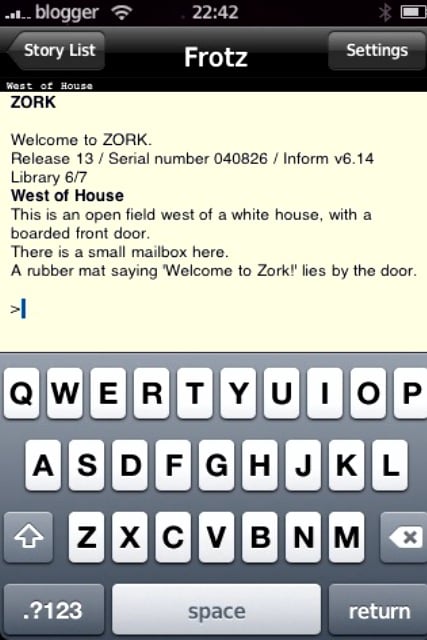
Zork on an iPhone in 2008, through the Frotz interpreter. Photo: Robert Nelson via Wikimedia Commons, CC BY 2.0.
The lesson from text adventures applies to any story you tell, as our storytelling lessons from text adventures post argues: a player stays when every room promises something new and every choice has a consequence.
Where AI Story Games Still Fall Short
AI story games in 2026 still struggle with three things: long-term consistency, fair rules and endings. A model can write a vivid scene, but it does not know where the story should go unless someone told it. These limits are worth knowing before you pay for any plan.
Consistency over hundreds of turns. Every tool in the play group forgets eventually. Saved facts and structured state slow the drift, but they do not stop it.
Fair rules. Without a rules engine, a persuasive player wins every fight. Friends & Fables answers this with 5e-based combat. Chat assistants leave it to you.
Endings. Open-ended games rarely end on their own. Authored engines end where the writer decided, which is why Twine, ink and Ren'Py still produce the most memorable story games.
Rights and prices that change. Several platforms publish no price or ownership terms on a public page. Check before you build a long project on one.
The pattern points at a mixed approach. Write the world, the cast and the endings yourself, then let the AI improvise inside them. That is how the strongest tools in each group already work.
Why We Built the Story Side Differently
Every play platform in this list starts at the scene. You type an action and get a paragraph. That is fun, and it skips the stage where good stories are decided.
A one-line prompt produces the average of every story the model has read, which is why so many AI adventures open in a tavern. A written world, a cast with secrets and a branch map give the AI something it cannot average away: your setting, your stakes and the one twist you care about.
So Taskade put the story bible in a shared workspace. The generators draft the world, the game lore and the quests into projects, your co-writers edit them together, and AI agents keep names, factions and promises consistent as the bible grows. When you are ready to build, you can hand the bible to Twine, ink, Ren'Py or Rosebud AI, and the first draft starts from your world instead of from nothing.
For a live story app, Taskade Genesis is an AI app builder that turns the same bible into a playable web app with an AI narrator. Kits in the Taskade App Factory show the shape: the Lore Generator builds a one-page lore sheet with factions and rumors, and the Tabletop Campaign Manager keeps session recaps, NPCs and quests for a human game master. Neither has a price, but both hold automations, so cloning either needs a paid plan.
Kit contents read from each kit page on November 7, 2026. A kit that holds automations needs a paid plan to clone, and each agent counts toward Free's 1-agent limit.
AI Story Game FAQ
What is the best AI story game in 2026?
It depends on what you want at the end of the evening. For an open-ended text adventure, AI Dungeon has the largest community library. For a campaign with real rules, Friends & Fables runs an AI game master with tactical combat based on D&D 5e rules. For stories set in famous worlds, try Hidden Door. To publish your own interactive fiction, Twine and ink are free and open source.
What is the best free AI text adventure?
Perchance AI RPG is free with no sign-up and states no daily limit. Friends & Fables gives 25 free game-master turns a day, Altworld starts with 10 guest turns, and AI Dungeon lets you play its base model without paying. ChatGPT and Claude also run a text adventure on their free plans if you give them a game-master prompt. Free plans checked November 7, 2026.
Is AI Dungeon still free in 2026?
Yes. AI Dungeon's pricing FAQ says you can use the model at its base amount endlessly without spending anything, and its Voyage public multiplayer is free for everyone. Paid memberships add a monthly credit allowance and more context. The plan list did not load on November 7, 2026, so we do not quote tier prices here.
Is "Storygame AI" a single app?
No. "Storygame AI" is mostly how people search for the whole category of AI story games. The closest product name is StoryGames.AI, a visual-novel assistant that Buildbox described in a 2023 guide for Buildbox Classic. Its current availability is not confirmed. Most people who search the term want an AI game master such as AI Dungeon or Friends & Fables.
How do AI story games work?
You type what your character does. The AI reads your action, the recent story and any saved facts, such as story cards or a lorebook, then writes the next scene. Some platforms also run a rules check, such as a combat turn, before they narrate. Authored tools such as Twine work differently: the writer creates every branch in advance.
Why do AI story games forget things?
A language model sees only a limited amount of recent text, so early details fall out of view in a long run. Story cards, lorebooks, long-term memories and short summaries help. Pin the facts that matter, and start a new chapter with a one-paragraph recap instead of playing hundreds of turns in one session.
Can I make my own AI story game without coding?
Yes. Twine lets you write branching stories without code and publishes to HTML. Rosebud AI and Gameer turn a description into a playable interactive story. In Taskade, you can describe a story game and Taskade Genesis builds a live web app with scenes, characters and an AI narrator.
Can I sell an interactive fiction game I made?
Often, but read the license first. Twine says anything you create is free to use, including commercially, and Ren'Py is free for commercial use. ChoiceScript is different: its license bars commercial use unless Choice of Games publishes the game or grants a commercial license. Rosebud AI grants commercial rights from its $30 a month 10x Dev plan. Check a hosted platform's terms for your plan before you sell.
Is there an AI dungeon master for D&D?
Yes. Friends & Fables runs an AI game master with tactical turn-based combat based on D&D 5e rules, long-term memories and battlemaps, and its free plan includes 25 turns a day. For a human-run table, Taskade offers a free D&D content generator and a Tabletop Campaign Manager kit for sessions, NPCs and quests. That kit holds automations, so cloning it needs a paid plan.
Are AI story games safe for kids?
Check each platform's age rules first. Character.AI removed open-ended chat for users under 18 in late 2025 and points teens to a guided Stories format instead. Hidden Door rates each world's content, from All ages to Mature. Authored tools such as Twine involve no live AI at all, so a parent or teacher controls every word of the story.
Can Taskade make an AI story game?
Yes, as a web app. Taskade Genesis builds a story game from a prompt, with scenes and characters stored as projects and an AI agent as the narrator. Taskade is not a combat-rules game master like Friends & Fables. It is strongest for the story bible, the branch map and a shareable story app.
Do I need a paid plan to build a story game in Taskade?
You can start on Free, which includes 3 Taskade Genesis apps, 1 AI agent, 10 automation runs per billing period and 2 workspace members. Free starts with 0 AI credits. On Free, you earn free AI credits with referrals and invites, and you can upgrade any time. A kit that holds automations, such as the AI Story Game kit, needs a paid plan to clone. Pro is $10 a month billed annually.
The Verdict
For open play, AI Dungeon is still the default, and Perchance is the free way to try the genre. For rules and a group, Friends & Fables runs the most complete AI game master. For known worlds, Hidden Door. For prose, NovelAI. For authored fiction, Twine and ink, and for a visual novel you can sell, Ren'Py.
And before any of them, write the world down. The play platforms improvise well, but they improvise best inside a world, a cast and an ending someone wrote first. Write the world first. Start your story bible free →
Further Reading
AI Game Generators: prompt-to-game builders for arcade, platformer and 3D games
▲ ■ ● Colossal Cave fit on one computer and one imagination. Today the AI writes the next room, and the world is still yours to build. Memory holds the lore, Intelligence narrates the scene, Execution saves the run. Build your story game free →