






In October 2023, researchers at Princeton asked the best language models in the world to fix real bugs from real GitHub repositories. The winner, Claude 2, solved 1.96 percent of them.
Twenty-five months later, Anthropic reported that Claude Opus 4.5 solved 80.9 percent of the human-validated subset of that same benchmark. In between, an entire industry was born, coding agents became billion-dollar product lines, one startup was taken apart by two buyers in a single week, and a joke coined on X became the Collins Dictionary Word of the Year.
This is the complete history of how software started writing itself, told in five generations plus the twenty-one-year baseline they replaced.
TL;DR: AI coding tools went from symbol-table autocomplete in 1996 through five generations: neural completion (2019), Copilot-style ghost text (2021), chat in the editor (2023), task agents (2024), and parallel agent fleets (2025). The measurable jump is stark: 1.96 percent of real GitHub issues solved in 2023 versus 80.9 percent in late 2025. Build software from a prompt.
The Five Generations of AI Coding Tools, at a Glance
Every AI coding tool shipped since 2018 fits one of five generations, and each generation is defined by exactly one thing: how much of the work loop the machine holds. Generation 1 held a token. Generation 5 holds a task, a test suite and a pull request. Generation 0 in the table below is the twenty-one-year baseline they replaced, and it contained no AI at all.
| Generation | Years | What the machine did | What you still had to do |
|---|---|---|---|
| 0. Symbol lookup | 1996-2017 | Matched identifiers from a parsed symbol table | Everything: design, logic, syntax, testing |
| 1. Neural completion | 2018-2020 | Predicted the rest of a line from patterns in public code | Write the structure, verify every suggestion |
| 2. Ghost text | 2021-2022 | Generated whole functions from a comment or signature | Read every diff, wire the pieces together, test |
| 3. Chat in the editor | 2023-2024 | Answered questions about your code, drafted files on request | Copy, place, integrate, run, debug |
| 4. Agents | 2024-2025 | Read the repo, edited many files, ran tests, iterated | Set the goal, review the pull request |
| 5. Fleets and harnesses | 2025-2026 | Ran several agents in parallel under written rules and permissions | Write the spec, own the review, hold the taste |
Two things are worth noticing before we go deeper. First, the gap between generations is shrinking: Generation 0 lasted twenty-one years, Generation 4 lasted about eighteen months. Second, the human job does not disappear at any rung. It moves up: from typing, to reading, to specifying, to judging.
Generation 0: When Autocomplete Was Just a Dictionary (1996-2017)
Microsoft shipped the first mainstream code completion in 1996, inside the Visual Basic 5.0 Control Creation Edition, and it predicted nothing at all. IntelliSense parsed your project into a symbol table and offered the names that were legal in that position. It was a dictionary with good manners, and for twenty-one years that was the state of the art.
The design spread fast because it was genuinely useful. Visual Studio .NET (2001) made IntelliSense central to the editor. Visual Studio 2005 stopped requiring a trigger character and began suggesting as you typed. Eclipse shipped Content Assist. JetBrains built IntelliJ IDEA on the premise that an IDE should understand the abstract syntax tree well enough to refactor safely, which is why IntelliJ completion felt smarter than everyone else's for a decade.
But the ceiling was hard, and it was structural. Symbol-table completion can only ever offer you a name that already exists somewhere. It cannot write the body of a function, because it has no model of what code means. Ask it to sort a list and it will happily offer you sort, sorted, sortBy and sortWith, and then stop.
For the longer arc of how programming got to this point at all, see our history of computing from binary to AI agents, which covers the compiler era that made high-level languages possible in the first place.
The interesting thing about Generation 0 is how long the ceiling held. Between 1996 and 2017, editors got faster, prettier and better at refactoring. None of them got closer to writing code.
Generation 1: The Neural Autocomplete Nobody Would Pay For (2018-2020)
The first tools to predict code rather than look it up appeared in 2019, and both of them were commercial failures that proved the concept. Deep TabNine, released in July 2019, fine-tuned OpenAI's GPT-2 on roughly two million files of public GitHub code and produced completions for any language without a language server. Kite, founded in 2014, reached 500,000 monthly active developers and then shut down.
Two ideas arrived with Generation 1 and never left.
The first is language-agnostic prediction. Symbol-table completion needs a parser per language. A transformer trained on text needs none: it is doing next-token prediction over characters that happen to be code. Deep TabNine worked in obscure languages on day one because it never knew what language it was in.
The second is statistical, not semantic, correctness. A neural completion is the most likely continuation, not the correct one. That distinction is the source of every complaint about AI coding tools written since, and it is worth internalizing early: these systems are pattern engines, not proof engines. Our explainer on non-determinism covers why the same prompt can produce different code on two runs.
Kite's founder, Adam Smith, wrote the most useful document in this entire history: a public post-mortem published on November 16, 2021, six weeks before GitHub Copilot's competitor launched into the same market and won. His two reasons deserve quoting because both turned out to be exactly right and exactly wrong at the same time.
On technology: models "don't understand the structure of code, such as non-local context," and building a tool that synthesizes code reliably "may cost over 100 million dollars." True in 2021. Solved by scale within eighteen months.
On business: Kite could not monetize. Individual developers would not pay, and "engineering managers only want to pay for discrete new capabilities." An 18 percent productivity improvement was not a capability. It was a nice-to-have.
Copilot solved both problems the same way: a much larger model, and distribution through GitHub and Visual Studio Code rather than a standalone install.
Generation 2: Copilot and the Ghost Text Era (2021-2023)
GitHub Copilot entered technical preview on June 29, 2021, and it was the first time most working programmers watched a machine write a function they had only described. It ran on OpenAI Codex, a GPT-3 descendant fine-tuned on public code, described in the paper Evaluating Large Language Models Trained on Code, submitted July 7, 2021 with 58 authors. On the HumanEval benchmark introduced in that paper, Codex solved 28.8 percent of problems on a single attempt. GPT-3 solved zero.
That zero is the whole story of Generation 2. Between GPT-3 and Codex sat nothing but training data and a fine-tune, and the difference was the gap between "cannot code" and "codes about as well as a distracted intern."
Copilot became generally available on June 21, 2022 at $10 per month or $100 per year, free for verified students and open source maintainers. GitHub reported more than 1.2 million developers had used the technical preview over the preceding twelve months, and claimed that "nearly 40 percent of code is being written by GitHub Copilot in popular coding languages, like Python." That 40 percent figure was measured as accepted suggestions in files where Copilot was enabled, which is a narrower claim than it sounds, and it set the template for a decade of AI coding statistics that are true but easy to misread.
Competitors arrived fast. Amazon's CodeWhisperer previewed in 2022 and was folded into Amazon Q Developer on April 30, 2024. Tabnine repositioned around private, self-hosted models. Replit shipped Ghostwriter in 2022. Open-weight coding models from Meta, the BigCode project and Alibaba gave teams a version they could run themselves.
The interaction model for the whole generation was ghost text: grey characters ahead of your cursor that you accept with Tab. It is a beautiful interface, and it has one fatal property. It can only help inside the file you already have open, at the position your cursor already occupies.
Note where the human sits in that loop. Every arrow passes through you. Generation 3 and 4 exist to remove arrows.
For the full company story behind this era, read our history of GitHub and our history of OpenAI Codex, which traces the same name across two completely different products five years apart.
Generation 3: Chat Moves Into the Editor (2023-2024)
ChatGPT's launch in November 2022 changed AI coding tools within four months, because it proved that a conversational interface could carry a coding task that a completion interface could not: "why is this broken?" By mid-2023, chat had been pulled inside the editor, and the unit of work jumped from a line to a file.
Three product shapes emerged in 2023, and all three still exist.
The AI-native editor. Anysphere was founded in 2022 by four MIT students and launched Cursor in March 2023 as a fork of Visual Studio Code with the AI treated as a first-class citizen rather than a plugin. The fork mattered: owning the editor meant owning the context, so Cursor could feed the model the whole repository rather than one open buffer. The full arc, including the funding ladder from a 2.87 million dollar pre-seed to a 29.3 billion dollar valuation, is in our history of Anysphere and Cursor.
The prompt-to-UI generator. Vercel announced v0 in October 2023, generating React components from a text description. One hundred thousand people joined the waitlist in three weeks. It was the first tool where the output was a rendered interface rather than a text file, which changed who could use it. See our history of Vercel and v0.
The prompt-to-app builder. Anton Osika released GPT Engineer as an open source experiment in 2023, which became Lovable. Bolt.new followed from StackBlitz on October 3, 2024 and reportedly reached 4 million dollars in annualized revenue within four weeks, one of the fastest product ramps on record. Our history of Lovable covers the pivot from a terminal script to a builder used by people who cannot read the code it produces.
Meanwhile the incumbents caught up. GitHub announced Copilot X in March 2023 and moved Copilot Chat to GPT-4-class models by November 2023. Then, on April 29, 2024, GitHub previewed Copilot Workspace, a task-centric environment where you start from an issue, get a plan, and approve it before code is written. Workspace was the hinge. It is the first mainstream product where the unit of work is a task, not a file.
And in October 2023, the benchmark that would define the next three years appeared.
SWE-bench: The Benchmark That Set the Agenda
SWE-bench was published on arXiv on October 10, 2023 by Carlos Jimenez, John Yang and colleagues at Princeton and the University of Chicago. It contains 2,294 real software engineering problems taken from GitHub issues and their merged pull requests across 12 popular Python repositories. To pass, a model must edit the codebase so the project's own tests go green.
The headline result was brutal and clarifying: the best model tested, Claude 2, resolved 1.96 percent. Every tool in Generation 3 could write a plausible function and almost none could fix a real bug in a real repository.
That gap became the industry's scoreboard, and the scoreboard changed the products.
Generation 4: The Agent Takes the Keyboard (2024-2025)
Cognition introduced Devin on March 12, 2024 and called it the first AI software engineer. Its claim was a SWE-bench score of 13.86 percent unassisted, against a previous state of the art of 1.96 percent unassisted and 4.80 percent assisted. Seven times better in five months, and the mechanism was not a bigger model. It was a loop.
The insight that defines Generation 4 is that most of the capability was never in the weights. It was in the scaffolding: give the model a shell, a file system, a browser and a test runner, then let it try, fail, read the error and try again. That scaffolding now has a name, the agent harness, and the cycle inside it is the agent loop.
Compare that with the ghost-text diagram above. The human appears twice instead of on every arrow, and the machine now closes its own feedback loop through the test suite. That is the entire difference between an assistant and an agent.
Four things had to ship in the same eighteen months for this to work, and they all did.
Tool use became reliable. Models learned to emit structured calls that a harness can execute, covered in our explainer on function calling and tool use. Without this, an agent cannot run a test.
Context windows got large enough to hold a repository. A model that can hold 200,000 tokens can hold the relevant slice of a real codebase. See context window for the numbers.
A connection standard arrived. Anthropic released the Model Context Protocol on November 25, 2024, with Block, Apollo, Zed, Replit, Codeium and Sourcegraph as launch adopters. Before MCP, every agent needed a bespoke connector for every system. After it, both sides implement one protocol. Our MCP explainer covers the mechanics.
Reasoning models made planning cheap enough to be worth doing. See reasoning models.
The products followed within months of each other.
| Date | Product | The shape it introduced |
|---|---|---|
| Sept 2024 | Replit Agent | Prompt to deployed app, in the browser |
| Nov 2024 | Windsurf (Codeium) | Agentic editor with repo-wide "flows" |
| Feb 24, 2025 | Claude Code (research preview) | The terminal as the agent's home |
| Feb 2025 | GitHub Copilot agent mode | Multi-file autonomous edits inside VS Code |
| Apr 16, 2025 | OpenAI Codex CLI | Open source terminal agent |
| May 16, 2025 | OpenAI Codex (cloud) | Agent that works in a sandbox, returns a diff |
| May 2025 | GitHub Copilot coding agent | Assign an issue, get a pull request |
| May 22, 2025 | Claude Code general availability | Agent plus IDE integrations plus an SDK |
Replit's launch is the clearest evidence that Generation 4 was a commercial event and not just a technical one. Replit Agent shipped in September 2024, and Replit's revenue went from roughly 2.5 million to over 150 million dollars in about a year. Claude Code went from a September 2024 internal side project to general availability in eight months.
The competition also got strange. In July 2025, Windsurf was taken apart in a single week: Google paid a reported 2.4 billion dollars to license its technology and hire its CEO and co-founder into DeepMind, after an OpenAI acquisition reportedly fell through, and Cognition, the maker of Devin, bought what remained. Three of the biggest names in AI coding touched the same company in seven days.
Vibe Coding, and What It Actually Named
On February 2, 2025, Andrej Karpathy posted that there was "a new way of programming" he called vibe coding: describing what you want, accepting the diffs without reading them, and forgetting the code exists. He meant it half as a joke about weekend projects.
It named something real. Five weeks later, on March 6, 2025, Y Combinator managing partner Jared Friedman said that for 25 percent of the Winter 2025 batch, 95 percent or more of the codebase was AI-generated, and stressed that these were highly technical founders who simply chose not to type it. Collins Dictionary named vibe coding its Word of the Year on November 6, 2025.
Our vibe coding explainer covers where the practice works well and where it produces software nobody can maintain. The short version: vibe coding is excellent for the first version and dangerous for the fiftieth, because the person who accepted the diffs is now the only one who could have caught what was wrong with them.
Generation 5: Fleets, Harnesses and the Written Spec (2025-2026)
By late 2025 the constraint was no longer whether an agent could finish a task. It was how many agents you could point at a codebase before the codebase stopped making sense. Generation 5 is the engineering answer to that question, and its artifacts are not models. They are files, permissions and protocols.
Four patterns define it.
Instructions became a file in the repo. AGENTS.md was released in August 2025 as an open format: a README written for agents, holding build steps, test commands and conventions. It is now used by more than 60,000 open source projects and stewarded by the Agentic AI Foundation under the Linux Foundation, with support across Codex, Cursor, GitHub Copilot, Gemini CLI, Jules, Devin, Aider and Factory. Anthropic followed in October 2025 with Agent Skills, folders of instructions an agent loads only when a task calls for them, which we cover in our review of Claude Code skills. Our AGENTS.md explainer covers what belongs in one.
Agents learned to delegate. A main agent spawns subagents with their own context windows for narrow jobs like searching a codebase or reviewing a diff, and only the conclusion comes back. This, plus context compaction, is why 2026 agents run for hours where 2024 agents ran for minutes.
Permission and isolation became product features. Once an agent can run shell commands, the question of what it is allowed to do stops being academic. See agent permissions and agent sandbox.
Prompting became specification. The skill that mattered in 2023 was writing a clever prompt. The skill that matters in 2026 is deciding what the agent should be told, what it should be able to see, and what it should never touch. That discipline has two names in current use: context engineering and spec-driven development. Both are downstream of the same realization: the model is a commodity, and the surrounding instructions are the product.
The same shift happened in workflow automation a decade earlier, when scripts became declarative pipelines. Our history of workflow automation traces that arc, and the parallel is exact: the valuable artifact stopped being the instruction and became the system that decides which instructions run.
The Definitive Timeline: Thirty Years in One Table
Here is every milestone that changed what the machine could do, with dates verified against primary sources. This is the table the rest of this article exists to support.
| Date | What shipped | What changed | Why it mattered |
|---|---|---|---|
| 1996 | IntelliSense (Visual Basic 5.0 CCE) | Completion from a parsed symbol table | Set the interface every editor still uses |
| 2001 | Visual Studio .NET, IntelliJ IDEA | AST-aware completion and refactoring | Proved the ceiling of symbolic methods |
| 2014 | Kite founded | First venture-backed bet on ML for code | Five years too early, documented why |
| Jul 2019 | Deep TabNine | GPT-2 fine-tuned on ~2M GitHub files | First neural, language-agnostic completion |
| Jul 2021 | Codex paper (arXiv 2107.03374) | 28.8% on HumanEval vs GPT-3's 0% | Showed code was a training-data problem |
| Jun 29, 2021 | GitHub Copilot preview | Whole functions from a comment | The mass-market moment |
| Nov 16, 2021 | Kite shuts down | 500K users, no revenue | The clearest failure post-mortem in the field |
| Jun 21, 2022 | Copilot GA, $10/mo | 1.2M preview users, paid product | AI coding became a business |
| Nov 2022 | ChatGPT | Conversation as a coding interface | Moved the unit of work from line to file |
| Mar 2023 | Cursor launches | AI-native editor fork | Owning the editor meant owning the context |
| Oct 10, 2023 | SWE-bench published | 2,294 real GitHub issues; best score 1.96% | Gave the industry an honest scoreboard |
| Oct 2023 | Vercel v0 | Prompt to rendered UI | Output stopped being a text file |
| Mar 12, 2024 | Devin | 13.86% on SWE-bench, 7x prior art | Proved scaffolding beat model size |
| Apr 29, 2024 | Copilot Workspace | Issue to plan to code | First mainstream task-level unit of work |
| Aug 2024 | SWE-bench Verified | 500 human-checked tasks; GPT-4o at 33.2% | Made the scoreboard trustworthy |
| Sept 2024 | Replit Agent | Prompt to deployed app in a browser | Removed the local environment entirely |
| Oct 3, 2024 | Bolt.new | ~$4M annualized revenue in four weeks | Showed the size of the non-developer market |
| Nov 25, 2024 | Model Context Protocol | One standard for tool and data connections | Ended bespoke connectors per tool |
| Dec 18, 2024 | Copilot Free in VS Code | 2,000 completions, 50 chats per month | Made AI completion the default, not an upgrade |
| Feb 2, 2025 | Karpathy coins "vibe coding" | Named accept-without-reading building | Collins Word of the Year, Nov 6, 2025 |
| Feb 24, 2025 | Claude Code research preview | Terminal-first agent | The CLI became a serious agent surface |
| Apr 16, 2025 | OpenAI Codex CLI | Open source terminal agent | Codex returns as an agent, not a model |
| May 2025 | Copilot coding agent, Claude Code GA | Assign an issue, receive a pull request | Delegation became a normal workflow |
| Jul 10, 2025 | METR randomized trial | 19% slower, felt 20% faster | First rigorous check on the productivity story |
| Jul 11, 2025 | Windsurf split | Google licenses tech; Cognition buys the rest | The consolidation phase begins |
| Aug 2025 | AGENTS.md | Agent instructions become a repo file | 60,000+ projects; now a Linux Foundation standard |
| Nov 2025 | Claude Opus 4.5 | 80.9% on SWE-bench Verified | Real-bug repair became routine, not aspirational |
| 2026 | Parallel agent fleets, spec-driven workflows | Several agents per repo under written rules | Review capacity becomes the bottleneck |
What Actually Got Better, and What Did Not
Scores on the industry's own benchmark went from about 2 percent to about 81 percent in twenty-five months, while measured developer productivity in mature codebases did not move in the same direction at all. Both statements are supported by careful evidence, and holding them together is the only honest way to read this history.
The capability curve is real
| Benchmark moment | Date | Score | Source |
|---|---|---|---|
| Best model on SWE-bench (Claude 2) | Oct 2023 | 1.96% | SWE-bench paper |
| Devin, unassisted | Mar 2024 | 13.86% | Cognition |
| GPT-4o on SWE-bench Verified | Aug 2024 | 33.2% | SWE-bench Verified |
| Claude Opus 4.5 on SWE-bench Verified | Nov 2025 | 80.9% | Anthropic |
SWE-bench Verified deserves a note. OpenAI worked with 93 experienced Python developers to screen the original benchmark and found many tasks were underspecified or had broken tests, so it published a 500-task human-validated subset in August 2024. GPT-4o scored 33.2 percent on it against 16 percent on the original set. That is not the model getting better. That is the ruler getting straighter, and it is a good reminder that benchmark jumps sometimes measure the benchmark.
The productivity curve is contested
On July 10, 2025, METR published a randomized controlled trial that ran against the entire industry narrative. Sixteen experienced open source maintainers worked through 246 real tasks in repositories they knew well, averaging over 22,000 GitHub stars and a million lines of code. Randomly, they were allowed or forbidden AI tools.
The result, in three numbers:
   BEFORE the tasks   developers forecast   AI would make them  24% FASTER
   AFTER  the tasks   developers believed   AI had made them    20% FASTER
   MEASURED           the stopwatch said    AI made them        19% SLOWER
                                                                ==========
                                            perception gap:     ~39 points
METR has since labeled the result historical, noting it reflects tools available between February and June 2025, and the study's population is deliberately the hardest case: experts in codebases they already hold in their heads. The speed finding may well not generalize. The perception gap is the part worth carrying forward: people are poor judges of their own speed when the waiting feels productive.
Practitioner sentiment tells a compatible story. Stack Overflow's 2025 developer survey found 84 percent of respondents use or plan to use AI tools and 51 percent of professionals use them daily, while only about 3 percent highly trust the accuracy of the output and roughly 46 percent somewhat or highly distrust it. The single biggest frustration, cited by 66 percent, was "AI solutions that are almost right, but not quite," and 45 percent said debugging AI-generated code takes more time.
Google's DORA research frames the same tension structurally: AI acts as an amplifier, magnifying an organization's existing strengths and weaknesses rather than fixing either. A team with strong review, tests and architecture gets faster. A team without them ships its existing problems more quickly.
The adoption curve is not contested at all
| Claim | Source and date |
|---|---|
| Over 25% of new code at Google is AI-generated, then reviewed by engineers | Sundar Pichai, Alphabet Q3 2024 earnings call, October 2024 |
| 25% of the YC Winter 2025 batch had 95%+ AI-generated codebases | Jared Friedman, March 6, 2025 |
| 84% of developers use or plan to use AI tools | Stack Overflow survey, 2025 |
| AGENTS.md adopted by 60,000+ open source projects | agents.md, 2026 |
The gap between those two curves is the actual state of the art in 2026. The tools are extraordinarily capable and the systems around them are still catching up, which is why AI code review and human-in-the-loop design became first-class topics rather than afterthoughts.
The Autonomy Ladder: Where Every Tool Sits in 2026
Every AI coding tool on the market occupies one of six rungs, and the rung is determined by a single test: what is the largest unit of work you can hand it without looking? A completion tool takes a token. A fleet takes a milestone.
The dotted line back to Rung 1 is the important edge. Every rung above 3 produces work a human must still read, and reading is the one thing that has not been automated. That is why the practical bottleneck in 2026 is review capacity, not generation capacity.
| Rung | What you hand it | What comes back | Typical wait |
|---|---|---|---|
| 1. Completion | A cursor position | A few tokens | Milliseconds |
| 2. Chat | A question | An explanation and a snippet | Seconds |
| 3. Multi-file edit | A described change | A diff across files | Under a minute |
| 4. Task agent | An issue or goal | Edits plus a passing test run | Minutes |
| 5. Delegated agent | An assignment | A pull request you did not watch | Tens of minutes |
| 6. Agent fleet | A milestone and a spec | Several branches to triage | Hours |
The Seven Deep Dives: One Company at a Time
Each company below changed the direction of this history once, and each has a dedicated history on this blog. Use the table as an index.
| Company | Its one contribution | Deep dive |
|---|---|---|
| GitHub | Turned AI completion into a mass-market product and a scoreboard for the field | History of GitHub |
| OpenAI | Codex proved code was a training-data problem in 2021, then returned as an agent in 2025 | History of OpenAI Codex |
| Anysphere | Forked the editor so the AI could see the whole repository | History of Anysphere and Cursor |
| Anthropic | Put the agent in the terminal and made long autonomous runs practical | History of Claude Code |
| Replit | Removed the local development environment from the equation | History of Replit |
| Lovable | Took prompt-to-app to people who never open a code editor | History of Lovable |
| Vercel | Made the output of a prompt a rendered interface | History of Vercel and v0 |
Two adjacent histories complete the picture: our history of LangChain covers the framework layer that taught the field how agents chain tools, and our history of OpenAI and ChatGPT covers the model releases underneath everything above. For the philosophical thread, what agentic engineering actually means and our piece on metacognitive AI look at what happens when systems evaluate their own work.
What Changed for People Who Do Not Write Code
The most consequential result of this thirty-year arc is that building software stopped requiring a repository. Roughly half the tools in Generation 3 and every prompt-to-app builder since assumed the user could not read a diff, and that assumption turned out to describe most people who have a problem worth solving with software.
Taskade Genesis is built for that half. You describe what you want in plain language, and you get a working app inside a workspace: the interface, the data, the AI agents that operate it, and the automations that keep it running. There is no repository to clone, no build step, no deployment, and no hosting decision. The app exists where your team already works.
The pieces map onto the generations above in a specific way.
The agent loop, without the terminal. Taskade AI Agents carry their own knowledge, a large built-in toolset including web search and file analysis, and the ability to work together on a task. They run against frontier models from top AI labs, and you never pick a model name unless you want to. Start with your first prompt and the agent tools reference.
The scaffolding, as a product. What Generation 4 called a harness, Taskade calls a workspace. Automations give agents triggers and actions, 100+ bidirectional integrations connect them to the systems you already use, and automation triggers decide when anything runs.
The memory, kept. Workspace DNA is the loop of Memory, Intelligence and Execution: what your team knows feeds what the agents decide, which feeds what actually runs, which feeds back into what the workspace knows. Agents that forget the last session are agents you have to re-brief forever.
Many ways to look at the same data. List, Board, Calendar, Table, Mind Map, Gantt and Org Chart, on the same underlying project. Timeline is part of the Gantt view.
Paid plans start at $10 per month billed annually on Pro, with Business at $25 per month billed annually. Email sign-in for published apps works on every plan, and custom domains sit on Pro and above. See pricing for the full ladder, or browse the community gallery for apps other people built from a prompt.
If you want the comparison rather than the pitch, we keep two: Claude Code vs Cursor vs Taskade Genesis for the developer-tool axis, and Taskade Genesis vs Bolt vs Lovable for the builder axis. Both are honest about which tool suits which job.
What Comes Next
The trajectory from here is legible because the constraint is legible: review capacity. Generation 5 can already produce more correct-looking code than any team can read, which means the next round of progress will come from tools that make verification cheaper rather than generation faster.
Three things are already visible in 2026.
Verification moves left. Test generation, property-based checking and AI code review run as part of the agent loop rather than after it. An agent that writes its own failing test first is a better agent than one that writes twice as much code.
Specifications become the source of truth. When several agents work one repository, the written spec is the only thing keeping them coherent. Spec-driven development is the formal version, and AGENTS.md is its minimum viable form.
The interface splits permanently. Developers get harnesses, permissions and terminal agents. Everyone else gets prompt-to-app products where the code is an implementation detail. These are different products for different jobs and the middle is emptying out. Bill Atkinson's HyperCard made the same bet in 1987 and it took forty years and a language model to pay off, as we cover in the HyperCard moment.
What has not changed in thirty years: somebody still has to know what the software is supposed to do. IntelliSense could not tell you. Neither can a fleet of agents. That judgment is the job, and it has only become more valuable as everything around it got automated.
Related Reading
- Best Vibe Coding Tools 2026: 9 AI Apps Ranked
- 15 Best Claude Code Alternatives in 2026 (No Terminal Required)
Frequently Asked Questions
What was the first AI coding tool?
It depends what counts. Microsoft's IntelliSense (1996, Visual Basic 5.0 Control Creation Edition) was the first mainstream code completion, but it matched names from a symbol table and predicted nothing. Deep TabNine, released in July 2019, was the first widely used neural completion, fine-tuning GPT-2 on public GitHub code. GitHub Copilot, in technical preview from June 29, 2021, was the first mass-market AI coding tool.
When did GitHub Copilot launch and what did it cost?
Technical preview began June 29, 2021, powered by OpenAI Codex. General availability came June 21, 2022 at $10 per month or $100 per year, free for verified students and open source maintainers. GitHub said more than 1.2 million developers used the preview in its first twelve months. A free Visual Studio Code tier launched December 18, 2024 with 2,000 completions and 50 chat requests per month.
What is SWE-bench and why does it matter?
SWE-bench is a benchmark of 2,294 real software engineering problems taken from GitHub issues and their merged pull requests across 12 Python repositories, published October 10, 2023. To pass, a model must make the project's own tests go green. It matters because it measures repair of real code rather than generation of self-contained functions. The best model scored 1.96 percent at publication; Claude Opus 4.5 reported 80.9 percent on the verified subset in November 2025.
Who coined the term vibe coding?
Andrej Karpathy, on X, on February 2, 2025. He described building where you accept AI suggestions without reading them and "forget that the code even exists." Collins Dictionary named it Word of the Year on November 6, 2025.
What is the difference between AI autocomplete and an AI coding agent?
Autocomplete predicts the next few tokens at your cursor and waits for you to accept. An agent takes a goal, searches the repository itself, edits multiple files, runs the tests, reads the failures and iterates. Autocomplete works per keystroke and returns in milliseconds. An agent works per task and can run for minutes or hours.
What is the Model Context Protocol and when did it launch?
MCP is an open standard for connecting AI tools to external data and systems, released by Anthropic on November 25, 2024 with Block, Apollo, Zed, Replit, Codeium and Sourcegraph as launch adopters. It replaced bespoke per-tool connectors with a single protocol both sides implement.
Do AI coding tools actually make developers faster?
Mixed, and highly task-dependent. METR's randomized trial of July 10, 2025 found 16 experienced maintainers took 19 percent longer on 246 real tasks in mature repositories when allowed AI tools, while believing they had been 20 percent faster. Adoption tells the other side: Stack Overflow's 2025 survey put usage at 84 percent. Google's DORA research describes AI as an amplifier of whatever practices a team already has.
What is AGENTS.md?
An open Markdown format for giving coding agents project-specific instructions: build steps, test commands, conventions. A README written for agents. Released August 2025, used by 60,000+ open source projects, stewarded by the Agentic AI Foundation under the Linux Foundation, supported across Codex, Cursor, GitHub Copilot, Gemini CLI, Jules, Devin, Aider and Factory.
How much code is written by AI in 2026?
Sundar Pichai told Alphabet's Q3 2024 earnings call that more than a quarter of new code at Google was AI-generated, then reviewed by engineers. Y Combinator's Jared Friedman said in March 2025 that 25 percent of the Winter 2025 batch had codebases 95 percent or more AI-generated. Stack Overflow's 2025 survey found 84 percent of developers using or planning to use AI tools, 51 percent of professionals daily.
Can non-developers build software with AI coding tools now?
Yes, in a separate product category. Developer agents like Claude Code, Codex and Cursor assume a repository and code review. Prompt-to-app builders removed those assumptions. Taskade Genesis is in that group: describe the app and get one with AI agents, automations and a database inside a workspace, no deployment step. Pro starts at $10 per month billed annually.
Why did Kite fail when GitHub Copilot succeeded?
Adam Smith's post-mortem of November 16, 2021 gives two reasons. The technology was not ready: models "don't understand the structure of code, such as non-local context," and reliable synthesis would cost "over 100 million dollars" to build. And monetization failed: 500,000 monthly active developers would not pay for a productivity improvement. Copilot arrived after transformers had crossed the capability line, with distribution through GitHub and Visual Studio Code.
What are subagents and why do coding agents use them?
A subagent is a helper spawned by a main agent, with its own context window and a narrow job like searching a codebase or reviewing a diff. Only its conclusion returns. This keeps thousands of tokens of intermediate output out of the main conversation, which is one of the main reasons 2026 agents run for hours where 2024 agents ran for minutes. See subagents and context compaction.
Thirty years of this history point in one direction: the machine keeps taking the next layer of typing, and the human keeps moving up to the next layer of judgment. IntelliSense took the identifier. Copilot took the function. Agents took the pull request. What none of them took, and what no roadmap suggests they will, is knowing what should exist in the first place.
That is the loop worth building for. Memory of what your team knows, intelligence that decides what to do with it, execution that actually runs. Start with a prompt and see what comes back.
▲ ■ ●
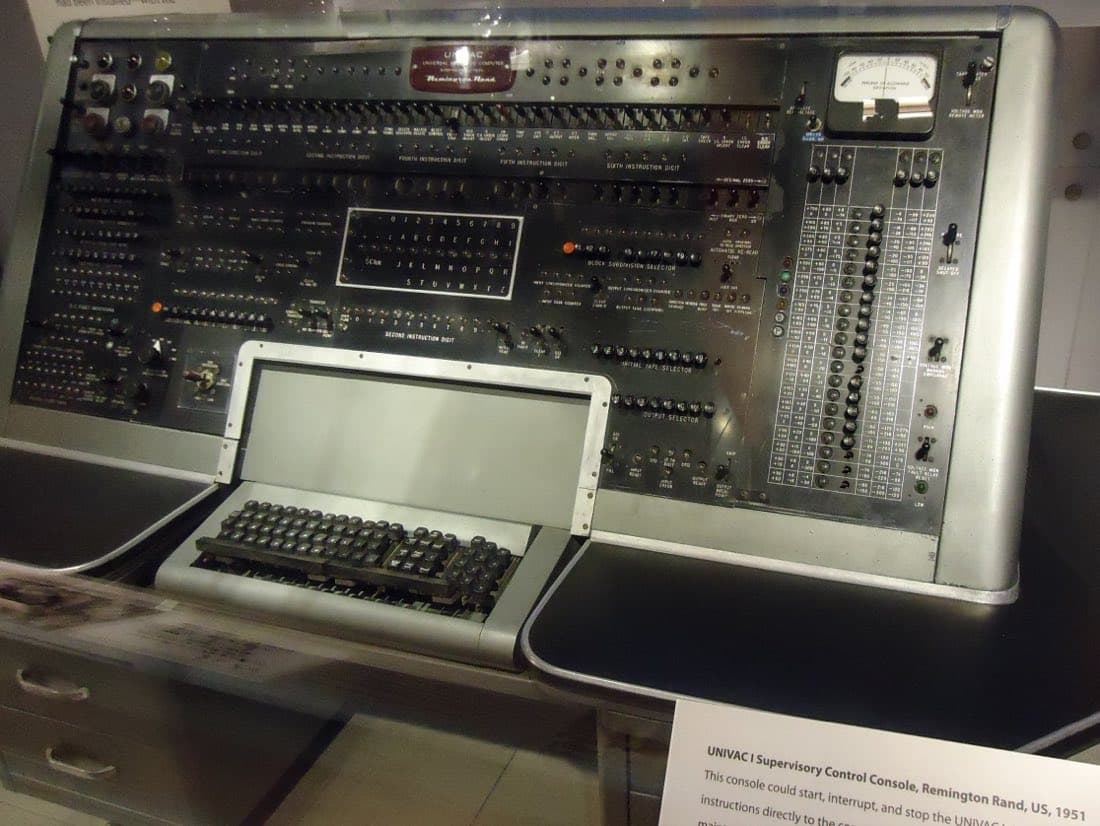
Featured image: Univac I Supervisory Control Console (Remington Rand, 1951) at the Computer History Museum. Photo: Tomwsulcer via Wikimedia Commons, CC0.