





Anysphere is an AI coding company that built Cursor, the world's most popular AI-first code editor. What started as a side project by four MIT students in 2022 became a $29.3 billion company by 2025, and in June 2026 SpaceX agreed to acquire it for $60 billion in stock, the largest startup acquisition on record.
But where did it all start? What makes Cursor different from GitHub Copilot? How does agentic coding work? In today's article, we explore the complete history of Anysphere and the future of AI-powered development. 🚀
Evaluating Cursor for your team? See our best Cursor alternatives, the best Claude Code alternatives, the full Cursor review, the Taskade Genesis vs Cursor comparison, or the three-way Claude Code vs Cursor vs Taskade Genesis breakdown. Not a developer? Taskade Genesis builds full apps from a prompt without code.
TL;DR: Anysphere is the company behind Cursor, the AI-first code editor founded by four MIT students in 2022. It reached a $29.3 billion valuation by November 2025, crossed $1 billion in annualized revenue that same month (reportedly $2 billion+ by early 2026), and in June 2026 agreed to a $60 billion all-stock acquisition by SpaceX, pending close. Cursor outputs code you still deploy; if you want the running app instead of the repo, Taskade Genesis builds it from a prompt.
What Is Anysphere? (Quick Answer)
Anysphere is an AI coding company, founded in 2022 by four MIT students, that built Cursor — the world's most popular AI-first code editor. A side project became a $29.3 billion company by November 2025 and, in June 2026, the target of a $60 billion all-stock acquisition by SpaceX, the largest startup acquisition ever recorded. Cursor's thesis: instead of bolting AI onto an existing editor as a plugin, rebuild the editor around AI from the ground up.
Anysphere at a Glance (2026)
| Fact | Detail |
|---|---|
| Company | Anysphere, Inc. |
| Flagship product | Cursor (AI-first code editor, VS Code fork) |
| Founded | 2022, by four MIT students |
| Founders | Michael Truell (CEO), Sualeh Asif, Arvid Lunnemark, Aman Sanger |
| Headquarters | San Francisco, USA |
| Cursor launch | March 2023 |
| Latest valuation | $60 billion (SpaceX acquisition agreement, June 2026, pending close); prior: $29.3 billion Series D (November 2025) |
| Total funding | $3.4 billion+ (2023–2025) |
| Revenue milestone | $1B+ annualized revenue (late 2025); reportedly $2B+ (early 2026); fastest to $100M ARR in history (14 months) |
| Key investors | OpenAI, Andreessen Horowitz, Thrive Capital, Accel, Coatue, Nvidia, Google |
🤖 What Is Anysphere?
Anysphere was founded in 2022 by four MIT students: Michael Truell, Sualeh Asif, Arvid Lunnemark, and Aman Sanger. Their mission was revolutionary—build an AI-first code editor that doesn't just suggest code, but understands your entire codebase and can autonomously complete complex tasks.
"We're not building better autocomplete. We're building a world where developers describe what they want, and AI agents figure out how to make it happen across dozens of files, maintaining consistency and architectural integrity."
Michael Truell, CEO of Anysphere
The company's flagship product, Cursor, is a fork of Visual Studio Code rebuilt from the ground up with AI capabilities embedded into the core runtime—not bolted on as an extension. This architectural decision would prove critical to Cursor's competitive advantage.
Within four years, Anysphere achieved what most startups dream of:
- $1 billion+ annualized revenue by late 2025 (reportedly $2 billion+ by early 2026)
- $29.3 billion valuation (November 2025)
- Fastest growth to $100M ARR in software history (14 months)
- Backing from OpenAI, Andreessen Horowitz, Thrive Capital, and Nvidia
- A $60 billion all-stock acquisition agreement with SpaceX (June 2026)
So, let's wind back the clock and see how four college students built the tool that's changing how the world writes code.
🥚 The History of Anysphere
The Early Days of AI Coding Assistants
To understand Anysphere's origin story, we need to understand the landscape they entered.
The idea of AI helping programmers write code isn't new. Early attempts date back to the 1960s with code generators and syntax autocomplete. But the modern era of AI coding assistants began with GitHub Copilot, launched in June 2021.
Copilot, built on OpenAI's Codex model (a fine-tuned version of GPT-3), was revolutionary. It could:
- Suggest entire functions based on comments
- Autocomplete code with contextual awareness
- Translate natural language descriptions into working code
By 2022, GitHub Copilot had millions of users and was generating approximately 40% of the code written by developers who used it. Microsoft (which owns GitHub) had proven the market for AI coding assistance was massive.
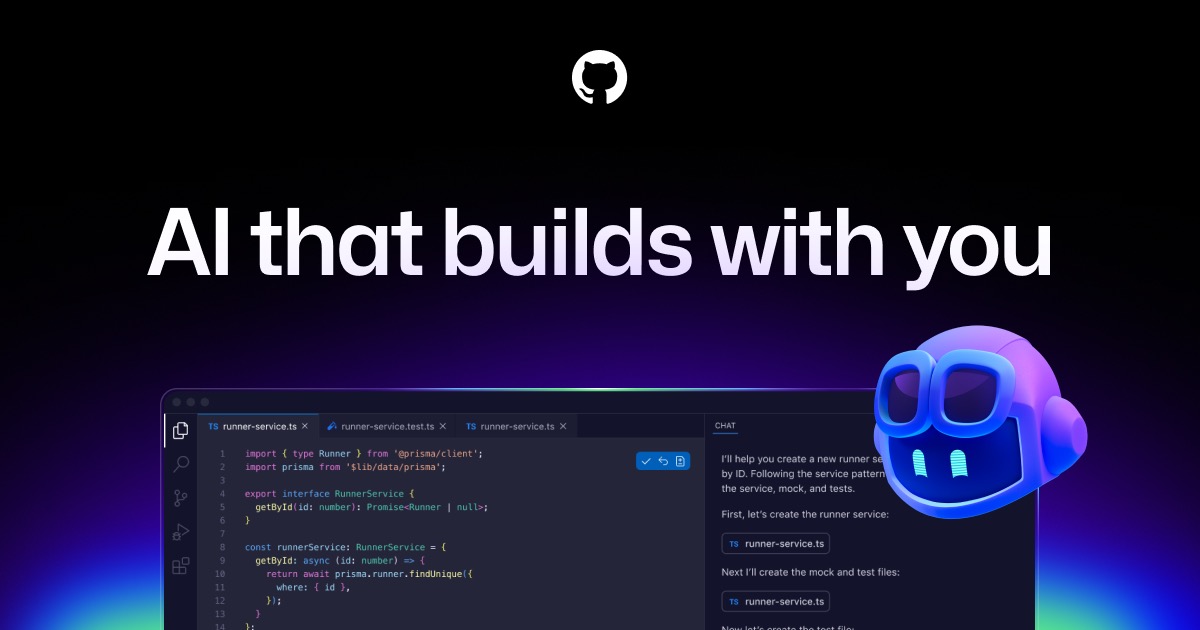
GitHub Copilot's suggestion interface, circa 2021. Image credit: GitHub
But there was a problem. Copilot was an extension—a plugin that sat on top of existing code editors. It worked within the constraints of the editor's extension API, which limited how deeply it could understand and manipulate code.
A group of ambitious MIT students saw an opportunity to do something different.
Four MIT Students with a Vision (2022)
In 2022, Michael Truell, Sualeh Asif, Arvid Lunnemark, and Aman Sanger were studying computer science and mathematics at MIT. All four had exceptional backgrounds:
- Sualeh Asif, originally from Karachi, Pakistan, competed in the International Math Olympiad
- Arvid Lunnemark was also a former Math Olympiad champion
- Michael Truell and Aman Sanger both became Neo Scholars—an elite program that identifies exceptional startup talent while they're still in college

The Anysphere founding team: Michael Truell, Sualeh Asif, Arvid Lunnemark, and Aman Sanger. Image credit: Anysphere
Through research at MIT CSAIL, internships at companies like Google, and participation in AI research programs, the four friends developed a shared belief: AI coding assistants were being built wrong.
The Cursor founding team discusses the future of AI-native programming on the Lex Fridman Podcast.
The problem with GitHub Copilot and similar tools wasn't the AI—it was the architecture. By building AI assistance as an extension, these tools could only see and modify what the editor's API exposed. They couldn't:
- Index the entire codebase efficiently
- Understand architectural patterns across hundreds of files
- Make coordinated changes to multiple files simultaneously
- Access the editor's core runtime for faster inference
The solution? Fork VS Code and rebuild it with AI at the core.
In 2022, they incorporated Anysphere and got to work.
OpenAI's First Bet & Cursor Launch (2023)
The timing couldn't have been better. OpenAI had just launched its Startup Fund—a venture arm designed to invest in companies building on OpenAI's technology. Anysphere's pitch was compelling: an AI-first code editor that would showcase what's possible when you design around AI from day one.
In March 2023, Anysphere launched Cursor to the world—a sleek, VS Code-compatible editor with AI baked into every interaction.
Early features included:
- AI Chat in the Editor: Ask questions about your codebase and get contextual answers
- Edit Mode: Highlight code and describe what you want to change
- Generate Mode: Describe a function, get a complete implementation
- Codebase Indexing: Cursor indexed your entire project for better context
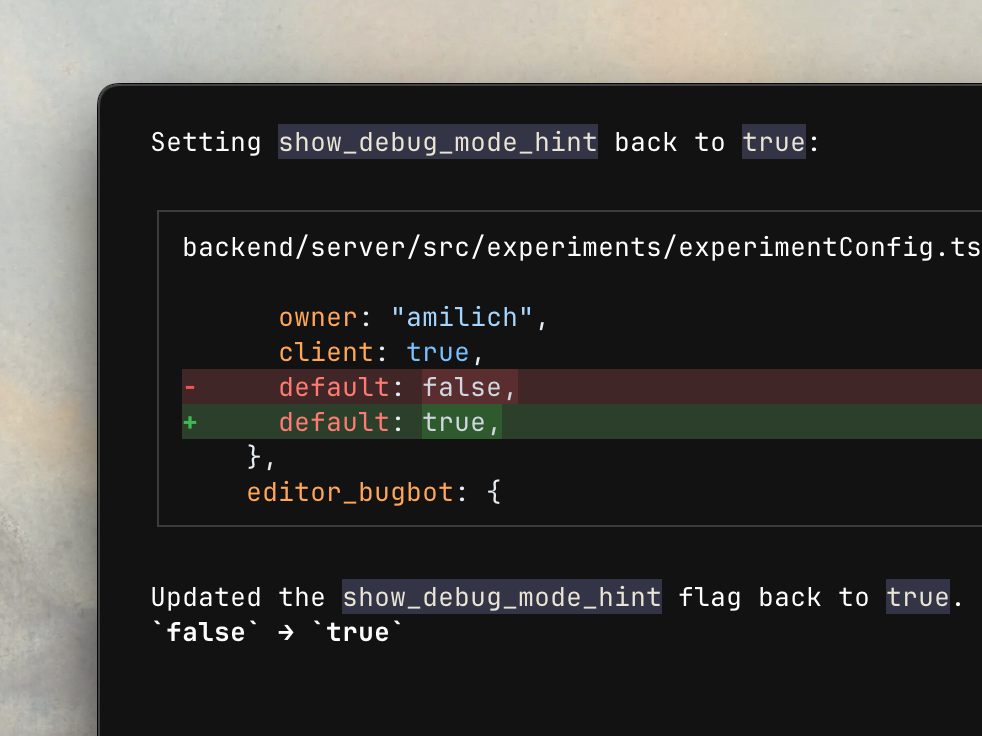
Cursor's initial interface in March 2023, showing AI chat and edit capabilities.
The developer community's response was immediate and enthusiastic. Here was a tool that felt like the future—not just autocomplete, but a genuine coding partner.
In October 2023, just seven months after launch, Anysphere announced an $8 million seed round led by the OpenAI Startup Fund, with participation from:
- Nat Friedman (former GitHub CEO)
- Arash Ferdowsi (Dropbox co-founder)
- Other prominent Silicon Valley angels
"We funded Anysphere because they're building the future of software development. Cursor isn't just better autocomplete—it's a fundamentally new way of working with code."
OpenAI Startup Fund Statement
The OpenAI backing was more than money—it was validation. And it signaled something interesting: OpenAI saw Cursor as a complement to their models, not a competitor.
The Composer Revolution (2024)
Throughout 2024, Anysphere was on a tear. The team grew from 4 to 40+ employees. Monthly Active Users (MAUs) grew exponentially. And the product kept getting better.
But the breakthrough came with Composer, which debuted in 2024 as Cursor's multi-file editing interface and later gave its name to the company's first proprietary coding model, shipped with Cursor 2.0 in October 2025.
Unlike GitHub Copilot, which relied on third-party models (initially Codex, later GPT-4), Cursor eventually built its own specialized coding model using reinforcement learning and custom training data. Composer was optimized for:
- Low latency: Most completions in under 30 seconds
- Codebase-wide reasoning: Understanding architectural patterns across files
- Multi-file editing: Coordinating changes to dozens of files simultaneously
- Semantic search: Finding relevant code even in massive repositories
The impact was dramatic. Developers could now:
- Describe a feature: "Add authentication to this API"
- Watch Composer work: It would identify relevant files, make coordinated edits, add tests
- Review and approve: All changes presented in a clean diff
In August 2024, Anysphere raised a $60M+ Series A at a $400 million valuation, led by Andreessen Horowitz (a16z) and Thrive Capital.
Then, just four months later in December 2024, they raised a $105 million Series B at a $2.6 billion valuation—led by the same investors plus Benchmark.
The ARR was doubling every two months. Cursor had become the fastest-growing developer tool in history.
(update) Cursor 2.0 & Multi-Agent Systems (2025)
The announcements in 2025 redefined what an AI code editor could do.
In late October 2025, Anysphere launched Cursor 2.0 with features that seemed like science fiction just months earlier:
Timeline of 2025-2026 Features:
| Date | Feature | Key Capabilities |
|---|---|---|
| Feb 2025 | Tab 2.0 | 21% fewer suggestions, 28% higher acceptance rate |
| May 2025 | Cloud Agents | Agents keep working while you're away |
| Oct 2025 | Cursor 2.0 + Composer | Multi-agent interface, up to 8 agents in parallel, first proprietary model |
| Nov 2025 | Plan Mode | Mermaid diagrams, task breakdown, agent orchestration |
| Dec 2025 | Visual Editing | Move elements, update colors, test layouts in real-time |
| Mar 2026 | Composer 2 | Frontier-level coding model, handles tasks requiring hundreds of actions |
Multi-Agent Parallelization was the killer feature. Instead of one AI assistant working sequentially, you could now:
- Run up to 8 agents simultaneously
- Each agent works in an isolated environment
- Agents can call other agents for specialized tasks
- The interface manages coordination and prevents conflicts
This enabled workflows like:
- Agent 1: Build the authentication system
- Agent 2: Set up the database schema
- Agent 3: Create API endpoints
- Agent 4: Write comprehensive tests
- Agent 5: Set up CI/CD pipelines
All running in parallel, completing in minutes what would take hours manually.
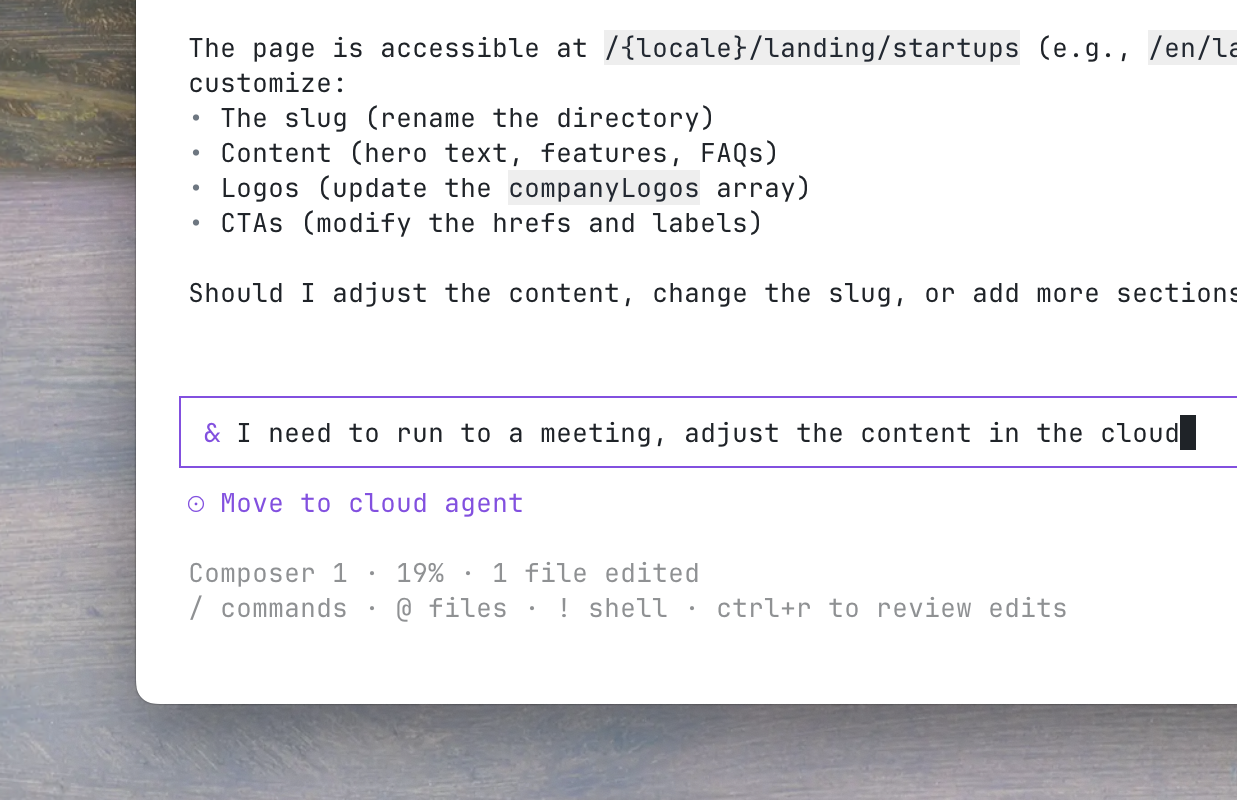
Cloud Agents solved another problem: long-running tasks. Now you could:
- Assign a complex refactoring job to an agent
- Close your laptop and go to a meeting
- Come back hours later to completed, tested code
The industry took notice. Major software companies began adopting Cursor for Enterprise, with enhanced security, team collaboration, and compliance features.
(update) The $29.3B Valuation Era (2025-2026)
The numbers became absurd.
In June 2025, Anysphere raised a $900 million Series C at a $9.9 billion valuation, led by Thrive Capital with participation from Andreessen Horowitz, Accel, and DST Global.
Just five months later, in November 2025, they closed a $2.3 billion Series D at a $29.3 billion valuation, co-led by Accel and Coatue Management.
Let's put this in perspective:
- Founded: 2022
- First funding: October 2023
- $29.3B valuation: November 2025
- Time to $29.3B: 37 months
For comparison:
- Uber took 5 years to reach $3.76B valuation
- Airbnb took 6 years to reach $2.5B valuation
- Stripe took 3 years to reach $1.75B valuation
Anysphere reached $29.3B in just over 3 years—making it one of the fastest-growing startups in history.
The Competitive Landscape in 2026:
| Company | Product | Valuation | Strength |
|---|---|---|---|
| Anysphere | Cursor | $60B (SpaceX acquisition, pending) | Agentic coding, multi-file editing |
| Microsoft | GitHub Copilot | N/A (Public) | Ecosystem integration, distribution |
| Cognition | Devin + Windsurf | $10.2B (Sept 2025) | Autonomous agents plus an IDE |
| Sourcegraph | Cody | $2.6B | Enterprise code search |
| Tabnine | Tabnine | $200M | On-premises, security |
The revenue actually outran the projections. Cursor crossed $1 billion in annualized revenue in late 2025, reportedly surpassed $2 billion by early 2026, and reached roughly $3 billion by late April 2026 according to TechCrunch's reporting around the SpaceX deal.
Four MIT students became billionaires before turning 30. And they're just getting started.
(update) The SpaceX Acquisition (June 2026)
The first half of 2026 escalated fast:
- March 2026: Anysphere shipped Composer 2, a frontier-level successor to its proprietary coding model, capable of tasks requiring hundreds of actions.
- April 2026: TechCrunch reported Cursor was in talks to raise $2 billion+ at a $50 billion valuation as enterprise growth surged.
- June 16, 2026: SpaceX agreed to acquire Anysphere for $60 billion in Class A common stock, disclosed in an SEC filing days after SpaceX's blockbuster IPO. The deal, the largest startup acquisition on record, is expected to close in Q3 2026.
Until the deal closes, Cursor continues to operate as before. What it means for the product long-term is the open question of the year in developer tools: the fastest-growing code editor in history is set to become part of an aerospace company.
AI Code Editor Market Map
The competitive landscape in 2026 spans three distinct tiers — code editors, autonomous coding agents, and no-code app builders — each targeting a different developer persona:
Code Editor Comparison (2026)
| Feature | Cursor | Windsurf | Devin | Claude Code | Taskade Genesis |
|---|---|---|---|---|---|
| Multi-model support | Yes | Yes | No | No | Yes (15+ models) |
| No-code creation | No | No | No | No | Yes |
| Built-in agents | Composer | Cascade | 1 agent | Terminal | Multi-agent teams |
| Deployment | Manual | Manual | Sandboxed | None | Auto (custom domains) |
| Workspace integration | File system | File system | Sandbox | Terminal | Full Workspace DNA |
| Starting price | $20/mo | $15/mo | $20/mo | API pricing | Free |
Taskade Genesis serves a different market: teams who want to build and deploy apps from prompts without writing code. Where Cursor transforms how developers write software, Genesis transforms who can build software — anyone with an idea and an internet connection. With built-in tools, 100+ integrations, multiple project views, and multi-agent collaboration, Genesis delivers production-ready apps with custom domains and password protection. Build your first app →
Cursor Outputs Code. Taskade Genesis Outputs a Running App.
Cursor is excellent for what it does: it writes and edits code files inside an editor you control. But the artifact you end up with is a repository — you still wire it up, deploy it, host it, and maintain it. If your goal is not a repo but a running app — a CRM you can use today, a dashboard your team opens tomorrow — Taskade Genesis skips the code artifact entirely. You describe the outcome, and Genesis assembles the projects, agents, automations, and views, then publishes a live app.
Here is the path from a sentence to a shipped, cloneable app:
Try It: Clone a Working App in One Click
Don't take the claim on faith — run the proof. Below is a live Taskade Genesis app with AI agents and automations already wired in. Click Clone and it lands in your workspace, ready to run, in about 30 seconds. No terminal, no deployment, no repo to maintain.
What you just cloned already includes the workspace primitives Cursor leaves you to assemble yourself:
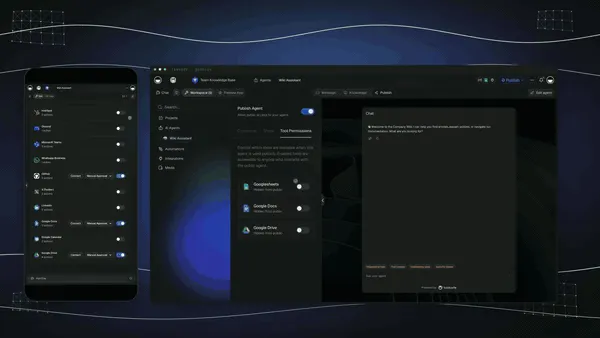
- Multiple project views — List, Board, Calendar, Table, Mind Map, Gantt, and Org Chart (Timeline lives inside Gantt)
- built-in agent tools — web search, code execution, file analysis, persistent memory, multi-agent collaboration
- Taskade EVE, the meta-agent that turns a plain-language prompt into a structured app, running on TSK-1, the Taskade System Kernel
- 100+ bidirectional integrations — triggers pull events in, actions push data out
- 15+ frontier models from OpenAI, Anthropic, Google, and open-weight providers
The Operator Story: 18 Months for a Team of 40, or a Few Weeks Solo
Taskade's first self-serve Enterprise customer, an IT program manager with no engineering team, built a production field-service dashboard on Taskade Genesis — four connected projects tracking customers, jobs, invoices, and his team, with 20+ live jobs running on a custom domain. His take:
"What I was able to accomplish in a few weeks would have taken me and a team of 40+ people 18 months or longer in the Fortune 500 space."
That is the difference between outputting code and outputting a running app. He didn't ship a repository for someone else to deploy — he shipped the dashboard his team uses every day. Build your own →
Pick Your Outcome, Not Your Editor
The fastest way to choose: decide what you want to ship, then pick the tool that ships it.
What do you want at the end?
│
├─ Faster code in my own editor ──────────► Cursor / GitHub Copilot
│
├─ Autonomous edits in a sandbox ─────────► Devin / Cloud Agents
│
├─ A specialized coding model in the IDE ─► Cursor Composer
│
└─ A RUNNING APP (not a repo) ────────────► Taskade Genesis
   • CRM, dashboard, invoice tool, portal     (clone the live app above)
   • agents + automations + 100+ integrations
   • live URL, custom domain, no deployment
🔎 The OpenAI, A16z & Thrive Partnerships
Unlike many startups that rely on a single lead investor, Anysphere cultivated a portfolio of strategic partners—each bringing different strengths to the table.
OpenAI Startup Fund (Seed, 2023)
OpenAI's investment was more than capital—it was a signal. By backing Cursor, OpenAI endorsed the thesis that AI-first developer tools would be a massive market. The partnership included:
- Early access to new OpenAI models
- Technical collaboration on prompt engineering and fine-tuning
- Marketing and distribution support through OpenAI's network
Interestingly, OpenAI reportedly tried to acquire Anysphere before the company's valuation skyrocketed. When that failed, OpenAI pivoted to trying to acquire Windsurf (Cursor's competitor) instead. That pursuit collapsed too: in July 2025 Google hired Windsurf's CEO and co-founder in a reported $2.4 billion licensing deal, and Cognition, the maker of Devin, acquired what remained of the company.
Andreessen Horowitz - a16z (Series A, Series B, Series C)
Marc Andreessen and Ben Horowitz's legendary VC firm led or co-led three consecutive rounds, signaling deep conviction in the vision. A16z brought:
- Enterprise sales connections
- Go-to-market expertise
- Operational support scaling from 4 to 300+ employees
Thrive Capital (Series A, Series B, Series C, Series D)
Joshua Kushner's Thrive Capital showed remarkable conviction, participating in every major round. Thrive specialized in:
- Product-market fit optimization
- Growth strategy
- Long-term vision alignment
Other Major Investors:
- Accel (Series C, Series D co-lead)
- Coatue Management (Series D co-lead)
- Benchmark (Series B)
- DST Global (Series C)
- Nvidia (Strategic investor)
- Google (Strategic investor)
The involvement of Nvidia and Google is particularly telling—both companies see Cursor as a critical platform for their AI infrastructure.
🤯 The Funding Frenzy
Anysphere's funding trajectory is unprecedented. Here is the complete round-by-round timeline:
| Round | Date | Amount Raised | Post-Money Valuation | Lead Investors |
|---|---|---|---|---|
| Pre-seed | 2023 | $2.87M | Undisclosed | Angels |
| Seed | Oct 2023 | $8M | Undisclosed | OpenAI Startup Fund |
| Series A | Aug 2024 | $60M+ | $400M | a16z, Thrive Capital |
| Series B | Dec 2024 | $105M | $2.6B | a16z, Thrive, Benchmark |
| Series C | Jun 2025 | $900M | $9.9B | Thrive, a16z, Accel, DST |
| Series D | Nov 2025 | $2.3B | $29.3B | Accel, Coatue |
| Acquisition | Jun 2026 | $60B (all-stock, pending close) | $60B | SpaceX |
Total Funding: $3.4 billion+ raised (2023–2025), capped by the $60 billion SpaceX acquisition agreement in June 2026.
The valuation curve makes the trajectory visceral — each rung is a multiple of the last:
What's driving this investor frenzy?
- Explosive Growth: ARR doubling every 2 months at peak
- Market Size: Every developer on Earth is a potential customer (28+ million developers globally)
- Network Effects: As more developers use Cursor, the training data improves, making the product better
- Generational Shift: Younger developers expect AI-first tools; older developers are converting rapidly
- Enterprise Expansion: Fortune 500 companies adopting Cursor for thousands of seats
The most remarkable aspect? Anysphere crossed $500 million ARR faster than any software company in history—reaching that milestone in just 24 months from launch.
🤔 So, What Makes Anysphere Different?
Agentic Coding Philosophy
The fundamental difference between Cursor and competitors like GitHub Copilot isn't the quality of the underlying AI—it's the philosophy.
GitHub Copilot optimizes for assistance: it suggests code, but you write it.
Cursor optimizes for agency: it completes entire tasks autonomously while you provide direction and review.
This shift from "copilot" to "agent" is profound:
Traditional AI Coding (Copilot Model):
- Developer writes a comment describing function
- AI suggests implementation
- Developer accepts or modifies
- Repeat for each function, file, test
Agentic Coding (Cursor Model):
- Developer describes feature: "Add user authentication with OAuth"
- AI agent breaks down the task (Plan Mode)
- Multiple agents work in parallel:
- Agent 1: Database schema changes
- Agent 2: API endpoints
- Agent 3: Frontend components
- Agent 4: Tests
- Developer reviews unified diff, approves or requests changes
- Agent refines based on feedback
The time savings are dramatic. Tasks that took hours now take minutes. Tasks that took days now take hours.
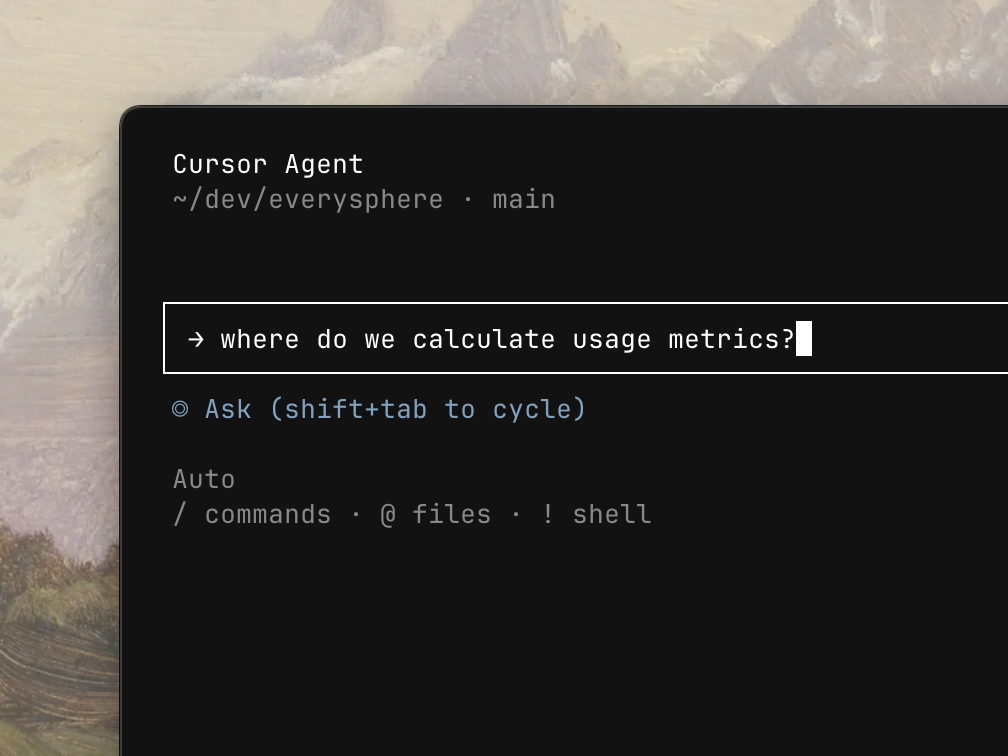
Cursor Agent Mode autonomously coordinating changes across 15 files for a single feature.
But there's a deeper implication: agentic coding changes what it means to be a developer.
The skill isn't writing code—it's:
- Architecting systems (agents implement your architecture)
- Reviewing and refining (catching edge cases and improving quality)
- Providing context (helping agents understand requirements and constraints)
This is what the industry calls "vibe coding"—describing the vibe of what you want, and letting AI figure out the implementation.
Codebase-Wide Context Understanding
Cursor's primary technical advantage is context.
GitHub Copilot, as an extension, is limited by the editor's API. It typically sees:
- The current file
- Recently opened files
- Whatever context fits in the prompt window (usually 4K-32K tokens)
Cursor, with AI embedded in the runtime, can:
- Index the entire repository using custom RAG (Retrieval-Augmented Generation)
- Understand the dependency graph across hundreds of files
- Track architectural patterns (e.g., "this project uses repository pattern")
- Maintain conversation context across sessions
Developers use special symbols to grant context:
@Codebase: Access to the entire project@Docs: Relevant documentation@Git: Git history and commit messages@Web: Real-time web search for libraries and APIs
This contextual awareness enables capabilities impossible for extension-based tools:
Multi-File Refactoring: Rename a function used in 47 files across 12 directories, update all imports, fix tests, update documentation—all in one operation.
Architectural Consistency: When you add a new API endpoint, Cursor knows to follow the same error handling, validation, and authentication patterns used elsewhere.
Intelligent Test Generation: Cursor analyzes your existing tests to match your testing style, assertion preferences, and edge case coverage.
Speed & Developer Experience
Cursor made a bet that latency matters—a lot.
While competitors optimized for model quality, Cursor optimized for speed:
- Composer completes most tasks in under 30 seconds @ ~250 tokens/second
- Tab suggestions appear instantly with <100ms latency
- Multi-agent parallelization enables 8x speedup on complex features
The experience difference is visceral. With Copilot, you wait for suggestions. With Cursor, the AI keeps up with your thinking.
Anysphere also obsessed over developer ergonomics:
- Keyboard-first design: Every action has a shortcut
- Inline editing: Changes appear directly in your code, not in a separate panel
- Smart diff presentation: Only shows what changed, with clear before/after
- Undo/redo for AI changes: Easy to revert if the agent makes a mistake
The result: Cursor feels fast and invisible—it enhances your workflow without disrupting it.
⚡️ Potential Benefits of Cursor AI
The implications of agentic coding extend far beyond productivity gains for individual developers.
Democratizing Software Development
Cursor lowers the barrier to entry for programming. A designer who knows basic HTML/CSS can now build complex full-stack applications by describing features to agents. This could:
- Expand the developer workforce from 28 million to 280+ million globally
- Enable citizen developers within enterprises to build internal tools
- Accelerate startup velocity (one developer with Cursor can accomplish what used to require a team)
Transforming Software Economics
If development costs drop 10x due to AI agents, the economics of software change fundamentally:
- More experimentation: Ideas that weren't economically viable become feasible
- Faster iteration: Ship features in days instead of months
- Smaller teams: Early-stage startups can compete with established players
Reducing Technical Debt
Agentic coding makes refactoring economically viable:
- Migrate to new frameworks: Agents can port entire codebases
- Update deprecated dependencies: Systematic upgrades across thousands of files
- Improve code quality: Automated cleanup of code smells and anti-patterns
Enterprise Adoption Concerns
While the benefits are clear, enterprises have legitimate concerns:
- Security: What if AI agents introduce vulnerabilities?
- Privacy: Is code being sent to external servers?
- Reliability: Can we trust AI-generated code for critical systems?
- Compliance: How do we audit AI contributions?
Cursor addresses these with Privacy Mode, enterprise controls, and audit logs—but the tension between capability and control remains.
👉 How to Get Started with Cursor
Ready to experience the future of coding? Here's how to get started.
Head over to https://cursor.com and download the editor for macOS, Windows, or Linux.
Installation & Setup:
- Download and install Cursor (it's a ~200MB download)
- Cursor automatically imports your VS Code settings, extensions, and keybindings
- Sign up for a free account (includes limited AI features)
- Upgrade to Cursor Pro ($20/month) for expanded usage
Your First AI-Powered Workflow:
- Open a project: Cursor works with any codebase
- Try Tab completion: Start typing, watch Cursor predict your next move
- Use Cmd+K for edits: Highlight code, press Cmd+K, describe what to change
- Ask questions: Cmd+L opens chat, ask "@Codebase how does authentication work?"
- Try Composer: Cmd+I opens Composer, describe a feature to build
Cursor's welcome screen with suggested first steps for new users.
Pro Tips:
- Use Privacy Mode if working on sensitive code (Settings → Privacy)
- Configure .cursorignore to exclude files from AI context (like .env files)
- Start small: Use Cursor for smaller features before trusting it with critical code
- Review everything: AI agents make mistakes; human review is essential
💡 Pro Tip: Want to supercharge your AI workflow? Taskade AI integrates with Cursor and other AI coding tools to manage your development tasks, create project plans, and coordinate team workflows. Check out our AI prompt templates to get started!
Pricing (as of mid-2026):
- Hobby (Free): Limited Agent requests and Tab completions
- Pro ($20/month): Included model usage with on-demand billing beyond it; Pro+ and Ultra tiers for heavier usage
- Teams ($40/user/month): Centralized billing, privacy mode, SSO, usage analytics
- Enterprise: Custom pricing, pooled usage, SCIM, audit logs, compliance features
🚀 Quo Vadis, Anysphere?
From an MIT dorm room in 2022, to a $29.3 billion valuation in 2025, to a $60 billion SpaceX acquisition agreement in June 2026: Anysphere's journey defies gravity.
But the most important question isn't where they've been—it's where they're going.
Michael Truell has been explicit about the vision:
"We're building a world beyond code. Eventually, you won't write code at all—you'll describe what you want in natural language, and superintelligent AI agents will handle the implementation, testing, deployment, and maintenance."
Michael Truell, YC Podcast (2025)
This vision raises profound questions:
Will developers become obsolete?
Probably not. Just as cars didn't eliminate transportation jobs (they created different ones), AI agents won't eliminate developers—they'll transform what developers do. The skill shifts from writing code to:
- System architecture: Designing how components interact
- Product thinking: Understanding user needs and translating them into specs
- Quality assurance: Reviewing AI-generated code for correctness and security
- Prompt engineering: Giving agents the right context and constraints
Can Anysphere maintain its lead?
The competitive threats are real:
- Microsoft/GitHub has infinite resources and distribution
- Cognition now pairs its Devin agent with the Windsurf editor, which it acquired in July 2025
- Google could integrate Gemini deeply into Android Studio and Cloud IDE, and already licensed Windsurf's technology for a reported $2.4 billion
- Anthropic could partner with another IDE vendor to compete
But Anysphere has advantages:
- Speed of innovation: Shipping features faster than anyone
- Developer loyalty: Net Promoter Scores above 70
- Talent density: Attracting top AI researchers and engineers
- Capital: $3.4B+ raised, plus SpaceX's balance sheet once the acquisition closes in Q3 2026
What about safety and alignment?
As AI agents become more autonomous, the risks increase:
- Security vulnerabilities: What if an agent accidentally introduces a critical bug?
- Malicious code: Could poisoned training data cause agents to insert backdoors?
- Job displacement: How do we manage the societal impact of 10x developer productivity?
These aren't hypothetical. In 2025, the CurXecute vulnerability demonstrated that poisoned data could rewrite Cursor configurations and execute attacker-controlled code. The incident was patched quickly, but it revealed the attack surface of autonomous agents.
The future is simultaneously exciting and uncertain. What's clear: Anysphere is at the center of the most important transformation in software development since the invention of high-level programming languages.
🐑 Before you go... Looking for an AI tool that integrates with your development workflow? Taskade AI has you covered!
💬 AI Chat: Coordinate with your team, get answers about your projects, and keep everyone aligned on development tasks.
🤖 AI Agents: Automate repetitive project management tasks while you focus on coding. Perfect for sprint planning and task tracking.
✏️ AI Assistant: Brainstorm features, plan architecture, organize development tasks, and maintain project documentation automatically.
🔄 Workflow Generator: Describe your development process and get a structured workflow with tasks, timelines, and dependencies.
Want to give Taskade AI a try? Create a free account and start today! 👈
🔗 Resources
- https://cursor.com/
- https://anysphere.inc/
- https://en.wikipedia.org/wiki/Anysphere
- https://techcrunch.com/2023/10/11/anysphere-raises-8m-from-openai-to-build-an-ai-powered-ide/
- https://www.infoq.com/news/2025/11/cursor-composer-multiagent/
- https://cursor.com/security
- https://www.cnbc.com/2026/01/07/anthropic-funding-term-sheet-valuation.html
- https://research.contrary.com/company/anysphere
- https://www.cnbc.com/2026/06/16/-spacex-to-buy-cursor-ai-parent-anysphere-for-60-billion.html
- https://techcrunch.com/2026/03/02/cursor-has-reportedly-surpassed-2b-in-annualized-revenue/
The Multi-Tool Developer: Why Engineers Use 3+ Coding Agents
The most productive AI-native developers are not loyal to a single tool. Andrej Karpathy described his own workflow in a March 2026 interview: he uses Cursor, Codex, Claude Code, and other coding agents simultaneously, switching between them based on availability and task fit. As he put it, "if you run out on Codex you should switch to Claude or whatnot." The goal is maximum token throughput across every subscription.
Each tool has a distinct personality. Karpathy noted that "Claude...it's excited with you. Codex is a lot more dry." These are not just cosmetic differences — they shape how developers interact with each agent, which tasks they delegate, and how they review the output. Some agents are better at exploratory refactoring; others excel at precise, scoped edits.
Karpathy captured the mindset shift perfectly: "I feel nervous when I have subscription left over — that just means I haven't maximized my token throughput." This multi-tool strategy validates a broader principle: the best results come from model diversity, not model loyalty. It is the same reason Taskade Genesis offers 15+ frontier models from OpenAI, Anthropic, and Google — different models suit different tasks, and switching between them is a feature, not a compromise. Pair that with AI agents that remember context across sessions, and multi-model workflows become a force multiplier for any team. Try Taskade Genesis for model flexibility.
Macro Actions: The End of Line-Level Editing
The unit of work in AI-assisted coding is no longer a line of code. Karpathy described the shift bluntly: "you can move in much larger macro actions. It's not just a line of code, it's a new functionality." Developers now delegate entire features — authentication systems, database schemas, API layers — to agents that plan and execute across multiple files.
This changes what a code editor is. Instead of a text editor where you type syntax, the editor becomes an orchestration dashboard where you describe intent, review diffs, and approve changes. The keyboard shortcut that matters most is not copy-paste — it is the one that launches an agent on a task.
The scale of this shift is hard to overstate. When asked about the percentage of code written by AI agents, Karpathy said: "I don't even think it's 20/80 by now. I think it's a lot more than that." If agents write the majority of code, the developer's role converges on architecture, review, and direction — the same trajectory that agentic workspaces and workflow automation follow in non-coding domains. For the general pattern behind this shift, see agentic workflows explained. Browse the Community Gallery to see what builders are creating with this approach.
💬 Frequently Asked Questions About Anysphere
Who founded Anysphere?
Anysphere was founded in 2022 by four MIT students: Michael Truell (CEO), Sualeh Asif, Arvid Lunnemark, and Aman Sanger. All four founders were computer science and mathematics students at MIT, with several being Math Olympiad champions and Neo Scholars.
What is Cursor AI?
Cursor is an AI-first code editor built by Anysphere. It's a fork of Visual Studio Code with AI capabilities embedded into the core runtime, enabling features like autonomous multi-file editing, codebase-wide understanding, and agentic coding with multiple AI agents working in parallel.
How is Cursor different from GitHub Copilot?
Cursor is a standalone AI-first code editor with AI embedded in the runtime, while GitHub Copilot is an extension that works within existing editors. Cursor can index entire codebases, coordinate changes across multiple files simultaneously, and run multiple AI agents in parallel—capabilities that extensions can't match.
How much does Cursor cost?
Cursor offers a free Hobby tier with limited Agent requests and Tab completions. Cursor Pro costs $20/month and includes a set amount of frontier model usage (OpenAI, Anthropic, Google, and Cursor's own Composer models), with on-demand billing beyond that and Pro+ and Ultra tiers for heavier usage. Teams pricing is $40/user/month, and Enterprise pricing is custom.
Is Cursor safe to use for private code?
Yes, Cursor offers Privacy Mode where no code is stored on Cursor's servers or sent to AI providers. Enterprise customers can enforce Privacy Mode organization-wide with compliance verification every 5 minutes. Cursor also maintains zero data retention agreements with OpenAI and Anthropic.
What is Composer in Cursor?
Composer is Cursor's proprietary AI model trained specifically for low-latency, agentic coding. It's optimized for understanding entire codebases, coordinating multi-file changes, and completing complex tasks autonomously in under 30 seconds. Composer uses reinforcement learning and custom semantic search.
Can Cursor replace developers?
Cursor doesn't replace developers—it transforms what developers do. Instead of writing every line of code, developers focus on architecture, product thinking, quality review, and providing context to AI agents. The role shifts from implementation to direction and oversight.
What is Agent Mode in Cursor?
Agent Mode in Cursor 2.0 allows developers to run up to 8 AI agents simultaneously, each working in isolated environments on different parts of a project. Agents can autonomously write code, run tests, make pull requests, and coordinate with other agents to complete complex features.
How much is Anysphere worth?
SpaceX agreed on June 16, 2026 to acquire Anysphere for $60 billion in stock, with the deal expected to close in Q3 2026. Before that agreement, Anysphere was valued at $29.3 billion following its $2.3 billion Series D in November 2025. The company raised over $3.4 billion in total funding from investors including OpenAI, Andreessen Horowitz, Thrive Capital, Accel, and Coatue Management.
Is Cursor better than VS Code?
Cursor is built on VS Code (it's a fork), so it maintains compatibility with VS Code extensions and settings while adding powerful AI capabilities. For developers who want AI-first features like multi-agent systems, codebase-wide context, and autonomous coding, Cursor offers significant advantages over VS Code with extensions.
What is vibe coding?
Vibe coding is a development approach where programmers describe the "vibe" or intent of what they want to build in natural language, and AI agents handle the implementation details. Instead of writing code line-by-line, developers focus on architecture and requirements while AI agents generate the code.
Can I use Cursor with my existing VS Code setup?
Yes, Cursor automatically imports your VS Code settings, extensions, themes, and keybindings when you first install it. You can switch between VS Code and Cursor seamlessly, and all your familiar shortcuts and workflows will work the same way.
What companies use Cursor?
Many of the world's largest software companies have adopted Cursor for Enterprise, though specific customer names are typically confidential. The tool is particularly popular among startups, where small teams use Cursor to achieve productivity levels previously requiring much larger engineering teams.
Did OpenAI try to buy Anysphere?
According to reports, OpenAI attempted to acquire Anysphere before the company's valuation skyrocketed into the billions. When that failed, OpenAI reportedly shifted its acquisition focus to Windsurf, one of Cursor's competitors in the AI code editor space.
🧬 Build Your Own AI Applications
While Anysphere builds the AI coding tools, Taskade Genesis lets you build complete AI-powered applications — a CRM, a dashboard, an invoice tracker, a client portal — and run them, not just generate code for them. Describe the outcome in plain language and Genesis assembles the agents, automations, and views, then ships it to a live URL. It's vibe coding for productivity, delivering living software instead of a repo to maintain. Plans start free, with Pro at $10/month and Business at $25/month, both billed annually. Explore ready-made AI apps or clone the live one above.
Stop shipping repos. Ship the running app. Build yours free →
▲ ■ ● Memory feeds Intelligence, Intelligence triggers Execution, Execution creates Memory — the self-reinforcing loop behind every app you build on Taskade.