
Vercel is a frontend cloud platform that started in 2015 as "Zeit Now"—a simple deployment tool—and evolved into a $9.3 billion company powering the web's fastest sites. What began with "type now to deploy" became the platform behind Next.js, v0 AI UI generation, and the design engineering movement.
But where did it all start? What makes v0 different from other AI builders? How did Next.js become the dominant React framework? In today's article, we explore the complete history of Vercel and the future of AI-powered frontend development. ⚡
🤖 What Is Vercel?
Vercel was founded in 2015 by Guillermo Rauch (CEO), Tony Kovanen (ex-CTO), and Naoyuki Kanezawa. Originally called Zeit, the company's mission was revolutionary—make deployment so simple that typing one command creates a live, production-ready URL.
"The best platform is the one that gets out of your way. You should focus on building your product, not configuring infrastructure."
Guillermo Rauch, CEO of Vercel
What started as a deployment platform evolved into something much bigger:
- Next.js: The world's most popular React framework (71% of React jobs require it)
- v0: AI-powered UI generation—describe your interface, get production React code
- Edge Functions: Serverless compute running globally in milliseconds
- Design Engineering Platform: Where design and engineering merge seamlessly
- Developer Experience (DX): Industry-leading simplicity—git push to deploy
By September 2025, Vercel had achieved:
- $9.3 billion valuation
- $100+ million ARR (82% YoY growth)
- 1 billion+ deployments served
- Backing from Accel, GV (Google Ventures), GIC, BlackRock, and Salesforce Ventures
- Powering sites for Walmart, Nike, Netflix, TikTok, Uber, Spotify
So, let's rewind and see how an Argentinian developer built the platform that powers the modern web.
🥚 The History of Vercel
The Early Days of Frontend Deployment Hell
To understand Vercel's origin story, we need to understand the pain it solved.
In 2015, deploying a frontend application was unnecessarily complex:
The Traditional Deployment Process:
- Write code locally
- Configure build pipeline (webpack, Babel, etc.)
- Set up hosting (AWS, DigitalOcean, shared hosting)
- Configure servers (Nginx, Apache)
- Handle SSL certificates manually
- Set up CDN (CloudFlare, Akamai)
- Configure cache headers
- Debug production issues blindly
- Repeat for every change
For a simple React app, developers spent hours configuring infrastructure instead of building features.
Platforms like Heroku existed for backend apps, but frontend deployment remained primitive. Services like GitHub Pages offered static hosting, but:
- No build step support
- No custom domains
- No serverless functions
- No preview deployments
- No rollback capabilities
One developer who saw this problem clearly was Guillermo Rauch.
Guillermo Rauch: From Argentina to Silicon Valley (1990-2015)
Guillermo Rauch was born in Argentina in 1990 and fell in love with programming as a teenager. He taught himself web development, contributing to open-source projects and building a reputation in the JavaScript community.
In 2010, Rauch created Socket.IO—a groundbreaking JavaScript library for real-time web applications. Socket.IO became wildly popular, used by companies like Microsoft, Zendesk, and Trello for real-time features like chat and notifications.

Guillermo Rauch, founder and CEO of Vercel, speaking about the future of frontend development.
Socket.IO's success gave Rauch credibility in the JavaScript world. But he noticed a problem: even with great tools like Socket.IO, deploying web applications remained frustratingly complex.
The Insight:
What if deployment could be instant? What if you could type one command and get a live URL?
In November 2015, Rauch founded Zeit (German for "time") to solve this problem.
Zeit Now: Deployment in One Command (2015-2017)
Zeit's first product was Now—a deployment tool so simple it seemed like magic.
The Now Utility:
Bash
$ now
> Deploying ~/my-app
> https://my-app-abc123.now.sh [copied to clipboard]
> Deployment complete! (1.2s)
That's it. One command. One second. Live URL.
What Made Now Revolutionary:
- Zero Configuration: No setup files, no config, just deploy
- Instant Deployment: Live in ~1 second
- Immutable Deployments: Every deploy gets a unique URL
- Automatic SSL: HTTPS by default, free
- Global CDN: Cached worldwide automatically
- Rollback: Easy to revert to previous versions
- Preview URLs: Every git branch gets its own URL
The developer community loved it. Now became the fastest way to show demos, share prototypes, and deploy side projects.
But Zeit had bigger ambitions than just deployment.
The Birth of Next.js (2016-2020)
In October 2016, just one year after founding Zeit, Guillermo Rauch and his team released Next.js—a React framework designed to solve the problems React didn't address.
The React Problem:
React is a phenomenal library for building UIs, but it's just a library. To build production apps, you need:
- Routing: React Router (manual setup)
- Server-Side Rendering (SSR): Build it yourself
- Code Splitting: Configure webpack manually
- Data Fetching: Figure out patterns yourself
- SEO: SSR again, plus meta tags, sitemaps
- Performance Optimization: Lazy loading, prefetching, image optimization—all manual
Next.js provided all of this out of the box:
Next.js 1.0 Features (2016):
- File-based routing (no React Router config)
- Automatic code splitting (every page loads only what it needs)
- Server-side rendering (SEO-friendly React)
- Hot module replacement (instant updates during development)
- Static export (deploy as static HTML)
The timing was perfect. React was exploding in popularity, but developers were drowning in configuration complexity. Next.js gave them a framework with batteries included.
Adoption Skyrocketed:
- 2017: Thousands of developers using Next.js
- 2018: Major companies adopting (Hulu, Twitch, AT&T)
- 2019: 50,000+ GitHub stars
- 2020: Next.js 9 introduced API Routes—serverless functions built into the framework
By 2020, Next.js had become the de facto React framework for production applications.
Zeit Becomes Vercel (2020-2022)
In April 2020, Zeit rebranded to Vercel—a name that better reflected the company's evolution from deployment tool to full frontend platform.
The Vercel Platform (2020):
- Next.js Hosting: Optimized specifically for Next.js (unsurprisingly)
- Edge Network: Deploy globally, serve from nearest location
- Analytics: Real-time performance monitoring
- Teams & Collaboration: Enterprise features for organizations
- Framework Agnostic: Support for Vue, Svelte, Angular, etc.
Key Milestones:
- 2020: $21M Series A led by Accel
- 2021: $150M Series D at $2.5B valuation
- 2022: Next.js 13 with App Router and React Server Components
The App Router (Next.js 13) was controversial but transformative. It introduced:
- React Server Components: Components that render on the server
- Streaming: Send HTML progressively, no waiting for full page load
- Layouts: Shared UI that doesn't re-render on navigation
- New Data Fetching:
async/awaitdirectly in components
Critics complained about breaking changes. Advocates celebrated the future of React.
By 2022, Next.js had 100,000+ GitHub stars and powered websites for Nike, Hulu, Twitch, Auth0, Marvel, Ferrari.
(update) v0 and Generative UI (2023-2024)
Then Vercel made a bold bet on AI.
In October 2023, Vercel launched v0—an AI-powered UI generator that creates React components from natural language prompts.
How v0 Works:
- Describe your UI: "Build a pricing table with 3 tiers, including a popular badge"
- v0 generates code: Full React component with Tailwind CSS and shadcn/ui
- Preview in browser: See the component rendered live
- Iterate: "Make the popular tier blue" → v0 updates the code
- Copy or deploy: Use the code in your project or deploy directly to Vercel
v0 Generative UI — official demo from Vercel.
What Made v0 Different:
Unlike other AI code generators that produce generic HTML, v0 generates production-ready React components using:
- shadcn/ui: High-quality, accessible component primitives
- Tailwind CSS: Utility-first styling (no CSS files)
- TypeScript: Type-safe by default
- Next.js conventions: Works seamlessly with Next.js apps
- Responsive Design: Mobile-first, looks good on all devices
Example v0 Prompt:
"Create a hero section with:
- Large heading with gradient text
- Subheading describing an AI product
- Two CTAs: primary and secondary
- Background with subtle grid pattern
- Responsive on mobile"
v0 Output:
Tsx
import { Button } from '@/components/ui/button'export default function Hero() {
return (
<section className="relative overflow-hidden bg-background">
<div className="absolute inset-0 bg-grid-slate-100/50" />
<div className="relative mx-auto max-w-7xl px-6 py-24 sm:py-32 lg:px-8">
<div className="text-center">
<h1 className="bg-gradient-to-r from-blue-600 to-purple-600 bg-clip-text text-4xl font-bold tracking-tight text-transparent sm:text-6xl">
Build Faster with AI
</h1>
<p className="mt-6 text-lg text-muted-foreground">
Generate production-ready React components in seconds
</p>
<div className="mt-10 flex items-center justify-center gap-x-6">
<Button size="lg">Get Started</Button>
<Button variant="outline" size="lg">Learn More</Button>
</div>
</div>
</div>
</section>
)
}
Perfect code. Production-ready. In 10 seconds.
v0 Evolution Timeline:
| Date | Feature | Impact |
|---|---|---|
| Oct 2023 | v0 Beta Launch | Generate single components from prompts |
| Mar 2024 | Multi-component Projects | Build entire pages with multiple components |
| Jul 2024 | Agent Mode | v0 acts autonomously—plans, fetches data, fixes errors |
| Nov 2024 | Platform API | Integrate v0 into your own tools |
| Jan 2026 | GitHub Integration | Deploy to Vercel directly from v0 |
Agent Mode (2024) was a game-changer. Instead of just generating static components, v0 could:
- Plan implementation steps
- Fetch data from APIs
- Inspect generated pages for errors
- Fix missing dependencies automatically
- Hook into GitHub repos
- Deploy to Vercel with one click
This was "vibe coding" for UI—describe the vibe, v0 builds it.
(update) The $9.3B Valuation and Design Engineering Era (2025-2026)
The numbers became extraordinary.
Funding Timeline:
- 2020: $21M Series A
- 2021: $150M Series D @ $2.5B valuation
- 2024: $250M Series E @ $3.25B valuation
- September 2025: $300M Series F @ $9.3B valuation
- Co-led by Accel and GIC
- Participation from BlackRock, StepStone, Khosla Ventures, Salesforce Ventures, GV, Tiger Global
Revenue Growth:
- 2024: $100M ARR
- 2025: Revenue up 82% YoY
- User growth doubled year-over-year
The Design Engineering Movement:
Vercel didn't just build tools—they defined a new role: Design Engineer.
Design Engineers are hybrids:
- Design sensibility (understand visual hierarchy, motion, interaction)
- Engineering capability (write production React, understand performance)
- AI-augmented (use v0 and AI tools to move faster)
Vercel's hiring page lists dozens of "Design Engineer" roles. Companies like Linear, Stripe, and Notion followed suit.
Next.js 15 & 16 (2024-2026):
| Version | Release Date | Key Features |
|---|---|---|
| Next.js 15 | October 2024 | Turbopack (Rust bundler), React 19, async request APIs |
| Next.js 16 | Early 2026 | Partial Pre-Rendering (PPR) stable, use cache for instant nav, Turbopack default |
Next.js 16's Partial Pre-Rendering (PPR) is revolutionary:
- Static shell loads instantly
- Dynamic content streams in progressively
- Feels instant, even with server data
Market Dominance:
- 68% of JS developers use Next.js (State of JS 2024)
- 71% of 1,000+ React jobs explicitly require Next.js
- Used by Nike, Apple, Netflix, TikTok, Uber, Spotify, Walmart
The Competitive Landscape (2026):
| Platform | Focus | Strength | Weakness |
|---|---|---|---|
| Vercel | Next.js, DX | Developer experience, v0 AI | Premium pricing |
| Netlify | Jamstack | Mature platform, predictable pricing | Stagnant growth |
| AWS Amplify | AWS integration | Enterprise scale, AWS ecosystem | Poor DX, complex setup |
| Cloudflare Pages | Edge performance | Speed, global network | Less Next.js optimization |
| Render | Full-stack hosting | Simple pricing, good for small teams | Fewer features |
Vercel carved out a unique position: the only platform built by the creators of the framework (Next.js), with AI-first tooling (v0).
🔎 The Investor Backing: Accel, GV, and Silicon Valley Giants
Vercel's investor list is a testament to its strategic importance.
Accel (Lead Investor)
Accel led Vercel's Series A (2020), Series E (2024), and co-led Series F (2025). The firm saw Vercel as the "GitHub of frontend deployment"—infrastructure that every developer would use.
GV (Google Ventures)
Google's investment in Vercel (Series B, 2020) signaled strategic alignment. With Google Cloud hosting many Next.js apps, and Google Chrome benefiting from fast web experiences, the partnership made sense.
GIC (Singapore's Sovereign Wealth Fund)
GIC co-led the Series F, bringing international credibility and long-term capital.
Strategic Investors:
- Salesforce Ventures: CRM integration opportunities
- BlackRock: Financial backing for aggressive expansion
- Khosla Ventures: AI-first thesis alignment
- Tiger Global: Growth-stage expertise
Total Raised: $863M across 6 rounds
These investors provided more than capital:
- Technical guidance: Scaling infrastructure globally
- Enterprise connections: Introductions to Fortune 500 companies
- AI model access: Early GPT-4 and Claude for v0
- Credibility: Validation for enterprise sales
🤯 The Revenue Surge: 82% YoY Growth
The 82% year-over-year revenue growth in 2025 is remarkable for a company already at $100M+ ARR.
Three Revenue Streams:
Vercel Pro ($20/month/seat)
- Unlimited deployments
- Team collaboration
- Analytics and insights
- Priority support
Vercel Enterprise (Custom Pricing)
- SSO and security controls
- Advanced analytics
- Dedicated support
- Custom SLAs
- Compliance (SOC 2, GDPR, HIPAA)
v0 Subscriptions
- Free tier: 200 credits/month
- Hobby: $10/month
- Pro: $60/month (unlimited generations)
Growth Drivers:
| Factor | Impact |
|---|---|
| Next.js dominance | 71% of React jobs require it → teams adopt Vercel |
| v0 viral demos | Social media showcasing AI-generated UIs |
| Enterprise adoption | Fortune 500 migrating from legacy platforms |
| Developer advocacy | Vercel's team evangelizes at conferences |
| Framework ecosystem | Support for Vue, Svelte, Astro expands TAM |
The Enterprise Shift:
Early Vercel customers were startups and indie developers. By 2025:
- 40%+ revenue comes from enterprise contracts
- Average contract value (ACV) increased 3x
- Walmart, Nike, and Netflix are reference customers
🤔 So, What Makes Vercel Different?
Developer Experience as Competitive Moat
Vercel's core philosophy: DX is the product.
Traditional Platform:
- Create account
- Configure project settings
- Set up build pipeline
- Configure environment variables
- Set up domains and SSL
- Monitor deployments
- Debug issues
Vercel:
- Connect GitHub repo
- Done. (Vercel auto-detects everything)
This simplicity compounds:
- Faster onboarding (developers productive in minutes)
- Lower abandonment (fewer steps = fewer drop-offs)
- Higher satisfaction (NPS scores above 70)
- Viral growth (developers share on social media)
The Next.js Integration Advantage
Because Vercel created Next.js, the integration is unmatched:
Vercel-Specific Next.js Optimizations:
- Automatic Image Optimization: Next.js
<Image>component serves WebP/AVIF automatically - Edge Middleware: Run code before requests hit your app
- ISR (Incremental Static Regeneration): Update static pages on-demand
- Streaming SSR: Send HTML progressively, no full-page blocking
- Route handlers: Serverless API routes with zero config
Competitors can host Next.js apps, but Vercel's optimizations make them 30-50% faster.
v0 and the AI-First Future
v0 represents Vercel's bet on the future: AI-augmented development.
The Vision:
In 5 years, frontend developers won't write every line of code. Instead:
- Describe intent: "Build a dashboard with analytics charts"
- AI generates: v0 creates components, layouts, interactions
- Developers refine: Adjust styling, add business logic, optimize performance
- Deploy instantly: Vercel handles infrastructure
This shifts development from implementation to direction:
- Less time writing boilerplate
- More time on product decisions
- Faster iteration cycles
- Higher quality (AI follows best practices)
v0 Platform API:
The v0 Platform API (beta) lets developers:
- Embed v0 generation in their own tools
- Build custom AI-powered design tools
- Create industry-specific UI generators
Example: A healthcare startup could build a "HIPAA-compliant patient portal generator" using v0's API.
⚡️ Potential Benefits of Vercel
Democratizing Frontend Development
Vercel lowers barriers to building production web apps:
For Beginners:
- No DevOps knowledge required
- Deploy in seconds, not hours
- Built-in best practices (performance, security)
For Startups:
- Focus on product, not infrastructure
- Scale automatically (no capacity planning)
- Predictable costs (no surprise AWS bills)
For Enterprises:
- Compliance built-in (SOC 2, GDPR)
- Global performance (Edge Network)
- Team collaboration features
Transforming Web Performance
Vercel's infrastructure makes fast websites the default:
- Edge Caching: Serve from 100+ global locations
- Automatic Compression: Brotli, gzip applied automatically
- Smart Prefetching: Next.js prefetches links in viewport
- Image Optimization: Serve modern formats, lazy load
- Code Splitting: Load only what's needed
Real-World Impact:
- Nike.com: 50% faster page loads after migrating to Vercel
- Hulu: Improved Core Web Vitals by 40%
- Walmart: Reduced server costs by 60% with Edge Functions
Concerns and Criticisms
Not everyone loves Vercel:
Vendor Lock-In:
- Vercel-specific features make migration difficult
- What if Vercel raises prices 10x?
- Open-source alternatives (Netlify, Cloudflare) exist
Pricing Concerns:
- Enterprise contracts can be expensive
- Bandwidth costs add up for high-traffic sites
- Small teams may outgrow free tier quickly
Next.js Complexity:
- Learning curve for App Router
- Breaking changes between versions
- "Too much magic" for some developers
Vercel's response: Premium DX justifies premium pricing. Migration is possible (it's just Next.js), but few customers leave once they experience the platform.
👉 How to Get Started with Vercel
Ready to experience the future of frontend? Here's how to start:
Getting Started:
- Go to https://vercel.com and sign up (free account)
- Click "Import Project"
- Connect your GitHub, GitLab, or Bitbucket
- Select a repository
- Vercel auto-detects framework and builds
- Done—live URL in ~30 seconds
Your First v0 Project:
- Go to https://v0.dev
- Sign in with GitHub
- Describe your UI:
- "Build a pricing page with 3 tiers"
- "Create a testimonial carousel"
- "Make a contact form with validation"
- Review generated code
- Click "Copy Code" or "Open in CodeSandbox"
- Integrate into your Next.js app
Pricing:
- Hobby (Free): Personal projects, unlimited deployments
- Pro ($20/month/seat): Teams, advanced analytics, priority support
- Enterprise: Custom pricing, SSO, compliance, SLAs
💡 Pro Tip: Building an AI app? Taskade AI helps you manage development projects, plan features, and coordinate with your team. Build UIs with v0, manage projects with Taskade!
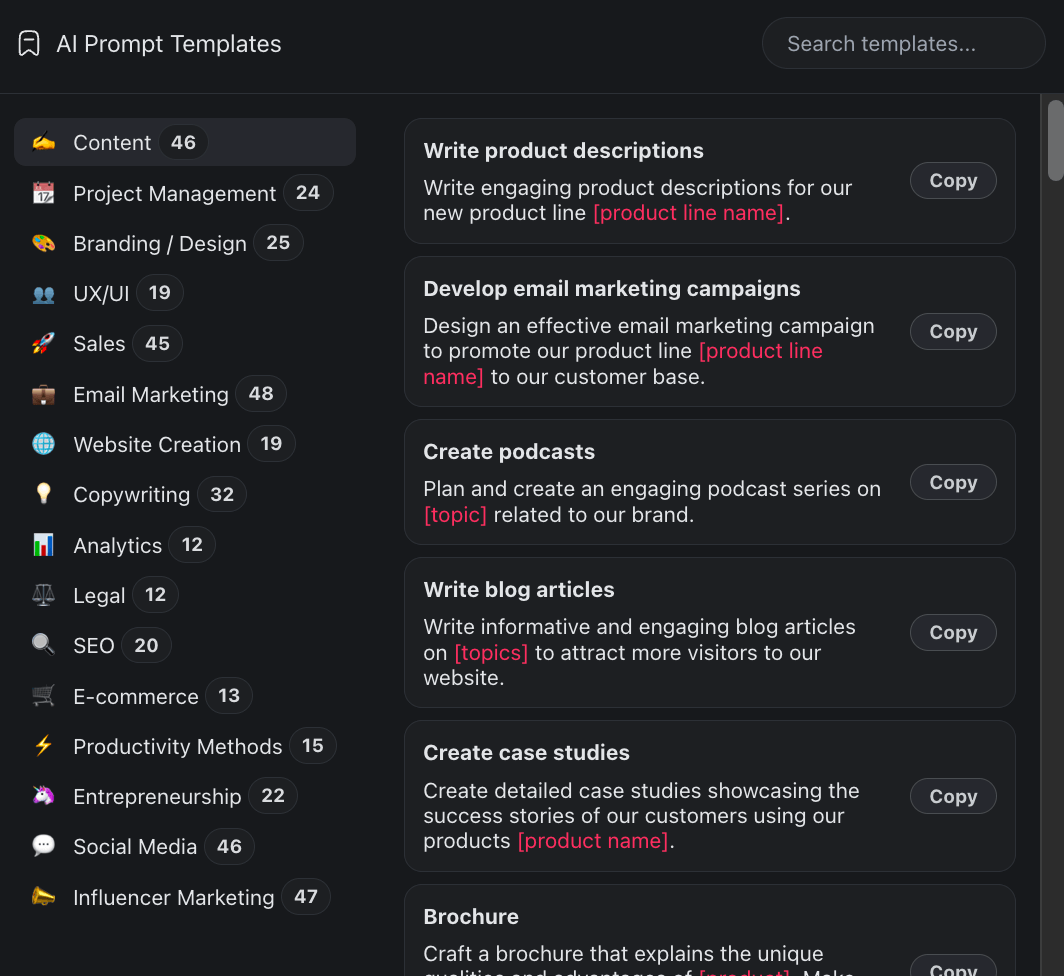
Use Taskade prompt templates to plan your Vercel projects.
Tips for Success:
- Start with a Next.js template
- Use v0 for UI components, customize business logic
- Enable Analytics to monitor performance
- Set up environment variables for API keys
- Use Preview Deployments for testing changes
🚀 Quo Vadis, Vercel?
From a simple deployment tool in 2015 to a $9.3 billion frontend platform in 2025—Vercel's journey is remarkable.
But the most important question isn't where they've been—it's where they're going.
Guillermo Rauch's Vision:
"In 10 years, building a website will be as simple as describing it in English. The gap between design and implementation will disappear. Everyone will be a creator."
Guillermo Rauch, Vercel CEO
Key Strategic Questions:
Can Vercel maintain its Next.js dominance?
Threats are real:
- Remix is gaining traction (better data loading)
- Astro is popular for content sites (faster, simpler)
- SvelteKit has passionate advocates (less complexity)
- React Server Components could work with any framework
But Vercel has advantages:
- First-mover: Built the category, owns mindshare
- Network effects: More developers → more templates → easier adoption
- Continuous innovation: Turbopack, PPR, App Router keep Next.js ahead
- Platform lock-in (soft): v0 generates Next.js code, deployments optimized for Next.js
Will v0 replace frontend developers?
Unlikely. The role evolves:
- Junior developers: Commodity UI work automated
- Mid-level developers: Focus on component architecture, state management
- Senior developers: Product thinking, performance, accessibility, complex interactions
The bottleneck shifts from writing CSS to designing user experiences.
What about competition?
- Netlify: Stagnant, losing market share
- AWS Amplify: Poor DX limits growth
- Cloudflare Pages: Strong on performance, weaker on DX
- Render: Good for small teams, lacks enterprise features
Vercel's moat: DX + AI + Next.js is a unique combination no competitor matches.
The Path to 10M Developers:
If Vercel achieves this milestone, frontend development becomes:
- Accessible to non-developers (designers, PMs, marketers)
- Faster for experienced developers (AI handles boilerplate)
- Higher quality (best practices baked into AI generation)
The future is one where anyone can build web experiences—where the barrier isn't technical skill, but creative vision.
🐑 Before you go... Looking for a way to manage your web development projects? Taskade AI integrates perfectly with Vercel!
💬 AI Chat: Coordinate Next.js features, track deployment cycles, keep your team aligned.
🤖 AI Agents: Automate project management while v0 handles the UI generation.
✏️ AI Assistant: Plan features, organize development sprints, document your Vercel projects.
🔄 Workflow Generator: Create development workflows that integrate v0 builds with your team's process.
Want to give Taskade AI a try? Create a free account and start today! 👈
🔗 Resources
- https://vercel.com/
- https://nextjs.org/
- https://v0.dev/
- https://en.wikipedia.org/wiki/Vercel
- https://vercel.com/blog/series-f
- https://vercel.com/blog/announcing-v0-generative-ui
- https://github.com/vercel/next.js
- https://research.contrary.com/company/vercel
Related Reading
💬 Frequently Asked Questions About Vercel
Who founded Vercel?
Vercel was founded in 2015 by Guillermo Rauch (CEO), Tony Kovanen (ex-CTO), and Naoyuki Kanezawa. Originally called Zeit, the company rebranded to Vercel in April 2020. Rauch is also the creator of Socket.IO, a popular real-time communication library.
What is Vercel used for?
Vercel is a frontend cloud platform used for deploying web applications with zero configuration. It's optimized for Next.js (which Vercel created) but also supports React, Vue, Svelte, Angular, and static sites. Developers use Vercel for instant deployments, global CDN, serverless functions, and team collaboration.
What is Next.js?
Next.js is a React framework created by Vercel in 2016. It provides server-side rendering, static site generation, file-based routing, API routes, and automatic code splitting out of the box. Next.js is now the most popular React framework, used by 71% of React jobs and powering sites for Nike, Netflix, and TikTok.
What is v0 by Vercel?
v0 is Vercel's AI-powered UI generator that creates production-ready React components from natural language descriptions. It generates code using shadcn/ui components, Tailwind CSS, and TypeScript. v0 can build entire pages, iterate based on feedback, and deploy directly to Vercel.
Is Vercel free to use?
Yes, Vercel offers a free Hobby tier for personal projects with unlimited deployments, preview deployments, and basic analytics. For teams and commercial projects, Vercel Pro costs $20/month per seat. Enterprise plans with custom pricing offer SSO, compliance, and dedicated support.
How is Vercel different from Netlify?
Vercel created Next.js and optimizes specifically for it, while Netlify is framework-agnostic. Vercel focuses on cutting-edge DX and AI tools like v0, while Netlify offers more mature, stable features. Vercel is generally faster for Next.js apps but more expensive at scale. Netlify has more predictable pricing.
What is the Vercel Edge Network?
The Vercel Edge Network is a global CDN with 100+ locations that serves your application from the location nearest to users. Edge Functions run serverless code at the edge with minimal latency (tens of milliseconds). This makes apps faster worldwide without manual CDN configuration.
How much does Vercel cost?
Vercel pricing includes: Hobby (free) for personal projects, Pro ($20/month per seat) for teams with advanced analytics and support, and Enterprise (custom pricing) with SSO, compliance (SOC 2, GDPR, HIPAA), and dedicated support. Bandwidth and compute usage may incur additional costs.
Can I use Vercel without Next.js?
Yes, Vercel supports any frontend framework including React (Create React App, Vite), Vue, Svelte, Angular, Astro, Nuxt, and static HTML. However, Next.js apps get the deepest optimization because Vercel built the framework specifically for their platform.
What is shadcn/ui?
shadcn/ui is a collection of re-usable React components built with Radix UI and Tailwind CSS. Unlike component libraries you install, shadcn/ui components are copied into your project, giving you full control. v0 uses shadcn/ui as its component foundation for generated UIs.
How much is Vercel valued at?
Vercel reached a $9.3 billion valuation in September 2025 after raising a $300 million Series F led by Accel and GIC. The company has raised $863 million total from investors including Google Ventures, Salesforce Ventures, BlackRock, and Tiger Global.
What are Edge Functions?
Edge Functions are serverless functions that run on Vercel's global Edge Network (100+ locations). They use V8 isolates instead of containers, starting in tens of milliseconds versus hundreds. Edge Functions are ideal for authentication, redirects, geolocation-based content, and A/B testing.
Is Next.js better than React?
Next.js is not a replacement for React—it's a framework built on top of React. Pure React is a UI library, while Next.js adds routing, SSR, file-based structure, API routes, and performance optimizations. For production apps, Next.js provides features you'd otherwise build yourself.
What is Partial Pre-Rendering (PPR)?
PPR is a Next.js 16 feature that renders static parts of a page immediately while streaming dynamic content progressively. This makes apps feel instant—users see the shell immediately, then dynamic data fills in without blocking. PPR combines the best of static and dynamic rendering.
🧬 Build Your Own AI Applications
While Vercel builds the AI UI platform, Taskade Genesis lets you build AI-powered productivity and workflow applications. Create custom AI agents, project templates, and automations with a single prompt. It's vibe coding for productivity—describe what you need, Taskade builds it as living software. Explore ready-made AI apps.