Lovable is an AI-powered app builder that lets anyone create full-stack web applications from plain English descriptions. What started as a viral open-source experiment on GitHub became one of the fastest-growing software companies in history, reaching $206M ARR in just 11 months and a $6.6 billion valuation.
TL;DR: Lovable turns plain-English prompts into full-stack web apps. Founded in November 2023 in Stockholm by Anton Osika and Fabian Hedin, it began as the viral open-source GPT Engineer (51,000+ GitHub stars) before hitting $206M ARR in 11 months and a $6.6B valuation. For apps with built-in agents and automations, see Taskade Genesis.
But where did it all start? How did a Swedish PhD student's GitHub repo spark a vibe coding revolution? In today's article, we take a deep dive into the history of Lovable, its meteoric rise, its controversies, and where it's heading next. 🔮
🤖 What Is Lovable?
Lovable was founded in November 2023 in Stockholm, Sweden by Anton Osika (CEO) and Fabian Hedin (CTO). The company grew out of GPT Engineer, an open-source tool that became one of the fastest-growing repositories in GitHub history with over 51,000 stars.
"We want to build the last piece of software humanity ever needs to build by hand."
Anton Osika, CEO of Lovable
The idea is deceptively simple: describe what you want in plain English, and Lovable generates a full-stack web application complete with frontend, backend, authentication, database, and deployment. No coding required.
Under the hood, Lovable generates:
- Frontend: React 18+ with TypeScript, powered by Vite
- Styling: Tailwind CSS + shadcn/ui component library
- Backend: Supabase (Postgres database, authentication, storage, edge functions)
- Deployment: Lovable-hosted domains, custom domains, or GitHub sync to Netlify/Vercel
But what makes Lovable different from a simple code generator is the feedback loop. You can see a live preview of your app as it's built, make changes through natural language, and iteratively refine the result. It's less like writing a spec and more like having a conversation with your developer.
By November 2025, the numbers told a staggering story:
- $206M ARR (up from $7M at the end of 2024 — 2,800% YoY growth)
- ~8 million users worldwide
- 100,000 new products built per day
- $6.6 billion valuation following a $330M Series B
So, let's wind back the clock and see how two Swedish engineers built the defining company of the vibe coding era.
🥚 The History of Lovable
The Founders: A Physicist and a Teenage Entrepreneur
The story of Lovable starts with two very different paths to the same destination.
Anton Osika was born on August 10, 1990, in Sweden. Inspired by The Matrix, he started coding at age 12. He went on to complete a Master's degree in Engineering Physics and Applied Mathematics at KTH Royal Institute of Technology — at double speed. His career reads like a tour of Europe's most ambitious tech endeavors: software engineer at CERN (the particle physics lab that invented the World Wide Web), first employee at Sana Labs (an AI education company that went on to raise $80M+), and co-founder of Depict.ai, a Y Combinator startup building AI-powered product recommendations that raised $20M.

Lovable's AI-powered app builder turns natural language prompts into production-ready applications in minutes.
Fabian Hedin is a different kind of prodigy. At just 26 years old, he's one of Europe's youngest self-made billionaires. His coding journey started in the most unlikely of places — a Minecraft server:
"I was running the server and you want to mod it, you want to change the experience and then you have to create a website for it. Then you have to figure out what is HTML, CSS and JavaScript, and you get into programming that way."
Fabian Hedin, First Block interview (2025)
Hedin was earning thousands from Minecraft at age 11. By high school, he was building SaaS products for other people's businesses, then decided he wanted to be "a longer term stakeholder" and cofounded a prop-tech SaaS startup with a classmate right after graduation. He sold it before moving to Stockholm for university. He also worked on Stephen Hawking's communication interface, holds a Bachelor's degree from KTH, and was named among the Top 30 CTOs in EMEA for 2025.
The two met when Hedin joined Depict.ai — Osika's YC startup in Stockholm — as an early engineer. "Anton was my boss, he was the CTO of that startup," Hedin recalled. He spent 10 months there — "I'm proud to say that's my longest employment to date" — before quitting to do his own thing.
Then, one Saturday morning in the summer of 2023, Osika called him:
"He was calling me, waking me up. 'Oh hey, do you want to go take a walk together?' And I was like, no, not really, but he's like, 'oh, I'm outside. Let's go for a walk.' And he asked me, do you know what GPT Engineer is?"
Fabian Hedin, on the founding moment of Lovable
That walk would spark a $6.6 billion company. Hedin didn't know what GPT Engineer was — "it was a few days old at that point, so I don't feel too bad" — but the implications were immediately clear to both of them.
That shared obsession — what if you could make software creation as easy as describing what you want? — would first manifest as an open-source experiment.
The Viral GitHub Moment: GPT Engineer (Spring 2023)
In spring 2023, Anton Osika posted a project to GitHub called GPT Engineer. The concept was straightforward: a command-line tool that took a natural language description and used GPT-4 to generate an entire codebase.
It was not the first AI code generation tool. GitHub Copilot had been around since 2022. But GPT Engineer did something different — instead of autocompleting individual lines, it tried to generate complete, functional projects from a single prompt.
The response was explosive.
GPT Engineer hit 40,000 GitHub stars by September 2023, making it one of the fastest-growing repositories in GitHub history. By February 2026, the star count had crossed 51,000.
Why did it go so viral? Because it crystallized a feeling that had been building in the developer community since ChatGPT's launch: if AI can write individual functions, why can't it write entire applications?
The GitHub stars translated into attention, talent, and — crucially — the conviction to start a company.
Founding the Company (November 2023)
In November 2023, Osika and Hedin formally founded the company in Stockholm, Sweden. The open-source project had proven the concept. Now they needed to build a product.
The KTH Royal Institute of Technology — their shared alma mater — would later recognize the founding with a KTH Innovation Award in 2025.
But building a commercial product from an open-source prototype is one of the hardest pivots in tech. What works as a developer toy rarely works as a business tool. As Hedin recalled, there were real doubts in the early days:
"I was never really that interested in improving developers. I more wanted to enable people to go 0 to 1 as fully non-technical. And I would say that's the harder problem. And we were a bit early on that... We had some doubts of will this actually work? Are the foundational models good enough for this use case? And they weren't really, but you could do basic prototypes."
Fabian Hedin, First Block interview
The next 12 months would prove this lesson painfully.
Launch 1: GPT Engineer App (April 2024)
The first commercial product launched in April 2024 as GPT Engineer App. It took the CLI tool and wrapped it in a web interface where users could describe an app and watch it get built in real time.
The result? Good, but not great. Users could generate simple apps, but the experience felt limited. The AI got stuck too often. Complex prompts produced broken output. There was no persistence — you couldn't iteratively improve an app across multiple sessions.
The traction was disappointing compared to the GitHub hype. The team had learned their first hard lesson: generating code and building usable applications are two very different problems.
Launch 2: The Summer of Evals (Summer 2024)
Undeterred, the team shipped a second major version in summer 2024. It was better — higher quality output, more reliable generation — but the AI still got stuck on anything beyond simple CRUD apps.
The gap between launches is where the real innovation happened. The team developed three key technical breakthroughs:
- Large Codebase Performance: A system that allowed the AI to work effectively across files with hundreds or thousands of lines, not just small snippets
- Evaluation-Driven Development: Rigorous "evals" — automated tests that measured generation quality — became the team's North Star metric, replacing subjective assessments
- Supabase Integration: Deep integration with Supabase gave generated apps a real backend (Postgres database, authentication, file storage, edge functions) instead of just a static frontend
These weren't flashy features. They were infrastructure. And they would make the third launch a very different story.
The Rebrand: GPT Engineer Becomes Lovable (December 2024)
In December 2024, the company made a bold decision: kill the GPT Engineer brand entirely and rebrand as Lovable.
The reasoning was strategic, but internally it wasn't easy. Hedin admitted:
"Changing the name was a big internal debate. I was actually a proponent for keeping GPT Engineer for a long time. I liked it and you get attached to names, but the company name was actually Lovable since we started."
Fabian Hedin, First Block interview
The "Lovable" name carried a specific product philosophy — the concept of a Minimum Lovable Product instead of the traditional MVP (Minimum Viable Product). As Hedin explained: "Before, you build this MVP, minimum viable product, and then you throw that away and you build the real thing. We're thinking, alright, you apply AI to this, now you can just build the real thing, and we can call that the minimum lovable product."
The rename also solved a practical problem: as the product evolved to use multiple AI models (including Anthropic Claude as the primary model), the "GPT" name had become misleading.
The third launch changed everything.
The Viral Third Launch (December 2024 - January 2025)
When Lovable launched under its new name in December 2024, the product had been quietly rebuilt from the ground up. The Supabase integration was seamless. The evals had driven generation quality up dramatically. The large codebase system meant apps could actually grow beyond a few screens.
The launch hit the front page of Product Hunt and Hacker News. It accumulated 75+ five-star reviews. Within five weeks, Lovable had reached $5.3M ARR. By February 2025, that number had climbed to $17M ARR.
In hindsight, Hedin's biggest regret was not launching sooner: "We were very early in the space and I at least didn't know of any other people fiddling this type of chat and preview interface before we did it, but we weren't the first to go and do a general launch of it. And I think that was a mistake in hindsight. We were basically behind a wait list for too long."
The timing of the third launch, however, was serendipitous. On February 2, 2025 — just weeks after Lovable's viral launch — AI researcher Andrej Karpathy posted a tweet that would define an entire movement:
"There's a new kind of coding I call 'vibe coding', where you fully give in to the vibes, embrace exponentials, and forget that the code even exists."
Andrej Karpathy, February 2, 2025
Lovable had launched the product that embodied vibe coding before the term even existed. The timing couldn't have been better. Every article, podcast, and tweet about vibe coding mentioned Lovable as one of the defining platforms.
The growth trajectory that followed was unlike anything the software industry had seen:
| Milestone | Timeline |
|---|---|
| $5.3M ARR | 5 weeks after launch |
| $17M ARR | 90 days (February 2025) |
| $100M ARR | 8 months |
| $200M ARR | 11 months (November 2025) |
As Osika would later claim: the growth was "faster than OpenAI, Cursor, Wiz, and every other software company in history."
💰 The Funding Rocket Ship
Lovable's revenue growth attracted investors at a pace that matched the product's own viral trajectory.
| Round | Date | Amount | Valuation | Lead Investors |
|---|---|---|---|---|
| Pre-Seed/Seed | October 7, 2024 | $7.46M | — | Hummingbird Ventures, byFounders |
| Pre-Series A | February 2025 | $15M | — | Creandum |
| Series A | July 2025 | $200M | $1.8B (unicorn) | Accel |
| Series B | December 18, 2025 | $330M | $6.6B | CapitalG (Alphabet), Menlo Ventures |
Total raised: ~$653 million.
The Series A in July 2025 was the unicorn moment — a $200M round from Accel valued Lovable at $1.8 billion, just 20 months after the company was founded. For context, it took Stripe 7 years and Notion 6 years to reach unicorn status.
Five months later, the Series B nearly quadrupled the valuation to $6.6 billion, led by CapitalG (Alphabet's growth investment fund) and Menlo Ventures. That round valued Lovable on par with companies like Figma at the time of its Adobe acquisition offer.
At 26, CTO Fabian Hedin became one of Europe's youngest self-made billionaires. CEO Anton Osika's estimated net worth reached approximately $1.6 billion.
The funding wasn't just financial validation — the investor list revealed strategic intent. CapitalG, as Alphabet's investment arm, signaled that Google saw AI app builders as a critical category. Menlo Ventures brought deep enterprise software expertise, foreshadowing Lovable's pivot toward enterprise customers.
To put the speed of Lovable's fundraising into perspective:
| Company | Time to $1B+ Valuation | Founded |
|---|---|---|
| Lovable | ~20 months | November 2023 |
| Cursor (Anysphere) | ~30 months | 2022 |
| OpenAI | ~3 years | 2015 |
| Stripe | ~7 years | 2010 |
| Notion | ~6 years | 2013 |
Lovable is one of the fastest companies to reach unicorn status in software history — a testament to both the market demand for vibe coding tools and the explosive revenue trajectory the team achieved after the rebrand.
⚙️ How Lovable Works Under the Hood
Understanding Lovable's technical architecture reveals both its strengths and its limitations.
The Tech Stack
When a user describes an app in natural language, Lovable generates a complete codebase using a carefully curated stack:
Frontend:
- React 18+ with TypeScript for type safety
- Vite as the build tool (fast hot module replacement)
- Tailwind CSS for utility-first styling
- shadcn/ui for pre-built, customizable components
Backend (via Supabase):
- PostgreSQL database with auto-generated schemas
- Row Level Security (RLS) policies for data access control
- Authentication (email/password, OAuth providers)
- File storage with CDN delivery
- Edge Functions for serverless backend logic
Deployment:
- Lovable-hosted subdomains (default)
- Custom domain support
- GitHub sync for exporting code to external repositories
- One-click deploy to Netlify or Vercel via GitHub integration
Smart Model Routing
One of Lovable's more interesting technical decisions is smart routing — the system doesn't send every prompt to the same LLM. Instead, it routes requests to different models based on the context and complexity of the task.
The primary model is Anthropic Claude, which handles the bulk of code generation. But simpler tasks like CSS tweaks or copy changes may be routed to faster, cheaper models. This approach balances quality with speed and cost.
CEO Anton Osika offered a rare look into Lovable's model strategy in a late-2025 interview:
"We use Claude for the actual coding. For debugging, we've found GPT-5 is actually better — it's really good at reasoning about what went wrong. We use different models for different parts of the pipeline."
Anton Osika, CEO of Lovable
Osika's view on the model landscape is pragmatic rather than tribal. When asked about the foundation model race, he noted that the real competition isn't between Lovable and other vibe coding tools — it's between the model providers themselves: "The foundation models are getting better at a crazy rate. The question is whether OpenAI or Anthropic or Google ships something that makes our product layer unnecessary. That's the existential risk for every AI application company."
The Molnett Acquisition (November 2025)
In November 2025, Lovable acquired Molnett, a Swedish cloud infrastructure startup specializing in Firecracker MicroVMs — the same lightweight virtual machine technology that powers AWS Lambda and Fly.io.
The acquisition signaled Lovable's ambition to control its own infrastructure stack. Instead of relying on third-party cloud providers for the sandboxed environments where user apps are built and previewed, Lovable could now run those environments on its own optimized infrastructure.
Firecracker MicroVMs boot in less than 125 milliseconds and use minimal memory, making them ideal for the thousands of ephemeral app-building sessions Lovable runs every hour.
Inside Lovable's Engineering Culture
As of late 2025, Lovable's engineering team numbers around 40 engineers working in what Hedin describes as an extremely flat structure:
"We have a very flat org. I'm the CTO but I still write code every day. We don't really have managers in the traditional sense. Everyone is close to the product."
Fabian Hedin, First Block interview
The team practices aggressive dogfooding — using their own product internally to build real tools. In one revealing anecdote, Hedin described how the team needed a CRM system to manage their growing office operations:
"We needed a CRM for the office and someone was like, 'should we buy Salesforce or HubSpot?' And I was like, 'just use Lovable.' And we built it in an afternoon. That's the best test of your own product — when you actually depend on it."
This culture of building internal tools with Lovable creates a tight feedback loop: every limitation the team encounters internally becomes a product improvement priority. It also lends credibility to the platform's claims about productivity — if Lovable's own engineers prefer it over buying established SaaS tools, the product clearly delivers meaningful value for certain use cases.
The Generation Pipeline
When you type a prompt like "build me a recipe sharing app with user profiles and search," Lovable's generation pipeline follows several stages:
- Prompt Analysis: The system parses your request to identify features, data models, and UI requirements
- Architecture Planning: Based on the analyzed features, the AI determines the file structure, component hierarchy, and database schema
- Code Generation: The AI generates complete files — React components, TypeScript types, Supabase migrations, and configuration files
- Live Preview: The generated code is compiled in a sandboxed environment and rendered as a live, interactive preview
- Diff Application: Follow-up prompts generate targeted diffs rather than regenerating the entire codebase, preserving existing work
This pipeline is why Lovable can handle iterative development — each prompt builds on the previous state rather than starting from scratch. It's also why the large codebase performance breakthrough from summer 2024 was so critical: without it, the AI would lose context as applications grew beyond a few files.
The Supabase Partnership
The Supabase integration deserves special attention because it's arguably Lovable's most important technical decision.
Supabase is an open-source Firebase alternative built on PostgreSQL. It provides a complete backend-as-a-service with a relational database, authentication, file storage, real-time subscriptions, and edge functions — all accessible through a clean REST and GraphQL API.
By standardizing on Supabase, Lovable gains several advantages:
- Predictable Schema: The AI can generate database schemas using PostgreSQL's well-documented syntax
- Built-in Auth: User authentication and session management come free with every app
- Row Level Security: Data access policies can be generated alongside the schema (when the AI does it correctly)
- Serverless Functions: Backend logic can be written as Deno-based edge functions
- Real-time: WebSocket subscriptions for live data updates are built into the Supabase client
The disadvantage is lock-in. Every Lovable app uses Supabase, which means migrating to a different backend requires significant refactoring. For prototypes, this doesn't matter. For production applications, it's a consideration.
📊 The Vibe Coding Movement
Lovable didn't just ride the vibe coding wave — it helped create it. But to understand why vibe coding matters, you need to understand the shift it represents.
What Is Vibe Coding?
The term was coined by Andrej Karpathy — former Tesla AI director and OpenAI researcher — in a tweet on February 2, 2025:
"There's a new kind of coding I call 'vibe coding', where you fully give in to the vibes, embrace exponentials, and forget that the code even exists. It's not really coding — I just see things, say things, run things, and copy-paste things, and it mostly works."
Vibe coding represents a fundamental shift in who can build software. Instead of learning programming languages, data structures, and algorithms, you describe what you want and let AI handle the implementation.
The implications are enormous:
- Designers can build functional prototypes without waiting for engineers
- Product managers can validate ideas in hours instead of sprint cycles
- Entrepreneurs can ship MVPs without hiring a development team
- Domain experts (doctors, lawyers, teachers) can build custom tools for their workflows
The Vibe Coding Ecosystem
Lovable exists within a rapidly growing ecosystem of AI app builders, each with a different focus:
| Platform | Focus | Key Differentiator |
|---|---|---|
| Lovable | End-to-end vibe coding | Supabase backend, iterative building |
| Bolt.new | Speed, multi-framework | Fast iteration, framework flexibility |
| v0 (Vercel) | React/Next.js | Design-to-code, Vercel deployment |
| Cursor | AI code editor | VS Code fork, codebase-aware editing |
| Replit Agent | Online IDE + AI | Browser-based, multiplayer |
What separates Lovable from tools like Cursor is the target audience. Cursor is for professional developers who want AI to augment their existing workflow. Lovable is for anyone — technical or not — who wants to go from idea to deployed app without writing a single line of code.
The Democratization Thesis
The broader thesis behind vibe coding is democratization. Today, roughly 30 million people worldwide are professional software developers. But hundreds of millions more have ideas for software they'd like to build — internal tools, side projects, startup MVPs, community platforms.
The gap between "having an idea" and "building software" has historically required either:
- Learning to code (months to years of investment)
- Hiring developers (expensive, slow, and hard to manage without technical knowledge)
- Using no-code tools (limited, rigid, and often ugly)
Vibe coding promises to close this gap. If AI can generate professional-quality code from natural language, the number of people who can create software expands from 30 million to potentially hundreds of millions.
Whether this promise is real or overhyped is the central question of the vibe coding movement. Lovable's trajectory — both its explosive growth and its declining traffic — will provide part of the answer.
🔥 The Controversies
Lovable's meteoric rise hasn't been without turbulence. Three significant controversies emerged in 2025.
1. The Traffic Decline (Barclays Report)
In late 2025, a Barclays analyst report revealed that web traffic to AI app builders had declined significantly since their mid-2025 peaks:
| Platform | Traffic Decline (since June 2025 peak) |
|---|---|
| v0 (Vercel) | Down 64% |
| Lovable | Down 40% |
| Bolt.new | Down 27% |
| Cursor | Stable |
| Replit | Stable |
The report raised uncomfortable questions. Was vibe coding a fad? Were users churning after the initial novelty wore off? Or was the market simply normalizing after a hype-driven peak?
Lovable's bulls argued that revenue continued growing even as traffic declined — suggesting the remaining users were more engaged and willing to pay. The bears countered that a 40% traffic decline is hard to spin positively for a company valued at $6.6 billion.
2. Security Vulnerability CVE-2025-48757
In 2025, security researcher Daniel Asaria discovered a critical vulnerability in Lovable-built applications. Out of 1,645 apps surveyed, 170 had missing Supabase Row Level Security (RLS) policies — meaning their database tables were publicly accessible.
The exposed data included:
- Personal user information
- API keys and secrets
- Application configuration data
- User-generated content
Asaria demonstrated the severity by infiltrating vulnerable apps in as little as 47 minutes. The vulnerability was assigned CVE-2025-48757.
The incident highlighted a fundamental tension in AI-generated code: Lovable's AI could generate functional RLS policies, but it didn't always do so by default. Users who didn't understand database security (the very audience vibe coding targets) were left exposed.
Lovable responded by improving default security policies and adding warnings for unprotected tables, but the incident damaged trust among security-conscious users and enterprises.
3. Code Quality Concerns
Beyond the specific RLS vulnerability, broader concerns emerged about the quality of AI-generated code:
- 45% of AI-generated code contains OWASP Top-10 vulnerabilities, according to industry research
- AI-generated code typically lacks proper test coverage
- Code reviews are bypassed when non-developers use the tool
- Technical debt accumulates rapidly as apps grow in complexity
- State management becomes tangled beyond simple CRUD operations
These aren't Lovable-specific problems — they apply to all AI app builders. But Lovable's positioning as a tool for non-developers makes the risks more acute. A professional developer using Cursor will review and test the generated code. A product manager using Lovable might ship it directly to users.
The code quality debate touches on a deeper philosophical question: who is responsible when AI-generated code fails? Is it the platform (Lovable), the AI model provider (Anthropic), or the user who deployed without review? As vibe coding scales, this question will increasingly find its way into courtrooms and regulatory discussions.
🏢 The Enterprise Pivot
Despite the controversies, Lovable made a strategic play for enterprise adoption in late 2025.
Slush 2025 Announcement
At Slush 2025 in Helsinki — one of Europe's largest startup conferences — Lovable announced its enterprise strategy. The claim was bold: more than half of Fortune 500 companies were already using Lovable.
Named enterprise customers included:
- Klarna — the Swedish fintech giant
- Deutsche Telekom — Europe's largest telecommunications company
- Uber — the ridesharing platform
- Zendesk — customer service software
- McKinsey — the global management consulting firm
The enterprise use cases were compelling:
Zendesk: Reduced prototype development from 6 weeks to 3 hours
McKinsey: Went from 4-6 months to hours for internal tool development
These numbers suggest enterprises aren't using Lovable to build production applications — they're using it to radically compress the prototyping and validation cycle. A McKinsey consultant can spin up a working prototype during a client meeting instead of commissioning a development team.
Osika revealed the actual revenue breakdown in a late-2025 interview, and it paints a more nuanced picture than the enterprise headlines suggest:
"About 80% of our revenue comes from people building complex applications — multi-page apps with backends, authentication, the whole thing. About 10% is enterprise. And about 10% is hobbyists building simple things."
The 80/10/10 split is striking. Despite the Fortune 500 name-dropping, Lovable's core revenue engine is individual builders tackling ambitious projects — not corporate prototyping budgets. The enterprise pivot is more about future growth than present reality.
The enterprise pivot also explains Lovable's pricing structure in 2026:
| Tier | Price | Credits | Key Features |
|---|---|---|---|
| Free | $0/month | 5 daily | Public projects, Lovable badge |
| Pro | $25/month | 100 monthly | Private projects |
| Business | $50/month | 200 monthly | SSO, priority support |
| Enterprise | Custom | Custom | Custom integrations, security |
The Business and Enterprise tiers signal where the revenue growth is heading — away from individual vibe coders and toward team-based enterprise adoption.
📋 Complete Lovable Timeline
Every major milestone from open-source experiment to $6.6 billion unicorn:
| Date | Event | Key Detail |
|---|---|---|
| Spring 2023 | GPT Engineer posted on GitHub | CLI tool for natural language code generation |
| September 2023 | 40,000 GitHub stars | One of the fastest-growing repos in GitHub history |
| November 2023 | Company founded in Stockholm | Anton Osika (CEO) and Fabian Hedin (CTO) |
| April 2024 | Launch 1: GPT Engineer App | Web interface, limited traction |
| Summer 2024 | Launch 2: Improved version | Better quality, but AI still got stuck too often |
| Summer-Fall 2024 | Key technical breakthroughs | Large codebase performance, evals, Supabase integration |
| October 7, 2024 | Pre-Seed/Seed round | $7.46M from Hummingbird Ventures, byFounders |
| December 2024 | Rebrand to Lovable | "GPT" name retired, product rebuilt from ground up |
| December 2024 | Viral third launch | Front page of Product Hunt and HN, 75+ five-star reviews |
| January 2025 | $5.3M ARR | 5 weeks after launch |
| February 2, 2025 | Karpathy coins "vibe coding" | Lovable becomes a defining platform of the movement |
| February 2025 | Pre-Series A: $15M from Creandum | $17M ARR reached within 90 days |
| July 2025 | Series A: $200M from Accel | $1.8B valuation — unicorn status |
| August 2025 | $100M ARR | 8 months from launch |
| November 2025 | $206M ARR | 2,800% YoY growth, ~8 million users |
| November 2025 | Molnett acquisition | Firecracker MicroVMs for infrastructure control |
| November 2025 | Slush 2025 enterprise announcement | More than half of Fortune 500 using Lovable |
| December 18, 2025 | Series B: $330M | $6.6B valuation, led by CapitalG and Menlo Ventures |
| 2025 | CVE-2025-48757 | RLS security vulnerability in 170 apps |
| 2025 | KTH Innovation Award | Recognition from founders' alma mater |
| 2026 (ongoing) | 51,000+ GitHub stars | GPT Engineer open-source repo continues growing |
🤔 So, What Makes Lovable Different?
The Integrated Backend Advantage
Most AI code generators produce frontend-only output. You get a pretty UI with no data persistence, no authentication, and no server logic. Lovable's deep Supabase integration changes this equation.
When you tell Lovable "build me a project management app with user accounts and team workspaces," it doesn't just generate React components — it creates a Postgres schema, sets up authentication flows, configures Row Level Security policies, and wires everything together with Supabase's client library.
This is the difference between a demo and an application. Most Lovable-generated apps are immediately functional, not just visually complete.
The Iterative Building Loop
Lovable's live preview and conversational interface create a tight feedback loop:
- Describe what you want
- See the result in real-time
- Refine through follow-up prompts
- Deploy when satisfied
This loop mirrors how a product manager would work with a developer — except the cycle time drops from days to minutes. You can try an idea, see it fail, pivot, and try again in a single sitting.
Smart Model Routing
By routing different types of requests to different LLMs, Lovable can optimize for both quality and speed. Complex architectural decisions go to Claude. Simple styling tweaks go to faster models. The user never sees this routing — they just experience consistently good results.
The Open-Source Heritage
Lovable's roots in the GPT Engineer open-source project give it a unique advantage: community trust. With 51,000+ GitHub stars, the project attracted thousands of contributors who stress-tested the code generation approach, reported edge cases, and suggested improvements.
This open-source feedback loop accelerated Lovable's development in ways that a purely closed-source competitor couldn't match.
⚡ Potential Benefits (and Real Limitations)
Where Lovable Excels
AI app builders like Lovable unlock genuine value in specific use cases:
Rapid Prototyping: The ability to go from idea to working prototype in minutes fundamentally changes how teams validate product concepts. Instead of a two-week sprint to build a prototype, a product manager can test five different approaches in an afternoon.
Internal Tools: Every company has a backlog of internal tools that never get built because engineering bandwidth is scarce. Lovable lets non-developers build dashboards, admin panels, and workflow tools without competing for developer time.
Early Validation: Before investing months of engineering effort, founders can use Lovable to build and ship an MVP, collect real user feedback, and validate the business model.
Learning: For aspiring developers, Lovable generates readable, well-structured React/TypeScript code that serves as a learning resource. You can see how a professional codebase is structured and learn from the patterns.
Where Lovable Falls Short
The honest assessment of Lovable's limitations is crucial for anyone considering it:
Complex Backend Logic: Multi-step workflows, complex business rules, background processing, and event-driven architectures exceed what Lovable can reliably generate. If your app needs a payment processing pipeline or a multi-tenant data isolation layer, you need a developer.
State Management at Scale: As applications grow beyond a few screens, state management becomes tangled. React's component model requires careful architecture to avoid prop drilling, unnecessary re-renders, and inconsistent state. AI-generated code rarely handles this well.
Production Readiness: Generated applications lack the hardening that production software requires — error monitoring, logging, performance optimization, graceful degradation, rate limiting, and comprehensive test suites.
Security by Default: The CVE-2025-48757 incident proved that AI-generated code doesn't always follow security best practices. Non-technical users may not know what Row Level Security is, let alone whether their app has it configured correctly.
Technical Debt: Every prompt adds code. Over time, Lovable-generated codebases accumulate redundant components, unused imports, and inconsistent patterns. Without developer oversight, this debt compounds quickly.
The bottom line: Lovable is exceptional for prototyping and validation, solid for simple production apps, and inadequate for complex production systems.
Who Should (and Shouldn't) Use Lovable
Use Lovable if you are:
- A product manager validating an idea before committing engineering resources
- A designer who wants to turn mockups into functional prototypes
- A founder building an MVP to test with early users
- A non-technical team member building internal tools or dashboards
- A student learning web development by studying generated code patterns
Don't use Lovable if you need:
- Complex backend logic with multi-step workflows and business rules
- Production-scale applications serving thousands of concurrent users
- Applications with strict security or compliance requirements (HIPAA, SOC 2, PCI)
- Native mobile applications (Lovable generates web apps only)
- Applications that require deep customization of the underlying framework
For teams that need both rapid prototyping and production-grade project management, Taskade Genesis offers a unique middle ground — AI-powered app building combined with a full workspace featuring custom AI agents, automation workflows, and multiple project views.
📈 The Competitive Landscape
The vibe coding market is crowded and evolving rapidly. Here's where each player stands:
| Platform | Target Audience | Strength | Weakness |
|---|---|---|---|
| Lovable | Non-developers, PMs | Full-stack with Supabase | Complex backend logic |
| Bolt.new | Speed-focused builders | Multi-framework, fast | Less backend depth |
| v0 (Vercel) | Designers, React devs | Beautiful UI generation | Frontend-focused |
| Cursor | Professional developers | Codebase-aware AI editor | Requires coding skills |
| Replit Agent | Beginners, educators | Browser-based, deployable | Performance limitations |
| Taskade Genesis | Teams, project managers | App building + workspace + agents + automation | Different category |
The most interesting competitive dynamic is between Lovable and Cursor. Lovable targets people who don't code. Cursor targets people who do. Both are growing rapidly, but their user bases barely overlap.
The bigger threat to Lovable may come from the infrastructure layer. If Supabase builds its own AI generation features, or if Vercel's v0 adds full backend support, the integrated stack that differentiates Lovable could become a commodity.
It's also worth noting that the competitive dynamics shift depending on the user's goal:
- For pure prototyping: Lovable and Bolt.new lead
- For design-to-code: v0 by Vercel excels
- For professional development: Cursor dominates
- For learning and education: Replit's browser IDE has the best onboarding
- For full workspace + app building: Taskade Genesis combines app generation with project management, agents, and automation
The market is large enough that multiple winners can coexist — but the question is whether any single platform can capture the majority of the value as vibe coding matures from novelty to standard practice.
👉 How to Get Started with Lovable
If you want to try vibe coding for yourself, Lovable offers a free tier.
Head to https://lovable.dev and create a new account.
The interface is simple: a chat window on the left and a live preview of your app on the right. Here's the basic workflow:
- Describe your app: "Build me a habit tracking app with daily streaks, weekly reports, and user accounts"
- Watch it generate: Lovable creates the codebase in real-time, showing a live preview as it builds
- Refine with follow-ups: "Change the color scheme to dark mode" or "Add a calendar view for the weekly report"
- Connect Supabase: For data persistence, link a Supabase project to get a real database and authentication
- Deploy: Publish to a Lovable subdomain or connect a custom domain
Keep in mind that Lovable works best for:
- Simple to medium-complexity web applications
- CRUD apps (create, read, update, delete)
- Landing pages and marketing sites
- Dashboard and admin panels
- MVPs and prototypes
For complex applications with sophisticated backend logic, multi-step workflows, or production-scale requirements, you'll want a more comprehensive platform.
💡 Pro Tip: Need more than just an app? Taskade Genesis builds AI-powered applications AND gives you a complete workspace with custom AI agents, multiple project views, automation, and team collaboration. Describe what you need, Taskade builds it as living software. Check out our gallery of ready-made AI apps to get started!
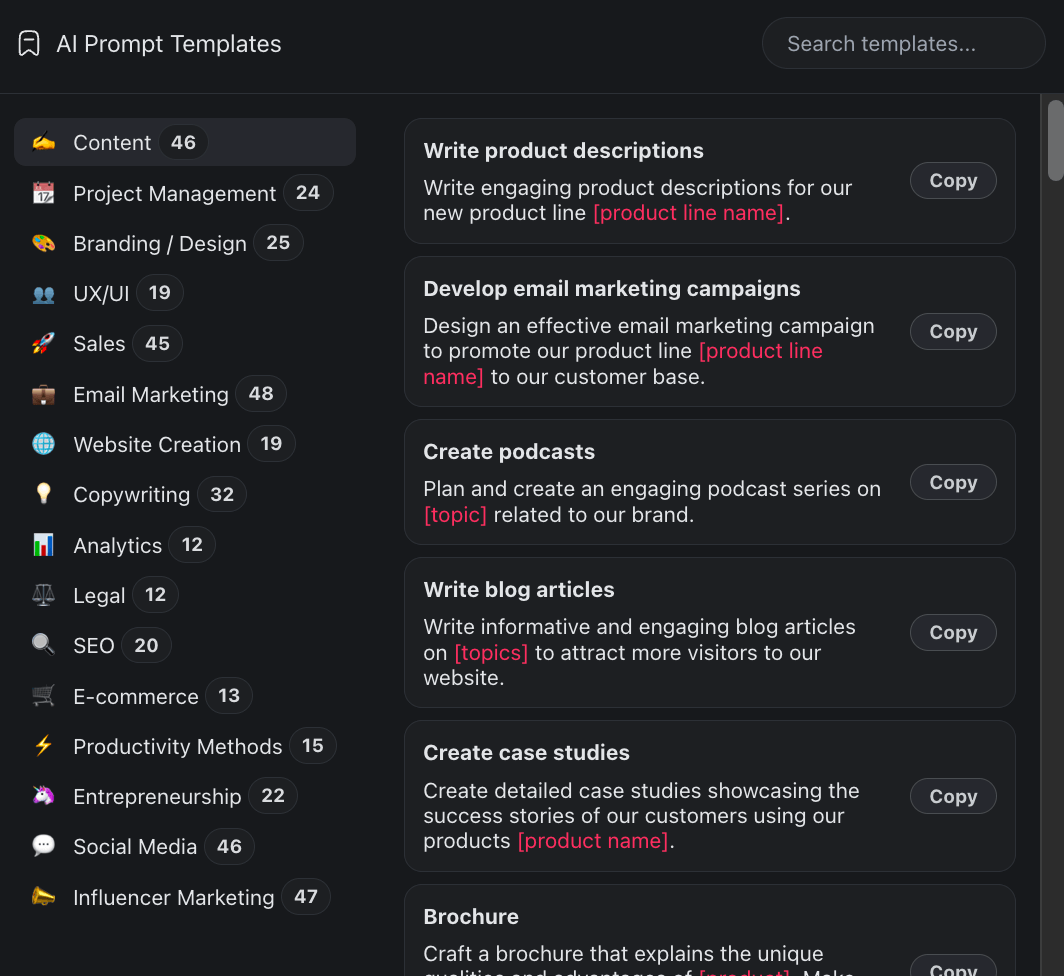
A 🤖 Prompt Templates Gallery works with frontier models from top AI labs.
Have fun exploring!
🎙️ Inside the Founders' Minds
Two interviews from late 2025 offer a rare window into how Lovable's founders think about their company, the competitive landscape, and the future of software creation.
In a conversation with Notion's "First Block" series, CTO Fabian Hedin reflected on the breakneck pace of building an AI company:
"My one piece of advice for founders is: don't build for the future. Build for now. The models are changing so fast that whatever you architect today for a use case six months from now, it's going to be wrong. Just solve the problem in front of you."
This philosophy explains Lovable's rapid iteration cycles — three launches in 18 months, each built on different technical foundations. Rather than over-engineering for hypothetical future capabilities, the team ships quickly and adapts as the models improve.
In a separate interview, CEO Anton Osika offered one of the most vivid metaphors for the current AI startup landscape:
"AI startups are like chickens shot out of a cannon. You're flying, you're going really fast, but you don't really have control. The question is whether you can grow wings before you hit the ground."
Osika is unusually candid about the existential risks. When asked about defensibility, he acknowledged the fragility of building on top of foundation models: "Every AI application company is one model update away from irrelevance — or from 10x improvement. You can't control which one you get."
On hiring, Osika optimizes for what he calls "slope over intercept" — the rate of learning over current knowledge:
"I hire for slope. I don't care where you are today. I care how fast you're getting better. In AI, everything you know is outdated in six months anyway. The only thing that matters is how fast you can learn new things."
But his most ambitious statement concerns Lovable's ultimate vision:
"We're going to see one-person unicorns. One person with AI tools building a billion-dollar company. That's not a fantasy — it's a prediction. And Lovable is the platform that makes it possible."
Whether this vision materializes or remains Silicon Valley hyperbole, it reveals the scale of Lovable's ambition. The company isn't just building a tool for prototyping — it's betting that AI will compress the entire software development process to the point where team size becomes almost irrelevant.
🚀 Quo Vadis, Lovable?
Lovable's journey from a GitHub side project to a $6.6 billion company took barely two years. The speed is breathtaking — but sustainability is the question hanging over the entire vibe coding category.
The bulls see Lovable as the beginning of a fundamental shift in software creation. If AI can generate applications from natural language, the addressable market isn't just developers — it's everyone with an idea. The total addressable market for "software creation" is orders of magnitude larger than the market for "developer tools."
The bears point to declining traffic, security concerns, and the inherent limitations of AI-generated code. Can Lovable grow beyond prototyping into production? Can it maintain its revenue trajectory as the initial hype fades? Can it compete as the big players — Google, Microsoft, and Vercel — build their own offerings?
Here's what to watch:
Enterprise Adoption: Lovable's pivot to enterprise is critical. If Fortune 500 companies use Lovable for prototyping but switch to traditional development for production, the revenue ceiling may be lower than the $6.6 billion valuation implies. If they start using it for production internal tools, the ceiling is much higher.
Infrastructure Play: The Molnett acquisition suggests Lovable wants to own more of the stack. Building on Firecracker MicroVMs could enable features that cloud-dependent competitors can't match — faster builds, lower costs, and better isolation.
Multi-Model Future: Lovable's smart routing already uses multiple LLMs. As models improve, Lovable's code generation quality will improve with them — without any effort from Lovable's own team. This is the rising-tide advantage of building on top of foundation models rather than training your own.
Code Quality Gap: The biggest existential question: will AI-generated code quality improve fast enough to close the gap with human-written code? If it does, vibe coding becomes the default way to build software. If it doesn't, vibe coding stays confined to prototyping — a useful but much smaller market.
Platform Partnerships: Lovable has begun exploring integrations through the Model Context Protocol (MCP), including a partnership with Notion. Hedin described the collaboration: "Notion built an MCP server and we integrated it so you can pull your Notion docs directly into Lovable as context for building apps." These kinds of data-source integrations could transform Lovable from a standalone builder into a connected platform that generates apps from a company's existing knowledge base.
The "Rebuild, Don't Maintain" Philosophy: Perhaps the most radical implication of Lovable's approach is what it does to the concept of technical debt. Hedin suggested that as AI generation improves, the traditional approach of maintaining and refactoring code may become obsolete: "If it takes you 10 minutes to build the whole thing from scratch, why would you spend an hour debugging? Just rebuild it." If this philosophy scales, it inverts decades of software engineering orthodoxy about code longevity and maintainability.
One thing is certain — whether we're ready or not, the barrier to creating software is falling toward zero. The age of vibe coding is just beginning, and Lovable is at the center of it.
🐑 Before you go... Lovable builds apps, but it can't manage them. Need a platform that builds AI-powered apps AND gives you workspace, agents, automation, and multiple project views? Taskade has you covered!
💬 AI Chat: Got a question about your project? The AI Chat gives you answers and helps your team stay on the same page. Decision-making has never been easier.
🤖 AI Agents: Tired of repetitive tasks? Let Taskade's AI Agents handle them. Agents work in the background, help your team save time, and let you focus on the big picture.
✏️ AI Assistant: Planning and organizing? Use the AI Assistant to brainstorm ideas, generate content, organize tasks, and ensure you always know what to do next.
🔄 Workflow Generator: Starting a project can be a puzzle. Describe your project and the Workflow Generator sets things up for you, giving you a clear path to follow.
Want to give Taskade AI a try? Create a free account and start today! 👈
🔗 Resources
- https://lovable.dev
- https://github.com/AntonOsika/gpt-engineer
- https://supabase.com
- https://x.com/kaborchanov/status/1886158579085742569
- https://www.accel.com/noteworthy/investing-in-lovable
- https://www.producthunt.com/products/lovable
- https://techcrunch.com/2025/12/18/lovable-raises-330m-series-b/
- https://www.creandum.com/journal/investing-in-lovable
- https://en.wikipedia.org/wiki/Lovable_(company)
- /blog/taskade-genesis-vs-lovable
💬 Frequently Asked Questions About Lovable
What is Lovable?
Lovable is an AI-powered app builder that generates full-stack web applications from natural language descriptions. It was originally called GPT Engineer and rebranded to Lovable in December 2024. The platform uses React, TypeScript, Tailwind CSS, and Supabase to generate functional web applications that include frontend, backend, authentication, and deployment.
Who founded Lovable?
Lovable was founded in November 2023 in Stockholm, Sweden by Anton Osika (CEO) and Fabian Hedin (CTO). Osika is a former CERN software engineer and YC founder with a Master's from KTH. Hedin, just 26 years old, is one of Europe's youngest self-made billionaires with a background that includes working on Stephen Hawking's communication interface.
What happened to GPT Engineer?
GPT Engineer was rebranded to Lovable in December 2024. The open-source GPT Engineer repository on GitHub (51,000+ stars) still exists, but the commercial product now operates under the Lovable brand. The team renamed it because the "GPT" name framed the product as a utility tied to a specific AI model, while the vision was to create a delightful end-to-end app building experience.
How much has Lovable raised?
Lovable has raised approximately $653 million across four rounds: $7.46M Pre-Seed/Seed (October 2024), $15M Pre-Series A (February 2025), $200M Series A at $1.8B valuation (July 2025), and $330M Series B at $6.6B valuation (December 2025). Investors include CapitalG (Alphabet), Menlo Ventures, Accel, Creandum, Hummingbird Ventures, and byFounders.
What is vibe coding?
Vibe coding is a term coined by AI researcher Andrej Karpathy on February 2, 2025, describing a programming approach where you describe what you want in natural language and let AI generate the code. Instead of writing code manually, you "fully give in to the vibes, embrace exponentials, and forget that the code even exists." Lovable is one of the defining platforms of the vibe coding movement.
Is Lovable free?
Lovable offers a free tier with 5 daily credits and public-only projects (with a Lovable badge). Paid plans include Pro ($25/month, 100 credits), Business ($50/month, 200 credits, SSO), and Enterprise (custom pricing). Credits are consumed each time you prompt the AI to generate or modify application code.
What tech stack does Lovable use?
Lovable generates applications using React 18+ with TypeScript for the frontend, Vite as the build tool, Tailwind CSS and shadcn/ui for styling, and Supabase for the backend (PostgreSQL database, authentication, storage, edge functions). The AI uses smart routing to direct prompts to different LLMs, with Anthropic Claude as the primary model.
Is Lovable secure?
Lovable has faced security concerns, most notably CVE-2025-48757 where 170 out of 1,645 apps surveyed had missing Supabase Row Level Security policies, exposing personal data and API keys. More broadly, 45% of AI-generated code contains OWASP Top-10 vulnerabilities. Lovable has improved default security policies, but users should always review generated security configurations, especially for applications handling sensitive data.
Can Lovable build production applications?
Lovable is best suited for prototyping, MVPs, internal tools, and simple production applications. It struggles with complex backend logic, multi-step workflows, sophisticated state management, and production-scale requirements. Enterprise customers like Zendesk and McKinsey primarily use it for rapid prototyping (reducing timelines from weeks or months to hours) rather than building production-critical systems.
How does Lovable compare to Cursor?
Lovable and Cursor target fundamentally different audiences. Lovable is for non-developers who want to build apps from natural language descriptions without writing code. Cursor is a VS Code fork for professional developers who want AI to augment their existing coding workflow. Cursor offers codebase-aware editing, multi-file edits, and Agent Mode. Lovable offers end-to-end app generation with integrated backend and deployment.
What is Lovable's growth rate?
Lovable grew from $7M ARR at the end of 2024 to $206M ARR by November 2025 — a 2,800% year-over-year increase. The platform has approximately 8 million users building 100,000 new products per day. However, a Barclays report noted that web traffic declined 40% from its June 2025 peak, raising questions about whether the initial hype cycle has cooled.
What did Lovable acquire?
In November 2025, Lovable acquired Molnett, a Swedish cloud infrastructure startup specializing in Firecracker MicroVMs — the same lightweight virtualization technology that powers AWS Lambda. The acquisition gives Lovable control over the sandboxed environments where user applications are built and previewed, enabling faster builds and lower infrastructure costs.
🧬 Build Your Own AI Applications
Lovable builds apps but can't manage them. Taskade Genesis builds complete AI-powered applications AND gives you a workspace with custom AI agents, multiple project views, automation, and team collaboration. It's vibe coding — describe what you need, Taskade builds it as living software. Compare the platforms: Taskade Genesis vs Lovable | Free Lovable Alternatives | Best AI App Builders.