







OpenAI Codex has one of the strangest arcs in AI: it launched in 2021, was quietly killed in 2023, came back from the dead in 2025 as something completely different, and by June 2026 had become a tool that builds and hosts entire web apps from a sentence. This is the complete history, what Codex was, what it is now, who can actually use the newest features, and the open alternative for everyone who can't.
TL;DR: OpenAI Codex began as a 2021 code-generation model that powered the first GitHub Copilot, was deprecated in 2023, and was reborn in May 2025 as an agentic coding system spanning CLI, desktop, IDE, and cloud. On June 2, 2026 it added Codex Sites, prompt-to-deployed-app. But only on Business/Enterprise plans, hosted by OpenAI with no public URL. Taskade Genesis builds live apps from a prompt for everyone, free included. Try it free →
The TSK-1 Benchmark sends the same app request to each model and records whether the app worked, with the GPT results on one page.
OpenAI Codex at a Glance: The Complete Evolution
| Era | Date | What it was |
|---|---|---|
| The first Codex | Aug 2021 | A GPT-3-descended model that turned English into code; powered the original GitHub Copilot |
| Deprecation | Mar 23, 2023 | OpenAI retired the Codex model API |
| The agentic reboot | May 2025 | Codex returns as an autonomous coding agent (cloud + CLI), not a model |
| Desktop era | Feb 2026 | Native Mac/Windows desktop app; ~6x usage growth follows |
| Token pricing | Apr 2, 2026 | Switch to token-based credit billing on a rolling 5-hour window |
| Native images | Apr 21, 2026 | GPT Image 2 generation available in-harness |
| Codex Sites | Jun 2, 2026 | Prompt-to-deployed-app + 6 role plugins; 5M+ weekly users, ~20% non-developers |
What Is OpenAI Codex?
OpenAI Codex is OpenAI's agentic coding system: you give it a task, and it plans, edits files, runs commands, and ships working software. It runs across four surfaces, a terminal CLI, a desktop app for Mac and Windows, an IDE extension (VS Code, and it also works inside Cursor), and a cloud version. It supports MCP, reusable skills, hooks, and sub-agents.
The critical thing to understand is that Codex today is not the Codex of 2021. The name was reused for an entirely different kind of product. The 2021 version was a model; the 2026 version is an agent, closer in spirit to Anthropic's Claude Code or Anysphere's Cursor than to a plain API. Understanding that "death and rebirth" is the key to the whole story.
The History of OpenAI Codex
2021: The First Codex (and the Birth of Copilot)
OpenAI Codex launched in August 2021 as a descendant of GPT-3, fine-tuned on billions of lines of public code. Its job was simple and revolutionary: translate natural language into working code. Codex became the engine behind the first version of GitHub Copilot, the autocomplete-in-your-editor product that, more than anything, kicked off the modern AI-coding era. (For the GitHub side of that story, see the complete history of GitHub.)
2023: Deprecation
On March 23, 2023, OpenAI deprecated the Codex model API, folding code generation into its general-purpose GPT-3.5 and GPT-4 models. For two years, "Codex" was effectively a retired brand, a footnote in the larger OpenAI and ChatGPT story. Most people assumed the name was gone for good.
2025: The Agentic Reboot
In May 2025, OpenAI revived the Codex name for something new: an autonomous coding agent that runs in the cloud and the terminal, with early models named codex-1 and codex-mini. This was the shift from AI that suggests code to AI that does the work, the move from autocomplete to agent that defines agentic engineering. Instead of completing your line, Codex now took a whole task, opened your project, made the changes, ran the tests, and reported back.
2026: Desktop, Models, and Token Pricing
Codex accelerated through early 2026:
- February 2026, a native desktop app for Mac and Windows launched, and usage roughly 6x'd in the months after.
- Models: Codex runs the GPT family plus coding-specialized variants (the GPT-5-Codex series), with the default in ChatGPT-authenticated sessions offering up to a 1-million-token context window. Model names change roughly monthly, so the lineup is best treated as a moving target.
- April 2, 2026: OpenAI moved Codex to token-based credit billing on a rolling 5-hour window. It made costs harder to predict; OpenAI's own estimate of power-user spend is roughly $100–200 per developer per month, and users widely report that there is no pre-task cost estimate and no flat plan below Enterprise.
- April 21, 2026, GPT Image 2 arrived, giving Codex native image generation inside the harness (a genuine edge, Anthropic ships no image model).
June 2, 2026: Codex Sites and "Codex for Every Role"
At its "Intelligence at Work" event, OpenAI did two things that turned Codex from a developer tool into something aimed at everyone:
- Codex Sites, create, deploy, and host websites, web apps, dashboards, and games from a prompt (details below).
- "Codex for every role, tool, and workflow", six role-specific plugins (Sales, Data Analytics, Creative Production, Product Design, Public Equity Investing, Investment Banking) bundling 62 apps and 110 skills, plus Annotations for targeted edits on docs, sheets, and slides.
OpenAI reported 5 million+ weekly Codex users, with non-developers (analysts, marketers, operators) now ~20% of users and growing about 3x faster than developers. That non-technical majority is the headline of the whole 2026 chapter.
OpenAI Codex vs Claude Code vs Cursor
The three leading agentic coding tools of 2026 overlap more than the marketing admits. Here's the honest split:
| OpenAI Codex | Claude Code | Cursor | |
|---|---|---|---|
| Shape | Agentic system (CLI + desktop + IDE + cloud) | Agentic system / workflow toolkit | AI-native IDE |
| Strongest at | Unified shipping, computer-use QA, native images | Customization, hooks, auto-delegating sub-agents | Visual editing, inline review |
| Image generation | Yes (GPT Image 2) | No | No |
| Pricing | Token credits (~$100–200/mo) | Subscription | Subscription |
For deeper head-to-heads, see Claude Code vs Cursor vs Taskade Genesis and the broader AI coding agents explained. Many developers run two of these together, the tools coexist more than they compete.
What Is Codex Sites?
Codex Sites, launched June 2, 2026, lets Codex build, deploy, and host an interactive web app from a plain-language prompt, invoked with the @Sites plugin. You describe a dashboard, intake form, or internal portal; Codex builds it, runs it, deploys it, and hands back a URL. It's genuinely impressive, and it's genuinely constrained. Here's who can use it and what it can't do:
| Codex Sites — the reality | Detail |
|---|---|
| Who can use it | ChatGPT Business (on by default) + Enterprise (admin-enabled). Not Free, Go, Plus, or Pro. |
| Hosting | Hosted by OpenAI. Returns a "production URL." |
| Public URL / custom domain | None. No "anyone with the link" mode, no custom domains. |
| Who can open it | Only members of your OpenAI workspace, or users of an identity provider you configure. External clients can't. |
| Payments | Prohibited by policy — you cannot build a paid checkout. |
| Export / portability | No documented code or data export. |
| Collaboration | Share-a-link + async save → review → deploy. Not real-time co-editing. |
Independent reviewers summed it up bluntly: Codex Sites is an internal-tool builder, not a public app publisher. Which raises the obvious question for the ~20% of Codex users who aren't developers, and for everyone locked out on a Plus or Free plan: what turns a prompt into an app you can actually publish, own, and charge for?
Beyond Code: When a Prompt Becomes a Live App
OpenAI Codex proved the future: describe what you want, and software gets built and deployed. The limitation is where that software lives, inside OpenAI's walls, for your coworkers only. Taskade Genesis was built for the opposite half of that loop: turning a prompt into a living application you publish to the open web and own, plus Stripe monetization on paid plans, with AI agents and automations that keep working after you close the tab.
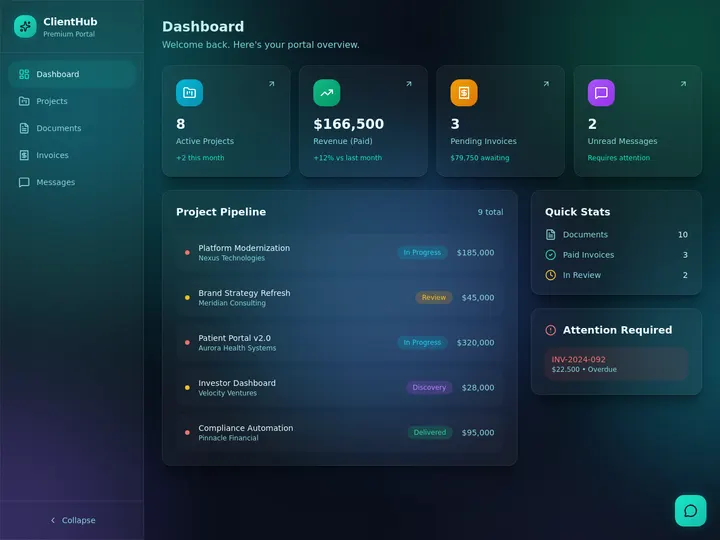
A live client portal published with Taskade Genesis, exactly the kind of external-facing app Codex Sites can't ship, because its apps stay locked inside your OpenAI workspace.
| Capability | OpenAI Codex Sites | Taskade Genesis |
|---|---|---|
| Prompt → live app | ✅ (Business/Enterprise only) | ✅ every tier, free included |
| Public URL + custom domain | ❌ | ✅ Public publish + custom domains (Pro+) |
| External client logins | ❌ workspace members only | ✅ GenesisAuth email sign-in (every tier) |
| Own / clone the build | ❌ no export | ✅ apps ship as cloneable Workspace DNA |
| Charge for it | ❌ payments prohibited | ✅ Stripe-powered App Kits (paid plans) |
| Pricing | token credits (~$100–200/mo) | flat, from $0 |
| Real-time multiplayer | ❌ async only | ✅ by default |
To be fair to Codex: OpenAI ships native GPT Image 2 image generation, sharp in-harness QA, and reaches 5M+ users a week, real advantages Taskade doesn't claim to match head-on. The wedge isn't "more AI." It's openness and ownership: OpenAI built the internal tool; Taskade Genesis ships the part that touches your customers. That same describe-build-deploy-share loop showed up across the industry in June 2026 (Codex Sites, Claude's Live Artifacts, Microsoft Scout), three giants validating one bet, each gated behind a wall. Taskade Genesis is that loop turned toward the open web.
TL;DR: Codex builds you code and an internal app. Taskade Genesis builds you a running, public app, with agents and automations, starting free, with client logins on every plan and Stripe monetization on paid plans. See how Genesis compares to Codex →
Watch: how Taskade Genesis turns a prompt into a live app with AI agents and automations, no GitHub, CI/CD, or Business seat required.
What this video shows: Six apps built from six prompts, including a marketing dashboard, a maintenance tracker, and a finance dashboard, each with its own projects, agent, and automations. Read the step-by-step walkthrough.
How to Get Started with OpenAI Codex (and the Alternative)
Not sure which tool fits your situation? Start here:
                         What do you want to build?
                                    │
              ┌─────────────────────┴─────────────────────┐
              ▼                                             ▼
   "I want to write code faster"          "I want the APP, not the code"
              │                                             │
              ▼                                             ▼
   OpenAI Codex / Claude Code /            Who actually uses the app?
   Cursor  (you deploy + host)                             │
                                     ┌────────────────────-─┴──────────────────────┐
                                     ▼                                              ▼
                            Just my internal team                 Clients / the public / I want to charge
                                     │                                              │
                                     ▼                                              ▼
                         Codex Sites (Business/Ent.)              Taskade Genesis (free: prompt-to-app
                         workspace-private, no charge             + public URL; client logins free,
                                                                  custom domain Pro+, Stripe paid)
OpenAI Codex is included with every ChatGPT plan at chat.openai.com, via the CLI, the desktop app, or the IDE extension; Codex Sites specifically requires Business or Enterprise. If you write code and want a faster shipping pipeline, it's excellent, compare it against the field in best Claude Code alternatives and best vibe coding tools.
If you want the app rather than the code, a dashboard, CRM, client portal, or internal tool you can publish and share with anyone, start with Taskade Genesis. Describe it in plain language, and you get a live app backed by frontier models from top AI labs, AI agents, automations, and 100+ integrations. Browse real builds in the Community Gallery before you start.
Related Reading
- What Is OpenAI? Complete History of ChatGPT, GPT-5 & More, the parent company's full story
- What Is GPT?, OpenAI's Astra, Sol and Luna tiers, with pricing and benchmarks
- What Is Anthropic? History of Claude AI, Codex's biggest agentic-coding rival
- What Is Anysphere? The History of Cursor, the AI-native IDE
- What Is GitHub? Complete History, where the original Codex powered Copilot
- What Is Agentic Engineering?, from autocomplete to autonomous agents
- Taskade Genesis vs Claude Live Artifacts, the self-updating-app comparison
- Best OpenAI Codex Alternative (Taskade Genesis), the prompt-to-app comparison
- OpenAI Codex Pricing Explained, plans, credits, and what power users really spend
- Best OpenAI Codex Alternatives (coders + non-coders), the full ranked field
- Codex vs Cursor · Codex vs GitHub Copilot · Codex vs Claude Code, the developer head-to-heads
Frequently Asked Questions About OpenAI Codex
Is OpenAI Codex the same as the 2021 Codex?
No. The 2021 Codex was a GPT-3-based model that powered the first GitHub Copilot and was deprecated in March 2023. The modern Codex (from May 2025) is an autonomous coding agent, a different kind of product that reused the name.
What is OpenAI Codex Sites?
Codex Sites (June 2, 2026) builds, deploys, and hosts web apps from a prompt. It's available only on ChatGPT Business and Enterprise, is hosted by OpenAI with no public URL or custom domain, and prohibits payment processing. See the full comparison with Taskade Genesis.
Can I use Codex Sites for free?
No. Codex Sites is gated to Business and Enterprise plans. If you want to build and publish a live app on a free plan, Taskade Genesis does prompt-to-app on every tier, including free.
Is OpenAI Codex better than Claude Code?
Neither is universally better. Claude Code wins on customization and auto-delegation; Codex wins on unified shipping, computer-use QA, and native images. If you don't write code at all, a prompt-to-app builder like Taskade Genesis is the better fit.
How much does OpenAI Codex cost?
Codex is included with ChatGPT plans but metered with token credits on a rolling 5-hour window; OpenAI estimates ~$100–200/developer/month for power users. Taskade Genesis uses flat pricing from $0 (Free) with Pro from $10/month, billed annually.
Can non-developers use OpenAI Codex?
Yes, about 20% of Codex's 5M+ weekly users are non-developers, the fastest-growing group. But the prompt-to-app feature (Sites) is Business/Enterprise-gated, which is why many non-technical builders choose Taskade Genesis instead.
OpenAI Codex went from a 2021 model, to a graveyard, to the agentic tool that now builds apps from a sentence. The next question isn't whether AI can build your software. It's whether you can publish it, own it, and charge for it. That's the line Taskade Genesis is built on. Start building free →
▲ Memory · ■ Intelligence · ● Execution