
Definition: The Living Trinity is the core architecture of Taskade Genesis — three interconnected systems that form a continuous loop: Memory (Projects), Intelligence (AI Agents), and Execution (Automations). Together, they create living software that thinks, responds, and acts.
The Three Pillars
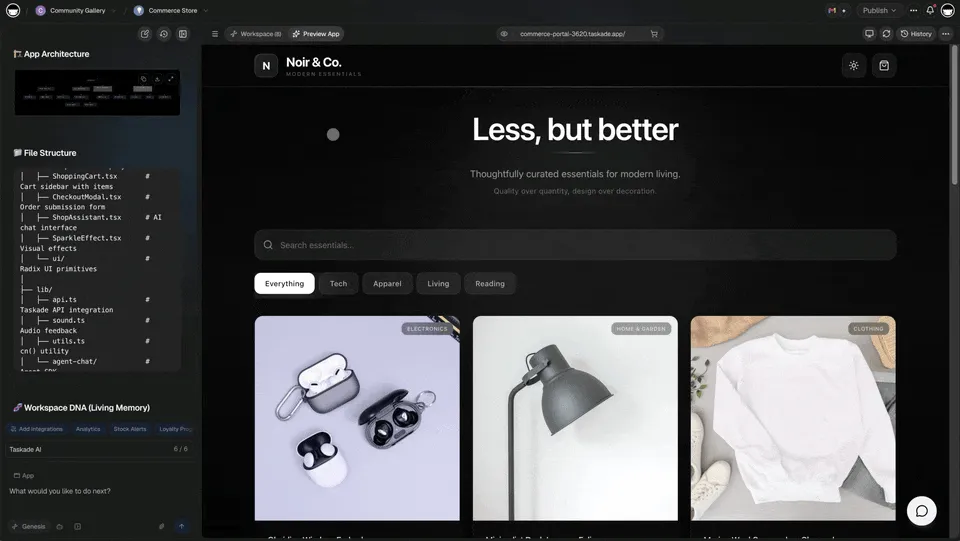
At the heart of Taskade Genesis lies three interconnected systems:
🧠 Memory (Projects)
- Your business data and knowledge stored in flexible structures
- Persistent context that compounds over time
- The foundation that feeds intelligence
🤖 Intelligence (AI Agents)
- AI that thinks, reasons, and makes decisions
- Uses your workspace context to provide relevant responses
- The brain that drives action
⚡ Execution (Automations)
- Workflows that execute with purpose
- Connect to 100+ external tools and services
- The hands that create new memory
The Continuous Loop
The Living Trinity operates as a continuous, self-reinforcing cycle:
→ Memory feeds Intelligence
→ Intelligence drives Action
→ Action creates new Memory
→ (cycle repeats, growing smarter)
This cycle is what makes Taskade Genesis alive. Each iteration compounds the intelligence of your system.
How the Trinity Works Together
Example: Customer Feedback System
- Memory: Customer submits feedback via Taskade Genesis app → stored in project database
- Intelligence: AI agent analyzes sentiment, categorizes issue, identifies patterns
- Execution: Automation routes to appropriate team, sends acknowledgment, schedules follow-up
- New Memory: Resolution logged, knowledge base updated, richer context for future interactions
Example: Sales Pipeline
- Memory: Lead information captured and stored with full context
- Intelligence: AI scores lead, suggests next actions, predicts close probability
- Execution: Automated follow-ups, calendar scheduling, CRM updates
- New Memory: Interaction history compounds, improving future predictions
Building with the Trinity
When you describe an app to Taskade Genesis, you're actually describing all three pillars:
Memory Requirements: "I need to track customer orders, preferences, and history"
Intelligence Requirements: "The system should recommend products and identify VIP customers"
Execution Requirements: "Send confirmations, update inventory, notify the warehouse"
Taskade Genesis automatically creates the infrastructure for all three pillars working together.
The Power of Integration
Without the Trinity (traditional tools):
- Data sits in isolated databases
- Manual analysis and decision-making
- Disconnected automation tools
- No learning or improvement
With the Trinity (Taskade Genesis):
- Data flows seamlessly between systems
- AI makes intelligent decisions in context
- Automations execute with full awareness
- System grows smarter with every interaction
Enterprise Applications
Customer Service Trinity:
- Memory: Complete customer history and interaction logs
- Intelligence: Sentiment analysis, issue prediction, resolution suggestions
- Execution: Ticket routing, escalation, follow-up automation
Operations Trinity:
- Memory: Inventory, suppliers, order history
- Intelligence: Demand forecasting, optimization recommendations
- Execution: Reorder triggers, supplier communications, logistics coordination
Sales Trinity:
- Memory: Leads, deals, customer relationships
- Intelligence: Lead scoring, opportunity analysis, win probability
- Execution: Outreach sequences, meeting scheduling, pipeline updates
The Evolution of Work
The Living Trinity represents a fundamental shift in how software works:
Old Paradigm: Humans operate tools that execute commands
New Paradigm: Humans collaborate with systems that think and act
Your workspace is no longer just a place to store information. It's a living partner that remembers, reasons, and responds.
Related Wiki Pages: Living Software, Workspace DNA, AI Agents, Automation