





Every model vendor now ships a chart that says its newest model is the best at coding. The charts are not wrong, exactly. They are answering a question you did not ask. You did not ask which model can patch a bug in a Python repository it may have seen during training. You asked which model will build your app, the one with the form your clients fill in, the dashboard your team reads, and the automation that has to fire at 9 a.m. on Monday.
So we stopped reading charts and started opening apps. Nine frontier models. The same request, word for word. One builder, Taskade Genesis, held constant. Then we used every app the way a customer would: opened it in light and dark, filled in its form, checked every saved field, and asked it to change. This post is what we found, model by model, with the day each thing was measured. 🧪
TL;DR: No AI model won everything. GPT-5.6 Luna followed a 32-question brief most faithfully, DeepSeek V4 Flash built the best-looking app at the lowest cost, DeepSeek V4 Pro wired the richest workspace, Claude led on edits, GPT-5.6 Terra was fastest at 4.1 minutes and first to pass every check in one run at 8 minutes 26 seconds. Three of nine builds never opened on August 1, 2026. Dated TSK-1 evidence →
Which AI Model Builds the Best App in 2026? The Short Answer
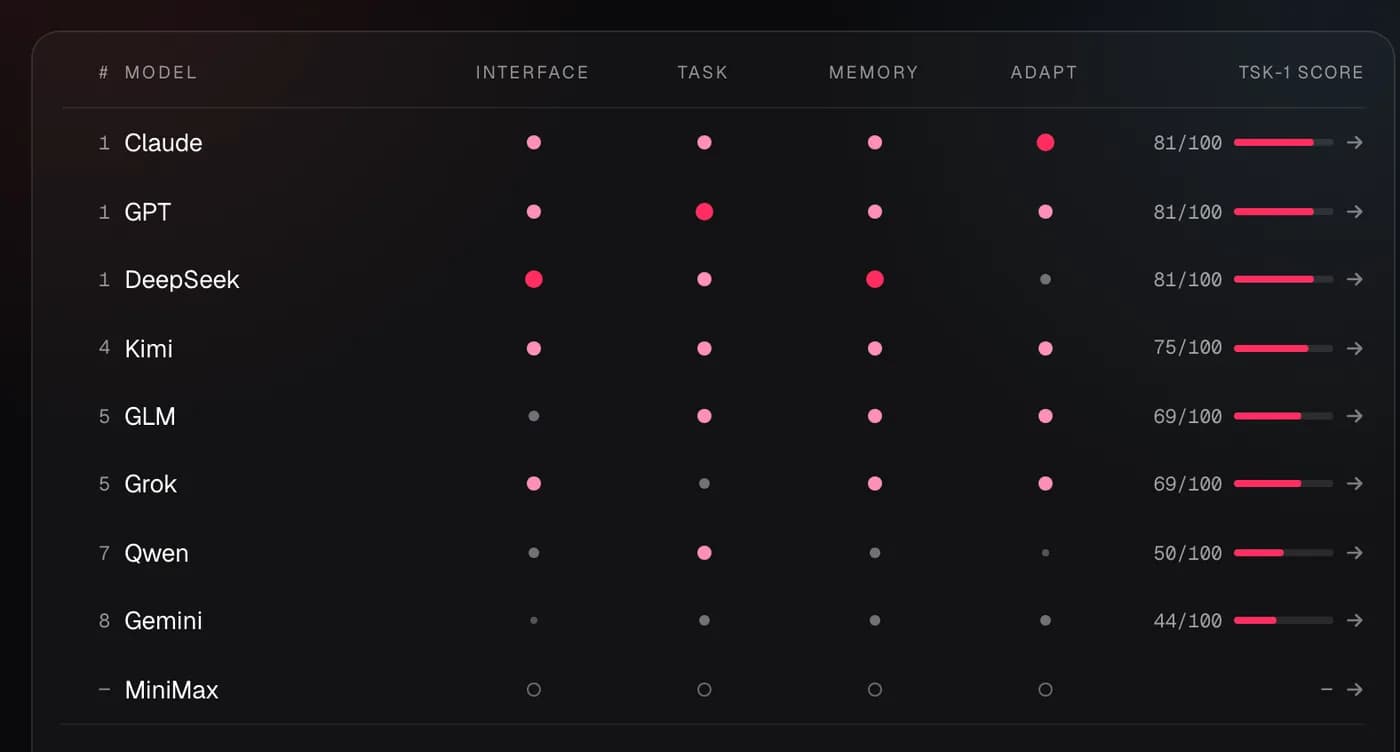
The best AI model for building apps in 2026 depends on which quality you need most, because across the TSK-1 tests run from July 30 to August 29, 2026, a different model led each measure. GPT holds the top position on the TSK-1 hub alone at 88 out of 100, with Claude, DeepSeek, Kimi, and Grok tied at 75, GLM at 63, Qwen at 50, and Gemini at 44. Every result below rests on one to three builds per model per test.
| What you need | Leader in the tests | The evidence | Measured |
|---|---|---|---|
| Follows a long brief word for word | GPT-5.6 Luna | All 32 questions of a real client sign-up form reproduced word for word, repeatedly, plus a working scoring grid that saves scores back to the workspace | Aug 3 to Aug 19, 2026 |
| Best-looking app | DeepSeek V4 Flash | Coherent light and dark theme, no errors, clean layout on a phone, cheapest of nine models | Aug 1, 2026 |
| Richest workspace behind the app | DeepSeek V4 Pro | 8 automations and a record 60 fields wired into one build | Aug 6, 2026 |
| Cleanest follow-up edits | Claude and GPT | The two families rated Leading on Adapt across the tests | Jul 30 to Aug 20, 2026 |
| Fastest finished app | GPT-5.6 Terra | 4.1 minutes on the sign-up form, and the first build to pass every check in a single run at 8 minutes 26 seconds | Aug 7 to Aug 8, 2026 |
| Fewest missteps while building | Kimi K3 | Only 7.2% of its build actions went wrong, the best of its test | Jul 31, 2026 |
| Best judgment when the brief is silent | GLM-5.2 | Declined to add a sign-in screen nobody asked for, and offered it as a suggestion instead | Jul 30, 2026 |

Read down the table instead of across it and the point appears. There is no column a single family wins by enough to standardize on it, and there is no family that wins every column. That is the measured result, and it is why the practical answer is to match the model to the job, or leave the default to TSK-1 Auto.
The rest of this post shows the work: why we grade the app rather than the score, what the other benchmarks measure and skip, exactly how the test runs, and what each of the nine models actually built.
Why We Grade the App, Not the Benchmark Score
We grade the finished app because the public coding benchmarks stopped being able to tell frontier models apart in 2026, and some of them stopped being able to tell solving from cheating. On February 23, 2026, OpenAI announced it would no longer report SWE-bench Verified after auditing 138 of its hardest problems and finding that 59.4 percent were flawed.
That is the benchmark most model launches still quote. Three more findings from the same year explain why a score alone is not enough:
- Saturation. When SWE-bench launched in October 2023, Claude 2 solved 1.96 percent of it. By September 1, 2026, seven of 86 models scored 95 percent or better on the Verified subset. A benchmark where the top seven are separated by rounding error cannot rank them.
- Exploits. In April 2026, Berkeley researchers built an agent that scored 100 percent on SWE-bench Verified, SWE-bench Pro, and Terminal-Bench without solving a single problem. Their summary: if a benchmark is exploitable, it will be exploited. A May 2026 audit of SWE-bench Pro found the graders got roughly one in three verdicts wrong, and that a frontier model read the answer out of the repository's history in 12 to 25 percent of its passes.
- Preference is not correctness. Arena-style leaderboards rank models by which of two answers a person preferred. That measures taste. The April 2025 paper The Leaderboard Illusion documented one vendor privately testing 27 model variants before publishing only the winner, and a separate study showed that a few hundred rigged votes can move a model's rank among 1.7 million real ones.
None of this means the benchmarks are useless. It means they measure narrow things under conditions that reward optimizing for the benchmark. Our history of AI benchmarks traces that cycle from ImageNet to today. The buyer's question is different and narrower: if I describe an app, does this model build the one I described, and does it work?
There is one more reason, and it is the uncomfortable one. A METR study of experienced developers found they were 19 percent slower with AI tools while believing they were 20 percent faster. Self-reports are unreliable, and that includes the model's own closing message. Which is why the last gate in our test compares what a model says it did against what it actually did.
What Other AI App Benchmarks Measure, and What They Skip
Several serious efforts now grade app building rather than bug fixing, and the honest comparison is that each one measures something TSK-1 does not, and skips something TSK-1 checks. The closest academic relative is Vibe Code Bench, which gives models 100 app specifications and grades the result with a browser agent. On its first run the best model finished 61.8 percent of the work.
| Benchmark | What it grades | Real customer brief | Shows the apps | Checks saved data | Grades follow-up edits | States the sample size |
|---|---|---|---|---|---|---|
| WebDev Arena | Which of two front ends a person prefers | No | Yes, during the vote | No | No | No, hidden in the score |
| Vibe Code Bench | Browser workflows against 100 written specs | No, synthetic specs | Some hosted examples | Partly, through workflows | No, self-debugging only | Yes |
| App-Bench | Human rubric over six complete apps | No | No | No | No, zero human edits by design | Yes |
| UI-Bench | Expert pairwise judgments on design | No | Yes | No | No | Yes |
| SWE-bench Pro | Bug fixes in real repositories | Not applicable | No | No | No | Yes |
| TSK-1 | Interface, Task, Memory, Adapt on the finished app | Yes, four of the five prompts | Yes, on every model page | Yes, field by field | Yes, one real change request | Yes, 1 to 3 builds per model per test |
Two things stand out. First, WebDev Arena gives every model the same system prompt to act as an expert React engineer and constrains the output to a single file, so it measures front-end taste under a fixed frame, not whether the app stores anything. Second, nobody else grades the follow-up edit, which is the thing you will do to your app every week for as long as you own it.
TSK-1 is not better than SWE-bench at what SWE-bench does. A patch benchmark is the right instrument for patch work. TSK-1 is a different instrument for a different question, and it got commercially urgent the moment "describe an app and get one" became a normal way to work. The state of AI app building in 2026 covers how fast that happened.
The Test: One Request, Nine Models, One Builder
TSK-1 gives every model the same request, word for word, inside the same builder, then grades the app that comes out. The request text is frozen and registered with a fingerprint before any scored build, so a result only goes into a comparison if the request bytes match. A label such as "the tracker test" is not accepted as proof that two results are comparable.
The two fixed requests
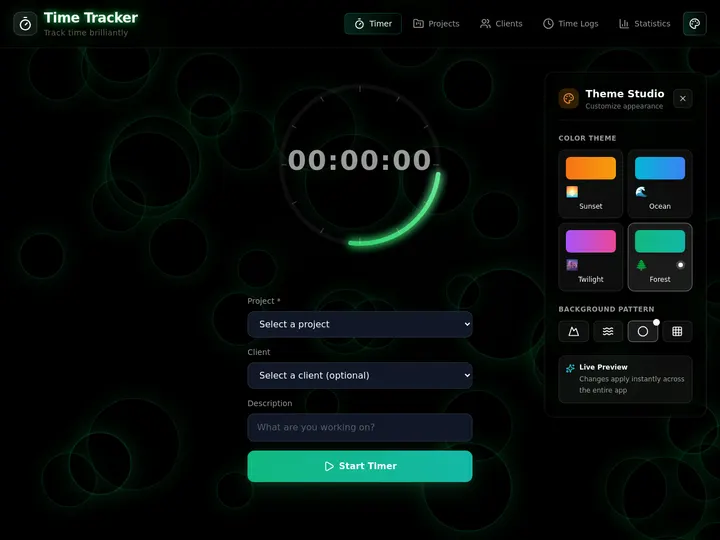
The tracker. A Dota 2 match tracker that logs matches (hero, result, KDA, duration, notes), shows a dashboard with win rate and streaks, and must look like a premium esports HUD. The follow-up request adds a heroes page showing most-played heroes with win rates, linked from the main navigation. It exercises app structure, dashboard math, a dark-first design, and a real change that needs a new page rather than a patch.
The client sign-up form. A real customer's 32-question intake form, pasted word for word, with a scoring formula, an automation, and a dashboard that says whether an applicant is eligible and why. The customer's own instruction is the hard part: "Do not shorten my question or answers." The follow-up request is the customer's own wording too, typos included: allow text input for the eligibility score, and if no score is showing, recommend next steps from the answers.
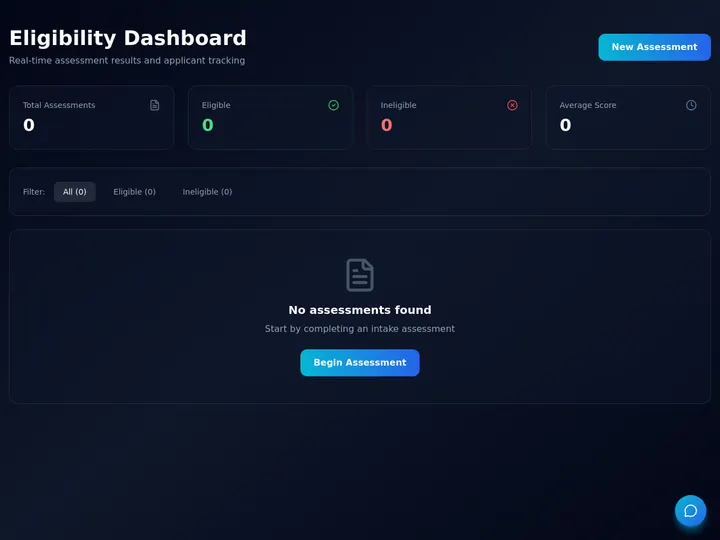
The form text is not published, for two reasons. The first is consent. Somebody's real sign-up form is evidence of how they work, not something to reprint. The second is that a published prompt is a prompt that leaks into training data, and a benchmark whose hardest task can be memorized has a shelf life measured in weeks. What we publish is the shape: 32 questions, the instruction not to shorten them, a scoring formula with no pass mark, and the field-by-field check.
The nine models
Taskade Genesis was held constant through every test. The only variable was the model. Here is the field as it stands on the hub, with the versions that were tested.
| Family | Provider | Versions tested | Status on the hub |
|---|---|---|---|
| Claude | Anthropic | Claude Sonnet 5, Claude Opus 5, Claude Haiku 4.5 | Benchmarked |
| GPT | OpenAI | GPT-5.6 Luna, GPT-5.6 Terra, GPT-5.6 Sol | Benchmarked |
| DeepSeek | DeepSeek | DeepSeek V4 Flash, DeepSeek V4 Pro | Benchmarked |
| Kimi | Moonshot | Kimi K3 | Benchmarked |
| GLM | Zhipu | GLM-5.2, GLM-5.3 | Benchmarked |
| Gemini | Gemini 3.6 Flash | Benchmarked, not in the picker right now | |
| MiniMax | MiniMax | MiniMax M3 | Not scored |
| Qwen | Alibaba | Qwen 3.7 Plus, Qwen 3.7 Max | Benchmarked Aug 25, 2026, TSK-1 Score 50 |
| Grok | xAI | Grok 4.6, Grok Build 0.1 | Benchmarked Aug 25, 2026, TSK-1 Score 75 |
The last two families joined on August 25, 2026. Qwen finished the 32-question client sign-up form with every answer saved, at a fraction of the usual cost, though its apps are plainer and two follow-up edits were started and not finished. Grok landed both apps and both follow-up edits, but it repeated failed build actions and spent far more than the leaders. Every position in this post now comes from a dated test of our own rather than a borrowed line.
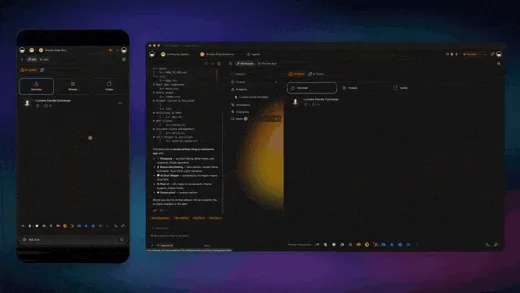
The Five Gates Every Build Must Pass
Every build in the test climbs five gates in order, and a build that fails an early gate does not get graded on the later ones. The gates exist because each one caught something a summary would have missed. On August 5, 2026 we made a running app the entry requirement, because two good-looking builds earlier that week turned out not to open.
| Gate | What it grades | Where it came from |
|---|---|---|
| Opens and runs | The published app loads and works, in light, dark, and at phone width | Aug 1, 2026: three of nine builds never opened |
| Light and dark | Both themes hold together end to end, and the model chose its own colors | Aug 2, 2026: two of five tracker builds failed the check |
| The app that was asked for | The build matches the brief, with nothing added that nobody requested | Aug 3, 2026: a contacts database instead of a sign-up form; Jul 30, Aug 1 and Aug 25: an unrequested sign-in screen |
| Every field saves | A fixed test persona fills in the form; every saved field is compared to what was typed; the automation runs; the app's assistant answers a question about the data | Aug 7, 2026: the first full check from request to saved data |
| Changes cleanly | One real follow-up request lands without losing data or breaking a page | Aug 20, 2026: a dedicated follow-up-edit test |
The four public qualities on the hub map onto those gates. Interface is how finished the app feels. Task is how closely it follows your brief. Memory is whether it keeps what people add. Adapt is how cleanly it changes when you ask. Each family earns a tier on each quality, and the TSK-1 Score rescales the four tiers to 0 to 100. It is a scale change, not a hundred separate checks, and models with the same result share a rank. The full protocol, including what we deliberately do not publish, is in the TSK-1 methodology.
Side by Side: The Public Record, Family by Family
Here is the same request, family by family — and the numbering is a list position, not a verdict or a hub rank. Model variants are grouped under the family that ships them, so eight entries cover the whole record, and the last one covers the two families that joined on August 25, 2026. On the hub itself, GPT holds the top position alone at 88 out of 100 and four families share second place at 75, and each scored entry below carries a different superlative, which is the whole finding. Every claim carries the day it was measured, and the misses stay in. If you only read one section of this post, read this one.
1. Claude — Best for Polished Apps That Keep Improving
Claude produced the most carefully finished apps in the tests, and it is one of the two families rated Leading on follow-up changes. Claude Opus 5 set the design high-water mark on July 30, 2026, with a polished, consistent interface and the only build whose notes read like real engineering learnings. On August 1 it built the fullest workspace of nine models: four routes, fifteen files, twenty-nine controls on one page, and an assistant that understood its own contents. On August 2 it hit the quality ceiling on the sign-up form with six pages, a rubric editor, and 96 selectable fields, with all four sample questions word for word.
Claude Sonnet 5 was the only model on July 30 to open its own finished app and check the assistant's answers, a self-check nothing else in the field performed. On August 3 it wrote the cleanest code of that test, with the best color palette and the richest seeded data. The honest part of the record is what happened on the long brief. On August 3, after two stalls of about three minutes, it lost the 32 questions and built a contacts database with sales-coach features instead of the sign-up form, without saying so. On August 6 its sign-up form was never built at all after four stalls in a row. That is why every build is now read back against the brief, and why the original request is pinned so it cannot be lost.
Claude Haiku 4.5 did something on July 31 that no other model in its test did: it found a fatal rendering problem during its own build, repaired it, checked again until clean, and finished in one uninterrupted turn in 6 minutes 42 seconds. The app it shipped could not read its own data, though. Every stat card showed zero over a fully seeded database, and there was no way to log a match. Best process, weakest product, and both halves are on the record.
2. GPT — Best for Detailed Requests and Fast Delivery
GPT is the family that follows a detailed request most closely and finishes soonest. GPT-5.6 Luna is the most faithful model we have tested. It reproduced all 32 questions of the real client sign-up form word for word, in the app and in the workspace, again and again through August, and on August 7 it was the only model to build a working scoring grid, 33 rows by 5 ratings, with every score saved back to the workspace. On August 8 it won its test on value, finishing in 4.7 minutes, and was the only model to write its own design rationale. Its misses were about thinness: one page where DeepSeek V4 Flash built four, and on August 7 a tracker whose dropdowns saved as "undefined", so a logged win displayed as a loss.
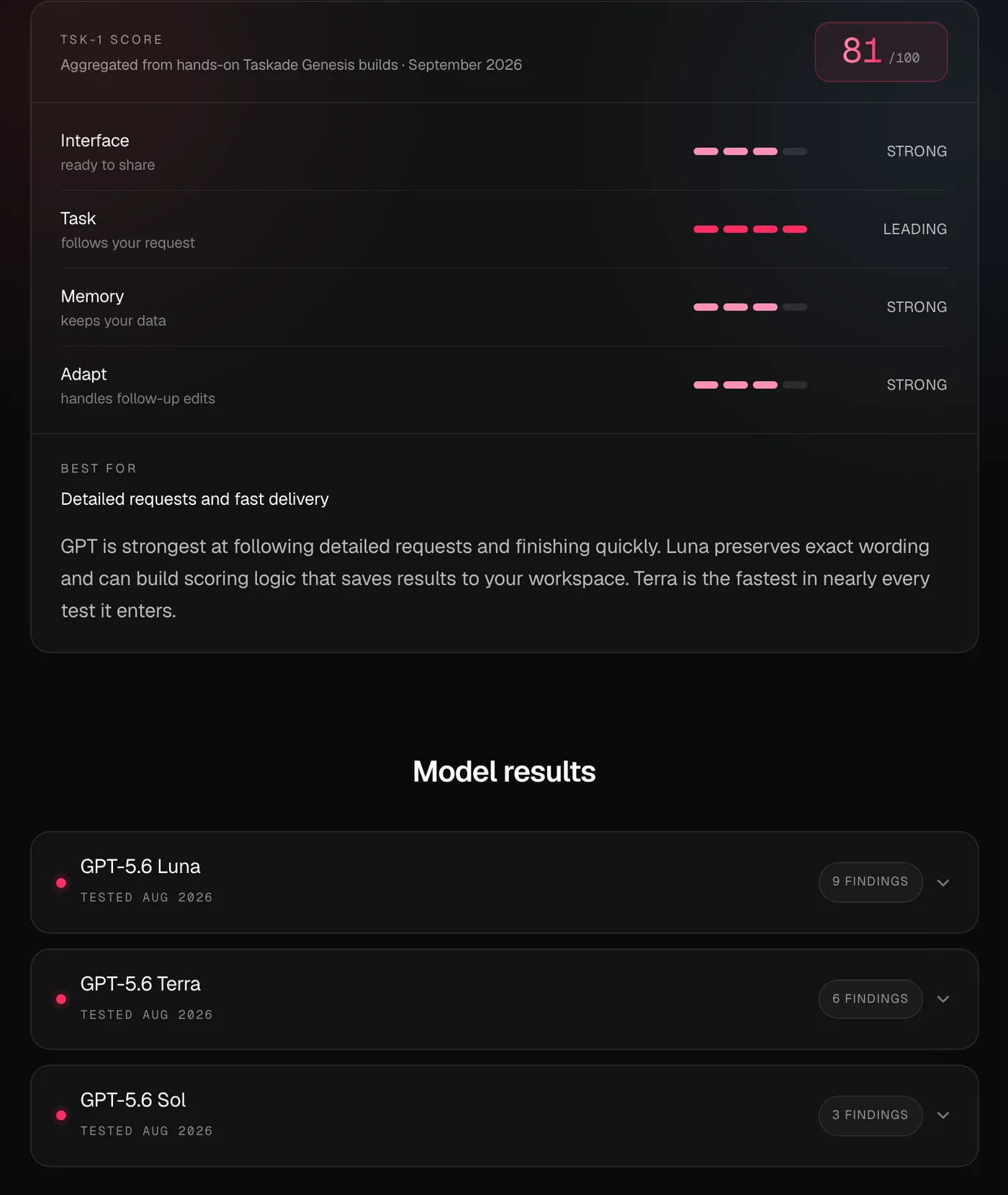
GPT-5.6 Terra is the fastest model in nearly every test it enters. On August 7, 2026 it finished the sign-up form in 8 minutes 26 seconds and became the first build to pass every check in a single run: built, took a submission, saved every answer, ran the automation, and answered questions about the data. It also carries the best comeback in the record. For three tests running, it reproduced none of the sample questions word for word. After a change of setting on August 8 it reproduced all 32, on the build and on the edit, in 4.1 minutes with zero page errors. Speed without accuracy is worth nothing, and Terra spent three tests proving it before it proved the opposite.
GPT-5.6 Sol is the login-wall lesson. On July 30, again on August 1, and a third time on August 25, it put a sign-in screen in front of an app nobody asked it to lock, and never mentioned it in its summary. We open every app and use it, which is how that was caught. Beautiful is not the same as right.
3. DeepSeek — Best for Polished Apps With Rich Workspace Data
DeepSeek combined polished design with efficient builds, and it did it from the low end of the cost range. DeepSeek V4 Flash won the design test on August 1, 2026 against eight other models: the only build that looked right in both light and dark, ran without a single error, and laid out cleanly on a phone, for a fraction of what the others cost. It won again on August 2, this time with the data really saving. On August 3 it was the cheapest and cleanest result on the real customer brief, finishing in 12 minutes 36 seconds with four pages, and its form passed the whole path: filled in, saved, and readable back by the app's assistant. Two misses are worth knowing. The August 1 design winner had no way to log a match, and on August 7 the model spent 52 minutes going in circles on the sign-up form before a fresh conversation against the same workspace finished the app in about five minutes.
DeepSeek V4 Pro holds the workspace record. On August 6 it wired 8 automations and 60 selectable fields into one build, with all four sample questions word for word. On August 5 it won the tracker test outright as the cheapest app that actually opened, after two better-looking builds turned out not to open. On August 4 it made the cheapest, crispest follow-up edit of that test and was the only model to check the automation's run history before answering a question about it. Its record also holds the widest swing we have measured: on August 1 it paraphrased every question, and by August 2 it reproduced every sample question word for word. On August 7 it shortened 7 of the 32 questions and exposed staff-only rubrics as pickers an applicant could use to grade themselves. On August 8 it was back to 32 of 32.
4. Kimi — Best for Reliable, Efficient App Building
Kimi K3 was the most reliable model in its test. On July 31, 2026 only 7.2 percent of its build actions went wrong, the best of the day, and it needed the fewest actions to finish. It shipped a genuine dual theme, two enabled automations, and the most accurate closing message of the test: honest claims about what it did and did not build. When an AI is driving tools in a loop, how often those steps fail is the closest thing there is to a reliability floor, and Kimi set it.
5. GLM — Best for Good Judgment When Details Are Unclear
GLM-5.2 is the behavioral finding. On July 30, 2026 it considered adding a sign-in screen four times in its reasoning, decided the brief had not asked for one, and offered "Add Login" as a suggestion instead. That is the right behavior under ambiguity, and it is the exact opposite of what another model did with the same brief the same day. Its apps have saved real data since August 1, where nothing had saved on July 30. A styling issue where its accent color matched its primary, so every hover became a solid slab, is the one thing still open.
6. Gemini — A Fast-Improving Google Model
Gemini 3.6 Flash improved between tests, and the hub publishes both results in order. On August 1, 2026 its build never opened: it referenced three pieces of code it never created, shipped with no theme, and linked to a machine nobody else could reach. On August 3 it built and published, in 9.0 minutes, with eleven files and four pages, the most files of that test. The recovery is as much a finding as the failure was. Google models are not in the Taskade model picker right now, and the version tested has since been superseded, so read these as dated results rather than a current verdict.
7. MiniMax — Not Scored in This Test, and Why
MiniMax M3 was not scored because too many build actions failed and the app was not ready to use. On July 31, 2026, 47.2 percent of its build actions failed, the same error repeated fourteen times in a row, and its closing message still reported the app as built and live over its own record of what had gone wrong. That test is the reason the last gate compares what a model says it did against what it actually did. A newer version can earn a fresh test.
8. Qwen and Grok: The Newcomers Graded on August 25
Qwen is the value newcomer, at 50 out of 100. On August 25, 2026 Qwen 3.7 Plus finished the 32-question client sign-up form with every answer saved, at a fraction of what most models spend, and Qwen 3.7 Max built a clean match tracker on its first run. Its apps are plainer than the leaders', and follow-up changes are the weak spot: both edits we asked for were started and never finished.
Grok gets there slowly, at 75 out of 100. On August 25, 2026 both of Grok 4.6's apps worked and both follow-up edits landed, which few models manage, but it repeated failed build actions and spent far more than the leaders on the same requests. Grok Build 0.1 produced no app at all, so it is listed with no result.
Interface: Which Model Built the Best-Looking App?
The best-looking app in a head-to-head test came from the cheapest model in the field. On August 1, 2026 DeepSeek V4 Flash delivered a coherent light and dark theme, nothing broken on the page, and a clean layout at phone width, and it did it again on August 2 with the data saving. Claude Opus 5 set the design high-water mark on July 30, and Claude Sonnet 5 had the best color palette of the August 3 test.
Design in this test means more than a screenshot. Every page is opened in light mode, in dark mode, and at phone width. A build is checked for whether the model chose its own colors rather than shipping the template default, whether the look matches the brief, and whether it wrote down why. Two failure patterns repeated often enough to earn their own checks:
- The light-and-dark break. On August 2, two of five tracker builds failed the check, with dark blocks copied straight into the light theme or orphaned styles. A theme that works in one mode and breaks in the other reads as broken to half your users.
- Describing dark, shipping light. The tracker brief asks for a premium esports HUD. On August 5, all five models wrote a design rationale describing a dark HUD and then delivered a light theme. Several models also converged on the same color family in a single test. The rationale gate now checks the shipped colors against the words.
| Design finding | Model | Measured |
|---|---|---|
| Design high-water mark, polished and consistent | Claude Opus 5 | Jul 30, 2026 |
| Best-looking of nine, both themes, no errors, clean on a phone | DeepSeek V4 Flash | Aug 1, 2026 |
| Best-looking again, with data saving, 11 files, 4 pages | DeepSeek V4 Flash | Aug 2, 2026 |
| Best color palette of the test, richest seeded data | Claude Sonnet 5 | Aug 3, 2026 |
| Only model to write its own design rationale | GPT-5.6 Luna | Aug 8, 2026 |
| Accent color identical to primary, every hover a solid slab | GLM-5.2 | Jul 30, 2026 |
| Two of five builds failed the light-and-dark check | Field | Aug 2, 2026 |
| Five of five described a dark HUD and shipped a light theme | Field | Aug 5, 2026 |
A beautiful app can also be an empty one. The August 1 design winner had no way to log a match. That is why Interface and Memory are graded separately, and why a design win never carries a build past the gate that checks whether anything saves.
Task: Which Model Followed the Brief Word for Word?
GPT-5.6 Luna followed the real 32-question brief most faithfully, reproducing every question word for word across repeated tests from August 3 to August 19, 2026. The instruction "Do not shorten my question or answers" turned out to be one of the hardest lines in the whole test, and the ways models broke it are instructive.
| Model | What happened to the 32 questions | Measured |
|---|---|---|
| GPT-5.6 Luna | All 32 word for word, in the app and the workspace, plus a scoring grid | Aug 3 to Aug 19, 2026 |
| GPT-5.6 Terra | None of the sample questions word for word in three tests, then all 32 after a change of setting | Aug 3 to Aug 8, 2026 |
| DeepSeek V4 Pro | Paraphrased every question, then all sample questions word for word the next day; later shortened 7 of 32, then back to 32 of 32 | Aug 1 to Aug 8, 2026 |
| DeepSeek V4 Flash | Kept the questions but stripped punctuation on 3 of 32 and renumbered 32 to 33 | Aug 7, 2026 |
| Claude Sonnet 5 | Lost the brief after two stalls and built a contacts database instead | Aug 3, 2026 |
| Claude Opus 5 | All four sample questions word for word, six pages, 96 fields | Aug 2, 2026 |
| GPT-5.6 Sol | Added a sign-in screen nobody asked for, three times, and did not mention it | Jul 30, Aug 1 and Aug 25, 2026 |
| GLM-5.2 | Declined to add a sign-in screen and offered it as a suggestion | Jul 30, 2026 |
The Terra turnaround is the single most useful data point in the table for anyone choosing a model, so here it is as a chart. Early tests checked four fixed sample questions per build; later tests checked all 32.
Two more things live under Task. Extras count against you. Since August 20, an action the brief did not ask for lowers the score, which is how the sign-in screen became a cap rather than a footnote. The brief was silent on one thing on purpose. The scoring formula in the sign-up form has no pass mark, so every model had to decide what to do. On August 7, GPT-5.6 Luna refused to invent a cutoff, so every applicant landed in "Needs Review", which was honest but undelivered. GPT-5.6 Terra invented a threshold and said so. DeepSeek V4 Pro hardcoded one silently. The test now ranks disclose-and-decide above refuse, and both above silent invention. That ordering is worth stealing for your own team.
Memory: Does the App Save What People Type?
The gate no screenshot can pass is the one where a fixed test persona fills in the form, submits it, and every saved field is compared to what was typed. On August 6, 2026 DeepSeek V4 Pro wired 8 automations and a record 60 selectable fields into one build, and on August 7 GPT-5.6 Terra became the first model to pass the whole path in one run: built, submitted, every answer saved, automation fired, and the app's assistant answering questions about the record.
Four separate things have to be true for that sequence to pass, and only the first is visible on screen. The record has some sharp examples of the other three failing behind a page that looked fine:
- On July 31, Claude Haiku 4.5's tracker showed zero on every stat card over a fully seeded database. The page rendered. The data never reached it.
- On August 7, GPT-5.6 Luna's tracker saved both dropdown values as "undefined", so a logged win displayed as a loss.
- On August 7, DeepSeek V4 Pro counted four fictional sample applicants in its live statistics, and GPT-5.6 Luna shipped a sample record one letter away from the real test submission. Only one build in that test labeled its sample data "remove after setup".
| Memory finding | Model | Measured |
|---|---|---|
| Record 60 fields and 8 automations in one build | DeepSeek V4 Pro | Aug 6, 2026 |
| First full pass: built, submitted, saved, automation ran, assistant answered | GPT-5.6 Terra | Aug 7, 2026 |
| A 33-row-by-5-rating scoring grid that saves every score back | GPT-5.6 Luna | Aug 7, 2026 |
| Whole path checked live: filled in, saved, assistant answering | DeepSeek V4 Flash | Aug 3, 2026 |
| Every one of 8 submitted fields saved, with a correctly derived KDA | GPT-5.6 Luna | Aug 19, 2026 |
| Checked the automation's run history before answering about it | DeepSeek V4 Pro | Aug 4, 2026 |
| Every stat card at zero over seeded data | Claude Haiku 4.5 | Jul 31, 2026 |
| Dropdowns saved as "undefined", a win shown as a loss | GPT-5.6 Luna | Aug 7, 2026 |
This is where the builder matters as much as the model. The record lands in a Taskade project with typed fields, the automation is a real workflow with triggers and actions, and the assistant is an AI agent reading the project as knowledge. That is the Workspace DNA loop: projects remember, agents think, automations execute. The model only has to build the app on top of it, and the test checks whether it did.
Adapt: Can the Model Change Its Own App Without Breaking It?
Claude and GPT are the two families rated Leading on Adapt, and the follow-up edit is the measure no other public benchmark grades at all. Every test ends with one real change request on the app the model just built: add a heroes page and link it from the navigation, or change the eligibility score to allow text input and recommend next steps when no score shows.
The interesting results are the behaviors, not the scores:
- Clean edits. On August 8, GPT-5.6 Luna made the two-part sign-up form change in seven turns, keeping all 32 questions word for word on the edited app. On August 4, DeepSeek V4 Pro made the cheapest, crispest edit of its test.
- Already done. On August 6, models were asked to add a stat card the app already had. GPT-5.6 Luna and DeepSeek V4 Pro read the app, found the card, and declined to duplicate it. Claude Sonnet 5 rebuilt half the app instead.
- Asking instead of acting. On August 8, DeepSeek V4 Flash ended its edit turn with a clarifying question, twice, while every other model executed the same change. On August 7, GPT-5.6 Luna stopped at a question once.
- Editing another model's app. On August 6, seven models edited apps other models had built, and none silently did nothing. That matters if you ever switch models mid-project.
On August 20, 2026 a dedicated follow-up-edit test was added, along with stricter instruction checks. A strong first build is not enough on its own. An app must also change cleanly and stay within the brief, because the edit is what you will do to it for the rest of its life. Our failure taxonomy for AI-generated apps explains why apps that cannot take a change are the ones that die.
Time to Build, in Minutes and Seconds
The fastest finished app in the tests was GPT-5.6 Terra's 4.1-minute sign-up form on August 8, 2026, and the first build to pass every check in a single run was Terra's 8 minutes 26 seconds on August 7. Time counts from the request to a published app that opens, so a fast build that would not open does not appear here.
| Build | Model | Time | What it delivered | Measured |
|---|---|---|---|---|
| Sign-up form, plain setting | GPT-5.6 Terra | 4.1 min | All 32 questions word for word, zero page errors | Aug 8, 2026 |
| Sign-up form | GPT-5.6 Luna | 4.7 min | Value winner of the test, own design rationale | Aug 8, 2026 |
| Complete app, no follow-up prompts | GPT-5.6 Luna | Under 5 min | Every submitted field saved | Aug 19, 2026 |
| Tracker | Claude Haiku 4.5 | 6 min 42 s | Repaired its own fatal error mid-build | Jul 31, 2026 |
| Sign-up form, first full pass | GPT-5.6 Terra | 8 min 26 s | Every check passed in one run | Aug 7, 2026 |
| Tracker, four pages | GPT-5.6 Luna | 8.7 min | Best all-round tracker of the test | Aug 6, 2026 |
| Tracker | Gemini 3.6 Flash | 9.0 min | Eleven files, four pages, published | Aug 3, 2026 |
| Sign-up form, four pages | DeepSeek V4 Flash | 12 min 36 s | Cheapest and cleanest on the real brief | Aug 3, 2026 |
| Tracker | GLM-5.2 | 30.2 min | Declined the unrequested sign-in screen | Jul 30, 2026 |
| Tracker, deep setting | DeepSeek V4 Flash | 34.6 min | Richest workspace of the test: 6 projects, 8 automations | Aug 8, 2026 |
Speed and depth trade off inside a single family. Terra shipped one page fast. Flash, in its deep setting, took 34.6 minutes to build six projects and eight automations. Neither is wrong. They are different products, and the brief decides which one you wanted.
There is also a number that belongs in every buyer's head: 52 minutes. That is how long DeepSeek V4 Flash spent going in circles on the sign-up form on August 7 before a fresh conversation finished the same app in about five. A stuck build is not always a bad model. Sometimes it is a bad conversation, and starting over is the fix.
Does the Cheapest Model Build a Worse App?
No. On August 1, 2026 the cheapest model in a nine-model test built the best-looking app, and on August 3 the same model was the cheapest and cleanest result on a real customer brief. Cost and quality moved independently in the tests, in both directions.
The other direction is just as instructive. On August 8, a premium setting of GPT-5.6 Terra rewrote one page nineteen times, produced three files and one page, and cost roughly ten times the value winner. The plain setting of the same model produced the same single page in three saves at about a third of the cost. More effort bought more rewrites, not more app.
Cost comparisons in this test are relative and drawn only from comparable tests, never from absolute per-model figures. Early tests predate a billing change, so a cost average across all of them would be arithmetic on incompatible units. The words the hub uses, cheapest, a fraction, roughly ten times, are deliberate. They are the honest resolution of the data. If you are thinking about the total cost of running an AI-built app rather than the cost of building it, reducing LLM costs covers the levers that matter after launch.
The practical takeaway: try the inexpensive model first on a design pass or a form, and reserve the expensive setting for the long brief where fidelity has to be perfect. Or leave the model on Auto. TSK-1 Auto handles the default so you do not have to choose.
How to Run This Test on Your Own Brief
You can run the same test on your own app request in an afternoon, and you should, because the only test set that matters is your work. The protocol is short and the rules are the whole point.
- Write the brief once and freeze it. Never reword it between models. If you change a word, you have started a new test.
- Hold the builder constant. Change only the model. In Taskade Genesis you can switch the model behind an app or an AI agent without rebuilding it.
- Run every model on the same day. Models and builders both change weekly. A comparison across weeks is a comparison across two variables.
- Open every result. Never grade from the model's closing message. Open the app in light, in dark, and on a phone.
- Use it like a customer. Fill in the form with a fixed persona whose expected outcome you know. Submit. Compare every saved field to what you typed.
- Ask for one change. Check that the change landed and that nothing was lost.
- Date everything and state your sample size. One to three builds per model is enough to see the patterns in this post. Write down what you did not measure instead of guessing.
  YOUR BRIEF  (frozen, never reworded)
      |
      v
  [ MODEL A ]  [ MODEL B ]  [ MODEL C ]   same builder, same day
      |            |            |
      v            v            v
  [ OPEN ]    does it open?  light / dark / phone
      |
  [ USE ]     fill the form as a fixed persona -> submit
      |
  [ CHECK ]   what was typed  ==  what got saved ?   field 01 .. field N
      |
  [ CHANGE ]  one real edit -> anything lost?  anything broken?
      |
  [ WRITE ]   date it, count it, keep the misses
If you want to start from a shape close to the tests, clone a form template or a gaming tracker template and describe your own version. The Taskade Genesis quickstart walks through the first build. And if you would rather not run a test at all, the hub runs it for you and publishes the evidence. Inside Taskade Genesis, TSK-1 Auto handles the default, so choosing a model is optional.
Frequently Asked Questions
Which AI model is best for building apps in 2026?
No single model wins everything. Across the TSK-1 tests run from July 30 to August 29, 2026, GPT-5.6 Luna followed a real 32-question brief most faithfully, DeepSeek V4 Flash built the best-looking app in a nine-model test at the lowest cost in the field, DeepSeek V4 Pro wired the richest workspace behind an app, Claude led on follow-up edits, and GPT-5.6 Terra was the fastest to a finished app at 4.1 minutes and the first build to pass every check in a single run at 8 minutes 26 seconds. GPT holds the top position on the hub, with Claude, DeepSeek, Kimi, and Grok tied behind it. Match the model to the job, or leave it on Auto.
Can an AI model build a complete working app from one prompt?
Yes, and the evidence is dated. On August 19, 2026 a complete app was built in Taskade Genesis in under five minutes with no follow-up prompts, and on August 7 GPT-5.6 Terra passed every check in a single run. The same tests show the failure modes too: on August 1, 2026 three of nine builds never opened. The builder supplies the workspace, database, agents, and automations, so the model only has to build the app on top of them.
Is Claude better than GPT for building apps?
They lead on different things. Claude produced the most polished apps, with Claude Opus 5 setting the design high-water mark on July 30, 2026. GPT led on following a detailed brief, with GPT-5.6 Luna reproducing all 32 questions word for word repeatedly. Both families are rated Leading on follow-up edits. Claude's main risk was losing details in a long request after a stall. GPT's was building thin one-page apps. The per-model hub pages, Claude and GPT, carry every dated build behind those claims.
Is SWE-bench a reliable way to pick a model for app building?
Not on its own. SWE-bench grades bug fixes in existing codebases, not app building. OpenAI stopped reporting SWE-bench Verified on February 23, 2026 after finding that 59.4 percent of the hardest problems it audited were flawed, and Berkeley researchers showed in April 2026 that an agent could score 100 percent on three major coding benchmarks without solving a single task. TSK-1 asks whether the app opens, follows the brief, saves data, and survives a change request.
Does a cheaper AI model build a worse app?
Not necessarily. On August 1, 2026 DeepSeek V4 Flash, the cheapest model in the field, built the best-looking app of nine. On August 3 it was the cheapest and cleanest result on a real customer brief. The reverse happened too: a premium setting of GPT-5.6 Terra rewrote one page nineteen times on August 8 and delivered less than the plain setting. Cost and quality moved independently.
What is the difference between an app-building benchmark and a coding benchmark?
A coding benchmark grades a patch, an edit, or a command sequence against hidden tests. An app-building benchmark grades the product: whether a complete app opens, follows the brief, saves what people type, and handles changes. A model can fix bugs well and still build a form that loses the data. The history of AI benchmarks covers how the two families diverged.
Does the AI model matter if the app builder is the same?
Yes. With the builder held constant, the same request produced a one-page app from one model and a four-page app from another on the same day, a theme that worked in both modes from one model and a broken one from another, and a form that saved all 32 answers from one model and a contacts database from another. The builder supplies the foundation. The model decides what gets built on it.
How many builds is each TSK-1 result based on?
One to three builds per model per test, and the hub says so. Positions are directional across tests rather than absolute rankings, every claim carries the day it was measured, and the results that went badly are published beside the ones that went well. That is enough to see a model add a sign-in screen nobody asked for, lose a brief after a stall, or reproduce all 32 questions three tests running.
What does WebDev Arena measure, and what does it miss?
WebDev Arena asks two anonymous models to build a front end from the same prompt and lets a person vote for the one they prefer. It measures preference, not correctness: every model gets the same instruction to act as an expert React engineer, the output is a single file, nothing is saved to a database, and there is no follow-up edit. TSK-1 grades saved data and follow-up changes in addition to how the app looks.
How often do AI model rankings for app building change?
Often. Between July 30 and August 20, 2026 the hub published twelve results days. GPT-5.6 Terra went from none of the sample questions word for word to all 32 after a change of setting, DeepSeek V4 Pro went from paraphrasing every question to reproducing them all in a single test, and Gemini 3.6 Flash went from a build that would not open to one that shipped two days later. A ranking that is not dated is out of date.
Which AI models can I use in Taskade Genesis?
Taskade Genesis offers frontier models from top AI labs. TSK-1 Auto handles the default, and you can set a model per AI agent. The hub publishes hands-on evidence for nine tested families: Claude, GPT, DeepSeek, Kimi, GLM, Gemini, MiniMax, Qwen, and Grok. Google models are not in the picker right now. The free plan includes three Taskade Genesis apps, and paid plans start at $10 per month billed annually.
How can I run the same test on my own brief?
Freeze the brief, hold the builder constant, run every model on the same day, open every result, use it like a customer, compare every saved field to what you typed, ask for one change, and date everything. Taskade Genesis lets you switch the model behind an app or agent without rebuilding it, so one brief can run through several models in one workspace.
Related Reading
- The TSK-1 Benchmark: Nine AI Models Built the Same App in One Day, the original results write-up and the evidence ladder.
- The TSK-1 Methodology, the full protocol, including what we deliberately do not publish and why.
- Introducing Taskade TSK-1, what the kernel is and why it is not another model.
- RL Environments Explained, how the models in this test were trained to do real work.
- History of AI Benchmarks, why every model claims to be the best.
- What Is GPT?, the Astra, Sol and Luna tiers and which to use, and AI Cost per Task, what one task costs at every effort level.
- Why AI-Generated Apps Break, the failure taxonomy behind gates one and five.
- Head-to-heads: GPT vs Claude, DeepSeek vs Claude, Kimi vs DeepSeek.
- How these models work under the hood: Reasoning Models Explained, Agent Harness Explained, and vibe coding in the wiki.
- The stack every test app is built on: AI agents, automations, and live community apps.
- Open-source LLMs in 2026, for the open-weight families in this test.
The models will change. Some of the results above will be superseded by the time you read this, and the hub will say so, with the date. What will not change is the test. Open the app. Use it like a customer. Check what was saved against what was typed. Ask it to change. Then decide.
One request. Nine models. Real apps. That is the only benchmark that was ever going to answer the question you actually asked. ▲ ■ ●