Is GPT better than Claude?
Neither replaces the other, because GPT and Claude lead on different dimensions. GPT leads on platform breadth (Custom GPTs, Sora, voice mode, Atlas browser), on reach with 500M+ weekly active users, and on the broadest developer ecosystem. Claude leads on Constitutional AI safety, long-form writing quality, and Claude Code's terminal-native agent. In TSK-1, GPT-5.6 Luna stuck closest to the customer's words, and Claude Sonnet 5 wrote the cleanest code we measured (Aug 3, 2026). Route per task rather than standardizing on one.
What TSK-1 Found
GPT-5.6 Luna (TSK-1, Aug 2026) sticks closest to your words: from early through mid-August it rebuilt what the customer asked for word for word and laid out neatly structured scoring rubrics. GPT-5.6 Terra is the fastest we have measured (Aug 7, 2026 - the first build where everything worked start to finish). Claude Sonnet 5 wrote the cleanest code we measured (Aug 3, 2026). Those were TSK-1 test runs from summer 2026. Claude is not selectable on Taskade credits today. The honest caveat: on Aug 3, 2026 Claude lost track of the customer's 32-question client sign-up form partway through and built a CRM instead. It never got back on track, and that is exactly why TSK-1 tests whether a model recovers, not just whether it can be right.
- GPT: From early through mid-August it followed the customer's wording most closely, word for word; and on Aug 7, 2026 it was the first to reach a build where everything worked start to finish.
- Claude: Aug 3, 2026 — the cleanest code we have measured; and in the same test it lost track of the customer's sign-up form mid-build and shipped the wrong app, which is why TSK-1 tests whether a model recovers.
See the full evidence at /tsk/gpt, /tsk/claude, and the TSK-1 hub.
The Headline
GPT and Claude defined the consumer AI race from 2023 to 2026. They are now neck-and-neck on quality benchmarks and diverging sharply on product strategy.
- GPT (OpenAI) is the platform play. 500M+ weekly active users, the Sora video model, voice mode, Atlas browser, the broadest Custom GPTs marketplace, and the deepest developer ecosystem. Choose GPT when you need reach, multimodal breadth, or the largest plugin / Custom GPT library.
- Claude (Anthropic) is the safety + coding play. Constitutional AI, Claude Code (terminal-native agent), Claude Cowork (desktop), Agent Teams, Computer Use. Choose Claude when you need long-form writing quality, code-agent reliability, or a documented safety posture.
Neither replaces the other. The 2026 best practice is to use both routed per task. Taskade Genesis routes frontier models from top AI labs with Auto, and Claude joins on your own Anthropic key.
TL;DR: GPT leads on breadth and reach. Claude leads on Constitutional AI safety, Claude Code agents (4% of GitHub commits), and long-form writing. ChatGPT Plus and Claude Pro both list $20/mo month-to-month, but ChatGPT starts at Go $8 with no annual billing, while Claude discounts to $17/mo billed annually. Taskade Genesis routes frontier models from top AI labs, and Claude joins on your own Anthropic key.
Two Different Founder Bets
Both companies were founded on the same conviction (AI is transformative). They diverged on what to do about it.
- OpenAI stayed on the capability-first scaling curve. Microsoft partnership, GPT-3 → GPT-4 → GPT-5 → GPT-6, Sora, voice mode, the consumer ChatGPT product. Mission: AGI by raw scale + tooling.
- Anthropic spun out in 2021 with a safety-first thesis. Constitutional AI, smaller deliberate model releases, focus on documented behavior. Mission: safe AGI through interpretability and Constitutional AI.
Both raised ~$60-80B in cumulative funding. Both are valued in the hundreds of billions. Both have shipped category-defining products. Different bets, both winning.
Architectures & Safety: Where the Real Difference Lives
Most listicles compare GPT and Claude on benchmark scores alone. The deeper difference is how each model is trained to behave.
OpenAI's approach: RLHF + Model Spec + Preparedness Framework
- Train on broad data, then refine through Reinforcement Learning from Human Feedback (RLHF)
- Publish a Model Spec document describing intended behavior
- Run a Preparedness Framework evaluating catastrophic-risk scenarios (CBRN, persuasion, model autonomy)
- Release new tiers as scale and tooling allow
Anthropic's approach: Constitutional AI + Responsible Scaling Policy
- Train the model against a written Constitution (now 23,000 words, up from 2,700 in 2023)
- Use the Constitution as a self-critique training signal (the model evaluates its own outputs against the principles)
- Publish Responsible Scaling Policy (RSP) levels (ASL-1 through ASL-4+) defining capability thresholds
- Invest heavily in mechanistic interpretability (reverse-engineering neural networks)
For most consumer chat tasks the visible difference is small. For compliance-sensitive contexts (legal, medical, financial, brand-safety), Claude's documented Constitutional AI plus ASL levels is the more externally-citable safety story. For pure reach and ecosystem, OpenAI's platform play wins.
Benchmarks: Where Each One Wins
May 2026 published scores from each provider (GPT-5.5 vs Claude Opus 4.7, a historical snapshot). Treat as direction.
Benchmark                    GPT-5.5         Claude Opus 4.7      Winner
─────────────────────────────────────────────────────────────────────────────────
SWE-bench Verified           88.7%           87.6%                GPT (margin)
GPQA Diamond                 92.0%           91.3%                GPT (margin)
MMLU-Pro                     88.0            89.5                 CLAUDE (margin)
LMSYS Arena Coding Elo       ~1490s          1561 (first >1500)   CLAUDE
Long-form writing quality    strong          strongest            CLAUDE
Image generation reasoning   ✓ DALL·E + Sora 2   text-to-image (partner) GPT
Voice mode                   ✓ realtime API  Cowork voice         GPT (margin)
Multi-step terminal agent    Operator        Claude Code (lead)   CLAUDE
Custom-tool marketplace      Custom GPTs     Skills + MCP         GPT (breadth)
Computer Use                 limited         ✓ flagship           CLAUDE
Safety posture documented    Model Spec      Constitutional + RSP CLAUDE
Consumer reach (MAU)         500M+ ChatGPT   strong, growing      GPT
API list price per 1M        see note *      $5 in / $25 out      see rate card
Consumer $20 rung            Plus $20/mo     Pro $20/mo m2m       tied
* This snapshot predates the GPT-6 family. OpenAI's GPT-6 lineup (September 2026) lists Astra at $10 in / $50 out, Sol at $2 / $10, and Luna at $0.10 / $0.50 per 1M tokens. Price your own workload against OpenAI's current page before you commit.
Industry context: A May 2026 IDC and Augment Code study found that organizations using a single LLM for all tasks overpay by 40 to 85% compared to those using intelligent routing across 3 or more models. The math is in the routing, not the model.
Pattern: GPT wins on platform breadth, multimodal, and reach. Claude wins on agentic coding, writing, and safety posture. They are close on raw benchmarks. They are far apart on product strategy.
Product Lineups: A Side-by-Side Map
| Surface | OpenAI ships | Anthropic ships |
|---|---|---|
| Chat | ChatGPT (web, mobile, desktop) | Claude.ai (web, mobile, desktop) |
| Image generation | DALL·E + Sora 2 (video) | partner-routed |
| Voice | Voice Mode (realtime API) | Cowork voice |
| Terminal agent | Operator | Claude Code (4% of GitHub commits) |
| Desktop agent | ChatGPT Desktop + Companion | Claude Cowork + Skills + MCP |
| Browser | Atlas | n/a (use Cowork browser tools) |
| Coding assistant | Custom integrations | Claude Code Agent Teams |
| Custom tools | Custom GPTs marketplace | Skills + MCP marketplace |
| Enterprise | ChatGPT Enterprise | Claude Enterprise |
| API | OpenAI API + AgentKit | Anthropic API + Claude Code SDK |
Two ecosystems with deliberate overlap. Both ship a chat surface, a desktop surface, a coding surface, and an enterprise tier. The product strategy difference is which surface each lab prioritized first (OpenAI: consumer chat + multimodal first; Anthropic: terminal coding + safety first).
When to Pick Each
In practice you do not pick once. The 2026 pattern is mixing both per task.
The routing matrix, with the cost consequence attached
Most head-to-heads stop at "which is better". The useful version adds a third column: what the choice does to your bill. Claude's per-million-token list prices are published, so the cost side of every Claude row below is a real number rather than a vibe.
| Task | Reach for | Why | Cost consequence |
|---|---|---|---|
| Long-context reasoning over a whole repo or document set | Claude, Opus tier | Handles the full 1M window, and Anthropic bills it at standard rates | $4 in / $20 out per 1M (Opus 5.5) - no long-context premium to budget for |
| Agentic coding, multi-step terminal work | Claude, Sonnet tier | Claude Code is the most mature terminal-native agent surface | $2 in / $10 out per 1M (Sonnet 5.5) |
| Cheap high-volume classification, routing, extraction | Claude, Haiku tier | Fastest and cheapest rung that still gets simple jobs right | $1 in / $5 out per 1M — a fifth of the Opus tier |
| Peak-quality single answers where nuance is the product | Claude Fable 5.1 | Anthropic's highest published rung | $10 in / $50 out per 1M - 2.5x the Opus 5.5 tier |
| Image and video generation | GPT | DALL·E and Sora are first-party; Claude routes image generation to partners | Consumer plan covers it; API cost not quoted here (see note above) |
| Realtime voice | GPT | Voice Mode and the realtime API are the mature surface | Consumer plan covers it |
| Broadest plugin / custom-tool marketplace | GPT | Custom GPTs is the larger public library | Included in Plus at $20/mo month-to-month |
| Multilingual and vision inside an existing workflow | either | Both are strong; the tie-breaker is what the rest of the pipeline already runs on | Whichever tier you already pay for |
| On-prem or self-hosted | neither | Both are hosted-API only | Open-weight models are the only route here |
Two things fall out of that table. First, the gap between Claude's own tiers ($1/$5 Haiku to $10/$50 Fable is a 10x spread) is wider than most quality gaps between the two labs — so tier discipline inside one vendor usually saves more than switching vendors. Second, price per token is not price per page: Claude 4.7 and later use a newer tokenizer that emits roughly 30% more tokens for the same text, so a rate-card comparison against another lab understates Claude's real cost per document. Price your own corpus before you commit.
Pricing: The Same $20 Rung, Two Different Ladders
Both ladders pass through $20/month. They diverge sharply above and below it, and only one vendor discounts for annual commitment.
| Tier | OpenAI ChatGPT | Anthropic Claude |
|---|---|---|
| Free | ✅ Yes (ads being tested on Free and Go in the US) | ✅ Yes, "free for everyone", usage limits apply |
| Entry paid | Go $8/mo | Pro $20/mo month-to-month |
| The $20 rung | Plus $20/mo | Pro $20/mo month-to-month |
| Annual billing | 🔴 None — OpenAI publishes no annual rate on any tier | Pro $17/mo billed annually, stated as $200 up front |
| Power user | Pro at two rungs, $100/mo and $200/mo | Max from $100/mo (choose 5x or 20x Pro usage) |
| Team | a team tier exists; per-seat price not verified for this update | Standard seat $25/mo month-to-month or $20 billed annually; separate Premium seat $125/mo ($100 annually) |
| Enterprise | Custom | Seat price plus usage at API rates |
| API | per token | per token, published rate card |
Two corrections worth making explicit, because both are widely mis-stated. ChatGPT's entry paid tier is Go at $8, not Plus at $20, and ChatGPT Pro is two distinct price points rather than a $100-to-$200 range. On the other side, Claude Max is published only as "from $100 per month" — Anthropic discloses the 5x and 20x usage steps but not a dollar figure for the upper one, so any "$100 to $200" Max range you see quoted elsewhere is inferred, not first-party.
Claude's published API rate card, per 1M tokens
| Rung | Input | Output |
|---|---|---|
| Claude Fable 5.1 | $10 | $50 |
| Opus 5.5 | $4 | $20 |
| Sonnet 5.5 | $2 | $10 |
| Haiku 4.5 | $1 | $5 |
Batch requests are 50% off in both directions, and a cache read on Opus 5.5 and Sonnet 5.5 bills at $0.20 per 1M input tokens. Sonnet kept its $2 / $10 price: the planned step-up to $3 / $15 did not happen. Opus 5 launched at $5 / $25 in July and Opus 5.5 lowered it to $4 / $20.
Taskade Genesis routes across frontier models from top AI labs with Auto (billed annually: Free $0, Pro $10, Business $25, Max $100, Enterprise $250 per month). The AI allowance comes with the subscription rather than as a separate consumer subscription per vendor, and cost shows in the tooltip per option. Claude runs on your own Anthropic key and bills to your Anthropic account.
The Taskade Genesis Angle: Workspace DNA for Both
Most listicles end with "pick one." This one ends with use both inside one workspace.
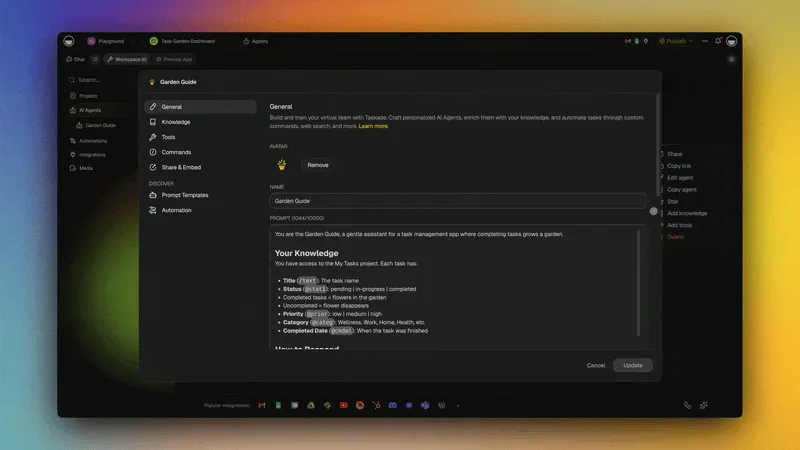
Taskade Genesis offers frontier models from top AI labs, and the model picker shows credit cost per option. Auto mode handles routing. Override per agent or per step. Claude runs in Taskade on your own Anthropic key through the Anthropic Claude connector or through BYOK for agents, both on Pro and up.
Workspace DNA wraps both:
▲ Memory       Projects, documents, customer records, knowledge graph
■ Intelligence AI Agents that pick the best model per task
               GPT for image / voice / Custom GPT-style tools
               Claude (your own Anthropic key) for code / writing / safety-critical
               Open-source for routine high-volume steps
● Execution    100+ bidirectional integrations, durable automations
Five 2026 patterns that work right now.
✓ GPT for image generation, Claude for the rest. Use GPT in image-generation steps for DALL·E quality. Use Claude for the surrounding reasoning and writing.
✓ Claude for code, GPT for voice. A Claude-powered code-edit tool connects to your workspace through the Taskade MCP Server. A voice-based agent on top runs through GPT.
✓ Claude Cowork + Taskade workspace. Cowork edits files on your machine. Taskade Genesis runs the deployed app that uses those files. MCP connects them.
✓ Claude for long-form, GPT for chat-style. An automation calls Claude Opus 5.5 on your own Anthropic key (Anthropic Claude connector) for the polished output. A customer-facing chatbot uses GPT for the conversational quality and reach across languages.
✓ Auto mode for everything else. Set Auto mode as the default on new agents. Taskade Genesis routes per task and adapts as new model versions ship.
See 10 Best Open-Source AI LLMs in 2026 for the open-source picks that complement both GPT and Claude.
Where Both Are Heading
A short look at the 2026 → 2027 roadmaps.
OpenAI's bets
- Stargate $500B infrastructure buildout for compute scaling
- Sora 2 video generation as a consumer surface
- Atlas browser as the agentic entry point
- Custom GPTs and AgentKit as the developer platform
- GPT-5 → GPT-6 scaling on the assumption that bigger still wins
Anthropic's bets
- Claude Code Agent Teams scaling agentic coding across enterprise
- Claude Cowork + Skills marketplace scaling desktop AI for non-technical users
- Computer Use + Claude Mythos as the embodied / agentic interface
- Mechanistic interpretability as the long-term safety moat
- Project CASH ("Claude is Growing Itself") as the recursive scaling bet
Where Taskade Genesis fits
Taskade Genesis is built for the multi-model reality both labs are creating. As GPT and Claude diverge further on product strategy, the workspace that routes across labs becomes more valuable, not less. Workspace DNA (Memory + Intelligence + Execution) provides the substrate. The model picker provides the choice. The agents and automations provide the workflow.
Read the deep histories for context:
- Anthropic Claude History 2026: Claude AI, Constitutional AI, Sonnet 4.6, Opus 4.6, Agent Teams, Cowork
- What is OpenAI?: ChatGPT, GPT-5, Sora, the platform play
Frequently Asked Questions
Is GPT or Claude better in 2026?
They lead on different dimensions. GPT leads on platform breadth (Custom GPTs, plugins, Sora, voice mode, Atlas browser), reach (500M+ weekly active users), and the broadest developer ecosystem. Claude leads on Constitutional AI safety posture, long-form writing quality, code reasoning conversations, Claude Code's terminal-native agent surface, and Computer Use. Taskade Genesis runs frontier models from top AI labs with Auto, and Claude runs there on your own Anthropic key, so you can route per task without committing to one ecosystem.
Which is more accurate, GPT or Claude?
The accuracy gap is now under 5 percentage points on most public benchmarks. Both score in the high 80s to low 90s on GPQA Diamond. Both score in the high 70s to low 80s on SWE-bench Verified. The right question is not which is more accurate overall, but which is more accurate at the specific job. Claude Opus tier wins on long-form writing nuance and PR-style code review. GPT tier wins on real-time web context, image generation reasoning, and multi-modal tasks like Sora video. Inside Taskade Genesis, Auto routes per task and avoids the average.
How do GPT and Claude differ in safety approach?
OpenAI uses Reinforcement Learning from Human Feedback (RLHF) with published model behavior documents, red-team evaluations, and the Preparedness Framework. Anthropic uses Constitutional AI (CAI), where the model is trained against a written constitution (23,000 words as of 2026) of principles, then self-critiques its outputs. Anthropic also publishes Responsible Scaling Policy (RSP) levels (ASL-1 through ASL-4+) defining which capability thresholds require which safety demonstrations. For organizations where safety posture matters as a compliance or brand requirement, Claude's Constitutional AI is the more documented and externally-cited approach.
How much do GPT and Claude cost compared?
As of August 2026, ChatGPT is Free, Go $8 per month, Plus $20 per month, and Pro at two separate rungs of $100 and $200 per month. Every one of those is month-to-month because OpenAI publishes no annual billing on any tier. Claude is Free, Pro at $20 per month month-to-month or $17 per month on the annual plan ($200 billed up front), Max from $100 per month, and Team at $25 per seat month-to-month or $20 per seat billed annually, with a separate Premium seat at $125 monthly. The two ladders only meet at the $20 rung. Taskade Genesis routes across frontier models from top AI labs with Auto, and the AI allowance is included in the subscription. Claude runs in Taskade on your own Anthropic key, billed by Anthropic.
How do I choose between GPT and Claude for a given task?
Route by task rather than by loyalty, and read the cost consequence alongside the quality one. Reach for Claude's Opus tier on long-context reasoning and safety-sensitive review, its Sonnet tier for agentic coding and everyday drafting, and its Haiku tier for high-volume classification where the cheapest correct answer wins. Reach for GPT when the job needs image or video generation, realtime voice, or the Custom GPT ecosystem. Anthropic's published API list prices run from $10 in and $50 out at Fable 5.1, $4 in and $20 out at Opus 5.5, and $2 and $10 at Sonnet 5.5, down to $1 and $5 at Haiku 4.5 (see Claude models explained), so the tier you pick inside one lab often moves the bill more than the lab you pick.
Can I use GPT and Claude together inside Taskade Genesis?
Yes. Taskade Genesis runs frontier models from top AI labs, with TSK-Auto as the default. Built in, with no key, paid plans can pick OpenAI GPT models, xAI Grok and open-weight models such as DeepSeek, Qwen, Kimi and GLM. On Pro and up, you can bring your own OpenAI, Anthropic or Google Vertex AI API key (BYOK), so Claude runs in your agents on your own Anthropic account. In automations, the Anthropic Claude connector runs Claude on your own key on Pro and up. Model lineup as of October 2026. A common 2026 pattern is one lab for writing, another for image and web tasks, and an open-weight model for bulk steps.
Which has better agent capability, GPT or Claude?
Both ship strong agent surfaces. OpenAI provides Custom GPTs with Actions and the AgentKit for developer-defined agents. Anthropic provides Claude Code (terminal agent), Claude Cowork (desktop GUI agent), Agent Teams (multi-Claude orchestration), and Computer Use. For terminal coding agents, Claude Code leads. For consumer Custom GPTs marketplace breadth, OpenAI leads. Inside Taskade Genesis, AI Agents v2 ship with a large built-in toolkit and run on the models Taskade routes, with Claude available on your own Anthropic key for agents on Pro and up.
Is Claude Code better than GPT for coding?
For terminal-native multi-step coding agents, Claude Code leads in 2026. Anthropic reports approximately 4% of all public GitHub commits are authored by Claude Code, and Anthropic's own engineers report a 67% increase in merged pull requests per day. For IDE-native inline completion, GitHub Copilot leads (which can be powered by Claude or GPT under the hood). For long-form architecture conversations, Claude Sonnet and Opus lead. For ChatGPT-style code chat, GPT is excellent. Most engineers in 2026 use both.
What about Claude Cowork vs GPT desktop?
Claude Cowork (launched January 2026) is Anthropic's desktop GUI for non-technical users with file access, browser automation, code execution, and a reusable Skills system. ChatGPT Desktop (launched 2024) is OpenAI's macOS and Windows app with Companion mode, Custom GPTs, voice, and screen vision. They target overlapping audiences with different surface designs. Cowork emphasizes Skills as reusable workflows. ChatGPT emphasizes Custom GPTs and the OpenAI ecosystem. Inside Taskade Genesis you get a third surface, a workspace where AI agents run alongside projects, automations, and 100+ integrations.
Does GPT or Claude have a longer context window?
Both ship long context windows in 2026. Claude runs up to 1 million tokens on its current models, and Anthropic bills that whole window at standard rates, so a 900,000-token request costs the same per token as a 9,000-token one. There is no long-context surcharge to plan around. GPT also ships a long window that varies by tier. One buyer's caveat cuts the other way: Claude 4.7 and later use a newer tokenizer that produces roughly 30 percent more tokens for the same text, so price per token is not price per page. Compare on a real document from your own corpus, not on a rate card. Inside Taskade Genesis you can mix long-context tasks with short-context routing per step.
Will Claude replace GPT or vice versa?
Neither. The 2026 reality is a multi-model ecosystem where GPT leads on platform breadth and consumer reach, Claude leads on Constitutional AI safety and coding agents, Gemini leads on multimodal Workspace integration, and open-source models (Kimi, Qwen, DeepSeek) lead on specific niches. Taskade Genesis is built for this multi-model reality, routing your workflows through frontier models from top AI labs so you do not have to bet on a single lab.
Final Word: Use Both
GPT is the platform. Claude is the partner. Neither replaces the other. The 2026 best practice is wiring both into the workflow where each one wins.
Inside Taskade Genesis the choice is not which frontier to bet on. The choice is which step of your workflow needs which brain. Workspace DNA makes the combination compound.
▲ Memory feeds Intelligence. ■ Intelligence triggers Execution. ● Execution creates Memory. Two frontier brains. One workspace. The right model for every step.
This is the origin of living software. 🌱
Build in Taskade Genesis with frontier models from top AI labs →
Related reading
- Claude Fable 5 & Mythos 5 Explained — Anthropic's newest Mythos-class model: benchmarks, pricing, and the catch.
- Anthropic Claude History 2026 — Complete Claude family history and roadmap.
- What is OpenAI? — Complete OpenAI history and ChatGPT evolution.
- 10 Best Open-Source AI LLMs in 2026 — The full open-source ranking.
- Multi-Model AI Access — How Taskade Genesis routes frontier models from top AI labs.
- Tools for AI Agents — The built-in agent toolkit.
- Multi-Agent Teams — Specialists with different model picks.
- Opus vs Sonnet — The Claude tier ladder.
- Kimi vs Claude — Open-source agentic coding vs Claude.
- Copilot vs Claude — IDE pair programmer vs frontier reasoner.
- Free ChatGPT Alternative — Taskade Genesis as a workspace alternative.
- TSK-1 GPT profile — Full benchmark evidence for the GPT family.
- TSK-1 Claude profile — Full benchmark evidence for the Claude family.
- TSK-1 hub — The complete model benchmark dataset.