





AI app building in 2026 is no longer a demo culture — it is a market with a $60 billion acquisition, five-plus vendors above $100 million in annual recurring revenue, and a regulator on each side of the Pacific. This is the state of AI app building in 2026, written as an industry report: the era-by-era history, the full funding league table, adoption and trust data, a market map, and the thesis the numbers point to — the race is moving from generating apps to operating them. 📊
Every figure carries a named source and a date. If you are writing about the category, you can cite any line on this page as of July 2026, and check the changelog to see what changed since.
TL;DR: AI app building in 2026 is defined by consolidation and commoditized creation. SpaceX acquired Cursor maker Anysphere at $60B (SEC 8-K, June 16, 2026), Lovable is reportedly raising at $13.2B on $500M ARR (TechCrunch, July 2026), and Gartner projects 40% of enterprise apps will carry task-specific AI agents by end-2026, up from under 5% in 2025. Meanwhile 63% of builders have no coding background. Making apps is now table stakes; keeping them alive is the open problem. Build one free →
The State of AI App Building at a Glance (July 2026)
| Signal | Number | Source, date |
|---|---|---|
| Largest deal | $60B — SpaceX acquires Anysphere (Cursor), all-stock | SEC 8-K, Jun 16, 2026 |
| Hottest round | Lovable in talks at $13.2B post-money (~$300M raise) | TechCrunch, Jul 8, 2026 |
| Category revenue leaders | Lovable $500M+, Replit ~$525M ARR | Company reports, mid-2026 |
| No-code AI platform market | $6.56B (2025) → $75.14B projected (2034), ~31% CAGR | Fortune Business Insights, 2025 |
| Enterprise agent adoption | 40% of enterprise apps with task-specific agents by end-2026, up from <5% | Gartner, Aug 26, 2025 |
| Who is building | 63% of AI app builder users have no coding background | Hostinger compilation, 2026 |
| New code that is AI-generated | ~46%, up from ~10% in 2023 | GitHub data, 2026 |
| Developer trust in AI output | 60% favorability, down from 77% in 2023 | Stack Overflow Developer Survey data, 2025 |
| Apps built with Taskade Genesis | 150,000+ | Taskade platform data, Jul 2026 |
Nine numbers, one arc: money and adoption are surging into the category at the exact moment trust in raw generation is falling. The rest of this report explains how those two lines crossed — and what gets built on the far side.
How Big Is the AI App Builder Market in 2026?
The no-code AI platform market is worth $6.56 billion in 2025 and projected to reach $75.14 billion by 2034 — a 31.13% compound annual growth rate, per Fortune Business Insights. Gartner puts the adjacent low-code development market above $30 billion in 2026 and forecasts $2.52 trillion in worldwide AI spending for 2026 (Gartner, January 2026). AI startups absorbed roughly $211 billion in 2025 venture funding — about half of all global VC (Crunchbase data), with private AI investment up 127.5% year over year.
| Market measure | Value | Source, date |
|---|---|---|
| No-code AI platform market, 2025 | $6.56B | Fortune Business Insights, 2025 |
| No-code AI platform market, 2034 (projected) | $75.14B (31.13% CAGR) | Fortune Business Insights, 2025 |
| Low-code development market, 2026 | >$30B | Gartner |
| Worldwide AI spending, 2026 (forecast) | $2.52T | Gartner, Jan 2026 |
| AI share of global venture funding, 2025 | ~$211B, roughly half of all VC | Crunchbase, 2025 |
| Private AI investment growth, 2025 | +127.5% | Ventureburn compilation, 2026 |
No analyst firm publishes a definitive "AI app builder" category size yet, so company-reported revenue is the honest yardstick — and it is compiled in the league table below. For the prehistory of these numbers, see our state of vibe coding data page and the micro app economy report; for hands-on tool evaluations, the free AI app builders guide and the best AI app builders roundup.
The Three Eras of AI App Building (2021–2026)
AI app building went through three distinct eras: the Copilot era (2021–2023), when AI autocompleted code for developers; the vibe coding boom (2024–2025), when full apps came out of a prompt and non-coders became the majority; and the consolidation and operation turn (2026), when the biggest independents sold, valuations repriced, and the competitive question shifted from making apps to running them.
| Era | Years | Defining tool pattern | Who builds | Signature stat |
|---|---|---|---|---|
| Copilot era | 2021–2023 | Autocomplete inside the IDE | Professional developers | ~10% of new code AI-generated (2023) |
| Vibe coding boom | 2024–2025 | Prompt-to-app generators | Non-coders become the majority | 63% of builder users have no coding background |
| Consolidation + operation turn | 2026 | Agents embedded in apps; incumbents acquire | Operators who must run what they built | 40% of enterprise apps to carry agents by end-2026 (Gartner) |
Era 1: The Copilot Era (2021–2023)
GitHub Copilot's 2021 launch set the template for the first era: AI as an autocomplete layer inside a professional developer's editor. By 2023 roughly 10% of new code was AI-generated (GitHub data), and the market question was whether suggestion-quality models could ever be trusted with whole files. Copilot's paid base would eventually reach 4.7 million subscribers (Microsoft FY26 Q2 earnings) — proof that assistance, not replacement, was the first product-market fit. The constraint of this era was structural: the human still assembled the application; AI just typed faster.
Era 2: The Vibe Coding Boom (2024–2025)
The second era began when generation jumped from the line of code to the whole app. Andrej Karpathy gave the behavior its name — vibe coding — in February 2025, and the tools arrived in a rush: Bolt.new, Lovable, v0, Replit Agent, Base44. The revenue curves were unlike anything in developer tools. Lovable went from launch to a $330M Series B at $6.6B (December 2025). Anysphere's Cursor grew ARR from $100 million in January 2025 to $1 billion by November 2025. In Y Combinator's Winter 2025 cohort, roughly a quarter of startups reported codebases that were 95% AI-generated (YC managing partner Jared Friedman, via TechCrunch, March 2025).
The era's defining transaction was small but prophetic: in June 2025, Wix acquired Base44 — six months old, solo-founded, bootstrapped, 250,000 users, $189K profit in its final independent month — for $80 million cash plus earnouts through 2029 and a $25M team retention pool (TechCrunch, June 2025). A one-person prompt-to-app company had become a strategic asset for a public incumbent. Consolidation had begun before most of the market noticed. We covered the operator side of this era in vibe-coded business and the tooling side in best vibe coding tools.
Era 3: The Consolidation and Operation Turn (2026)
The third era is the one this report documents. In thirteen months, three landmark deals repriced the category: Wix–Base44 ($80M, June 2025), SAP–n8n (strategic investment doubling n8n to $5.2B, May 2026), and SpaceX–Anysphere ($60B all-stock, June 2026). Meanwhile Gartner projected 40% of enterprise applications will feature task-specific AI agents by end of 2026, up from under 5% in 2025 — agents moving from novelty to default component. And a new problem surfaced in the adoption data: apps were being generated far faster than anyone had figured out how to operate them. That gap — generation outrunning operation — is the story of the rest of this page, and the debate we traced in will vibe coding kill SaaS and the execution layer thesis.
Who Raised, Who Got Acquired: The 2025–2026 Funding League Table
The defining transaction of 2026 is SpaceX acquiring Anysphere, the company behind Cursor, in an all-stock deal valuing it at $60 billion — disclosed in an SEC 8-K dated June 16, 2026, closing expected Q3 2026, and the largest acquisition of a venture-backed startup on record. Around it sits the densest twelve months of deals the application-software market has seen. No other page on the web compiles this ledger in one table, so here it is.
| Company | Event | Value | Date | Source |
|---|---|---|---|---|
| Anysphere (Cursor) | Acquired by SpaceX, all-stock option exercised | $60B | Jun 16, 2026 | SEC 8-K |
| Anysphere (Cursor) | xAI acquisition-rights deal | — | Apr 21, 2026 | Press reports |
| Anysphere (Cursor) | $2.3B Series D (Accel, Coatue) | $29.3B post | Nov 2025 | Press reports |
| Lovable | Reported raise talks (~$300M, Menlo Ventures expected lead) | $13.2B post | Jul 8, 2026 | TechCrunch |
| Lovable | $330M Series B | $6.6B | Dec 2025 | Press reports |
| Notion | Tender offer | $11B | Jan 2026 | Press reports |
| Replit | $400M Series D (led by Georgian) — 3× its Sept 2025 valuation | $9B post | Mar 2026 | TechCrunch |
| n8n | SAP strategic investment; embeds n8n in SAP's Joule Studio | $5.2B (~2× prior) | May 12, 2026 | Bloomberg |
| n8n | $180M Series C | $2.5B | Oct 2025 | Press reports |
| Genspark | Funding round | $2.6B post | Jun 2026 | Press reports |
| StackBlitz (Bolt.new) | $135M raised to date; Microsoft Azure/365 partnership May 2026 | ~$700M | Aug 2025 | Forbes via Sacra |
| Base44 | Acquired by Wix, cash + earnouts through 2029 | $80M | Jun 2025 | TechCrunch |
| Manus | Meta acquisition blocked, ordered unwound by China's NDRC | $2B | Apr 2026 | Press reports |
*Lovable's $13.2B is reported talks as of July 8, 2026, not a closed round.
The velocity is easiest to see in one company. Anysphere's ARR went $100M (January 2025) → $1B (November 2025) → $3B+ (May 2026) — and then the company sold anyway:
The Revenue League Table
Valuations tell you what buyers believe; ARR tells you what customers pay. At least five vendors now report nine-figure recurring revenue on the same core promise — describe an app, get an app.
| Platform | Reported ARR | As of | Source |
|---|---|---|---|
| Notion* | ~$600M, growing ~50% | Jan 2026 | Press reports |
| Replit | Apr 2026 | Company-reported | |
| Lovable | $500M+ (crossed $400M in Feb 2026, adding ~$100M in one month with 146 employees) | Jun 2026 | TechCrunch, company reports |
| Genspark | $250M, up from $50M a year earlier | Jun 2026 | Company-reported |
| Base44 | $100M within ~9 months of Wix acquisition | 2026 | Company/Wix-reported |
| Manus | $100M | Dec 2025 | Company-reported |
| n8n | ~$40M (estimate); 1,400+ enterprise customers, 1.7M monthly active builders | Mid-2025 / May 2026 | Sacra estimate; Bloomberg |
*Notion is a workspace incumbent that added agentic app-building (Custom Agents, February 2026) rather than a pure prompt-to-app vendor; it is included because it competes for the same buyer.
Read the table vertically and the story is growth; read it horizontally and the story is convergence. Vendors arrived at nine-figure revenue from different starting points — IDE, website builder, search engine, workspace — and all now sell some version of the same generation moment. When five companies can grow this fast on the same promise, the promise itself is becoming table stakes. The durable differences live in what surrounds the generated app, which is where agent builders and agentic workspaces enter the data.
Why Is the AI App Builder Market Consolidating?
Three landmark deals in thirteen months — Wix–Base44 (June 2025), SAP–n8n (May 2026), SpaceX–Anysphere (June 2026) — share one logic: distribution is buying generation. Incumbents with customers and infrastructure acquired the prompt-to-app layer rather than rebuilding it, exactly as cloud incumbents once absorbed mobile and collaboration startups. Add Meta's blocked bid for Manus, and every major platform family has now either bought, invested in, or been refused a generation company.
Three structural signals sit inside this map, as of July 2026:
- Consolidation started at the very top. The most valuable independent company in the category — Anysphere, at $3B+ ARR — chose to sell. When the revenue leader exits into a larger platform, every board in the category re-runs its independence math.
- The playbook already compounded once. Wix's $80M Base44 buy turned into a reported $100M ARR line within roughly nine months — the proof-of-concept that generation startups are worth more inside a distribution machine than outside it. (The full backstory is in our Anysphere and Cursor history.)
- Regulators are now a category variable. China's NDRC blocking and unwinding Meta–Manus in April 2026 made cross-border M&A in agentic software a reviewed activity on both sides of the Pacific. Deal certainty, not just deal price, now shapes who can buy whom.
None of this says the category is slowing. It says the market now treats app generation as strategic infrastructure — the same shift we argued in the execution layer thesis.
What Does the AI App Builder Market Map Look Like in 2026?
The category sorts into six buckets in 2026, defined by where the app lives after generation: IDE-native agents, full-stack generators, agentic builders, business no-code, the automation layer, and agentic workspaces. Most "best AI app builder" lists flatten these into one ranking; they are different products for different day-two realities.
| Bucket | You get | The app lives | Day-two reality |
|---|---|---|---|
| IDE-native agents | Code in your repo | Your infrastructure | You are the maintainer |
| Full-stack generators | A deployed artifact | Vendor hosting | Re-prompt or export to maintain |
| Agentic builders | An agent-assembled app | Vendor cloud | Agent iterates; context can drift |
| Business no-code | A visually assembled app | Vendor platform | Manual upkeep in the builder UI |
| Automation layer | Workflows without interfaces | Vendor/self-hosted | Strong ops, no app surface |
| Agentic workspaces | An app inside a live workspace | The workspace itself | Memory, agents, and automations maintain it |
The buckets are converging from both ends — generators are adding agents, workspaces are adding generation — which is exactly what a pre-consolidation market looks like. For the deeper taxonomy, see what agentic AI actually is and the AI agent stack; for head-to-head evaluations, Taskade vs Lovable, the Replit alternative breakdown, and the n8n alternative breakdown.
Who Is Actually Building AI Apps in 2026?
Mostly people who cannot code — and that is the most under-covered fact in the category. 63% of AI app builder users have no coding background, and citizen developers outnumber professional developers roughly 4:1 — an estimated 100–120 million versus 27.7 million professionals (Hostinger compilation, 2026). Gartner projects 80% of low-code users will be non-programmers. On the professional side, 90% of developers regularly use at least one AI tool at work (JetBrains Developer Ecosystem, January 2026) and ~46% of all new code is AI-generated, up from ~10% in 2023 (GitHub data).
| Adoption metric | Value | Source, date |
|---|---|---|
| AI app builder users with no coding background | 63% | Hostinger compilation, 2026 |
| Citizen vs professional developers | ~4:1 (100–120M vs 27.7M) | Hostinger compilation, 2026 |
| Low-code users who will be non-programmers (projected) | 80% | Gartner |
| Developers regularly using an AI tool at work | 90% | JetBrains, Jan 2026 |
| New code that is AI-generated | ~46% (vs ~10% in 2023) | GitHub data, 2026 |
| Enterprise apps with task-specific agents by end-2026 | 40% (vs <5% in 2025) | Gartner, Aug 26, 2025 |
| Organizations scaling agentic AI in ≥1 function | ~23% | McKinsey, 2026 |
| Task completion speedup with AI assistance | ~55% faster | GitHub research |
| Prototyping cost reduction | Up to ~90% | Industry compilations, 2026 |
| GitHub Copilot paid subscribers | 4.7M | Microsoft FY26 Q2 earnings |
Two gaps in this table matter more than any single number. First, the Gartner 40% projection vs McKinsey's 23% scaling reality: agents are being embedded into software faster than organizations are learning to operate them. Second, the 63% non-coder majority is measured but never addressed — the stat pages count these builders; almost nobody writes for what happens after their app ships. That operator — a person with a working app, real users, and no engineering team — is the customer the next era gets decided by, and the reason step-by-step operator education (like our Learn guide to the models behind Taskade Genesis) matters as much as generation quality.
The Trust Paradox: Adoption Up, Confidence Down
Here is the strangest pair of lines in the 2026 data: usage of AI coding tools is at an all-time high, and trust in their output is at an all-time low. Stack Overflow Developer Survey data shows favorability toward AI tools falling from 77% in 2023 to 60% in the 2025 survey, and only ~33% of developers trust AI code accuracy, down from 43% in 2024.
| Trust metric | Value | Source |
|---|---|---|
| Developer favorability toward AI tools | 77% (2023) → 60% (2025) | Stack Overflow Developer Survey data |
| Developers trusting AI code accuracy | ~33% (down from 43% in 2024) | Stack Overflow Developer Survey data |
| Major issues in AI-generated vs human code | 1.7× more (470 GitHub PRs analyzed) | CodeRabbit, Dec 2025 |
| AI code samples with OWASP Top-10 vulnerabilities | 45% | Veracode GenAI Code Security Report, 2025 |
| Measured vs perceived speed with AI (experienced devs) | 19% slower, felt 20% faster | METR study, 2025 |
The METR result deserves its own sentence: in a controlled study, experienced developers working on familiar codebases with AI assistance were 19% slower while believing they were 20% faster. Perception and measurement disagree by nearly 40 points.
The resolution of the paradox is not "AI code is bad." It is that raw generation without review, guardrails, or context produces confident-looking work that costs more to verify than it saved to produce. Professional teams resolve it with code review. The 63% non-coder majority cannot — they need the guardrails built into the platform: managed runtimes, permission systems, role-based access (Owner through Viewer, in Taskade's case), and apps that stay connected to the workspace context that created them instead of shipping as unreviewable artifacts. Trust, in other words, is becoming a platform feature rather than a model property.
Taskade Genesis by the Numbers: Original Platform Data
More than 150,000 apps have been built with Taskade Genesis as of July 2026, on a platform with 535,000+ monthly active users. The figures below are original data from Taskade's own platform — published with dates so they can be cited directly.
| Metric | Value | As of |
|---|---|---|
| Apps built with Taskade Genesis | 150,000+ | Jul 2026 |
| Monthly active users | 535,000+ | Jul 2026 |
| Community app clones per month | 10,000+, up 5.4× vs Jan 2026; grew every month of H1 2026 | Jun 2026 |
| Share of site visitors reaching Taskade Genesis app pages | ~10% | Mid-2026 |
| Bidirectional integrations | 100+ | Jul 2026 |
| Custom-domain community apps | Among top referrers of traffic back to taskade.com | Jun 2026 |
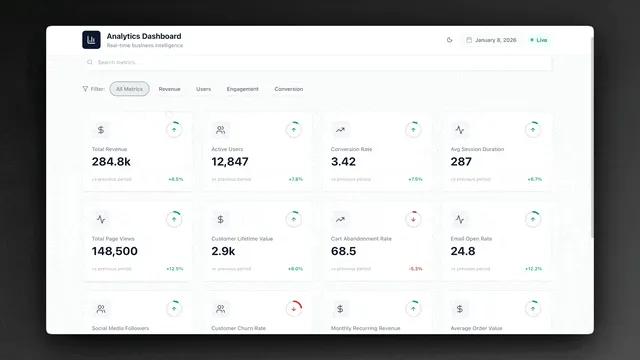
Two of these numbers are leading indicators for the whole category. Cloning is reuse: when someone clones an app from the community gallery instead of prompting from scratch, the market is maturing from generation to distribution — and cloning grew every single month of H1 2026. Custom-domain referrals are the flywheel turning outward: apps that users run on their own domains were among the top referrers of traffic back to taskade.com by June 2026, meaning deployed apps now market the platform that built them. For what one of these apps looks like inside, see the anatomy of a Taskade Genesis app; plans start free, with paid tiers from $10/month billed annually.
From Generation to Operation: The Living Software Turn
Put the whole report together and one conclusion falls out: app creation is commoditizing, and app operation is the open problem. Multiple vendors sit between $100M and $500M+ ARR selling the same prompt-to-app moment; each new agent release makes that moment cheaper. What no funding round has solved is day two — the moment the person who prompted the app walks away and the app starts going stale.
The difference between the artifact model and the runtime model is easiest to see as a sequence — the same operator, the same app, two weeks apart:
This is the shift we call the living software era: SaaS quietly evolved into apps that stay connected to the context that created them, and the living app movement is the user-side evidence. It is also the bet behind TSK-1, the Taskade System Kernel — the coordination layer that keeps models, agents, and workflows working against one shared memory, so an app persists as a running system rather than a generated artifact. Inside Taskade Genesis, that means the workspace is the backend: projects hold the memory, AI agents with built-in tools reason over it, 15+ frontier models from OpenAI, Anthropic, Google, and open-weight providers are selectable per task, and 100+ bidirectional integrations plus always-on automations keep the app executing after the prompt. The market data above says the generation race is being won by many companies at once. The operation race has barely started.
Will AI Replace App Developers?
No — the 2026 data shows AI redistributing the work, not removing the workers. AI now reliably produces the 60–80% of an application that is scaffolding — CRUD screens, boilerplate, integrations glue — while the remaining judgment layer stays human: architecture, security review, data modeling, and deciding what to build at all. That split explains every apparent contradiction in this report: 46% of code is AI-written and only 33% of developers trust it; 90% of developers use AI tools and a METR study measured them 19% slower on familiar code. The scaffold got cheap; the judgment got more valuable. What changed for non-developers is bigger: for the 63% majority with no coding background, AI did not replace a developer they never had — it gave them their first one, in the form of agent teams they can direct in plain language.
What Comes Next: Predictions Through the End of 2026
Dated, hedged, and written down so we can be graded — here is where the July 2026 data points for the next two quarters. (We will score these in the January 2027 refresh.)
| # | Prediction (as of July 2026) | Basis | Confidence |
|---|---|---|---|
| 1 | Lovable's reported round closes near $13.2B, giving the category its second $10B+ private company | TechCrunch, Jul 8, 2026; $500M ARR run-rate | High |
| 2 | At least one more incumbent acquires a generation startup before year-end, repeating the Wix–Base44 playbook | Three deals in 13 months; Base44 compounding to $100M ARR | Medium-high |
| 3 | Gartner's 40% enterprise-agent figure roughly lands, but the operations gap (McKinsey's ~23% scaling) persists into 2027 | Embedding is easy; operating against real context is not | Medium-high |
| 4 | Trust metrics keep sliding until maintenance and review tooling matures — "day two" becomes standard category vocabulary | 77%→60% favorability trend; 1.7× defect data | Medium |
| 5 | Generation itself gets bundled toward free, and headline metrics shift from apps created to apps still alive — retention, clones, and active automations | Five+ vendors selling the same moment; cloning growth in Taskade data | Medium |
The through-line of all five: value is migrating from the moment of creation to the system of operation. Watch the metrics vendors brag about — the year generation counts disappear from press releases is the year the operation era officially begins.
Methodology and Sourcing
Every external figure on this page carries a named source and a date inline. Nothing is presented as our estimate when it is a company's claim, and nothing is presented as closed when it is reported talks (Lovable's $13.2B is labeled as talks, not a round). Where reports conflict, we use the more conservative figure with primary attribution — for example, Anysphere's ARR is cited as $3B+ (May 2026) rather than higher figures circulating on low-authority aggregators. Taskade figures are original platform data compiled in July 2026 and rounded; we publish counts and growth multiples, not revenue. Superseded figures are kept dated rather than silently replaced, and corrections land in the changelog below.
Related deep dives if you are evaluating specific vendors: Taskade vs Lovable, the Base44 alternative breakdown, and our histories of Anysphere/Cursor, OpenAI, and Anthropic.
Changelog
This page updates quarterly. Each entry notes what changed and when the data was compiled.
- July 2026 — Initial publication. Data compiled July 2026: three-era history, funding league table through the SpaceX–Anysphere 8-K (June 16, 2026) and Lovable's reported July 8 raise talks, market-size figures (Fortune Business Insights, Gartner), adoption and trust compilation (JetBrains, GitHub, Stack Overflow, METR, CodeRabbit, Veracode), market map, predictions ledger, and the first public release of Taskade Genesis platform data (150,000+ apps, 535K+ MAU, cloning and referral trends).
Frequently Asked Questions About the State of AI App Building
How big is the AI app builder market in 2026?
Fortune Business Insights sizes the no-code AI platform market at $6.56B in 2025, projected to $75.14B by 2034 (31% CAGR), and Gartner puts low-code above $30B in 2026. Company-reported revenue confirms the scale: five-plus vendors — Lovable ($500M+), Replit ($525M), Genspark ($250M), Base44 ($100M), Manus ($100M) — report nine-figure ARR as of mid-2026.
What is the largest AI app builder in 2026?
By valuation, Anysphere (Cursor): SpaceX's $60B all-stock acquisition, disclosed in an SEC 8-K on June 16, 2026, is the largest acquisition of a venture-backed startup on record. By prompt-to-app ARR, Replit (~$525M) and Lovable ($500M+) lead, with Notion at ~$600M as a workspace incumbent.
Which AI app builder companies got acquired or funded in 2026?
The headline ledger: SpaceX–Anysphere ($60B, June 2026), SAP's strategic investment doubling n8n to $5.2B (May 2026), Replit's $400M Series D at $9B (March 2026), Genspark at $2.6B (June 2026), and Lovable's reported talks at $13.2B (July 2026) — on top of Wix–Base44 ($80M, June 2025) and Lovable's $6.6B Series B (December 2025). Meta's bid for Manus was blocked by China's NDRC in April 2026.
Why did Lovable's valuation double in six months?
Revenue velocity: $400M ARR in February 2026 (adding ~$100M in one month with 146 employees, per TechCrunch), $500M by June. The December 2025 Series B priced it at $6.6B; the reported July 2026 talks price it at $13.2B — almost exactly tracking the revenue doubling underneath.
Who acquired Cursor, and what happened to Anysphere?
SpaceX. After Anysphere's $2.3B Series D at $29.3B (November 2025) and an acquisition-rights deal with xAI (April 2026), SpaceX exercised a $60B all-stock purchase option on June 16, 2026, per an SEC 8-K, with closing expected in Q3 2026. Anysphere's ARR ran $100M → $1B → $3B+ between January 2025 and May 2026.
What percentage of code is now written by AI?
About 46% of new code is AI-generated as of 2026, up from roughly 10% in 2023 (GitHub data). Ninety percent of developers use at least one AI tool at work (JetBrains, January 2026), and roughly a quarter of Y Combinator's Winter 2025 startups reported codebases that were 95% AI-generated.
Can non-technical people really build production apps with AI?
Yes — they are the majority. 63% of AI app builder users have no coding background, and citizen developers outnumber professionals roughly 4:1 (100–120M vs 27.7M). The harder question is maintenance, which is why platforms that keep the app connected to memory, agents, and automations after launch matter for this audience.
Are AI-generated apps safe to use in production?
With guardrails, yes. Unreviewed AI code carries 1.7× more major issues than human code (CodeRabbit, 470 PRs) and 45% of samples contain OWASP Top-10 vulnerabilities (Veracode). Managed runtimes, permission systems, and role-based access reduce what a solo builder must audit — trust is becoming a platform feature, not a model property.
What happens to AI-built apps after launch — who maintains them?
That is the open problem of 2026 and the thesis of this report. Apps generated as artifacts go stale on day two. The emerging answer is apps that live inside a workspace runtime — memory, agents, and automations keeping them current — which is the problem TSK-1, the Taskade System Kernel, is built to coordinate.
Will AI replace app developers?
No. AI reliably produces the 60–80% of an app that is scaffolding; the judgment layer — architecture, security, data modeling, deciding what to build — stays human. The trust data (33% trust in AI code accuracy; METR's 19%-slower finding) shows why review and judgment got more valuable, not less.
Is vibe coding still a thing in 2026?
Yes, but it grew up. The behavior Andrej Karpathy named in February 2025 is now a market with multiple $100M+ ARR vendors, enterprise buyers, and a consolidation wave. The 2026 conversation is about operating and maintaining generated apps — see our state of vibe coding data page for that side of the ledger.
How is Taskade Genesis different from the other platforms in this report?
Most platforms here generate an app as an artifact you then host and maintain. Taskade Genesis builds the app inside a workspace that is also its runtime: projects hold the memory, AI agents with built-in tools reason over it, 15+ frontier models are selectable per task, and 100+ bidirectional integrations plus automations keep it executing. Start free, with paid plans from $10/month billed annually.
The numbers on this page will change every quarter. The direction they point will not: 2026 proved that anyone can create an app, and the next set of winners will be decided by whose apps are still alive — remembering ▲, reasoning ■, and executing ● — a year after the prompt. Build one that persists, or clone a live one and watch the data update around you.