






The Feynman Technique is one of the simplest yet effective ways to learn new things. Whether you’re into productivity, marketing, or quantum physics, this four-step framework will help you acquire knowledge in a refreshing and surprisingly humbling way.
TL;DR: The Feynman Technique is a four-step loop — learn it, teach it simply, find your gaps, then simplify again. It works because explaining out loud exposes the gaps you didn't know you had (the "illusion of explanatory depth," Rozenblit & Keil, 2002). Build your teach-back loop in Taskade.
Learning things by heart sucks. It’s monotonous, uninspiring, and you’re likely to start bleeding key facts as soon as you don’t need them. And this is where the Feynman Technique, named after a famous physicist and science educator, comes into play.
In today’s article, you’ll rediscover the child-like curiosity of learning. You’ll also learn (no pun intended) how to use outlining and mind mapping to make that knowledge stick.
🧠 Before you start... Looking for more learning tips? Be sure to check other articles on the blog and master the art of personal knowledge management (PKM).
👨🔬 What Is the Feynman Technique?
Who Was Richard Feynman?
Regarded as one of the greatest physicists of all time(1), Richard Feynman was an avid science educator and a vibrant figure in the scientific world. His work earned him multiple awards, including the Albert Einstein Award (1954) and the Nobel Prize (1965) for his contribution in the field of quantum electrodynamics.(2)

Professor Richard Feynman lecturing at CERN (1965)(3)
On top of being an accomplished scientist, Feynman reveled in teaching others. His unorthodox academic style, a peculiar sense of humor, and an exceptional ability to elucidate complex topics earned him a nickname the “Great Explainer.”
“Incidentally, Feynman wasn’t famous just for being a great teacher and a world-class scientist; he was also quite a character. He translated Mayan hieroglyphics. He loved to play the bongos. While helping develop the atomic bomb at Los Alamos, he entertained himself by figuring out how to break into the safes that contained top-secret research.”
Bill Gates, “The Best Teacher I Never Had”(4)
As it is the case with history’s most successful figures, it’s natural to think of Feynman as an outlier who was simply “gifted” in what he did. While he was considered a genius, Feynman attributed his track record to an iterative learning process.
How Does the Feynman Technique Work?
Feynman didn’t put much faith in innate abilities. Instead, he focused on getting under the surface of everything he wanted to learn. As he points out in his memoir Surely You're Joking, Mr. Feynman!, the point of learning is not to memorize but to understand.
“I don’t know what’s the matter with people: they don’t learn by understanding; they learn by some other way—by rote, or something. Their knowledge is so fragile!”
Richard P. Feynman, Surely You're Joking, Mr. Feynman!
Feynman’s common-sense approach to acquiring knowledge crystallized in what’s known as the Feynman Technique. The technique breaks down into four key steps. 👇
🌟 Step 1: Pick a topic and start learning about it.
🌟 Step 2: Imagine you’re explaining the topic to a child.
🌟 Step 3: Identify what you still don’t know and dig deeper.
🌟 Step 4: Simplify and turn knowledge into a gripping narrative.
This simple four-step framework strips the learning process of jargon, ambiguity, and complexity and improves comprehension. But before we explain it in detail, let’s take a look at some of the cool benefits of the Feynman Technique.
🪪 Who Actually Named It?
Quick honest note: Feynman never sat down and wrote out a numbered "Feynman Technique." The branded four-step worksheet was popularized online around 2011 — first by Scott H. Young, then Thomas Frank (College Info Geek), then Farnam Street. So the steps are named for, and inspired by, Feynman, but they were devised by later popularizers. 🙂
What's genuinely his is the attitude: understand, don't memorize. The clearest distillation was found on his blackboard at his death in 1988 — "What I cannot create, I do not understand." Pair that with his warning from the 1974 Caltech commencement — "The first principle is that you must not fool yourself — and you are the easiest person to fool" — and you have the whole philosophy. The steps are just scaffolding for that one idea.
What Are the Benefits of the Feynman Technique?
You Approach Things With an Open Mind
Children and adults see the world in completely different ways. Whenever you approach a new subject, you do so burdened by prejudice and bias. A child’s mind, on the other hand, soaks everything up indiscriminately and with genuine excitement.
“Asking questions is what brains were born to do, at least when we were young children. For young children, quite literally, seeking explanations is as deeply rooted a drive as seeking food or water.”
Alison Gopnik, professor of philosophy at UC Berkeley
The Feynman Technique helps you awaken that child-like mind. By shedding preconceived notions, you rediscover the joy of learning. This is incredibly humbling and refreshing and helps you understand how much you don’t know.
You Learn How to Ask Better Questions
You start life with no answers and only advance by asking the right questions, and we mean a lot of those. Children do that all the time. They probe the most mundane aspects of everyday life to the point where there’s nothing else left to uncover.
By improving your questioning capacity, you become more effective at poking and probing your own knowledge. This, in turn, can help you identify gaps and inconsistencies, and what’s really fun, extract knowledge from experts around you.
You Reduce Friction in Communication
We live in a noisy world. You probably send and receive dozens of emails and texts each day. That’s on top of the hours spent on calls and video conferences. But what part of that communication smorgasbord do you consider essential and effective?
“These, then, are the ten rules of effective communication, all summarized in single words: simplicity, brevity, credibility, consistency, novelty, sound, aspiration, visualization, questing, and context.”
Frank Luntz, Words That Work
The Feynman Technique celebrates the art of meaningful communication. It allows you to remove unnecessary complexity and explain intricate topics in a frugal and accessible way. After all, why use three words when one would do?
🧪 Why the Feynman Technique Actually Works (The Science)
The Feynman Technique works because explaining a concept forces your brain to produce knowledge instead of merely recognizing it — and decades of cognitive-science research show producing beats recognizing every time. When you re-read a chapter and think "I get it," that fluent feeling is mostly recognition. The moment you try to teach it from a blank page, the illusion pops. Here's the research stack behind each step. 👇
| Effect | What it means for you | Source |
|---|---|---|
| Generation effect | You remember what you produce yourself far better than what you merely read. Writing the explanation is the learning. | Slamecka & Graf, 1978 |
| Self-explanation effect | Explaining a concept to yourself, in your own words, deepens understanding beyond re-reading. | Chi et al., 1989 |
| Testing effect / retrieval practice | Recalling from a blank page beats re-reading. Re-reading only feels productive. | Roediger & Karpicke, 2006 |
| Protégé effect | Just expecting to teach makes you organize and learn material better — before you teach a soul. | Nestojko et al., 2014 |
| Illusion of explanatory depth | We believe we understand things until we try to explain them. Explaining punctures the illusion — this is why the blank page is diagnostic. | Rozenblit & Keil, 2002 |
| Desirable difficulties | Effortful study (explaining, recalling) builds durable memory; easy, fluent re-reading does not. | Robert Bjork |
Notice the through-line: feedback exposes gaps, and gaps are where the learning lives. That's not just a study trick — it's how high-performing systems operate everywhere. How Jensen Huang runs NVIDIA treats "feedback is learning" the same way: bad news travels fast, gaps surface early, nobody fools themselves about what's working. And training AI agents is literally teaching-to-learn at machine speed — the model improves by being made to produce answers, get corrected on the gaps, and try again. The Feynman loop is the human version of the same feedback engine.
It also pairs beautifully with the rest of your learning toolkit. The teach-back step is far more powerful when ideas are wired together — see connected thoughts and retention — and when you can anchor them spatially with the method of loci. Sharpen the questions you ask yourself during the gap-finding step with asking better questions, and organize what you uncover with hierarchical thinking so each fact slots into the bigger picture.
👉 How Do You Use the Feynman Technique?
The technique is a loop, not a checklist — each pass through it sends you back smarter. Here's the cycle at a glance. 👇
Step #1: Pick a Subject and Start Learning
This part isn’t much different from what you’d normally do to learn something new. Pick a topic you’re interested in, make a comprehensive list of resources, and dig in. The only rule is that you should learn to comprehend rather than just to remember.

If you’re dealing with a new topic, read broadly and focus on getting a holistic view of the subject. Don’t worry if you don’t soak up all the details at this stage. Keep your primary sources at hand as you’ll likely come back to them in the next step.
👁 Pro Tip: Use Mind Mapping for a Bird’s Eye View
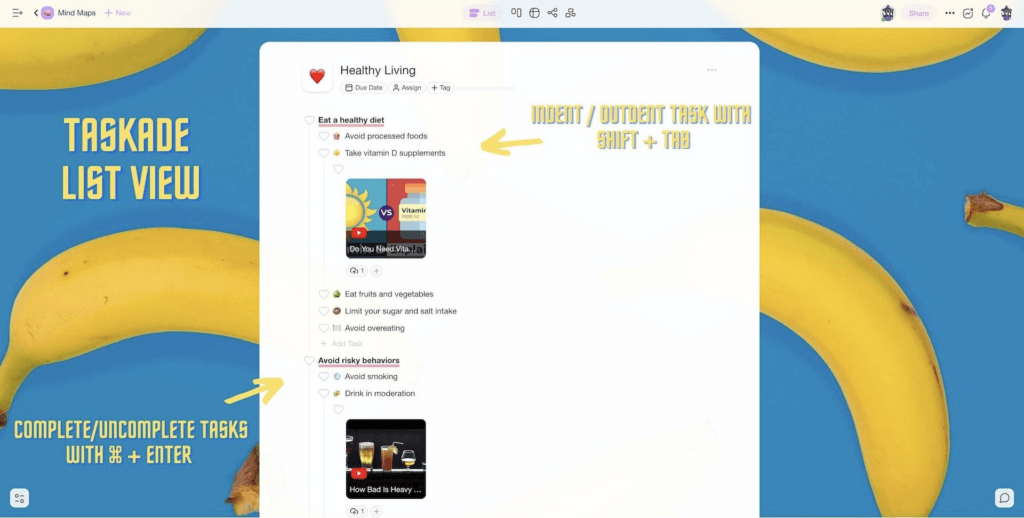
You can use Taskade’s Mindmap view to see all the moving parts of a topic, thought, or idea. Start by putting a core theme in the center and add new branches as you go. You can even upload images, videos, and other materials to improve retention.
Here’s a simple healthy living mind map created in Taskade. 👇

Step #2: Teach Yourself as You Would a Child
Now comes the fun part. Pretend you’re about to explain what you’ve just learned to a child—or actually do that if you’re a parent!—in the simplest way possible. Use plain language, avoid jargon, rely on analogies, and do that as quickly as possible.
Here’s an excellent example from Wired’s “5 Levels” series. 👇
This step will put your knowledge to the test and help identify potential potholes. Even if you think you’ve mastered a subject, chances are there’s still much you don’t know. And a battery of deceptively simple wh-questions is the best way to expose that.
💬 Pro Tip: Keep Track of the Questions You Can’t Answer
You can pretend you’re giving a lecture to an imaginary audience with no prior knowledge of the subject. You can even talk to a mirror or record yourself for better effect. Come up with thought probing questions and add them to your mind map. Better still, build a custom AI agent to play the curious student and quiz you back — it's a tireless audience that turns the teach-back step into a real back-and-forth.
Step #3: Fill In the Gaps in Your Knowledge
Chances are the previous step exposed gaps in your knowledge of the subject. You may lack names, dates, or other key facts and details. Whatever it is, go back to the source and fill in the blanks so you can make a better job of teaching others.
“One of the best habits a learner can instill in herself is regular self-quizzing to recalibrate her understanding of what she does and does not know.”
Peter C. Brown, Make It Stick: The Science of Successful Learning
It may happen that the source material is lacking in some way. If that’s the case, cast a wider net and dig into more in-depth resources. Better still, seek out subject-matter experts and pester them with questions you prepared in the previous step.
Step #4: Simplify and Tell a Grand Story
Children love stories. Heck, even grown-ups fall for captivating yarns told by the fireside. Use the power of storytelling to fit what you’ve learned into a context, solidify the knowledge, and make the process even more exciting by retelling it yourself.

Combine the notes and questions from the previous steps, summarize what you know about the subject, and create a story to revisit every time you feel you need a refresher. Be sure to check Tiago Forte’s progressive summarization method for guidance.
🧙♂️ Pro Tip: Turn Your Mind Map into an Outline
Outlining is a great way to organize all kinds of information. Assembling facts, dates, and events in a hierarchical order will help you see how each element fits the bigger picture. Taskade allows you to transform your mind map into an outline in a blink.
And that’s it!
🐑 Parting Words
Let’s face it. For many of us, the excitement of learning new things—and often even the inclination to do so—fades once we transition into adulthood. The mundane of everyday life takes over and it becomes increasingly difficult to feel the “magic.”
The Feynman Technique puts curiosity back on the menu. It helps open the mind and rediscover the pure joy of exploring the unknown with a child-like mind.
So, what are you waiting for?
🎯 Pick a subject and start learning.
🍼 Teach yourself as you would a child.
🩹 Fill in the gaps in your knowledge.
🌟 Simplify and tell a grand story.
Sign up for free and supercharge your learning with Taskade AI! 🤖
🤖 Custom AI Agents: Create custom AI agents to personalize your learning schedule, streamline research and writing, and manage resources.
🪄 AI Generator: Stimulate deeper learning and understanding with personalized, AI-generated content, study guides, and exercises.
✏️ AI Assistant: Use the AI assistant to plan, draft, and refine team documents while getting insights for collective improvement and synergy.
🗂️ AI Prompt Templates Library: Explore a curated collection of AI prompt templates designed for various educational scenarios.
💬 AI Chat: Engage in interactive learning with AI Chat, where you can ask questions, receive explanations, and discuss topics in-depth.
📄 Media Q&A: Employ AI to analyze your learning patterns, provide feedback on progress, and offer adaptive learning strategies.
And much more...

❓ Frequently Asked Questions
What is the Feynman Technique and how does it work?
The Feynman Technique is a four-step learning method inspired by physicist Richard Feynman's approach to understanding complex topics: 1) Choose a concept and write everything you know about it, 2) Explain it as if teaching a 12-year-old (using simple language, no jargon), 3) Identify gaps where your explanation breaks down — these reveal what you don't truly understand, 4) Go back to the source material, fill the gaps, and simplify your explanation further. The technique works because teaching forces deep understanding.
Why is the Feynman Technique effective for learning?
The Feynman Technique works because it exploits a cognitive principle: you only truly understand something when you can explain it simply. Most people confuse recognition (reading something and thinking "I get it") with actual comprehension. By forcing yourself to teach the concept in plain language, you expose the illusion of knowledge — the gaps between what you think you know and what you actually understand. Filling those gaps creates durable, transferable knowledge.
How can you combine the Feynman Technique with a second brain?
Combine them by using your second brain (a tool like Taskade) to: 1) Capture raw source material in a dedicated knowledge project, 2) Create a "teach-back" note where you explain the concept in simple terms, 3) Highlight gaps and create tasks to research them, 4) Iterate your explanation as understanding deepens, 5) Link your simplified explanation to related concepts in your knowledge base. This creates a growing network of deeply understood knowledge rather than superficially collected information.
What tools support the Feynman Technique for learning?
Tools that support the Feynman Technique need writing space, iteration support, and knowledge linking. Taskade works well — its outliner lets you write explanations in hierarchical bullet points (breaking concepts into progressively simpler levels), AI agents can quiz you on concepts to test understanding, Mind Map view shows relationships between ideas, and collaborative features let you teach concepts to teammates for real feedback. The key is using any tool that makes writing and revising explanations frictionless.
Did Richard Feynman invent the Feynman Technique?
Not exactly. The method is named for and inspired by Richard Feynman, but the four-step worksheet was popularized later, around 2011, by writers like Scott H. Young and Thomas Frank. What is genuinely Feynman's is the attitude — understand, don't memorize — captured in his line "What I cannot create, I do not understand."
What is the science behind why the Feynman Technique works?
Three well-studied effects explain it. The generation effect (Slamecka and Graf, 1978) shows you remember what you produce yourself. Retrieval practice (Roediger and Karpicke, 2006) shows recalling from a blank page beats re-reading. The illusion of explanatory depth (Rozenblit and Keil, 2002) shows we overestimate understanding until we try to explain — which is why the blank page is diagnostic.