






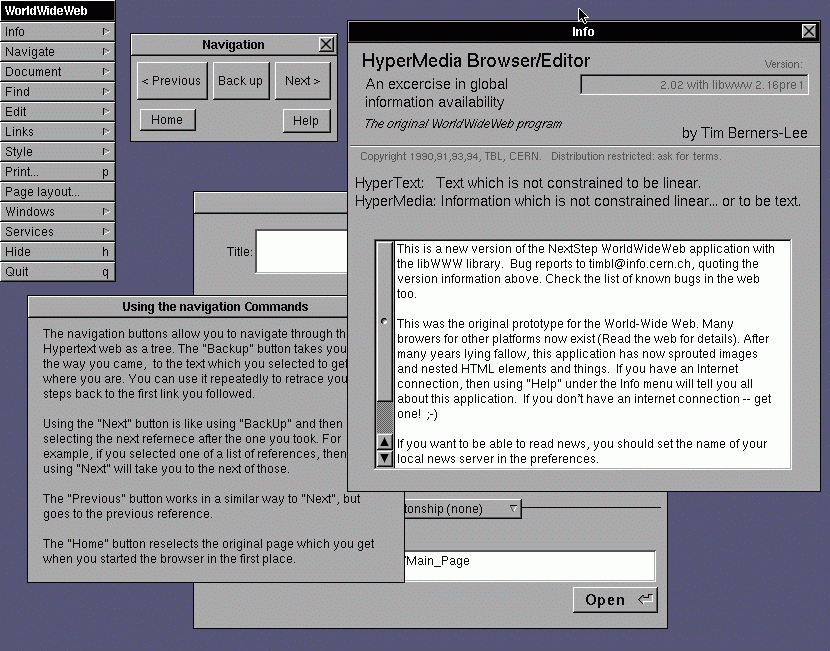
The first web browser ran on a black cube. In 1990, Tim Berners-Lee wrote WorldWideWeb on a NeXT cube at CERN, and the program called itself a "HyperMedia Browser/Editor." It could read the web and write to it. Thirty-four years later, a startup with a cube for a logo set out to rebuild the browser for a new kind of user: software.
That startup is Browserbase. It runs real web browsers in the cloud so AI agents can do what people do online: open a page, click the button, fill the form, log in, and bring the data back. In under three years it went from a solo founder's memo to $67.5 million raised, a $300 million valuation, an open-source framework with more than 5 million monthly downloads, and a seat at the table where Cloudflare decides which bots get through.
This is the complete history: the headless browsers that came before, the founder's one hard-won skill, every product and funding round, the fight over stealth and identity, and what the story teaches anyone building with AI agents. 🧭
TL;DR: Browserbase, founded in January 2024 by Paul Klein IV, runs cloud browsers for AI agents and maintains Stagehand, an open-source framework with 5.78M npm downloads in August 2026. It raised $67.5M, reached a $300M valuation in June 2025, and moved from stealth to signed agent identity. Build agents that act on what they find →
What Is Browserbase and How Much Is It Worth in 2026?
Browserbase is a San Francisco infrastructure company that runs web browsers in the cloud for AI agents. It was founded in January 2024 by Paul Klein IV, raised a reported $67.5 million across four rounds, and was valued at $300 million after a $40 million Series B led by Notable Capital in June 2025. Its homepage claims 35 million+ browser sessions a month across 10,000 customers.
The product is a simple promise with a hard problem underneath it. A developer asks for a browser, gets one in seconds, connects to it over the Chrome DevTools Protocol (CDP), drives it with Playwright, Puppeteer, Selenium, or Browserbase's own Stagehand, and disconnects when the job is done. Browserbase handles the fleet: containers, fonts, proxies, CAPTCHAs, regions, recordings, and a live view a human can take over.
Browserbase at a Glance (September 2026)
| Fact | Detail |
|---|---|
| Founded | January 2024, San Francisco (public launch April 2, 2024) |
| Founder | Paul Klein IV, solo founder and CEO |
| Thesis | "An Internet Browser for AI" memo, November 30, 2023 |
| Total funding | ~$67.5M reported (pre-seed, seed, Series A, Series B) |
| Latest valuation | $300M post-money (Series B, June 2025) |
| Lead investors | Kleiner Perkins, CRV, Notable Capital |
| Open source | Stagehand (MIT), 25,000+ GitHub stars |
| Stagehand downloads | 5.78M on npm in August 2026 |
| Scale claimed | 35M+ sessions a month, 10,000 customers, 800,000 weekly SDK downloads (homepage, as of Sept 22, 2026) |
| Products | Browsers, Stagehand, Director, MCP server, Functions, Fetch, Search, Model Gateway, Agent Identity, Browserbase Agents |
Last updated: September 22, 2026. Browserbase ships fast, and its funding and scale figures come from the company and its investors. Check browserbase.com before you quote a number in a memo.
The Browserbase Timeline at a Glance
🧬 The Prehistory: Browsers Were Built for People (1990 to 2023)
Every tool Browserbase builds on was made for a human at a screen or for a tester checking that a website still works. That mismatch, a browser designed for one person on a laptop and asked to serve thousands of machines on a server, is the opening Browserbase walked into.
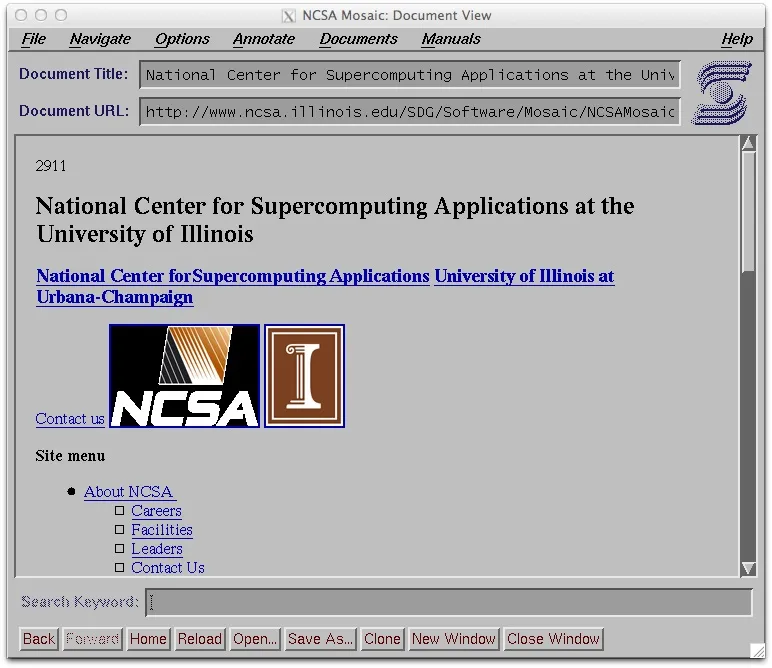
NCSA Mosaic (1993) made the web graphical and popular. Screenshot: Wikimedia Commons, CC0.
The web started as a read-and-write medium. WorldWideWeb let Berners-Lee edit pages as easily as he read them. Mosaic (1993) and Netscape (1994) turned the browser into a reading machine for the public, and the write half faded into forms and content-management systems. The full human story lives in our history of web browsers.
The machine story runs in parallel. It is the story of people who needed a browser without a person in front of it.
| Year | Milestone | Why it matters to Browserbase |
|---|---|---|
| 1990 | WorldWideWeb, the first browser and editor, on a NeXT cube | The web begins as read-write |
| 2004 | Selenium starts at ThoughtWorks as a JavaScript test runner | Browser automation is born as QA |
| 2004-2008 | Beautiful Soup, then Scrapy | Scraping without a JavaScript engine |
| 2011 | PhantomJS, a scriptable headless WebKit | The first popular headless browser |
| 2012 | Chrome's remote debugging protocol over WebSocket | The ancestor of the Chrome DevTools Protocol |
| 2017 | Headless Chrome (Chrome 59) and Puppeteer | A real browser becomes scriptable on a server |
| 2017 | Browserless (hosted headless Chrome) and Luminati, later Bright Data | The pre-AI hosted options |
| 2018 | WebDriver becomes a W3C Recommendation | A standard remote-control API |
| 2020 | Microsoft launches Playwright, led by the former Puppeteer lead | Cross-browser automation, and Stagehand's first engine |
| 2023 | Bright Data launches a Scraping Browser | Hosted browsers sold to scrapers |
The pattern matters. Selenium, Puppeteer, and Playwright were all designed so a test fails when a page changes. Developers bent them into robotic process automation anyway, and the scripts broke every time a website moved a button. The hosted options that existed before 2024 came from a proxy company controlled by a private-equity firm and a small bootstrapped service. Paul Klein's complaint about the market leader, as he told Latent Space, was blunt: "they just jacked up their prices quite a bit and the dashboard hasn't changed in five years."
👤 Who Founded Browserbase? Paul Klein IV and His One Trick
Paul Klein IV founded Browserbase alone, after spending years on one unglamorous problem: running web browsers on servers. He learned identity and login systems at Twilio, then ran headless-browser infrastructure as CTO of Stream Club, which Mux acquired in December 2021. He told his co-founders he would never start another company unless it was browser infrastructure.
Twilio: the identity years (2016 to 2020)
Klein applied to about 500 internships and, by his own account, heard yes from Twilio and eventually Amazon. He joined Twilio as an intern in 2016, built part of its login page, and became tech lead of the login and identity-and-access team two years later. "I didn't have a life. I just love my job," he told Latent Space. The identity background matters: it returns ten years later as his thesis about how agents should log in.
Stream Club: the browser that ran on a server (2020 to 2021)
In the spring of 2020, Klein and his co-founders built Stream Club in a weekend: a live-streaming studio that ran in the browser. It raised a $2.1 million pre-seed and later added an API and SDK. To compose and edit video, the company ran web browsers on servers, and Klein became the person who kept them alive.
"The browser that you and I run on our local computers is not designed to be run at scale on servers… It's designed for a MacBook Air, not for a Lambda." — Paul Klein IV, Open Source Startup Podcast
Mux announced its acquisition of Stream Club on December 22, 2021, its first acquisition. Mux's press release framed the deal around browser-based live-streaming studios. Klein's own account is that Mux "really wanted to buy our headless browser infrastructure." He stayed at Mux, working on self-service and on browser infrastructure, until January 5, 2024.
The vow
"I actually told my co-founders I would never start another company unless it was a browser infrastructure company." — Paul Klein IV, Latent Space, February 2025
On the same show, swyx joked that Klein could become the Nikita Bier of headless browsers, a founder with one trick who keeps selling browser companies. Klein's answer: "I truly do only have one trick."
| Year | Paul Klein IV | Lesson carried into Browserbase |
|---|---|---|
| 2016 | Twilio intern, then tech lead of login and identity | Identity and auth, the future "agent auth" thesis |
| 2020 | Co-founds Stream Club, a browser-based streaming studio | Browsers on servers are painful |
| 2021 | Mux acquires Stream Club (Dec 22) | Headless-browser infrastructure has buyers |
| 2021-2024 | Works at Mux | Developer experience at a great API company |
| 2023 | Publishes "An Internet Browser for AI" (Nov 30) | The thesis, written down |
| 2024 | Leaves Mux (Jan 5), founds Browserbase alone | One trick, done twice |
📝 The Memo: "An Internet Browser for AI" (November 2023)
Paul Klein published "An Internet Browser for AI" on November 30, 2023, a roughly 3,000-word memo arguing that AI agents would need their own browsers and that nobody was building the infrastructure well. It came three weeks after Andrej Karpathy sketched an "LLM OS" with a browser among its peripherals, and it is still the company's founding document.
The memo's argument has two halves. First, large language models made web data easy to use: fetch a page, hand the HTML to a model, get a summary or a table back. Many modern sites only render after JavaScript runs, so that fetch needs a real browser. Second, and bigger, models can write the automation itself. Klein's clearest version came later:
"If you wanted to write a script to book a demo call on 100 websites, previously you had to write 100 scripts. Now you write one script that uses LLMs to generate that script for each website in real time." — Paul Klein IV, Latent Space
On the Open Source Startup Podcast he reached for a database analogy. The bull case for Snowflake, he said, is that writing SQL used to be painful and now you can write as many queries as you want. "When you decouple your human effort from the utilization of the infrastructure, the opportunity of the infrastructure platform goes up quite a bit."
Klein compressed the whole thesis into one line on Latent Space: "The future of software is software using software." Your accounting app clicks a button, opens your email, finds the receipt, and uploads it. That future, he argued, needs new infrastructure, new interfaces, and human checkpoints, because AI is slower and less predictable than a function call. The browser is one piece of that stack, and the one he knew how to build.
🏗️ Year One: Infrastructure First (2024)
Browserbase spent 2024 building the hosted browser before anything else. It closed a $1.8 million pre-seed in March, joined AI Grant in April, raised a $6.5 million seed led by Kleiner Perkins in June, and a $21 million Series A co-led by Kleiner Perkins and CRV on October 29. Most first-year customers were switchers from homegrown browser fleets.
Most developer-tool companies ship a framework first and monetize infrastructure later. Browserbase did the opposite on purpose. Playwright and Puppeteer were already everywhere, and teams already had scripts. Klein's read was that the missing piece was a great place to run those scripts. "The majority of our customers in the first year were switchers," he said, moving from DIY infrastructure or another vendor.
2024 milestones
| Date | Milestone |
|---|---|
| Jan 2024 | Klein leaves Mux (Jan 5). The Browserbase GitHub organization appears (Jan 30). |
| Mar 28, 2024 | $1.8M pre-seed from Alana Goyal (Basecase), Yuri Sagalov, Guillermo Rauch, and a dozen founders |
| Apr 2, 2024 | Public launch announcement |
| Apr 2024 | Joins AI Grant as, in Klein's words, the only company in its batch that spent zero dollars on AI |
| Jun 6, 2024 | $6.5M seed led by Kleiner Perkins. Self-serve opens at Hobby $39 and Startup $99 a month. |
| Jul-Aug 2024 | Live view, custom proxies, optional session recording |
| Sep-Oct 2024 | SOC 2 Type 1 and HIPAA |
| Oct 29, 2024 | $21M Series A (Kleiner Perkins and CRV, with Okta Ventures). Stagehand 1.0 ships the same day. |
| Oct 30, 2024 | A new website from Hervé Studio, a Paris design agency |
| Dec 5, 2024 | The open-source Browserbase MCP server |
Why a browser is hard to run on a server
Klein's favorite way to explain the business is to walk through what happens when you try to build it yourself. You write a Playwright script that works on your laptop, then you try to run it in production.
A browser session is stateful: it must stay open while a client talks to it, which makes it one of the hardest kinds of system to operate. The small traps pile up. A vision model looking for an emoji needs the emoji font installed. A headless browser has no screen, so you need recordings to know what happened. Chrome alone was too big for a typical serverless function, and a single virtual CPU made it crawl.
The first Browserbase ran on AWS ECS and Fargate, "the largest Fargate customer in our region for a little while," Klein claims. The company then moved to Kubernetes with predictive scaling and warm pools across regions, and Klein has described Firecracker micro-VMs for fast, isolated startup. His rule for what to build in-house: "I can't tell my customers, hey, we went down because so-and-so went down."
            How a Browserbase session is wired (simplified)  your code / agent                 Browserbase cloud
─────────────────                 ─────────────────────────────────────
Stagehand, Playwright,   CDP      ┌─────────────────────────────────────┐
Puppeteer, Selenium ─────────────▶│  session (one isolated Chromium)    │
▲                  websocket│   ├─ fonts, extensions, downloads   │
│                           │   ├─ proxies (routed per site)      │
│  live view iframe         │   ├─ CAPTCHA solving (optional)     │
└───────────────────────────│   ├─ identity / signed requests     │
human can take over      │   └─ recording → replay             │
└─────────────────────────────────────┘
warm pools · regions · autoscale
Proxies, CAPTCHAs, and the "sketchy vendor" problem
Browserbase owns no proxies. It routes traffic across audited providers and switches when one fails. Klein described the alternative, buying proxies and CAPTCHA solvers on your own, as feeling "like you're buying drugs": pay in Bitcoin, trust the docs at your peril. Browserbase restricted some CAPTCHA solving to plans where it knows the customer, and it said from the start that it wanted to become "an arbiter of good bots." That goal becomes the Cloudflare story later in this history.
Live view: a browser inside a browser
Live view is the feature that made Browserbase feel different. It embeds the remote browser in your own app as an iframe, streams page frames over the Chrome DevTools Protocol, and sends a person's clicks and keystrokes back. It exists for trust ("customers don't trust AI agents, at least the first pass") and for human-in-the-loop moments: a CAPTCHA that fails, or a two-factor code sent to a phone.
Paul Klein IV on the Latent Space podcast (February 2025): the infrastructure walk, proxies, CAPTCHAs, live view, and Open Operator.
🎭 Stagehand: Natural Language Meets the Browser (2024 to 2026)
Stagehand is Browserbase's open-source framework for controlling a browser with code plus natural language. Paul Klein and Jeremy Press started it in June 2024. It launched on October 29, 2024 with three methods (act, extract, observe), dropped its Playwright dependency in v3 (October 2025), moved into a browser extension in v4 (August 2026), and reached 5.78 million npm downloads in August 2026.
Stagehand started as a habit. Klein caught himself pasting a page's HTML into a model and asking it to write the Playwright code to click the right button. "This really should be part of the frameworks themselves," he concluded. So instead of writing "click the third red button that says Buy Now," a developer writes "click the Buy Now button," and the framework asks a model to pick the right element.
The three verbs
| Method | What it does | Example instruction |
|---|---|---|
| act | Takes one action on the page | "click the checkout button" |
| extract | Pulls structured data that matches a schema | "the title, price, and rating of the top result" |
| observe | Lists the actions available on the page | "actions related to buying this item" |
| agent (added in v2) | Runs a multi-step goal in a loop | "search flights from SFO to Dubai for May 8 to 15" |
The design choice that won developers over was restraint. Teams that already automated the web told Browserbase they did not trust AI to choose their steps, but they did trust it to repair a step that broke. So Stagehand kept the sequence of steps in code and added AI only where durability mattered.
"I really don't trust AI to do the steps I care about, but I do trust AI to self-heal or fix the step that went wrong." — a customer view Klein describes on the Open Source Startup Podcast
Why Stagehand is open source
Klein says it was never a debate. Every incumbent framework is open source. Automating every kind of website is bigger than any one team. And enterprise buyers relax when the part they integrate with is open: "If you love Stagehand, don't worry, it's open source, you could go run this on your own infrastructure." The hosted browser stays closed, because "the value of Browserbase is that you have a team of 30 people constantly maintaining this infrastructure."
Stagehand versions
| Version | Date | What changed |
|---|---|---|
| 1.0 | Oct 29, 2024 | act, extract, observe on top of Playwright. Launched with the Series A. |
| (inflection) | Jan 2025 | Switch to the page's accessibility tree, better models, the Operator launch |
| 2.0 | Mar 31, 2025 | agent() for computer-use models, action caching |
| Python | Jun 2025 | Stagehand for Python and the hosted Stagehand API |
| 3.0 | Oct 29, 2025 | Drops the Playwright dependency and talks to Chrome over CDP. Browserbase's benchmark: 44.11% faster on average across iframes and shadow-root interactions. |
| Multi-language | Jan 2026 | Go, Java, Ruby, Rust, and more (several alpha) |
| Server-side caching | Feb 2026 | Cached actions skip the model on a repeat run |
| 4.0 | Aug 10, 2026 | Core logic moves into a browser extension. TypeScript, Python, and Go SDKs at feature parity. agent() is removed, and Stagehand.create({ browser }) replaces the old env setting. |
The growth curve
Stagehand did not take off at launch. Klein remembers "a couple thousand weekly downloads" in October 2024. The npm registry shows the climb that followed, and it shows no overnight success.
Source: npm registry, package @browserbasehq/stagehand. Downloads include automated installs such as CI runs, so read the shape, not the absolute count.
Two things stand out. The first jump arrived in December 2024 (287,000 downloads, up from 13,000 in November), a month before the January 2025 inflection Klein describes. And the second wave in 2026 (2.2 million in February to 5.8 million in August) lines up with Browserbase's platform launches and Stagehand's expansion to more languages. On the Open Source Startup Podcast in September 2025, Klein cited about 18,000 GitHub stars and 400,000 weekly downloads. The repository passed 25,000 stars in September 2026.
Evals: the leaderboard next to the framework
Stagehand publishes a model leaderboard at stagehand.dev/evals that ranks models on browser tasks by accuracy, cost, and speed. Klein's reason is practical. A model can top a coding benchmark and still fail at a date picker, "the bane of the existence of LLMs," and a customer who picks the wrong model blames the framework. Publishing task-specific evals is how Browserbase keeps that blame where it belongs.
🎬 Director and the Vercel Playbook (2025)
Director is Browserbase's prompt-to-automation builder, launched with the $40 million Series B in June 2025. A user describes a task in plain English, Director runs an agent in a live browser, and the result is a reusable Stagehand script. Paul Klein calls Director an agent builder rather than an agent, and compares it to Vercel's v0 for websites.
Director began with an odd signal. In 2024, after Cursor took off, dentists started booking demo calls with Browserbase, three in two weeks. They were smart, owned their practices, lived with bad software, and had tried to wire Cursor and Stagehand together. They wanted "something low-code." The first attempt to launch Director, in early 2025, stalled. The team committed in late April and made Director the headline of the Series B.
"If you imagine v0 is for building a website, Director is for building automations to interact with any website." — Paul Klein IV, Open Source Startup Podcast
On that podcast, Klein ran the first live demo in the show's history: Director verified a California real-estate license by opening the state lookup, typing the license ID, reading the result, and writing the Stagehand code as it went. Change the variable and the workflow runs again. "Director isn't an agent, it's an agent builder," he said.
The Vercel analogy
Klein describes the whole company in one comparison, which he spelled out on Omar Waseem's podcast in October 2025.
| Layer | Browserbase product | Vercel equivalent | What it does |
|---|---|---|---|
| Infrastructure | Browserbase | Vercel | Runs browsers in the cloud |
| Framework | Stagehand | Next.js | Open-source way to control them |
| Application | Director | v0 | Generates the framework code from a prompt |
The strategy is a vertical stack, not a horizontal spread. "Every investment I make in Browserbase helps Stagehand and Director. Everything I make in Stagehand helps Director," Klein said. He warns that multi-product companies fail when they sell adjacent products to a different buyer too early. Browserbase sells one job, automate the web, through three entry points. Engineering is shaped like a pyramid: about three teams on the infrastructure, one on Stagehand, one on Director.
There is an echo here of Bill Atkinson's HyperCard, which let people who were not programmers build software by stacking cards. Director makes the same bet for web automation: the prompt that describes the task becomes the program that runs it.
💰 The Money: From a $1.8M Pre-Seed to a $300M Valuation
Browserbase raised a reported $67.5 million in its first 18 months: a $1.8 million pre-seed, a $6.5 million seed, a $21 million Series A, and a $40 million Series B at a $300 million valuation. At the Series B it reported more than $3 million in revenue, 1,000+ customers, and 20,000+ developer signups. No 2026 round was announced.
| Round | Date | Amount | Led by | Notes |
|---|---|---|---|---|
| Pre-seed | Mar 28, 2024 | $1.8M | Angels and founders | Alana Goyal, Yuri Sagalov, Guillermo Rauch |
| Seed | Jun 6, 2024 | $6.5M | Kleiner Perkins | With Basecase and AI Grant. Self-serve launch. |
| Series A | Announced Oct 29, 2024 | $21M | Kleiner Perkins and CRV | Okta Ventures joins. Stagehand launches. |
| Series B | Jun 2025 | $40M | Notable Capital | CRV and Kleiner Perkins return. $300M valuation. Director launches. |
| Total | ~$67.5M | The reported total suggests the seed figure includes the pre-seed. |
The angel list reads like a map of developer-tool royalty. Coverage of the Series B by Upstarts names Guillermo Rauch (Vercel), Jeff Lawson (Twilio), Patrick Collison (Stripe), and Aaron Levie (Box) as angel investors. Klein also named investors from the auth world on Latent Space, including people from Stytch and Clerk, and Okta Ventures joined the Series A. He said he backs them because "they'll make Browserbase's mission more possible."
What the Series B numbers said
| Metric at the Series B (June 2025) | Value |
|---|---|
| Revenue | more than $3M (run-rate or cumulative not stated) |
| Customers | 1,000+ |
| Developer signups | 20,000+ |
| Staff | 30 |
| Browser sessions | 25M in 2024, 50M in 2025 by June |
One caution sits under every revenue number you will see for Browserbase. The company has published only "more than $3 million in revenue," and third-party ARR figures are estimates. Treat them as guesses.
On Latent Space in February 2025, Klein made a public, falsifiable bet: "I can predict that Browserbase will be a billion dollar company one day. So let's check back in five years." Four months later, the Series B priced it at $300 million.
🚀 How Browserbase Grew: The Product-Led Playbook
Browserbase grew almost entirely through inbound, self-serve sign-ups that expanded into large contracts. Paul Klein says most revenue is expansion revenue, that the company ran no retargeting ads, and that founder and team content, integrations with agent frameworks, and big single-day launches did the rest.
Five growth levers
| Lever | What Browserbase did | Klein's line |
|---|---|---|
| Self-serve first | Developer and Startup plans, then contracts at committed spend | Usage pricing ties revenue to customer success |
| Integrations | LangChain, LlamaIndex, CrewAI, and later MCP | Be where agent builders already are |
| People over logos | Launches from named employees, not only the company account | "People follow people, not brands" |
| A playful brand | Lego-like blocks and a cube, against dark-mode developer tools | A reaction to "too much dark mode" |
| Launch days | One big post per launch, all energy behind it | "Nobody cares about your launch week" |
Klein's LinkedIn discovery was humbling. Posts about his wife Julia go viral. Posts about Browserbase get about 100 likes. His conclusion was to tell your own story first and earn the right to talk about the product later.
He also named the cost of going first. "I'm spending all this money teaching everybody about headless browsers. Then I have like two or three companies riding along beside it." Director, in his framing, is market education, the way OpenAI's Operator made his mother understand what Browserbase does.
Pricing history
| Date | Change |
|---|---|
| Jun 2024 | Self-serve launch: Hobby $39 a month, Startup $99 a month, Scale custom |
| Feb 25, 2025 | A Free plan appears |
| Jun 2025 | Price cut at the Series B: Hobby becomes Developer at $20 a month, with more concurrency |
| 2026 | Search and Fetch calls, agent runs, and model tokens bundled into plans |
| Sep 2026 | Free $0 (3 concurrent browsers, 1 browser hour), Developer $20 (25 concurrent, 100 hours), Startup $99 (100 concurrent, 500 hours), Scale custom |
Pricing changes often, so check the live Browserbase pricing page for current numbers.
The founder at 10 to 50 people
By late 2025, Klein described scaling from 10 to 50 people as "miles harder" than the three marathons and an Ironman he had finished. He took over engineering directly, with 25 direct reports ("I'm going Jensen mode"), and ran a Slack channel called blocked by Paul as a living to-do list. About 35% of the company were former founders. His advice to his earlier self fit in three words: "Clarity drives output."
🛡️ From Stealth to Identity: The Fight Over Who Gets to Browse (2025 to 2026)
Browserbase began by helping agents get past bot defenses with proxies, CAPTCHA solving, and a stealth mode. In August 2025 it joined the first cohort of Cloudflare's signed agents program, built on Web Bot Auth. By April 2026 it had reframed stealth as identity. The shift tracks the web's publishers, who started blocking AI traffic by default.
The turn was predicted early. In February 2025, Klein was open about the CAPTCHA business being temporary:
"We're building this company knowing that the CAPTCHA solving is short-lived until we figure out how to authenticate good bots." — Paul Klein IV, Latent Space
By the Series B, Klein told Upstarts that Browserbase vets every at-scale customer's use case, a form of know-your-customer checks, and that it had "never received a complaint or takedown request." Seven weeks later, its traffic was at the center of a public dispute between Cloudflare and Perplexity.
He also named the structural reason a startup could do what a big lab would not: "Imagine this New York Times headline: OpenAI CAPTCHA solving… Browserbase solves CAPTCHAs. No one cares." His prediction for the long run was bigger than CAPTCHAs. "Auth is the biggest thing that will prevent agents from accessing stuff," he said, and he sketched an OAuth-like flow in which an agent asks to log in as you, you approve on your phone, and the agent gets narrow scopes: book the apartment, but do not message anyone.
The 2025 to 2026 sequence
| Date | Event |
|---|---|
| Jan 2025 | Browserbase ships Advanced Stealth, a custom Chromium, on its Scale plan |
| Jul 1, 2025 | Cloudflare blocks AI crawlers by default on new domains and launches pay per crawl |
| Aug 4, 2025 | Cloudflare accuses Perplexity of stealth crawling |
| Aug 2025 | Perplexity replies that Cloudflare "confused Perplexity with 3-6M daily requests of unrelated traffic from BrowserBase," and puts its own Browserbase use under 45,000 requests a day. The dispute is unresolved. |
| Aug 5, 2025 | Browserbase publishes "Separating agent trust from threat": "If the internet is going to remain open, then agents are going to need to self identify." |
| Aug 28, 2025 | Cloudflare launches signed agents. Its first cohort: ChatGPT agent, Goose from Block, Browserbase, and Anchor Browser. Garry Tan posts about a "Cloudflare-Browserbase axis of evil." |
| Sep 2025 | Stytch supports Web Bot Auth with Browserbase. Cloudflare publishes the Content Signals Policy for robots.txt. |
| Oct 2025 | 1Password launches Secure Agentic Autofill, with early access through Browserbase. Visa builds its Trusted Agent Protocol on the same signatures. |
| Feb 2026 | Fingerprint launches authorized AI agent detection with Browserbase and others |
| Apr 2026 | Browserbase: "What we previously framed as stealth is more accurately described as identity." Verified browsers launch. |
| Sep 22, 2026 | Okta Cross App Access support |
How Web Bot Auth works
Web Bot Auth attaches a cryptographic signature to each request, using the HTTP Message Signatures standard (RFC 9421). A website or its CDN checks the signature against the platform's published key and decides whether to let the agent through.
The axis of evil, and the armistice
Garry Tan's post landed the day the partnership launched: "Cloudflare-Browserbase axis of evil was not in my bingo card for 2025 LEGALIZE AI AGENTS." A browser company and the company that blocks browsers were working together. Klein did not take it personally. "I don't think Garry meant it. He had a good hook," he told Omar Waseem, and he answered with a team photo. On the Open Source Startup Podcast he called it an armistice: "me and Garry are all good."
His defense rests on two points. Browserbase partners with many companies, not only Cloudflare: he named Okta, an investor, and Stytch, and 1Password and Fingerprint followed. And the program is optional. "I describe it as TSA PreCheck for agents. If you want to get TSA PreCheck, you're going to get through security faster. But if you don't, you still have a way."
He also makes a rights argument that anyone building agents will hear again: "I should be able to have my agent access my software on my behalf… AI has a right to use your software just as much as you do."
The honest tension
One small episode shows why the old tools linger. When Google launched its Gemini 2.5 Computer Use model in October 2025, the public demo ran in an environment hosted by Browserbase. Simon Willison watched it appear to solve a Google CAPTCHA and wrote it up, then retracted the post: "it was Browserbase that solved the CAPTCHA even while Gemini was thinking about doing so itself." Built-in CAPTCHA solving was still doing quiet work under a frontier-lab demo.
The identity story is real progress, and it is not finished. A Web Bot Auth signature proves a request came from Browserbase. It does not prove which Browserbase customer sent it, or why. Every customer shares one platform reputation, which is why a crawling dispute between Cloudflare and Perplexity could land on Browserbase at all. The missing piece is delegation: proof that an agent acts for a specific person with specific permissions. That is exactly the "agent auth" flow Klein described in early 2025, and it is why Okta, Stytch, and 1Password keep showing up in the partner list.
🧩 The 2026 Platform: Search, Fetch, Functions, Gateway, Agents
In 2026 Browserbase grew from a browser into a web platform for agents: Functions (February), Fetch and Search APIs (March), a Model Gateway (April), the identity reframe (April), Browserbase Agents (June), and Stagehand v4 (August). Staff now describe the company in four verbs: search the web, fetch a page, crawl, and take action.
| Date | Launch | What it does |
|---|---|---|
| Feb 10, 2026 | Functions | Deploy Stagehand or Playwright code to run next to the browser |
| Feb 17, 2026 | Server-side caching | Repeat actions skip the model on a cache hit |
| Mar 11, 2026 | Fetch API | Get one page's content without driving a full session |
| Mar 14, 2026 | Hosted MCP server | The hosted MCP server (first offered July 2025) moves onto Browserbase infrastructure at mcp.browserbase.com |
| Mar 17, 2026 | Search API | Web search for agents, powered by Exa |
| Apr 5, 2026 | Model Gateway | One Browserbase key for models from several labs |
| Apr 6, 2026 | Agent Identity | Verified browsers, stealth reframed as identity |
| Jun 30, 2026 | Browserbase Agents | "One Prompt, One API Call": a managed agent that returns a typed result, on every plan |
| Jul 28, 2026 | Model Router | Automatic model choice per task |
| Aug 10, 2026 | Stagehand v4 | Core logic in a browser extension |
| Sep 10, 2026 | Navigate | Browserbase's first conference, a one-day event in San Francisco |
The boundary kept moving up the stack
In February 2025, Klein drew a firm line. Open Operator, the open-source clone of OpenAI's Operator that Browserbase shipped on Operator's launch day, was "a reference project," and agent loops were "pretty close to the application layer," where customers build their own. Browserbase was "not interested in going the product route yet."
Sixteen months later, Browserbase Agents offers a managed agent through a single API call. The path ran from a reference project (January 2025) to an agent builder (Director, June 2025) to managed agents (June 2026). When a plain hosted browser becomes easy to copy, a company climbs toward the layer where the task is defined.
Agentic commerce: "we give the roads"
Browserbase's field marketing lead, Erika Bricky, gave the clearest 2026 version of the company thesis on a July 2026 podcast about agents as business buyers. Suppliers, distributors, and governments will not rebuild their websites for agents, she argued. "The DMV's not going to build an MCP." So the job is to let agents use the human web as it is:
"They will not reinvent the wheel for agents. We will give the roads instead." — Erika Bricky, Browserbase
She added a limit that matters for anyone designing agent products: "Humans need some level of control over what is happening to feel comfortable," and a fully headless purchase with no front end to watch is "very scary." Payment rails for agents, from Coinbase's x402 to Stripe's agent wallet, multiplied in 2025 and 2026, but measured volume stayed small, and OpenAI scaled back ChatGPT's Instant Checkout in March 2026, letting merchants use their own checkout.
Paul Klein IV on the Open Source Startup Podcast (recorded September 2025): the memo, open-source strategy, the eval leaderboard, and a live Director demo.
⚔️ Browserbase vs the Field: Competitors in 2026
Browserbase competes with a crowded field of cloud browsers, agent frameworks, and scraping APIs. Its closest rivals are Kernel, Anchor Browser, Steel, Hyperbrowser, Browserless, and Cloudflare Browser Run. Browser Use and Skyvern sell agent frameworks with their own clouds, and Firecrawl and Apify lead in crawling. Browserbase has the largest disclosed funding among pure hosted-browser startups.
| Company | Focus | Funding (reported) |
|---|---|---|
| Browserbase | Cloud browsers, Stagehand, identity, managed agents | ~$67.5M through a $40M Series B (Jun 2025) |
| Kernel | Browser infrastructure for agents (YC S25) | $22M combined seed and Series A, led by Accel (Oct 2025) |
| Anchor Browser | Browser automation, in Cloudflare's first signed-agent cohort | $6M seed, Blumberg Capital (Oct 2025) |
| Browser Use | Open-source agent library plus a cloud browser | $17M seed, Felicis (Mar 2025) |
| Firecrawl | Crawl and scrape API, then a browser sandbox and agent endpoint | $14.5M A (Aug 2025), $75M B announced Sep 2026 |
| Cloudflare Browser Run | Headless browsers on Cloudflare's network, with live view | Part of a public company |
| Steel · Hyperbrowser | Open-source and hosted browser APIs | Smaller or undisclosed rounds |
| Browserless · Bright Data | Pre-AI hosted browsers and scraping browsers | Bootstrapped with an outside stake, and PE-backed |
The consumer agents that created demand
The big labs taught the public what a browser agent is, then several of them pulled back.
| Product | Company | Launched | Status by September 2026 |
|---|---|---|---|
| Computer use | Anthropic | Oct 22, 2024 | An API capability used by many agents |
| Project Mariner | Dec 11, 2024 | Shut down May 2026, folded into Gemini | |
| Operator | OpenAI | Jan 23, 2025 | Folded into ChatGPT agent (Jul 2025). ChatGPT agent itself was removed by July 2026 in favor of ChatGPT Work and its cloud browser. |
| Comet | Perplexity | Jul 9, 2025 | Free for everyone from Oct 2025 |
| Claude in Chrome (piloted as Claude for Chrome) | Anthropic | Aug 26, 2025 (pilot) | Generally available on every paid Claude plan since Aug 26, 2026 |
| Dia | The Browser Company | 2025 | Acquired by Atlassian (announced Sep 2025) |
| ChatGPT Atlas | OpenAI | Oct 21, 2025 | Deprecated. Stopped working Aug 9, 2026, with agentic browsing moved into ChatGPT and Codex. |
| Gemini 2.5 Computer Use | Oct 7, 2025 | Google's public demo ran in an environment hosted by Browserbase | |
| Copilot Mode in Edge | Microsoft | 2025 | Retired May 13, 2026, with its features moved into regular Edge |
Klein's view of the competition has stayed consistent: the market is not zero-sum, and a tool this complex deserves its own primitive. He also argues against running a full operating system just to control a browser, which is how many computer-use agents work: "browsers are little OSs," and a browser-only fleet delivers "90% of the functionality at 10% of the cost of running a full OS." He credits specialists such as pig.dev for the legacy Windows cases that do need one.
🔍 Where the Browserbase Story Gets Told Wrong
Most pages about Browserbase repeat at least one error: the wrong year for the Mux sale, a Series A "in November," a founding "in 2023," Stagehand "built on Playwright," or 2024 pricing. The primary record settles each one. This table lists the claims we found in press releases, databases, and 2026 listicles, next to what the sources of record say.
| Common claim | What the record says | Source of record |
|---|---|---|
| Klein sold Stream Club to Mux in 2020, or in 2023 | Mux announced the acquisition on December 22, 2021 | Mux press release |
| Browserbase was founded in 2023 | The memo is from November 2023. Klein left Mux on January 5, 2024, and the company was incorporated that month. | Klein's memos, company registry data |
| Browserbase had three founding members | Klein describes himself as a solo founder in every interview | Latent Space, Open Source Startup Podcast |
| The Series A closed in November 2024 | Announced October 29, 2024. Upstarts reports it was raised in September. | Klein's announcement, Upstarts |
| The Series B was $27.5 million | $40 million at a $300 million valuation, led by Notable Capital | Browserbase, Upstarts |
| Stagehand is built on Playwright | True for v1 and v2 only. v3 (October 2025) removed the Playwright dependency, and v4 (August 2026) runs inside a browser extension. | Browserbase blog |
| The Hobby plan costs $39 a month | That was June 2024. Since June 2025, the entry paid plan is Developer at $20 a month. | Browserbase changelog, pricing page |
| Browserbase dropped stealth | It reframed stealth as identity in April 2026. CAPTCHA solving still ships. | Browserbase blog, docs |
| Gemini solved a Google CAPTCHA in its launch demo | Browserbase's built-in CAPTCHA solver did | Simon Willison's retraction |
Two lessons come out of the table. Company databases copy each other, so one early error spreads everywhere. And a fast-shipping company outruns its own coverage: most reviews still describe the 2024 product in 2026.
Browserbase by the Numbers, 2024 to 2026
| Metric | 2024 | Mid-2025 | 2026 |
|---|---|---|---|
| Browser sessions | 25M for the year | 50M by June | 35M+ a month (Sept) |
| Customers | Hundreds of AI companies by early 2025 | 1,000+ | 10,000 (homepage) |
| Team | Solo founder, then about 20 | 30, then about 45 by September | About 85 (August, third-party estimate) |
| Stagehand npm downloads | 13K in November | 1.42M in June | 5.78M in August |
| Funding raised | $27.5M through the Series A (the seed figure appears to include the pre-seed) | $67.5M reported total | No new round announced |
🔭 Eight Lessons From the History of Browserbase
The Browserbase story compresses into eight lessons for anyone building with AI agents: a founder's scar tissue became the product, infrastructure came before the framework, LLMs turned a testing niche into an automation market, and the company climbed the stack as the browser became a commodity.
- Your worst problem can be your best company. Stream Club had to run browsers on servers, and that pain became Browserbase. The same lesson shows up in a Replit engineering post about turning a headless browser into a video renderer: browsers do not want to be servers, or cameras.
- Sell the missing layer first. Frameworks existed, so Browserbase sold the place to run them, then built its own framework, then the app on top.
- AI changes the unit economics of effort. One script that writes scripts turns a fixed QA market into an open-ended automation market.
- Small verbs beat long prompts. Stagehand kept act, extract, and observe, and fought feature creep. "It's wrong to build frameworks with growth in mind… that's how you build slop," Klein said.
- Use the smallest sufficient primitive. A browser, not a full operating system, covers most computer-use work at a fraction of the cost.
- The web's gatekeepers set the rules. Browserbase's path from stealth to identity followed Cloudflare's default block, not the other way around.
- Trust needs a window. Live view and human takeover made cloud browsers usable before anyone trusted agents to act alone.
- Commodities climb. As hosted browsers multiplied, Browserbase moved toward identity, frameworks, and managed agents, the layers closer to the task.
| Lesson | Evidence | What it means for your agent project |
|---|---|---|
| Scar tissue | Stream Club to Mux to Browserbase | Build on a problem you have lived |
| Missing layer | "Switchers" were the first customers | Meet developers where their code already is |
| Effort decoupling | The Snowflake analogy | Expect usage to grow faster than headcount |
| Small verbs | Three core Stagehand methods | Constrain the AI to atomic, checkable steps |
| Smallest primitive | "90% of the functionality at 10% of the cost" | Do not rent a whole computer to click a button |
| Gatekeepers | Signed agents, Content Signals | Plan for identity, not evasion |
| A window | Live view, human takeover | Keep a human on the first runs |
| Climbing | Open Operator to Director to Agents | Own the layer where the job is defined |
🧠 What Browserbase Means for Teams Building With AI Agents
Browserbase gives AI agents hands on the web: a real browser that can click, fill, and log in. What it does not give a team is a place for the work to live afterward. Results need somewhere to land, someone to own the next step, and a memory that makes tomorrow's run better than today's. That is a workspace problem, not a browser problem.
This is where Taskade fits, and it is worth being precise about the fit. Taskade is not a browser-infrastructure company. Taskade AI agents can search the web and read pages as built-in tools, and Taskade automations include Search Web, Scrape Webpage, and HTTP Request actions plus 100+ bidirectional integrations. Taskade does not run a cloud browser that clicks buttons or logs in on other websites. For those steps, teams pair a browser-agent service with Taskade, and the MCP Client action can call a remote MCP server from inside an automation.
| Job | Browser infrastructure (Browserbase and peers) | Taskade workspace |
|---|---|---|
| Click, fill, and log in on a website | ✅ Core product | ➖ Pair a browser service |
| Search the web and read a page | ✅ Search and Fetch APIs | ✅ Built-in agent tools and automation actions |
| Store results where a team can see them | ➖ Your own database | ✅ Projects, with multiple project views |
| Reason over results with context | ➖ Your own agent loop | ✅ AI agents with persistent memory |
| Act on results across other tools | ➖ Your own code | ✅ Automations with 100+ bidirectional integrations |
| Turn the workflow into an app | ➖ Your own frontend | ✅ Taskade Genesis apps from a prompt |
That loop is Workspace DNA: projects hold the memory, agents turn it into intelligence, and automations execute on it, then write the result back so the next run starts smarter. A browser agent without a system of record is a clever script. A browser agent whose results land in a workspace becomes part of how a team works.
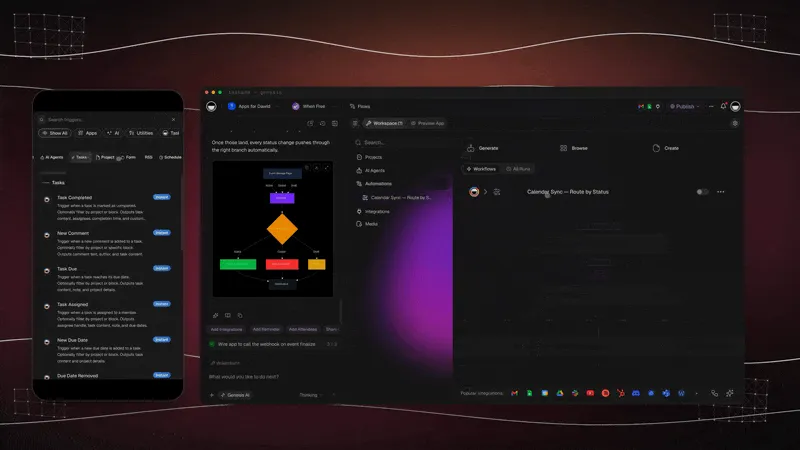
Schedule an automation that searches, reads, and files what it finds, then routes it to the right person.

Taskade speaks MCP in both directions: a hosted MCP server lets outside AI tools work in your workspace on paid plans, and the MCP Client action calls other MCP servers from your automations.
Build a living market tracker instead of reading one
History pages go stale the day they publish. A tracker does not. With Taskade Genesis, you can describe a live dashboard for any company or market, for example "track funding rounds, product launches, and competitor moves for browser-infrastructure startups, and summarize changes every Monday," and get a working app with an agent and a scheduled automation behind it.

Clone a live investor dashboard from the Community Gallery, then point it at the companies you follow.
Taskade runs on 15+ frontier models from OpenAI, Anthropic, and open-weight providers, with role-based access from Owner to Viewer, and paid plans start at $10 a month billed annually. Start with a free AI agent →
🔮 What's Next for Browserbase?
Browserbase enters late 2026 with a clear lead in funding among pure hosted-browser startups, a framework that keeps growing, and a platform that now spans search, fetch, identity, and managed agents. The open questions are commoditization, delegation, and whether a company with this much agent traffic trains its own models.
Commoditization. More than ten funded startups now sell cloud browsers, and Cloudflare offers its own. Browserbase's answer so far is to own the layers above the browser: Stagehand, identity, and agents. The next two years will test whether developers pay a premium for that stack or treat browsers as interchangeable.
Delegation. Signed requests solved "which platform is this?" The harder question is "which person does this agent act for, and what may it do?" Okta's Cross App Access, 1Password's autofill, and Stytch's work point at the answer Klein described in 2025: scoped, approved, revocable agent access.
Models. Erika Bricky said in July 2026 that Browserbase is probably the largest aggregator of computer-use data generated by agents, and that Klein had tweeted "we should just train our own model," while the company says publicly it is not doing so right now. If that changes, Browserbase stops being only a road and starts building cars.
The bet. Klein's own scoreboard is public. In February 2025 he predicted a billion-dollar company and said to check back in five years. The check-in date is 2030. 🔮
🔗 Related Reading
- Browser Agents Explained: how browser agents work, what shut down in 2026, and the API-first, browser-last ladder
- What Are AI Agents? The Complete Guide: the perceive, reason, act, learn loop behind every browser agent
- History of Anthropic and Claude: the lab behind computer use and Claude in Chrome
- History of OpenAI and ChatGPT: from GPT to Operator, ChatGPT agent, and Atlas
- History of Web Browsers: WorldWideWeb, Mosaic, Netscape, and Chrome
- History of Mermaid.js: the diagrams-as-code story behind every diagram on this page
- History of HyperCard: Bill Atkinson's software for people who do not program
- LLM vs RAG vs AI Agent vs Agentic AI: where browser agents sit on the capability ladder
- AI Web Scraping Without Code: pull live page data into a table on a schedule
- The History of MCP: the protocol that lets assistants call a browser server
- Context Engineering: why small, atomic steps beat long prompts
- Agent Builders Explained and the best AI agent builders
- Claude Code History: the coding agent that made agents mainstream
- Wiki: Browser agents, Computer-use agents, Agent sandbox, Agent experience, MCP client
📚 Sources
- Paul Klein IV, An Internet Browser for AI (November 30, 2023)
- Latent Space: Open Operator, Serverless Browsers and the Future of Computer-Using Agents (February 28, 2025)
- Open Source Startup Podcast, Episode 184: Building the Browser for AI (October 2025)
- Omar Waseem: Browserbase, the Company Building Browsers for AI (October 2025)
- Upstarts: Browserbase raises $40M and launches Director (June 2025)
- Browserbase: Series B and beyond and the Browserbase blog
- VentureBeat on the Browserbase seed round (June 2024)
- Mux acquires Stream Club (December 2021)
- Cloudflare: Web Bot Auth, signed agents, and pay per crawl
- Stagehand on GitHub and the npm download API
- Contrary Research: Browserbase
- Image credits: WorldWideWeb screenshot and NCSA Mosaic screenshot, Wikimedia Commons (public domain and CC0)
💬 Frequently Asked Questions About Browserbase
What is Browserbase?
Browserbase is a San Francisco company that runs real web browsers in the cloud for AI agents and automation code. Developers connect over the Chrome DevTools Protocol and click, type, read, and log in on websites the way a person would. It also maintains Stagehand, an open-source framework, and sells search, fetch, identity, and managed-agent products.
Who founded Browserbase and when?
Paul Klein IV founded Browserbase alone in January 2024, two months after publishing "An Internet Browser for AI" on November 30, 2023. He was an engineer at Twilio and then co-founder and CTO of Stream Club, a browser-based streaming studio that Mux acquired in December 2021.
How much money has Browserbase raised?
A reported $67.5 million: a $1.8 million pre-seed (March 2024), a $6.5 million seed led by Kleiner Perkins (June 2024), a $21 million Series A co-led by Kleiner Perkins and CRV (October 2024), and a $40 million Series B led by Notable Capital at a $300 million valuation (June 2025).
What is Stagehand?
Stagehand is Browserbase's MIT-licensed framework for controlling a browser with code and natural language. Its methods act, extract, and observe click, pull structured data, and list available actions. It launched in October 2024 and passed 5 million monthly npm downloads in August 2026.
Is Browserbase open source?
Stagehand is open source under the MIT license with more than 25,000 GitHub stars. The hosted browser infrastructure is closed source, and Paul Klein argues that its value is the team that keeps the fleet running, not the container files.
What is Browserbase Director?
Director turns a plain-English task into a reusable Stagehand script by running an agent in a live browser. It launched with the Series B in June 2025, and Paul Klein calls it an agent builder, the v0 of web automation.
How does Browserbase handle CAPTCHAs and bot detection?
It started with proxies, CAPTCHA solving, and stealth. Since August 2025 it has used Cloudflare's signed agents program and Web Bot Auth signatures, and in April 2026 it reframed stealth as identity with Verified browsers. CAPTCHA solving remains a separate feature.
What are the best Browserbase alternatives?
Kernel, Anchor Browser, Steel, Hyperbrowser, Browserless, Bright Data, and Cloudflare Browser Run offer cloud browsers. Browser Use and Skyvern pair frameworks with their own clouds, and Firecrawl and Apify specialize in crawling. Pick by whether you need a raw browser, an agent framework, or clean page data.
Do you have to pay for Browserbase to use Stagehand?
No. Stagehand is MIT-licensed and runs on a local browser, so you pay only your model provider. You pay Browserbase when you run Stagehand on its cloud browsers, which add live view, recordings, proxies, identity, and parallel sessions. There is a free plan, and paid plans start at $20 a month.
Where is Browserbase headquartered and how big is the team?
Browserbase is based in San Francisco. It had about 20 people in February 2025, 30 at the June 2025 Series B, and about 45 by September 2025, and a third-party estimate put it near 85 in August 2026.
Can Taskade AI agents browse the web?
Taskade agents search the web and read pages, and automations add Search Web, Scrape Webpage, and HTTP Request actions plus 100+ bidirectional integrations. Taskade does not click or log in on other websites. Teams pair a browser service for those steps, and Taskade provides the workspace where results are stored, reasoned over, and routed.
The first browser could read and write. For thirty years, machines mostly read. Browserbase's history is the story of giving software the other half back, one session at a time, and of the fight over who gets to use it. ▲ ■ ●