






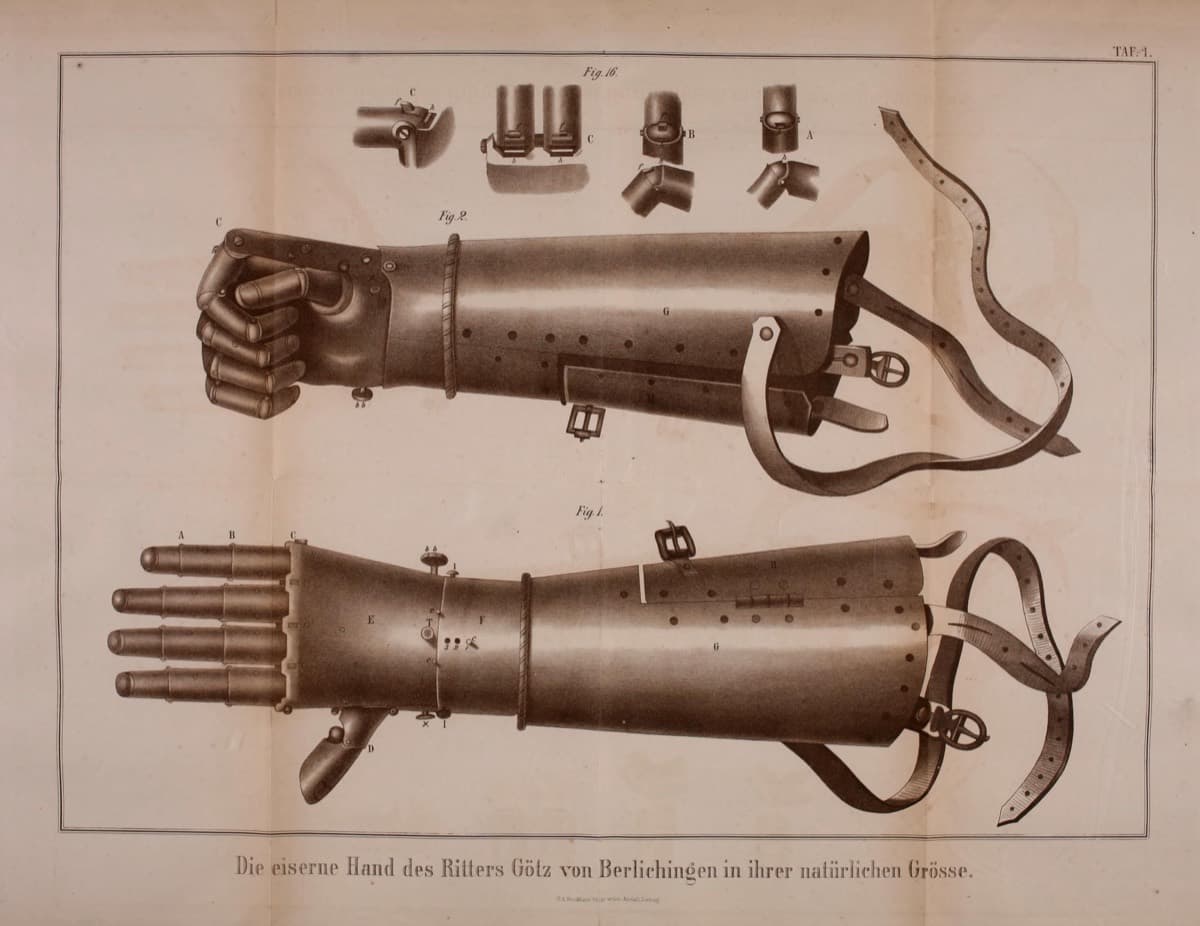
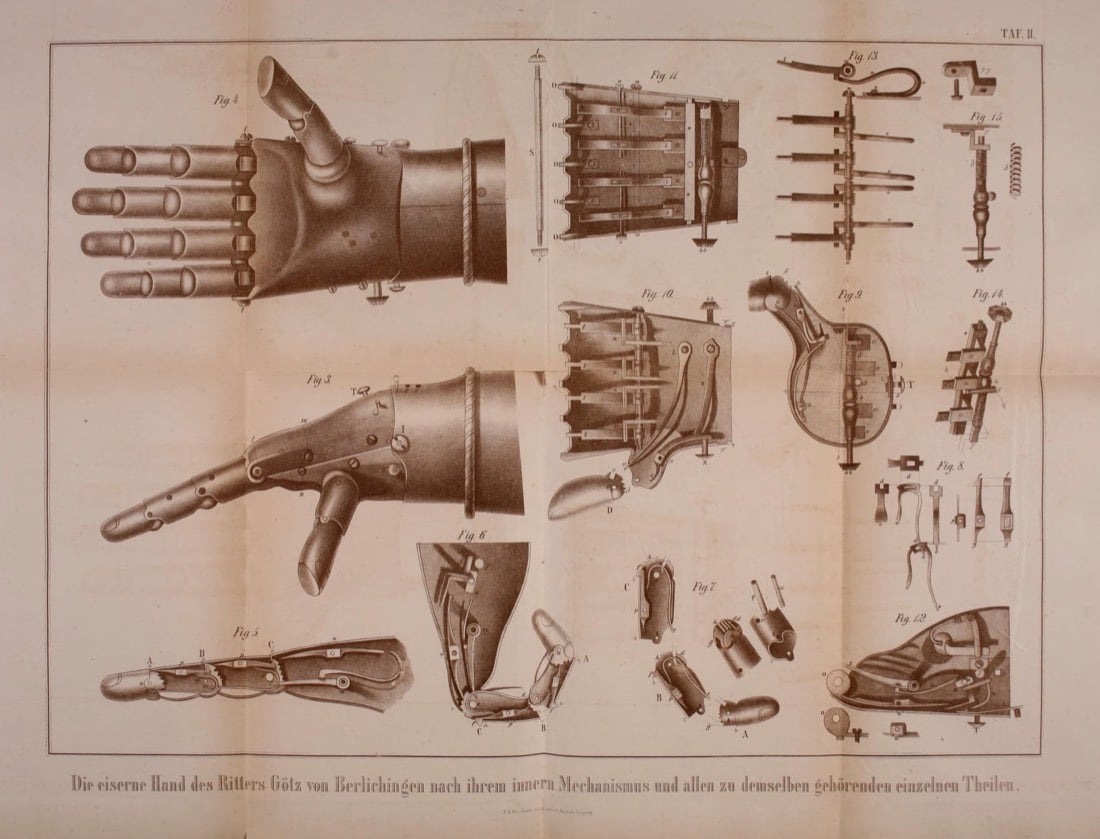
In 1504, at the siege of Landshut, a German knight named Götz von Berlichingen lost his right hand to his own sword when cannon fire drove it back against him. He had a replacement built out of iron. The second version had jointed fingers on ratchets that could be set by hand, and it held a shield, a rein, or a quill. It felt nothing. It reasoned about nothing. It just closed on the thing you put in it and did not let go.
That is a surprisingly exact description of what happened to language models between 2021 and 2026.
A model on its own is a very good reader and writer with no way to touch anything. It cannot check today's price, run a query, send an email, or add two large numbers reliably. The entire history below is the story of bolting a hand onto it: first as a research trick, then as an API parameter, then as an open protocol, and finally as a screen it could point at. This is the missing link between "chatbot" and "agent," and it happened in about forty months.
TL;DR: LLM tool use went from a research paper to industrial plumbing in under four years. Toolformer landed February 9, 2023, OpenAI shipped function calling June 13, 2023, and by December 9, 2025 the Model Context Protocol reported 97 million monthly SDK downloads across 10,000 active servers. See how Taskade agents use tools →
What Is Tool Use in a Large Language Model?
Tool use is the ability of a model to emit a structured request naming an external function and its arguments, which software outside the model then executes and feeds back as new context. The model does not run anything. In a 2026 production stack, a single tool call crosses four boundaries: the model writes a call, a harness validates it against a schema, the harness executes it, and the result re-enters the transcript as fresh input.
That separation is the whole design. It is why tool calling is safe enough to ship: every permission check, timeout, rate limit, and audit log lives in the code around the model, never inside it. It is also why tool use is not one invention but a stack of them, each fixing a failure the previous layer exposed.
Three terms get used interchangeably and should not be:
- Tool use is the capability.
- Function calling is the specific API mechanism: declare a function with a JSON Schema, get back a name and arguments, run it yourself.
- Provider-hosted tools are functions the model vendor runs on your behalf, such as web search or a code sandbox. You never see the call.
The Prehistory: Why a Model Needed Hands at All (2021 to 2022)
Every early tool-use paper is answering the same complaint: a model that has read the entire internet still cannot tell you what happened this morning, and still gets long multiplication wrong. The knowledge is frozen at the training cutoff and the arithmetic is pattern-matched rather than computed. Neither problem gets solved by scale, which is exactly why researchers reached outside the model instead.
| Research milestone | Date | The idea | What it proved |
|---|---|---|---|
| WebGPT | Dec 17, 2021 | Fine-tune GPT-3 to issue commands in a text-based browser | A model could act in an environment, not just answer |
| MRKL Systems | May 1, 2022 | Route parts of a query to calculators, databases, and APIs | Named the neuro-symbolic pattern the whole field rebuilt |
| ReAct | Oct 6, 2022 | Interleave a reasoning trace with actions and observations | Gave tool use a repeatable loop shape |
| LangChain | Oct 24, 2022 | Open-source glue for chaining prompts and tools | Made tool use a weekend project, not a lab project |
| PAL | Nov 2022 | Model writes Python, an interpreter runs it | Offloading computation beat teaching models to compute |
WebGPT is the one people forget. Reiichiro Nakano and colleagues at OpenAI fine-tuned GPT-3 to answer long-form questions inside a text-only web browser, with human feedback deciding which browsing behavior was good. It shipped in December 2021, a full year before ChatGPT. The model was already searching, clicking, and quoting sources. It just had no product around it.
MRKL, from AI21 Labs in May 2022, contributed the architecture diagram everyone else redrew. Its acronym stands for Modular Reasoning, Knowledge and Language, and its argument was blunt: stop trying to make one network do discrete reasoning, and route those parts to modules that already do it correctly.
The Definitive Timeline of LLM Tool Use, 2021 to 2026
Tool use crossed from research to default API surface in roughly thirty months, between the ReAct paper in October 2022 and the OpenAI Responses API in March 2025. Every row below is dated to a primary source: an arXiv submission, a vendor announcement, or a protocol specification revision.
| Date | What shipped | What changed | Why it mattered |
|---|---|---|---|
| Dec 17, 2021 | WebGPT | GPT-3 fine-tuned to browse a text web environment | First widely cited proof a model could act |
| May 1, 2022 | MRKL Systems | Router sends sub-queries to external modules | Named the pattern the field would rebuild |
| Oct 6, 2022 | ReAct | Thought, action, observation, repeat | The loop every agent framework still copies |
| Oct 24, 2022 | LangChain first commit | Reusable tool and chain abstractions | Tool use became accessible outside labs |
| Nov 2022 | PAL | Reasoning as generated code, run by an interpreter | Symbolic offload beats bigger models on math |
| Feb 9, 2023 | Toolformer | Model self-labels its own API calls, then fine-tunes | Tool use could be learned, not just prompted |
| Mar 23, 2023 | ChatGPT plugins | Browsing, code interpreter, retrieval, 12 partners | First consumer-scale tool ecosystem |
| Mar 30, 2023 | HuggingGPT | LLM as controller selecting other models as tools | Tools stop being APIs, start being models |
| May 24, 2023 | Gorilla | Model fine-tuned on three model-hub API sets | API hallucination becomes a measurable defect |
| Jun 13, 2023 | OpenAI function calling | functions parameter; model returns JSON arguments |
The date tool use became a normal API feature |
| Nov 6, 2023 | OpenAI DevDay | Parallel function calling, JSON mode, Assistants API | One turn could now fan out to many tools |
| Nov 21, 2023 | Claude 2.1 | Tool use in beta, 200K context window | Second frontier lab ships the primitive |
| Dec 13, 2023 | Gemini Pro API | Function declarations in an OpenAPI-shaped schema | Three-way format divergence begins |
| Feb 2024 | Berkeley Function-Calling Leaderboard | Public head-to-head eval of tool calls | You could finally argue with numbers |
| Feb 15, 2024 | Gemini function calling GA | Generally available on Vertex AI | All three major APIs now support it |
| May 30, 2024 | Anthropic tool use GA | Across the Claude 3 family, Bedrock, Vertex AI | Tool use is table stakes, not a differentiator |
| Jun 17, 2024 | tau-bench | Agent plus simulated user plus domain policy | Exposed consistency, not just accuracy |
| Aug 6, 2024 | Structured Outputs | strict: true guarantees schema-valid arguments |
Ends the "model returned bad JSON" era |
| Oct 22, 2024 | Computer use | Screenshot in, mouse and keyboard out | The tool becomes the entire screen |
| Nov 25, 2024 | Model Context Protocol | Open spec for exposing tools to any client | N by M integrations collapse to N plus M |
| Jan 23, 2025 | OpenAI Operator | Computer-Using Agent model in a hosted browser | Computer use becomes a consumer product |
| Mar 11, 2025 | Responses API + Agents SDK | Built-in web search, file search, computer use | Tools move to the provider's servers |
| Mar 26, 2025 | MCP spec revision + OpenAI adopts MCP | Streamable HTTP transport, structured authorization | Remote servers viable; protocol goes cross-vendor |
| Apr 9, 2025 | Google commits to MCP | Support in the Gemini API and SDK | Three-way agreement on the plumbing |
| Jun 18, 2025 | MCP spec revision | OAuth 2.1 resource-server model, elicitation | Enterprise authorization story lands |
| Nov 24, 2025 | Advanced tool use | Tool search, programmatic tool calling, examples | "Too many tools" becomes the new bottleneck |
| Nov 25, 2025 | MCP spec revision 2025-11-25 | Current protocol version | Stable target for client and server authors |
| Dec 9, 2025 | MCP joins the Agentic AI Foundation | Vendor-neutral governance under the Linux Foundation | Tool plumbing becomes shared infrastructure |
Toolformer: The Model That Taught Itself to Use an API
Toolformer, submitted to arXiv on February 9, 2023 by Timo Schick, Jane Dwivedi-Yu, Roberto Dessì, Roberta Raileanu, Maria Lomeli, Luke Zettlemoyer, Nicola Cancedda, and Thomas Scialom at Meta AI, showed a model could decide for itself when an API call was worth making. The training method is the interesting part: the model sampled candidate API calls into its own training text, executed them, and kept only the calls whose results reduced its prediction loss on the following tokens. Then it fine-tuned on what survived.
The tool set was deliberately mundane: a calculator, a question answering system, two search engines, a translation system, and a calendar. That mundanity is the point. The paper's framing is that models "struggle with basic functionality, such as arithmetic or factual lookup, where much simpler and smaller models excel." The fix was never to make the model better at arithmetic. The fix was to let it hand arithmetic to a calculator.
Toolformer is the conceptual ancestor of every "the model knows which tool to reach for" claim made since. It also set up the failure mode that dominated the next three years: a model that decides when to call can also decide wrongly, confidently, and repeatedly.
ReAct: The Loop That Made Tools Repeatable
ReAct, submitted October 6, 2022 by Shunyu Yao, Jeffrey Zhao, Dian Yu, Nan Du, Izhak Shafran, Karthik Narasimhan, and Yuan Cao, is the single most copied structure in agent engineering. It interleaves a reasoning trace with task actions so the model can revise a plan after seeing what actually happened. The paper reports absolute success rate improvements of 34 percent on ALFWorld and 10 percent on WebShop over imitation and reinforcement learning baselines, plus gains on HotpotQA and Fever.
What made it stick was not the score. It was the shape. Before ReAct, a tool call was a one-shot substitution. After ReAct, it was a cycle with a stopping condition, which is exactly what an agent loop is. The ReAct pattern is why your agent framework has a max_steps parameter.
What Actually Happens During One Tool Call
Exactly one step in a tool call touches the outside world, and the model is not in it. The model produces text; the agent harness parses, validates, authorizes, executes, and returns. Read the trace below and notice that turns two and four are pure text generation, while turn three is ordinary software doing ordinary work.
TURN 1   -> model      role: user
                       content: "What was our Q3 revenue?"
           tools[]     [{ name: "query_db",
                          input_schema: { sql: string } }]TURN 2   <- model      stop_reason: tool_use
tool_call   { id: "call_01",
name: "query_db",
arguments: { sql: "SELECT sum(amount) ..." } }
NOTE        The model produced TEXT. Nothing has run yet.
TURN 3   -> harness    validate args -> check permission -> set timeout
-> execute -> catch errors -> redact
tool_result { tool_use_id: "call_01",
content: "418293.55" }
NOTE        This is the ONLY step that touches the world.
TURN 4   <- model      stop_reason: end_turn
content     "Q3 revenue was $418,293.55."
Everything that has ever gone wrong with an AI agent went wrong at one of those four lines. Bad arguments break turn two. Missing permission checks break turn three. Errors returned as prose instead of structured data break turn four, because the model reads "something went wrong" and narrates a plausible answer anyway. This is why agent permissions and the agent environment matter more than model choice for reliability.
Tool-Calling Formats by Provider
There is no single wire format for tool calls, and the differences are not cosmetic. Anthropic returns a parsed object, OpenAI returns a JSON string you must parse yourself, and Google expects an OpenAPI-flavoured declaration. Framework authors spend real effort on this table.
| Surface | Where tools are declared | What comes back | The constraint that bites |
|---|---|---|---|
| OpenAI Chat Completions | tools[], each a JSON Schema function |
tool_calls[] with id, name, and arguments as a string |
You must JSON.parse the arguments; set strict: true for schema guarantees |
| OpenAI Responses API | tools[] including hosted web search, file search, computer use |
Typed output items in one unified stream | Built-in tools execute on the provider's servers, not yours |
| Anthropic Messages API | tools[], each with an input_schema |
A tool_use content block with a parsed input object; stop_reason: "tool_use" |
The result goes back as a tool_result block inside a user turn |
| Google Gemini | tools[].function_declarations in an OpenAPI schema subset |
A functionCall part carrying args |
Only a subset of JSON Schema is accepted |
| Model Context Protocol | Server advertises via tools/list |
Client invokes via tools/call |
Model-agnostic: it sits above whichever API you use |
The practical consequence is that "supports function calling" is not a binary. It never was.
2024: The Year Tool Calls Became Reliable
Reliability, not capability, was the 2024 story. On August 6, 2024, OpenAI shipped Structured Outputs, reporting that gpt-4o-2024-08-06 scored 100 percent on complex JSON Schema adherence evaluations against under 40 percent for gpt-4-0613. Setting strict: true on a function definition moved argument validity from "usually fine" to a decoding guarantee.
Measurement caught up in the same window. The Berkeley Function-Calling Leaderboard arrived in February 2024 from the same Berkeley group behind Gorilla, scoring single calls, parallel calls, multiple-tool selection, and the underrated skill of declining to call a tool when none applies. Then tau-bench, published June 17, 2024 by Shunyu Yao, Noah Shinn, Pedram Razavi, and Karthik Narasimhan, put an agent in a conversation with a simulated user under domain rules and introduced a pass-to-the-k metric that measures whether the agent behaves the same way across repeated trials. The headline finding was uncomfortable: strong models succeeded on fewer than half the tasks, and consistency was far worse than raw accuracy suggested.
| Benchmark | First published | What it measures | What it exposed |
|---|---|---|---|
| APIBench / Gorilla | May 24, 2023 | Selecting the right API across three model hubs | API hallucination is its own failure class |
| Berkeley Function-Calling Leaderboard | Feb 2024 | Single, parallel, multiple, and irrelevance detection | "Supports function calling" hides huge variance |
| tau-bench | Jun 17, 2024 | Tool, agent, and user under domain policy | Consistency collapses even when accuracy looks fine |
| WebArena | Jul 2023 | Realistic tasks on self-hosted web apps | Web agents sat far below human completion |
| OSWorld | Apr 2024 | Open-ended tasks on a real desktop | Screen-level control was barely functional at launch |
If you are building evaluation into your own workflows, the same discipline applies at product scale: see agent evals explained and agent evaluation.
Computer Use: When the Tool Became the Whole Screen
Computer use removed the requirement that a tool exist at all. On October 22, 2024, Anthropic released a public beta in which Claude reads a screenshot and returns cursor movements, clicks, and keystrokes, scoring 14.9 percent on OSWorld against a next-best model at 7.7 percent and humans at 70 to 75 percent. The company described the model as learning to "count how many pixels vertically or horizontally it needs to move a cursor," and called the result slow and often error-prone.
OpenAI followed on January 23, 2025 with Operator, powered by a Computer-Using Agent model that combined vision with reasoning and reported 38.1 percent on OSWorld and 58.1 percent on WebArena. Fourteen months separated a 14.9 and a 38.1 on the same benchmark.
The strategic significance is bigger than the scores. Function calling requires someone to build and maintain an API. Computer use requires only that software have a screen, which describes essentially all enterprise software written before 2015. That is why computer use agents and browser agents became the fallback path for systems with no integration story, and why they carry the highest risk: a model that can click anything can click the wrong thing.
MCP: Solving the N by M Problem
The Model Context Protocol, released by Anthropic on November 25, 2024, standardized how a tool is published so that it does not have to be rebuilt for every client. Before MCP, connecting N applications to M tools meant writing N times M integrations. After MCP, each application implements the protocol once and each tool implements it once, which is N plus M.
The launch shipped three things at once: the specification and SDKs, local server support in Claude Desktop, and a repository of pre-built servers for Google Drive, Slack, GitHub, Git, Postgres, and Puppeteer. Block and Apollo were named as early adopters.
What made it a standard rather than a vendor format was the next five months. Sam Altman confirmed OpenAI support on March 26, 2025, starting with the Agents SDK. Demis Hassabis said Google would support it in the Gemini API and SDK on April 9, 2025. By December 9, 2025 Anthropic donated MCP to the newly formed Agentic AI Foundation under the Linux Foundation, alongside Block's goose and OpenAI's AGENTS.md, with platinum members including AWS, Anthropic, Block, Bloomberg, Cloudflare, Google, Microsoft, and OpenAI.
| Spec revision | Headline change | Practical effect |
|---|---|---|
| 2024-11-05 | Initial release, local-first transports | Desktop-scoped servers, no mandated auth |
| 2025-03-26 | Streamable HTTP transport, structured authorization | Remote and proxy-friendly servers become viable |
| 2025-06-18 | OAuth 2.1 resource-server model, elicitation | Standards-based enterprise authorization |
| 2025-11-25 | Current revision | Stable target for client and server authors |
If you are wiring MCP into a real workspace, start with what MCP is, then MCP servers, choosing between servers, and building a hosted server. The wiki entries for MCP servers and MCP clients cover the two halves of the protocol.
2025 to 2026: The New Bottleneck Is Too Many Tools
Once every tool was easy to publish, the constraint moved from access to attention. Every tool definition is text sitting in the context window before any work begins, and near-duplicate tools make selection harder rather than easier. On November 24, 2025 Anthropic shipped three features aimed squarely at this: a Tool Search Tool, Programmatic Tool Calling, and Tool Use Examples.
The reported numbers are specific. Loading tool definitions on demand rather than upfront cut one measured context load from 77,000 tokens to 8,700, an 85 percent reduction, while accuracy on Anthropic's MCP evaluation rose from 49 to 74 percent for Opus 4 and from 79.5 to 88.1 percent for Opus 4.5. Programmatic tool calling, where the model writes code that orchestrates tools inside a sandbox and only the final output re-enters context, dropped average usage from 43,588 to 27,297 tokens on complex research tasks, a 37 percent reduction. Tool Use Examples raised accuracy on complex parameter handling from 72 to 90 percent.
The academic literature has caught up as well. A March 2026 survey, The Evolution of Tool Use in LLM Agents, organizes the field across inference-time planning, training methods, safety, resource efficiency, capability completeness, and evaluation, and draws the line this article draws: single-tool calls and long-horizon multi-tool orchestration are different problems.
What Still Breaks, and What Fixed It
Six failure modes account for most production incidents involving tool-using agents, and five of them have a known mitigation with a shipping date attached. This is the practical distillation of the timeline above.
| Failure | What you see | Root cause | What fixed it |
|---|---|---|---|
| Invalid arguments | JSON that will not parse or omits a field | Free-form generation of a structured payload | Constrained decoding and strict schemas, Aug 2024 |
| Wrong tool chosen | Calls search when it should query the database | Too many similar tool descriptions | Fewer, sharper tools; on-demand tool search, Nov 2025 |
| Tool definition bloat | Context is half full before work starts | Every schema sent on every request | Deferred loading of definitions, Nov 2025 |
| Silent failure | Tool errors, model narrates a plausible result anyway | Errors returned as prose, not structure | Structured error objects plus explicit retry policy |
| Runaway loop | The same call repeated until the budget dies | No progress check in the loop | Step budgets, loop detection, approval gates |
| Irreversible action | The invoice was sent twice | No idempotency on write operations | Dry runs, idempotency keys, human in the loop |
The pattern across all six is the same one Götz von Berlichingen's blacksmith understood. The hand does not need to feel. It needs a ratchet that holds a defined position, and a person who decides what to put in it. For deeper coverage of the recovery half, see AI agent error recovery and agent observability.
How Taskade Puts Tools in an Agent's Hands
Taskade AI Agents come with tools already wired, so the tool-selection problems above are configuration rather than engineering. Agents draw on a built-in toolset including web search, file analysis, and workspace actions, and they act inside the same workspace where your projects, documents, and data already live. That matters because the hardest part of tool use in practice is not the call format, it is giving the model an environment worth acting in.
Three pieces do the work:
- 100+ bidirectional integrations across the tools your team already uses. Triggers pull events in, actions push data out, so an agent can both watch for a change and respond to it.
- A hosted MCP server on paid plans, which lets outside AI clients connect to your Taskade workspace over the open protocol described above. The connection runs one direction only: clients connect in. To reach outward into your own systems, Taskade agents use 100+ integrations rather than third-party MCP servers. See the Taskade MCP server and the setup guide.
- Automations for the deterministic parts. When a step must run the same way every time, a workflow beats a model deciding, and the agent calls the workflow as a tool.
Taskade Genesis turns a plain-language description into a working app with agents and automations attached, and Taskade EVE coordinates the agents inside it. Under the hood you get frontier models from top AI labs, so tool-heavy work can be routed to whichever model handles it best. Everything lands in a workspace with multiple project views: List, Board, Calendar, Table, Mind Map, Gantt, and Org Chart.
Paid plans start at $10 per month for Pro, billed annually. Start building free →
Frequently Asked Questions
What is tool use in a large language model?
Tool use is the ability of a language model to produce a structured request that names an external function and supplies its arguments, so software outside the model can run it and hand the result back. The model never executes anything itself. It writes a call, a surrounding program runs it, and the output is appended to the conversation for the next turn.
When did function calling actually launch?
OpenAI shipped function calling in the Chat Completions API on June 13, 2023, with the gpt-3.5-turbo-0613 and gpt-4-0613 models. Anthropic put tool use in beta with Claude 2.1 on November 21, 2023 and made it generally available on May 30, 2024. Google added function calling to the Gemini API in December 2023 and marked it generally available on Vertex AI on February 15, 2024.
What is the difference between tool use and function calling?
Tool use is the capability. Function calling is the API mechanism most providers use to deliver it. Function calling specifically means declaring a function with a JSON Schema, having the model return the function name plus arguments, and running it yourself. Tool use is the broader term that also covers provider-hosted tools such as web search and code execution, and screen-level control such as computer use.
What was Toolformer and why did it matter?
Toolformer was a February 9, 2023 paper from Meta AI by Timo Schick and colleagues showing a language model could teach itself when to call an API. The model annotated its own training data with candidate API calls, kept only the calls that reduced prediction loss, then fine-tuned on the result. It used a calculator, a question answering system, two search engines, a translator, and a calendar.
What is the ReAct pattern?
ReAct is a prompting pattern from the October 6, 2022 paper by Shunyu Yao and colleagues that interleaves a reasoning trace with actions and observations, so the model thinks, acts, reads the result, and thinks again. It reported absolute success rate gains of 34 percent on ALFWorld and 10 percent on WebShop over imitation and reinforcement learning baselines, and it is still the loop shape most agent frameworks use.
Does the model actually run the tool?
No. The model only emits text that happens to be a well-formed call. The surrounding program, usually called an agent harness, parses that call, validates the arguments, decides whether it is allowed, executes it, catches errors, and appends the result to the transcript. Every safety control, permission check, timeout, and retry lives in the harness, not in the model.
What is the Model Context Protocol and how does it relate to function calling?
The Model Context Protocol is an open standard Anthropic released on November 25, 2024 that lets any application expose tools, resources, and prompts to any AI client over one wire format. Function calling is how a specific model API receives a tool. MCP is how a tool gets published once and reused by many clients, which turns an N by M integration problem into N plus M.
Why do AI agents get worse when you give them more tools?
Because every tool definition is text that occupies the context window before the work starts, and near-duplicate tools make selection harder. Anthropic reported on November 24, 2025 that loading tools on demand instead of upfront cut one measured context load from 77,000 tokens to 8,700, an 85 percent reduction, and raised accuracy on its MCP evaluation from 79.5 percent to 88.1 percent for its strongest model.
What is computer use and how is it different from function calling?
Computer use gives a model a screenshot and lets it return mouse and keyboard actions, so it drives ordinary software instead of calling a purpose-built API. Anthropic shipped it in public beta on October 22, 2024, scoring 14.9 percent on OSWorld against 70 to 75 percent for humans. OpenAI shipped Operator on January 23, 2025, reporting 38.1 percent on OSWorld and 58.1 percent on WebArena.
What are the main benchmarks for LLM tool use?
The Berkeley Function-Calling Leaderboard, first released in February 2024, scores single, parallel, multiple, and irrelevance-detection calls. Tau-bench, published June 17, 2024, tests an agent against a simulated user and domain policies with a pass-to-the-k metric for consistency. OSWorld and WebArena measure screen-level and web-level task completion for computer use agents.
How do I give an AI agent tools without writing code?
Use a platform where the tools are already wired. Taskade AI Agents ship with a built-in toolset covering web search, file analysis, and workspace actions, plus 100+ bidirectional integrations and a hosted MCP server on paid plans. You describe the job in plain language and the agent picks the tools. Paid plans start at $10 per month for Pro, billed annually.
Keep Reading
- The history of workflow automation for the pre-AI half of this story
- The agent harness explained, the software layer that actually runs your tools
- Agentic design patterns and the AI agent stack
- What is LangChain and the history of Claude Code
- Context engineering, because tool definitions are context too
- Wiki: tool calling, tools, structured outputs, chain of thought, agent skills, agent sandbox
- Product: Taskade AI Agents, Automations, Integrations, Community apps
Forty months separate a research paper about a model that could use a calculator from a Linux Foundation project with 97 million monthly SDK downloads. The models did not change shape in that time. What changed is that we built them a hand, then a wrist, then a rule about what they are allowed to pick up. Memory tells an agent what it knows, intelligence tells it what to do, and execution is the part that finally touches something real.
▲ ■ ●