






How often do you touch base with your distributed team? If the answer is “whenever it’s necessary,” then you’re missing out on a number of interesting benefits of organic internal communication. Find out how you can leverage the power of dialogue to make your team more self-sufficient, tight-knit, and productive.
Here are some questions we’re biting into in this article:
💡 Before you begin… This is another installment in our mini-series on effective communication in remote teams. Be sure to catch up on the previous articles once you’re done reading:
💬 What’s Internal Communication?
Think about the time and effort you put into communicating with your clients. You guide them through the sales process, follow up after the deal, and touch base once in a while to see if they need anything else.
Good internal communication in a distributed team isn’t much different. But instead of helping your clients succeed, you do the same for your remote workers.
The typical internal communication channels include:
🎙 Virtual meetings (video conferencing or calls)
📬 Internal newsletters
🗣 Team-wide chat sessions
🗄 Wikis and knowledge bases
👥 1-on-1, direct messages
💬 Company blog
The purpose? Most of the time, internal newsletters and memos are limited to rolling out policy changes, pushing project updates, and announcing personnel comings and goings. What a waste...
When done right, organic internal communication can help you break interpersonal barriers, prevent misunderstanding, and motivate your team to fight another day.
But that’s not all.
Why Should You Even Bother?
In the 2008 book Tribes: We Need You to Lead Us, author and keynote speaker Seth Godin brings up the uncanny, tribal nature of team communication. According to Godin:
“A tribe is a group of people connected, connected to a leader, and connected to an idea. For millions of years, human beings have been part of one tribe or another. A group needs only two things to be a tribe: a shared interest and a way to communicate.”(1)
Sure, at a glance, your distributed team may not seem like a tribe, at least not in the conventional mammoth-hunting and cave-dwelling sense. Your remote workers are probably spread across several time zones, come from different backgrounds, and may even speak different languages.
But as long as your folks are willing to hustle together toward a common goal (and not kill each other in the process), they are a tribe alright. And that means they need to communicate, coordinate_,_ and collaborate to not get eaten alive by, erm… bloodthirsty deadlines.
Here’s another reason why dialogue matters.
According to Buffer’s 2020 “State of Remote Work” report, collaboration and communication are remote workers’ top biggest struggles, with loneliness coming as a close second.
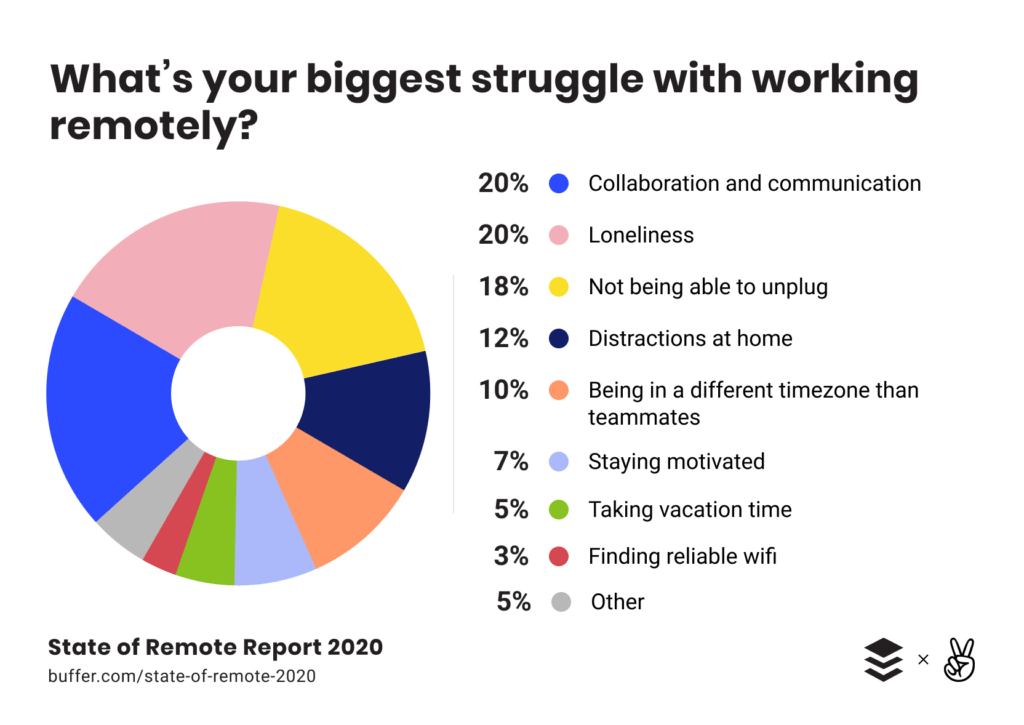
State of Remote Remote Work 2020 by Buffer(2)
The crazy thing about this is that these answers haven’t changed for three years in a row! Although the word “communication” is placated all over our hyperconnected world and we have the means (tools) to make it happen, there’s still plenty of room for improvement.

📈 3 Ways To Improve Your Internal Communication
1. Become a Fine Storyteller
Don’t want to start a team newsletter because you’re not a good communicator?
Don’t fret about it.
Ed Catmull, the author of Creativity, Inc.: Overcoming the Unseen Forces That Stand in the Way of True Inspiration, argues that it’s much better to share your imperfect, rough thoughts and ideas than to polish them ad infinitum and never ship.
As Catmull notes:
“Don’t wait for things to be perfect before you share them with others. Show early and show often. It’ll be pretty when we get there, but it won’t be pretty along the way.”(3)
Here’s the thing. Distributed teams need communication like, pardon the loftiness, a tree needs water. It’s much better to communicate often and improvise a bit than risk breaking team integrity.

No, your remote team won’t mind a makeshift but genuine email you put your heart into. As long as the message is clear and personal, the delivery can be a bit off.
So, again, how can you become a great storyteller?
🤷♀️ Focus on the clarity of the message
👨🎨 Give it a personal touch
🙋♀️ Weave in your own experience
👨🏻💼 Drop the jargon and salesy language
If you still feel that writing is beyond your depth, try Hemingway Editor. It’s a free tool that will help you adjust the tone of voice, cut out the fluff, and get more confident in what you have to say.
Taskade Internal Communication Tip #1
Writing doesn’t have to be (too) hard. Taskade lets you and your team create customizable templates for newsletters, memos, correspondence, and all kinds of business documentation.
Like this Weekly Team Update. 👇
To make your task even easier, we’ve compiled several useful templates that’ll help you keep your team on the ball, manage day-to-day business, and track your progress.
You access hundreds of our free templates here. 👈
2. Leave Some Breadcrumbs
“You can’t make people listen to you. You can’t make them execute. That might be a temporary solution for a simple task. But to implement real change, to drive people to accomplish something truly complex or difficult or dangerous—you can’t make people do those things. You have to lead them.”
Jocko Willink, Extreme Ownership: How U.S. Navy SEALs Lead and Win(4)
This is something we discussed in one of our previous articles, “The Sound of Remote Collaboration: Autonomous Squads.” tldr; The most effective remote teams are the ones that have all the skills and knowledge necessary to make decisions internally and act (mostly) autonomously.
If your internal comms are either non-existent or your team needs to constantly follow-up and pester you for business intel, it means you’re bottlenecking their performance big time.
Good internal comms not only give information and elicit a response but also provide enough context and resources (breadcrumbs) so your team always knows what to do next.
“So, how do I create those breadcrumbs?”

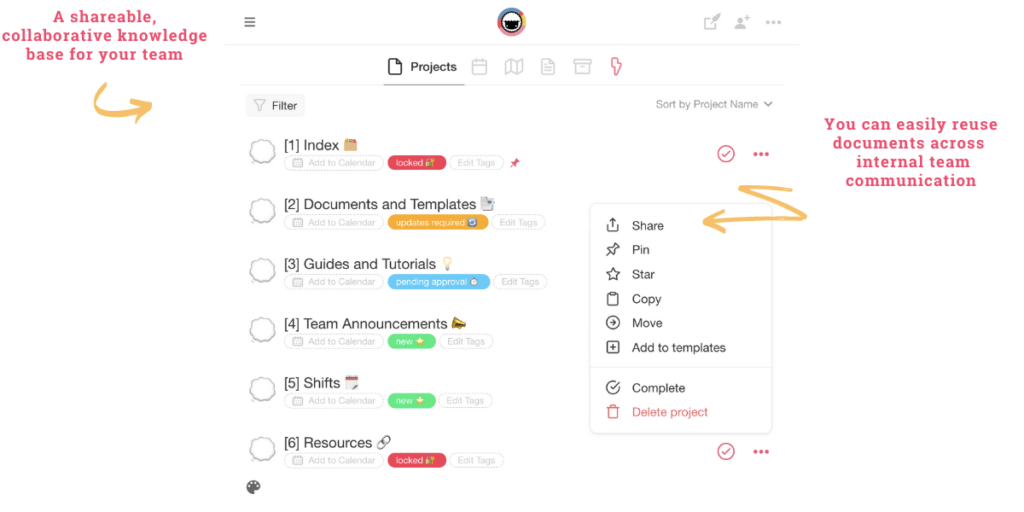
For starters, you’re going to need a single source of truth (SSOT) where you’ll store and curate your team’s collective knowledge. It can be a digital second brain, collaborative Zettelkasten, team wiki, or a knowledge base. The key is to make it accessible and easy to cross-link across your internal comms.
With a SSOT onboard, you’ll be able to store, curate and easily repurpose:
👉 Process guidelines
📑 Document templates
📼 Screenshots and videos
👨💻 Snippets of code
🔔 Project updates
And more...
Once you’ve mastered the art of making your internal communication crisp (and interesting), focus on actionability. Explicitly state what kind of response you expect, e.g. “complete the pulse survey by 5 pm,” offer help in completing the task, and most importantly provide all the extra resources for the task at hand.
Taskade Internal Communication Tip #2 🐑
Manually copying and pasting internal documents into your team communication isn’t very productive. In Taskade, you can create a collaborative bulletin board and simply cross-reference existing information.
Projects and blocks of text can be connected using the @mention functionality or hyperlinks embedded directly into the selected text. Drop by our Help Center to learn more.
3. Share the Responsibility
Effective internal communication is a two-way street. And that means your voice as a leader shouldn’t be the only one that’s heard. In other words, you don’t want the whole stage all to yourself.
Going back to Jocko Willinks’s Extreme Ownership:
“When a leader takes too much ownership, there is no ownership left for the team or subordinate leaders to take. So the team loses initiative, they lose momentum, they won’t make any decision, they just sit around and wait to be told what to do.”
So, how do you share ownership?

Start by appointing the communicator of the week. If you do send out a regular team newsletter (hats off to you), let other team members contribute. Rotate shifts and make sure everybody can share their thoughts and suggestions, and maybe even appreciate the work you’ve been putting in.
Here are some more ideas:
📬 Create a virtual suggestions box
🚦 Ask for feedback on internal comms
❤️ Run regular pulse surveys
💡 Ask for ad-hoc contributions
🤝 Acknowledge feedback
Oh, and one more thing.
Internal communication should flow naturally, up and down the command chain. And that’s exactly what Elon Musk made clear in one of his famous emails to Tesla employees:
“(...) people are forced to talk to their manager who talks to their manager who talks to the manager in the other dept who talks to someone on his team. Then the info has to flow back the other way again. This is incredibly dumb.”(5)
Your job as a leader is to encourage dialogue and nurture the spirit of companionship whenever possible. If you’re not sure where to start, give your team the right tools and let them take the initiative.
Taskade Internal Communication Tip #3 🐑
Want to create a team newsletter but don’t want to give up control completely? Taskade comes with several user roles/permissions you can assign or revoke depending on the situation.
Here’s a video explaining how permissions work in Taskade:
Frequently Asked Questions
How do you improve internal communication in a distributed team?
Establish clear communication channels and norms — define which tool is for what, set response-time expectations, create a shared knowledge base, hold regular but focused check-ins, and use project-based communication instead of generic chat channels. The key is making information easy to find, not just easy to send.
What are the most common internal communication problems in remote teams?
The biggest problems are information silos between tools, unclear ownership of decisions, important updates getting lost in chat, lack of informal knowledge sharing, and over-reliance on meetings for alignment. These issues compound across time zones and can severely impact team velocity.
Should distributed teams use synchronous or asynchronous communication?
Use both strategically. Default to async for updates, documentation, and non-urgent discussions — this respects time zone differences. Reserve synchronous communication for brainstorming, conflict resolution, and relationship-building. Most distributed teams communicate 80% async and 20% sync.
What tools improve internal communication for distributed teams?
Choose a platform that combines communication with work context. All-in-one workspaces like Taskade integrate chat, tasks, documents, and AI agents so conversations happen alongside the work they reference — eliminating the disconnect between 'where we talk' and 'where we work.'
🐑 Conclusion
Regular, organic internal communication is the key driver of employee engagement in distributed teams. Since your team doesn’t have the benefit of swing-by-your-desk exchanges and watercooler meetups, you should create an internal communication strategy that will bridge that information gap.
📚 Reading Corner
If you want to learn more about the principles of good team communication (not only in a remote setup), check these four awesome books for some ideas:
❓ Start with Why by Simon Sinek
⚔️ Extreme Ownership by Jocko Willink and Leif Babin
🤝 How to Win Friends & Influence People by Dale Carnegie
🍽 Leaders Eat Last by Simon Sinek
Supercharge team collaboration with Taskade AI! 🤖
🤖 Custom AI Agents: Set up your own AI agents to organize and plan your tasks or create clear, actionable plans for any project or goal.
🪄 AI Generator: Simplify the creation of personal projects and documents with an AI. Turn ideas into structured outlines and detailed plans.
✏️ AI Assistant: Use OpenAI GPT (frontier models) to enhance your writing and outlining tasks. Perfect for quickly drafting, organizing, and editing.
🗂️ AI Prompt Templates Library: Dive into a wide array of AI prompt templates to guide and inspire your personal and work projects.
💬 AI Chat: Engage with AI in a one-on-one conversation to dissect complex ideas, find solutions to problems, or plan next steps.
📄 Media Q&A: Use AI to analyze and summarize documents. Extract key insights without spending hours reading the whole thing.
And much more...

🔗 Resources
https://www.amazon.com/Tribes-We-Need-You-Lead-ebook/dp/B001FA0LAI
https://www.amazon.com/Creativity-Inc-Overcoming-Unseen-Inspiration/dp/0812993012
https://www.amazon.com/Extreme-Ownership-U-S-Navy-SEALs/dp/1250067057
https://www.inc.com/justin-bariso/this-email-from-elon-musk-to-tesla-employees-descr.html