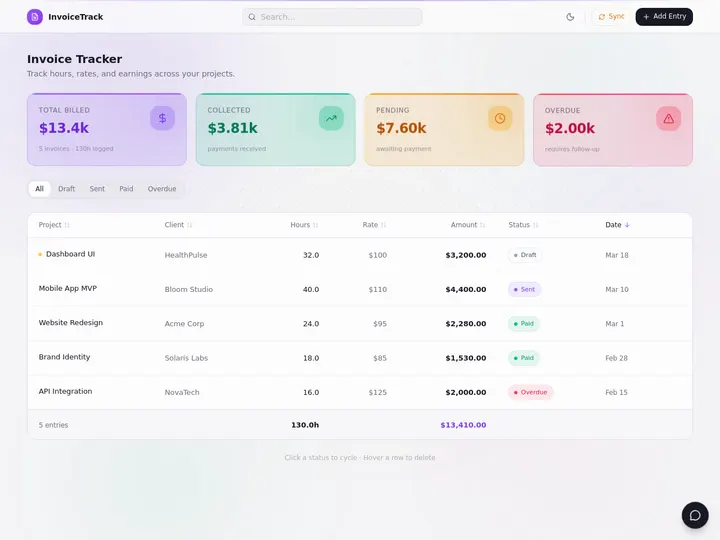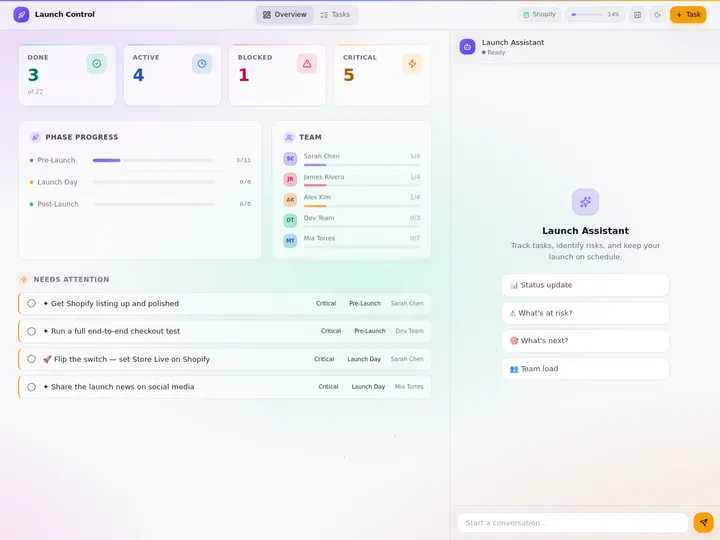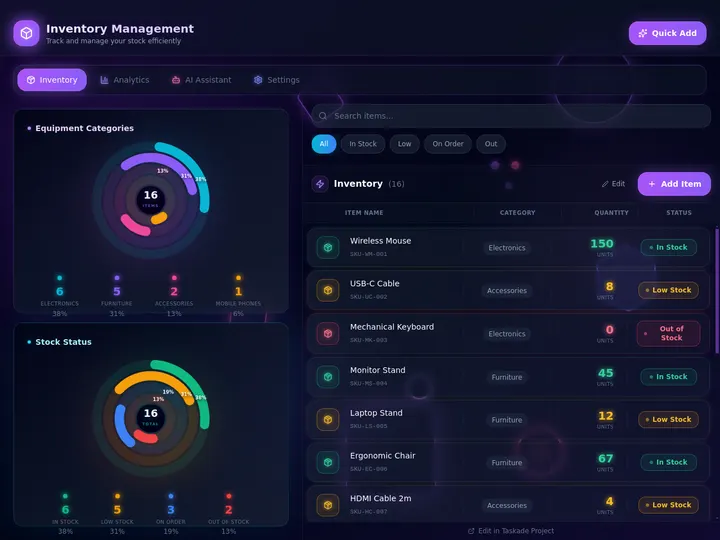
TL;DR: Same tests, different stories. DeepSeek V4 Flash built the best-looking app on Aug 1, 2026: light-and-dark theme, zero errors, clean on a phone, at a fraction of the field's cost. Gemini 3.6 Flash improved between tests, from a build that never opened (Aug 1, 2026) to one that built, published, and worked (Aug 3, 2026). Route by task inside Taskade Genesis rather than standardizing on one.
What TSK-1 Found
We ran both families in the same tests, and the findings split cleanly. DeepSeek V4 Flash built the best-looking app on Aug 1, 2026 at a fraction of the field's cost. On Aug 3, 2026 it posted the cheapest, fastest, and cleanest run of that test. Gemini 3.6 Flash was in both of those tests, and its story is one of progress. Its Aug 1, 2026 build never opened. Its Aug 3, 2026 build was published and worked. We open every finished app, so progress is measured by what people can actually run, not by what a model says it did.
- DeepSeek: Aug 1, 2026 - best-looking app, the only one that looked right in both light and dark, ran without a single error, and laid out cleanly on a phone; Aug 3, 2026 - cheapest, fastest, and cleanest run on the 32-question client sign-up form, 12 minutes 36 seconds; Aug 6, 2026 - the richest workspace of any model measured (a record 60 fields, 8 automations, all four builds word for word); Aug 25, 2026, in a test Gemini was not part of - Flash finished the match tracker and made both follow-up changes cleanly, but its long-form build ran out of time, while Pro built the cheapest complete match tracker of that test.
- Gemini: Aug 1, 2026 - the finished build never opened: three missing pieces, no light-and-dark styling, and links pointing at a machine nobody else can reach; Aug 3, 2026 - built and published this time, a clear step up, though it used too many resources to qualify as the best value in the test.
See the full evidence at /tsk/gemini, /tsk/deepseek, and the TSK-1 hub.
Gemini 3.6 Flash vs DeepSeek V4 Flash
These two met in two tests, and the second is the one to read. On Aug 1, 2026, DeepSeek V4 Flash won on looks outright: the only build that looked right in both light and dark, ran without a single error, and laid out cleanly on a 390px phone screen. It did that at a fraction of the field's cost. Gemini 3.6 Flash was graded in the same test and its finished build never opened. Three pieces were missing, there was no light-and-dark styling, and the links pointed at a machine nobody else can reach. Nothing shipped.
Two days later the gap narrowed. On Aug 3, 2026 both models took a real customer's request: a 32-question client sign-up form. DeepSeek V4 Flash was the cheapest, fastest, and cleanest run, done in 12 minutes 36 seconds. Gemini built and published this time. That is a real step up, and we confirmed it by opening the app rather than taking the model's word for it. It still used too many resources to qualify as the best value in that test, so DeepSeek kept the efficiency title.
The telling detail is direction. DeepSeek V4 Flash held its design lead on Aug 2, 2026 as well, when its finished workspace saved real data with light and dark themes both working throughout. Gemini moved from nothing usable to a working app in two days, Aug 1 to Aug 3, 2026. DeepSeek V4 Flash's most recent result came from a later test Gemini was not part of (Aug 25, 2026): it finished the match tracker and made both follow-up changes cleanly, but its long-form build ran out of time. On published rates, DeepSeek V4 Flash is also the cheaper model at peak, and exactly half that price off-peak. Gemini 3.6 Flash's rate is scheduled to double on January 1, 2027, so the price gap between them widens next year unless one vendor moves.
Gemini 3.6 Flash vs DeepSeek V4 Pro
One rung up, the comparison becomes breadth versus mixed-format input. DeepSeek V4 Pro's defining moments are about wiring up a lot of your data and finishing what it starts. On Aug 6, 2026 it wired 8 automations and a record 60 fields, and all four builds matched the customer's wording word for word. That is the richest workspace behind an app we have measured. On Aug 5, 2026 it won the tracker test as the most efficient app that actually opened, after two better-looking builds turned out not to open at all. On Aug 25, 2026, in a test Gemini was not part of, it built the cheapest complete match tracker of that test. And it holds the biggest single-test jump we have measured: from none of its four builds matching the brief to all four word for word on a shorter prompt (Aug 2, 2026).
Gemini 3.6 Flash cannot match that record on our evidence, and this page does not pretend otherwise. What Gemini brings is something DeepSeek does not offer at all: text, image, video, audio, and PDF in a single prompt, against a 1,048,576-token input window. DeepSeek V4 Pro is a text model. If the job starts from a recorded meeting or a folder of scanned forms, Gemini is the only one of these two whose own API reads the source directly. Inside Taskade the connector's steps are narrower: a prompt, a structured extraction, and a question about an image.
The output ceilings also point in opposite directions. Gemini 3.6 Flash returns at most 65,536 tokens per call. Both DeepSeek V4 models return up to 384K. A single step that has to emit a whole file set favors DeepSeek. A single step that has to ingest a large mixed-format source favors Gemini.
Choose Gemini If…
A comparison that never concedes anything is not worth reading. Gemini is the better pick in several common cases.
- Your inputs are not text. Gemini 3.6 Flash accepts text, image, video, audio, and PDF in one prompt on Google's own API. Neither DeepSeek V4 model reads video or audio, and only an experimental version of Flash takes images. In Taskade, the Gemini connector exposes a prompt step, a structured extraction, and an image question.
- You want a managed Google endpoint with a published rate card. Standard, batch, and cached-input prices are all on Google's pricing page, with batch at half price and cached input at $0.075 per million against $0.75 standard.
- You value the pace of improvement. Gemini moved from a build that never opened to a published, working app between Aug 1 and Aug 3, 2026. We measure what people can run, and by that measure Gemini improved between the two tests.
- A giant input matters more than a giant output. A 1,048,576-token window with a 65,536-token output ceiling suits a step that reads a lot and answers briefly.
Choose DeepSeek If…
- Visual polish on a budget is the job. Aug 1, 2026 is the standing evidence: the cheapest model in the test produced the best-looking app.
- You want open weights. DeepSeek V4 is MIT across code and weights, so you can download, self-host, and fine-tune. Gemini never ships weights. If the model has to live inside your own network, DeepSeek is the only candidate here.
- A single step has to emit a lot at once. DeepSeek V4's 384K maximum output is far above Gemini 3.6 Flash's 65,536 ceiling. That is the difference between generating a whole file set in one call and stitching several together.
- You are wiring up a lot of your data. The record 60 fields and 8 automations of Aug 6, 2026 are the most of your data any model has wired up for us.
- Your volume is high and your budget is tight. The published rate card is the cheapest on this page. Off-peak billing is exactly half of peak, and peak is only 01:00-04:00 and 06:00-10:00 UTC on weekdays (as of September 2026), so scheduled batch work can sit entirely outside it.
The Taskade Angle: Route, Don't Standardize
Most comparison pages end with "pick one". The evidence for these two families points the other way: one owns looks, value, and workspace depth today, and the other owns mixed-format input and a fast rate of improvement. Serious teams run both and route between them.
One fact first, stated plainly. Gemini is not in the Taskade model picker right now, where Google models are hidden. Gemini was part of the benchmark, which is where the findings on this page come from. With your own Google AI key, the Google Gemini automation connector still runs "Ask Gemini" as a step inside your automations. DeepSeek V4 Flash and V4 Pro are both in the picker.
Taskade routes across 15+ frontier models from OpenAI, Anthropic, and open-weight providers inside one workspace, with the AI allowance included in the subscription rather than a separate API account per lab. Paid plans start at Pro $10/mo billed annually, with Business $25, Max $100 and Enterprise $250 per month billed annually. You set the model per agent or per automation step, so a design pass on V4 Flash, a data-wiring pass on V4 Pro, and an Ask About an Image step on Gemini can each get the model that leads there. Leave a step on TSK-1 Auto and it adapts the depth instead: fast when the step is quick, deeper reasoning when it is not.
Four patterns that hold up:
- Gemini reads, DeepSeek builds. An Ask About an Image step reads a screenshot, or an Extract Structured Data step pulls fields out of text. A DeepSeek agent turns that answer into a working app with saved data.
- Cheap model iterates, deep model wires. Design loops on V4 Flash. Field-heavy builds on V4 Pro, where the record 60 fields were measured.
- Every step lands in the same project graph. Whichever model runs a step, the result becomes shared workspace memory, so the next agent inherits context instead of re-deriving it.
- Scheduled automations read from the same place. Model choice becomes a per-step setting, not a platform decision. When Gemini's next version lands, the step changes and the workspace does not.
See 10 Best Open-Source AI LLMs in 2026 for how DeepSeek sits in the wider open-weight field.
Final Word: Progress vs Value
Gemini 3.6 Flash is the progress pick. It went from a build that never opened to one that built, published, and worked in two days, it reads video, audio, images, and PDFs that DeepSeek cannot, and it comes with a managed Google endpoint. DeepSeek V4 is the value pick: the best-looking app at a fraction of the field's cost, the cheapest, fastest, and cleanest run of the Aug 3, 2026 test, the richest workspace behind an app, and MIT weights on the cheapest published rates here.
Neither is the winner. The winner is the setup that puts mixed-format reading where the source lives and value where the volume lives.
▲ Memory feeds Intelligence. ■ Intelligence triggers Execution. ● Execution creates Memory. One closed model, one open family. One workspace. No single point of vendor failure.
This is the origin of living software. 🌱
Build with DeepSeek and 15+ frontier models →
Related reading
- 10 Best Open-Source AI LLMs in 2026 - Where DeepSeek sits in the open-weight field.
- History of AI benchmarks - Why every model claims to be best, and how TSK-1 differs.
- Gemini vs Claude - Google's mixed-format model against Anthropic's reasoning-first family.
- Kimi vs DeepSeek - Bespoke license versus MIT, head to head.
- GLM vs DeepSeek - Two MIT-weight families from the same test.
- Qwen vs DeepSeek - Apache 2.0 versus MIT.
- Multi-Model AI Access - How Taskade routes across providers.
- Multi-Agent Teams - Specialists with different model picks.
- Google Gemini automation connector - Run "Ask Gemini" as a step with your own Google AI key.
- TSK-1 Gemini profile - Full evidence for the Gemini family.
- TSK-1 DeepSeek profile - Full evidence for the DeepSeek family.
- TSK-1 hub - The complete model test dataset.