Is Gemini better than Claude?
Neither is better overall, because Gemini and Claude lead on different things. Gemini from Google DeepMind leads on multimodal input (video, audio, image, and code in one prompt), on graduate-level scientific reasoning, and on Google product integration. Claude from Anthropic leads on agentic coding and long-form writing, with Constitutional AI safety training. On the API, Gemini 3.1 Pro is roughly 1.7 to 2 times cheaper than Claude Opus 5.5. Send ingestion to Gemini and reasoning to Claude, and pick per task.
What TSK-1 Found
On Aug 1, 2026, Gemini 3.6 Flash did not place: the app it handed in would not open. Checking that the app actually opens exists to catch exactly this. On Aug 3, 2026 its app did open and publish, but the price ruled it out. Claude holds the quality ceiling: the best-looking build we have measured (Jul 30, 2026), the most complete app of its test (Aug 1, 2026), and the cleanest code we have measured (Aug 3, 2026). The contrast is the whole point of opening the app yourself: it catches the gap between "I built it" and "it runs."
- Gemini: Aug 1, 2026 — did not place; the app it handed in would not open. Aug 3, 2026 — it opened and published, but the price ruled it out.
- Claude: the quality ceiling — the best-looking build we have measured (Jul 30, 2026), the most complete app of its test (Aug 1, 2026), and the cleanest code (Aug 3, 2026).
See the full evidence at /tsk/gemini, /tsk/claude, and the TSK-1 hub.
The Headline
Gemini and Claude won different races in 2026. Gemini won the multimodal race. Claude won the agentic coding race. The interesting question is not who wins — it is which task you send where, and what that choice costs.
- Gemini 3.1 Pro is the only frontier model that ingests video, audio, image, and text natively in one 1-million-token prompt, and it leads the field on graduate-level scientific reasoning.
- Claude's Opus tier is the category leader on agentic coding and long-form writing, and Claude Code is the terminal agent most teams reach for on whole-repository work.
Neither replaces the other. The 2026 best practice is to use Gemini for the ingestion and Claude for the reasoning, routed per step.
TL;DR: Gemini 3.1 Pro is the multimodal-native frontier. Claude's Opus tier is the reasoning-and-coding-native frontier. On the API, Gemini is roughly 1.7 to 2× cheaper than Opus, because the current Opus 5.5 rate is $4 in / $20 out per 1M tokens, not the retired $15 / $75. Taskade Genesis orchestrates the workflow around whichever models you choose, and Claude joins on your own Anthropic key.
Two Different Frontier Bets
Both companies are race-leading frontier labs. Their bets are structurally different.
- Google DeepMind is the integration play. Multimodal-native from day one. Deep ties to Search, Workspace, Android, Chrome, and Vertex AI. Measured release pacing (Hassabis: "five to 10 years to AGI"). Research lineage running back to DeepMind's 2014 acquisition.
- Anthropic is the alignment + capability play. Constitutional AI safety, Responsible Scaling Policy, mechanistic interpretability. Rapid release pacing (Amodei: "AI will replace all software developers within a year"). Founded 2021.
Different bets. Both winning.
Architecture: Multimodal-Native vs Text-First
The architectural difference shows up in what each model does naturally in one prompt.
Concretely, Gemini can do this:
Here is a 30-minute meeting recording (audio), a 50-page sales deck (PDF), and last quarter's revenue dashboard (image). What three actions should the team take this week?
Claude can do that too, but Gemini does it without modality conversion penalties. Native multimodal training shows up in tasks that combine formats.
Conversely, Claude shines on long-form reasoning across a single text modality:
Read these 8 PRs across our microservices, identify the architectural drift, and write a memo for the engineering leadership team.
Both ship 1 million token context windows. The difference is what you put inside it.
Where Each Leads
Benchmark tables go stale within weeks, and every lab publishes on a different harness. Here is the durable shape of the result instead of a scoreboard — run both on your own work for the real answer.
Capability                   Gemini 3.1 Pro    Claude (Opus tier)   Reach for
─────────────────────────────────────────────────────────────────────────────
Scientific / graduate QA     category leader   frontier-tier        GEMINI
Agentic coding               frontier-tier     category leader      CLAUDE
Long-form writing            frontier-tier     category leader      CLAUDE
Multimodal (video + audio)   ★★★★★ native      ★★ text + image      GEMINI
Long-context coherence       strong (1M)       strong (1M)          tie
Tool calling reliability     strong            strongest            CLAUDE
Google surface integration   ✓ deep (native)   via MCP              GEMINI
Web search integration       ✓ native          via MCP or API tool  GEMINI
Terminal coding agent        Gemini CLI        ★★★★★ Claude Code    CLAUDE
Pattern: Gemini wins on multimodal breadth and the Google ecosystem. Claude wins on coding and agentic depth. They meet in the middle on scientific reasoning, where Google's measured-scaling bet paid off.
Quote (Demis Hassabis, Davos Jan 2026): Today's AI is "nowhere near" human-level AGI and the timeline is "five to 10 years." Gemini's product cadence reflects this measured posture.
Quote (Dario Amodei, Davos Jan 2026): AI would "replace the work of all software developers within a year" and reach "Nobel-level scientific research in multiple fields within two years." Claude's product cadence reflects this rapid posture.
The Routing Matrix: Which Model, and What It Costs You
This is the table to keep. Every row is a task, a pick, and the cost consequence of that pick. All API figures are per 1M tokens, verified September 2026.
| Task | Reach for | Why | Cost consequence |
|---|---|---|---|
| Video, audio and text in one prompt | Gemini 3.1 Pro | only frontier model with native multimodal ingestion | $2 in / $12 out under 200K; $4 / $18 above |
| Agentic coding, whole-repo refactors | Claude, Opus tier | category leader on agentic coding and tool calling | $4 in / $20 out (Opus 5.5), flat at any context length |
| Cheap high-volume classification | Gemini Flash-Lite tier | cheapest frontier-family option per token | Gemini 3.1 Flash-Lite $0.25 in / $1.50 out |
| Mid-tier general work | Claude Sonnet tier | frontier-tier quality at a mid-tier rate | Sonnet 5.5 at $2 / $10 |
| Fast multimodal at volume | Gemini Flash tier | Flash generation is the volume workhorse | Gemini 3.6 Flash $1.50 in / $7.50 out |
| Whole-codebase or multi-document reasoning | either, at 1M context | both ship 1M windows | Claude bills the full window at standard rates; Gemini steps up past 200K |
| Overnight batch jobs, repeated system prompts | Claude | Batch API and prompt caching are steep | Batch 50% off both directions; cache hit 0.1× base input |
| Google Docs, Sheets, Gmail work | Gemini in Google Workspace | deepest native integration | a separate Workspace business seat, not a Google AI consumer plan |
| Web search inside an API workflow | either | Gemini has native search; Claude prices it explicitly | Claude web search on the API is $10 per 1,000 searches |
| Multiple of the above, one team | route per task | no single lab wins every row | Taskade's own models, plus Claude and Gemini on your own API keys |
Two things that quietly break naive cost maths:
- Price per token is not price per page. Claude 4.7 and later use a newer tokenizer that produces roughly 30% more tokens for the same text. A per-token comparison flatters Claude's headline rate by that much.
- Long context is not surcharged on Claude. A 900K-token request bills at the same per-token rate as a 9K-token request. Gemini 3.1 Pro doubles its input rate above 200K, so the cost gap between the two narrows as your prompts grow.
When to Pick Each
In practice: Gemini for ingestion, Claude for reasoning. The pattern works.
Pricing: The Gap Is Real, But It Is 2×, Not 8×
Most Gemini-vs-Claude comparisons on the web still price Claude's Opus tier at $15 in and $75 out per 1M tokens and conclude Gemini is 6 to 8 times cheaper. That rate belongs to a retired Opus generation. The current Opus tier, Opus 5.5, is $4 in / $20 out, which puts the real gap at roughly 1.7 to 2×, and narrower still above 200K tokens.
| API tier (per 1M tokens) | Gemini 3.1 Pro | Claude Opus 5.5 |
|---|---|---|
| Input, ≤200K context | $2 | $4 |
| Output, ≤200K context | $12 | $20 |
| Input, >200K context | $4 | $4 (flat) |
| Output, >200K context | $18 | $20 (flat) |
| Batch discount | available | 50% off both directions |
| Cache hit | available | 0.1× base input |
On the consumer side the two lineups do not line up rung for rung, so compare carefully:
| Rung | Google AI plans | Claude plans |
|---|---|---|
| Free | Gemini app free tier | Free, "free for everyone" |
| Entry paid | Google AI Plus $7.99/mo month-to-month | — |
| Mid | Google AI Pro (check the plans page — we do not publish a figure we cannot verify) | Pro $20/mo month-to-month, or $17/mo with the annual discount ($200 billed up front) |
| Power user | Google AI Ultra — two rungs, $100 and $200/mo | Max — from $100/mo, 5× or 20× more usage than Pro |
| Team | Google Workspace business seats (separate product line) | Team $25/seat month-to-month, $20/seat billed annually; Premium seat $125 / $100 |
| Enterprise | Workspace enterprise tiers | Seat price plus usage at API rates |
Two corrections worth internalising if you are budgeting from older write-ups. Google AI Ultra was cut from $250 to $200 and a new $100 Ultra rung was added, so "Ultra costs $250" is simply out of date. And Google now meters by compute used, not by prompts per day — a daily prompt allowance is a retired mechanic, and a heavy multimodal session eats far more of your allowance than the same count of short text prompts.
Taskade Genesis includes the AI allowance for its built-in models in the subscription (billed annually: Free $0, Pro $10, Business $25, Max $100, Enterprise $250 per month). Claude usage bills to your own Anthropic account and Gemini usage to your own Google AI account, so budget those two lines separately.
The Taskade Genesis Angle: Your Keys, One Workspace
The 2026 best practice for mixing Gemini and Claude is Gemini for the ingestion layer, Claude for the reasoning layer. Taskade Genesis is where the resulting work lands and moves.
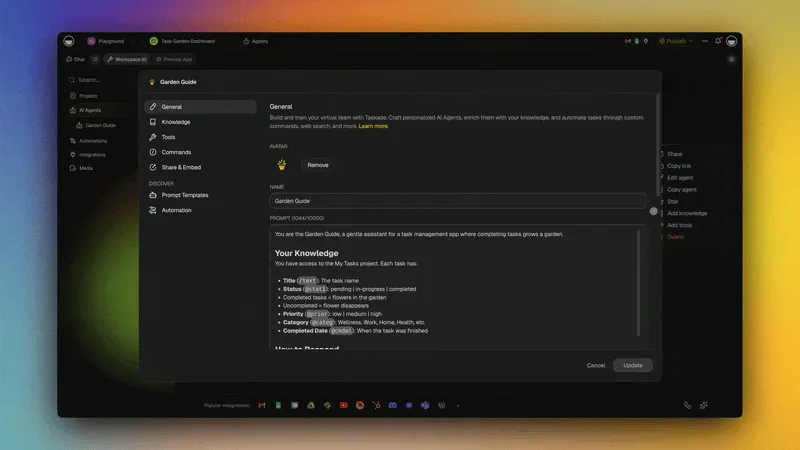
Taskade Genesis runs frontier models from top AI labs, with the AI allowance included in the subscription. Claude runs on your own Anthropic key through the Anthropic Claude connector or BYOK on Pro and up, and Gemini runs on your own Google AI key through the Google Gemini connector on Pro and up. Five patterns that work right now.
✓ Pattern 1: Gemini transcribes, Claude analyses. Transcribe a 30-minute video with Gemini's native audio processing outside Taskade. A research automation then takes the transcript and uses an Ask Claude step on your own Anthropic key for thematic analysis and recommendation drafting.
✓ Pattern 2: Gemini ingests, Claude codes. Feed the repo into Gemini 3.1 Pro's 1M context window to extract architecture and dependencies. Claude Code then drives the refactor, and it can read and write your Taskade projects through the MCP Server.
✓ Pattern 3: Gemini for Google surfaces, Taskade for everything else. Tasks that touch Google Docs, Sheets, or Gmail lean on Gemini in Workspace. Tasks that touch the rest of your tools run in a Taskade Genesis app on Taskade's own models.
✓ Pattern 4: Gemini for retrieval, Claude for the answer. Use Gemini Deep Research to gather sources with Google citations. Then bring them into a Taskade project, where a Claude step on your own key or a Taskade agent writes the customer-facing report.
✓ Pattern 5: Auto mode handles the Taskade side. Set Auto mode as the default on new agents. Taskade Genesis routes per task across its own models and adapts as new versions ship, which matters in a year when both labs changed prices and tiers.
Industry context. A May 2026 IDC and Augment Code study found teams running 5+ models with intelligent routing save 40 to 85% versus single-model deployments. Two-model routing captures most of the gain.
See 10 Best Open-Source AI LLMs in 2026 for the open-source picks that complement both Gemini and Claude.
Where Both Are Heading
Google DeepMind's bets
- Native multimodal as the default surface. video, audio, image, code in one prompt
- Google surface integration depth. Gemini in every Google productivity product
- Gemini CLI + Vertex AI. production-grade agent infrastructure for enterprise
- Measured AGI pacing. Hassabis's five-to-ten-year timeline
- Compute-based metering. allowances that track workload shape, not prompt counts
Anthropic's bets
- Claude Code Agent Teams scaling agentic coding across enterprise
- Claude Cowork + Skills for desktop AI beyond the terminal
- Computer Use as the embodied interface
- Mechanistic interpretability as the long-term safety moat
- Flat long-context pricing as a deliberate cost-predictability play
Where Taskade Genesis fits
Both labs are building for the multi-model reality. Workspace DNA (Memory + Intelligence + Execution) is the substrate that carries the output of either model into one workflow. You choose the models. The agents and automations are the workflow.
Read the deep histories:
- Anthropic Claude History 2026. Claude family timeline and roadmap.
- Claude Models Explained. The current Claude lineup and prices.
- What is OpenAI?. OpenAI evolution for the third-party angle.
Frequently Asked Questions
Is Gemini better than Claude in 2026?
They lead on different things. Gemini from Google DeepMind leads on multimodal capability (native video, audio, image, and code in one prompt), on graduate-level scientific reasoning, and on Google product integration across Docs, Sheets, Slides, and Gmail. Claude from Anthropic is the category leader on agentic coding and long-form writing, and it carries Anthropic's Constitutional AI safety posture. The useful question is not which model is better overall, but which one you send a given task to. Gemini is not in the Taskade model picker. Taskade Genesis runs frontier models from top AI labs, and in automations the Google Gemini and Anthropic Claude connectors run on your own API key.
Which is better for coding, Gemini or Claude?
Claude's Opus tier (currently Opus 5.5) is the category leader on agentic coding, and Claude Code is the terminal agent most widely used for whole-repository work. Gemini is frontier-tier on coding benchmarks and ships Gemini CLI for code agent workflows, with deeper hooks into Google Cloud and Vertex AI for production deployment. For frontier coding quality, reach for Claude. For Google ecosystem integration, reach for Gemini. In Taskade Genesis, agents on Taskade models can plan while a Claude step on your own Anthropic key handles the build.
Does Gemini have a longer context window than Claude?
Both ship 1 million token context windows in 2026. Gemini pairs its 1M window with native multimodal support, so video, audio, image, and code interleave inside the same prompt. Claude's 1M window is text and vision. The pricing behaves differently at scale: Anthropic bills the full 1M window at standard rates, so a 900K-token request costs the same per token as a 9K-token request, while Gemini 3.1 Pro steps up from 2 dollars in and 12 dollars out per 1M tokens to 4 dollars in and 18 dollars out once a prompt passes 200K tokens.
How does Gemini's multimodal capability compare to Claude?
Gemini was designed from day one as a multimodal model with native video, audio, image, and text training. You can paste a 30-minute video into a Gemini prompt alongside a 50-page PDF and ask reasoning questions about both. Claude added vision in later releases but is fundamentally text-and-image rather than text-image-video-audio. For workloads where one prompt mixes formats, Gemini has the architectural edge. For text-heavy reasoning across many documents, the two are competitive.
How much do Gemini and Claude cost on consumer plans?
Google's consumer lineup is Google AI Plus, Google AI Pro, and Google AI Ultra. Entry is Google AI Plus at 7.99 dollars per month month-to-month, and AI Ultra now spans two rungs at 100 and 200 dollars per month. Claude publishes Free, Pro at 20 dollars per month month-to-month or 17 dollars per month with the annual discount (200 dollars billed up front), Max from 100 dollars per month, and Team at 25 dollars per seat month-to-month or 20 dollars per seat billed annually. Check both vendor pricing pages before you buy, since these tiers moved twice in 2026.
Is Gemini cheaper than Claude on the API?
Yes, but by roughly 1.7 to 2 times, not the 6 to 8 times that older comparisons claim. Gemini 3.1 Pro is 2 dollars per 1M input tokens and 12 dollars per 1M output tokens for prompts under 200K, rising to 4 and 18 dollars above that. Claude Opus 5.5 is 4 dollars per 1M input and 20 dollars per 1M output, Sonnet 5.5 is 2 dollars in and 10 dollars out, Haiku 4.5 is 1 dollar in and 5 dollars out, and Fable 5.1 is 10 dollars in and 50 dollars out. Above 200K tokens the gap narrows further, because Claude does not add a long-context surcharge. Two effects also cut against a naive per-token comparison: Anthropic's Batch API is 50 percent off in both directions and cache hits bill at a tenth of base input, while Claude 4.7 and later use a tokenizer that produces roughly 30 percent more tokens for the same text.
Does Google still meter Gemini by prompts per day?
No. Google now meters its consumer AI plans by compute used rather than by a fixed number of prompts per day, so any comparison that still quotes a daily prompt allowance is describing a retired system. The practical consequence is that a heavy multimodal session (long video, large PDFs) consumes far more of your allowance than the same number of short text prompts. Plan for workload shape, not prompt count.
How is Google Workspace with Gemini different from the Google AI plans?
They are separate product lines and separate bills. Google AI Plus, Pro, and Ultra are consumer subscriptions for the Gemini app and its surfaces. Gemini in Google Workspace is a business seat that puts Gemini inside Docs, Sheets, Slides, Gmail, Meet, and Drive alongside the rest of Workspace. Buying one does not get you the other, which is the most common budgeting mistake teams make when they compare Google against Claude on price alone.
Is Gemini better than Claude for research?
Gemini Deep Research and search-augmented chat are backed directly by Google Search, which makes Gemini strong when the research needs live retrieval and source links. Claude is strong on the synthesis half: long-form research writing where nuance and structure matter, plus the Artifacts surface for inline content. The productive pattern is to use Gemini for retrieval and Claude for the write-up. Gather the sources with Gemini Deep Research, then bring them into a Taskade project, where a Taskade agent or a Claude step on your own Anthropic key writes the report.
Can I use Gemini and Claude together with Taskade Genesis?
Yes, on your own API keys. Taskade Genesis runs frontier models from top AI labs with Auto as the default, and the AI allowance is included in the subscription. Gemini is not in the model picker: connect your own Google AI key with the Google Gemini automation connector (Pro and up, billed by Google). Claude does not run on Taskade credits either: connect your own Anthropic key with the Anthropic Claude automation connector (Pro and up, billed by Anthropic), or use BYOK on Pro and up so agents run on your Claude key. A common 2026 pattern is to ingest video or PDFs with Gemini outside Taskade, then bring the structured output into a Taskade project for agents and automations to act on.
Final Word: Different Strengths, One Workflow
Gemini is the multimodal-native frontier and it is genuinely cheaper per token - by about 1.7 to 2× against Claude's Opus tier, less once you account for Claude's flat long-context pricing, batch discount, and cache rate. Claude is the reasoning-native frontier and the category leader on agentic coding and long-form writing.
Pick one and you optimize for one strength. Route between them and you pay the right rate for each task.
▲ Memory feeds Intelligence. ■ Intelligence triggers Execution. ● Execution creates Memory. Two frontier labs on your own keys, one workspace for the work that follows.
This is the origin of living software. 🌱
Build the workflow around them in Taskade Genesis →
Verify these numbers yourself
- Google AI plans: one.google.com/about/google-ai-plans
- Gemini API pricing: ai.google.dev/gemini-api/docs/pricing
- Claude plans: claude.com/pricing
Related reading
- Claude Fable 5 & Mythos 5 Explained — Anthropic's newest Mythos-class model: benchmarks, pricing, and the catch.
- Anthropic Claude History 2026 — Complete Claude family history and roadmap.
- 10 Best Open-Source AI LLMs in 2026 — Full open-source ranking.
- GPT vs Claude — OpenAI vs Anthropic head-to-head.
- Opus vs Sonnet — The Claude tier ladder.
- Kimi vs Claude — Open-source agentic coding vs frontier chat.
- Multi-Model AI Access - How Taskade Genesis runs frontier models from top AI labs.
- Tools for AI Agents — The built-in agent toolset.
- Taskade MCP Server — Use Claude Desktop or Cursor with your workspace.
- TSK-1 Gemini profile — Full benchmark evidence for the Gemini family.
- TSK-1 Claude profile — Full benchmark evidence for the Claude family.
- TSK-1 hub — The complete model benchmark dataset.