

TL;DR: CrewAI is the open-source Python framework for role-based multi-agent teams, free to self-host with your own model keys. Taskade Genesis gives you multi-agent AI teams without code, inside a workspace with deployed apps and 100+ bidirectional integrations. Free Forever to start, with Pro at $10/mo billed annually for 10 seats. Try Taskade Genesis free →
See the alternative working, clone in 60 seconds
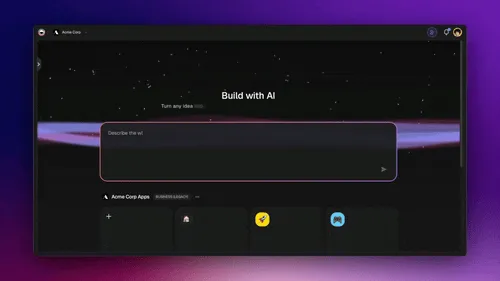
No signup, no credit card. See the live storefront demo →
| Capability | CrewAI | Taskade Genesis |
|---|---|---|
| Pricing (starting) | Framework free (self-host, bring your own LLM keys); managed Free 50 executions/mo, Enterprise custom | $0 Free · $10/mo Pro (10 seats), billed annually |
| Build surface | Python code you write and host | ✅ No-code workspace, plain language |
| Multi-agent teams | ✅ Crews and Flows, in code | ✅ Agents collaborating in a shared workspace |
| Automation engine | Flows plus cron on the platform | ✅ Durable runtime, 100+ integrations |
| Workspace DNA loop | ❌ | ✅ ▲ Memory · ■ Intelligence · ● Execution |
Overall winner: ✅ Taskade Genesis, for any team whose goal is shipping an agent-powered app without writing or hosting code. CrewAI remains the stronger choice when a Python engineering team wants full programmatic control over agent logic and a framework they fully own.
Table of Contents
- Quick Comparison Table
- The fundamental difference in 2026
- What is Taskade Genesis?
- What is CrewAI in 2026?
- Key differences
- Choose CrewAI if
- Why teams choose Taskade
- Pricing and total cost of ownership
- Frequently asked questions
- Ship agent teams without code
The fundamental difference in 2026
CrewAI is a framework. Taskade Genesis is a platform. That single distinction shapes everything else.
CrewAI hands a Python developer a powerful kit for building multi-agent systems: role-based agents, Crews that collaborate, and Flows that give event-driven control. You write the code, connect your own model keys, and host the result. Taskade Genesis takes the same idea, teams of AI agents that work together, and delivers it as a finished, deployed application you build by describing it. Your workspace is the backend. Your projects are the memory. Your agents are the team. There is no code to write and nothing to host.
Both let you build agents that collaborate. The question is whether you want to program that team in Python or assemble it in a workspace and put a live app in front of real users.
CrewAI asks: "How should I code this agent team?" Taskade Genesis asks: "What should this agent team do for my users?"
What is Taskade Genesis?
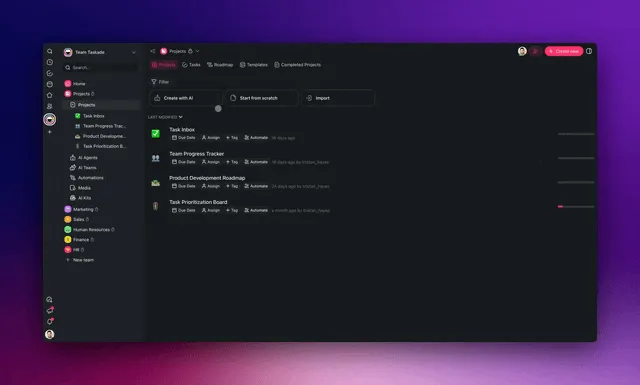
Taskade Genesis is the AI app builder inside the Taskade workspace. It is built on Workspace DNA: Memory (Projects), Intelligence (AI Agents), and Execution (Automations), a self-reinforcing loop where what your team does becomes the substrate the agents reason over. Founded by John Xie, Dionis Loire, and Stan Chang in 2017, Taskade is a Y Combinator-backed platform with over a million users and a public Community Gallery of apps anyone can clone.
A single prompt to Taskade Genesis can produce a customer support portal, an ops dashboard, a CRM, a research assistant, a form-driven intake system, or an internal tool, all with built-in AI agents that collaborate, automations, custom domains (Business and above), password protection (Pro and above), and the option to embed agents publicly with GenesisAuth. No DevOps. No CI/CD. No infrastructure to maintain. No API keys to wire up.
Taskade Genesis is for everyone: founders, marketers, ops, product managers, customer success, and engineers who want to skip plumbing and focus on the idea.
What is CrewAI in 2026?
CrewAI (crewai.com) is an open-source Python framework for orchestrating role-playing, autonomous AI agents. Founded in 2023 by Joao Moura, formerly head of AI engineering at Clearbit, it was built from the ground up as an independent framework with zero dependency on LangChain, which its team credits for measurable speed gains. Developers declare each agent's role, goal, and backstory, group agents into Crews that collaborate on tasks, and use Flows for precise, event-driven control.
CrewAI at a glance (2026): open-source Python framework, 54k+ GitHub stars. Raised $18M total (inception round led by boldstart ventures; Series A led by Insight Partners, announced October 2024) with angels including Andrew Ng and HubSpot co-founder Dharmesh Shah. Executes 10M+ agents monthly, used by nearly half of the Fortune 500, with 100,000+ developers trained through its courses. Model-agnostic: you bring your own LLM API keys.
Two building blocks define the framework:
- Crews optimize for autonomy and collaborative intelligence. A Crew is a team of role-based agents working together, delegating and negotiating task hand-offs to reach a result.
- Flows optimize for control. They are event-driven automations that combine precise workflow logic, single LLM calls, and native support for Crews.
On top of the framework, CrewAI offers a managed platform (formerly CrewAI Enterprise) with a visual editor and AI copilot, GitHub integration, observability through OpenTelemetry tracing, guardrails, human-in-the-loop steps, cron scheduling, and the ability to export a Crew as an MCP server. The free Basic tier includes 50 workflow executions per month; the Enterprise tier is custom-priced and adds single sign-on, role-based access control, dedicated infrastructure, enterprise connectors, and hands-on support.
CrewAI is, on its own terms, an excellent framework. The question for a team choosing between CrewAI and Taskade Genesis is not "is CrewAI capable," it is "does the team want to write and host agent code, or configure agents in a workspace and ship a deployed app?"
Key differences
Build surface: code vs workspace
- CrewAI is Python. You install the library, define agents and tasks in code, wire your tools as functions, and run the Crew. Powerful and precise, but it assumes a developer at the keyboard.
- Taskade Genesis is a workspace. You describe the app and the agent team in plain language, then refine visually. A non-engineer can build a multi-agent app, and an engineer can go faster without boilerplate.
Multi-agent teams
Both platforms are built around agents that collaborate, which is the whole point of CrewAI and a core capability of Taskade AI Agents v2. CrewAI expresses the team as Crews and Flows in code, with per-agent roles and shared coordination. Taskade expresses the team as configured agents in one workspace, each with its own role, persistent memory, and tools, all reading and writing to a single shared memory. Same conceptual model, two very different build experiences.
Tools and integrations
- Taskade ships durable Automations with branching, looping, and filtering across 100+ bidirectional integrations. Triggers pull external events in (Slack messages, Gmail, Sheets rows, Calendly events, webhooks). Actions push data out (Stripe checkouts, Shopify orders, Notion syncs, Salesforce updates, GitHub PRs). Agents use a large built-in toolset (web search, code execution, file analysis, image generation, and more) plus custom tools you define.
- CrewAI treats tools as Python functions you write and wrap. Its managed platform adds cron scheduling, enterprise connectors, and MCP export, but the day-to-day trigger-and-action integrations are code you build and maintain.
Models and cost
- Taskade includes access to 15+ frontier models from OpenAI, Anthropic, and open-weight providers, included in your plan. Model access and cost are part of the flat subscription.
- CrewAI is model-agnostic and requires you to bring your own LLM API keys. That flexibility is real, but your token bill is billed separately by your provider on top of any platform fee.
Hosting and the end-user surface
- CrewAI's output is code that runs where you put it. You own deployment, scaling, monitoring, and the runtime. There is no built-in surface for a non-technical end user to click into.
- Taskade's output is a deployed app at a shareable URL with custom domains (Business and above), password protection (Pro and above), real-time role-based access, and multiple project views. Anyone can use it, including your customers, with agents embedded right inside.
Workspace memory
Taskade's Workspace DNA gives every agent persistent context across projects, files, integrations, and the live state of your business, so the workspace gets smarter the longer you use it. CrewAI provides shared memory within a Crew, scoped to the code you run. Powerful inside a pipeline, but not a continuously accumulating team memory across a whole organization.
Choose CrewAI if
Honest comparison content beats hatchet jobs. Three places where CrewAI is genuinely the better choice:
- You want full programmatic control. Role-based Crews and event-driven Flows give a Python engineering team fine-grained control over agent logic, task hand-offs, and custom tools that a no-code surface cannot match.
- You want an open framework you fully own. CrewAI is open source with 54k+ GitHub stars, built independent of LangChain to be lean and fast, and self-hostable on your own infrastructure with any model provider you choose.
- You have a large, code-first community behind you. With 10M+ agents executed monthly, adoption across nearly half of the Fortune 500, and 100,000+ developers trained through its courses, CrewAI is a safe, well-supported standard for engineers embedding agents deep inside existing code.
If your team lives in Python and the deliverable is agent logic inside your own stack, CrewAI is a strong pick.
Why teams choose Taskade
Taskade Genesis wins when the goal is a working, agent-powered app rather than a codebase to maintain. It gives non-engineers and engineers alike a way to build multi-agent teams in plain language, ship them as deployed apps, and connect 100+ integrations without hosting anything. The models are included, the collaboration is real-time, and the workspace memory compounds over time. The table below is the differentiator, not the prose.
| Dimension | CrewAI | Taskade Genesis |
|---|---|---|
| Build experience | Python code you write and host | No-code workspace, plain language |
| Result | A framework and a running process | A deployed app anyone can use |
| Models | Bring your own keys, tokens billed separately | 15+ frontier models included in the plan |
| Integrations | Tools you code as Python functions | 100+ bidirectional, built in |
| Team surface | Git-based, engineers only | Real-time multiplayer, role-based access |
| Memory | Shared within a Crew, in code | Workspace DNA across the whole workspace |
Pricing and total cost of ownership
| Plan | Taskade Genesis | CrewAI |
|---|---|---|
| Free | Free Forever, full app builder, multi-agent teams, limited AI credits | Framework free to self-host; managed Basic tier 50 executions/mo |
| Entry | Pro $10 / month billed annually, unlimited apps, 10 seats, frontier models included | Bring your own LLM keys; tokens billed separately by your provider |
| Mid | Business $25 / month billed annually, unlimited seats, higher AI capacity | Managed platform, custom pricing |
| High end | Max $100 / month billed annually, maximum AI capacity | Enterprise: dedicated infrastructure, SSO, RBAC, support |
| Enterprise | $250 / month billed annually, custom SLA | Custom, not publicly listed |
The headline math: Taskade Pro is $10 per month billed annually for 10 seats, with frontier models and 100+ integrations included, and no separate token bill to reconcile. CrewAI's framework is free, but the real cost is the LLM tokens your agents consume from your own provider, plus the engineering time to build, host, and operate the system, plus a custom Enterprise fee if you want single sign-on, dedicated infrastructure, and support. For a non-engineering team, that total cost of ownership is the difference between shipping this week and staffing a project.
Frequently asked questions
How does Taskade Genesis compare to CrewAI in 2026?
CrewAI is an open-source Python framework for building multi-agent systems: you declare role-based agents, group them into Crews, wire event-driven Flows in code, host it yourself, and bring your own LLM keys. Taskade Genesis gives you multi-agent AI teams no-code, inside a workspace, returning a deployed application with collaborating agents, automations, and 100+ integrations already connected. CrewAI is the framework for engineers who want to program agent logic. Taskade is the platform for teams who want the working result.
Is there a no-code alternative to CrewAI?
Yes. Taskade Genesis is the closest no-code equivalent to CrewAI's multi-agent model. Where CrewAI asks you to define agents, tasks, and orchestration in Python, Taskade lets you build a team of AI agents that collaborate using plain language and visual configuration, sharing one workspace memory and embeddable inside a deployed app.
How much does CrewAI cost in 2026?
CrewAI's open-source framework is free, but you self-host it and bring your own LLM API keys, so your real cost is the tokens your agents consume. The managed platform has a free Basic tier with 50 workflow executions per month and a custom-priced Enterprise tier. Taskade Genesis is a flat subscription with models included: Free, Pro $10, Business $25, Max $100, and Enterprise $250 per month, all billed annually.
Can Taskade build multi-agent teams like CrewAI?
Yes. Multi-agent collaboration is a core capability of Taskade AI Agents v2. You can build several specialized agents that hand work to each other inside one workspace, each with its own role, persistent memory, and tools. The difference is the build surface: CrewAI expresses the team as Python code, while Taskade expresses it as agents you configure with no code.
Do I need to bring my own API keys with Taskade like CrewAI?
No. CrewAI requires your own LLM API keys, billed by your provider on top of any platform cost. Taskade Genesis includes access to frontier models inside the plan price, with AI credit packs available as additive capacity for heavy generation work.
Which AI models does Taskade Genesis use?
Taskade includes access to 15+ frontier models from OpenAI, Anthropic, and open-weight providers. CrewAI is model-agnostic and connects to whatever provider you supply keys for.
Does Taskade Genesis include workflow automations?
Yes, durable workflow automations across 100+ bidirectional integrations. CrewAI's managed platform adds cron scheduling and enterprise connectors, but tools are Python functions you write, not a catalog of trigger-and-action integrations you switch on.
What does CrewAI do better than Taskade Genesis?
Programmatic control, openness, and community. Its Crews and Flows give Python engineers fine-grained control over agent logic, it is fully open source with 54k+ GitHub stars and self-hostable, and it has a large, code-first community. For an engineering team embedding agents inside existing code, that flexibility is best-in-class.
Can I use CrewAI and Taskade Genesis together?
Yes. Some engineering teams use CrewAI to run custom agent pipelines in Python and use Taskade Genesis to ship the workspace-facing surfaces: internal tools, dashboards, customer portals, and agent-powered apps that non-engineers can build and operate without code.
Ship agent teams without code
CrewAI gives Python engineers a powerful framework for coding multi-agent teams. Taskade Genesis gives everyone, engineers and non-engineers alike, a workshop where the agent team comes out finished, hosted, and ready for real users.
- Start building with Taskade Genesis free → One prompt, one deployed app with an agent team
- Browse the Community Gallery Clone multi-agent apps shipped by other builders
- Read the Workspace DNA explainer How Memory, Intelligence, and Execution work together
Explore Taskade Genesis
- AI App Builder Build complete apps from one prompt
- AI Agent Platform Digital teammates that work together 24/7
- Vibe Coding Natural-language app creation
- AI Website Builder Sites in seconds
- Workflow Automation AI-powered business automation
Learn the Taskade Genesis architecture
- Your living workspace How Workspace DNA fits together
- Your First App A 5-minute tutorial
- Custom AI Agents The Intelligence pillar
- Automations & Workflows The Execution pillar
- Roles & Permissions Role-based access from Owner to Viewer
Related reading
- What are multi-agent systems? Building your AI autonomous team
- What are AI agents? The future of workflow automation
- Best AI agent builders in 2026 Category overview
- Best AI agents in 2026 Ranked and compared
- AI agent builders explained The informational deep dive
- The build-without-permission manifesto Why we build this way
- Origin of living software The future of apps
- Taskade vs Simular Sai operates desktop software, Taskade Genesis ships a cloud app