






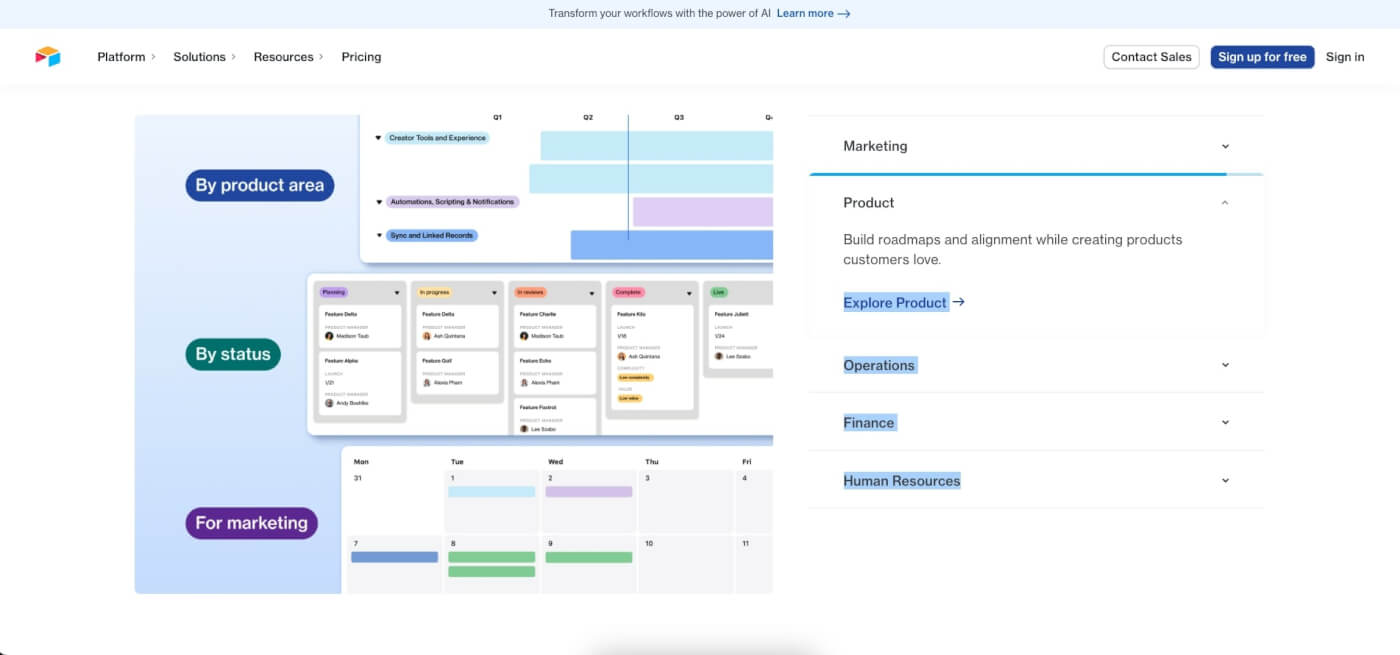
Airtable is the company that turned a spreadsheet into a database that builds apps. In 14 years it went from "you'll never get developers to use a no-code tool" to a $11.7 billion decacorn powering more than 500,000 organizations, then through two layoff rounds and a viral "Airtable is dead" tweet, and finally to a CEO-led AI refound that ships near-weekly capability releases plus two brand-new agent products on their own domains.
This is the complete history of Airtable, the founders, the funding, the product layers, the people, the layoffs, the refound, Cobuilder, Omni, the DeepSky acquisition, Superagent, and Hyperagent. 🔮
TL;DR, From spreadsheet to Superagent in 18 months. Airtable went from a 2012 spreadsheet-meets-database side bet to a $11.7B Series F decacorn, then through 491 layoffs and the "Airtable is dead" meme cycle. Between June 2025 and February 2026 it rebuilt itself as an AI-native app platform: Omni (June 24 2025 conversational refound), the DeepSky acquisition (October 2025, former OpenAI engineering leader for ChatGPT Business Products), Superagent.com (January 27 2026, first standalone product in 13 years), and Hyperagent.com (early 2026, cloud agents with their own compute). Build the same shape. But with embedded agents and one-prompt deploy, in Taskade Genesis →
🤖 What Is Airtable?
Airtable is a low-code platform that combines a relational database, a no-code interface designer, and workflow automations into one workspace. Founded in 2012 by Howie Liu, Andrew Ofstad, and Emmett Nicholas, it serves more than 500,000 organizations and roughly 80 percent of the Fortune 100, including OpenAI, Anthropic, Amazon, Netflix, Google, and Airbnb. As of 2026 the company reports approximately half a billion in annualized revenue with $100M+ in free cash flow.
The mental model is three layers stacked on top of each other:
┌────────────────────────────────────────────────┐
│  INTERFACES   ← what end users actually touch  │
├────────────────────────────────────────────────┤
│  AUTOMATIONS  ← background workflow logic      │
├────────────────────────────────────────────────┤
│  DATA         ← tables, fields, relations      │
└────────────────────────────────────────────────┘
Behind the familiar grid sits a typed, relational schema. Cells are typed: a date field rejects text, a single-select field is constrained to defined options, a link-to-another-record field threads bidirectional relationships between tables. Above the data sits a logic layer of triggers and actions; above that sits a designer that turns the database into something a non-builder can click through.
That three-layer separation is the wedge. Excel and Google Sheets are flexible but unstructured; Salesforce is structured but inaccessible. Airtable's bet was that the middle of the spectrum, typed, relational, but consumer-grade, was an entire category nobody had built.
📊 Airtable at a Glance: The Complete Evolution
The 14-year arc, from Howie Liu selling Etacts to Salesforce in 2010 through the Hyperagent public open in April 2026:
Snapshot table
| Metric | Value |
|---|---|
| Founded | 2012 (San Francisco) |
| Founders | Howie Liu (CEO), Andrew Ofstad, Emmett Nicholas |
| CTO (2025–) | David Azose (ex-OpenAI) |
| Customers | 500,000+ organizations; ~80% of Fortune 100 |
| Headcount | ~700 (post two layoff rounds totaling ~491 people) |
| Total raised | ~$1.4B across 7 rounds |
| Cash retained | ~$700M (per TechCrunch, Jan 2026) |
| Free cash flow | $100M+ annualized |
| Last primary valuation | $11.7B (Series F, Dec 13 2021) |
| Secondary valuation 2026 | ~$4B |
| Reported revenue (2026) | "Half a billion" (Howie Liu, Greg Eisenberg pod) |
| AI products (2026) | Omni, Field Agents, Superagent, Hyperagent |
Snapshot as of May 2026. Funding and valuation figures cross-checked against Airtable's own newsroom posts, TechCrunch, Bloomberg, and CNBC. Revenue is Liu's own framing on the Greg Eisenberg podcast (Apr 2026).
🥚 Founders & Founding (2010–2014)
Airtable was founded in 2012 by Howie Liu, Andrew Ofstad, and Emmett Nicholas, three engineers who met through Duke connections and wanted to consumerize the relational database. The seed of the company sat inside Salesforce, where Liu had landed two years earlier after the Etacts acquihire.
Howie Liu's path: Duke → Etacts → Salesforce → Airtable
Born in 1989 in College Station, Texas, Howie Liu taught himself C++ at age 13 and entered Duke University at 16. He graduated in 2009 with degrees in Mechanical Engineering and Public Policy. In February 2010, at age 20, he co-founded Etacts with Evan Beard through Y Combinator's W2010 batch, a Gmail and IMAP relationship-management tool that pulled inbox metadata into a usable CRM surface. Etacts raised about $650,000 from Ron Conway, Eric Hahn, Jim Young, Lorenzo Thione, Barney Pell, Joshua Schachter, Jawed Karim, and Ashton Kutcher.
On December 21, 2010, Salesforce acquired Etacts for an undisclosed sum. Etacts shut down on January 31, 2011 and Liu joined Salesforce as a product manager working on social CRM. Force.com, Salesforce's developer platform, was scaling fast around him, and the question that became Airtable started forming: what would Force.com look like if a non-developer could use it?
Andrew Ofstad and Emmett Nicholas
Andrew Ofstad grew up in rural Montana, studied Electrical Engineering and Economics at Duke, and spent years at Google as a Product Manager on Android before leading the redesign of Google Maps. Emmett Nicholas was a Stack Overflow software engineer for three-plus years before joining the founding team. The three connected through Duke; the often-repeated "all three were classmates" line oversimplifies. They overlapped but in different cohorts.
| Founder | Role | Background |
|---|---|---|
| Howie Liu | Co-founder, CEO | Duke (ME + Public Policy, age 16); Etacts (YC W2010, sold to Salesforce 2010); Salesforce PM |
| Andrew Ofstad | Co-founder, CPO | Duke (EE + Economics); Google PM (Android); led Google Maps redesign |
| Emmett Nicholas | Co-founder | Duke; software engineer at Stack Overflow (3+ years) |
How the founders connect: Force.com → Etacts → Airtable → Hyperagent
The throughline of Howie Liu's 17-year crusade reads as one decision tree:
Why investors said no
Airtable raised pre-seed angel checks from Ashton Kutcher, Michael Birch (Bebo), and Josh Reeves (Gusto) in 2012 and 2013, but the institutional VCs were skeptical. Liu summarized it in his 2022 Upfront Summit conversation with Axios:
"Every investor at the time thought we were nuts. They said, 'You can build a great product, but people will not come.'"
The thesis was hard to articulate before "low-code" was a category and before the consumerization-of-enterprise wave (Miro, Figma, Zoom, Slack) had crested. Airtable spent two years in stealth and then opened an invite-only beta in 2014.
A note on the founding-year ambiguity: Wikipedia, Crunchbase, and Tracxn cite 2012. Contrary Research cites January 2013. Golden encyclopedia cites September 2012. The 2012 framing is most-cited and aligns with the founders' own retrospectives. But some company materials use 2013 as a formal incorporation date.
The patient three-year incubation: how Airtable was different from Etacts
The founding decisions Liu made in 2012 were a deliberate inversion of the ones he made in 2010 with Etacts. He told the Startup Grind audience in 2018, right after the Series B, that he had finally given himself the luxury Etacts never had: time. That difference shows up in eight specific design choices that compounded into the eventual decacorn.
| Decision | Etacts (2010) | Airtable (2012–15) | What changed |
|---|---|---|---|
| Pre-launch incubation | ~10 weeks (YC W2010 sprint) | ~3 years in stealth, public launch March 2015 | Liu had savings and the patience to plan 5–6 chess moves ahead, not 2–3 |
| Product research | Built first, validated later | Talked to "anyone and everyone" who had worked on a database product — Microsoft Access teams, prior database startup founders, productivity-tool product leaders | Domain saturation before the first line of UI code |
| Strategy artifact | None — survival-mode | A vision plan ("the equivalent of a business plan that's no longer common") with explicit market sizing and the next 5–6 execution phases | Long-horizon ladder, not a tactical to-do list |
| MVP discipline | Ship to survive | Ship at "necessary embarrassment" — felt the v1 was incomplete but drew the line | Diminishing-return curve consciously bent |
| Investor profile | Default YC seed motion | Hand-picked "very, very patient investors" because the long incubation required it | Mismatched-time-horizon risk eliminated up front |
| Sales motion | Standard prosumer launch | Bottoms-up only, never top-down — "from conception to now" | Created the land-and-expand pattern that defines Airtable to this day |
| Onboarding | Blank slate | Templates on day one — "you don't want to start with a blank slate" | Suggestion solves the cold-start problem for an open-ended tool |
| Positioning | Replace Salesforce CRM whole-cloth | Not categorically better than Excel — better only for the swath of use cases where Excel is used as a makeshift database | A wedge, not a frontal assault |
Liu's framing of the Excel positioning is worth quoting directly because the lesson generalizes to every horizontal product:
"We're not trying to be categorically better than Excel, but rather, you know, for this large class of use cases we can be much better. But for the numerical use cases we're not the right tool, you should use Excel."
, Howie Liu, Startup Grind interview, 2018
The invisible product decision baked into that framing: Airtable shipped templates on launch day specifically to make the use-case wedge legible to first-time visitors who couldn't otherwise tell what a "consumer Force.com" was for. Today every horizontal AI product faces the same cold-start problem; templates and gallery patterns are the analogue.
The Etacts vision Liu still kept: an "automated and intelligent" CRM
The Etacts pitch in 2010, described by Liu on Startup Grind as a CRM "that would automatically pull in your emails and your phone calls, Facebook, Twitter, LinkedIn, you know, kind of graph, and show you an evergreen dashboard of all the people you had or hadn't talked to", reads in 2026 like a description of what AI-augmented relationship-management products are now finally shipping. Liu's mistake with Etacts was timing, not vision. The same automated-and-intelligent instinct survived through Airtable's three product layers and is the throughline that makes Omni and Hyperagent feel like the natural endpoint of a 17-year crusade rather than a strategic pivot.
The Ashton Kutcher meeting (literally) on the set of Two and a Half Men
The most-told Airtable origin anecdote is also true: Liu pitched Ashton Kutcher for Airtable in his trailer in Burbank, right after Kutcher walked off the set of Two and a Half Men. Kutcher had previously invested in Etacts as part of his first year attending YC demo days, so the relationship existed, but the geography was real. Liu's framing on Startup Grind is matter-of-fact: Kutcher "is an extremely savvy, extremely sharp tech investor that holds his own or better against any of the other top tech investors." The trailer setting is the colour; the institutional discipline of the pitch is the lesson.
📦 Public Launch and the Long Crawl (2015–2017)
Airtable launched publicly in March 2015, debuted on Hacker News, and closed a $3 million seed round on February 25, 2015 led by Caffeinated Capital with Freestyle Capital, Data Collective, and CrunchFund. A $7.6 million Series A from CRV (Charles River Ventures), with Ashton Kutcher participating, followed in May 2015.
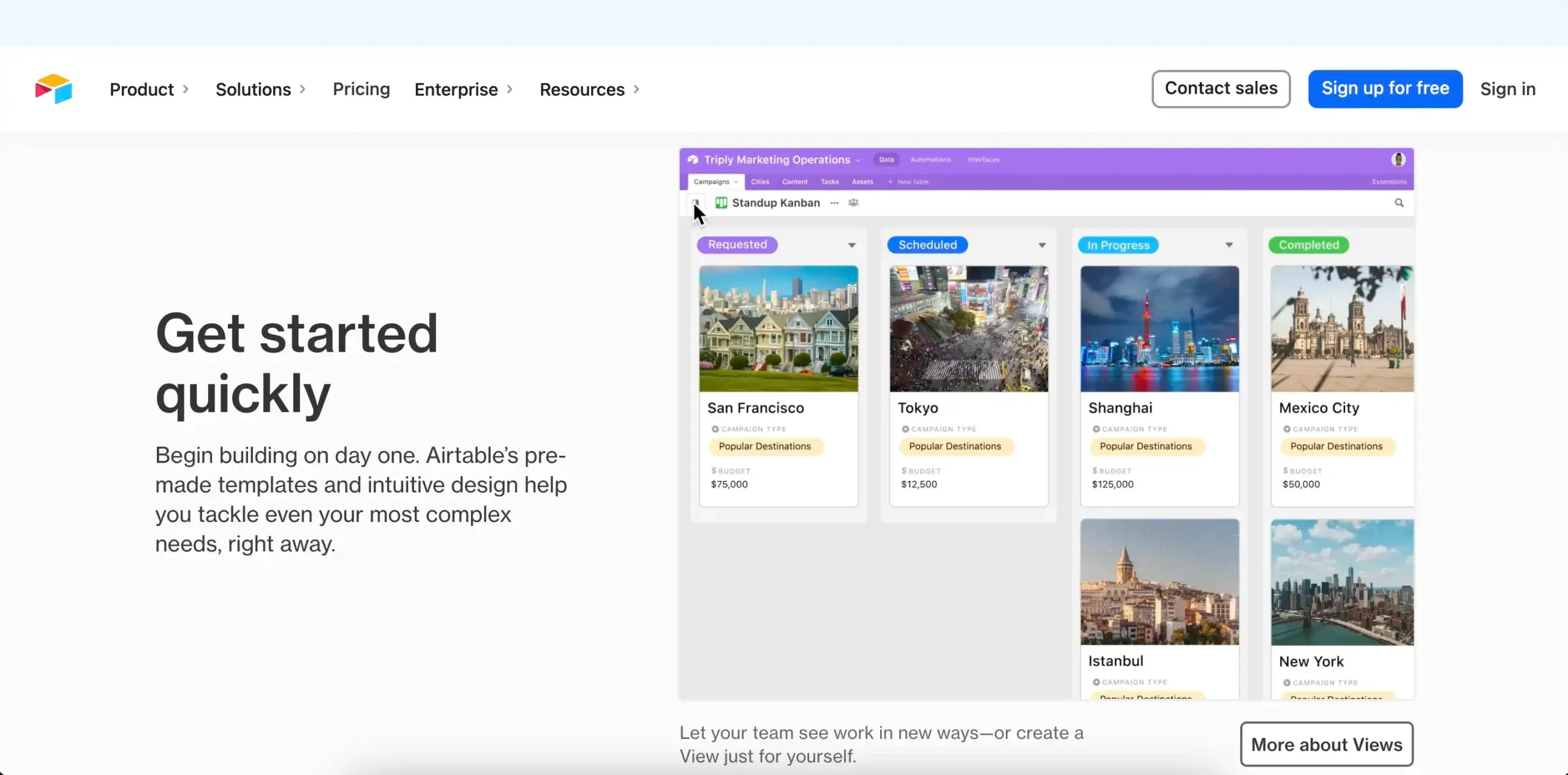
The product evolved fast: API and embedded database in April 2015, Forms in July, Zapier integrations and the Barcode field in August, an iOS redesign in December. In 2016 came Calendar view (April), the iPad app (July), the Gallery view plus native macOS and Android apps in September alongside the 2 million bases milestone, then Kanban view in November. In September 2017 the team launched Airtable Universe, the community gallery of templates and apps that became one of the most enduring sources of organic discovery.
The First Round Review interview with Andrew Ofstad captures the organic adoption pattern that VCs underestimated:
"I visited WeWork. I looked around and everybody's computer monitor had Airtable open. And I was like, 'Oh my God, this is actually a thing.'"
, Andrew Ofstad, First Round Review
The land-and-expand pattern looks like this:
By 2017 the seed pattern was clear enough that Airtable bought billboards across the SF Bay Area. The thesis was now visible: the wedge wasn't displacing Excel. It was creating a category of internal apps that had never existed, one creator at a time.
The wedge succeeded because Liu refused the maximalist pitch. Excel-as-numerical-tool stayed Excel; Airtable only competed for the makeshift-database swath where you couldn't attach files to a cell, couldn't save filtered views per-team, couldn't link two tables together. Defining the territory you don't want is what made Airtable's territory easy for a non-developer to understand.
🧱 Becoming a Platform: Blocks → Apps, Automations, Sync (2018–2020)
On March 14, 2018 Airtable raised a $52 million Series B led by CRV and Caffeinated and simultaneously launched Airtable Blocks, branded by Business Wire as "a powerful DIY software creation platform for non-coders." Blocks were the first signal that Airtable wasn't a fancy spreadsheet. It was infrastructure.
Eight months later in November 2018 came the Series C: $100 million at a $1.1 billion valuation, led by Benchmark and Thrive Capital. Airtable was officially a unicorn, and the Hacker News thread logged the cultural reaction, half congratulations, half "this is a glorified spreadsheet."
The platform expansion accelerated in September 2020, when TechCrunch covered the Series D: $185 million at roughly $2.585 billion. The same announcement shipped:
- Apps (Blocks rebranded)
- Automations (triggers + actions, no-code workflow logic)
- Sync (data flows from external sources)
- Marketplace (third-party Apps distribution)
Suddenly Airtable wasn't a database with views. It was a database, with logic, with sync sources, with a marketplace of extensions. The three-layer mental model was now a product reality.
That sequence is the canonical "Airtable approval workflow" that the 9x crash course walks through in 25 minutes. Two automations plus one interface plus two tables equals a working internal app, built by one person in an afternoon.
🚀 The Decacorn Era and Interface Designer (2021)
Three rounds in fifteen months. March 15, 2021: TechCrunch reported the Series E at $270 million led by Greenoaks Capital with WndrCo (Jeffrey Katzenberg), Caffeinated, CRV, and Thrive, post-money $5.77 billion.
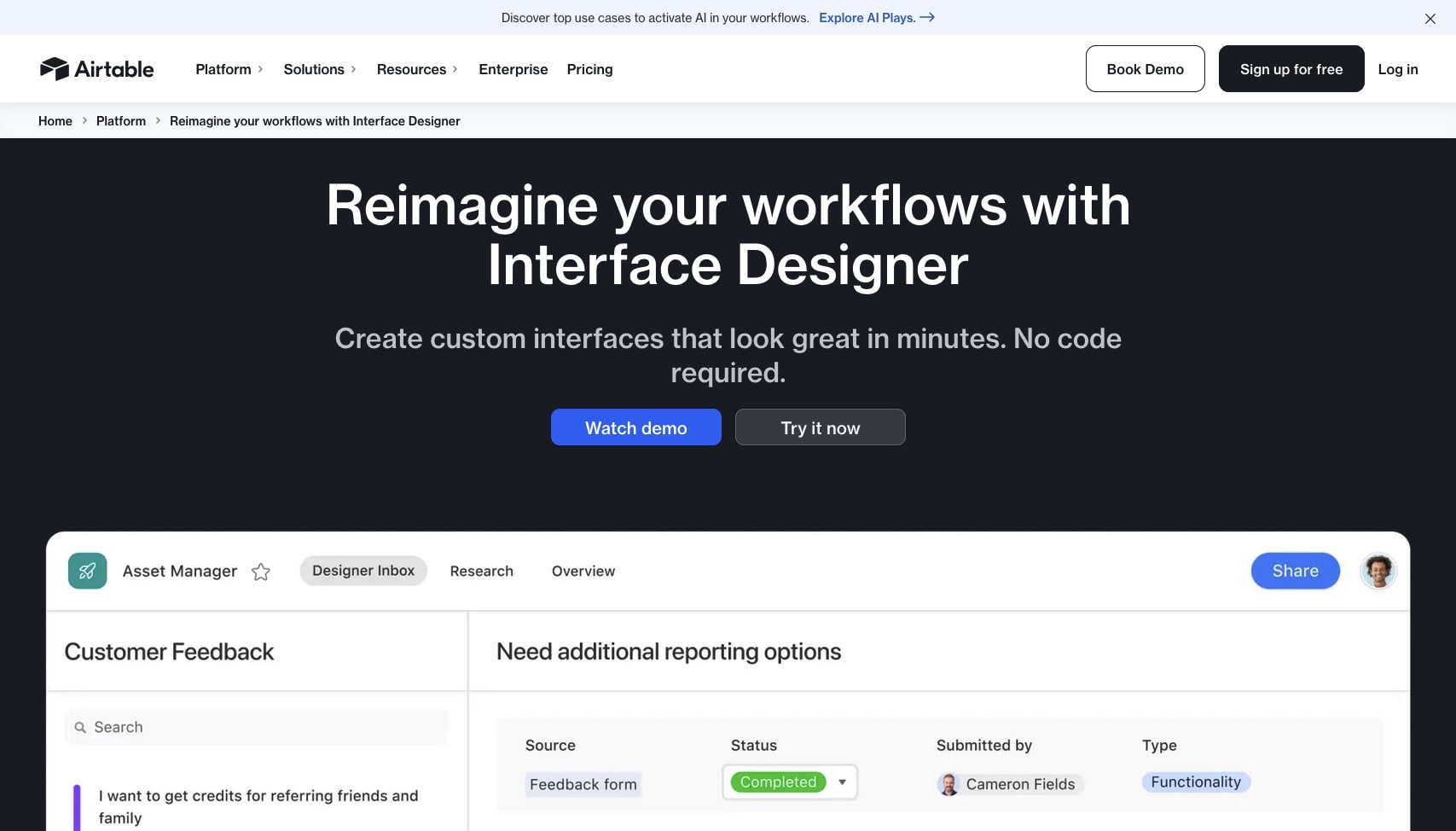
November 9, 2021: the Interface Designer beta opened to all users, via the Airtable blog. For the first time, the no-code app surface was a first-class shipped product, not a marketplace block.
December 13, 2021: the Series F at $735 million led by XN, with Salesforce Ventures, Franklin Templeton, JPMorgan Growth, MSD Capital (Michael Dell), Silver Lake, T. Rowe Price and existing investors. Post-money $11.7 billion. Bloomberg framed the round as Europe expansion fuel; CNBC framed it as low-code's coming-out party.
In Liu's Upfront Summit talk weeks later, he was explicit about the durable-growth philosophy:
"It's the outer years of durable growth that really matter that drive valuation. Growing 100% for one or two years but expected to flatline is much less valuable than growing 70-80% with belief you can sustain that 3-4-5 years out."
, Howie Liu, Upfront Summit 2022
In early 2021 Liu also brought in Peter Deng as Chief Product Officer (full-time December 2020 after an advisor period). Deng had ten years at Facebook on News Feed, Messenger, Groups, and Events, then was the first Head of Product at Instagram, then Head of Product at Oculus, then Head of Rider at Uber. His framing on the Airtable Table Talk podcast became the canonical articulation of the platform thesis:
"Every bit of functionality we build, we think of it as building a Lego block. If we execute well over 5–10 years, customers can build a lot of different kinds of software, not just collaborative applications."
, Peter Deng, Airtable Table Talk #15 (2022)
Three pillars for the year: Data, Alignment, Simplicity. New customers asked "how do I get data in?" Mature customers asked "how do I connect key pieces of multiple workflows?" The PRD template at Airtable opened with a single question: what customer problem are you trying to solve?
🧠 Inside the Three-Layer Mental Model
The three layers, Data, Automations, Interfaces, are the canonical Airtable mental model. Every external tutorial teaches them in this order, and every internal product launch fits into one of the three.
Layer 1: Data: typed, relational, view-aware
Field types are the most underrated piece of Airtable's architecture. The type determines what data is allowed: a date field rejects text, a single-select field is restricted to defined options, a link-to-another-record field threads bidirectional relationships and auto-creates the reverse field on the other side.
| Field type | What it stores | Notable feature |
|---|---|---|
| Single line text | Short string | Default text field |
| Long text | Multi-line, optional rich text | Markdown, mentions, attachments inline |
| Number / Currency / Percent | Typed numerics | Format-aware validation |
| Single select | One option from a defined list | Color-coded chips |
| Multiple select | Many options from a defined list | Color-coded chips |
| Date | ISO date / datetime | Time zone aware |
| User | Workspace member | Triggers @-mention notifications |
| Attachment | Files in object storage | Image previews, OCR (Pro+) |
| Link to another record | Foreign key | Bidirectional, auto-reverse field |
| Lookup | Pulled from linked record | Read-only computed |
| Rollup | Aggregate of linked records | Sum, count, avg, etc. |
| Formula | Computed expression | RECORD_ID(), IF(), dates math |
| Button | Trigger action from interface | Hooks automations |
View types sit on top of the same underlying data. One table, many ways to see it:
| View | Best for | Pro tip |
|---|---|---|
| Grid | Default, spreadsheet-like editing | Lock views to prevent edits |
| Kanban | Status pipelines (CRM, support, content calendars) | Group by single-select |
| Calendar | Date-driven workflows (events, content schedule) | Color-code by status |
| Gallery | Visual catalogs (products, portfolios) | Cover image from attachment field |
| Timeline | Roadmaps, dependencies | Mid-tier plan only |
| Gantt | Project plans with dependencies | Pro plan only |
Layer 2: Automations: triggers and actions
Automations have two halves. Triggers specify when a flow runs; Actions specify what happens.
| Triggers | Actions |
|---|---|
| Record created | Create record |
| Record updated | Update record |
| Record matches conditions | Find records |
| Form submitted | Send email |
| Webhook received | Send Slack message |
| At scheduled time | Send Microsoft Teams message |
| Email received | Send SMS via Twilio |
| Button clicked from interface | Run a script (JavaScript) |
| Calendar event created | Generate with AI (prompt + record context) |
| External integration event | Conditional branch (if/else) |
Every record in Airtable has a RECORD_ID(), a unique identifier that automations pass around to update the right record. You can surface it as a formula field for debugging:
RECORD_ID() → "rec0aB1cD2eF3gH4i"
The conditional branch is the unlock. Peter Deng called it out as one of the "big" features he was unembarrassed about shipping: "I've never written a program that didn't have an if/else statement." Loops, error handling, and branching turned automations from one-shot triggers into real workflows.
Layer 3: Interfaces: the no-code app surface
The Interface Designer is what the end user actually touches. Layouts come pre-built (List, Dashboard, Kanban, Record Review, Form). The right panel configures whatever element is selected. Permissions are managed at the interface level. You build a public campaigns interface and a restricted admin interface, then scope them to specific user groups.
┌─────────────────────────────────────────────────────────┐
│ Pages    │  ┌────────────────┐ │  Right Panel           │
│ ▸ Home   │  │  CANVAS        │ │  ┌──────────────────┐  │
│ ▸ Admin  │  │                │ │  │ Element settings │  │
│ ▸ Inbox  │  │  [Card]        │ │  │ Source: Tasks    │  │
│ ▸ Form   │  │  [Card]        │ │  │ Filter: due ≤ 7d │  │
│          │  │  [Chart]       │ │  │ Group by: status │  │
│          │  └────────────────┘ │  └──────────────────┘  │
└─────────────────────────────────────────────────────────┘
The killer pattern: filter records to "the current user." A single interface scopes itself per viewer, so every team member sees only the records they're assigned to. By default everything is read-only. You toggle user actions on per element to allow editing, creating, or deleting records.
Side-by-side: the three layers
| Layer | What it does | Example primitive | End-user persona |
|---|---|---|---|
| Data | Persistence + structure | link-to-another-record, single-select, formula |
The base owner |
| Automations | Background workflow logic | Trigger → Action, if/else, scripts | The ops lead |
| Interfaces | What the end user touches | Dashboard, Record Review, Form, Buttons | Everyone else |
🤝 Customer Spotlight: Who Actually Builds on Airtable
Airtable's customer list reads like a tour through every category of internal app. In 2026 the homepage shows logos for OpenAI, Anthropic, Harvey, Amazon, Walmart, Netflix, Google, Airbnb, American Express, and HBO. The historical roster includes Tesla, Adobe, Atlantic Records, Condé Nast Entertainment, Shopify, Time, Autodesk, and Intuit.
| Customer | Industry | Use case | What it replaced |
|---|---|---|---|
| Netflix | Streaming | Production tracking, content ops | Spreadsheets + ad hoc tools |
| Time / Atlantic Records / Condé Nast | Media | Editorial calendars, asset tracking | Excel + email |
| Shopify | Commerce | Cross-team ops + integrations | Internal tooling |
| Amazon / Baker Hughes / IBM | Enterprise | Ops, planning, R&D tracking | SharePoint, custom apps |
| JetBlue | Airlines | Internal ops, planning | Legacy enterprise tools |
| BlackRock | Finance | Product development tracking | Custom dashboards (cited "2x product velocity") |
| OpenAI | AI | ChatGPT launch planning, ops | Internal sheets + Slack |
The viral wedge that Andrew Ofstad described, "head of production goes from Netflix to next company, brings Airtable", is what made the customer list look so industry-spanning. The pattern repeats: a single power user adopts the tool inside a function, the function adopts it across the org, the org adopts it across departments, and finally an enterprise contract gets signed.
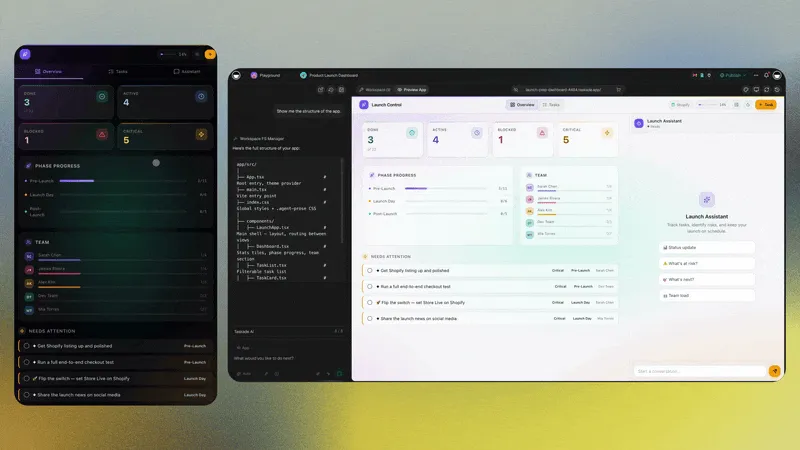
A 2026 highlight: Airtable's Shopify automation piece runs live, syncing inventory, orders, and customers bidirectionally across the e-commerce stack.
🤖 Enter AI: From Airtable AI to the First Cracks (2023)
On May 10, 2023 Airtable announced its AI launch, AI Field Type, AI Component Library, "Apps by Airtable," Verified Data, Two-Way Sync, and a Services Partner Program. The beta program opened June 27, 2023.
The launch quote captured the moment:
"With AI breakthroughs that are capable of a broad range of reasoning and creative work, every form of knowledge work faces imminent transformation."
, Howie Liu, May 10 2023
The product worked. The strategy didn't, yet. Throughout 2023, Airtable's growth team was rebuilding onboarding under Head of Growth Lauryn Isford, who later joined Notion. Her contrarian framework, shared on Lenny's Podcast, still informs how Airtable thinks about activation:
"An activation rate that falls in a lower percentage range, maybe 5 to 15 percent for most companies, is better than one that falls in a higher percentage range, because there's likely much higher correlation with long-term retention."
Isford rebuilt onboarding around three buckets: an immersive guided wizard (highest impact), learning-style segmentation (technical-fluent vs visual learner, instead of role-based), and ongoing education via a design pattern internally nicknamed "the Mole." Result: roughly 20% lift in activation rate over 12 to 18 months.
But the macro environment was about to bite.
💀 The Two Layoff Rounds and the C-Suite Reset (2022–2023)
Airtable executed two layoff rounds nine months apart, cutting roughly 491 people in total, by some employee accounts on Glassdoor, close to 47% of staff over nine months.
December 8, 2022, Round 1:
- ~254 employees (~20% of staff)
- Three execs depart: Seth Shaw (CRO, joined Nov 2020), Peter Deng (CPO, joined Dec 2020), Johanna Jackman (CPeopleO, joined May 2021), all stayed on briefly as advisors
- Airtable retained the full $735M Series F
- Pivot framing: "narrowly focused mode of execution" targeting 1,000+ employee enterprises
- (TechCrunch coverage)
September 14, 2023, Round 2:
- 237 employees (~27%)
- Affected: product and SMB-sales primarily
- Severance: 16 weeks pay, 2 months accelerated equity vesting, 6 months of health care
- Liu to Forbes (via SF Standard): "It's a sickening feeling. I made the decisions that got us here."
The 2024 enterprise pivot showed up in the product structure too. The plan ladder simplified to Free / Team / Business / Enterprise Scale, the "Plus" plan was eliminated. HyperDB was announced September 26, 2024, built to sync 100M+ records from Snowflake, Databricks, and Salesforce. ProductCentral launched October 16, 2024 as a vertical solution with JetBlue and BlackRock cited as anchor customers (BlackRock attributing "2x product velocity" to it).
In January 2024 Airtable also acquihired Airplane, an internal-tooling startup, sunsetting the original product by March 2024.
📰 The "Airtable Is Dead" Moment
Sometime in 2024, a viral tweet declared Airtable dead. Howie Liu's framing on Lenny Rachitsky's podcast, captured in a framing tweet by Lenny, recounts the dynamic precisely: a writer published numbers that were "wrong by a strong multiple" on revenue and growth rate, and the take spread before any correction could land.
"A lie gets around the world some number of times before truth has even has time to get out of bed."
, Howie Liu, Lenny's Podcast (Aug 2025)
That experience, the embarrassment plus the realization that the AI wave had moved past the company, became the catalyst. By the time of Liu's Lenny appearance in August 2025, the product strategy had already turned over.
Verification note: agents researching this article could not source the original CB Insights tweet or a specific All-In podcast segment. Lenny's framing tweet is the canonical reference; the article does not assert specifics that aren't sourced.
🛠️ Cobuilder: The Fastest-Adopted Feature in Company History (2024–2025)
Cobuilder was Airtable's first major AI bet and, internally, the fastest-adopted feature the company had ever shipped. Released in 2024 (Airtable newsroom), it let users describe an app in plain language and watch the database, the views, and the basic interface assemble themselves.
The output was a real Airtable base, not a synthetic mockup. That detail mattered: the agent wasn't generating code that someone had to deploy. It was generating Airtable primitives that the user could immediately edit, extend, and ship.
Cobuilder set the architectural pattern for everything that came next. Instead of having an LLM write a database from scratch (the failure mode of pure vibe-coding tools), have it compose Airtable's existing primitives. The agent gets reliability for free; the user gets editability for free.
That insight became the wedge for the AI-native relaunch the next year.
🔁 The Refound: Howie Liu's IC CEO Era (2025)
In June 2025, Liu reframed Airtable publicly as a refounding moment. The August 2025 Lenny Podcast episode, How we restructured Airtable's entire org for AI, laid out the philosophy. The frame had three parts:
- The IC CEO: CEOs becoming individual contributors again, hands on the product
- Refounding every product: AI is not a one-time form factor shift; every model release implies new UX
- Fast-thinking vs slow-thinking org, two halves with different operating cadences
"Every software product, in my opinion, has to be refounded."
, Howie Liu, Lenny's Podcast (2025)
"It's now hard to taste the soup without participating in at least some part of creating the soup."
, Howie Liu, on the IC CEO frame
Liu's daily workflow shifted radically. Standing one-on-ones got cancelled by default. The barbell: longer in-person lunches every one to two months for genuine relationship building, plus topical timely meetings driven by real "alpha." A new standing meeting, a weekly AI execution sprint check-in, replaced most of the recurring calendar.
The Dan Shipper signal he cited: what predicts a company successfully adopting AI? Does the CEO use ChatGPT or Claude daily? Liu's answer: hourly.
His own usage included LLM map-reduce over a year of sales call transcripts to extract product, marketing, and positioning insights, costing hundreds of dollars per run, with equivalent consulting work running into millions. Liu has stated he is one of Airtable's largest individual inference-cost users globally.
The "go play with every AI product for a week" sprint
The sharpest piece of practical advice Liu gave in the Lenny conversation was the permission slip he started giving people on the EPD org:
"If you want to cancel all your meetings for like a day or for an entire week and just go play around with every AI product that you think could be relevant to Airtable, go do it."
, Howie Liu, Lenny's Podcast (Aug 2025)
The logic ladders out of the chef metaphor: you cannot understand new ingredients from a recipe card, you have to actually cook with them. AI is something you have to play with, both the packaged-up product layer and the underlying primitives reachable via API or chat, to know what new dishes are even possible.
That permission is what most product orgs are still failing to grant in 2026. The companies that compound do, the ones that stall don't.
That cycle, identify, build, ship, measure, repeat with the new ingredient, replaced the slower roadmap cycle. As of 2025, Liu reported that roughly half of Airtable's EPD organization is now on AI capabilities.
On the Greg Eisenberg podcast in April 2026, he described his coding workflow:
"I have like 30 different Claude Code instances running in parallel and each one is coupled up to a browser fully autonomous. It can go and get other agents to comment on any PRs it creates."
That's frontier mode. And it's the reason a 14-year-old company is shipping on the same cadence as AI-native startups.
🏗️ Fast-Thinking vs. Slow-Thinking: How Airtable Restructured for AI
The org evolved through three shapes. The current one, fast/slow, was inspired by Daniel Kahneman's Thinking, Fast and Slow.
The fast-thinking AI Platform group ships major capabilities on a near-weekly basis. Each release has to be jaw-dropping, not incremental. Who succeeds on the fast team? People with high autonomy and entrepreneurial instincts (literal former founders included), comfort thinking full-stack across technical layers and UX, and a relish for openness rather than feeling overwhelmed by it.
The slow-thinking group handles deliberate bets requiring premeditation. HyperDB, Airtable's data store now handling multi-hundred-million-record datasets, is the canonical example. You cannot ship HyperDB as a hacky one-week prototype. The slow group owns the infra that turns initial seeds of adoption into durable enterprise growth.
The two halves complement each other. Fast equals top-of-funnel excitement, AI-tourist traffic, new use cases. Slow equals retention, expansion, and the durable revenue base. Liu's diagnosis of pure-AI-native startups: wide top of funnel but weak retention. Airtable's slow half is the answer to that.
The full reorg arc: three shapes in five years
The fast-versus-slow split is the third reorg, not the first. Liu walked through the entire sequence on the Lenny podcast:
   Reorg #1 (2020-21)              Reorg #2 (~2022-24)             Reorg #3 (2025-)
   FEATURE TEAMS                   BUSINESS-UNIT PILLARS           FAST + SLOW THINKING
   ─────────────                   ─────────────────────           ────────────────────
   Search team                     Enterprise pillar               AI Platform (fast)
   Mobile team                     Teams / NUX pillar              Deliberate Bets (slow)
   Sync team                       AI pillar
   etc.                            Solutions pillar
                                   Infra pillar
   ↓                               ↓                               ↓
   Each remit = 1 feature.         Each pillar = 1 BU outcome.     Two cadences.
   Incremental by definition.      Crossfunctional bets possible.  One-cohesive product.
   Hard to plan org-wide bets.     Still slow vs cursor / surf.    Ships near-weekly.
Each shape solved a specific problem of the prior one. Feature teams couldn't make holistic bets, every team's remit was an incremental improvement to one surface. Business-unit pillars unblocked holistic bets within a customer segment but still left the road map fragmented across pillars when AI-native peers were shipping a single coherent product near-weekly. Fast-plus-slow is the answer Liu landed on for the agent era.
The quality bar for the fast group is not "ship something". It's higher than that.
"Each of them should be like truly awesome value, right? Like you should drop your jaw at like how awesome it is to use this new capability in Airtable."
, Howie Liu, on the AI Platform team's bar (Lenny's Podcast, Aug 2025)
That bar is the reason a 14-year-old company is now releasing capabilities at the same cadence as a one-year-old startup. Speed without taste is noise; speed with taste is what compounds.
🧪 The Refound Test: "Useful Building Blocks or a Buyer"
The piece of the Lenny conversation that operators have been quoting back at each other since August 2025 is Liu's binary test for any pre-AI software company:
"If you were literally founding a new company from scratch with the same mission, how would you execute on that mission using a fully AI-native approach? If you can't, then you should find a buyer, and then if you really care about this mission, like go and start the next carnation of it."
, Howie Liu, Lenny's Podcast (Aug 2025)
The test has two layers. The first is whether the existing primitives are useful building blocks you can leverage, or legacy assets you would be better off without. The second is whether you have the honesty to introspect and act on the answer.
Liu's own answer to the test for Airtable: the no-code primitives, typed fields, link-to-record, automations, interfaces, do accelerate an AI-native build, because the agent doesn't have to generate every layer from scratch. That belief is the architectural premise behind Omni, Superagent, and Hyperagent. If Liu had concluded the primitives were dead weight, the Lenny quote is unambiguous about what he says he would have done: sell, then start over.
Most pre-AI SaaS companies still owe their teams that conversation. Few have had it.
🦾 The AI-Native Relaunch and Omni (June 24, 2025)
Airtable's relaunch announcement on June 24, 2025 unified the Cobuilder and Assistant features into a single conversational surface called Omni. Field Agents launched alongside as a new agentic primitive that runs inside individual fields. AI capabilities and credits became included in every plan, including Free.
The core Omni architecture is the dodge. Pure vibe-coding business apps from scratch hits known failure modes:
- Unreliable, bug-prone code
- Data and security issues
- Context collapse, the agent can't manage all the code as the app grows
Airtable's primitives, a CRUD interface on a data layer, beautiful by default, let the agent manipulate a working app without writing every layer from scratch.
"When the cost of making apps goes to zero, how many more apps will we see made?"
, Howie Liu, AI-Native Airtable launch letter (Jun 24, 2025)
Omni's pricing is structured to encourage adoption. App building and iteration, no extra cost. Data analysis Q&A, 10 credits per response. The bet: meet users where they are, charge for the heavy lifting.
The form-factor ladder: Copilot → Cursor → Composer → Omni-style workspace
Liu's clearest framing of why the Omni surface exists is a four-step ladder of how model capability has shaped UX form factor since 2022:
| Era | Model capability | UX form factor that fit | Builder example |
|---|---|---|---|
| 2022–23 | First-generation chat models — short, often-wrong completions | Inline autocomplete of a few lines at a time | GitHub Copilot |
| 2024 | Frontier reasoning models with multi-turn coherence | Agentic edit + chat over a repo | Cursor (early agent mode) |
| 2025 | Frontier reasoning + reliable tool-use | One-shot whole-app codegen with a long task loop | Cursor Composer, Lovable, Bolt |
| 2026 | Frontier + persistent workspace context | Agent-as-default surface — the app is an artifact the agent manipulates | Omni, Taskade Genesis |
"We now made our agent the default way of doing everything in Airtable… the Airtable app as you know it is almost like an artifact that's manipulated by, and tool-used by, the agent."
, Howie Liu, Lenny's Podcast (Aug 2025)
That sentence is the architectural claim of the entire AI-native relaunch. The product surface didn't add a chatbot. It inverted the relationship. The conversational agent is now the canonical entry point, and the classic Airtable canvas is something the agent edits on the user's behalf. The same inversion is the design premise of Taskade Genesis: one prompt produces the database, the automations, the interface, and the agents in a single workspace.
The form-factor ladder also explains why "throw a chat sidebar on it" was never going to be enough. Each model generation implies a novel form factor to capitalize on its new capability, and the company that ships the right form factor first owns the era.
🧠 The DeepSky Acquisition: How Gradient Became Airtable's AI Engine (Oct 13, 2025)
Upstarts Media broke the news on October 13, 2025: Airtable had completed its largest acquisition in company history, buying DeepSky (formerly known as Gradient, which had raised approximately $40 million in venture funding). The deal brought 12 staff plus founders Chris Chang (CEO), Forrest Moret, and Mark Kim-Huang.
The bigger move: David Azose joined as Airtable's new CTO. Azose had previously led engineering for ChatGPT Business Products at OpenAI, after stints at DoorDash, Uber, and Microsoft. The Seattle-based hire signaled that Airtable's AI ambitions were no longer a roadmap item. They were a separate engineering org with its own leadership.
| Person | Role | Came from |
|---|---|---|
| David Azose | CTO | OpenAI (ChatGPT Business Products lead); prior DoorDash, Uber, Microsoft |
| Chris Chang | DeepSky CEO; reports to Liu | DeepSky (formerly Gradient) |
| Forrest Moret | DeepSky co-founder | DeepSky |
| Mark Kim-Huang | DeepSky co-founder | DeepSky |
DeepSky operates semi-independently inside Airtable. Chang reports to Liu directly. The organizational signal: this acquisition wasn't bolted onto an existing team. It was given autonomy to ship, fast.
The first major output of that autonomy landed three months later.
🌐 Superagent: First Standalone Product in 13 Years (Jan 27, 2026)
On January 27, 2026, Airtable launched Superagent at superagent.com, its first standalone product brand in 13 years. TechCrunch covered the launch with a sharp framing: Airtable's secondary-market valuation had fallen $7.7 billion from peak, but Liu thought Superagent was just the warm-up.
Superagent is a multi-agent research and analysis system. A coordinator agent deploys parallel specialists across different data sources (FactSet, Crunchbase, SEC filings, plus your own Airtable bases). The output isn't a wall of text. It's interactive matrices, comparison cards, maps, and structured deliverables you can edit and re-prompt.
"You're not prompting an AI. You're orchestrating a team. That's the difference."
, Howie Liu, Superagent launch (Jan 27, 2026)
Superagent uses frontier models from OpenAI, Anthropic, and Google. Pricing tiers run from $20/month per user up to $200/month for power users, with bundled inference credits (per TechCrunch). VentureBeat's deep dive emphasized the execution-visibility angle: every step the multi-agent system takes is inspectable and auditable, not a black box.
For the Airtable category, this was the clearest "we are back" signal in three years.
⚡ Hyperagent: Cloud Agents with Their Own Compute (Early 2026)
If Superagent was Airtable saying "we ship standalone products again," Hyperagent was Liu saying "the agent surface deserves a separate brand on a separate domain." Hyperagent.com launched as a fully separate site, with its own visual identity and pricing.
Hyperagent is a turnkey agent platform where every session gets its own isolated, full computing environment in the cloud. Real browser. Real shell. Real filesystem. Image and video generation. Mapping. Data warehouse access. Hundreds of enterprise integrations. Skill-learning compounds across sessions. One-click Slack deployment makes any agent deployable as a Slack-native coworker.
Homepage copy (verbatim)
- Hero: "Weeks of work. Overnight."
- Core: "The system of agents that does real work, learns how your organization operates, and deploys across your entire team."
- Anti-positioning: "Not a chatbot. Powerful cloud agents with a full computing environment."
Featured demos with token costs
| Task | Time | Cost |
|---|---|---|
| Personalized prospect outreach | 23m 48s | $8.82 |
| Real-estate listing kit | 9m 34s | $6.75 |
| Startup investment research | 18m 27s | $12.05 |
Those numbers are the citation capsule. The reframe Liu pushed on Greg Eisenberg's podcast:
"Think about the opportunity cost of my time. That's the real reframe, human equivalent time cost vs. '$150 sounds expensive vs. a $10/month sub.'"
A $150 inference run that produces a board memo, Liu's actual recent example, replaces consulting work that would cost millions and take weeks.
Launch incentives
- Founding 500: $10 million in inference grants
- First 1,000 signups: $1,000 bonus inference credits + 2.5x cost subsidy on top-tier Claude and other frontier models, up to $15,000/month, for one year
- Greg Eisenberg podcast community: separate $1,000 to first 1,000 builders ($1M total community pledge)
How Liu positions Hyperagent vs. the field
| Comp | Howie's framing |
|---|---|
| OpenClaude | "OpenClaude is Linux. Hyperagent is the Mac." — turnkey, secure-by-default, cloud-native, beautiful UX vs. raw and technical for power users |
| Manus | "First real holy-crap, YOLO agent." Hyperagent extends the idea with visual UX, fleet management, and a deployability story |
| Perplexity Computer | Closest comp. Hyperagent ships more powerful tools out of the box, better UX, deployability |
| Codex / Claude Code | "Hyperagent is general-purpose, not just code" |
The fleet command center
Once you build many agents, Hyperagent surfaces them as a fleet, content marketer, market researcher, customer email responder. Each plays a role and can be deployed to Slack one-click. Each accumulates memory and skills over time.
Rubrics: the eval-as-first-class-primitive differentiator
This is the piece Liu was clearest about as the unlock that separates Hyperagent from Manus or Perplexity Computer:
"If you're using Manus, who is the judge? The judge is you, the human. It's not a top-tier frontier model, it's a huge gating factor."
Hyperagent rubrics let you define what good looks like for a task, pin a rubric to an agent, have an LLM-as-judge score every run on the dimensions you care about, see trend lines over time, and auto-suggest model downgrades to a smaller model (~5x cost reduction) when score doesn't drop.
Skills as the primitive
"Skills are the most important concept and primitive in the frontier agents world. The models are generally intelligent enough, like Einstein. He may not know real estate, but if you give him a playbook, he figures it out."
Skills are composable, interactively created, and evergreen. They improve over time via automatic learnings or interactive correction. Every agent run accumulates new memories, skill suggestions, system-prompt suggestions, and tool-access suggestions. The fleet is self-improving by construction.
This is what Liu means by "the agent surface deserves a separate brand." Hyperagent isn't an Airtable feature. It's a different product category, with its own IA, its own pricing, its own URL.
The Hyperagent skill lifecycle
Skills compound across runs. Memory accumulates. The fleet self-improves.
Liu's framing: agents converge on human-shaped roles for the same reason humanoid robots converge on humanoid form, infrastructure is built for human ergonomics. With agents the constraint is the physics of context windows. We won't get infinite context, so we partition agents the way we partition humans: into roles in a company.
🛍️ The 2026 Product Stack: Full Lineup
| Product | Audience | Interface | Key capability |
|---|---|---|---|
| Airtable platform | Business builders | Web + mobile | Three-layer: Data + Automations + Interfaces |
| HyperDB | Enterprise data engineers | Inside Airtable | Sync 100M+ records from Snowflake/Databricks/Salesforce |
| Omni | All Airtable users | Conversational chat | Build apps from prompts, reusing Airtable primitives |
| Field Agents | Builders | Inside fields | Per-field agentic logic |
| Cobuilder | Same as Omni (now unified) | Conversational | Instant no-code app creation (rolled into Omni Jun 2025) |
| Marketplace + Apps SDK | Developers + ISVs | Web | Third-party extensions and integrations |
| Superagent (superagent.com) | Knowledge workers, analysts | Standalone web | Multi-agent research, deliverable-shaped outputs |
| Hyperagent (hyperagent.com) | Builders, ops, founders | Standalone web + Slack | Cloud agents with full compute environment, fleet command center |
The shape of the company is now visibly two-product: the legacy platform (Airtable + HyperDB + Omni + Field Agents) and the standalone agent brands (Superagent + Hyperagent). DeepSky-the-org powers both.
💰 The Funding History
Total raised: approximately $1.36 billion per Airtable's own Series F newsroom, restated as ~$1.4 billion in TechCrunch's January 2026 piece. Cash retained: ~$700 million. No Series G announced as of mid-2026.
| Round | Date | Amount | Post-money | Lead | Other notable participants |
|---|---|---|---|---|---|
| Pre-seed angels | 2012–13 | (undisclosed) | — | — | Ashton Kutcher, Michael Birch (Bebo), Josh Reeves (Gusto) |
| Seed | Feb 25, 2015 | $3M | — | Caffeinated Capital | Freestyle Capital, Data Collective, CrunchFund |
| Series A | May 2015 | $7.6M | — | CRV (Charles River Ventures) | Ashton Kutcher |
| Series B | Mar 14, 2018 | $52M | ~$152M | CRV + Caffeinated | Freestyle, Slow Ventures |
| Series C | Nov 2018 | $100M | $1.1B (unicorn) | Benchmark + Thrive Capital | Coatue, CRV, Caffeinated |
| Series D | Sep 14, 2020 | $185M | ~$2.585B | Thrive Capital | D1 Capital, Greenoaks, ICONIQ |
| Series E | Mar 15, 2021 | $270M | $5.77B | Greenoaks Capital | WndrCo (Katzenberg), Caffeinated, CRV, Thrive |
| Series F | Dec 13, 2021 | $735M | $11.7B | XN | Salesforce Ventures, Franklin Templeton, JPMorgan Growth, MSD Capital (Dell), Silver Lake, T. Rowe Price |
The arc is classic decacorn. The Series F was opportunistic, Liu told Upfront Summit 2022 that they hadn't touched the Series E yet and raised because the round came to them, not because they needed cash. That decision now looks prescient: $700M of dry powder funded the entire AI refound without a dilutive Series G.
👥 The People Behind Airtable
The exec roster turned over significantly in late 2022 and again in late 2025. The current leadership shape:
| Person | Role | Joined | Departed | Notes |
|---|---|---|---|---|
| Howie Liu | Co-founder, CEO | 2012 | current | Etacts → Salesforce → Airtable |
| Andrew Ofstad | Co-founder, CPO | 2012 | current | Ex-Google PM (Android, Maps redesign) |
| Emmett Nicholas | Co-founder | 2012 | current | Ex-Stack Overflow engineer |
| Peter Deng | CPO (interim era) | Dec 2020 | Dec 2022 | Ex-Facebook (10y), Instagram, Oculus, Uber. → Felicis GP → OpenAI VP Consumer Product |
| Seth Shaw | CRO | Nov 2020 | Dec 2022 | Departed in first layoff round |
| Johanna Jackman | Chief People Officer | May 2021 | Dec 2022 | Departed in first layoff round |
| Lauryn Isford | Head of Growth | (era unverified) | (later → Notion) | Drove ~20% activation lift; reverse-trial advocate |
| David Azose | CTO | Oct 2025 | current | Ex-OpenAI (ChatGPT Business Products lead); DoorDash, Uber, Microsoft |
| Chris Chang | DeepSky CEO (Superagent) | Oct 2025 | current | Reports directly to Liu |
| Forrest Moret | DeepSky co-founder | Oct 2025 | current | — |
| Mark Kim-Huang | DeepSky co-founder | Oct 2025 | current | — |
The throughline: founders still run the company. Liu remains CEO, Ofstad remains CPO, Nicholas remains an active co-founder. The 2025 hires reinforced rather than displaced.
🥊 Airtable vs. The Field (2026)
Airtable invented the low-code business-app category but the landscape around it has multiplied. Each adjacent player took the same primitives and weighted them differently.
| Tool | Data layer | Logic layer | UI layer | AI agents | Best for |
|---|---|---|---|---|---|
| Airtable | Relational DB | Automations + Field Agents | Interface Designer | Omni + Hyperagent | Internal business apps |
| Notion | Document blocks (light DB) | Buttons, formula | Pages, sub-pages | Notion AI (writing-first) | Knowledge base + docs |
| Coda | Doc-database hybrid | Formulas + Packs | Doc as app | Coda AI | Doc-as-app workflows |
| Smartsheet | Spreadsheet-first | Workflow rules | Dashboards | Smartsheet AI | Enterprise PMO |
| Monday | Boards (rows) | Automations | Boards + dashboards | Monday AI | Project management |
| ClickUp | Tasks (rows) | Automations | Multiple views | ClickUp AI Brain | All-in-one PM |
| Bubble | App database | Workflows | Visual page builder | (limited) | Full web apps |
| Retool | Connect to your DB | JS + queries | Drag-and-drop UI | Retool AI | Internal tools for engineers |
| Glide | Sheets-based | Logic blocks | Mobile-first UI | Glide AI | Mobile apps from sheets |
| Taskade Genesis | Memory (Projects) | Execution (Automations) | Live apps | Intelligence (Agents) — built in | One prompt → live app with embedded agents + memory |
The simplification: every player took some subset of the three layers and added one bolt-on. Airtable started with the strongest data layer and earned the right to add agents. Taskade Genesis takes the same three-layer pattern and adds agents as a first-class fourth layer, apps that come pre-loaded with their own memory, agents, and automations.
For deeper category dives, see the complete history of Notion AI, the history of Monday, and the history of ClickUp.
🎨 The Under-Merchandised AI Problem (Liu's PM Critique)
The most counterintuitive product critique Liu made in the Lenny conversation was self-directed at the entire AI-product category, ChatGPT included. His point: most AI products today are under-merchandised. The capabilities are real, but the visual metaphors and affordances on top of them are weak, a giant blank chat box is the dominant pattern, and it tells the user almost nothing about what the model can actually do.
"Most of [AI's awesome capabilities] are really under-merchandised, and there's like very poor visual or otherwise metaphors or affordances given to users to help represent or understand what those underlying capabilities are."
, Howie Liu, Lenny's Podcast (Aug 2025)
The implication for product teams in 2026 is concrete. The roles inside an AI-product team need to flatten:
| Role (legacy) | Role (Liu's frame) | Why it matters |
|---|---|---|
| PM (writes specs) | PM-prototyper with design sensibility | Has to feel the capability, not describe it |
| Engineer (implements) | Engineer-designer who can shape UX | Final-mile UX comes from whoever is closest to the model |
| Designer (mocks) | Designer-builder who can wire up real prototypes | Static mocks don't capture agent behavior |
"There's a strong advantage to any of those three roles who can kind of cross over into the other two. As a PM, you need to start looking more like a hybrid PM-prototyper who has some good design sensibilities."
, Howie Liu, Lenny's Podcast (Aug 2025)
Same insight, different domain: Nick Turley, Head of ChatGPT at OpenAI, has framed the related discipline on the engineering side as asking "is this maximally accelerated?" of every initiative, and Turley adds the second half: with AI, you often don't know what people want to do with it until it's out. The two beliefs combine into a single operating principle for the agent era, ship fast, ship visual, let usage tell you what to merchandise next. Airtable's fast-thinking org ships near-weekly precisely because that loop is the unlock.
For Taskade Genesis, this is the same reason every layer ships with first-class affordances, the database, the agents, the automations, and the published app are all visible in one canvas the moment you describe them. There's no blank chat box pretending the capability doesn't exist.
🧬 Why Workspace DNA Beats Database + Bolt-Ons
Airtable's three-layer pattern, Data, Automations, Interfaces, is the canonical low-code shape. Taskade Genesis takes that shape and adds Intelligence as a built-in layer. The mapping is clean:
The key difference: in Airtable the AI layer is bolted onto the existing primitives. In Taskade Genesis, Memory feeds Intelligence, Intelligence triggers Execution, and Execution writes back to Memory, a self-reinforcing loop where every layer was designed alongside agents from day one.
| Layer | Airtable | Taskade Genesis | Differentiator |
|---|---|---|---|
| Data / Memory | Relational tables, fields, links | Projects with structured + unstructured memory | Taskade Genesis Projects feed agents directly — no MCP plumbing |
| Logic / Execution | Automations (triggers + actions) | Automations with 100+ bidirectional integrations — triggers pull events in, actions push data out | Execution writes back to Memory, closing the loop |
| UI / Apps | Interface Designer (build by hand) | One prompt → live app with database, automations, agents, all wired | No field-type picking, no relation setup, no interface designer step |
| Intelligence / Agents | Omni + Hyperagent (separate brands, separate UX) | Custom AI agents with persistent memory, slash commands, built-in tools, public embedding, multi-agent collaboration | Agents are a first-class layer, not a bolt-on |
Airtable's argument is "we're already the trusted database; AI should ground on us." Taskade's stronger version: the database, the agents, and the automations are one workspace. Memory feeds Intelligence which triggers Execution which writes back to Memory, no MCP round-trip required.
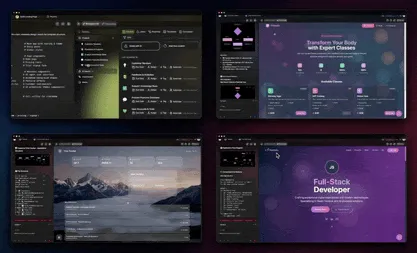
The lesson Rob Bridner articulated on the BuiltOnAir podcast. That AI agents need a single source of truth and visual feedback when they act, is exactly the gap Taskade Genesis closes by construction.
"Visual feedback and confirmation", Rob's pain point with autonomous research agents is the gap Taskade Genesis closes natively. Apps built with Taskade Genesis surface what the agent did, what records exist, and let humans inspect and edit at every step.
🚀 Full Taskade Genesis Capability Surface (the apples-to-apples table)
For builders deciding between Airtable and Taskade Genesis in 2026, here is the full surface, every Taskade Genesis primitive that maps to (or extends) the Airtable model:
| Capability | Airtable (2026) | Taskade Genesis (2026) |
|---|---|---|
| Relational data layer | Bases + tables + link-to-record | Projects with structured + unstructured memory |
| No-code interface | Interface Designer | One prompt → live app, instantly published |
| Workflow automations | Triggers + actions, if/else, scripts | 100+ bidirectional integrations — triggers pull events in, actions push data out, durable execution |
| AI agents (built in) | Field Agents (per-field), Omni (conversational) | built-in tools, persistent memory, slash commands, multi-model |
| Multi-agent collaboration | Hyperagent fleet (separate brand, separate URL) | Native multi-agent in same workspace, shared memory, public embedding |
| Custom agent tools | Limited; via integrations | Custom tool builder, scoped per agent |
| Mobile build | Mobile read; primary editing on web | Build, edit, publish from phone |
| Real-time video chat | No | Yes, native to every workspace |
| Project views | 6 (Grid, Kanban, Calendar, Gallery, Timeline, Gantt) | 7 (List, Board, Calendar, Table, Mind Map, Gantt, Org Chart) |
| App publishing | Interface URL + Forms | One-click publish to Community Gallery, custom domain, password-protect, OIDC/SSO via GenesisAuth |
| MCP support | Hyperagent only | Hosted MCP server on every paid plan — Claude Desktop, Cursor, and VS Code connect into the workspace via OAuth |
| Pricing entry | Team $20/mo annual | Free |
| AI on Free plan | Yes (since June 2025) | Yes |
| Build a CRM in one prompt | Multi-step Cobuilder + Omni | One prompt → live app with database, agents, automations |
The architectural difference Liu names, "every session gets its own isolated, full computing environment in the cloud", is what Hyperagent uses to dodge context collapse on its own domain. Taskade Genesis dodges the same failure mode in a different way: by composing the Workspace DNA primitives (Memory + Intelligence + Execution) inside one workspace, so the agent never has to re-collect context that already lives next to it.
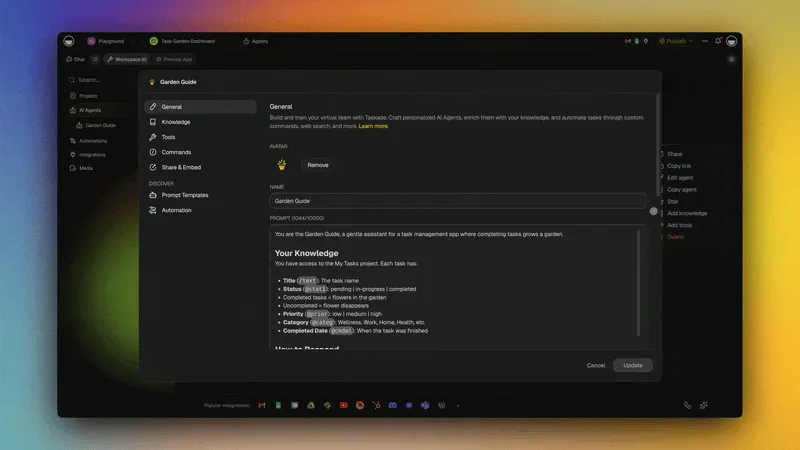
Both paths work. Hyperagent is the right answer when you want a fleet of agents that go deep on enterprise integrations from their own surface. Taskade Genesis is the right answer when you want one workspace where the database, the agents, and the automations grow together, and the app deploys the moment you describe it.
📚 Further Reading
History posts in this series
- Anthropic & Claude AI Complete History, $380B, Constitutional AI, Claude Code Agent Teams
- OpenAI & ChatGPT Complete History, GPT-5, Stargate, the $500B race
- Notion AI Complete History, all-in-one workspace, $11B journey
- Monday.com Complete History, Work OS evolution
- ClickUp Complete History, one-app productivity
- n8n Complete History, workflow automation roots
- Lovable Complete History, vibe coding origins
- Replit Complete History, Ghostwriter to Agent
- History of Mermaid.js, diagrams as code
AI architecture & agent design
- What Is Agentic Engineering?, how AI agents reshape software
- Single-agent vs Multi-agent AI Teams, fleet patterns
- Agentic Workflows: Path Towards AGI, design patterns
- How Do Large Language Models Work?, transformers explained
- Vibe Coding vs No-Code vs Low-Code, category breakdown
- Code vs Runtime: Taskade Genesis Manifesto. They generate code, we generate runtime
- Agentic Workspaces, the Workspace DNA loop
Try Taskade Genesis
- Build a free Taskade Genesis app, one prompt, one live app
- AI Agents, custom agents with memory, slash commands, built-in tools
- Automations, 100+ bidirectional integrations, durable execution
- Community Gallery, clone real Genesis apps in one click
- Free Airtable alternative, Workspace DNA, included
- Learn: Projects & Databases, the Memory pillar deep dive
- Best AI App Builder for Your Business in 2026: A Non-Technical Operator's Guide
- Build an AI Sales Pipeline App That Closes Deals (2026)
- Connect Your Apps. Automate Your Business. (10 Best Zapier Alternatives, 2026)
🛣️ Try It Yourself
Airtable invented a category and is now refounding itself for the AI era. The architecture lesson, don't have the agent write everything from scratch; have it compose existing primitives, is the right answer to the context-collapse problem.
Taskade Genesis takes that lesson one step further. Memory, Intelligence, and Execution are one workspace. Agents come built-in. Automations come bidirectional. One prompt produces the database, the agents, and the deployed app, all wired together, all live, all editable.
One prompt. One app. Diagrams that live. Memory that feeds intelligence that triggers execution.
Frequently Asked Questions
What is Airtable and who founded it?
Airtable is a cloud-based low-code platform that combines a relational database, a no-code interface designer, and workflow automations. It was founded in 2012 in San Francisco by Howie Liu, Andrew Ofstad, and Emmett Nicholas. Liu had previously co-founded Etacts (Y Combinator W2010), which was acquired by Salesforce in December 2010. As of 2026, Airtable serves more than 500,000 organizations including OpenAI, Anthropic, Amazon, Netflix, Google, and Airbnb, with reported annualized revenue of approximately half a billion dollars and roughly $700 million in cash retained on the balance sheet.
When was Airtable founded?
Airtable was founded in 2012 by Howie Liu, Andrew Ofstad, and Emmett Nicholas in San Francisco. The product spent two years in stealth, opened an invite-only beta in 2014, and launched publicly in March 2015. Liu had just sold Etacts to Salesforce in 2010, and the founders combined a vision for a consumer-grade Force.com, a relational database powerful enough for engineers but simple enough for anyone in a business to build apps without code.
Is Airtable a database or a spreadsheet?
Airtable is a relational database with a spreadsheet-style interface. Behind the familiar grid of rows and columns is a typed, relational schema with field types like single-select, attachment, date, and link-to-another-record, plus bidirectional relationships, multiple views over the same data including Grid, Kanban, Calendar, Gallery, Timeline and Gantt, automations, and a no-code interface designer. Spreadsheets are flexible but unstructured. Airtable trades a little cell-level freedom for the structure that lets non-developers build real internal apps.
How much funding has Airtable raised?
Airtable has raised approximately $1.4 billion across seven rounds. The largest were Series D ($185M, September 2020, ~$2.585B post-money), Series E ($270M, March 2021, $5.77B), and Series F ($735M, December 2021, $11.7B post-money) led by XN with participation from Salesforce Ventures, Franklin Templeton, JPMorgan Growth, MSD Capital (Michael Dell), Silver Lake, T. Rowe Price, and existing investors including Benchmark, Thrive Capital, Coatue, D1 Capital, Greenoaks, and CRV. Roughly $700 million remains on the balance sheet as of January 2026.
What is Airtable Hyperagent?
Hyperagent is Airtable's standalone agent-builder platform, hosted on its own domain at hyperagent.com. Each Hyperagent session runs in its own isolated, full computing environment in the cloud, a real browser, shell, filesystem, image and video generation, mapping, data warehouse access, and hundreds of enterprise integrations. CEO Howie Liu soft-announced it in late 2025 and opened public signups in April 2026 with a Founding 500 program offering $10 million in inference grants. The product positions itself as a turnkey, cloud-native alternative to OpenClaude and a more deployable answer to Manus or Perplexity Computer.
What is Airtable Superagent?
Superagent is Airtable's first standalone product in 13 years, launched January 27, 2026 at superagent.com. It is a multi-agent research and analysis system that deploys parallel specialists for investment memos, competitive analysis, and other deliverables, returning interactive matrices and cards rather than walls of text. Superagent is built on the DeepSky acquisition completed in October 2025 and uses frontier models from OpenAI, Anthropic, and Google. Pricing tiers run from $20 to $200 per month with bundled inference credits.
What is Airtable Omni?
Omni is Airtable's conversational AI agent, announced June 24, 2025 in the AI-Native Airtable relaunch that unified the earlier Cobuilder and Assistant features. Omni builds Airtable apps from existing platform primitives, tables, automations, interfaces, combined with codegen for final-mile bespoke functionality. CEO Howie Liu calls Omni the new default surface: the agent is the workspace, and the classic Airtable app becomes 'an artifact manipulated by, and tool-used by, the agent.' This pattern dodges the context-collapse failure mode pure vibe-coding tools hit.
What is Airtable Cobuilder?
Cobuilder was Airtable's first major AI bet, a feature for instant no-code app creation released in 2024 that became the fastest-adopted feature in company history. At the AI-native relaunch on June 24, 2025, Cobuilder and the older Assistant feature were unified into a single conversational surface called Omni, with Field Agents added as a new agentic primitive. Free, Team, Business, and Enterprise plans all received AI credits as part of that relaunch.
How is Airtable different from Notion, Coda, and Smartsheet?
Airtable is database-first, a relational schema with link fields, structured views, automations, and a no-code interface designer for business apps. Notion is document-first, a fluid canvas with structured database blocks, optimized for knowledge management. Coda is a document-database hybrid where formula-driven docs work like apps. Smartsheet is a spreadsheet-first project execution platform aimed at enterprise PMOs. Airtable's wedge has always been low-code business apps. Taskade Genesis takes the same three-layer pattern, data, logic, interface, and adds a fourth layer that none of the others ship by default: embedded AI agents with persistent memory.
Why did Airtable lay off employees in 2022 and 2023?
Airtable executed two layoff rounds nine months apart. December 8, 2022 cut about 254 people (roughly 20 percent of staff) and saw three senior executives depart: Chief Revenue Officer Seth Shaw, Chief Product Officer Peter Deng, and Chief People Officer Johanna Jackman. September 14, 2023 cut another 237 people (about 27 percent) with severance of 16 weeks pay, two months accelerated equity vesting, and six months of health care. CEO Howie Liu told Forbes the cuts were 'a sickening feeling' and reframed the company around customers spending $1 million or more annually.
What is the Airtable refound for AI?
The refound is Howie Liu's term for restructuring Airtable as if he were starting an AI-native company on day one, while reusing existing primitives where they help and cutting where they hurt. The binary test Liu has stated publicly: if you wouldn't build the same thing as a fully AI-native company today, you should sell and start the next carnation. The refound included a third reorg into a fast-thinking AI Platform group that ships near-weekly and a slow-thinking group that handles deliberate bets like HyperDB, the AI-Native Airtable relaunch with Omni in June 2025, the DeepSky acquisition in October 2025 that brought David Azose from OpenAI as CTO, and standalone product launches Superagent (January 2026) and Hyperagent (early 2026). Liu himself shifted into 'IC CEO' mode, back as an individual contributor, hourly Claude user, with most standing one-on-ones cancelled and an explicit permission slip to the team to spend a full week playing with every AI product on the market.
How much is Airtable worth in 2026?
Airtable's last publicly disclosed primary valuation was $11.7 billion at the December 2021 Series F. Secondary-market activity in 2024 to 2026 has marked the company in the roughly $4 billion range, but the company also retains approximately $700 million of the $1.4 billion it has raised, generates over $100 million in annualized free cash flow, and has reported a Rule of 40 score above 50. As of early 2026, no Series G has been announced and Howie Liu has stated publicly that Airtable is 'public-capable' but not actively pursuing an IPO.
Who is Howie Liu, the CEO of Airtable?
Howie Liu is the co-founder and CEO of Airtable. Born in 1989 in College Station, Texas, he taught himself C++ at age 13 and entered Duke University at 16, graduating in 2009 with degrees in Mechanical Engineering and Public Policy. In 2010 he co-founded Etacts (YC W2010), a Gmail relationship-management tool, which Salesforce acquired in December 2010. He then worked at Salesforce as a product manager before founding Airtable in 2012 with Andrew Ofstad and Emmett Nicholas. Liu is known for the 'IC CEO' management style, running parallel Claude Code instances in his daily workflow, and being one of the largest individual inference-cost users of Airtable AI globally.
What did Peter Deng do as Chief Product Officer at Airtable?
Peter Deng joined Airtable as Chief Product Officer in December 2020 and departed in December 2022 alongside the first layoff round. He came from a long consumer-product career, roughly ten years at Facebook on News Feed, Messenger, Groups, and Events, followed by Head of Product roles at Instagram, Oculus, and Uber's Rider business. At Airtable, Deng framed strategy around three product layers (data, automations, interfaces) shipped as composable building blocks. He later became a General Partner at Felicis and joined OpenAI as VP of Consumer Product.
What did Lauryn Isford do at Airtable?
Lauryn Isford was Head of Growth at Airtable, where she rebuilt onboarding over 12 to 18 months and drove a roughly 20 percent lift in activation rate. The biggest win was an immersive guided wizard that walked first-time users through their first workflow with real-time visualization. She also championed learning-style segmentation over role segmentation, the 'reverse trial' pricing model (freemium plus a time-limited premium trial), and the contrarian view that activation rates of 5 to 15 percent, harder-to-reach metrics, correlate better with long-term retention than easy-to-hit activation. She later joined Notion as Head of Product Growth.
Can Taskade Genesis replace Airtable?
For business apps that need a relational data layer, automations, and a custom interface, Airtable is the dominant low-code choice. Taskade Genesis takes the same three-layer pattern, Memory, Intelligence, Execution, and adds two layers Airtable is still racing to integrate by default: AI agents with persistent memory, slash commands, built-in tools, and multi-agent collaboration, plus an instant-deployment surface where one prompt produces the database, the automations, the interface, and the agents in a single workspace. For teams who want apps that come pre-loaded with their own memory, agents, and automations, Taskade Genesis is the answer. Try it free at taskade.com/create.