







TL;DR: Clay enriches your GTM data with 100+ providers and stops at the table. Taskade Genesis starts where Clay stops, turning enriched lead data into a deployed sales system with autonomous AI agents, pipeline workflows, and custom-domain portals. Genesis Pro is $10/month; Clay Starter is $149/month. They are better together. Try Taskade Genesis free →
Workspace DNA: The System That Acts on Clay's Data
Clay produces the richest possible row of enriched data. Taskade Genesis turns that row into a running GTM system. The connection is Workspace DNA, the self-reinforcing loop that closes the gap between data table and deployed pipeline.
In GTM terms: Clay populates Memory (enriched lead data). Taskade Genesis adds Intelligence (an AI agent that scores the lead, drafts outreach, and flags ICP fit) and Execution (automations that create deal projects, assign reps, update Salesforce, and trigger Slack alerts). The Execution step creates new Memory, a deal project with full history, attached files, and follow-up tasks, which feeds the next Intelligence cycle. Clay fills the table; Taskade Genesis runs the machine.
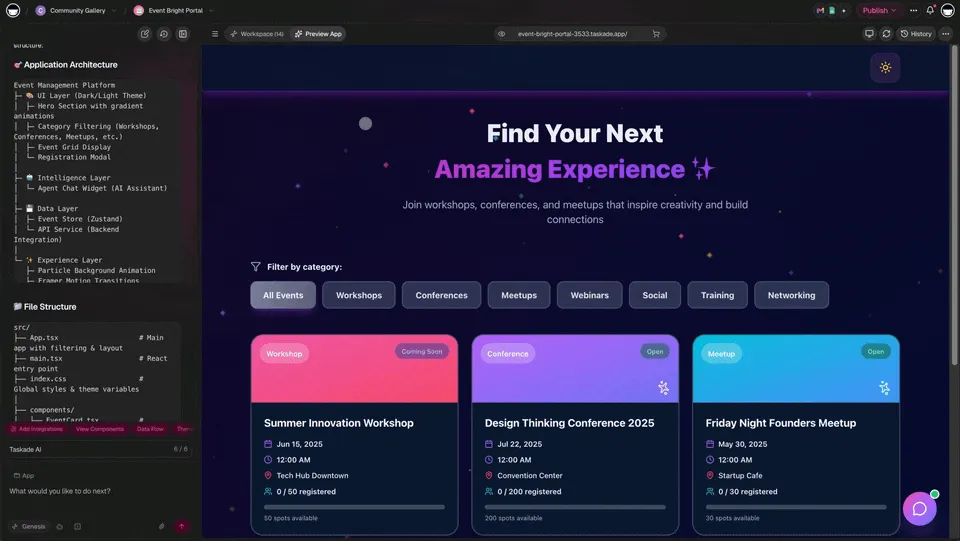
Why This Comparison Is Different
Clay and Taskade Genesis are not head-to-head competitors. They address different parts of the GTM stack. This comparison exists because many founders and GTM leaders ask: "Do I need Clay, or can Taskade do what Clay does?"
The honest answer: Clay does something Taskade Genesis does not, waterfall lead enrichment from 100+ data providers. If your primary bottleneck is getting accurate email addresses, company data, and intent signals at scale, Clay is the right tool and has no equivalent in Genesis.
The flip side: Clay produces enriched data tables. Tables stay in Clay. They cannot deploy a customer-facing portal, run an autonomous sales agent that scores and routes leads, publish to a community for discovery, or trigger a multi-step workflow across Salesforce, Slack, Stripe, and GitHub.
Taskade Genesis is where enriched data becomes an operational system. The wedge is not Clay vs Genesis. It is the gap between a data table and a running app.
For founders building GTM infrastructure in 2026, the stack looks like this: Clay enriches leads → Taskade Genesis deploys the sales system that acts on them. For teams at earlier stages where full Clay functionality is unnecessary, Taskade Genesis alone covers pipeline management, campaign planning, and customer portals end-to-end.
Quick Comparison Table
| Dimension | Clay | Taskade Genesis |
|---|---|---|
| Primary function | Lead enrichment (100+ providers, waterfall) | AI app builder (prompt → deployed system) |
| Data enrichment | ✅ Core product | ❌ Not a data enrichment tool |
| AI agents | ⚠️ Claygent (research + outreach drafting) | ✅ Autonomous agents, built-in tools, 15+ frontier models |
| Deployed apps | ❌ Tables stay in Clay | ✅ Custom domains, public URLs, password protection |
| Automation reach | ✅ HubSpot, Salesforce, Gmail, Webhooks | ✅ 100+ bidirectional integrations |
| Project views | ❌ Spreadsheet table only | ✅ multiple views (List, Board, Calendar, Table, Mind Map, Gantt, Org Chart) |
| External portals | ❌ | ✅ |
| Community gallery | ❌ | ✅ 150,000+ cloneable apps |
| Free tier | ✅ Limited | ✅ Unlimited viewers, AI credits |
| Starter pricing | $149/month (5,000 credits) | Free |
| Pro pricing | $800/month | $10/month, ≤10 seats (annual) |
| Workspace DNA | ❌ | ✅ Memory + Intelligence + Execution |
| Best for | Outbound-heavy GTM teams, lead enrichment | App building, pipeline ops, customer-facing systems |
Taskade Genesis Capabilities at a Glance
┌─────────────────────────────────────────────────────────────────────┐
│  TASKADE GENESIS CAPABILITIES                                       │
├─────────────────────────────────────────────────────────────────────┤
│  Memory          7 project views (List/Board/Calendar/Table/Mind   │
│                  Map/Gantt/Org Chart) · RBAC · workspace-          │
│                  scoped knowledge bases                            │
│                                                                     │
│  Intelligence    AI Agents v2 · 34 built-in tools · 15+ frontier  │
│                  models from OpenAI/Anthropic/Google + Vercel AI   │
│                  Gateway · custom slash commands · persistent      │
│                  agent memory · multi-agent collaboration          │
│                                                                     │
│  Execution       Durable workflow execution · 100+ bidirectional   │
│                  integrations · branching/looping/retries · agent  │
│                  call primitive · ask_ai_structured (typed JSON)   │
│                                                                     │
│  Interface       Genesis Auth (OIDC/SSO) · custom domains ·        │
│                  password protection · App Users (beta) ·          │
│                  Community Gallery · Stripe Connect for creators   │
└─────────────────────────────────────────────────────────────────────┘
What Is Clay?
Clay is a GTM data platform founded in 2021 and based in New York. It lets sales and growth teams build lead lists, enrich them with data from 100+ providers (Apollo, LinkedIn Sales Navigator, Clearbit, Hunter.io, BuiltWith, and more), and automate outbound workflows.
Clay's core innovation is waterfall enrichment: configure a sequence of data providers in priority order, and Clay tries each one until it finds a match for a given field (email address, company size, tech stack, etc.). This multi-provider fallback dramatically improves data coverage compared to relying on a single provider.
Clay also includes Claygent, an AI agent that can research companies and people from web sources and draft personalized outreach messages based on enriched data. It integrates with Salesforce, HubSpot, Gmail, Slack, and Webhooks for pushing enriched data downstream.
Clay is priced on a credit model: Starter at $149/month (5,000 enrichment credits), Explorer at $349/month (10,000 credits), Pro at $800/month (50,000 credits), and Enterprise at custom pricing. Credits are consumed by enrichment API calls. Clay is a deliberate investment for outbound-first GTM teams with real lead volume.
What Is Taskade Genesis?
Taskade Genesis is the AI app builder on Taskade, built on Workspace DNA, the self-reinforcing loop of Memory (Projects), Intelligence (AI Agents), and Execution (Automations). EVE, the Genesis meta-agent, builds deployed apps from natural-language prompts.
For GTM teams, Taskade Genesis covers the operational layer that Clay does not: sales pipeline management, deal tracking with multiple project views, autonomous AI agents that score and route leads, campaign planning portals, customer-facing apps with custom domains, and reliable automation workflows connecting Salesforce, HubSpot, Slack, Gmail, Stripe, and 100+ more integrations.
A Genesis sales app built for a 5-person team might include: a sales pipeline board (deal stages, probability, owner), an AI agent that summarizes each deal and flags stale opportunities, automations that trigger on Slack DMs, form submissions, or CRM webhooks, and a customer portal shared with prospects via a branded custom-domain URL.
Pricing: Free ($0), Pro ($10/month, ≤10 seats, billed annually), Business ($25/month, unlimited seats), Max ($100/month), Enterprise ($250/month). AI agents included on every plan, including Free. See /pricing.
5 Key Differences
1. Sales Pipeline Workflow: Data Table vs Running System
Clay's sales workflow ends at enriched data export. You push a Clay table to HubSpot or a Google Sheet, and then the pipeline management starts in a different tool.
Taskade Genesis IS the pipeline management tool, with AI built in. A Sales Pipeline Workflow on Genesis tracks deals from first contact to close, with an AI agent that monitors deal health, flags opportunities idle for 7+ days, and drafts follow-up messages. Automations push stage changes to Slack, trigger Salesforce updates when a deal closes, and pull in new leads from a Clay webhook.
This Sales Pipeline Workflow shows the full operational model:
Clone this Sales Pipeline and connect your Clay webhook to auto-populate new leads. Explore more at /automate.
2. Sales Agent Studio: Claygent vs Autonomous Taskade Genesis Agent
Clay's Claygent is an excellent research tool: given a company or person, it can browse the web and return structured data (funding stage, tech stack, recent news, product description) that Clay then uses to personalize outreach templates. Claygent is triggered manually or on a Clay table row. It does not run continuously or respond to external events.
Taskade Genesis sales agents are deployed and autonomous. They sit inside a running app and respond to triggers: a new lead webhook fires → the agent reads the enriched data, scores the lead against your ICP criteria using web search tools, drafts a personalized first-touch email, assigns a rep via role-based access, and sends a Slack alert, all in one automation chain without a human in the loop.
This Sales Agent Studio was purpose-built for exactly this kind of autonomous GTM agent:
Clone this Sales Agent Studio and configure your ICP criteria in the agent's instruction prompt. See /agents for the full autonomous agent capability spec.
3. Sales Pipeline Dashboard: Spreadsheet vs Multi-View Intelligence
Clay's interface is a spreadsheet. It is the right interface for enrichment, columns of data, waterfall configs, formula builders. But it is not designed for pipeline review meetings, deal health monitoring, or rep performance tracking.
Taskade Genesis Sales Pipeline Dashboards use multiple project views simultaneously. The Table view mirrors the Clay spreadsheet you know. The Board view shows deals by stage. The Gantt view tracks expected close dates against timeline. The Calendar view surfaces renewal and follow-up dates. An embedded AI agent summarizes the pipeline weekly and flags deals at risk of slipping.
This Sales Pipeline Dashboard gives you the full multi-view intelligence layer:
Clone this Sales Pipeline Dashboard and import your Clay export as the initial data. Read Best AI App Builder Demos You Can Clone Today for more GTM app examples.
4. Campaign Planning Portal: Clay Table vs Deployed Campaign System
Clay can help you identify and enrich prospects for a campaign. It does not build the campaign planning portal, manage the campaign calendar, coordinate content creation, or distribute assets across platforms. Those workflows require a different tool.
Taskade Genesis Campaign Planning Portals cover the full campaign lifecycle: from audience definition (informed by Clay enrichment data) through content planning, creation workflows, and multi-channel distribution, all managed by AI agents that track deadlines, summarize campaign performance, and trigger distribution automations.
This Campaign Planning Portal shows what a GTM-specific campaign system looks like as a Taskade Genesis app:
Clone this Campaign Planning Portal and use it to plan your next launch. Link to Founder Operating System 2026 for the full GTM operating system framing.
5. Multi-Platform Publishing: Manual Export vs Automated Distribution
When Clay finishes enriching a prospect list for a content-led outbound campaign, distributing the campaign itself, blog posts, social content, email sequences, partner announcements, requires entirely separate workflows. Clay is not a publishing tool.
Taskade Genesis Multi-Platform Publisher handles the distribution layer: an AI agent adapts a core content piece for each channel (blog, LinkedIn, X, email), automations push each adapted piece to the right integration endpoint, and the project board tracks publication status across channels.
This Multi-Platform Publisher demonstrates the distribution workflow:
Clone this Multi-Platform Publisher and connect it to your content calendar. See /templates for more distribution workflow starters.
When to Choose Clay
Clay is the better choice when:
- Lead enrichment is your primary bottleneck. You need accurate email addresses, mobile numbers, company firmographics, and technographic data at scale from 100+ providers with waterfall fallback
- You run high-volume outbound: Clay's credit model and enrichment depth are designed for teams sending thousands of personalized emails per month
- Your team is SDR-heavy: Clay's Claygent and outreach sequencing workflows are purpose-built for sales development representatives who live in outbound motions
- You need Intent data and prospect list building: Clay's integrations with LinkedIn, Bombora, and other intent providers are not replicated in Genesis
- You have existing HubSpot or Salesforce infrastructure and need a data enrichment layer that pushes clean data into your existing CRM
Clay is worth the investment for growth-stage startups and enterprise sales teams whose pipeline velocity directly correlates with data quality and outbound volume. At $149-$800/month, it is a deliberate infrastructure investment.
When to Choose Taskade Genesis
Taskade Genesis is the better choice when:
- You need to build apps that external users access, customer portals, partner portals, investor dashboards, demo environments, not just internal CRM views
- You want AI agents that run the pipeline autonomously, scoring leads, drafting follow-ups, flagging stale deals, and updating stakeholders without manual intervention
- Your enrichment needs are lightweight, for teams at early stages where a well-crafted prompt and web search tools cover most research needs, Taskade Genesis avoids Clay's $149+/month enrichment overhead
- You need campaign operations, not just campaign targeting, planning, content creation, distribution, and performance tracking all in one system
- Budget is a constraint: Taskade Genesis Pro at $10/month covers the full sales operations layer (pipeline, agents, automations, portals) without the Clay credit overhead
- You want to publish apps to a gallery or deploy customer-facing systems: Clay has no equivalent to Genesis's community gallery, custom domain deployment, or external-user app model
- You need all project views across your pipeline: Table mirrors the Clay spreadsheet; Board shows deals by stage; Gantt tracks close dates; Calendar surfaces follow-ups; Mind Map lets your team brainstorm ICP criteria (Timeline is the scrolling component inside Gantt, not a separate view)
- You want role-based access for rep access control: Owner to Viewer, with deal-level permissions you can reason about
- Your AI agent needs cross-model routing, 15+ frontier models from OpenAI, Anthropic, Google, and open-weight providers, with per-agent selection so your scoring agent uses a different model than your drafting agent
- You want the Workspace DNA loop running your GTM, each enriched Clay lead becomes Memory, Intelligence scores and drafts it, Execution creates the deal and fires the notifications, Execution creates new Memory, the pipeline runs itself
The Recommended Stack: Clay + Taskade Genesis
For GTM teams serious about outbound, the two tools are complementary:
- Clay: Enrich your ICP list with 100+ providers, validate emails, research companies with Claygent, segment by firmographic and intent data
- Clay webhook → Taskade Genesis: When enrichment is complete, Clay fires a webhook that triggers a Taskade automation: creates a deal project, assigns the right agent, runs the AI scoring workflow, pushes to the pipeline dashboard, and sends a Slack alert
- Taskade Genesis: Manages the full operational layer: pipeline tracking, autonomous follow-up agents, campaign planning portal, customer-facing portals, and distribution automation
The Clay table becomes a Taskade Genesis running system. The data that stops at the Clay row starts executing in Genesis.
Read Your Workspace Is a Computer for the Workspace DNA framing behind this architecture, and see Best AI App Builder Demos for more sales-specific Taskade Genesis app examples.
Pricing Comparison
| Plan | Clay | Taskade Genesis |
|---|---|---|
| Free | ✅ Limited credits | ✅ Unlimited viewers, AI credits |
| Starter | $149/month (5,000 credits) | Free |
| Explorer | $349/month (10,000 credits) | — |
| Pro | $800/month (50,000 credits) | $10/month, ≤10 seats (annual) |
| Business | — | $25/month, unlimited seats (annual) |
| Max | — | $100/month, max AI capacity |
| Enterprise | Custom | $250/month, custom SLA |
| AI agents | Claygent (research + drafting) | Autonomous agents, built-in tools, 15+ frontier models |
| Deployed apps | ❌ | ✅ Custom domains, public URLs |
Stack cost for a 5-person GTM team:
- Clay Explorer ($349) + Taskade Genesis Pro ($10) = $359/month, full enrichment + full operational layer
- Taskade Genesis Pro alone ($10/month), pipeline ops, agents, portals, no Clay enrichment depth
Migration: How to Use Clay Data in Taskade Genesis
If you are running Clay and want to connect it to a Taskade Genesis sales system:
- Set up a Clay webhook, in Clay's Integrations, configure a webhook to fire when enrichment completes for a row
- Create a Taskade automation trigger, use Taskade's HTTP Webhook trigger (Business+ plan) to receive Clay's payload
- Map Clay fields, configure the automation to extract name, company, email, enrichment data, and ICP score from the Clay JSON payload
- Create the deal project, the automation creates a new Taskade project for the lead using a deal template (role-based access, board view, AI agent pre-configured)
- Run the scoring agent, the AI agent reads the Clay enrichment data, researches the company further with web search tools, and produces an ICP score + outreach draft
- Push to your CRM, if you use Salesforce or HubSpot, Taskade's automation can create/update a CRM record with the Genesis score and outreach draft
For teams starting from scratch (no Clay yet), Taskade Genesis alone covers early-stage GTM operations. Visit /learn for setup guides and /apps to explore sales-specific Taskade Genesis apps.
FAQ
Is Taskade Genesis a good Clay alternative?
It depends on your use case. Clay is a purpose-built GTM data enrichment platform, if your primary need is lead enrichment with 100+ data providers, Clay has no direct equivalent. Taskade Genesis is an AI app builder: it deploys live apps from enriched data, runs autonomous sales agents, manages pipeline workflows, and distributes across custom-domain portals. For teams that have outgrown Clay's table-stops-at-Clay model and need their data to live in a deployed customer-facing system, Genesis is the natural next layer.
What does Clay do that Taskade Genesis does not?
Clay provides automated lead enrichment from 100+ data providers (Apollo, LinkedIn, Clearbit, Hunter, etc.) with a waterfall enrichment model that tries each provider in sequence until it finds data. This multi-provider enrichment depth is Clay's core differentiator. Taskade Genesis does not do waterfall lead enrichment. Genesis is for building apps, deploying workflows, and running AI agents. It consumes enriched data, it does not produce it.
What does Taskade Genesis do that Clay cannot?
Taskade Genesis deploys customer-facing apps with custom domains, embeds autonomous AI agents that run pipeline stages, manages sales workflows with reliable automation across 100+ integrations (Salesforce, HubSpot, Slack, Gmail, Stripe, GitHub), builds team portals and dashboards accessible to external users, and publishes apps to a community gallery for discovery and cloning. Clay produces enriched data tables. Genesis turns those tables into running systems.
How does Clay pricing compare to Taskade Genesis?
Clay pricing is credit-based: Starter at $149/month, Explorer at $349/month, Pro at $800/month. Taskade Genesis Pro is $10/month (≤10 seats, annual). The tools serve different functions. Many high-performing GTM teams use both, Clay enriches the data, Taskade Genesis deploys the system that acts on it. Combined stack cost: $359/month for Clay Explorer + Genesis Pro.
Can Taskade Genesis run AI sales agents autonomously?
Yes. Taskade Genesis can build and deploy sales agent workflows where an AI agent receives a lead (from a webhook, form, or CRM trigger), analyzes the enriched data, scores the lead, drafts a personalized outreach message, assigns it to the right rep, and sends a Slack notification, fully automatically. The agent operates with built-in tools, 15+ frontier models from OpenAI, Anthropic, Google, and open-weight providers, and persistent memory stored as Taskade Projects.
What GTM workflows can Taskade Genesis handle?
Taskade Genesis handles: sales pipeline management (stage tracking, deal scoring, rep assignment), campaign planning and execution, content distribution across channels, customer onboarding portals, partner portals, investor dashboards, and multi-platform publishing. All of these run with embedded AI agents and reliable automation workflows across 100+ integrations. GTM data from Clay, Apollo, or HubSpot can flow into Genesis via webhook, API, or CSV import.
Does Taskade integrate with Clay?
Yes, via webhooks and API. When Clay finishes an enrichment run, it can fire a webhook that triggers a Taskade Genesis automation, creating a project for each enriched lead, assigning it to a sales agent, and pushing it through the pipeline workflow. This is the recommended stack for GTM teams: Clay enriches, Taskade Genesis deploys. The two tools are complementary, not competing, for teams doing serious outbound.
What is the Taskade Genesis sales agent workflow stack?
A typical Genesis sales stack: (1) Lead arrives via Clay webhook or HubSpot trigger. (2) An AI agent with web search and company research tools scores the lead and drafts outreach. (3) An automation creates a deal project, assigns a rep, and sends a Slack alert. (4) The Sales Pipeline app tracks deal stages. (5) A Campaign Planning Portal manages multi-touch outreach. (6) Stripe integration triggers a close notification. All steps run in Taskade Genesis on reliable automation workflows.
Get Started
Clay gives you enriched data. Taskade Genesis gives you the running system that acts on it, deployed apps, autonomous agents, reliable automation workflows, and a pipeline that executes while you sleep.
Start free at /create, explore sales-specific Taskade Genesis apps in the Community Gallery, or browse agent templates to build your first autonomous sales agent today.
Migration Workflow: Clay Data → Taskade Genesis GTM System
The fastest path: export your Clay table as CSV, import into Taskade Genesis's Table view, then prompt EVE to wrap it in a sales pipeline app with an AI scoring agent and Slack alert automations. For ongoing enrichment, configure a Clay webhook that fires into a Taskade HTTP trigger, every new Clay row becomes a live deal project automatically. The table that used to stop at Clay now executes at Genesis.
Explore cloneable Genesis demos, Founder OS, AI Agents, Automations, Templates, Workspace DNA wiki, and the Community Gallery to build your full GTM stack.