






Every comparison of AI app builders ranks the same three things: how fast it generates, what it costs, and how good the UI looks. We went looking for a comparison that ranked a fourth thing — how painful month six is — and could not find one.
So we checked all ten leading builders for a single property instead.
Does it keep a record of why your app is shaped the way it is?
Not what it built. Not what it knows. Why. The decision that was made, the alternative that was rejected, and the reason. That is the artifact a maintainer needs when someone asks for one change six weeks after launch and nobody on the team can safely make it.
TL;DR: We checked 10 AI app builders for persistent decision rationale. None ships a structured, queryable record of rejected alternatives. Claude Code's docs come closest by naming architectural decisions outright; Google Antigravity ships the most structured artifacts; Lovable leads the pure app builders. All still require you to maintain it yourself. See how a workspace does it →
The Comparison
We verified all ten builders against each product's own documentation, feedback boards and release notes in September 2026, and scored one property: does it persist why the app is shaped the way it is? The score is strict. A file that steers future work is not the same as a record of past decisions.
| Builder | Persists why? | The mechanism | Where it lives |
|---|---|---|---|
| Claude Code | Closest invitation | Docs explicitly name "architectural decisions" as project-memory content — but it is a freeform file you write | A file in your repo |
| Google Antigravity | Most structured | Implementation Plans reviewed before the agent acts, Walkthrough after — per-task, not an archive | Per-task artifacts |
| Lovable | Partial | Knowledge file sent with every prompt — forward-looking brief, no rejected alternatives | Product settings |
| Cursor | Partial | Rules live in the repo and travel with a clone; Memories are personal, short facts, availability varied by version | A file in your repo |
| Replit Agent | Partial, session-scoped | Checkpoints snapshot code + conversation + database together; a rollback, not a history | Platform snapshots |
| v0 | No | Account-level custom instructions for style and output preference only | Account settings |
| Bolt.new | Partial | Knowledge at account, project and team scope, plus Skills and a claude.md file — broad steering, no rejected alternatives |
Product settings + repo |
| Base44 | No | None. "Context amnesia" is an open request on their own feedback board | Nowhere durable |
| YouWare | No evidence found | Continuity marketed informally; no named rules or memory file in docs | Nowhere documented |
| Emergent | No | Fork branches a project with a fresh context window — solves context decay, not rationale loss | Nowhere durable |
The finding, stated plainly: none of the ten ships a structured, persistent, queryable record of rejected alternatives and rationale. The field splits three ways, and every one of those ways is useful for something other than this.
What Each One Actually Ships
Each of the ten builders below is strong at something, from Claude Code's repo-level memory file to Base44's all-in-one backend. This section scores one narrow property, persistent decision rationale, and names the concrete mechanism each tool ships. A low score here says nothing about whether a tool is the right choice for you.
Claude Code — Anthropic's terminal-based agent. Its documentation instructs you to record "coding standards, architectural decisions, naming conventions, and common workflows" in a project memory file. Naming architectural decisions outright is unmatched here, and its context-trimming command deliberately preserves rationale while discarding derivable facts. The limit: it is a markdown file you write and keep current, with no structure for alternatives or supersession.
Google Antigravity — an agent-first IDE. It generates Task Lists and Implementation Plans that you review and approve before the agent acts, then a Walkthrough after. A reviewed Implementation Plan is real structured rationale for a specific change, which is more than any pure app builder offers. The limit: the documentation frames these as per-task review deliverables, not a searchable archive spanning an app's whole history.
Lovable — React and Tailwind web apps with a Supabase backend and GitHub sync. Its Knowledge file is a persistent project document sent with every prompt, holding vision, users, features and conventions. It is the most product-mature steering memory among pure app builders. The limit: it steers what happens next rather than recording what already happened and why. Our full write-up: Lovable review.
Cursor — the AI-native editor. Rules are hand-written, committed to the repository, and travel automatically to the next developer on clone, which makes them the most team-native artifact reviewed. Memories auto-capture short facts but stay personal to one user, never enter the repo, and availability has varied across recent versions. The limit: neither is structured for rejected alternatives. Our full write-up: Cursor review.
Replit Agent — browser-based building with integrated deploys. Its checkpoints snapshot project contents, conversation context and connected databases together, which is the most granular full-state rollback in this comparison. The limit: it restores a past state rather than explaining one, and context reportedly does not carry well into a new chat session. Our full write-up: Replit review.
v0 — Vercel's builder, rebuilt in 2026 with Git integration and a full-stack sandbox. Third-party benchmarks consistently rate its UI and component generation the best in class, and idiomatic Next.js output genuinely eases a later human handoff simply because the code reads the way a developer expects. The limit: custom instructions cover style preference, not decisions. Our full write-up: v0 review.
Bolt.new — StackBlitz's in-browser IDE, and the most layered steering setup reviewed. Knowledge holds persistent instructions at three scopes (account, project, team), Skills add instructions that fire only in matching situations, and a claude.md file carries persistent project context. The limit is the one every tool here shares: all of it describes how to build next, never which approach was rejected and why. Our full write-up: Bolt review.
Base44 — acquired by Wix in 2025. Its all-in-one encapsulation removes a whole category of maintenance burden: no separate database, hosting and auth accounts to keep in sync. The limit is documented by its own users — "context amnesia" sits as an open request on Base44's public feedback board, which is the strongest possible confirmation that this gap is real and known.
YouWare — a 2026 entrant aimed explicitly at non-engineers, with continuity described in plain language rather than developer jargon. That is the right audience instinct for this problem, because the people most exposed to the month-six wall are precisely those who cannot read the code to reconstruct intent. The limit: no named context or rules file appears in its documentation, so we score it no-evidence-found rather than absent.
Emergent — a 2026 entrant with voice input. Its Fork mechanism creates a git-branch-style copy with a fresh context window as a session approaches its token ceiling, preserving code while shedding stale conversation. That is a genuinely version-control-literate answer to context decay. The limit: context decay and rationale loss are different problems, and Fork solves the first.
Why Does Month Six Hurt So Much?
Month six hurts because four kinds of knowledge are destroyed the instant the build completes: the original request in the requester's own words, the decisions and rejected alternatives, the deliberate scope cuts, and the open blockers. The code survives, so the only artifact left cannot answer the one question a maintainer asks: why is it like this?
  BUILD COMPLETES
        │
        ├── ✗  what the person actually asked for, in their words
        ├── ✗  what got decided, and what was rejected
        ├── ✗  what was deliberately left out of scope
        └── ✗  what is blocked, waiting on a human
        │
        └── ✓  the code   ← the only thing that survives
                 │
                 └── month six: "why is it like this?"
                      the file tree cannot answer
A human engineering team records all four as routine — tickets, commit messages, a design doc, a thread someone can search. A generative build records none of them. That is not a model failure. The model did what it was asked. The loss is structural, and it is why the wall arrives on a schedule rather than at random.
Repair or Rebuild? A Decision You Can Actually Run
Decide repair versus rebuild by grading the recoverability of the reasoning, not the quality of the code. The five questions below each point one way. If three or more land in the rebuild column, the knowledge behind the app is gone, and every repair pays interest on it. Fewer than three usually means repair is cheaper.
| Question | Points toward repair | Points toward rebuild |
|---|---|---|
| Can someone still say why the core pieces exist? | Yes | No |
| Could you re-specify the whole app in a day? | Yes | No |
| Does changing one thing routinely break another? | No | Yes |
| Is there any written record from build time? | Yes, even partial | None |
| Is the data model something you would design again? | Yes | No |
A rebuild that records its own reasoning as it goes usually costs less than the next four repairs — and the rebuild only pays off if you capture the four fields this time.
Who Each Tool Is Actually For
Scoring one narrow property says nothing about fit, so this table maps each of the ten builders to the reader it serves best. Developers who want records in git, non-technical founders, front-end teams, plan reviewers and fast iterators each have a clear first choice, and decision memory is only one input.
| If you are… | Reach for | Because |
|---|---|---|
| A developer who wants the record in git | Cursor or Claude Code | Rules and project memory live in the repo and travel on clone |
| Non-technical, want it all in one place | Base44 or YouWare | No separate database, hosting or auth accounts to keep in sync |
| Shipping a polished front end fast | v0 or Lovable | Best-rated UI output; idiomatic code eases a later handoff |
| Wanting to review the plan before it runs | Google Antigravity | Implementation Plans are approved before the agent acts |
| Iterating hard and breaking things | Bolt.new, Replit or Emergent | Fast loops, granular rollback, and fresh-context forking |
The Four Fields to Capture at Build Time
No builder generates this artifact for you, so write it yourself at build time. It holds four fields: the request in the requester's own words, the choice with at least one rejected alternative and the reason, what was left out on purpose, and what is still blocked. It takes about ninety seconds per decision:
  DECISION: ______________________________________
  ASKED FOR (their words): _______________________
  CHOSE: _________________________________________
  REJECTED: ____________  BECAUSE: _______________
  LEFT OUT ON PURPOSE: ___________________________
  STILL BLOCKED ON: ______________________________
Write it wherever your team will actually look. The format matters far less than the habit, and the habit has to start at build time — reconstructed six months later, it is guesswork wearing a template.
What a Workspace-Native Approach Changes
A code generator struggles to keep this record because its output is a file tree, and a file tree has nowhere natural to put a rejected alternative. A workspace changes that. The app, its data, its agents and the notes about why it was built that way can live side by side, where the whole team can open them.
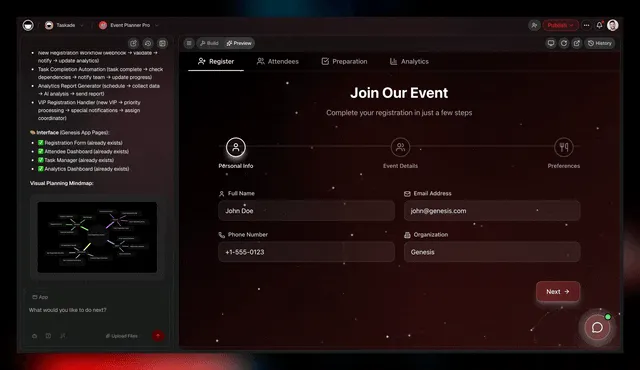
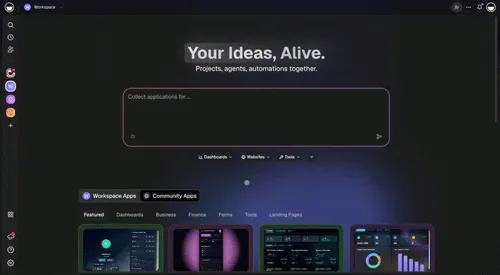
In Taskade, Taskade Genesis builds the app inside your workspace. Projects hold what the app knows, and AI agents with persistent memory carry context from one session to the next. A decision log is just another project, with the same views, editing and sharing — so the record is something a non-technical founder can open and correct, rather than a markdown file in a repo they have to remember to maintain.
That is a structural answer rather than a discipline answer, and it is the difference between a habit that survives month six and one that does not.
We should be exact about the scope of that claim: this changes where the record lives and who can edit it. Keeping it accurate is still work, and any team that will not do that work will have the same problem in any tool.
▲ ■ ● Memory, Intelligence, Execution — the record is the part that has to outlive the build.
Build something that remembers why →
Deeper Reading
On the maintenance problem
- A Year of Agent Memory Experiments — what we measured trying to solve this, including what did not work
- Structure Beats Instruction — why an artifact outperforms a rule
- Replay Simulators Explained — what a recorded history is worth once you have one
- The Frontend Playground Era — why generated interfaces outrun their foundations
- The Living App Movement — what running software should look like instead
Builder reviews and market context
- The State of Vibe Coding · How to Choose an AI App Builder · Best AI Agent Builders
- Lovable review · Bolt review · v0 review · Cursor review · Replit review
Concepts
- Agent Memory · Persistent Memory · Persistent Context
- Context Window · Context Rot · Context Engineering
- Spec-Driven Development · AGENTS.md
Frequently Asked Questions
Which AI app builder is best for long-term maintenance?
No builder currently ships a complete answer, but they differ meaningfully. Claude Code's documentation explicitly names architectural decisions as something to record in its project memory file, which is the most direct invitation of any tool reviewed. Google Antigravity ships the most structured native artifacts through its reviewed Implementation Plans. Lovable's Knowledge file is the most product-mature steering memory among the pure app builders. All three still require you to maintain the record yourself, and none of them archives the alternatives you rejected.
Does Lovable explain why it wrote code a certain way?
Partially. Lovable ships a Knowledge file, a persistent project document sent with every prompt that holds product vision, target users, core features and conventions. It is forward-looking steering context rather than a backward-looking decision record, and nothing in the documentation describes logging alternatives that were considered and rejected. It is the most mature feature of its kind among pure app builders, and it still does not answer why a given approach was chosen over another.
Does Bolt.new keep a record of design decisions?
Partially, and more than most. Bolt ships a Knowledge feature holding persistent instructions at three scopes, account, project and team, plus reusable Skills that apply in matching situations, and it reads a claude.md file for project context. That is a genuinely mature steering layer. What it is not is a decision record: Knowledge describes how Bolt should build going forward, not which approaches were considered and rejected and why. That is the same limit every tool here shares.
Why do AI-generated apps become hard to change after a few months?
Because the reasoning behind the app's shape is discarded when the build finishes while the code survives. Four things disappear at that moment: what the person actually asked for in their own words, what was decided and what alternatives were rejected, what was deliberately left out of scope, and what is still blocked. Nothing in the file tree answers the only question a maintainer has, which is why the app is like this.
Does Replit Agent remember your project between sessions?
Partially, and mostly within a session. Replit's checkpoints snapshot project contents, conversation context and connected databases together at milestones, which makes it the most granular full-state rollback of any tool reviewed. That is a mechanism for restoring the current understanding rather than a history of alternatives considered, and third-party analysis reports that context does not carry well into a new chat session.
What is the difference between AI memory and an architectural decision record?
AI memory usually stores facts and preferences that help the model act correctly next time, such as which package manager a repository uses. An architectural decision record stores why a choice was made, what else was considered, and what would have to change for the decision to be revisited. Most builders ship some form of the first. None ships a structured version of the second, which is the artifact a maintainer actually needs six months later.
Can you use Cursor Rules as a decision log?
You can, with discipline, and it is the most team-native option reviewed because Rules live in the repository and travel with a clone. Cursor also has an automatically captured Memories feature, but it stores short preference facts, stays personal to one user, never enters the repository, and its availability has varied across recent versions. Neither mechanism is structured for recording rejected alternatives, so any decision log you build there is a convention you maintain rather than a feature you enable.
What should you write down when an AI builds your app?
Four things, captured at the moment of the build rather than reconstructed later. The request in the requester's own words. The decision that was made and at least one alternative that was rejected, with the reason. What was deliberately left out of scope. What is blocked and waiting on a person. Those four fields are what a maintainer needs and what no builder captures automatically today.
Is Google Antigravity better for maintainability than other AI builders?
On this specific dimension it ships the most structured native mechanism. Antigravity generates Task Lists and Implementation Plans that you review and approve before the agent acts, and a Walkthrough summarizing what it did afterward. A reviewed Implementation Plan is genuine structured rationale for a specific change. The documentation describes these as per-task review deliverables rather than a searchable archive spanning the whole history of an app, so it strengthens the moment of the change rather than the month-six question.
Should you rebuild or repair an AI-generated app that has become unmaintainable?
Decide it on whether the reasoning is recoverable, not on the state of the code. If the people who made the key decisions are still reachable and the app is small enough to re-specify in a day, repair is usually cheaper and you should capture the decisions as you go. If nobody can say why core pieces exist and changing one thing keeps breaking another, you are paying interest on knowledge that is gone, and a rebuild that records its own reasoning will usually cost less than the next four repairs.
Do any AI app builders store the alternatives they rejected?
None of the ten reviewed here does. The field splits three ways: no durable decision record at all (style settings, state snapshots, or no documented mechanism), a freeform file the human must write and keep current, or a per-task plan-and-review artifact. Each is useful, and none is a structured, queryable record of what was considered and set aside. This gap appears as an open, unshipped request on at least one builder's own public feedback board.